
Chapter 1 Introduction to Project Management 1 Learning
- Slides: 31
Chapter 1: Introduction to Project Management 1
Learning Objectives • Understand the growing need for better project management, especially for information technology projects • Explain what a project is and provide examples of information technology projects • Describe what project management is and discuss key elements of the project management framework 2
Learning Objectives • Discuss how project management relates to other disciplines • Understand the history of project management • Describe the project management profession, including recent trends in project management research, certification, and software products 3
Project Management Statistics • The U. S. spends $2. 3 trillion on projects every year, an amount equal to one-quarter of the nation’s gross domestic product (GDP). • The world as a whole spends nearly $10 trillion of its $40. 7 trillion gross product on projects of all kinds. • More than sixteen million people regard project management as their profession; on average, a project manager earns more than $82, 000 per year. * *PMI, The PMI Project Management Fact Book, Second Edition, 2001 PMI (Project Management Institute ) 4
More Information on Project Management • More than half a million new information technology (IT) application development projects were initiated during 2001, up from 300, 000 in 2000. * • Famous business authors and consultants are stressing the importance of project management. As Tom Peters writes in his book, Reinventing Work: the Project 50, “To win today you must master the art of the project!” *The Standish Group, “CHAOS 2001: A Recipe for Success” 5
Motivation for Studying Information Technology (IT) Project Management • IT projects have a terrible track record – A 1995 Standish Group study (CHAOS) found that only 16. 2% of IT projects were successful and over 31% were canceled before completion, costing over $81 B in the U. S. alone • The need for IT projects keeps increasing – In 2000, there were 300, 000 new IT projects – In 2001, over 500, 000 new IT projects were started 6
Advantages of Using Formal Project Management • Better control of financial, physical, and human resources • Improved customer relations • Shorter development times • Lower costs • Higher quality and increased reliability • Higher profit margins • Improved productivity • Better internal coordination • Higher worker morale 7
What Is a Project? • A project is “a temporary endeavor undertaken to accomplish a unique product or service” (PMBOK® Guide 2000, p. 4) • Attributes of projects – unique purpose – temporary – require resources, often from various areas – should have a primary sponsor and/or customer – involve uncertainty 8
Samples of IT Projects • Northwest Airlines developed a new reservation system called Res. Net (see case study on companion Web site at www. course. com/mis/schwalbe) • Many organizations upgrade hardware, software, and networks via projects • Organizations develop new software or enhance existing systems to perform many business functions • Note: “IT projects” refers to projects involving hardware, software, and networks 9
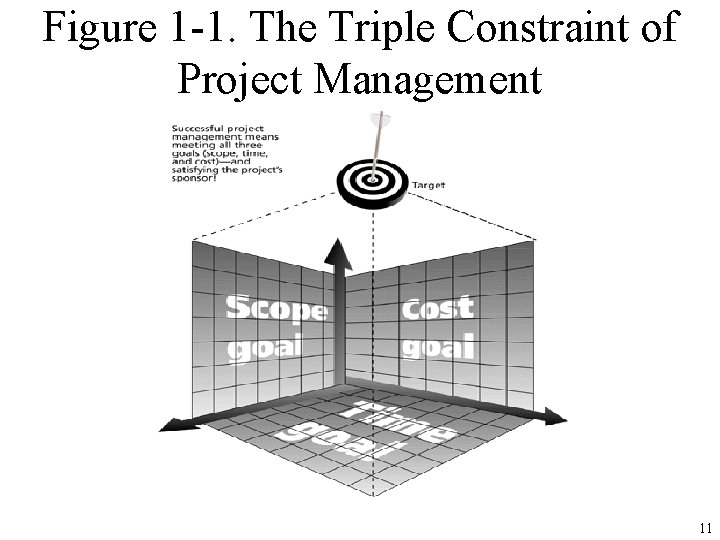
The Triple Constraint • Every project is constrained in different ways by its – Scope goals: What is the project trying to accomplish? – Time goals: How long should it take to complete? – Cost goals: What should it cost? • It is the project manager’s duty to balance these three often competing goals 10
Figure 1 -1. The Triple Constraint of Project Management 11
The 2001 Standish Group Report Showed Decided Improvement in Project Success • Time overruns significantly decreased to 163% compared to 222% • Cost overruns were down to 145% compared to 189% • Required features and functions were up to 67% compared to 61% • 78, 000 U. S. projects were successful compared to 28, 000 • 28% of IT projects succeeded compared to 16% 12
Why the Improvements? The reasons for the increase in successful projects vary. * – The average cost of a project has been more than cut in half. – Better tools have been created to monitor and control progress – Better skilled project managers with better management processes are being used. *The Standish Group, "CHAOS 2001: A Recipe for Success" (2001) 13
What is Project Management? Project management is “the application of knowledge, skills, tools, and techniques to project activities in order to meet project requirements” (PMI*, Project Management Body of Knowledge (PMBOK® Guide), 2000, p. 6) *The Project Management Institute (PMI) is an international professional society. Their web site is www. pmi. org. 14
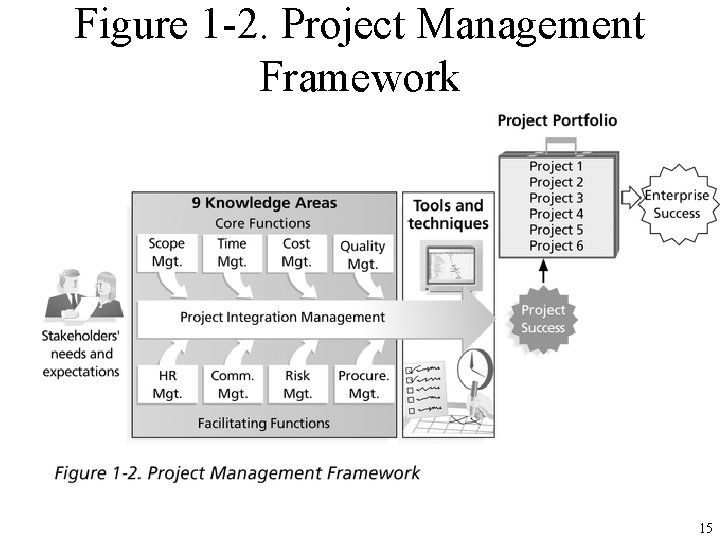
Figure 1 -2. Project Management Framework 15
Project Stakeholders • Stakeholders are the people involved in or affected by project activities • Stakeholders include – the project sponsor and project team – support staff – customers – users – suppliers – opponents to the project 16
9 Project Management Knowledge Areas • Knowledge areas describe the key competencies that project managers must develop – 4 core knowledge areas lead to specific project objectives (scope, time, cost, and quality) – 4 facilitating knowledge areas are the means through which the project objectives are achieved (human resources, communication, risk, and procurement management) – 1 knowledge area (project integration management) affects and is affected by all of the other knowledge areas 17
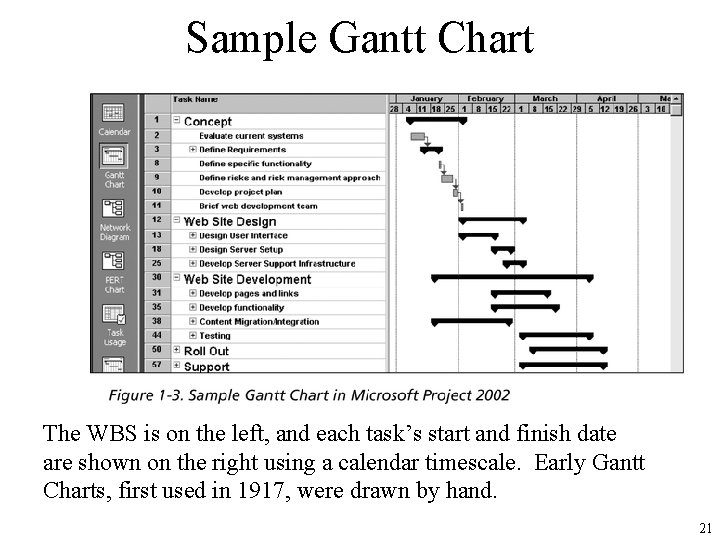
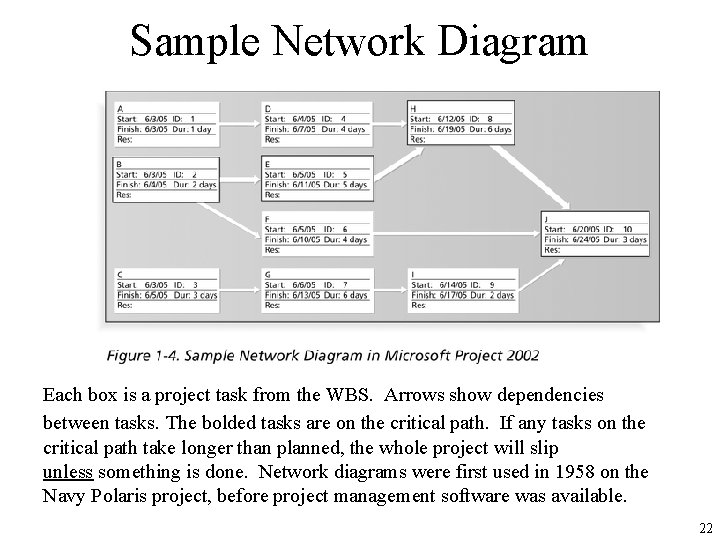
Project Management Tools and Techniques • Project management tools and techniques assist project managers and their teams in various aspects of project management • Some specific ones include – Project Charter, scope statement, and WBS (work breakdown structure) (scope) – Gantt charts, network diagrams, critical path analysis, critical chain scheduling (time) – Cost estimates and earned value management (cost) – See Table 1 -1 on p. 11 for many more 18
How Project Management Relates to Other Disciplines • Much of the knowledge needed to manage projects is unique to the discipline of project management • Project mangers must also have knowledge and experience in – general management – the application area of the project 19
History of Project Management • Some people argue that building the Egyptian pyramids was a project, as was building the Great Wall of China • Most people consider the Manhattan Project to be the first project to use “modern” project management • This three-year, $2 billion (in 1946 dollars) project had a separate project manager and a technical manager 20
Sample Gantt Chart The WBS is on the left, and each task’s start and finish date are shown on the right using a calendar timescale. Early Gantt Charts, first used in 1917, were drawn by hand. 21
Sample Network Diagram Each box is a project task from the WBS. Arrows show dependencies between tasks. The bolded tasks are on the critical path. If any tasks on the critical path take longer than planned, the whole project will slip unless something is done. Network diagrams were first used in 1958 on the Navy Polaris project, before project management software was available. 22
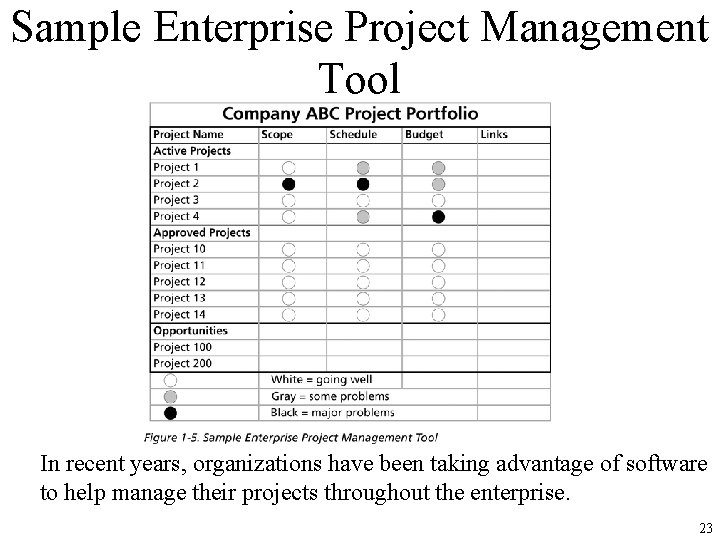
Sample Enterprise Project Management Tool In recent years, organizations have been taking advantage of software to help manage their projects throughout the enterprise. 23
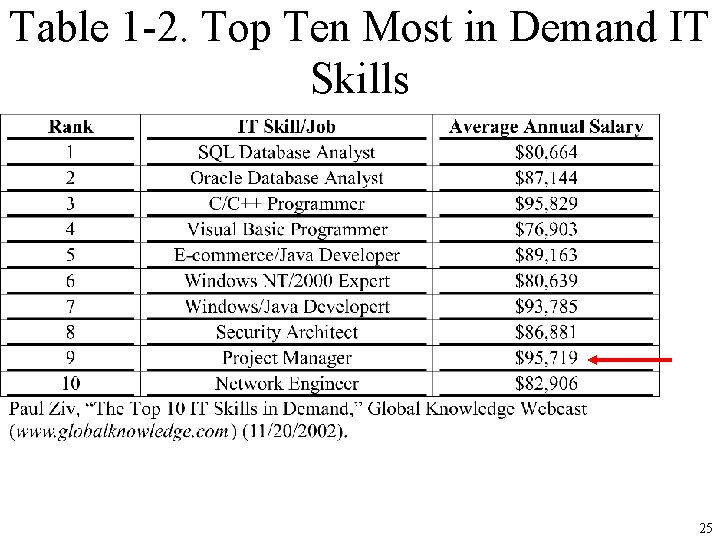
The Project Management Profession • The job of IT Project Manager is in the list of the top ten most in demand IT skills • Professional societies like the Project Management Institute (PMI) have grown tremendously • Project management research and certification programs continue to grow 24
Table 1 -2. Top Ten Most in Demand IT Skills 25
Project Management Knowledge Continues to Grow and Mature • PMI hosted their first research conference in June 2000 in Paris, France, and the second one in Seattle in July 2002 • The PMBOK® Guide 2000 is an ANSI standard • PMI’s certification department earned ISO 9000 certification • Hundreds of new books, articles, and presentations related to project management have been written in recent years 26
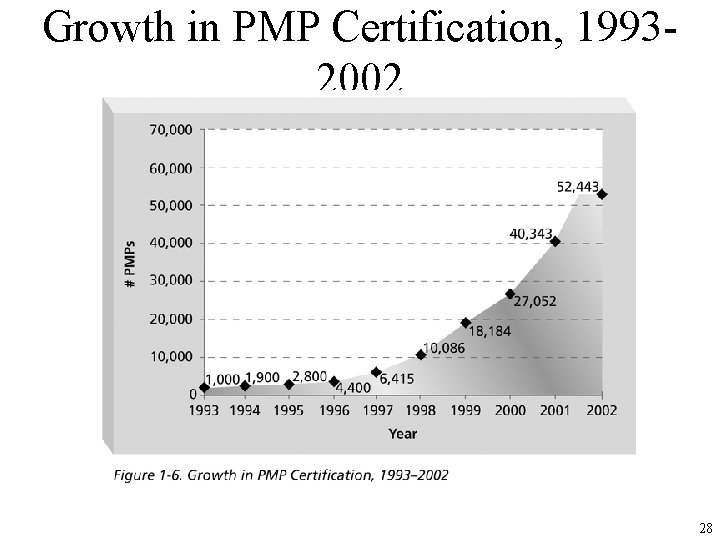
Project Management Certification • PMI provides certification as a Project Management Professional (PMP) • A PMP has documented sufficient project experience, agreed to follow a code of ethics, and passed the PMP exam • The number of people earning PMP certification is increasing quickly • PMI and other organizations are offering new certification programs (see Appendix B) 27
Growth in PMP Certification, 19932002 28
Ethics in Project Management • Ethics is an important part of all professions • Project managers often face ethical dilemmas • In order to earn PMP certification, applicants must agree to the PMP code of professional conduct 29
Project Management Software • By 2003, there were hundreds of different products to assist in performing project management • Three main categories of tools exist: – Low-end tools: Handle single or smaller projects well, cost under $200 per user – Midrange tools: Handle multiple projects and users, cost $200 -500 per user, Project 2000 most popular – High-end tools: Also called enterprise project management software, often licensed on a per-user basis • Project 2002 now includes a separate version for enterprise project management (see Appendix A for details on Project 2002) 30
You Can Apply Project Management to Many Areas • Project management applies to work as well as personal projects • Project management applies to many different disciplines (IT, construction, finance, sports, event planning, etc. ) • Project management skills can help in everyday life 31