
Chapter 1 Introduction to Physics Units of Chapter
- Slides: 20
Chapter 1 Introduction to Physics
Units of Chapter 1 • Physics and the Laws of Nature • Units of Length, Mass, and Time • Dimensional Analysis • Significant Figures • Converting Units • Order-of-Magnitude Calculations • Scalars and Vectors • Problem Solving in Physics
1 -1 Physics and the Laws of Nature Physics: the study of the fundamental laws of nature • these laws can be expressed as mathematical equations • much complexity can arise from relatively simple laws
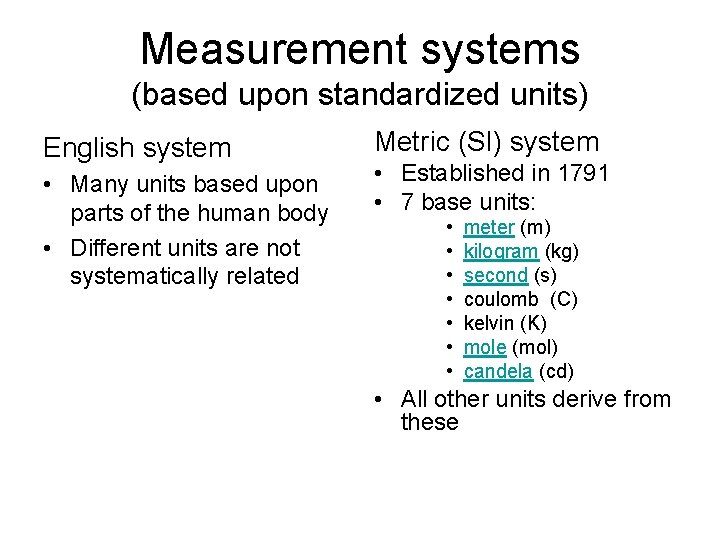
Measurement systems (based upon standardized units) English system • Many units based upon parts of the human body • Different units are not systematically related Metric (SI) system • Established in 1791 • 7 base units: • • meter (m) kilogram (kg) second (s) coulomb (C) kelvin (K) mole (mol) candela (cd) • All other units derive from these
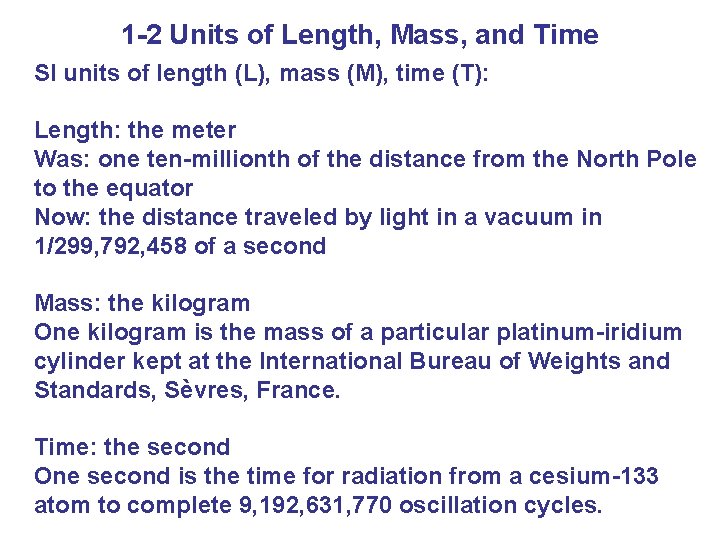
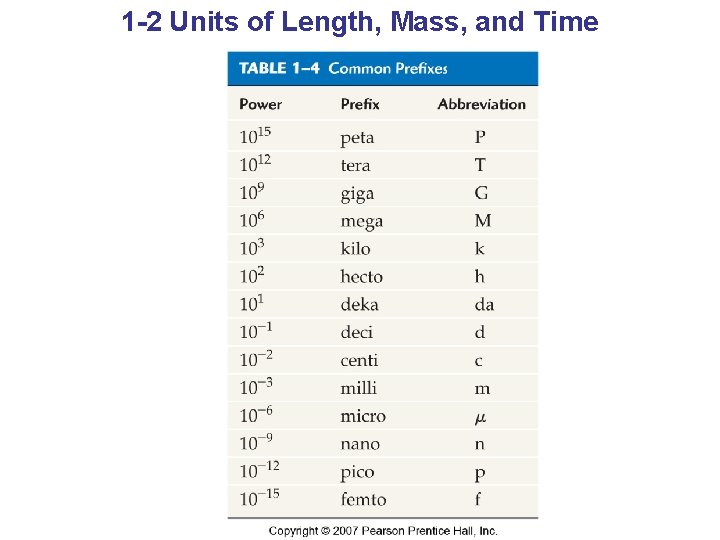
1 -2 Units of Length, Mass, and Time SI units of length (L), mass (M), time (T): Length: the meter Was: one ten-millionth of the distance from the North Pole to the equator Now: the distance traveled by light in a vacuum in 1/299, 792, 458 of a second Mass: the kilogram One kilogram is the mass of a particular platinum-iridium cylinder kept at the International Bureau of Weights and Standards, Sèvres, France. Time: the second One second is the time for radiation from a cesium-133 atom to complete 9, 192, 631, 770 oscillation cycles.
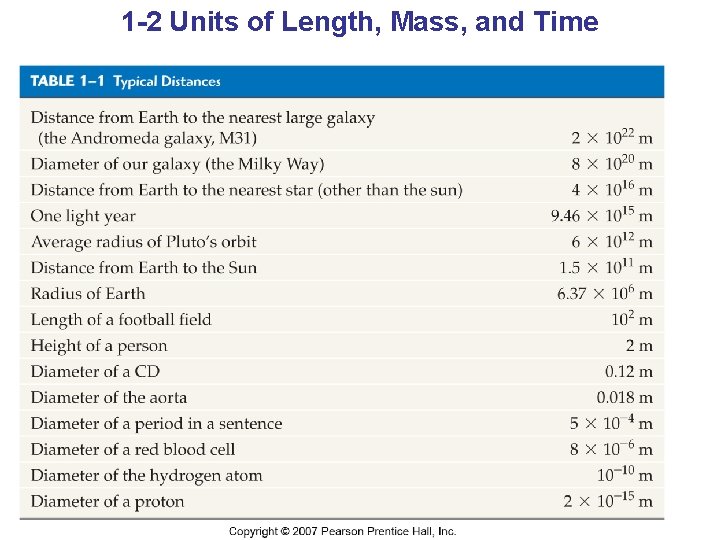
1 -2 Units of Length, Mass, and Time
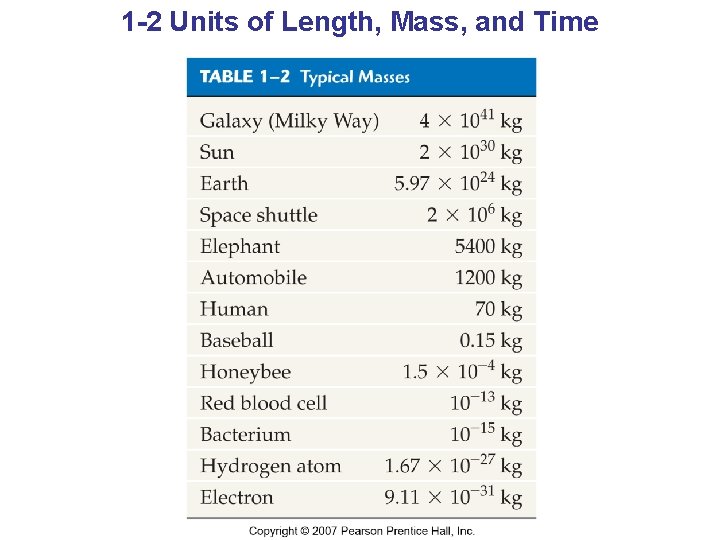
1 -2 Units of Length, Mass, and Time
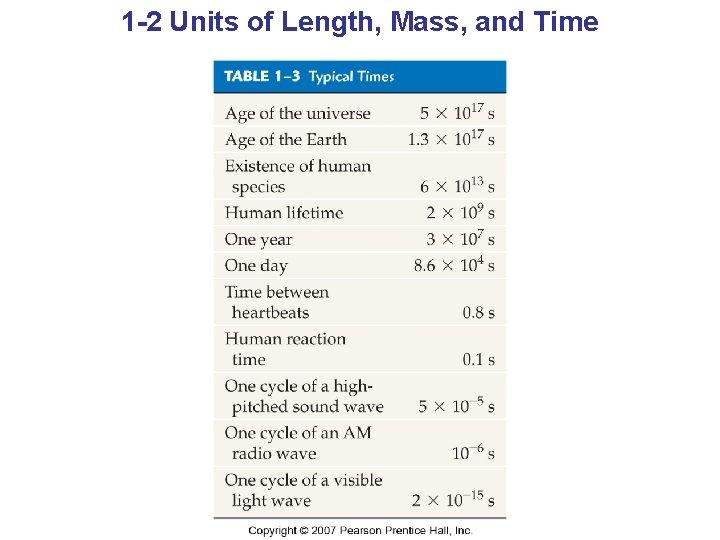
1 -2 Units of Length, Mass, and Time
1 -2 Units of Length, Mass, and Time
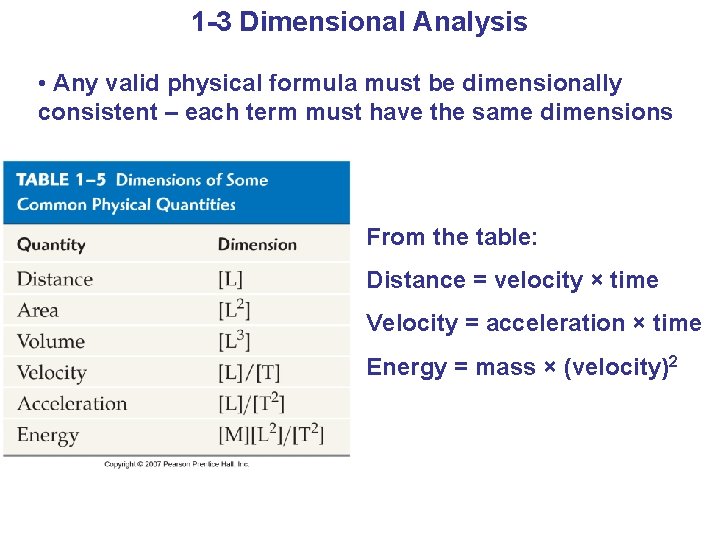
1 -3 Dimensional Analysis • Any valid physical formula must be dimensionally consistent – each term must have the same dimensions From the table: Distance = velocity × time Velocity = acceleration × time Energy = mass × (velocity)2
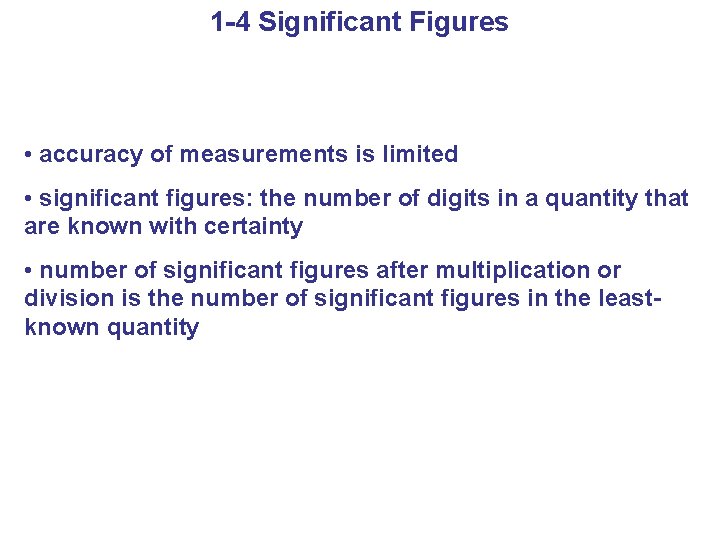
1 -4 Significant Figures • accuracy of measurements is limited • significant figures: the number of digits in a quantity that are known with certainty • number of significant figures after multiplication or division is the number of significant figures in the leastknown quantity
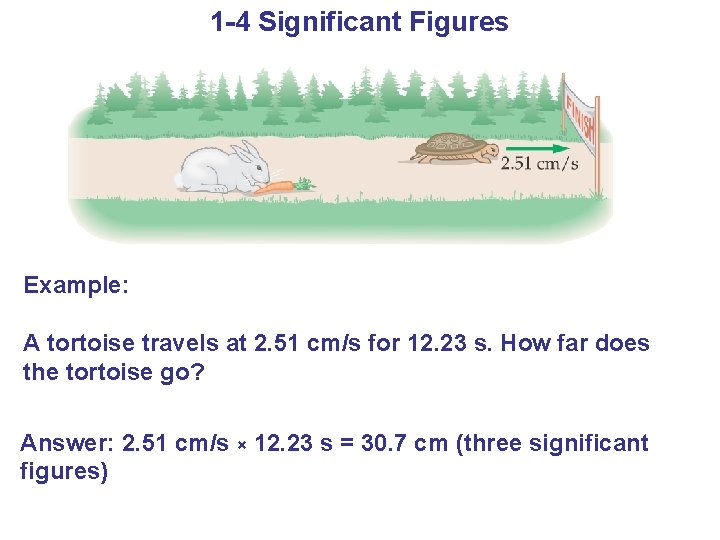
1 -4 Significant Figures Example: A tortoise travels at 2. 51 cm/s for 12. 23 s. How far does the tortoise go? Answer: 2. 51 cm/s × 12. 23 s = 30. 7 cm (three significant figures)
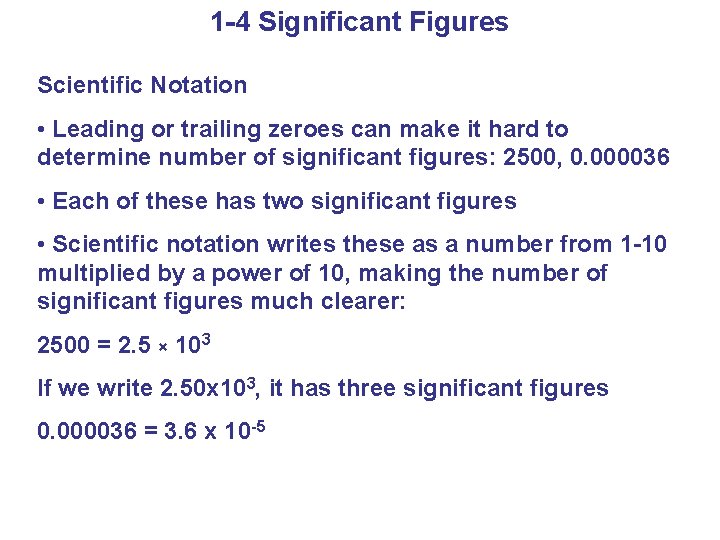
1 -4 Significant Figures Scientific Notation • Leading or trailing zeroes can make it hard to determine number of significant figures: 2500, 0. 000036 • Each of these has two significant figures • Scientific notation writes these as a number from 1 -10 multiplied by a power of 10, making the number of significant figures much clearer: 2500 = 2. 5 × 10³ If we write 2. 50 x 103, it has three significant figures 0. 000036 = 3. 6 x 10 -5
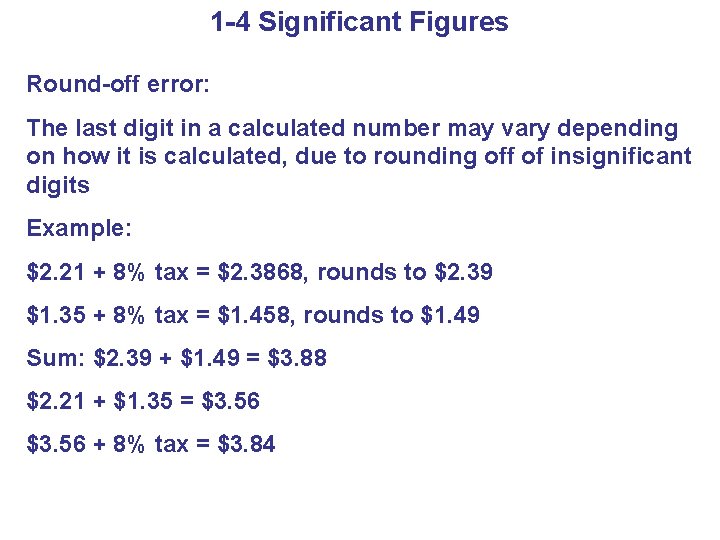
1 -4 Significant Figures Round-off error: The last digit in a calculated number may vary depending on how it is calculated, due to rounding off of insignificant digits Example: $2. 21 + 8% tax = $2. 3868, rounds to $2. 39 $1. 35 + 8% tax = $1. 458, rounds to $1. 49 Sum: $2. 39 + $1. 49 = $3. 88 $2. 21 + $1. 35 = $3. 56 + 8% tax = $3. 84
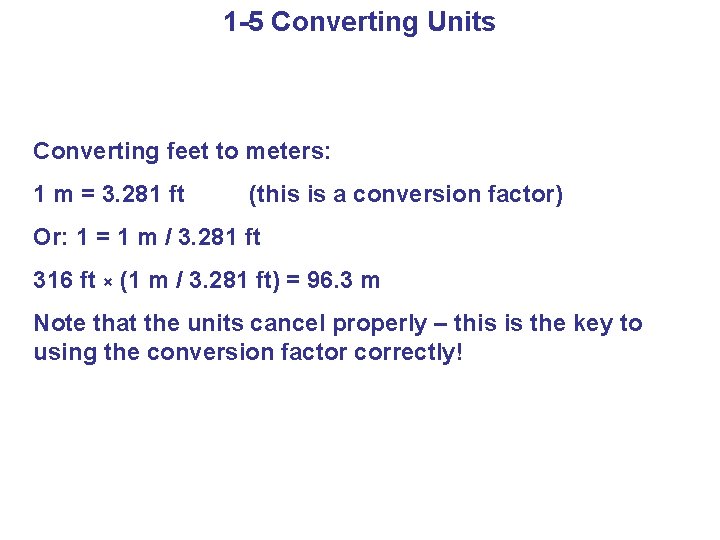
1 -5 Converting Units Converting feet to meters: 1 m = 3. 281 ft (this is a conversion factor) Or: 1 = 1 m / 3. 281 ft 316 ft × (1 m / 3. 281 ft) = 96. 3 m Note that the units cancel properly – this is the key to using the conversion factor correctly!
1 -6 Order-of-Magnitude Calculations Why are estimates useful? 1. as a check for a detailed calculation – if your answer is very different from your estimate, you’ve probably made an error 2. to estimate numbers where a precise calculation cannot be done
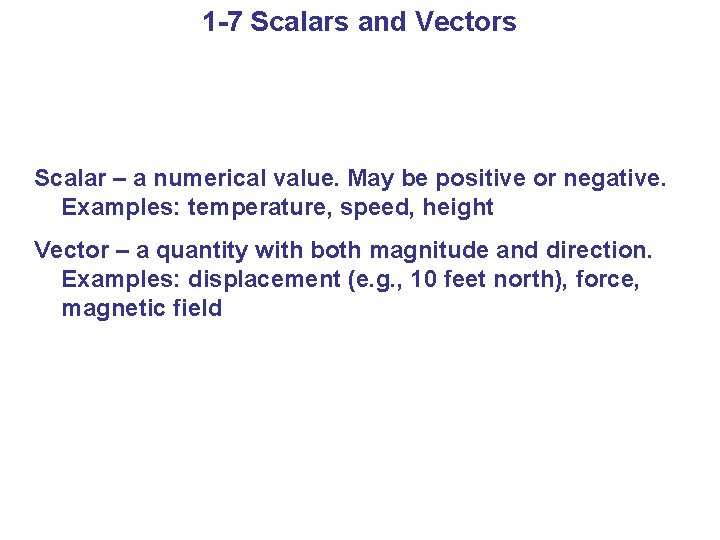
1 -7 Scalars and Vectors Scalar – a numerical value. May be positive or negative. Examples: temperature, speed, height Vector – a quantity with both magnitude and direction. Examples: displacement (e. g. , 10 feet north), force, magnetic field
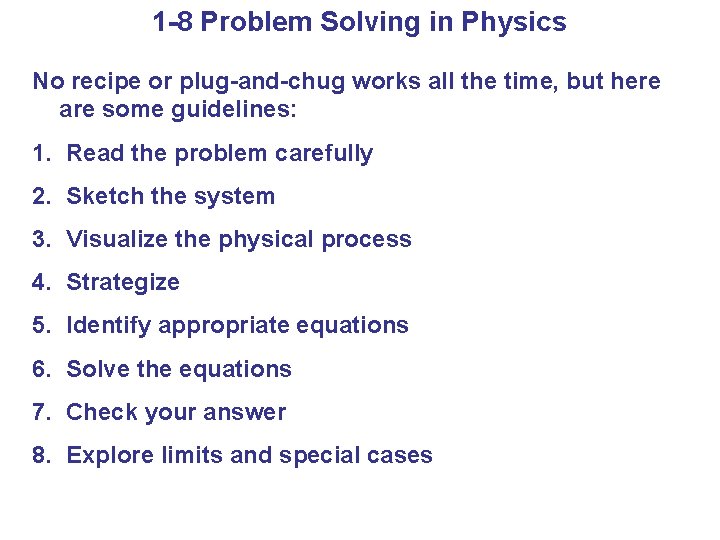
1 -8 Problem Solving in Physics No recipe or plug-and-chug works all the time, but here are some guidelines: 1. Read the problem carefully 2. Sketch the system 3. Visualize the physical process 4. Strategize 5. Identify appropriate equations 6. Solve the equations 7. Check your answer 8. Explore limits and special cases
Summary of Chapter 1 • Physics is based on a small number of laws and principles • Units of length are meters; of mass, kilograms; and of time, seconds • All terms in an equation must have the same dimensions • The result of a calculation should have only as many significant figures as the least accurate measurement used in it
Summary of Chapter 1 • Convert one unit to another by multiplying by their ratio • Order-of-magnitude calculations are designed to be accurate within a power of 10 • Scalars are numbers; vectors have both magnitude and direction • Problem solving: read, sketch, visualize, strategize, identify equations, solve, check, explore limits