
Chapter 1 Introduction to Operations Management Why Are



- Slides: 46
Chapter 1 Introduction to Operations Management
Why Are Some Companies More Successful Than Others? A major reasons is that they do a better job of managing their operations. · Companies that are in trouble often focus their turnaround efforts on beefing up their operations. · Two recent examples are · Chrysler · Ford ·
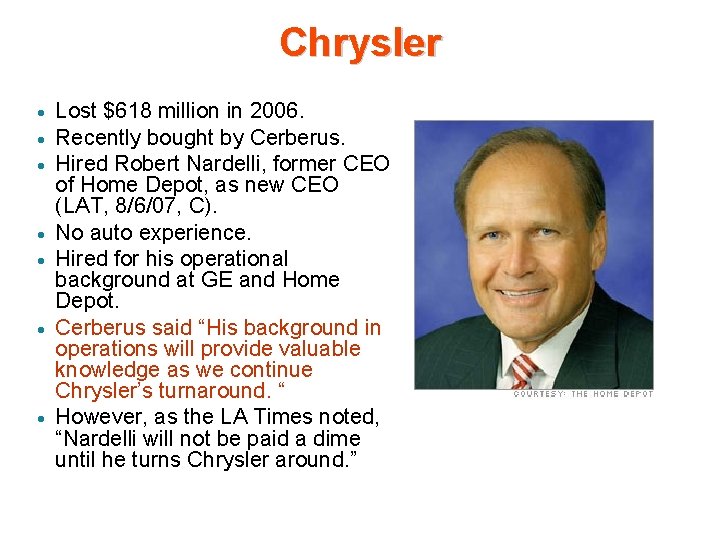
Chrysler · · · · Lost $618 million in 2006. Recently bought by Cerberus. Hired Robert Nardelli, former CEO of Home Depot, as new CEO (LAT, 8/6/07, C). No auto experience. Hired for his operational background at GE and Home Depot. Cerberus said “His background in operations will provide valuable knowledge as we continue Chrysler’s turnaround. “ However, as the LA Times noted, “Nardelli will not be paid a dime until he turns Chrysler around. ”
Ford · · Same thing happened at Ford hired Alan Mulally from Boeing who also lacked experience in auto industry but had a strong background in operations, especially manufacturing, customers satisfaction, and supplier relations.
Managing Operations · Involves the design, § evaluation, and § improvement § of an organizations operations. · An operation is any activity involved in producing a good or providing a service.
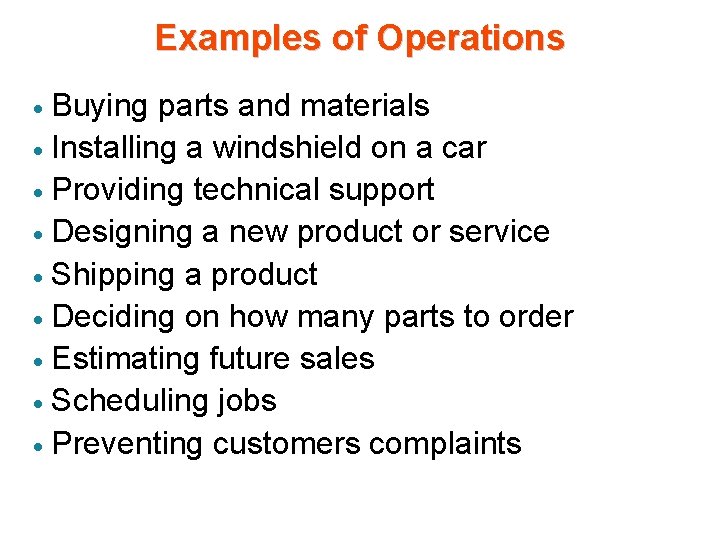
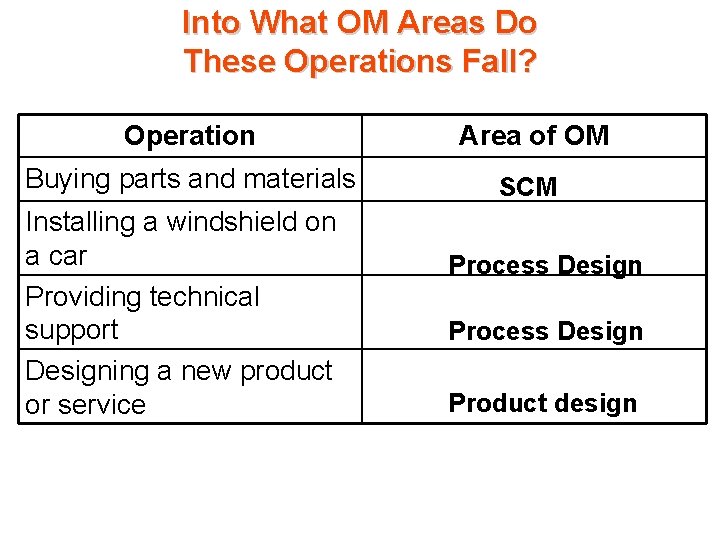
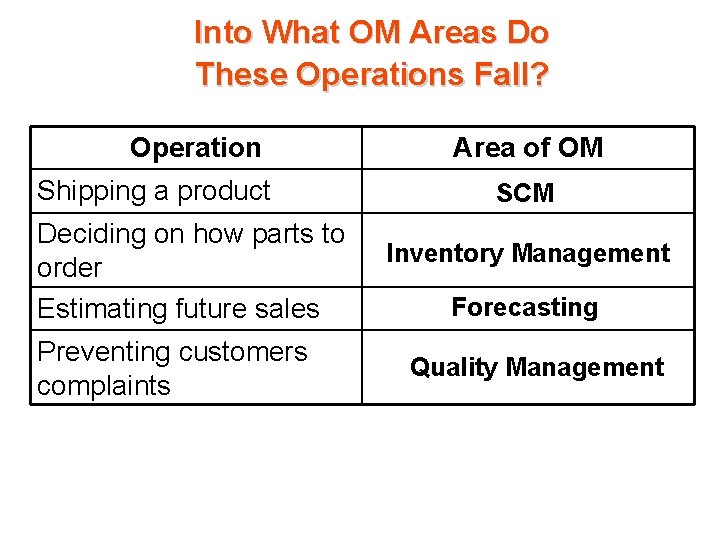
Examples of Operations Buying parts and materials · Installing a windshield on a car · Providing technical support · Designing a new product or service · Shipping a product · Deciding on how many parts to order · Estimating future sales · Scheduling jobs · Preventing customers complaints ·
Operations Fall into Different Areas of Operations Management (OM) · Forecasting · · Predicting future demand of a product or service Product or service design Designing new products or services · Redesigning existing products ·
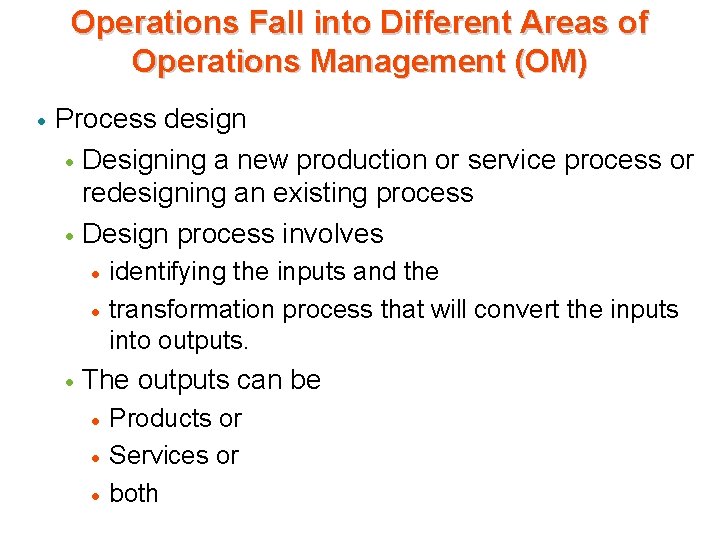
Operations Fall into Different Areas of Operations Management (OM) · Process design · Designing a new production or service process or redesigning an existing process · Design process involves · · · identifying the inputs and the transformation process that will convert the inputs into outputs. The outputs can be · · · Products or Services or both
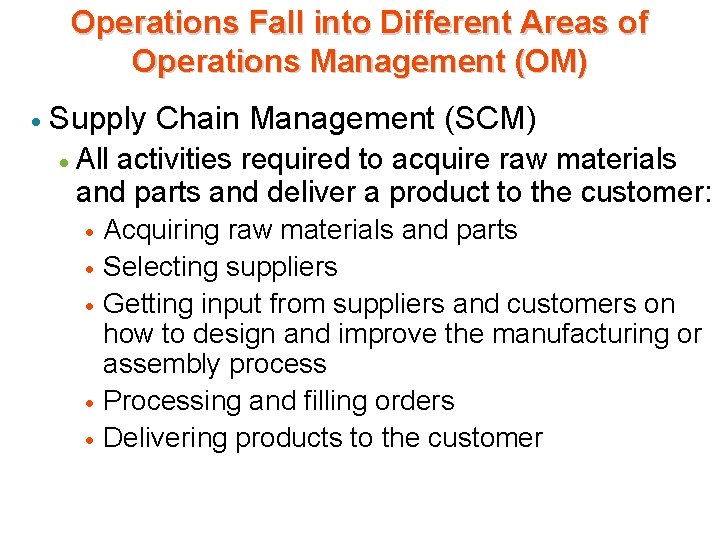
Operations Fall into Different Areas of Operations Management (OM) · Supply Chain Management (SCM) · All activities required to acquire raw materials and parts and deliver a product to the customer: · · · Acquiring raw materials and parts Selecting suppliers Getting input from suppliers and customers on how to design and improve the manufacturing or assembly process Processing and filling orders Delivering products to the customer
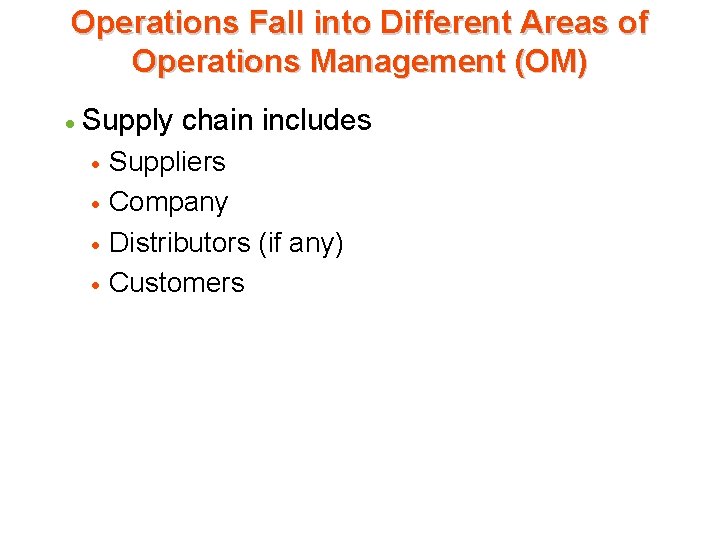
Operations Fall into Different Areas of Operations Management (OM) · Supply chain includes · · Suppliers Company Distributors (if any) Customers
Operations Fall into Different Areas of Operations Management (OM) · Scheduling · Assignment problem · · What jobs should we assign to what machines to minimize total cost? Sequencing · · In what order should jobs be processed on different machines to minimize total processing time? Doing the right job or activity, at the right time, and in the right order.
Operations Fall into Different Areas of Operations Management (OM) · Capacity planning · Achieve a match between production or service capacity of a company, a division, a machine, or a service unit and the predicted level of demand. · Important to plan capacity because of consequences of poor planning: · One is ? – · Other is ? -
Operations Fall into Different Areas of Operations Management (OM) · Capacity planning · What is one area of capacity planning at CSUN? · What are the consequences of poor capacity planning in this area?
Operations Fall into Different Areas of Operations Management (OM) · Inventory management To provide enough inventory to satisfy customer demand while minimizing inventory costs. · Important to manage inventory because of two types of errors: · · · One error – Other error -
Operations Fall into Different Areas of Operations Management (OM) · Quality management Designing, · implementing and · managing programs to insure that product and service quality is continuously improved at every level of an organization. ·
Into What OM Areas Do These Operations Fall? Operation Area of OM Buying parts and materials SCM Installing a windshield on a car Providing technical support Designing a new product or service Process Design Product design
Into What OM Areas Do These Operations Fall? Operation Shipping a product Deciding on how parts to order Estimating future sales Preventing customers complaints Area of OM SCM Inventory Management Forecasting Quality Management
Recent Business Examples of OM Issues In the slides that follow, operational issues involving different companies are presented. · Identify the major area(s) of OM into which each issue falls. ·
Paccar “Commercial trucks are mostly commodities, mass produced for big fleet operators whose major focus is price. But Paccar, a company that makes Kenworth and Peterbit trucks, charges 10% more. Customers say it worth it. ” (Business Week, 1/30/06) · · · · Product design Process design Forecasting Scheduling Capacity planning Inventory management Supply chain management (SCM) Quality management
Paccar custom builds trucks to the individual specs. Buyers are offered 1000 s of options, from engines and axles to upholstery. · · · · Product design Process design Forecasting Scheduling Capacity planning Inventory management Supply chain management (SCM) Quality management
Paccar Part by part, Paccar designs the truck on a computer with a dealer. Orders are then zapped to Paccar’s factories, where workers assembly trucks for delivery 6 to 8 weeks later. Its computerized machinery can make parts in hours, not days or weeks. · · · · Product design Process design Forecasting Scheduling Capacity planning Inventory management Supply chain management (SCM) Quality management
Boeing’s 787 (Deamliner) (LAT, July 9 2007) • Unveiled on July 8, 2007 • Already has almost 700 orders • Uses carbon fiber materials • Lighter • Burns less fuel • More durable • Less prone to corrosion than aluminum · · · · Product design Process design Forecasting Scheduling Capacity planning Inventory management Supply chain management (SCM) Quality management
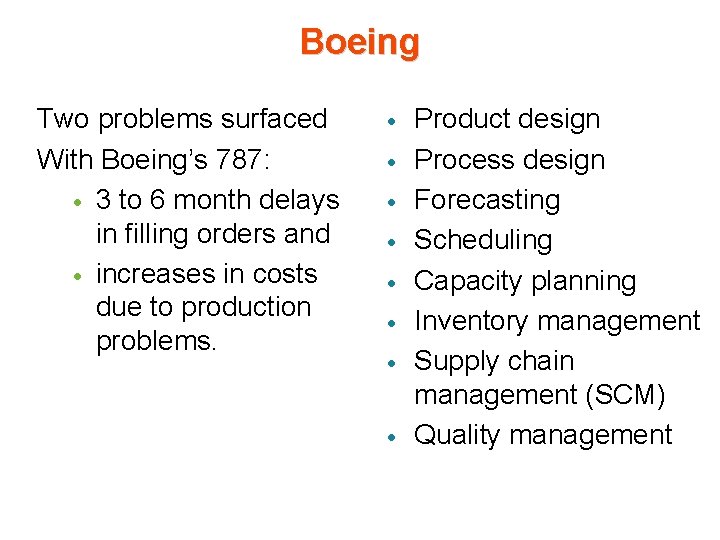
Boeing Two problems surfaced With Boeing’s 787: · 3 to 6 month delays in filling orders and · increases in costs due to production problems. · · · · Product design Process design Forecasting Scheduling Capacity planning Inventory management Supply chain management (SCM) Quality management
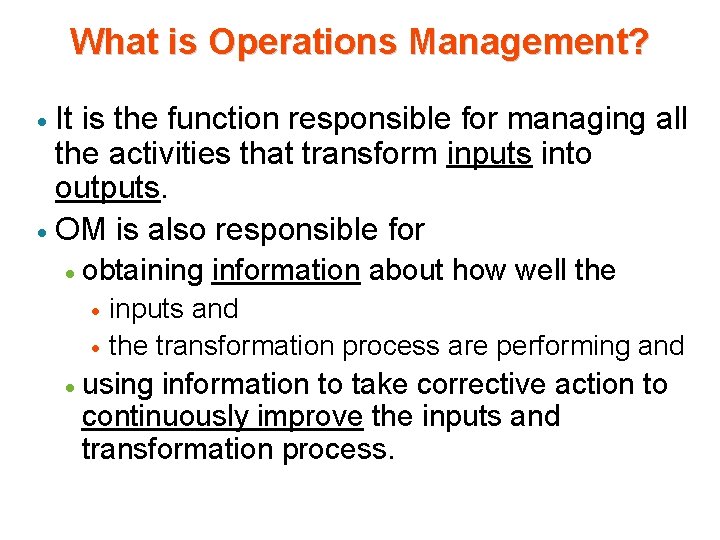
What is Operations Management? It is the function responsible for managing all the activities that transform inputs into outputs. · OM is also responsible for · · obtaining information about how well the · · · inputs and the transformation process are performing and using information to take corrective action to continuously improve the inputs and transformation process.
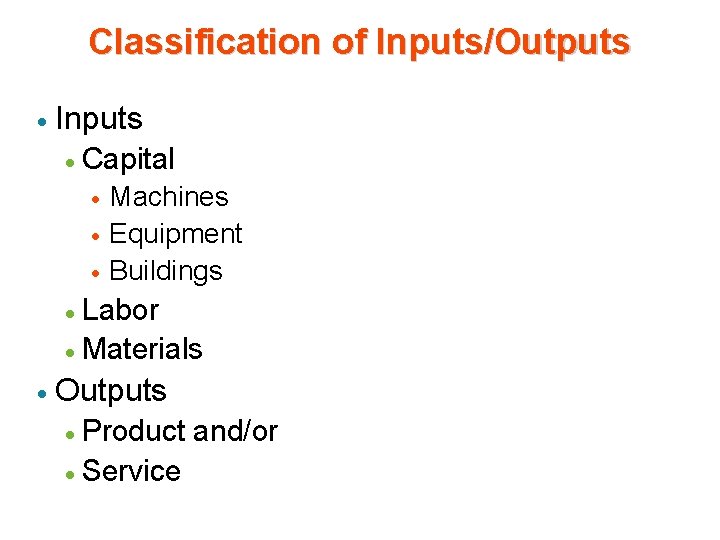
Classification of Inputs/Outputs · Inputs · Capital · · · Machines Equipment Buildings Labor · Materials · · Outputs Product and/or · Service ·
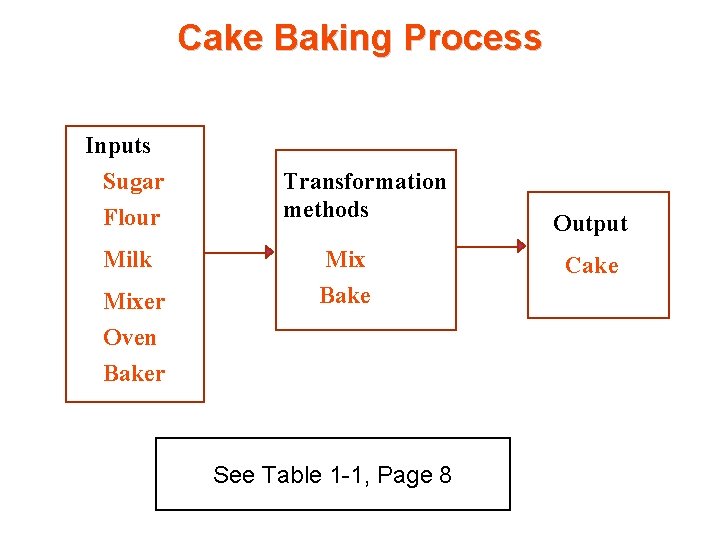
Cake Baking Process Inputs Sugar Flour Milk Mixer Oven Baker Transformation methods Mix Bake See Table 1 -1, Page 8 Output Cake
Classification of Inputs Sugar Flour Materials Milk Capital Mixer Oven Baker Labor
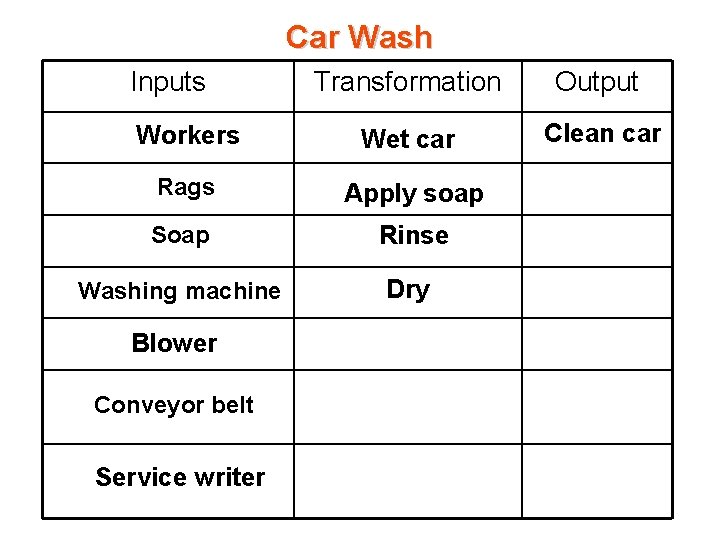
Car Wash Inputs Transformation Output Workers Wet car Clean car Rags Apply soap Soap Rinse Washing machine Dry Blower Conveyor belt Service writer
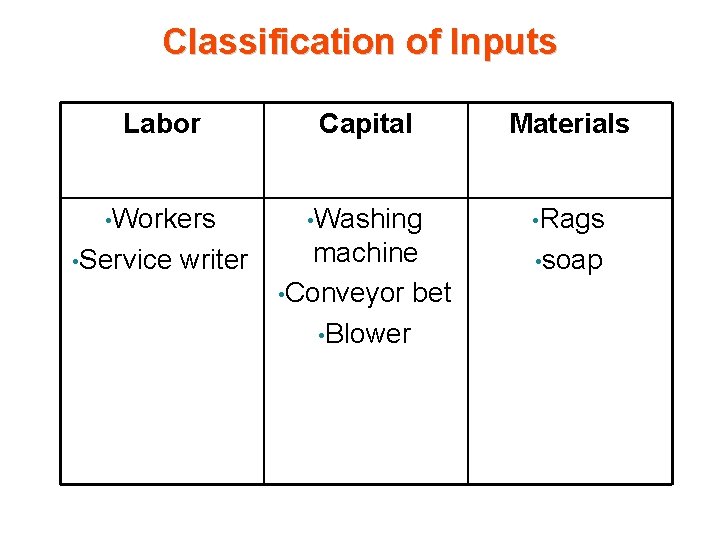
Classification of Inputs Labor Capital Materials • Workers • Washing • Rags machine • Conveyor bet • Blower • soap • Service writer
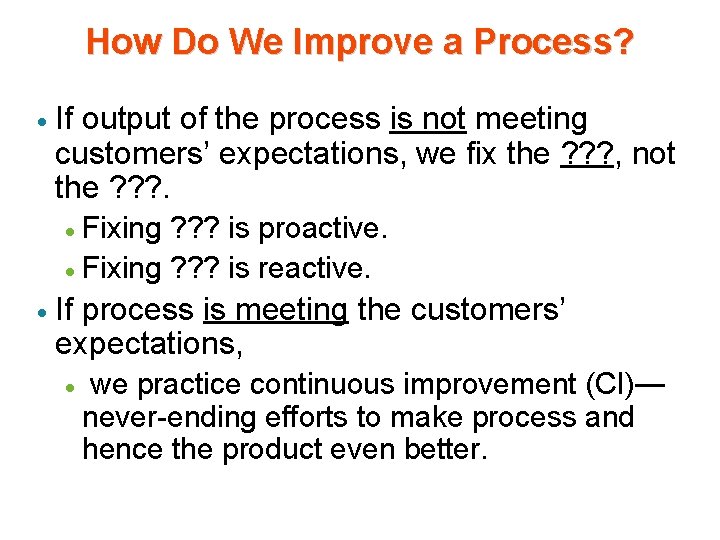
How Do We Improve a Process? · If output of the process is not meeting customers’ expectations, we fix the ? ? ? , not the ? ? ? . Fixing ? ? ? is proactive. · Fixing ? ? ? is reactive. · · If process is meeting the customers’ expectations, · we practice continuous improvement (CI)— never-ending efforts to make process and hence the product even better.
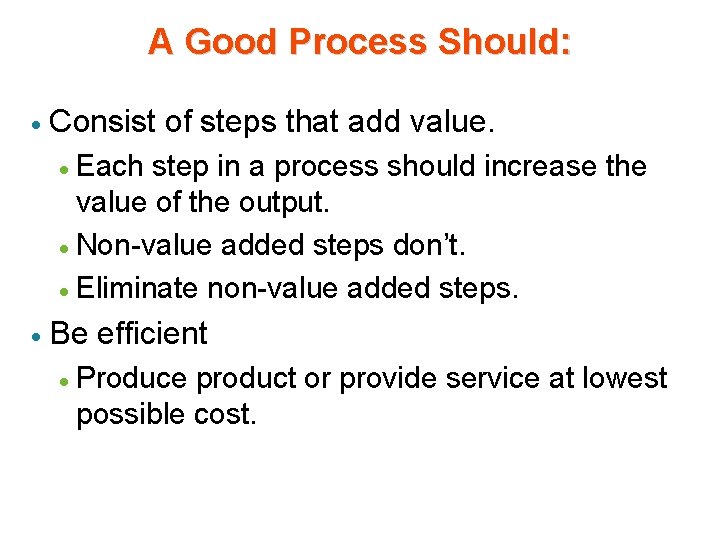
A Good Process Should: · Consist of steps that add value. Each step in a process should increase the value of the output. · Non-value added steps don’t. · Eliminate non-value added steps. · · Be efficient · Produce product or provide service at lowest possible cost.
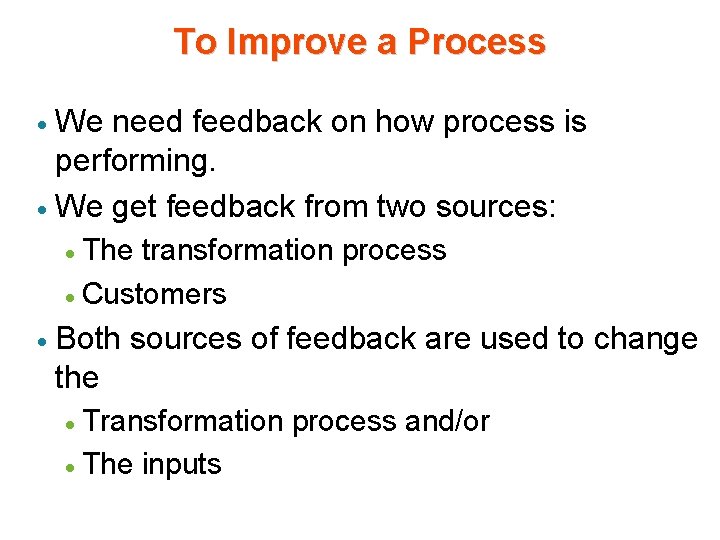
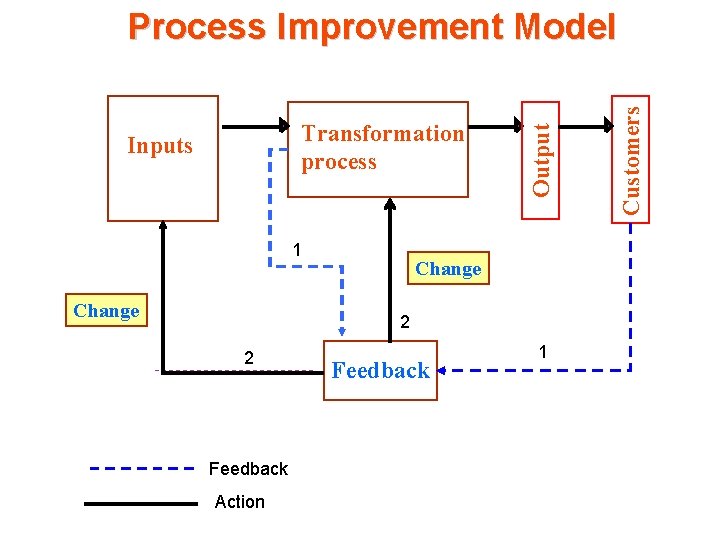
To Improve a Process We need feedback on how process is performing. · We get feedback from two sources: · The transformation process · Customers · · Both sources of feedback are used to change the Transformation process and/or · The inputs ·
1 Change 2 2 Feedback Action Feedback 1 Customers Transformation process Inputs Output Process Improvement Model
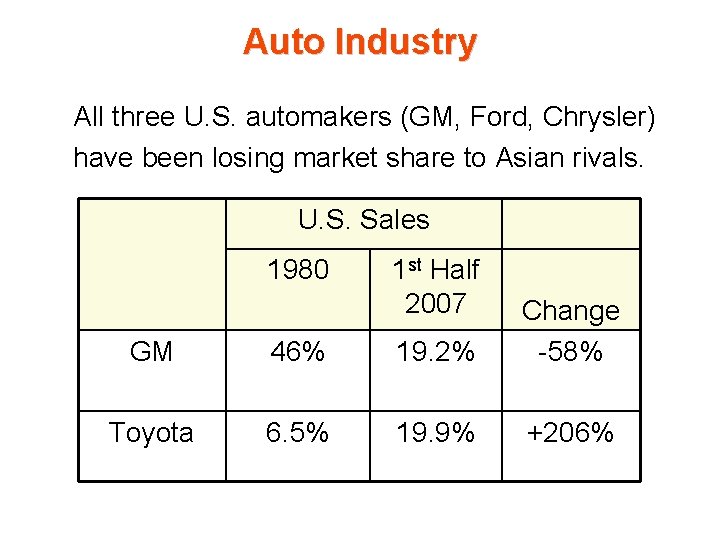
Auto Industry All three U. S. automakers (GM, Ford, Chrysler) have been losing market share to Asian rivals. U. S. Sales 1980 1 st Half 2007 GM 46% 19. 2% Change -58% Toyota 6. 5% 19. 9% +206%
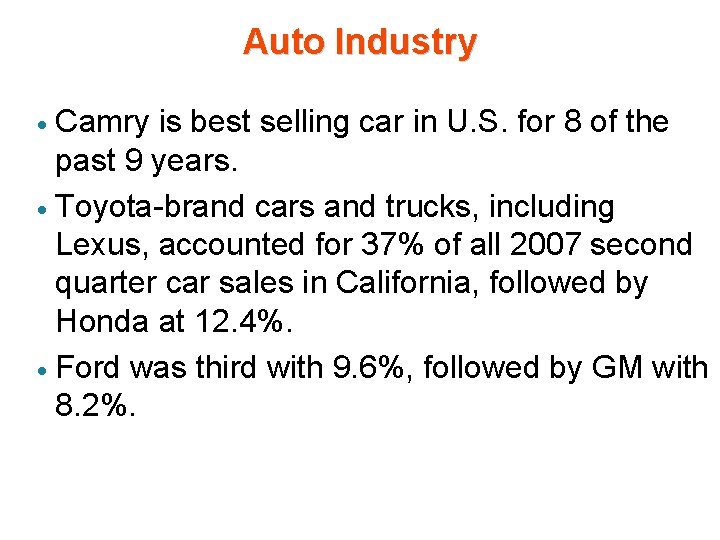
Auto Industry Camry is best selling car in U. S. for 8 of the past 9 years. · Toyota-brand cars and trucks, including Lexus, accounted for 37% of all 2007 second quarter car sales in California, followed by Honda at 12. 4%. · Ford was third with 9. 6%, followed by GM with 8. 2%. ·
Auto Industry GM, Ford have red ink · GM lost $3. 4 billion in last quarter · Ford, $254 million · Both are closing plants · Laying off workers · Cutting production ·
Auto Industry · Due to two operational issues quality and · product line · Quality – later · Product line · · Buyer’s are turning away from products that have been main source of profit: · gas-hungry pickups and SUV’s
What Factors Explain Toyota’s Success? Higher manufacturing quality · Higher reliability · Spends more on hiring best people · Spends more on training · Spends more on taking care of customers · · Implications? Lower prices · More fuel efficient vehicles · More elegant designs ·
Toyota is not cutting cost by spending less. · They spend more on · taking care of customers, · training workers, · improving quality, etc. · · How can they charge lower prices?
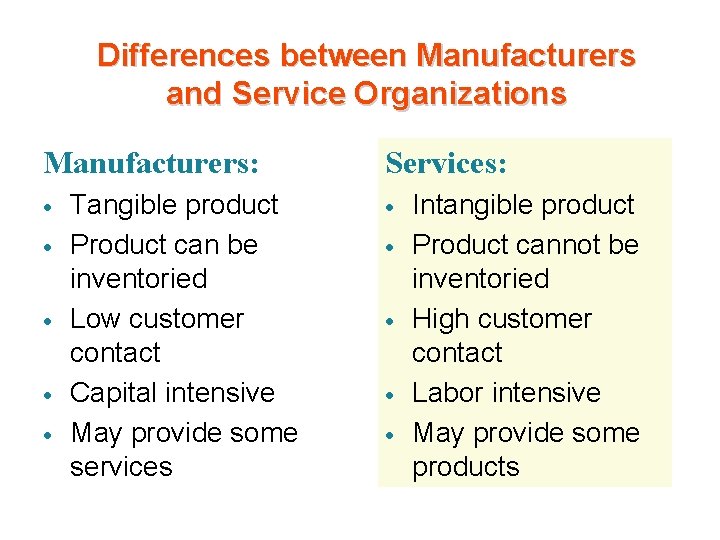
Differences between Manufacturers and Service Organizations Manufacturers: · · · Tangible product Product can be inventoried Low customer contact Capital intensive May provide some services Services: · · · Intangible product Product cannot be inventoried High customer contact Labor intensive May provide some products
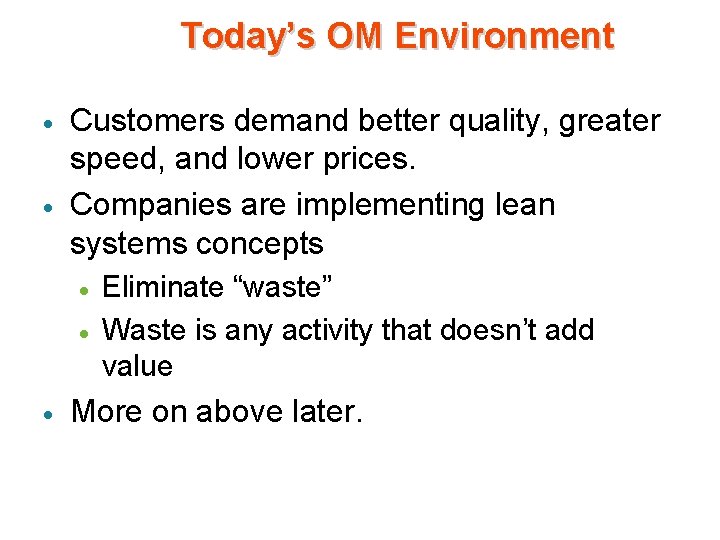
Today’s OM Environment · · Customers demand better quality, greater speed, and lower prices. Companies are implementing lean systems concepts · · · Eliminate “waste” Waste is any activity that doesn’t add value More on above later.
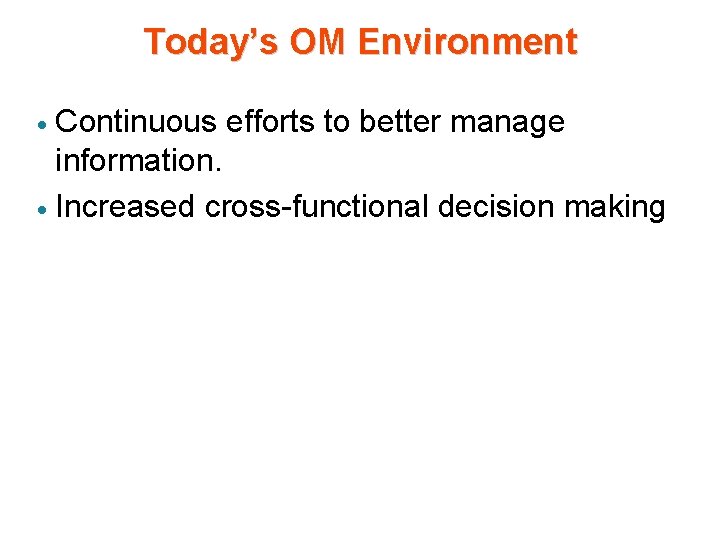
Today’s OM Environment Continuous efforts to better manage information. · Increased cross-functional decision making ·
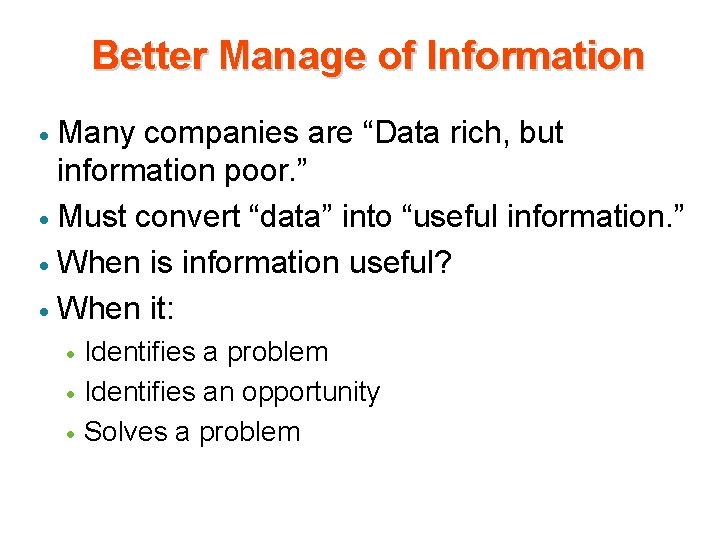
Better Manage of Information Many companies are “Data rich, but information poor. ” · Must convert “data” into “useful information. ” · When is information useful? · When it: · Identifies a problem · Identifies an opportunity · Solves a problem ·
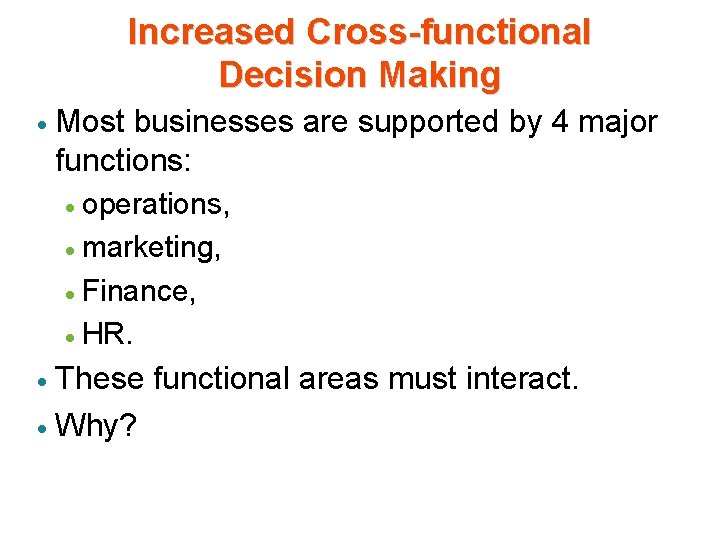
Increased Cross-functional Decision Making · Most businesses are supported by 4 major functions: operations, · marketing, · Finance, · HR. · These functional areas must interact. · Why? ·
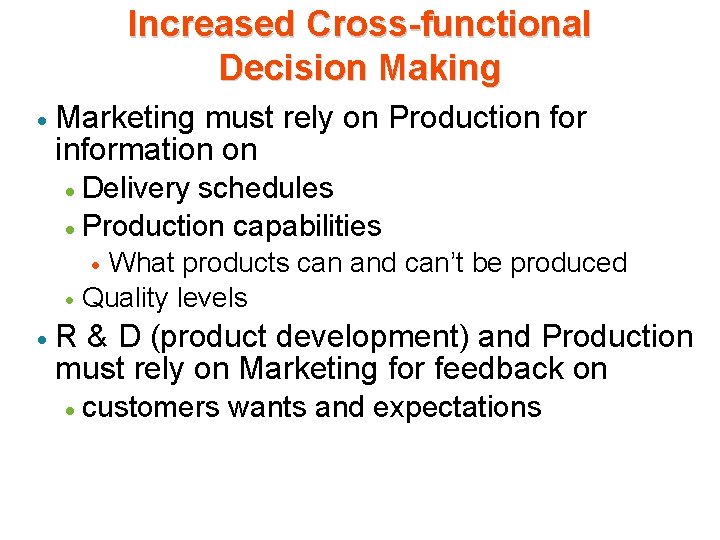
Increased Cross-functional Decision Making · Marketing must rely on Production for information on Delivery schedules · Production capabilities · What products can and can’t be produced · Quality levels · · R & D (product development) and Production must rely on Marketing for feedback on · customers wants and expectations
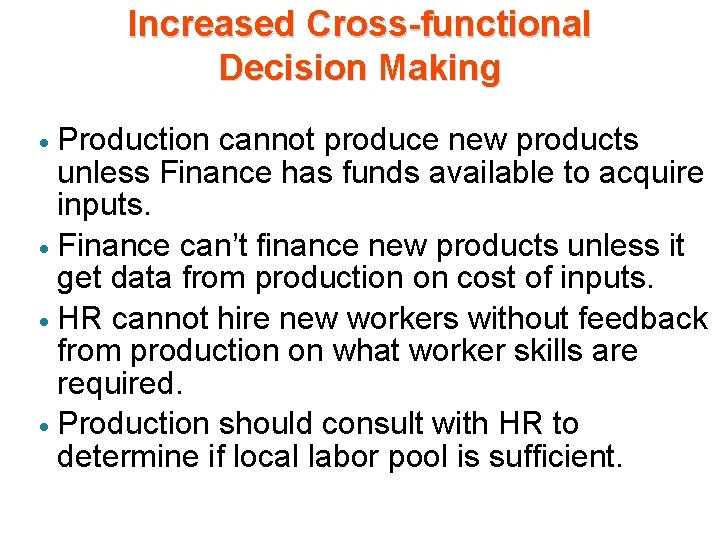
Increased Cross-functional Decision Making Production cannot produce new products unless Finance has funds available to acquire inputs. · Finance can’t finance new products unless it get data from production on cost of inputs. · HR cannot hire new workers without feedback from production on what worker skills are required. · Production should consult with HR to determine if local labor pool is sufficient. ·