
Chapter 1 Introduction to Operations Management Mc GrawHillIrwin

- Slides: 40
Chapter 1 Introduction to Operations Management Mc. Graw-Hill/Irwin Copyright © 2012 by The Mc. Graw-Hill Companies, Inc. All rights reserved.
Chapter 1: Learning Objectives � You should be able to: 1. Define the term operations management 2. Identify the three major functional areas of organizations and describe how they interrelate 3. Identify similarities and differences between production and service operations 4. Describe the operations function and the nature of the operations manager’s job 5. Summarize the two major aspects of process management 6. Explain the key aspects of operations management decision making 7. Briefly describe the historical evolution of operations management 8. Characterize current trends in business that impact operations management Instructor Slides 1 -2
Operations Management �What is operations? �The part of a business organization that is responsible for producing goods or services �How can we define operations management? �The management of systems or processes that create goods and/or provide services Instructor Slides 1 -3
Good or Service? Goods are physical items that include raw materials, parts, subassemblies, and final products. • Automobile • Computer • Oven • Shampoo Services are activities that provide some combination of time, location, form or psychological value. • Air travel • Education • Haircut • Legal counsel Instructor Slides 1 -4
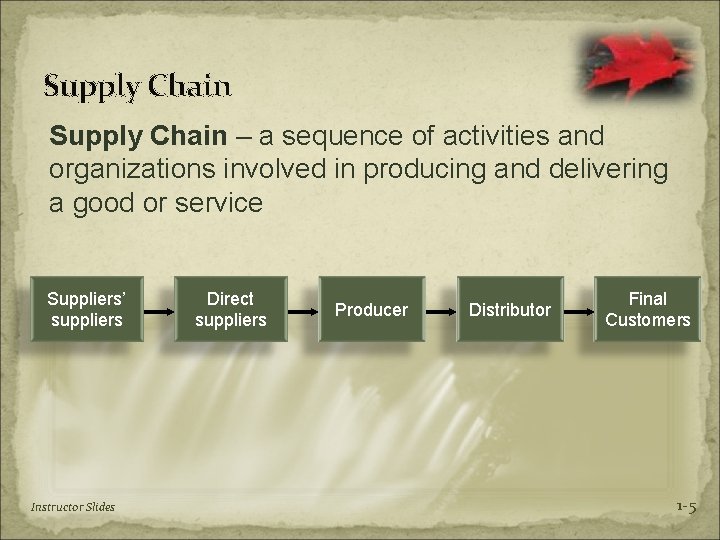
Supply Chain – a sequence of activities and organizations involved in producing and delivering a good or service Suppliers’ suppliers Instructor Slides Direct suppliers Producer Distributor Final Customers 1 -5
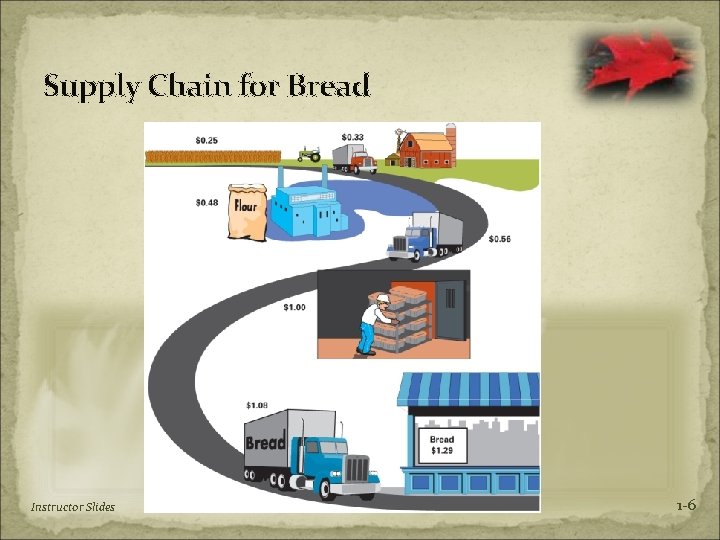
Supply Chain for Bread Instructor Slides 1 -6
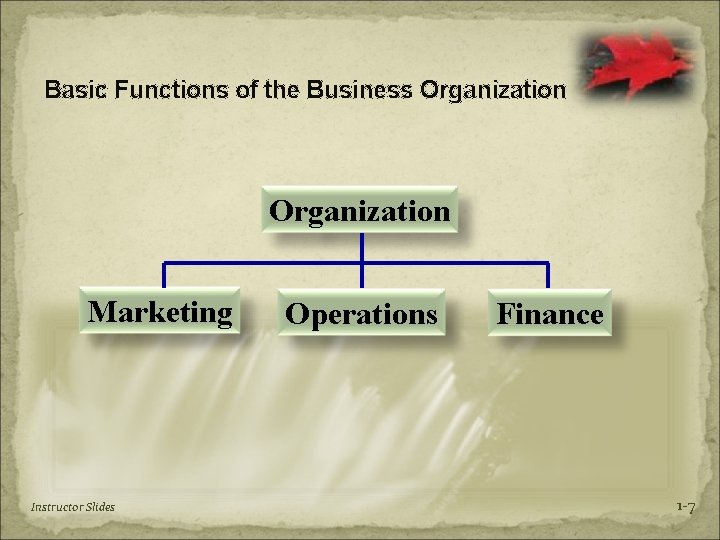
Basic Functions of the Business Organization Marketing Instructor Slides Operations Finance 1 -7
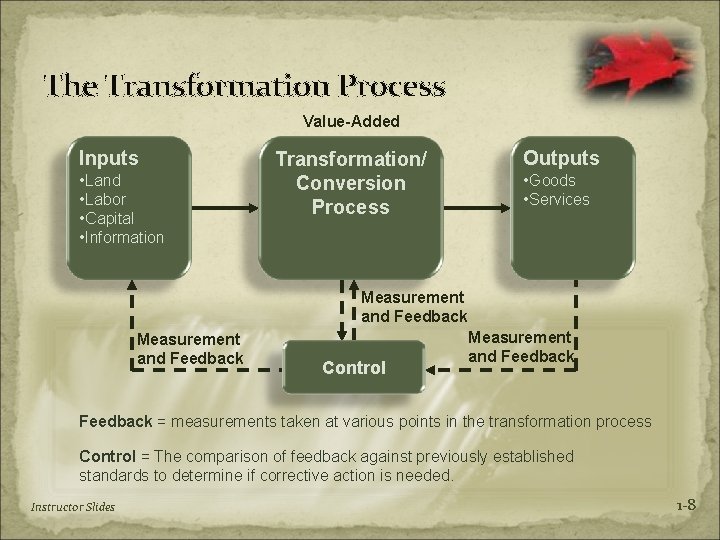
The Transformation Process Value-Added Inputs • Land • Labor • Capital • Information Transformation/ Conversion Process Outputs • Goods • Services Measurement and Feedback Control Measurement and Feedback = measurements taken at various points in the transformation process Control = The comparison of feedback against previously established standards to determine if corrective action is needed. Instructor Slides 1 -8
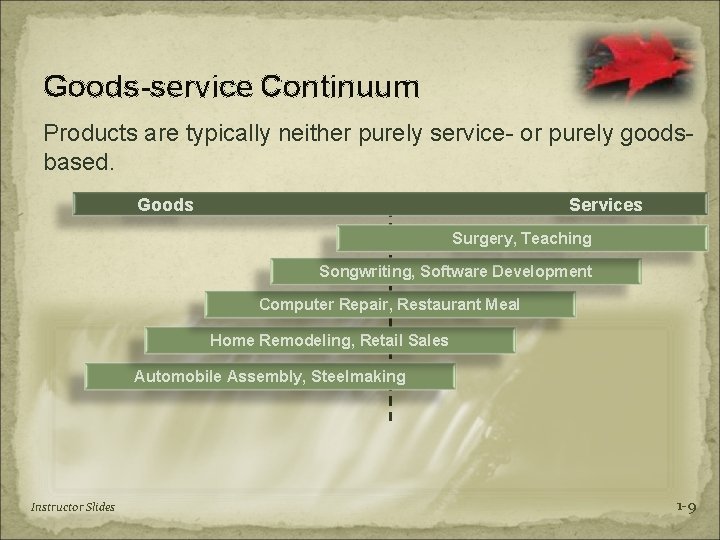
Goods-service Continuum Products are typically neither purely service- or purely goodsbased. Goods Services Surgery, Teaching Songwriting, Software Development Computer Repair, Restaurant Meal Home Remodeling, Retail Sales Automobile Assembly, Steelmaking Instructor Slides 1 -9
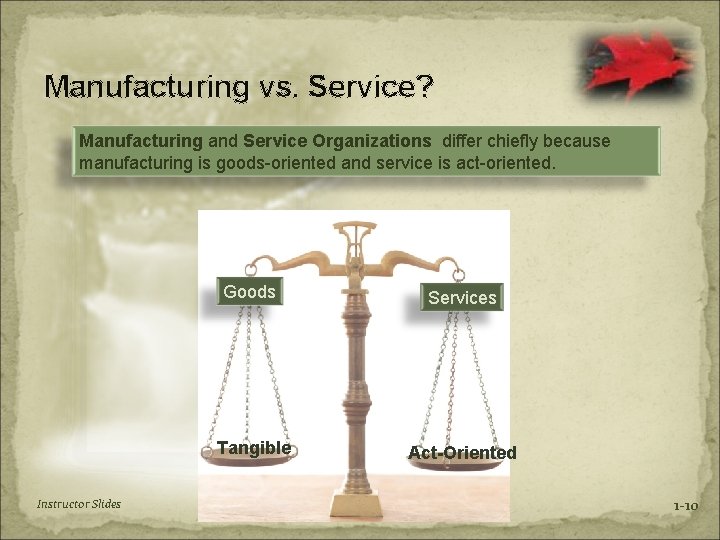
Manufacturing vs. Service? Manufacturing and Service Organizations differ chiefly because manufacturing is goods-oriented and service is act-oriented. Instructor Slides Goods Services Tangible Act-Oriented 1 -10
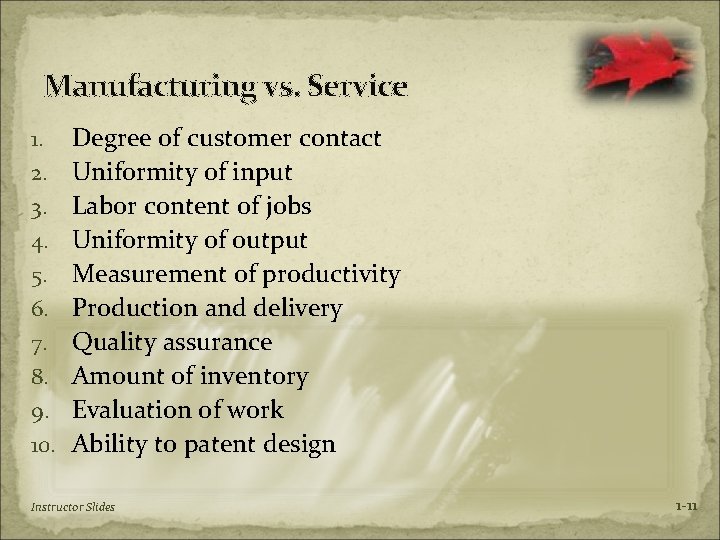
Manufacturing vs. Service 1. 2. 3. 4. 5. 6. 7. 8. 9. 10. Degree of customer contact Uniformity of input Labor content of jobs Uniformity of output Measurement of productivity Production and delivery Quality assurance Amount of inventory Evaluation of work Ability to patent design Instructor Slides 1 -11
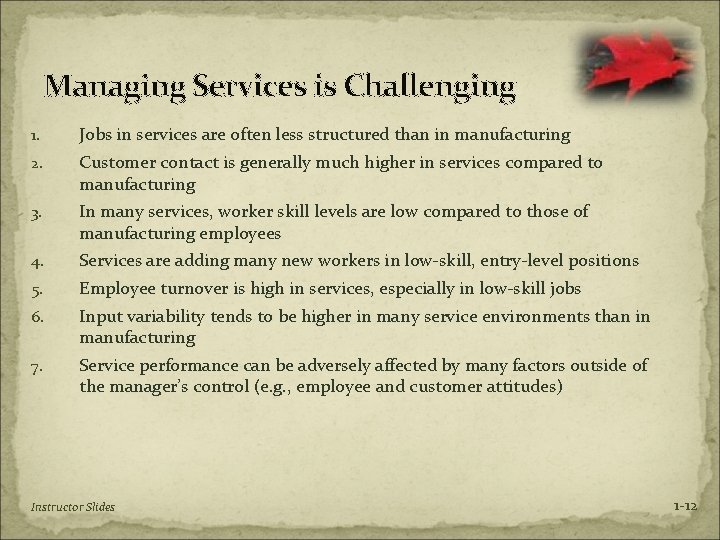
Managing Services is Challenging 1. Jobs in services are often less structured than in manufacturing 2. Customer contact is generally much higher in services compared to manufacturing 3. In many services, worker skill levels are low compared to those of manufacturing employees 4. Services are adding many new workers in low-skill, entry-level positions 5. Employee turnover is high in services, especially in low-skill jobs 6. Input variability tends to be higher in many service environments than in manufacturing 7. Service performance can be adversely affected by many factors outside of the manager’s control (e. g. , employee and customer attitudes) Instructor Slides 1 -12
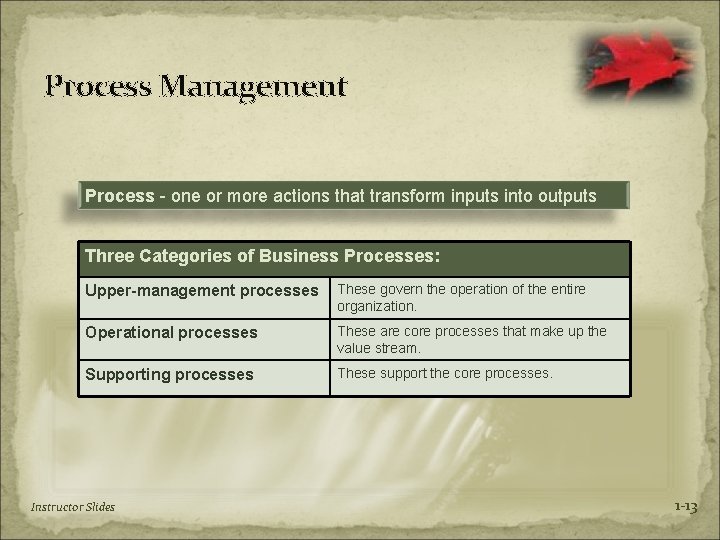
Process Management Process - one or more actions that transform inputs into outputs Three Categories of Business Processes: Upper-management processes These govern the operation of the entire organization. Operational processes These are core processes that make up the value stream. Supporting processes These support the core processes. Instructor Slides 1 -13
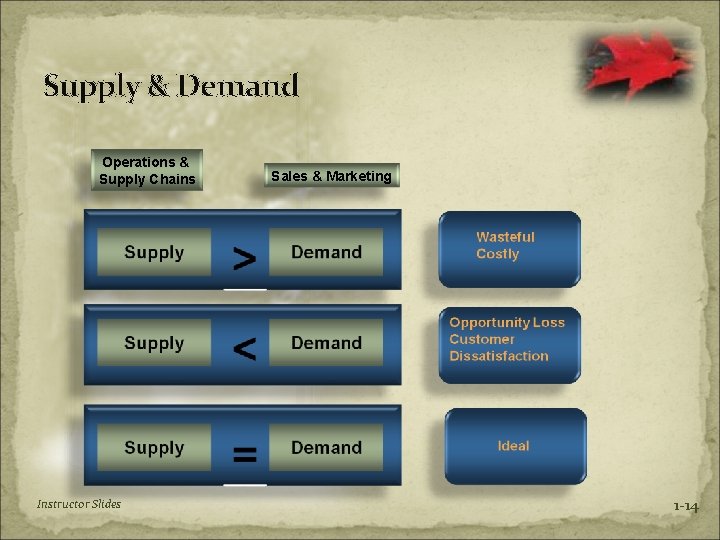
Supply & Demand Operations & Supply Chains Instructor Slides Sales & Marketing 1 -14
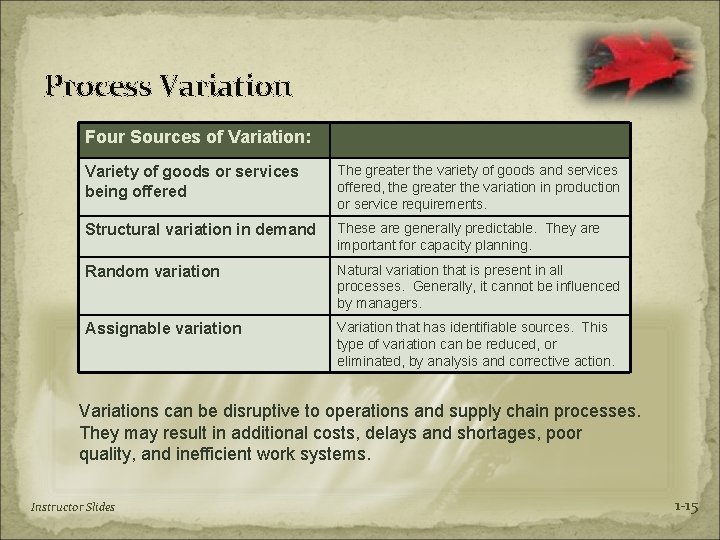
Process Variation Four Sources of Variation: Variety of goods or services being offered The greater the variety of goods and services offered, the greater the variation in production or service requirements. Structural variation in demand These are generally predictable. They are important for capacity planning. Random variation Natural variation that is present in all processes. Generally, it cannot be influenced by managers. Assignable variation Variation that has identifiable sources. This type of variation can be reduced, or eliminated, by analysis and corrective action. Variations can be disruptive to operations and supply chain processes. They may result in additional costs, delays and shortages, poor quality, and inefficient work systems. Instructor Slides 1 -15
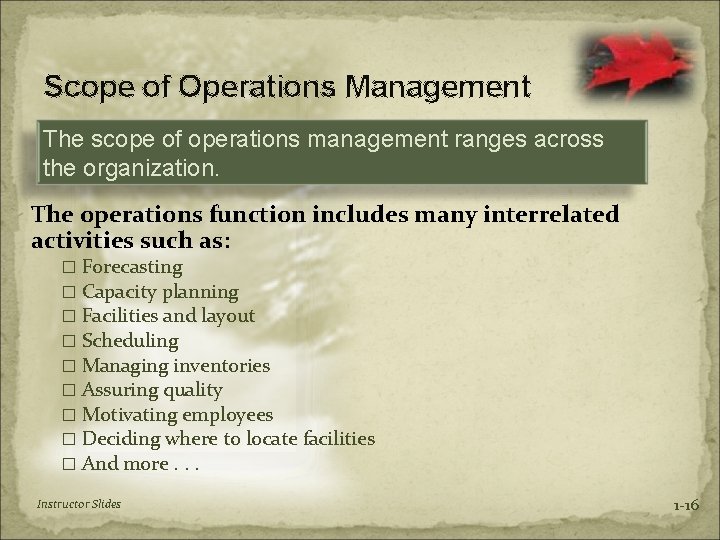
Scope of Operations Management The scope of operations management ranges across the organization. The operations function includes many interrelated activities such as: � Forecasting � Capacity planning � Facilities and layout � Scheduling � Managing inventories � Assuring quality � Motivating employees � Deciding where to locate facilities � And more. . . Instructor Slides 1 -16
Role of the Operations Manager The Operations Function consists of all activities directly related to producing goods or providing services. A primary function of the operations manager is to guide the system by decision making. �System Design Decisions �System Operation Decisions Instructor Slides 1 -17
System Design Decisions • System Design – Capacity – Facility location – Facility layout – Product and service planning – Acquisition and placement of equipment • These are typically strategic decisions that • usually require long-term commitment of resources • determine parameters of system operation Instructor Slides 1 -18
System Operation Decisions • System Operation • These are generally tactical and operational decisions – Management of personnel – Inventory management and control – Scheduling – Project management – Quality assurance • Operations managers spend more time on system operation decision than any other decision area • They still have a vital stake in system design Instructor Slides 1 -19
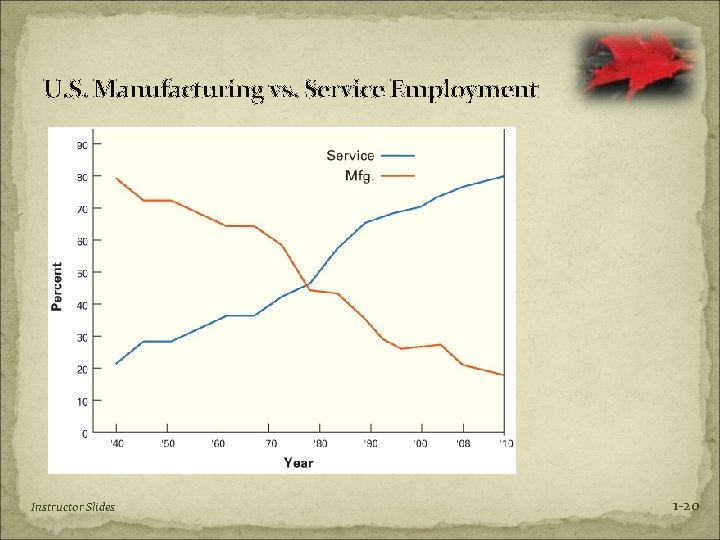
U. S. Manufacturing vs. Service Employment Instructor Slides 1 -20
Why Study OM? �Every aspect of business affects or is affected by operations �Many service jobs are closely related to operations � Financial services � Marketing services � Accounting services � Information services �There is a significant amount of interaction and collaboration amongst the functional areas �It provides an excellent vehicle for understanding the world in which we live Instructor Slides 1 -21
Decision Making � Most operations decisions involve many alternatives that can have quite different impacts on costs or profits � Typical operations decisions include: � What: What resources are needed, and in what amounts? � When: When will each resource be needed? When should the work be scheduled? When should materials and other supplies be ordered? � Where: Where will the work be done? � How: How will he product or service be designed? How will the work be done? How will resources be allocated? � Who: Who will do the work? Instructor Slides 1 -22
General Approach to Decision Making �Modeling is a key tool used by all decision makers � Model - an abstraction of reality; a simplification of something. � Common features of models: �They are simplifications of real-life phenomena �They omit unimportant details of the real-life systems they mimic so that attention can be focused on the most important aspects of the real-life system Instructor Slides 1 -23
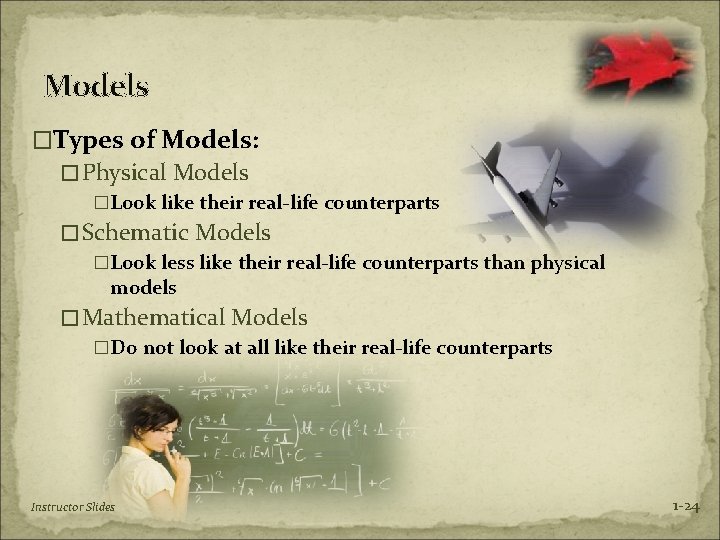
Models �Types of Models: �Physical Models �Look like their real-life counterparts �Schematic Models �Look less like their real-life counterparts than physical models �Mathematical Models �Do not look at all like their real-life counterparts Instructor Slides 1 -24
Benefits of Models 1. Models are generally easier to use and less expensive than dealing with the real system 2. Require users to organize and sometimes quantify information 3. Increase understanding of the problem 4. Enable managers to analyze “What if? ” questions 5. Serve as a consistent tool for evaluation and provide a standardized format for analyzing a problem 6. Enable users to bring the power of mathematics to bear on a problem. Instructor Slides 1 -25
Quantitative Methods �A decision making approach that frequently seeks to obtain a mathematically optimal solution �Linear programming �Queuing techniques �Inventory models �Project models �Forecasting techniques �Statistical models Instructor Slides 1 -26
Systems Approach � System - a set of interrelated parts that must work together � The business organization is a system composed of subsystems �marketing subsystem �operations subsystem �finance subsystem � The systems approach � Emphasizes interrelationships among subsystems � Main theme is that the whole is greater than the sum of its parts � The output and objectives of the organization take precedence over those of any one subsystem Instructor Slides 1 -27
Historical Evolution of OM �Industrial Revolution �Scientific Management �Human Relations Movement �Decision Models and Management Science �Influence of Japanese Manufacturers Instructor Slides 1 -28
Industrial Revolution � Pre-Industrial Revolution � Craft production - System in which highly skilled workers use simple, flexible tools to produce small quantities of customized goods � Some key elements of the industrial revolution � Began in England in the 1770 s � Division of labor - Adam Smith, 1776 � Application of the “rotative” steam engine, 1780 s � Cotton Gin and Interchangeable parts - Eli Whitney, 1792 � Management theory and practice did not advance appreciably during this period Instructor Slides 1 -29
Scientific Management �Movement was led by efficiency engineer, Frederick Winslow Taylor � Believed in a “science of management” based on observation, measurement, analysis and improvement of work methods, and economic incentives � Management is responsible for planning, carefully selecting and training workers, finding the best way to perform each job, achieving cooperate between management and workers, and separating management activities from work activities � Emphasis was on maximizing output Instructor Slides 1 -30
Scientific Management - contributors �Frank Gilbreth - father of motion studies �Henry Gantt - developed the Gantt chart scheduling system and recognized the value of non-monetary rewards for motivating employees �Harrington Emerson - applied Taylor’s ideas to organization structure �Henry Ford - employed scientific management techniques to his factories �Moving assembly line �Mass production Instructor Slides 1 -31
Human Relations Movement �The human relations movement emphasized the importance of the human element in job design � Lillian Gilbreth � Elton Mayo – Hawthorne studies on worker motivation, 1930 � Abraham Maslow – motivation theory, 1940 s; hierarchy of needs, 1954 � Frederick Hertzberg – Two Factor Theory, 1959 � Douglas Mc. Gregor – Theory X and Theory Y, 1960 s � William Ouchi – Theory Z, 1981 Instructor Slides 1 -32
Decision Models & Management Science � F. W. Harris – mathematical model for inventory management, 1915 � Dodge, Romig, and Shewart – statistical procedures for sampling and quality control, 1930 s � Tippett – statistical sampling theory, 1935 � Operations Research (OR) Groups – OR applications in warfare � George Dantzig – linear programming, 1947 Instructor Slides 1 -33
Influence of Japanese Manufacturers �Refined and developed management practices that increased productivity � Credited with fueling the “quality revolution � Just-in-Time production Instructor Slides 1 -34
Key Issues for Operations Managers Today �Economic conditions �Innovating �Quality problems �Risk management �Competing in a global economy Instructor Slides 1 -35
Environmental Concerns �Sustainability �Using resources in ways that do not harm ecological systems that support human existence �Sustainability measures often go beyond traditional environmental and economic measures to include measures that incorporate social criteria in decision making �All areas of business will be affected Product and service design Consumer education programs Disaster preparation and response Supply chain waste management Outsourcing decisions Instructor Slides 1 -36
Ethical Issues in Operations Ethical issues arise in many aspects of operations management: Financial statements Worker safety Product safety Quality The environment The community Hiring and firing workers Closing facilities Workers rights Instructor Slides 1 -37
The Need for Supply Chain Management �In the past, organizations did little to manage the supply chain beyond their own operations and immediate suppliers which led to numerous problems: �Oscillating inventory levels �Inventory stockouts �Late deliveries �Quality problems Instructor Slides 1 -38
Supply Chain Issues 1. 2. 3. 4. 5. 6. 7. 8. The need to improve operations Increasing levels of outsourcing Increasing transportation costs Competitive pressures Increasing globalization Increasing importance of e-business The complexity of supply chains The need to manage inventories Instructor Slides 1 -39
Elements of Supply Chain Management � Customers – what products/services do customers want � Forecasting – predicting timing and volume of customer demand � Design – incorporating customer wants, manufacturability, and time to market � Capacity planning – matching supply and demand � Processing – controlling quality, scheduling work � Inventory – meeting demand requirements while managing costs � Purchasing – evaluating potential suppliers, supporting the needs of operations on purchased goods and services � Suppliers – monitoring supplier quality, on-time delivery, and flexibility; maintaining supplier relations � Location – determining the location of facilities � Logistics – deciding how to best move information and materials Instructor Slides 1 -40