
Chapter 1 Introduction to Multidrug Resistant Organisms TEXAS

- Slides: 20
Chapter 1: Introduction to Multidrug – Resistant Organisms TEXAS DEPARTMENT OF STATE HEALTH SERVICES INFECTIOUS DISEASE CONTROL UNIT STEPHANIE TITUS, MPH JUNE 2014
Outline 1. WHAT ARE MULTIDRUG – RESISTANT ORGANISMS (MDROs)? 2. WHAT IS THE IMPORTANCE OF MDROs IN PUBLIC HEALTH? 3. WHICH MDROs ARE REPORTABLE IN TEXAS? 4. HOW TO REPORT EACH MDRO?
What are Multidrug – Resistant Organisms? �Term used to describe bacteria that have acquired resistance to multiple antibiotic therapies or classes of antibiotics �Found in many healthcare settings: Acute care facilities Long-term care facilities ICUs, NICUs Burn units
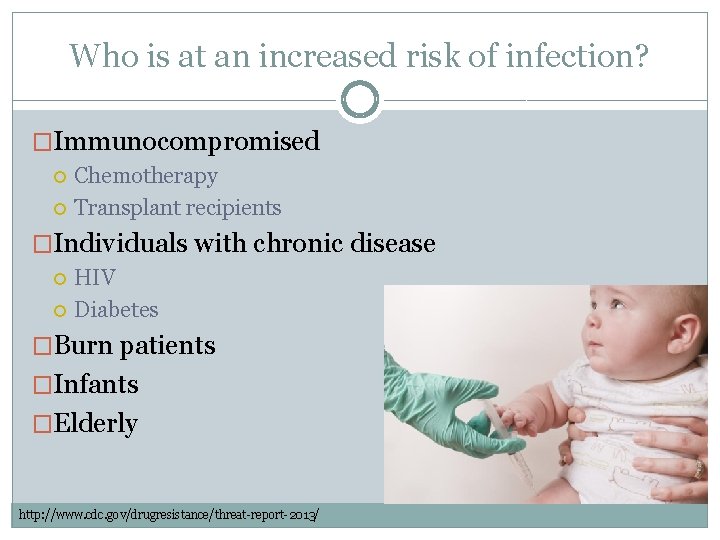
Who is at an increased risk of infection? �Immunocompromised Chemotherapy Transplant recipients �Individuals with chronic disease HIV Diabetes �Burn patients �Infants �Elderly http: //www. cdc. gov/drugresistance/threat-report-2013/
Public Health Importance of MDRO Infections �Inappropriate treatment of MDRO may extend duration of illness �Alternative treatment options may be less effective, more expensive, or more toxic �MDRO infections are associated with longer hospital stays, increased morbidity and mortality �MDROs can move from the healthcare setting into the community http: //www. cdc. gov/drugresistance/threat-report-2013/
Reporting MDROs in Texas 1. WHICH MDROs MUST BE REPORTED 2. HOW TO REPORT MDROs 3. FORMS REQUIRED FOR REPORTING
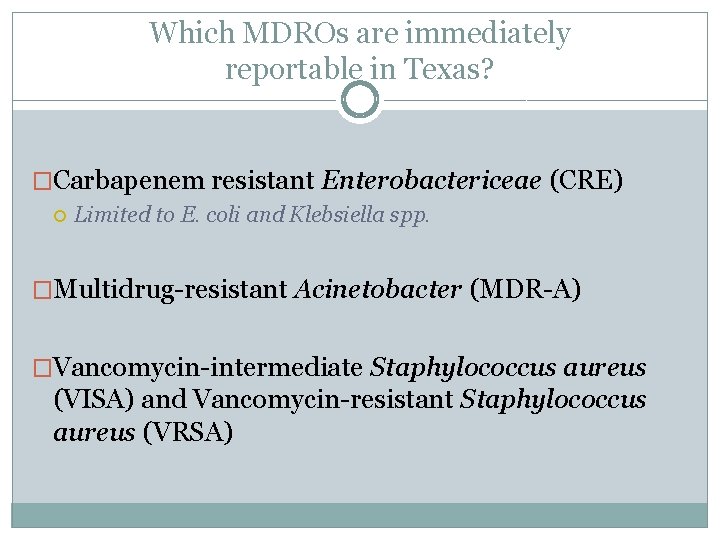
Which MDROs are immediately reportable in Texas? �Carbapenem resistant Enterobactericeae (CRE) Limited to E. coli and Klebsiella spp. �Multidrug-resistant Acinetobacter (MDR-A) �Vancomycin-intermediate Staphylococcus aureus (VISA) and Vancomycin-resistant Staphylococcus aureus (VRSA)
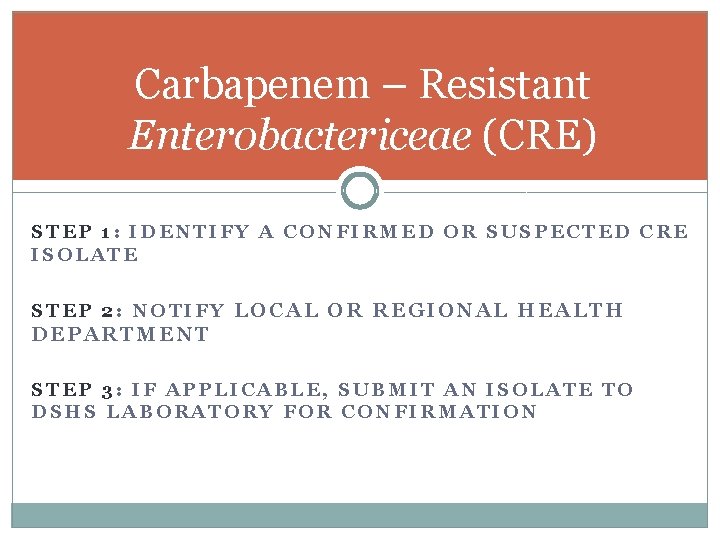
Carbapenem – Resistant Enterobactericeae (CRE) STEP 1: IDENTIFY A CONFIRMED OR SUSPECTED CRE ISOLATE STEP 2: NOTIFY LOCAL OR REGIONAL HEALTH DEPARTMENT STEP 3: IF APPLICABLE, SUBMIT AN ISOLATE TO DSHS LABORATORY FOR CONFIRMATION
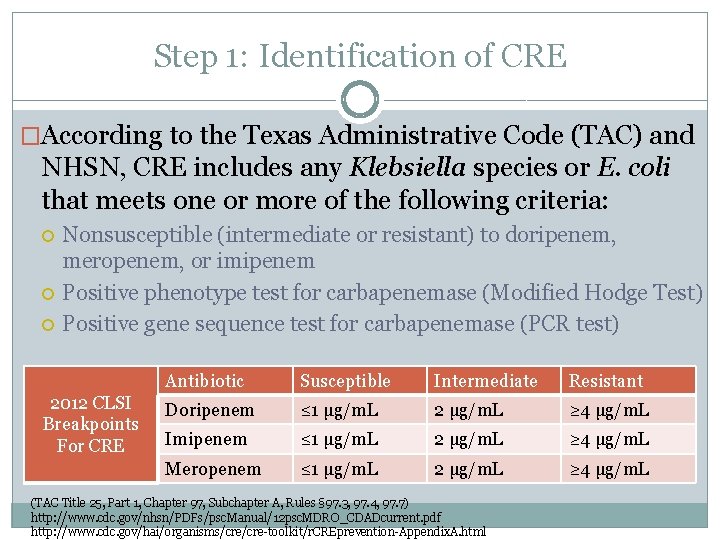
Step 1: Identification of CRE �According to the Texas Administrative Code (TAC) and NHSN, CRE includes any Klebsiella species or E. coli that meets one or more of the following criteria: Nonsusceptible (intermediate or resistant) to doripenem, meropenem, or imipenem Positive phenotype test for carbapenemase (Modified Hodge Test) Positive gene sequence test for carbapenemase (PCR test) 2012 CLSI Breakpoints For CRE Antibiotic Susceptible Intermediate Resistant Doripenem ≤ 1 μg/m. L 2 μg/m. L ≥ 4 μg/m. L Imipenem ≤ 1 μg/m. L 2 μg/m. L ≥ 4 μg/m. L Meropenem ≤ 1 μg/m. L 2 μg/m. L ≥ 4 μg/m. L (TAC Title 25, Part 1, Chapter 97, Subchapter A, Rules § 97. 3, 97. 4, 97. 7) http: //www. cdc. gov/nhsn/PDFs/psc. Manual/12 psc. MDRO_CDADcurrent. pdf http: //www. cdc. gov/hai/organisms/cre-toolkit/r. CREprevention-Appendix. A. html
Step 2: Notify local or regional health department �Notify your local or regional health department immediately by phone. �Provide an Initial Provider Disease Report Form (EPI – 2 form) and supporting documents (H&P, discharge summary) to your local/regional health department. The MDRO form may also be required. Initial Provider Disease Report Form found here Multidrug Resistant Organism Investigation Form found here �Provide a copy of the lab report including: List carbapenems tested Susceptibilities to antibiotics List minimum inhibitory concentrations (MICs) if available �Describe positive phenotype or PCR test (if applicable) http: //www. dshs. state. tx. us/idcu/investigation/forms/ http: //www. dshs. state. tx. us/IDCU/health/antibiotic_resistance/CRE-Investigation. doc
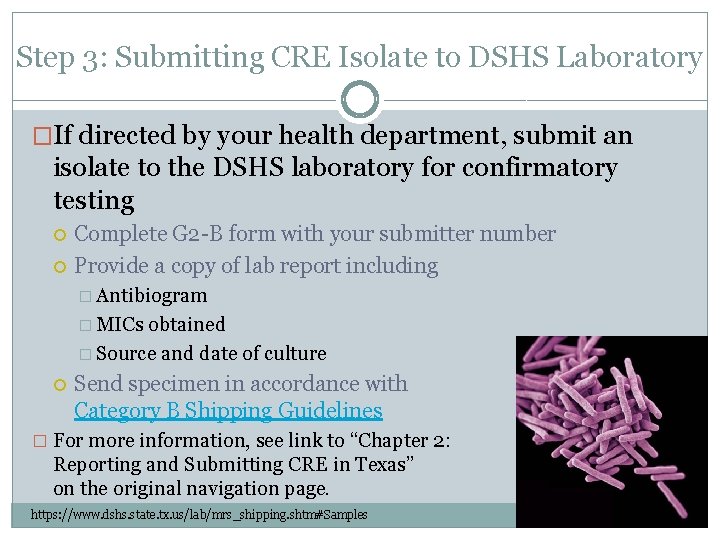
Step 3: Submitting CRE Isolate to DSHS Laboratory �If directed by your health department, submit an isolate to the DSHS laboratory for confirmatory testing Complete G 2 -B form with your submitter number Provide a copy of lab report including � Antibiogram � MICs obtained � Source and date of culture Send specimen in accordance with Category B Shipping Guidelines � For more information, see link to “Chapter 2: Reporting and Submitting CRE in Texas” on the original navigation page. https: //www. dshs. state. tx. us/lab/mrs_shipping. shtm#Samples
Multidrug – Resistant Acinetobacter (MDR-A) STEP 1: IDENTIFY CONFIRMED OR SUSPECTED MDR-A ISOLATE STEP 2: NOTIFY LOCAL OR REGIONAL HEALTH DEPARTMENT STEP 3: IF APPLICABLE, SUBMIT AN ISOLATE TO DSHS LABORATORY FOR CONFIRMATION
Step 1: Notification of MDR-A �According to the TAC and NHSN, to qualify, the Acinetobacter isolate must be nonsusceptible to at least three of the following six antimicrobial classes: Beta-lactam / beta-lactamase inhibitor combination Amino-glycosides Carbapenems Fluoroquinolones Cephalosporins Sulbactam (TAC Title 25, Part 1, Chapter 97, Subchapter A, Rules § 97. 3, 97. 4, 97. 7)
Step 2: Notify local or regional health department �Notify your local or regional health department immediately by phone. �Provide an Initial Provider Disease Report Form (EPI – 2 form) and supporting documents (H&P, discharge summary) to your local/regional health department. The MDRO form may also be required. Initial Provider Disease Report Form found here Multidrug Resistant Organism Investigation Form found here �Include a copy of the lab report Antibiogram Describe susceptibilities to antibiotics tested List minimum inhibitory concentration (MIC) http: //www. dshs. state. tx. us/idcu/investigation/forms/ http: //www. dshs. state. tx. us/IDCU/health/antibiotic_resistance/MDR-A-Investigation. doc
Step 3: Submitting MDR-A Isolate to DSHS Laboratory �Finally, if directed by your health department, submit an isolate to the DSHS laboratory for confirmatory testing Complete G 2 -B form with your submitter number Provide a copy of lab report including � Antibiogram � MICs obtained � Source and date of culture Send specimen in accordance with Category B Shipping Guidelines � For more information, see link to “Chapter 3: Reporting and Submitting MDR-A in Texas” on the original navigation page.
Vancomycin-Intermediate and Vancomycin-Resistant Staphylococcus aureus (VISA/VRSA) STEP 1: IDENTIFY CONFIRMED OR SUSPECTED VISA/VRSA ISOLATE STEP 2: NOTIFY LOCAL OR REGIONAL HEALTH DEPARTMENT STEP 3: SUBMIT AN ISOLATE TO DSHS LABORATORY FOR CONFIRMATION
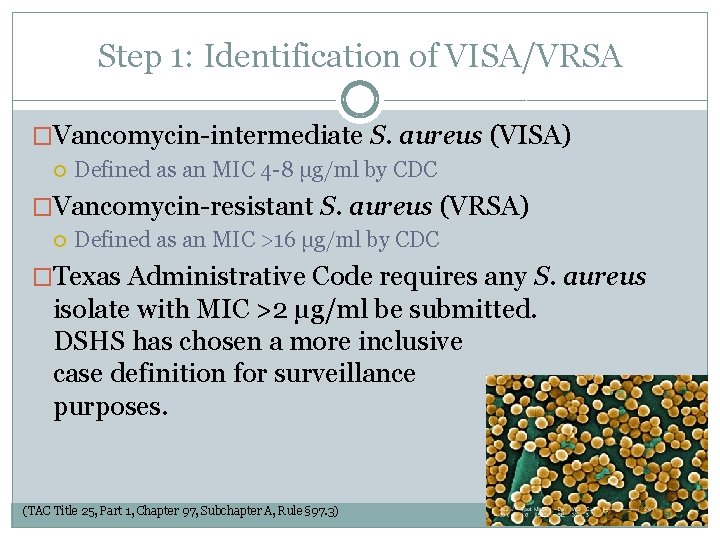
Step 1: Identification of VISA/VRSA �Vancomycin-intermediate S. aureus (VISA) Defined as an MIC 4 -8 μg/ml by CDC �Vancomycin-resistant S. aureus (VRSA) Defined as an MIC >16 μg/ml by CDC �Texas Administrative Code requires any S. aureus isolate with MIC >2 μg/ml be submitted. DSHS has chosen a more inclusive case definition for surveillance purposes. (TAC Title 25, Part 1, Chapter 97, Subchapter A, Rule § 97. 3)
Step 2: Notify local or regional health department �Notify your local or regional health department immediately by phone �Practitioners must complete two forms and submit them to your health department 1. VISA/VRSA Case Report Form � Form is found at the bottom of linked webpage 2. Initial Provider Disease Reporting Form (EPI-2) �Include a copy of the lab report Describe susceptibility to vancomycin List minimum inhibitory concentration (MIC) http: //www. dshs. state. tx. us/idcu/investigation/forms/
Step 3: Submitting a VISA/VRSA Isolate to DSHS Laboratory �Finally, you must submit a lab isolate to the DSHS laboratory for confirmatory testing Complete G 2 -B form with your submitter number Provide a copy of lab report including � Antibiogram � MICs obtained � Source and date of culture Send specimen in accordance with Category B Shipping Guidelines � For more information, see link to “Chapter 4: Reporting and Submitting VISA/VRSA in Texas” on the original navigation page. https: //www. dshs. state. tx. us/lab/mrs_shipping. shtm#Samples
Summary �MDROs are organisms that do not respond to multiple antibiotic therapies. They pose an formidable threat to public health in Texas. �CRE, MDR-A, and VISA/VRSA are the immediately reportable MDRO conditions in Texas. �Practitioners should notify their local or regional health departments and submit an isolate to the DSHS Laboratory as indicated.