
Chapter 1 Introduction to Lifespan Development Life Span
- Slides: 50
Chapter 1 Introduction to Life-span Development
Life Span versus Life Expectancy § Human Life Span § Based on ___________-- 122 years § § Life Expectancy § The ______of years that a person born in a particular year can expect to live
§ Development § the pattern of movement or change that begins at conception and continues through the human life span § each of us develops § partly like all other individuals § partly like some other individuals § partly like no other individuals
Contemporary Concerns § Health and Well-Being § Parenting and Education § Sociocultural Contexts and Diversity § Ethnicity, culture and changing demographics in society § socioeconomic status (SES) § Negative effects of poverty § gender
4 Major Issues in Developmental Psychology
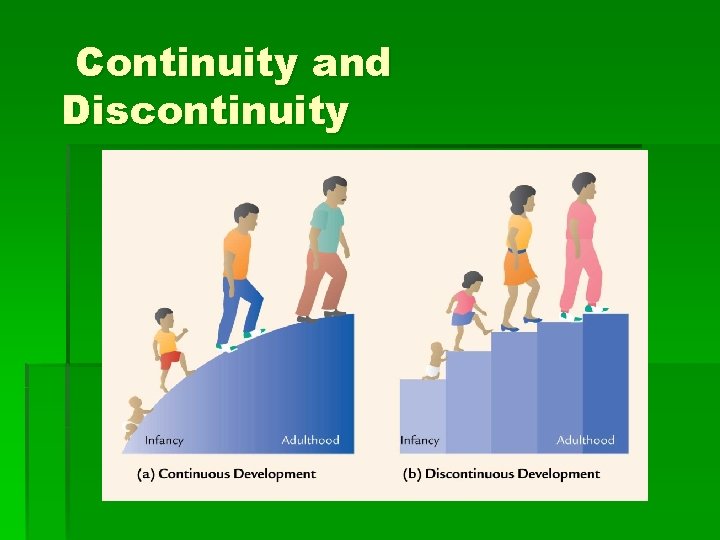
Continuity and Discontinuity
Continuity and Discontinuity § Continuity – § Discontinuity -§ Is change in development gradual or abrupt? § Are some aspects continuous and others discontinuous?
Nature-Nurture Issue § Nature refers to an organism’s _______________ § Nurture to its ______ § Early on psychologists asked which has the greatest influence, and now ask how do the two interact?
One course of development or many? Universal or unique? § One course would suggest all humans develop in the same way (same processes or pattern) § this does not mean we are identical § Many would emphasize that differences in experience could result in different paths of development – culture, gender, etc. § In what ways is human development universal? How do different environments and experiences result in differing paths of development
Stability-Change Issue § Stability is the degree to which we remain high or low in characteristics throughout life § Can result from ____or_____ § Plasticity is the tendency to ____or develop different characteristics § To what degree do early traits and characteristics persist through life, or how much do they change, and why?
§ Most life-span developmentalists acknowledge that development is not all nature or all nurture, not all stability or all change, and not all continuity or all discontinuity § Nature and nurture, stability and change, continuity and discontinuity characterize development throughout the human life span resulting in multiple possible paths though development though some aspects are more universal (Gottlieb, 2007; Rutter, 2007)
Characteristics of the Life. Span Perspective § Life-span perspective views development as § Lifelong § ______ § Multidirectional § Plastic § ______ § Contextual (Baltes, 1987, 2003; Baltes, Lindenberger, & Staudinger, 2006)
The Nature Of Development § Biological processes produce changes in an individual’s physical nature § Cognitive processes refer to changes in the individual’s thought, intelligence, and language § Socioemotional processes involve changes in the individual’s relationships with other people, changes in emotions, and changes in personality
Biological, Cognitive, and Socioemotional Processes § Inextricably intertwined § Multidirectional § Influence developmental periods § variations in the capabilities of individuals of the same age § age-related changes
Periods of Development § Developmental period refers to a time frame in a person’s life that is characterized by certain features § prenatal period -- conception to birth § infancy -- birth to 18 or 24 months § early childhood -- end of infancy to age 5 or 6 § middle and late childhood -- 6 to 11 years of age
§ Periods of development, continued § adolescence -- transition from childhood to early adulthood, approximately 10 to 12 to 18 to 22 years of age § early adulthood -- late teens or early twenties through the thirties § middle adulthood -- approximately 40 to about 60 years of age § late adulthood -- sixties or seventies and lasts until death
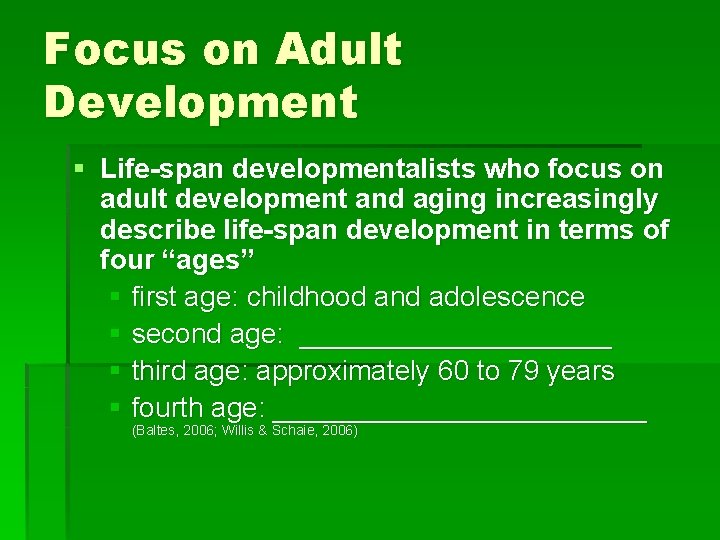
Focus on Adult Development § Life-span developmentalists who focus on adult development and aging increasingly describe life-span development in terms of four “ages” § first age: childhood and adolescence § second age: __________ § third age: approximately 60 to 79 years § fourth age: ____________ (Baltes, 2006; Willis & Schaie, 2006)
Theories of Development
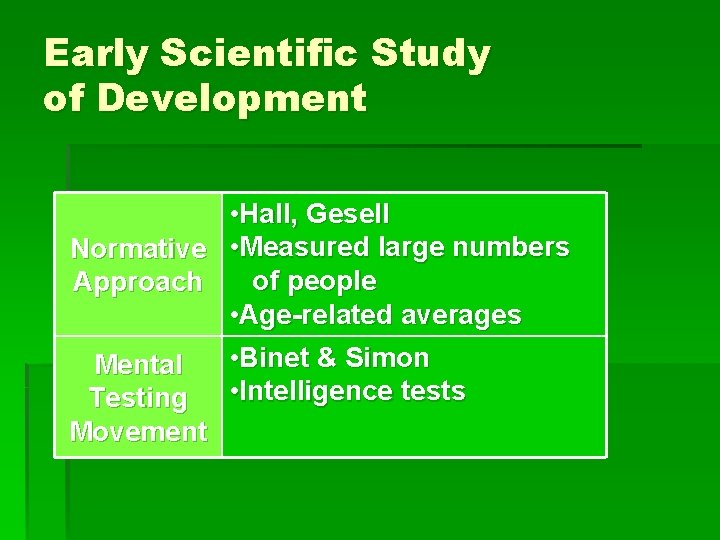
Early Scientific Study of Development • Hall, Gesell Normative • Measured large numbers of people Approach • Age-related averages • Binet & Simon Mental Testing • Intelligence tests Movement
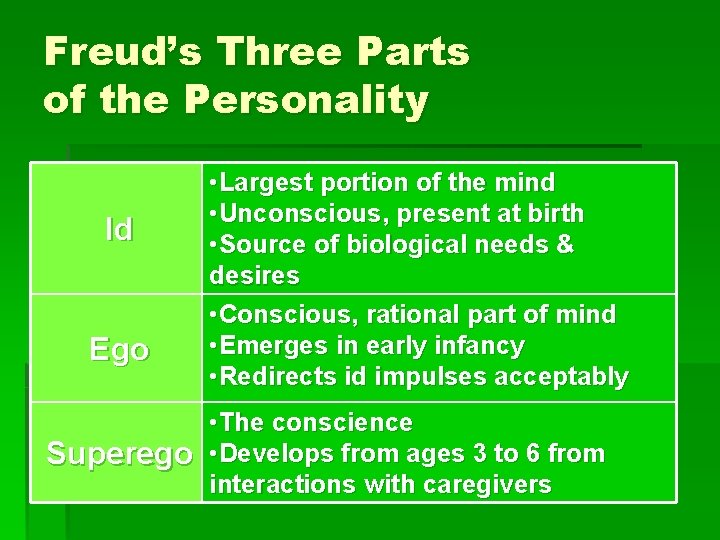
Freud’s Three Parts of the Personality Id Ego Superego • Largest portion of the mind • Unconscious, present at birth • Source of biological needs & desires • Conscious, rational part of mind • Emerges in early infancy • Redirects id impulses acceptably • The conscience • Develops from ages 3 to 6 from interactions with caregivers
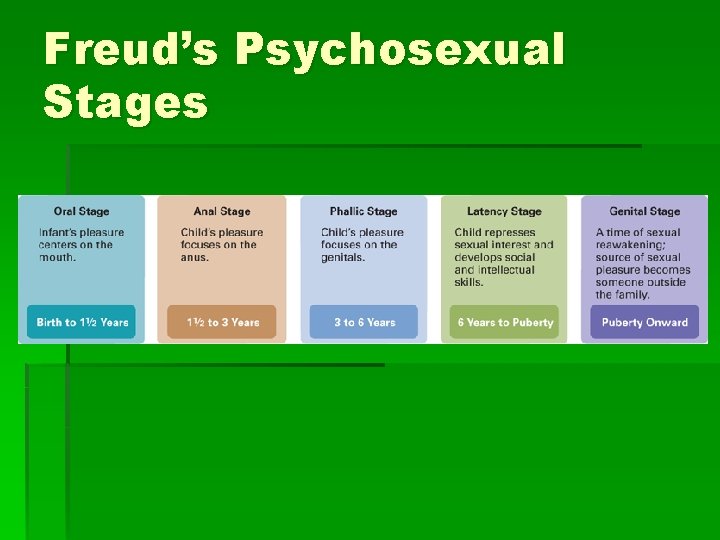
Freud’s Psychosexual Stages
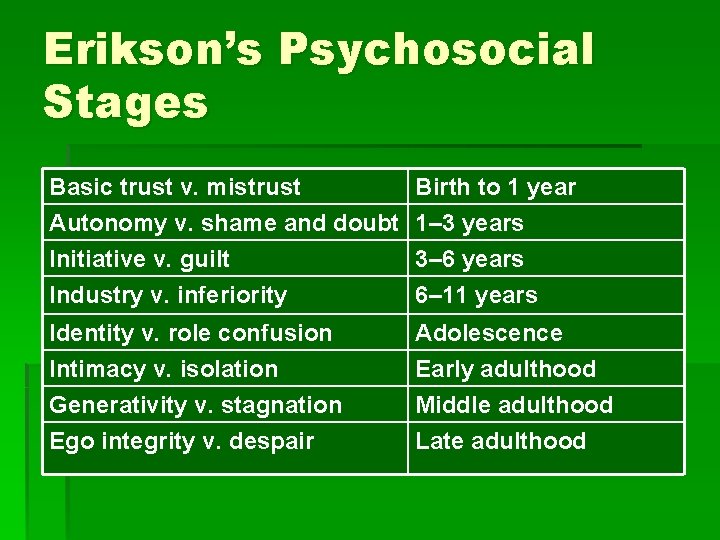
Erikson’s Psychosocial Stages Basic trust v. mistrust Autonomy v. shame and doubt Initiative v. guilt Industry v. inferiority Birth to 1 year 1– 3 years 3– 6 years 6– 11 years Identity v. role confusion Intimacy v. isolation Generativity v. stagnation Ego integrity v. despair Adolescence Early adulthood Middle adulthood Late adulthood
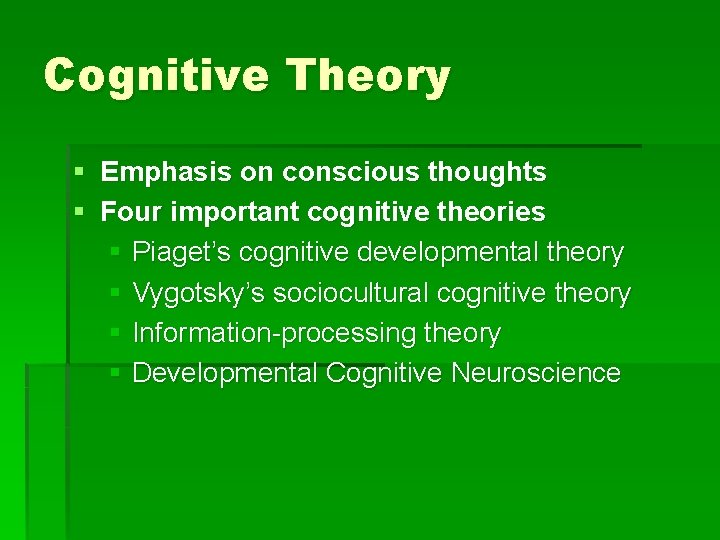
Cognitive Theory § Emphasis on conscious thoughts § Four important cognitive theories § Piaget’s cognitive developmental theory § Vygotsky’s sociocultural cognitive theory § Information-processing theory § Developmental Cognitive Neuroscience
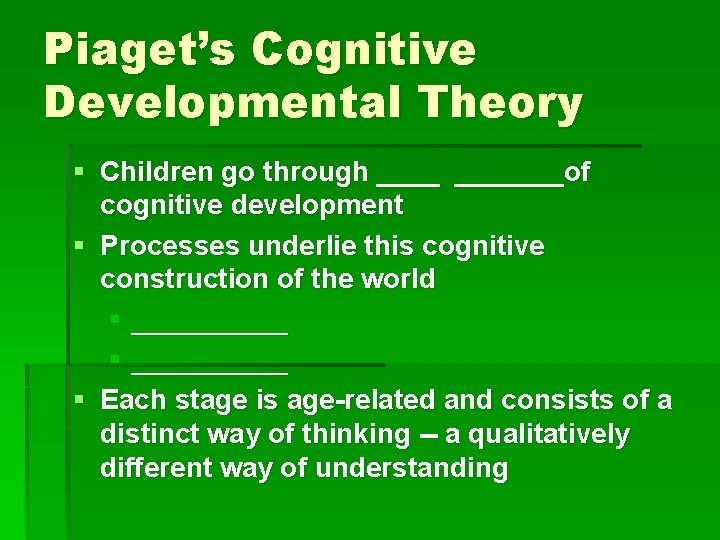
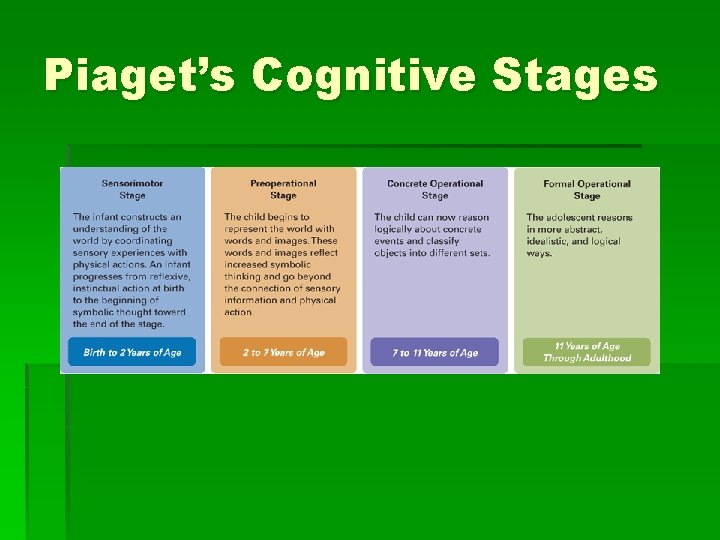
Piaget’s Cognitive Developmental Theory § Children go through _______of cognitive development § Processes underlie this cognitive construction of the world § __________ § Each stage is age-related and consists of a distinct way of thinking -- a qualitatively different way of understanding
Piaget’s Cognitive Stages
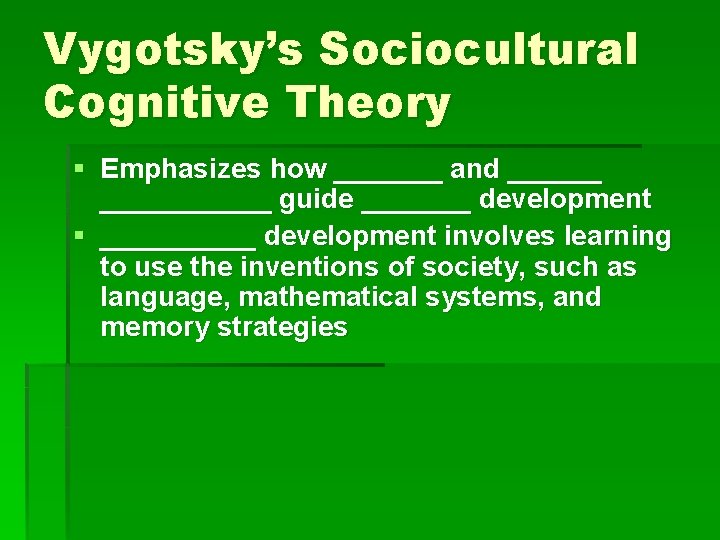
Vygotsky’s Sociocultural Cognitive Theory § Emphasizes how _______ and ___________ guide _______ development § _____ development involves learning to use the inventions of society, such as language, mathematical systems, and memory strategies
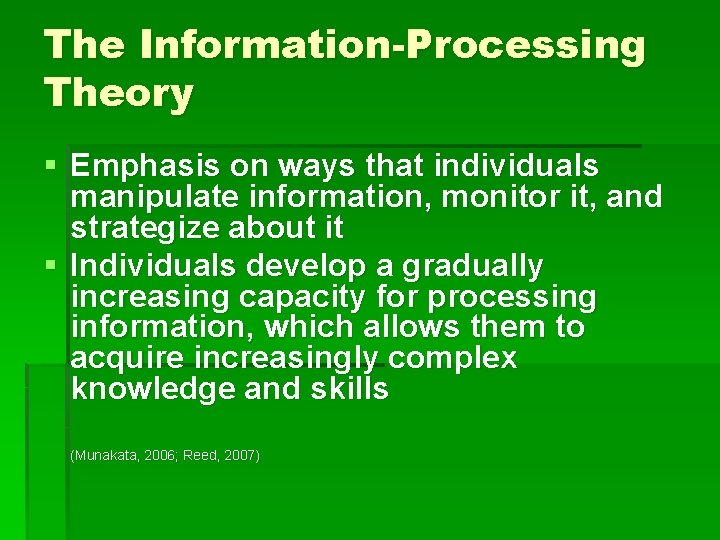
The Information-Processing Theory § Emphasis on ways that individuals manipulate information, monitor it, and strategize about it § Individuals develop a gradually increasing capacity for processing information, which allows them to acquire increasingly complex knowledge and skills (Munakata, 2006; Reed, 2007)
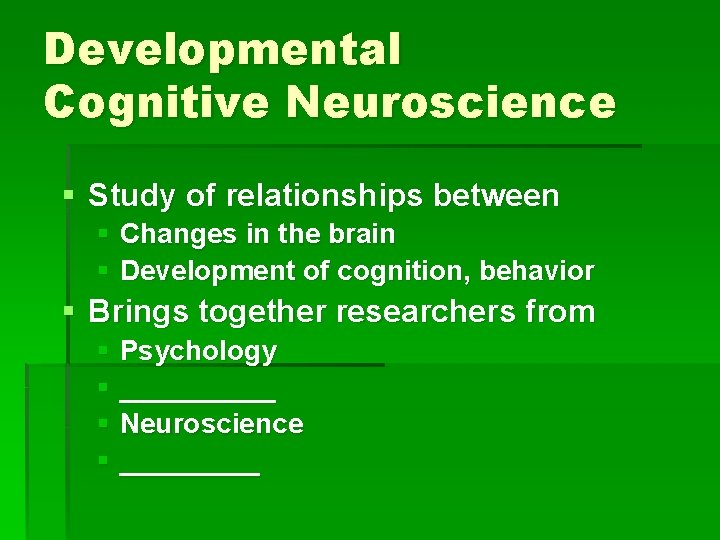
Developmental Cognitive Neuroscience § Study of relationships between § Changes in the brain § Development of cognition, behavior § Brings together researchers from § Psychology § _____ § Neuroscience § _____
Behavioral and Social Cognitive Theories § Behaviorism -- we can study scientifically only what can be directly observed and measured § Two versions of behaviorism § B. F. Skinner’s operant conditioning § Albert Bandura’s social cognitive theory
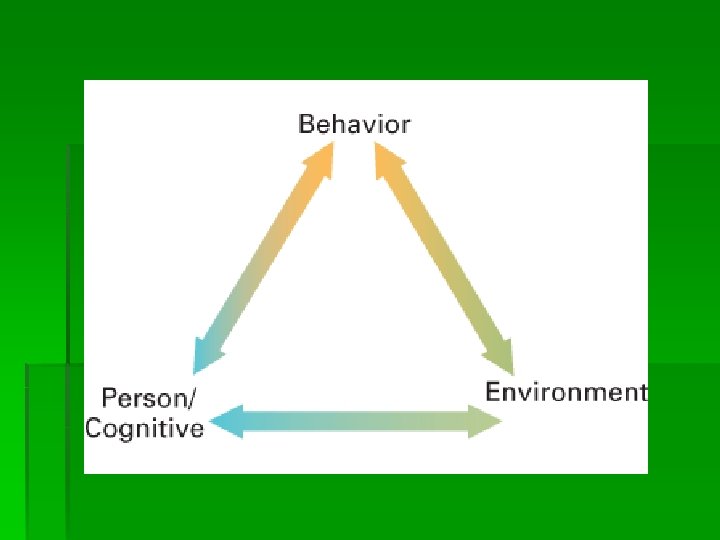
Behavioral and Social Cognitive Theories § Skinner’s Operant Conditioning § consequences of a behavior produce changes in _____________ § rewards and punishments shape development § Bandura’s Social Cognitive Theory § holds that behavior, environment, and cognition are the key factors in development § observational learning (also called imitation or modeling)
Ethological Theory § Ethology stresses § Behavior is strongly influenced by biology § It is tied to evolution § Characterized by critical or sensitive periods § An individual is biologically prepared to acquire adaptive behavior or particularly sensitive to stimuli during a limited time period but need supportive environment or stimulation to develop
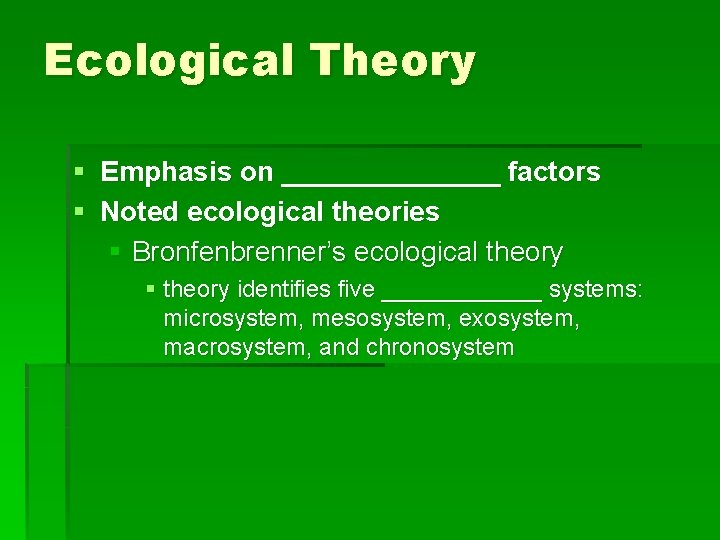
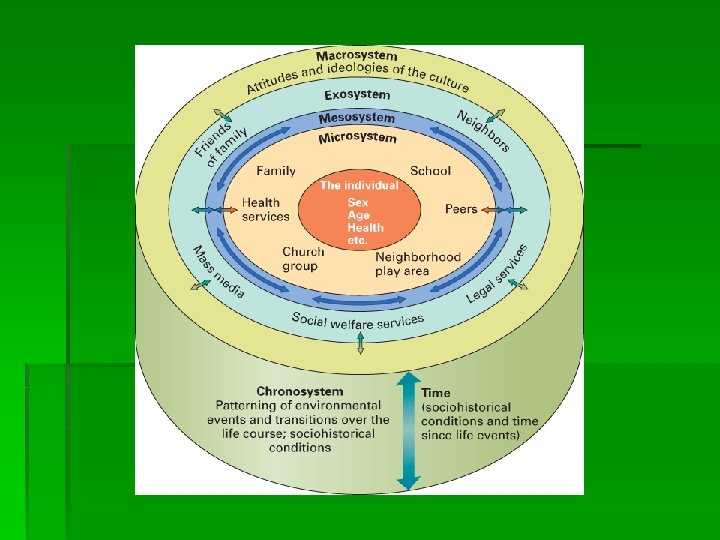
Ecological Theory § Emphasis on _______ factors § Noted ecological theories § Bronfenbrenner’s ecological theory § theory identifies five ______ systems: microsystem, mesosystem, exosystem, macrosystem, and chronosystem
Eclectic Theoretical Orientation § No single theory described in this chapter can explain entirely the rich complexity of life-span development, but each has contributed to our understanding of development
Research
Research in Life-Span Development § Application of scientific method § Methods for collecting data § observation § laboratory observation § naturalistic observation § asking questions -- survey and interview § standardized testing § case study § physiological measures
Research Designs § __________-- observe and record behavior § _______ research -- describe the strength of the relationship between two or more events or characteristics § ______ -- regulated procedure in which one or more factors are manipulated while all other factors are held constant
Critical Terms and Concepts Relating to Research
Variables § Experiments include two types of changeable factors § independent variable § manipulated, influential, experimental factor § a ______ § dependent variable § can change in response to changes in the independent variable § ________
Experimental and Control Groups § Experimental group is a group whose experience is manipulated § A control group is a comparison group § As much like the experimental group as possible, which is treated in every way like the experimental group except for the manipulated factor (independent variable) § Control group serves as a baseline against which the effects of the manipulated condition can be compared
Modified Experiments Field Experiment § Capitalize on opportunities for random assignment in natural settings Natural or Quasi - Experiment § Compare differences in treatment that already exist § Match groups as much as possible
Ethnography § Descriptive, qualitative technique § Goal is to understand a ______ or social group § Participant Observation § Researcher lives in community for months or years
Developmental vs. cohort effects § Developmental effects – differences to to developmental processes § Cohort effects – differences due to ________, or other factors unique to the time or group
Methods of Researching Developmental Change
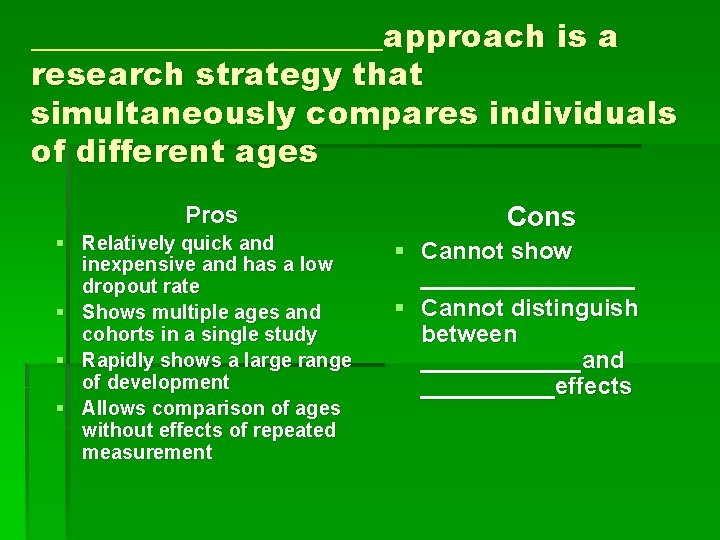
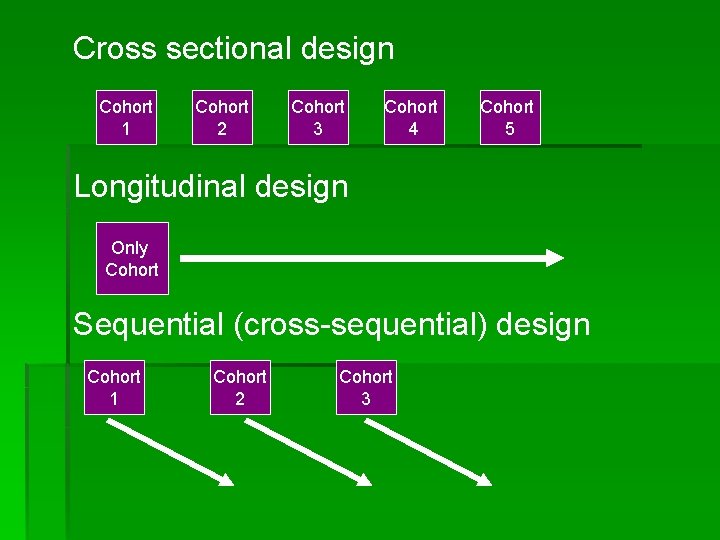
___________approach is a research strategy that simultaneously compares individuals of different ages Pros § Relatively quick and inexpensive and has a low dropout rate § Shows multiple ages and cohorts in a single study § Rapidly shows a large range of development § Allows comparison of ages without effects of repeated measurement Cons § Cannot show ________ § Cannot distinguish between ______and _____effects
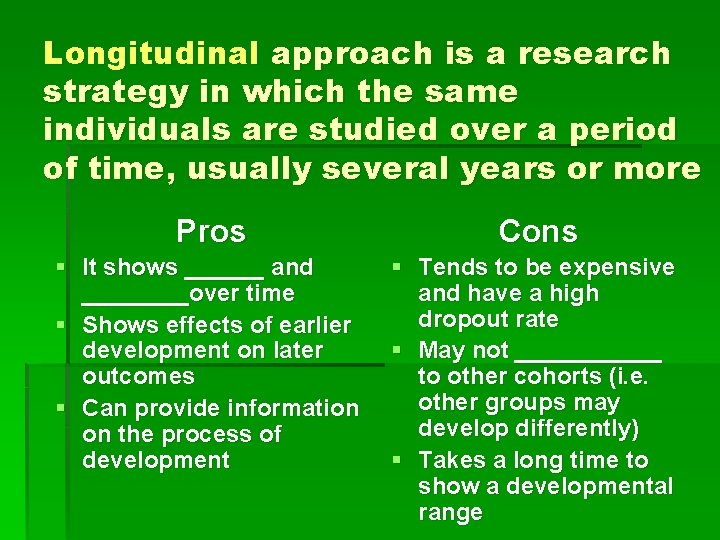
Longitudinal approach is a research strategy in which the same individuals are studied over a period of time, usually several years or more Pros Cons § It shows ______ and ____over time § Shows effects of earlier development on later outcomes § Can provide information on the process of development § Tends to be expensive and have a high dropout rate § May not ______ to other cohorts (i. e. other groups may develop differently) § Takes a long time to show a developmental range
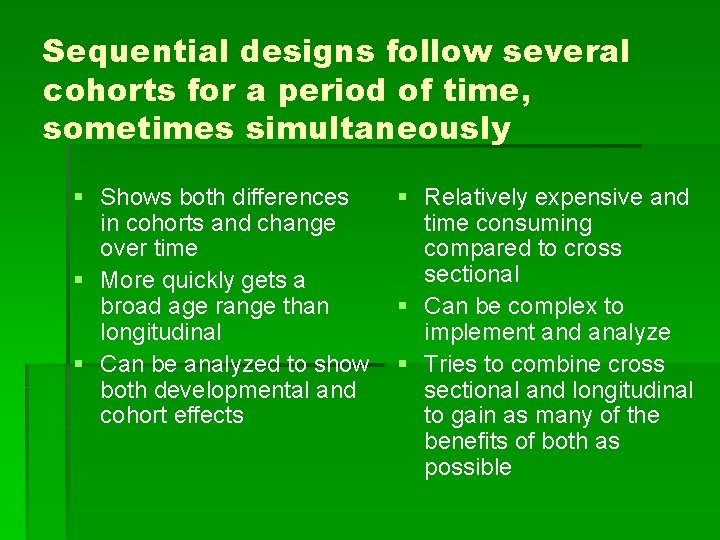
Sequential designs follow several cohorts for a period of time, sometimes simultaneously § Shows both differences in cohorts and change over time § More quickly gets a broad age range than longitudinal § Can be analyzed to show both developmental and cohort effects § Relatively expensive and time consuming compared to cross sectional § Can be complex to implement and analyze § Tries to combine cross sectional and longitudinal to gain as many of the benefits of both as possible
Cross sectional design Cohort 1 Cohort 2 Cohort 3 Cohort 4 Cohort 5 Longitudinal design Only Cohort Sequential (cross-sequential) design Cohort 1 Cohort 2 Cohort 3
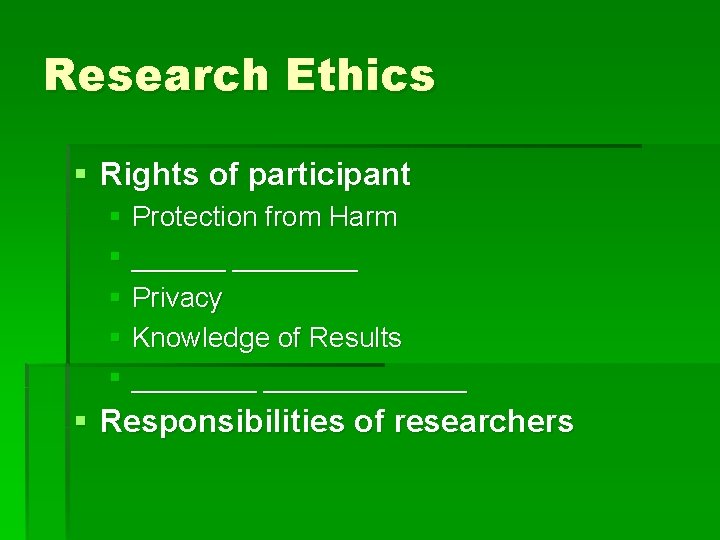
Research Ethics § Rights of participant § Protection from Harm § ________ § Privacy § Knowledge of Results § _____________ § Responsibilities of researchers