
Chapter 1 Introduction to Java 1 Why Java
- Slides: 34
Chapter 1 Introduction to Java 1
Why Java? The answer is that Java enables users to develop and deploy applications on the Internet for servers, desktop computers, and small hand-held devices. The future of computing is being profoundly influenced by the Internet, and Java promises to remain a big part of that future. Java is the Internet programming language. FJava is a general purpose programming language. FJava is the Internet programming language. 2
Java, Web, and Beyond F Java can be used to develop Web applications. F Java Applets F Java Servlets and Java. Server Pages F Java can also be used to develop applications for hand-held devices such as Palm and cell phones 3
Java’s History F James Gosling and Sun Microsystems F Oak F Java, May 20, 1995, Sun World F Hot. Java – The first Java-enabled Web browser F Early History Website: http: //java. sun. com/features/1998/05/birthday. html 4
Optional Characteristics of Java Is Simple F Java Is Object-Oriented F Java Is Distributed F Java Is Interpreted F Java Is Robust F Java Is Secure F Java Is Architecture-Neutral F Java Is Portable F Java's Performance F Java Is Multithreaded F Java Is Dynamic F www. cs. armstrong. edu/liang/intro 6 e/Java. Characteristics. pdf 5
Optional F F F Characteristics of Java is partially modeled on C++, but greatly Java Is Simple simplified and improved. Some people refer to Java Is Object-Oriented Java as "C++--" because it is like C++ but with more functionality and fewer negative Java Is Distributed aspects. Java Is Interpreted Java Is Robust Java Is Secure Java Is Architecture-Neutral Java Is Portable Java's Performance Java Is Multithreaded Java Is Dynamic 6
Optional F F F Characteristics of Java Is Simple Java Is Object-Oriented Java Is Distributed Java Is Interpreted Java Is Robust Java Is Secure Java Is Architecture-Neutral Java Is Portable Java's Performance Java Is Multithreaded Java Is Dynamic Java is inherently object-oriented. Although many object-oriented languages began strictly as procedural languages, Java was designed from the start to be object-oriented. Object-oriented programming (OOP) is a popular programming approach that is replacing traditional procedural programming techniques. One of the central issues in software development is how to reuse code. Objectoriented programming provides great flexibility, modularity, clarity, and reusability through encapsulation, inheritance, and polymorphism. 7
Optional F F F Characteristics of Java Is Simple Java Is Object-Oriented Java Is Distributed Java Is Interpreted Java Is Robust Java Is Secure Java Is Architecture-Neutral Java Is Portable Java's Performance Java Is Multithreaded Java Is Dynamic Distributed computing involves several computers working together on a network. Java is designed to make distributed computing (e. g. Web Services) easy. Since networking capability is inherently integrated into Java, writing network programs is like sending and receiving data to and from a file. 8
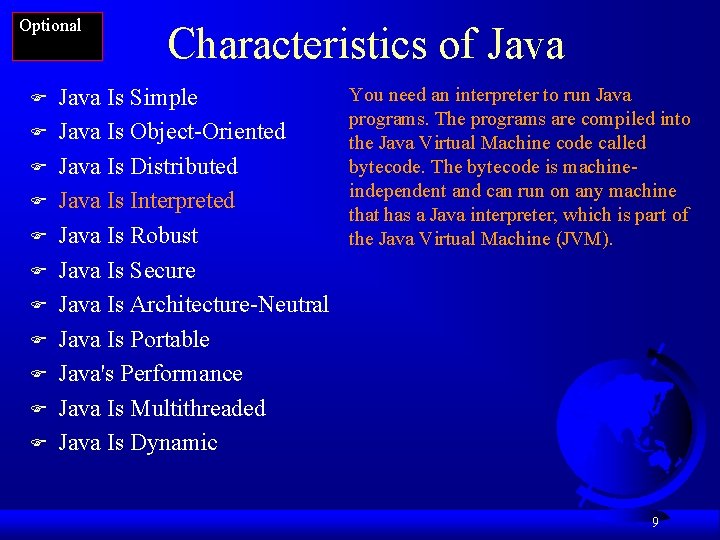
Optional F F F Characteristics of Java Is Simple Java Is Object-Oriented Java Is Distributed Java Is Interpreted Java Is Robust Java Is Secure Java Is Architecture-Neutral Java Is Portable Java's Performance Java Is Multithreaded Java Is Dynamic You need an interpreter to run Java programs. The programs are compiled into the Java Virtual Machine code called bytecode. The bytecode is machineindependent and can run on any machine that has a Java interpreter, which is part of the Java Virtual Machine (JVM). 9
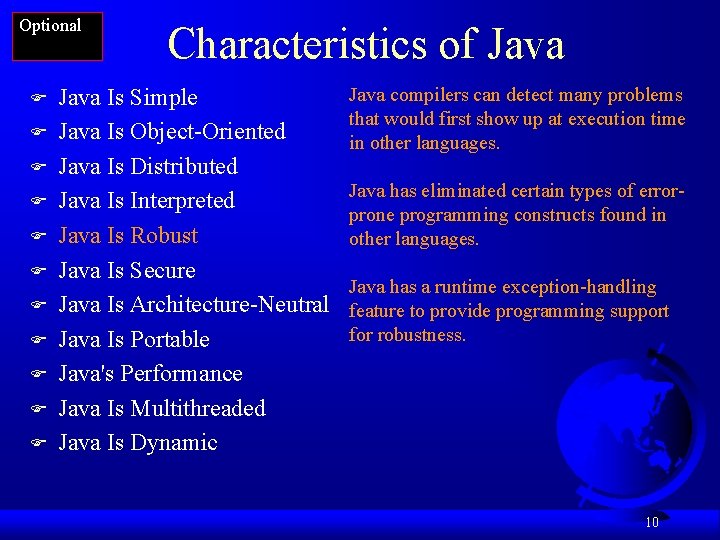
Optional F F F Characteristics of Java Is Simple Java Is Object-Oriented Java Is Distributed Java Is Interpreted Java Is Robust Java Is Secure Java Is Architecture-Neutral Java Is Portable Java's Performance Java Is Multithreaded Java Is Dynamic Java compilers can detect many problems that would first show up at execution time in other languages. Java has eliminated certain types of errorprone programming constructs found in other languages. Java has a runtime exception-handling feature to provide programming support for robustness. 10
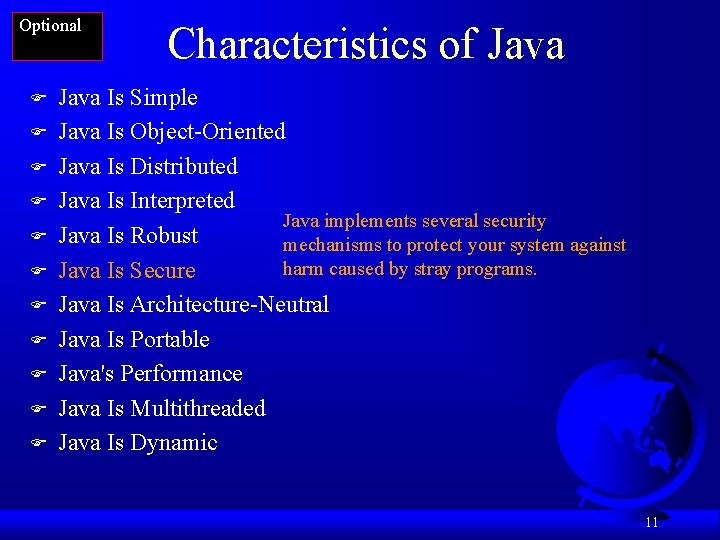
Optional F F F Characteristics of Java Is Simple Java Is Object-Oriented Java Is Distributed Java Is Interpreted Java implements several security Java Is Robust mechanisms to protect your system against harm caused by stray programs. Java Is Secure Java Is Architecture-Neutral Java Is Portable Java's Performance Java Is Multithreaded Java Is Dynamic 11
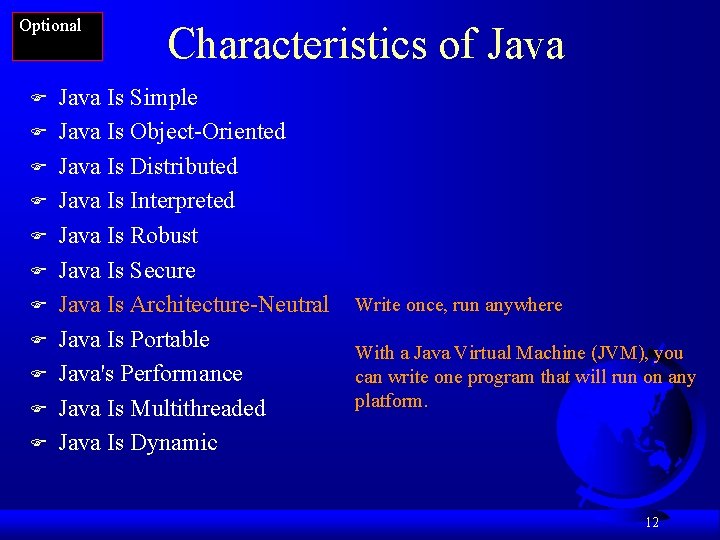
Optional F F F Characteristics of Java Is Simple Java Is Object-Oriented Java Is Distributed Java Is Interpreted Java Is Robust Java Is Secure Java Is Architecture-Neutral Java Is Portable Java's Performance Java Is Multithreaded Java Is Dynamic Write once, run anywhere With a Java Virtual Machine (JVM), you can write one program that will run on any platform. 12
Optional F F F Characteristics of Java Is Simple Java Is Object-Oriented Java Is Distributed Java Is Interpreted Java Is Robust Java Is Secure Java Is Architecture-Neutral Java Is Portable Because Java is architecture neutral, Java programs are portable. They can be run on Java's Performance any platform without being recompiled. Java Is Multithreaded Java Is Dynamic 13
Optional F F F Characteristics of Java Is Simple Java Is Object-Oriented Java Is Distributed Java Is Interpreted Java Is Robust Java Is Secure Java Is Architecture-Neutral Java Is Portable Because Java is architecture neutral, Java programs are portable (moveable). They Java's Performance can be run on any platform without being Java Is Multithreaded recompiled. Java Is Dynamic 14
Optional F F F Characteristics of Java Is Simple Java Is Object-Oriented Java Is Distributed Java Is Interpreted Java Is Robust Java Is Secure Java Is Architecture-Neutral Java Is Portable Java's Performance Multithread programming is smoothly Java Is Multithreaded integrated in Java, whereas in other languages you have to call procedures specific to the Java Is Dynamic operating system to enable multithreading. 15
Optional F F F Characteristics of Java Is Simple Java Is Object-Oriented Java Is Distributed Java Is Interpreted Java Is Robust Java Is Secure Java Is Architecture-Neutral Java Is Portable Java was designed to adapt to an evolving Java's Performance environment. New code can be loaded on the fly Java Is Multithreaded without recompilation. There is no need for developers to create, and for users to install, major Java Is Dynamic new software versions. New features can be incorporated transparently as needed. 16
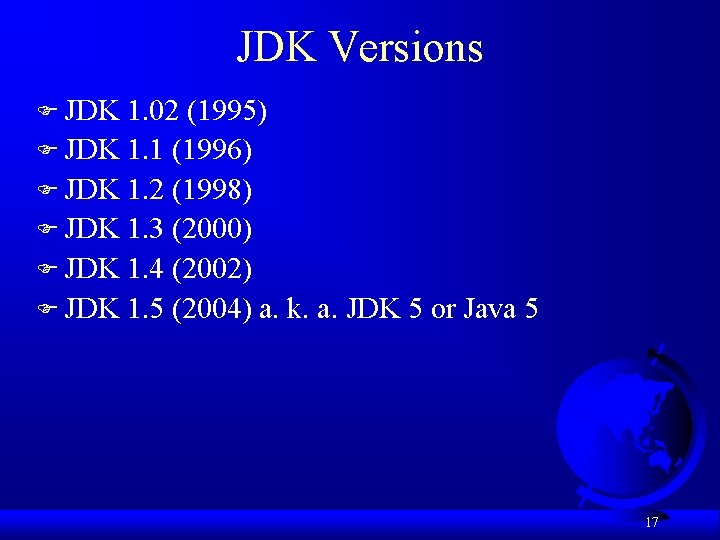
JDK Versions F JDK 1. 02 (1995) F JDK 1. 1 (1996) F JDK 1. 2 (1998) F JDK 1. 3 (2000) F JDK 1. 4 (2002) F JDK 1. 5 (2004) a. k. a. JDK 5 or Java 5 17
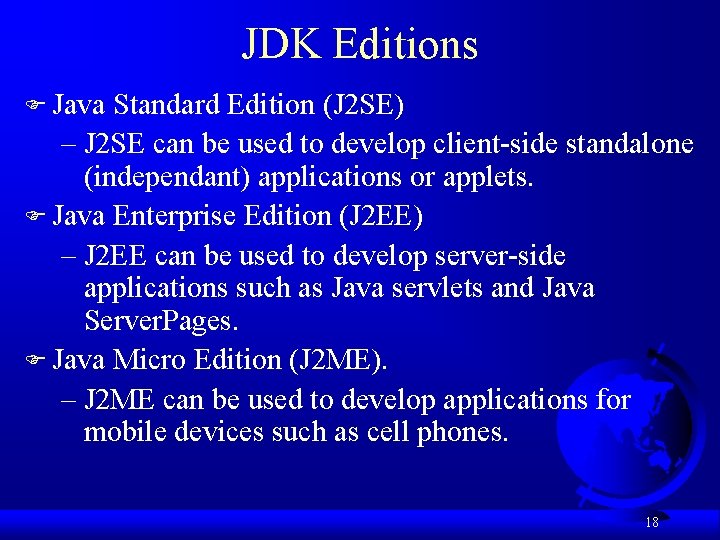
JDK Editions F Java Standard Edition (J 2 SE) – J 2 SE can be used to develop client-side standalone (independant) applications or applets. F Java Enterprise Edition (J 2 EE) – J 2 EE can be used to develop server-side applications such as Java servlets and Java Server. Pages. F Java Micro Edition (J 2 ME). – J 2 ME can be used to develop applications for mobile devices such as cell phones. 18
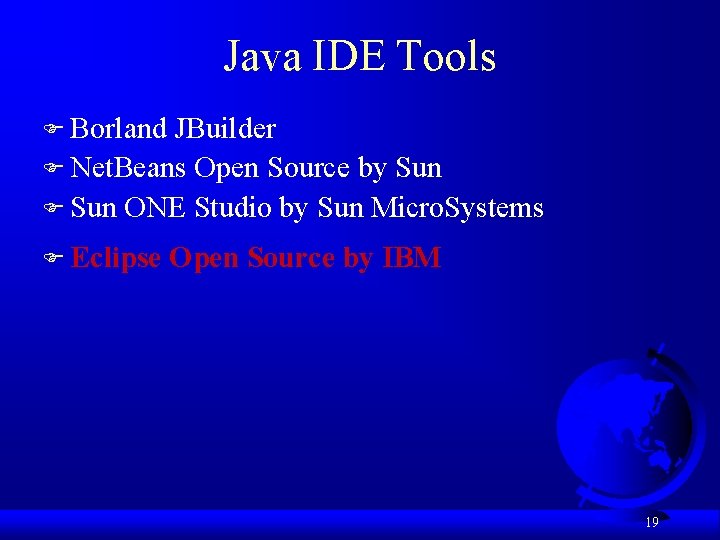
Java IDE Tools F Borland JBuilder F Net. Beans Open Source by Sun F Sun ONE Studio by Sun Micro. Systems F Eclipse Open Source by IBM 19
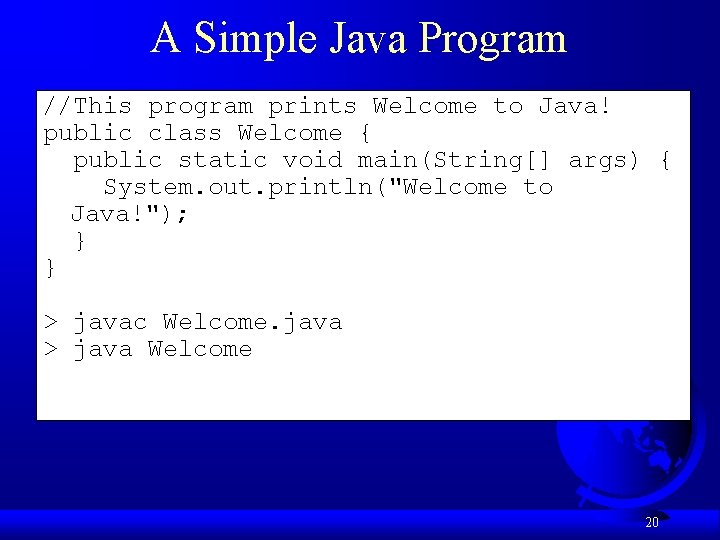
A Simple Java Program //This program prints Welcome to Java! public class Welcome { public static void main(String[] args) { System. out. println("Welcome to Java!"); } } > javac Welcome. java > java Welcome 20
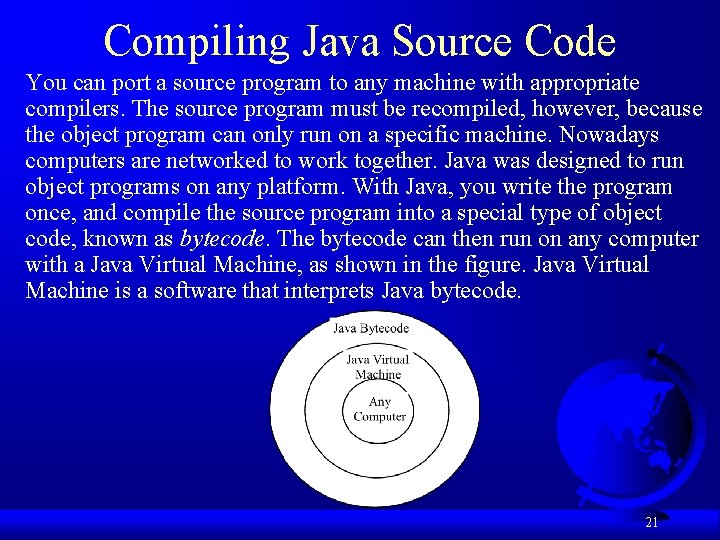
Compiling Java Source Code You can port a source program to any machine with appropriate compilers. The source program must be recompiled, however, because the object program can only run on a specific machine. Nowadays computers are networked to work together. Java was designed to run object programs on any platform. With Java, you write the program once, and compile the source program into a special type of object code, known as bytecode. The bytecode can then run on any computer with a Java Virtual Machine, as shown in the figure. Java Virtual Machine is a software that interprets Java bytecode. 21
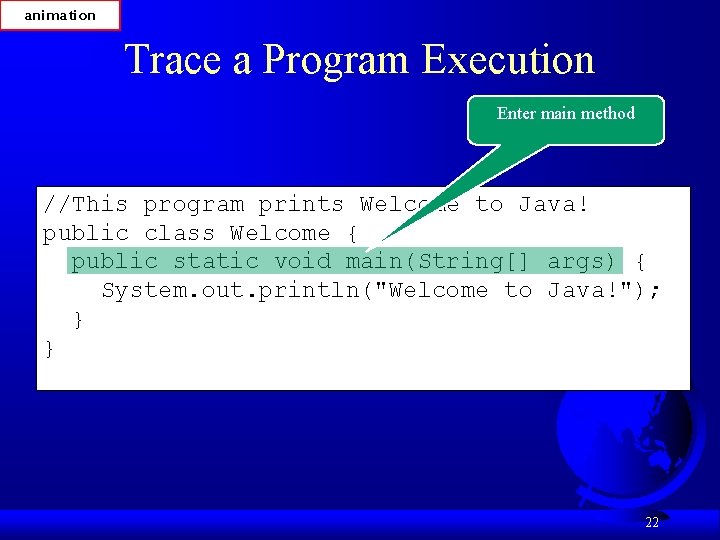
animation Trace a Program Execution Enter main method //This program prints Welcome to Java! public class Welcome { public static void main(String[] args) { System. out. println("Welcome to Java!"); } } 22
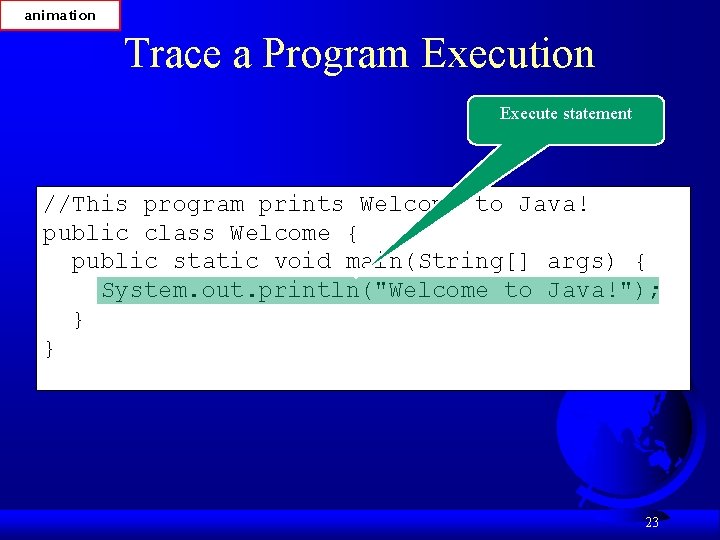
animation Trace a Program Execution Execute statement //This program prints Welcome to Java! public class Welcome { public static void main(String[] args) { System. out. println("Welcome to Java!"); } } 23
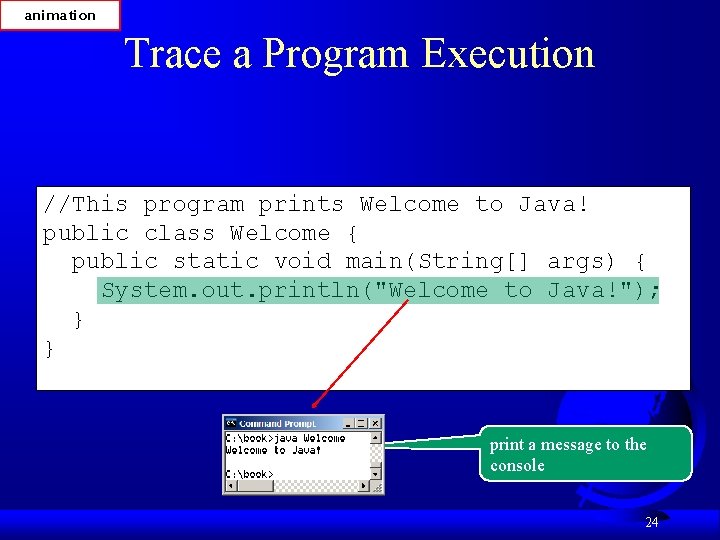
animation Trace a Program Execution //This program prints Welcome to Java! public class Welcome { public static void main(String[] args) { System. out. println("Welcome to Java!"); } } print a message to the console 24
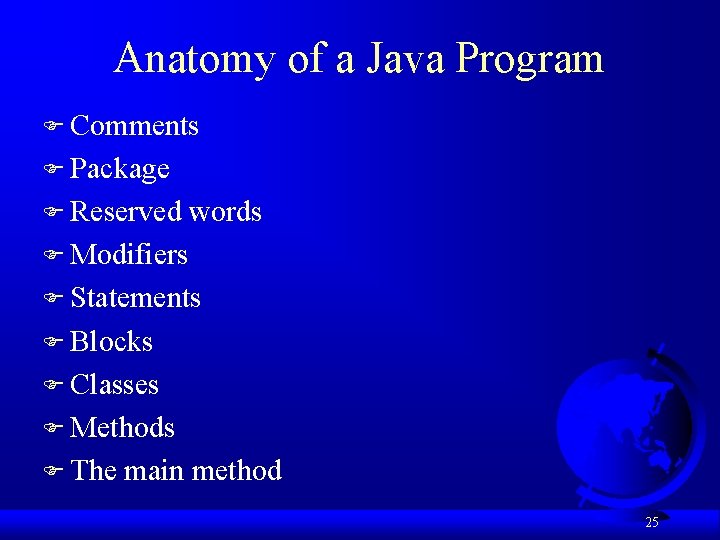
Anatomy of a Java Program F Comments F Package F Reserved words F Modifiers F Statements F Blocks F Classes F Methods F The main method 25
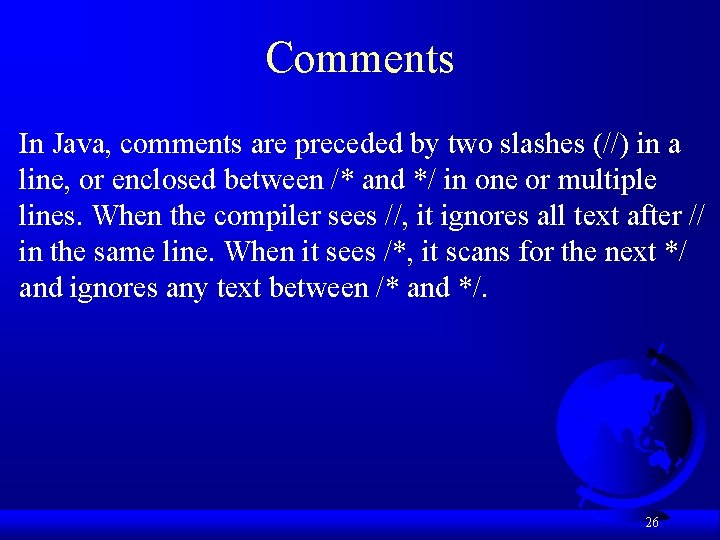
Comments In Java, comments are preceded by two slashes (//) in a line, or enclosed between /* and */ in one or multiple lines. When the compiler sees //, it ignores all text after // in the same line. When it sees /*, it scans for the next */ and ignores any text between /* and */. 26
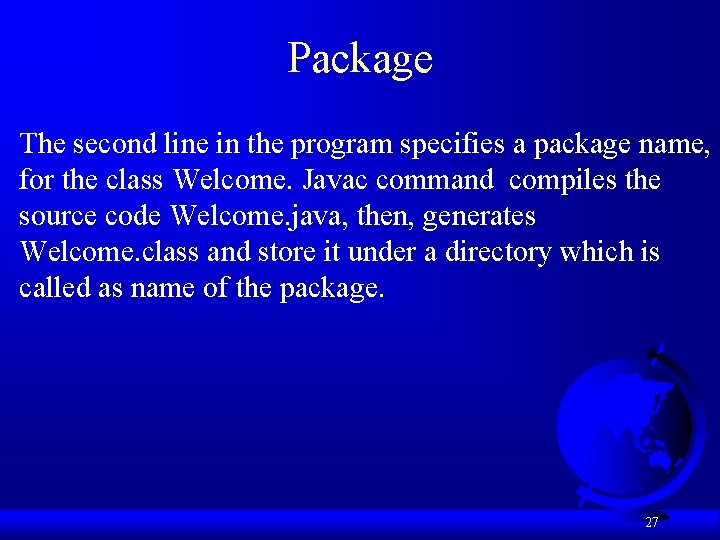
Package The second line in the program specifies a package name, for the class Welcome. Javac command compiles the source code Welcome. java, then, generates Welcome. class and store it under a directory which is called as name of the package. 27
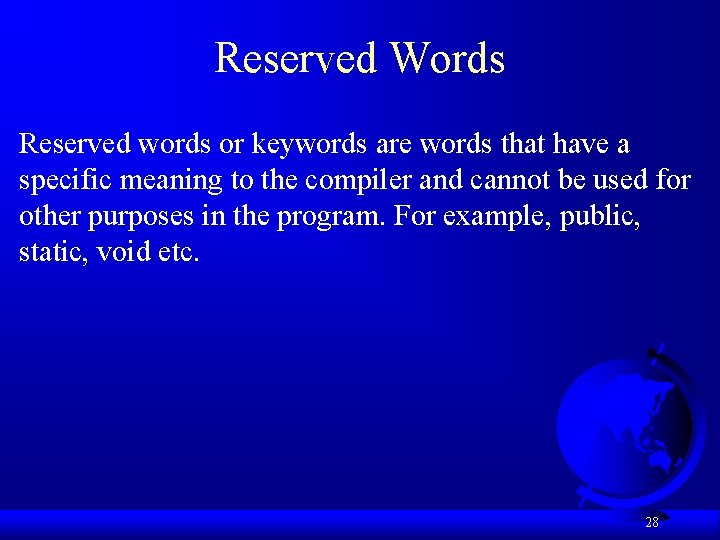
Reserved Words Reserved words or keywords are words that have a specific meaning to the compiler and cannot be used for other purposes in the program. For example, public, static, void etc. 28
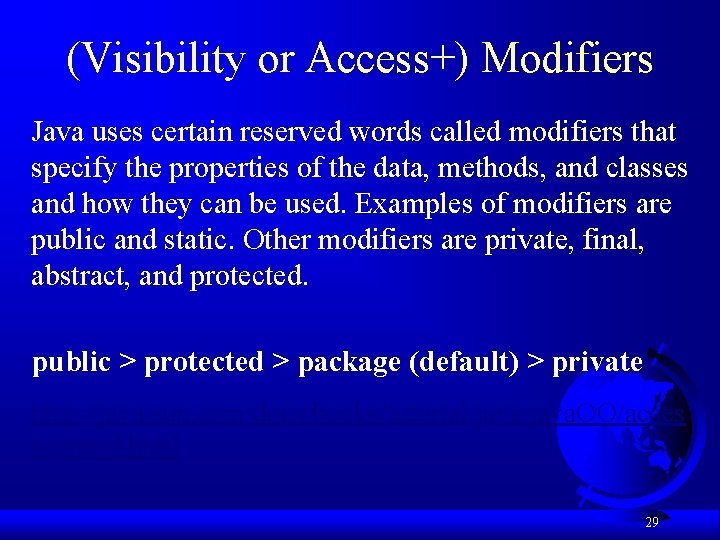
(Visibility or Access+) Modifiers Java uses certain reserved words called modifiers that specify the properties of the data, methods, and classes and how they can be used. Examples of modifiers are public and static. Other modifiers are private, final, abstract, and protected. public > protected > package (default) > private http: //java. sun. com/docs/books/tutorial/java. OO/acces scontrol. html 29
Statements A statement represents an action or a sequence of actions. The statement System. out. println("Welcome to Java!") in the program is a statement to display the greeting "Welcome to Java!" Every statement in Java ends with a semicolon (; ). 30
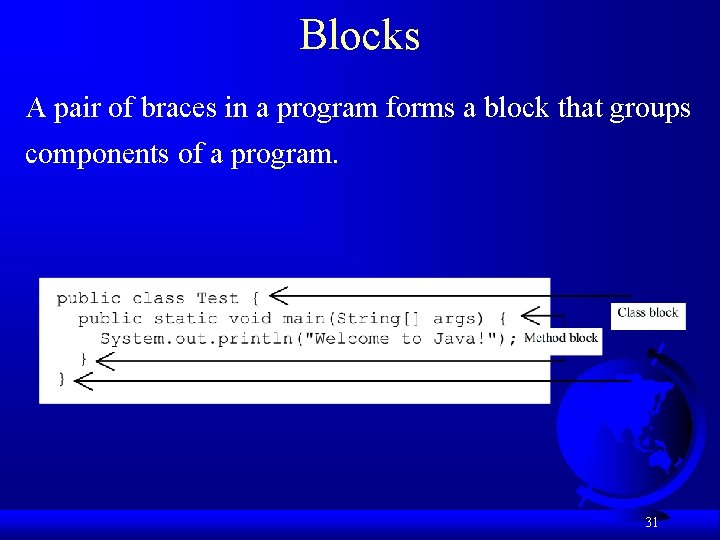
Blocks A pair of braces in a program forms a block that groups components of a program. 31
Classes The class is the essential Java construct. A class is a template or blueprint for objects. To program in Java, you must understand classes and be able to write and use them. The mystery of the class will continue to be unveiled throughout this book. For now, though, understand that a program is defined by using one or more classes. 32
Methods What is System. out. println? It is a method: a collection of statements that performs a sequence of operations to display a message on the console. It can be used even without fully understanding the details of how it works. It is used by invoking a statement with a string argument. The string argument is enclosed within parentheses. In this case, the argument is "Welcome to Java!" You can call the same println method with a different argument to print a different message. 33
main Method The main method provides the control of program flow. The Java interpreter executes the application by invoking the main method. The main method looks like this: public static void main(String[] args) { // Statements; } 34