
Chapter 1 Introduction to ECommerce Learning Objectives In
Chapter 1 Introduction to E-Commerce

Learning Objectives In this chapter, you will learn about: • the basic elements of e-commerce • differences between e-commerce and traditional commerce • advantages and disadvantages of using ecommerce • the international nature of e-commerce 2

Learning Objectives (Cont. ) • how the Internet and the WWW stimulated the emergence of e-commerce • economic forces that have created a business environment to foster e-commerce • the ways by which businesses use value chains to identify e-commerce opportunities 3
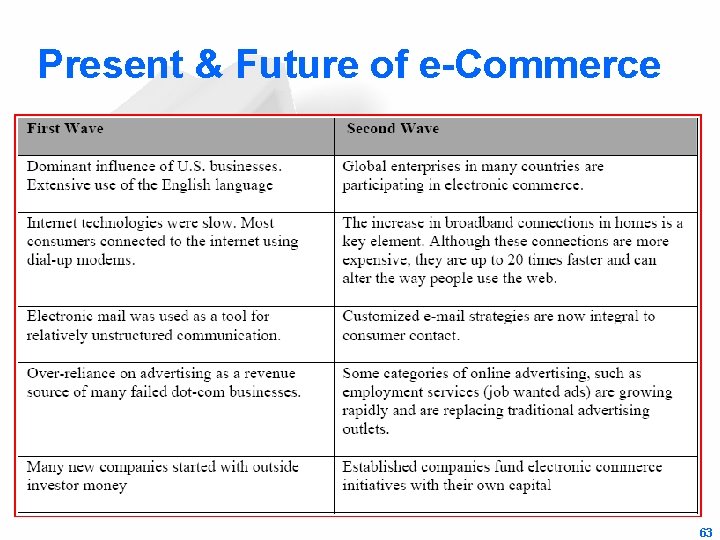
First wave of e-Commerce (1997 - 2000) • Most of the businesses were US based – Difficult to buy online unless you live in the same country • One network, one language i. e. English – Language barrier • Businesses started with outside investor money backing good ideas – Wrong perception of advertising revenue model • Email had high HR cost (still need someone to process it!)
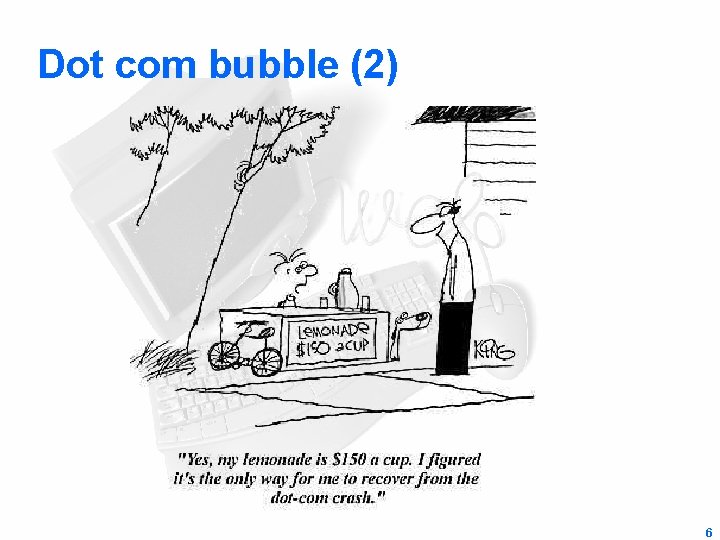
Dot com bubble (1) • Yesterday new Lemonade company A opens costing $10 • Today – – – – – • John heard of these Lemonade companies and think it’s a good investment John buys shares for $12 Jim sees John buying shares Jim think it’s a good investment too Jim buys shares for $14 James sees John and Jim buying shares James think it’s a good investment too James buys shares for $20 … Tomorrow – The company still costs $10 – Company B opens right next to company A with a better business model – Company A goes bust and John, Jim, James, … loose everything 5
Dot com bubble (2) 6
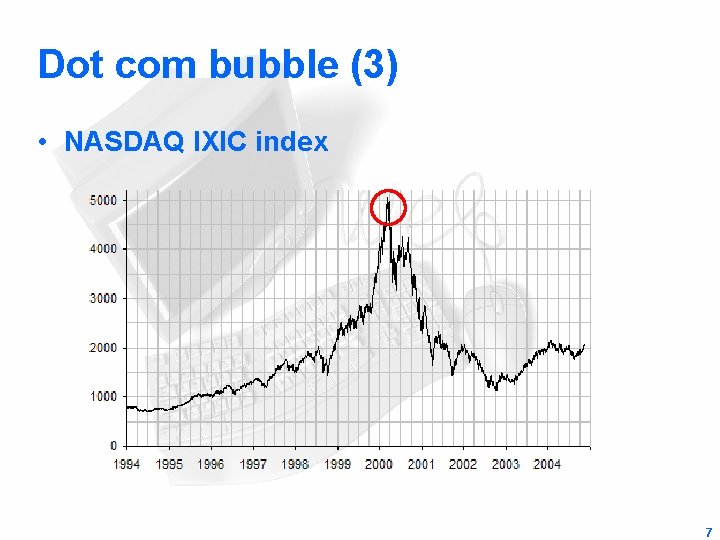
Dot com bubble (3) • NASDAQ IXIC index 7
Second or Mature Wave of E-Commerce 1. International dimension 2. Reliance to revenue models as opposed to “good ideas” – Own funds at stake now 3. Explosion in internet usage (Broad Band, Wi. Max, etc) 4. Emails used to build consumer relationships 5. Advertising is much more sophisticated
What is e-Commerce? More than just Web shopping! Business activities conducted using electronic data transmission via Internet and WWW Can you name a few? 9
Some definitions … • Electronic commerce (e-commerce) – Businesses trading with other businesses and internal processes • Electronic business (e-business) – Term used interchangeably with e-commerce – The transformation of key business processes through the use of Internet technologies 10
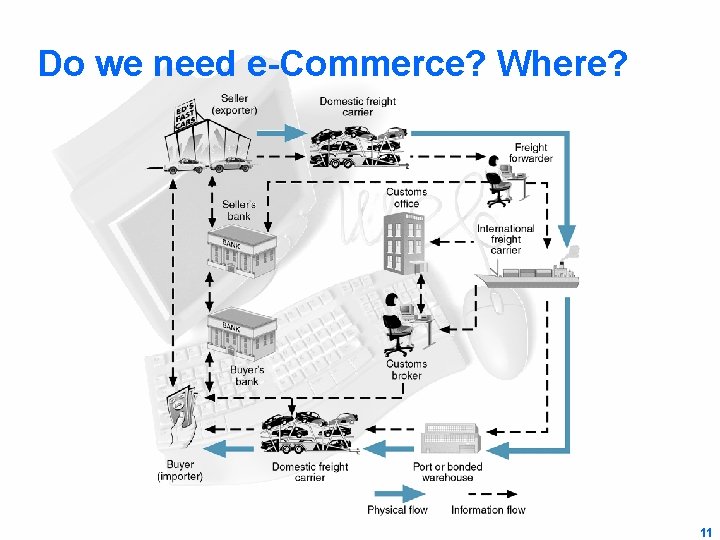
Do we need e-Commerce? Where? 11
Business Jargon • Activity – task performed by worker in doing his job – E. g. Packaging books • Transaction – exchange of value (purchase or sale) – E. g. Electronic Payment • Business process – group of related activities and transactions – E. g. Purchasing from an Online Bookstore 12
Elements of E-Commerce • Electronic funds transfers (EFTs) – Also called wire transfers – System of transferring money from one bank account directly to another without any paper money changing hands – Electronic transmissions of account exchange information over private communications networks – Used since the 60 s • Electronic data interchange (EDI) – Transmitting computer-readable data in a standard format to another business – Developed by the Data Interchange Standards Association and uses ANSI X 12 13
Value Added Network (VAN) • A value added network is an independent firm that offers connection and EDI transaction forwarding services to buyers and sellers engaged in EDI • VANs are responsible for ensuring the security of data transmitted • VANs charged a fixed monthly fee plus a per-transaction charge to subscribers • Used a lot prior to the internet • Today’s VANs focus more on security issues 14
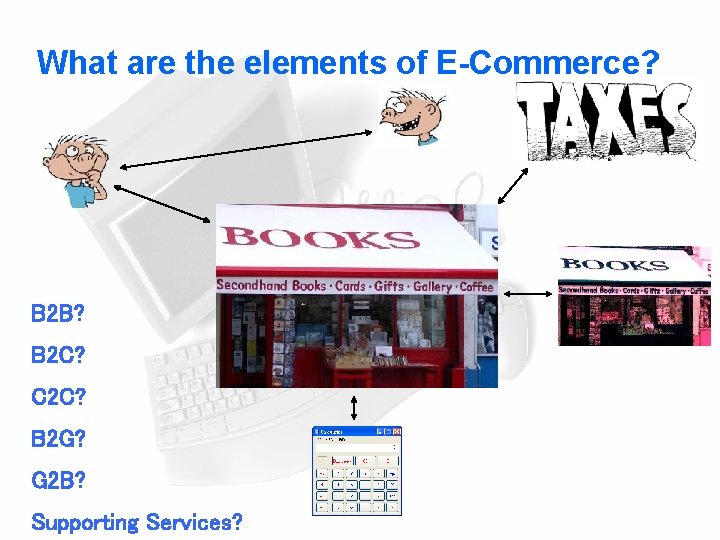
What are the elements of E-Commerce? B 2 B? B 2 C? C 2 C? B 2 G? G 2 B? Supporting Services?
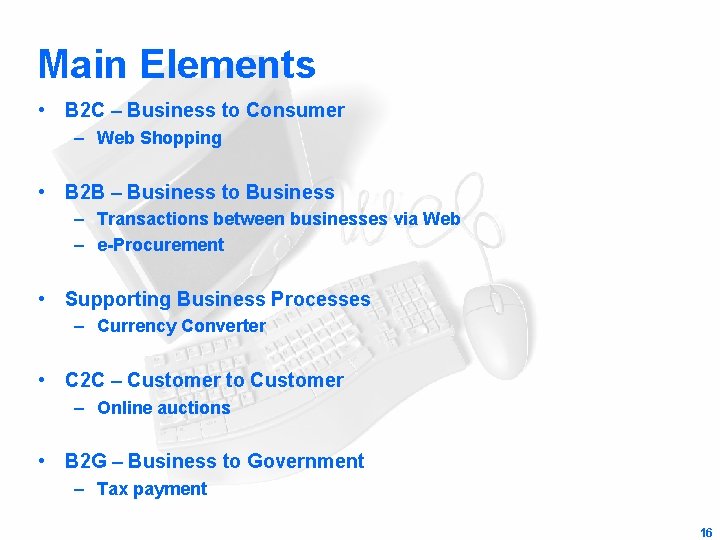
Main Elements • B 2 C – Business to Consumer – Web Shopping • B 2 B – Business to Business – Transactions between businesses via Web – e-Procurement • Supporting Business Processes – Currency Converter • C 2 C – Customer to Customer – Online auctions • B 2 G – Business to Government – Tax payment 16
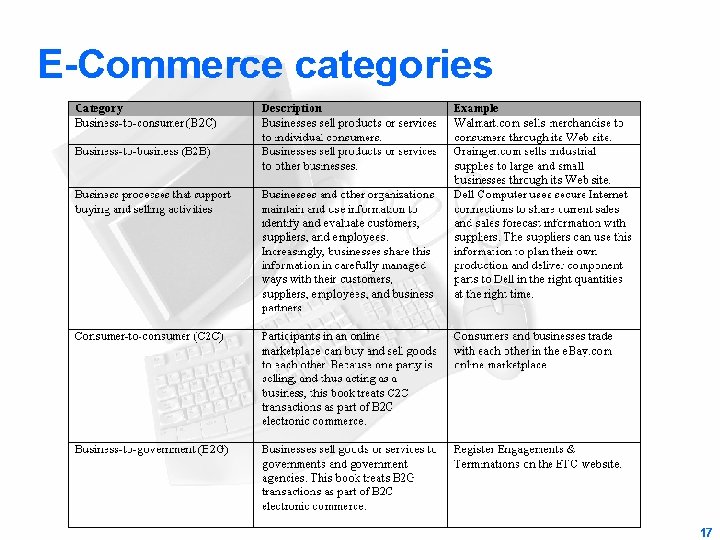
E-Commerce categories 17
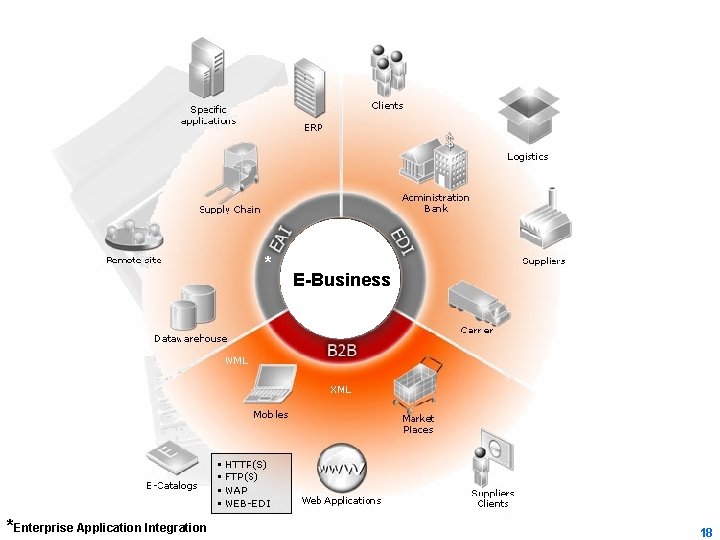
* *Enterprise Application Integration E-Business 18
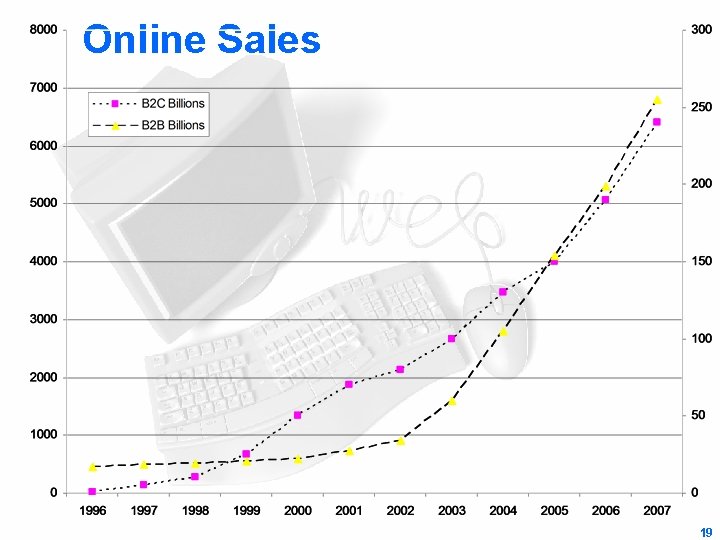
Online Sales 19
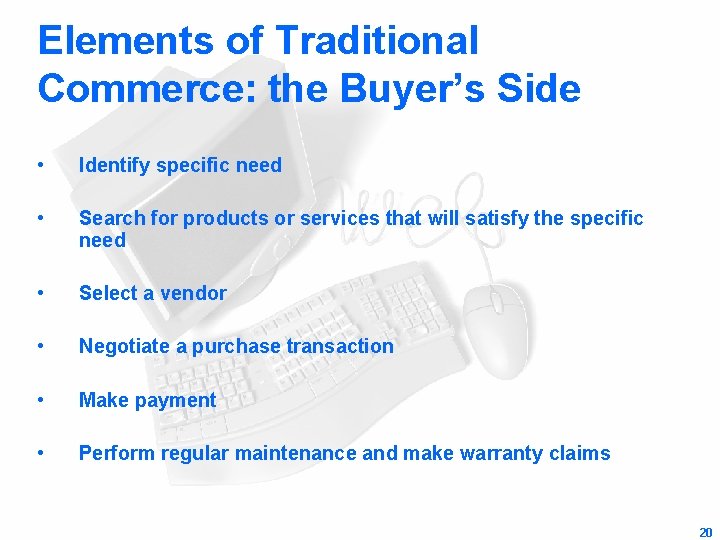
Elements of Traditional Commerce: the Buyer’s Side • Identify specific need • Search for products or services that will satisfy the specific need • Select a vendor • Negotiate a purchase transaction • Make payment • Perform regular maintenance and make warranty claims 20
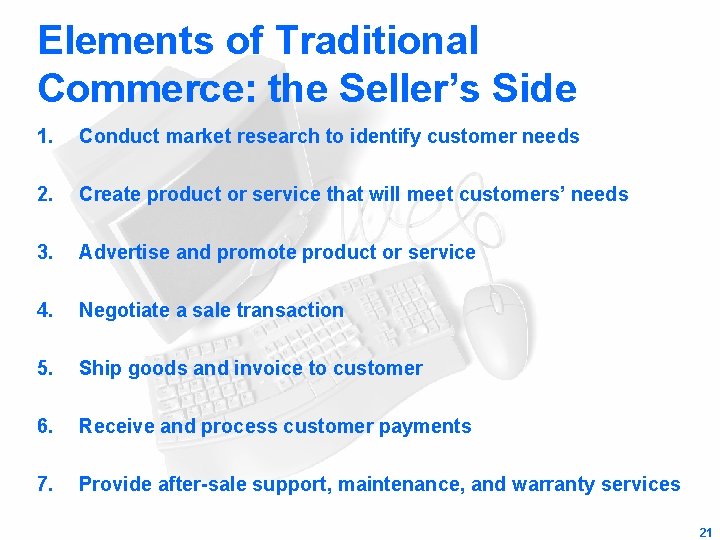
Elements of Traditional Commerce: the Seller’s Side 1. Conduct market research to identify customer needs 2. Create product or service that will meet customers’ needs 3. Advertise and promote product or service 4. Negotiate a sale transaction 5. Ship goods and invoice to customer 6. Receive and process customer payments 7. Provide after-sale support, maintenance, and warranty services 21
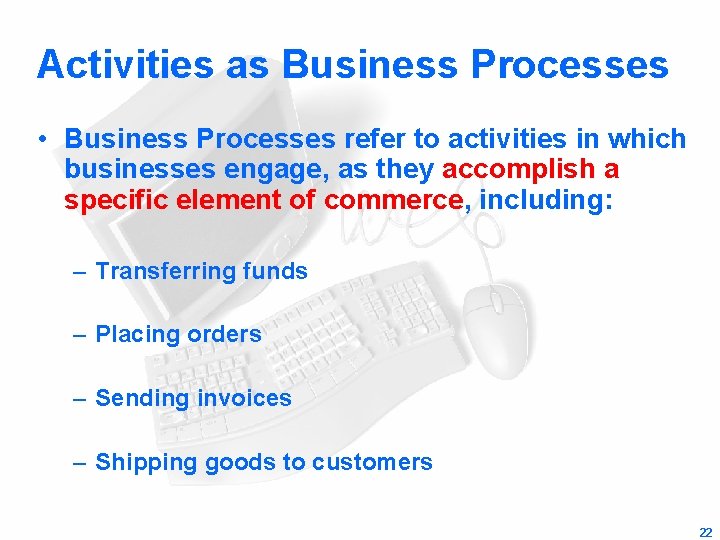
Activities as Business Processes • Business Processes refer to activities in which businesses engage, as they accomplish a specific element of commerce, including: – Transferring funds – Placing orders – Sending invoices – Shipping goods to customers 22
Advantages of E-Commerce (1) • Electronic commerce can – Increase sales – decrease costs • Web advertising reaches to a large amount of potential customers throughout the world • Web creates virtual communities for specific products or services 23
Advantages of E-Commerce (2) • A business can reduce the costs by using electronic commerce in its – sales support – order-taking processes • Electronic commerce increases sale opportunities for the seller • Electronic commerce increases purchasing opportunities for the buyer 24
General Welfare of Society • Electronic commerce benefits the general welfare of society because: – electronic payments of tax refunds and welfare • cost less to issue and arrive securely – electronic payments can be audited easily – electronic commerce enables people to work from home (teleworking) – electronic commerce makes products and services available in remote areas 25
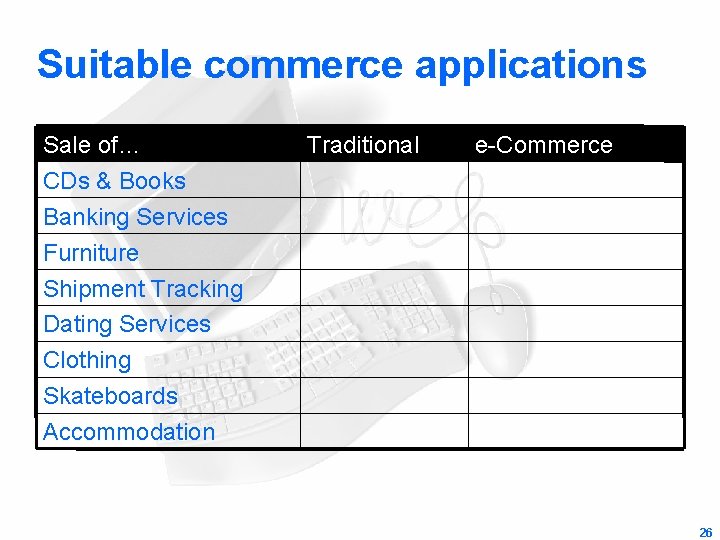
Suitable commerce applications Sale of… CDs & Books Banking Services Furniture Shipment Tracking Dating Services Clothing Skateboards Accommodation Traditional e-Commerce 26
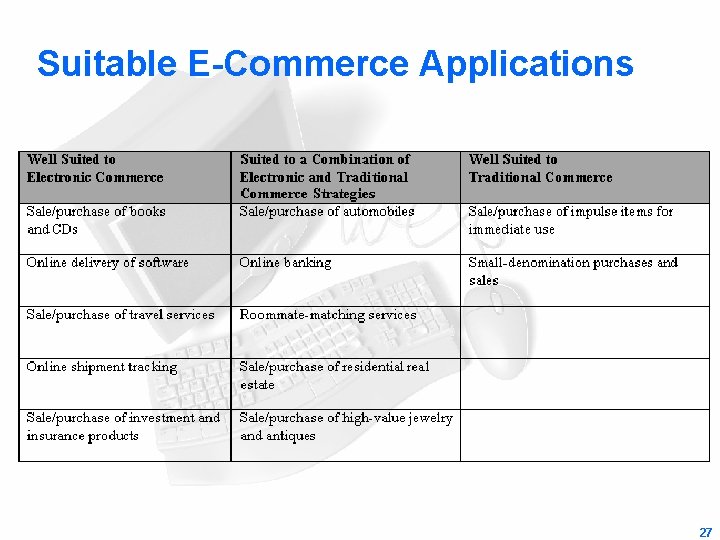
Suitable E-Commerce Applications 27
Disadvantages of E-Commerce • Some business processes are difficult to be implemented through electronic commerce – Furniture? • Businesses face cultural and legal obstacles to conducting electronic commerce – E-betting (in Malta) • Return-on-investment is difficult to apply to electronic commerce 28
Myths of E-Commerce 1. All I Have to Do is Create A Website, People will Come to My Website, Buy My Goods or Services, and I Can Sit Back and Collect the Money. 2. Doing Business on the Internet Is a Waste of Time. No one is really making money or growing their business. 3. Taking Credit Cards Over the Internet is Next to Impossible for A Small Start Up Business. 4. If I Put a Site on the Information Super Highway, I will have Instant Access to Millions of Potential Customers. 5. I Put Up a Site On the Net and Nobody Come. Only Huge Sites with Big Budgets Enjoy a Large Volume of Traffic. 29
Myth 1 • All I Have to Do is Create A Website, People will Come to My Website, Buy My Goods or Services, and I Can Sit Back and Collect the Money. • • Net business is not so different from real one You need – – • A good business plan A good marketing strategy Understand the demographics of your customers Offer customers a reason to buy from you Its only easier to setup + less startup costs & operating expenses
Myth 2 • Doing Business on the Internet Is a Waste of Time. No one is really making money or growing their business. • E-commerce growth rate is over 145% with sales topping 150 billion dollars • Offers benefits to consumers such as instant access, 24/7, immediate feedback, highly adaptable
Myth 3 • Taking Credit Cards Over the Internet is Next to Impossible for A Small Start Up Business. • Not that difficult but can be daunting • Banks don’t offer to small businesses (high risk) • Service can be expensive or complicated • Some “fly by night” operators only stay in business until they get your deposit • But packages exist such as Yahoo!Small Business
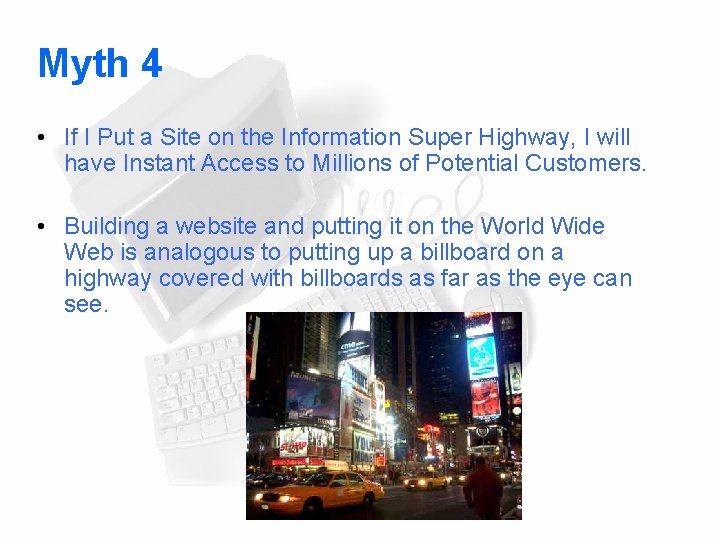
Myth 4 • If I Put a Site on the Information Super Highway, I will have Instant Access to Millions of Potential Customers. • Building a website and putting it on the World Wide Web is analogous to putting up a billboard on a highway covered with billboards as far as the eye can see.
Myth 5 • I Put Up a Site On the Net and Nobody Come. Only Huge Sites with Big Budgets Enjoy a Large Volume of Traffic. • True, many people do spend a lot of time building their website only to find that no one is looking at it. • But other smaller sites do manage …
International Electronic Commerce • About 60 percent of all electronic commerce sites are in English, therefore many language barriers need to be overcome • The political structures of the world presents some challenges – China, etc. • Legal, tax, and privacy are concerns of international electronic commerce – VAT, Spam, Porn, Piracy, etc. 35
The Internet and World Wide Web • The Internet is a large system of interconnected computer networks that spans the globe • The Internet supports e-mail, online newspapers and publications, discussion groups, games, and free software • The World Wide Web includes an easy-to-use standard interface for Internet resources accesses 36
Origins of the Internet • In the early 1960 s, the U. S. Department of Defense started research on networking computers • Its researchers developed a multiple channels network • In 1969, the Defense Department used this network model to connect four mainframe computers at different locations – DARPA (Defence Advanced Research Projects Agency) 37
New Uses for the Internet • In 1972, a researcher wrote a program that could send and receive messages over the network • E-mail was born and became widely used • The network software include: – File Transfer Protocol (FTP) – User’s News Network (Usenet) 38
Commercial Use of the Internet • Companies used the PC to construct their networks in 1980 s • National Science Foundation (NSF) funded the network services in 1980 s • In 1989, NSF permitted two commercial e-mail services • As the 1990 s began, the Internet started to serve the global resource accesses 39
Growth of the Internet • In 1991, the NSF further eased its restriction on Internet commercial activity • The privatization of the Internet was substantially completed in 1995 • The new structure of the Internet was based on four network access points (NAPs) • Internet service providers (ISPs) sell Internet access rights directly to customers 40
Development of Hypertext • In the 1960 s, Ted Nelson described his pagelinking system hypertext – Xanadu, Cosmic Book • In 1987, Nelson published a book about a global system for online hypertext publishing and commerce • In 1991, Berners-Lee of CERN developed the code for a hypertext server program and made it available on the Internet 41
SGML, XML, HTML? ▼Standard Generalised Markup Language (SGML) ▼e. Xtensible Markup Language (XML) ▼Hyper. Text Markup Language (HTML) ▼X-HTML or HTML 4. 0 42
HTML • A hypertext server is a computer that stores files written in the hypertext markup language (HTML) • HTML is a language that includes a set of codes (or tags) attached to text • A hypertext link points to another location in the same or another HTML document 43
Web Browser and Markup Languages • A web browser is a software interface that lets users browse HTML documents • HTML is based on the Standard Generalized Markup Language (SGML) • e. Xtensible Markup Language (XML) allows users to define new meanings for its commands in web page 44
Graphical User Interface • A graphical user interface (GUI) is a way of presenting program control functions and program output to users • Web browsers include: – Mosaic – Netscape Navigator – Microsoft Internet Explorer 45
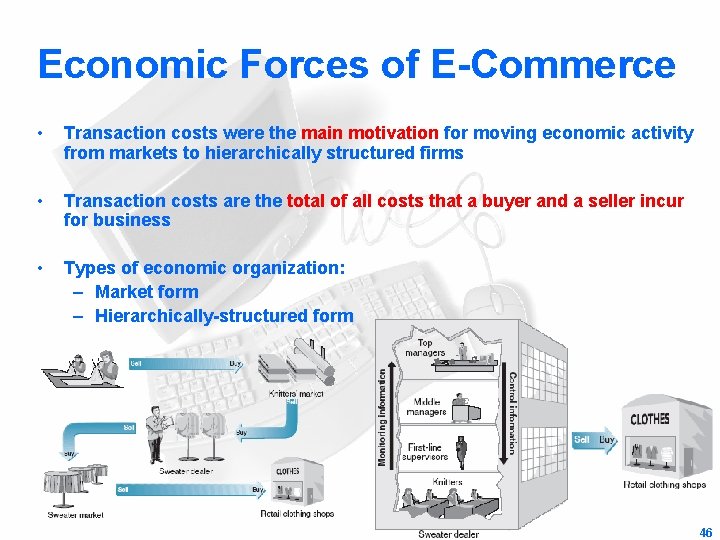
Economic Forces of E-Commerce • Transaction costs were the main motivation for moving economic activity from markets to hierarchically structured firms • Transaction costs are the total of all costs that a buyer and a seller incur for business • Types of economic organization: – Market form – Hierarchically-structured form 46
The Role of Electronic Commerce • Businesses and individuals can use electronic commerce to reduce transaction cost • Electronic commerce can make network economic structures, which rely on information sharing, and are much easier to construct and maintain 47
Value Chains • A strategic business unit is one particular combination of product, distribution channel, and customer type • A value chain is a way of organizing the activities that each strategic business unit undertakes to design, produce, promote, market, deliver, and support the products or services it sells 48
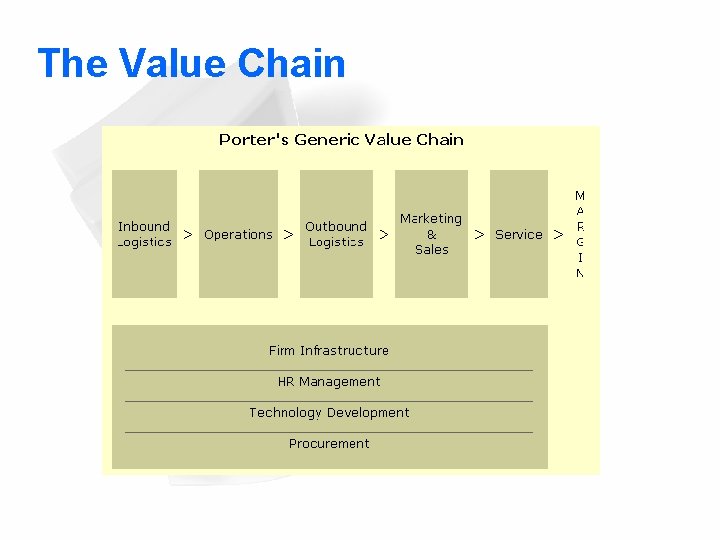
The Value Chain
Strategic Business Unit Value Chains • For each business unit, the primary activities are: – – – – Identify customers Design Purchase materials and supplies Manufacture Market and sell Deliver Provide after-sale service and support 50
Strategic Business Unit Value Chains • The support activities of value chain for a strategic business unit include: – Finance and administration – Human resources – Technology development 51
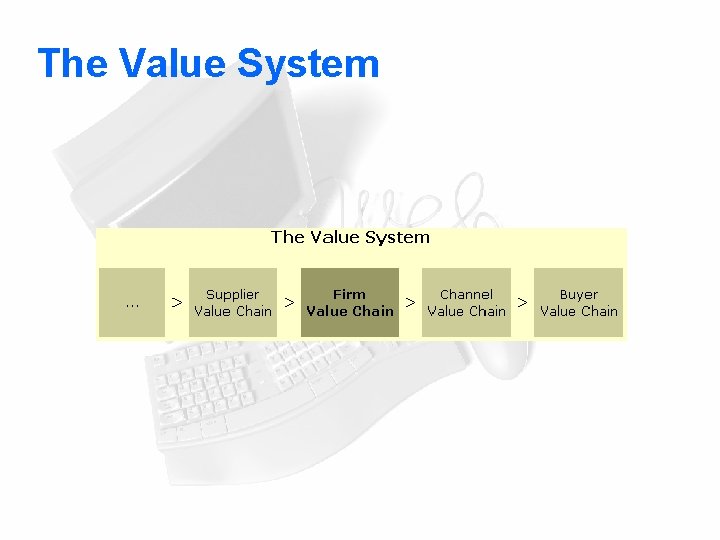
The Value System
Industry Value Chains • Value system describes the larger stream of activities into which a particular business unit’s value chain is embedded • Industry value chain refers to value systems • Using the value chain reinforces the idea that electronic commerce should be a business solution 53
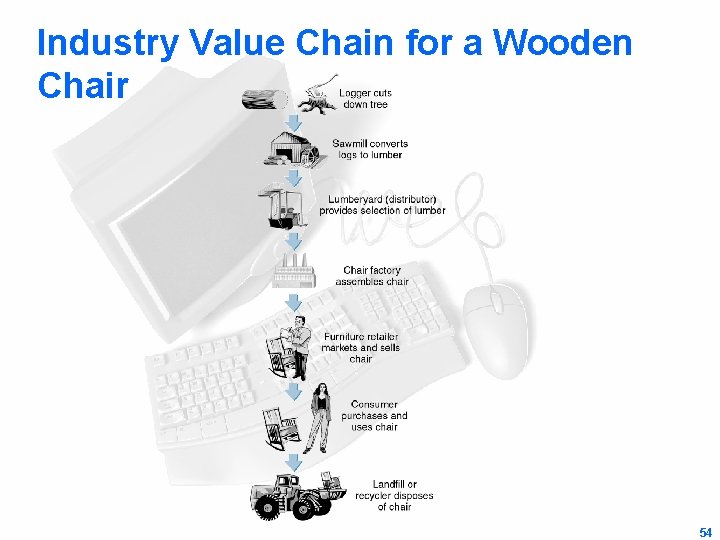
Industry Value Chain for a Wooden Chair 54
SWOT Analysis: Evaluating Business Unit Opportunities • SWOT analysis – An analyst first looks into the business unit to identify its strengths and weaknesses – The analyst then reviews the operating environment and identifies opportunities and threats 55
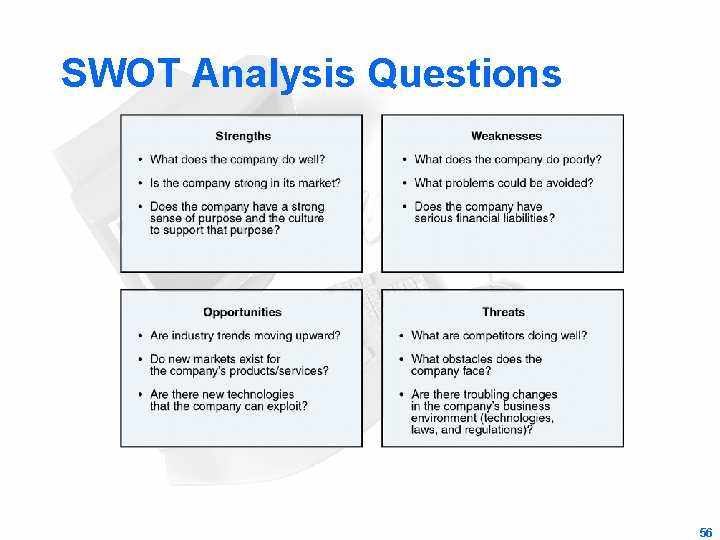
SWOT Analysis Questions 56
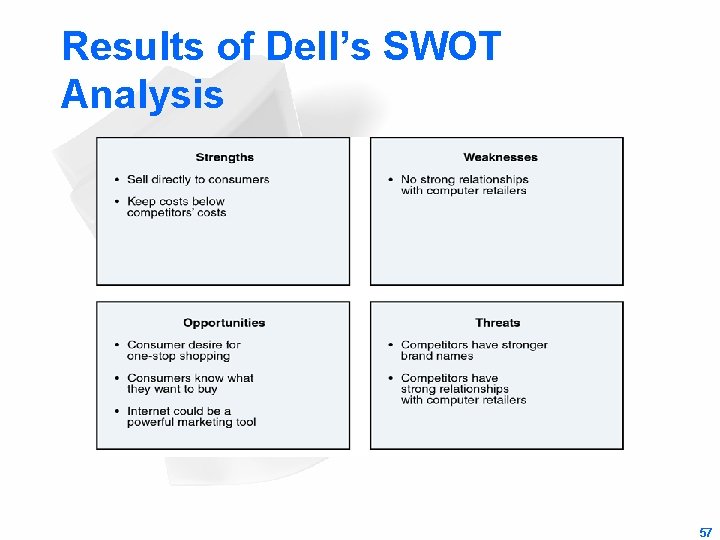
Results of Dell’s SWOT Analysis 57
International Issues of e. Commerce • Trust • Language • Culture • Infrastructure 58
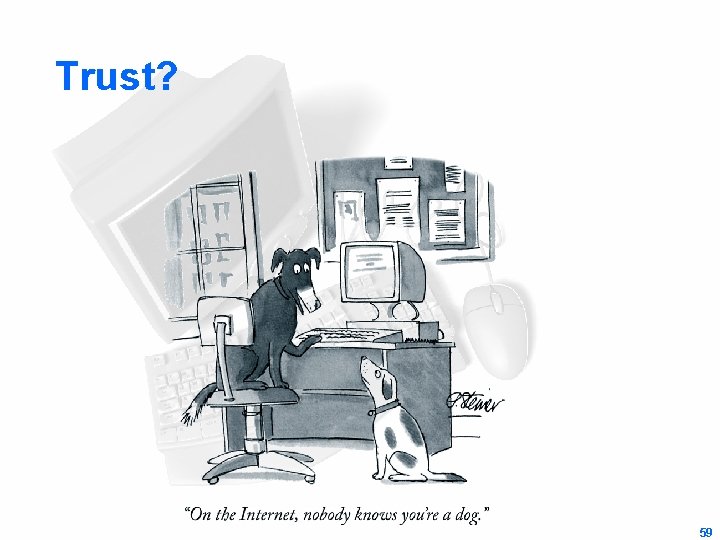
Trust? 59
Language Issues • To do business effectively in other cultures – Must adapt to those cultures • Researchers have found that – Customers are more likely to buy products and services from Web sites in their own language • Localization – Translation that considers multiple elements of the local environment 60
Culture Issues • Important element of business trust – Anticipate how the other party to a transaction will act in specific circumstances (China? ) • Culture – Combination of language and customs – Varies across national boundaries – Varies across regions within nations 61
Infrastructure Issues • Internet infrastructure includes – Computers and software connected to the Internet – Communications networks over which message packets travel • Reliability? – Connection type • Always on • Dial-up 62
Present & Future of e-Commerce 63
Review • • What is e-Commerce? Internet and WWW Economic forces and e-Commerce Value Chains in e-Commerce 64
Ponder about… • Why is Amazon so successful? • Are online supermarkets successful in Malta? • Why? • Perform a SWOT analysis … 65
Online Study • Plan a holiday for 2 adults by searching the Internet for information, competing to identify the most economical rates for 2 people. • Include – – travel fare lodging admission costs entertainment 66
- Slides: 66