
Chapter 1 Introduction to Criminology Introduction Theoretical development
- Slides: 24
Chapter 1: Introduction to Criminology
Introduction • Theoretical development is woven into our understanding of crime and policy. • Focuses on concepts: Crime, criminal, deviant, and criminology. • Summarizes adult criminal justice and juvenile justice. • Explains how criminology informs policy and programs. • Overview of victimology. Schram, Introduction to Criminology, Third Edition. © SAGE Publications, 2021. 2
Key Concepts in Understanding Criminology (1 of 5) What Is a Crime? • Crime is a violation of the law: Legalistic approach. • Mala in se: Acts which inherently are deemed evil and immoral. • Mala prohibita: A wrong prohibited. • Deviance: Unusual behaviors and unlawful acts. Schram, Introduction to Criminology, Third Edition. © SAGE Publications, 2021. 3
Key Concepts in Understanding Criminology (2 of 5) What Is Criminology and Criminal Justice? • Criminology: Coined by Raffaele Garofalo. • Edwin Sutherland: The body of knowledge regarding crime as a social phenomenon. • Criminology is the scientific study of crime. • Philosophical, legal, and journalistic perspectives of crime are not scientific. Schram, Introduction to Criminology, Third Edition. © SAGE Publications, 2021. 4
Key Concepts in Understanding Criminology (3 of 5) • Criminal justice: The agencies and institutions that are interrelated and work together toward common goals. • Individuals argue that the term system of criminal justice is an oxymoron. Schram, Introduction to Criminology, Third Edition. © SAGE Publications, 2021. 5
Key Concepts in Understanding Criminology (4 of 5) The Consensus and Conflict Perspectives of Crime • Consensus perspective views both formal system of laws and enforcement of those laws. – Assumes that individuals agree on what is right and wrong. – No major theorist considered this to be the best perspective of law. Schram, Introduction to Criminology, Third Edition. © SAGE Publications, 2021. 6
Key Concepts in Understanding Criminology (5 of 5) • Conflict perspective maintains that there is conflict between various societal groups with different interests. – The conflict is resolved when the group in power achieves control. Schram, Introduction to Criminology, Third Edition. © SAGE Publications, 2021. 7
The Criminal Justice System (1 of 5) • Criminal justice system is an apparatus society uses to enforce the standards of conduct. • General purpose: To control crime, to prevent crime, and to provide and maintain justice. • The structure and organization is often presented as three components: Law enforcement, courts, and corrections. Schram, Introduction to Criminology, Third Edition. © SAGE Publications, 2021. 8
The Criminal Justice System (2 of 5) Law Enforcement • Includes various levels of organization: Federal, State, and Local. • Federal law enforcement agencies include FBI, DEA, and ATF. • Two models of state police departments: State police and Highway patrol. • Local-level agencies are divided into counties and municipalities. Schram, Introduction to Criminology, Third Edition. © SAGE Publications, 2021. 9
The Criminal Justice System (3 of 5) Courts • The United States has a dual court system Corrections. – Consists of separate yet interrelated systems: The federal courts and the state courts. • Jurisdiction: Authority of a court to hear and decide cases within an area of law. – Categorized as limited, general, or appellate. Schram, Introduction to Criminology, Third Edition. © SAGE Publications, 2021. 10
The Criminal Justice System (4 of 5) Corrections • An offender is processed in the correction system. • Probation is essentially an arrangement between the sentencing authorities and the offender. • Offenders are required to serve their sentences in a corrections facilities like jail and prison. Schram, Introduction to Criminology, Third Edition. © SAGE Publications, 2021. 11
The Criminal Justice System (5 of 5) The Juvenile Justice System • Parens patriae: Essential component to understanding the juvenile justice system. • Transfer provisions can be categorized into three types: Judicial waiver, concurrent jurisdiction, and statutory exclusion. Schram, Introduction to Criminology, Third Edition. © SAGE Publications, 2021. 12
Criminological Theory (1 of 5) • Respected scientific theories in all fields of study have the same characteristics. • Illustrated by the scientific review process. • Characteristics include: Parsimony, Scope, Logical consistency, Testability, Empirical Validity, and Policy implications. Schram, Introduction to Criminology, Third Edition. © SAGE Publications, 2021. 13
Criminological Theory (2 of 5) Characteristics of Good Theories • Parsimony: Explains a certain phenomenon. • Scope: Range of criminal behavior. • Logical consistency: The extent to which concepts of a theoretical model make sense. Schram, Introduction to Criminology, Third Edition. © SAGE Publications, 2021. 14
Criminological Theory (3 of 5) Characteristics of Good Theories • Testability: The extent to which a theoretical model can be empirically tested. • Empirical validity: The extent to which a theoretical model is supported by scientific research. Schram, Introduction to Criminology, Third Edition. © SAGE Publications, 2021. 15
Criminological Theory (4 of 5) Three Requirements for Determining Causality • Various criteria are involved in determining causality. • The three criteria required to determine causality: Temporal ordering, covariation or correlation, and accounting for spuriousness. Schram, Introduction to Criminology, Third Edition. © SAGE Publications, 2021. 16
Criminological Theory (5 of 5) Theory Informs Policies and Programs • Inform and guide policies that attempt to reduce crime. • Replace negative, antisocial role models with more positive, prosocial role models. • Focuses on social structure. – Challenge: Focus not necessarily on the individual, but on the community. Schram, Introduction to Criminology, Third Edition. © SAGE Publications, 2021. 17
Victimology (1 of 7) • Victimology can be defined as the scientific study of victims. • The study includes: – Reasons that some individuals are more likely to be victimized. – The legal rights of victims. – The incidence/spatial distribution of victimization in a given geographic area. • NCVS: Considered accurate estimate of crimes in the United States Schram, Introduction to Criminology, Third Edition. © SAGE Publications, 2021. 18
Victimology (2 of 7) Victim Precipitation • The increased likelihood of an individual becoming a victim due to something they did that put them more at risk. – Passive victim precipitation: Something they did not or forgot to do. – Active victim precipitation: Actually doing something, increases their probability of being victimized. Schram, Introduction to Criminology, Third Edition. © SAGE Publications, 2021. 19
Victimology (3 of 7) Incidence/Prevalence of Victimization • Misperceptions: The type of individual who is most likely to be victimized. • Occurs among teenagers and young adults. • According to NCVS and UCR, violent victimization has dropped. Schram, Introduction to Criminology, Third Edition. © SAGE Publications, 2021. 20
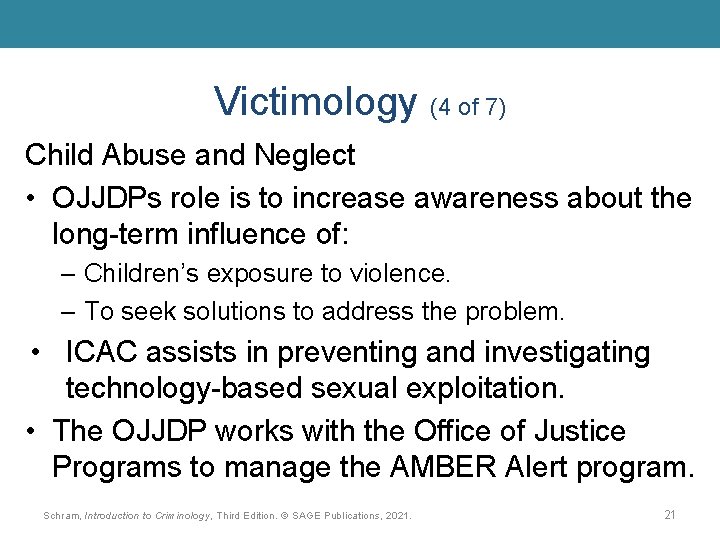
Victimology (4 of 7) Child Abuse and Neglect • OJJDPs role is to increase awareness about the long-term influence of: – Children’s exposure to violence. – To seek solutions to address the problem. • ICAC assists in preventing and investigating technology-based sexual exploitation. • The OJJDP works with the Office of Justice Programs to manage the AMBER Alert program. Schram, Introduction to Criminology, Third Edition. © SAGE Publications, 2021. 21
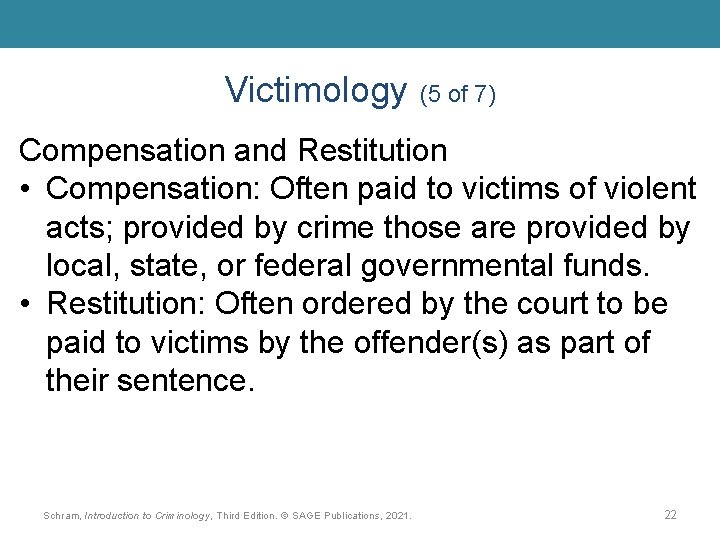
Victimology (5 of 7) Compensation and Restitution • Compensation: Often paid to victims of violent acts; provided by crime those are provided by local, state, or federal governmental funds. • Restitution: Often ordered by the court to be paid to victims by the offender(s) as part of their sentence. Schram, Introduction to Criminology, Third Edition. © SAGE Publications, 2021. 22
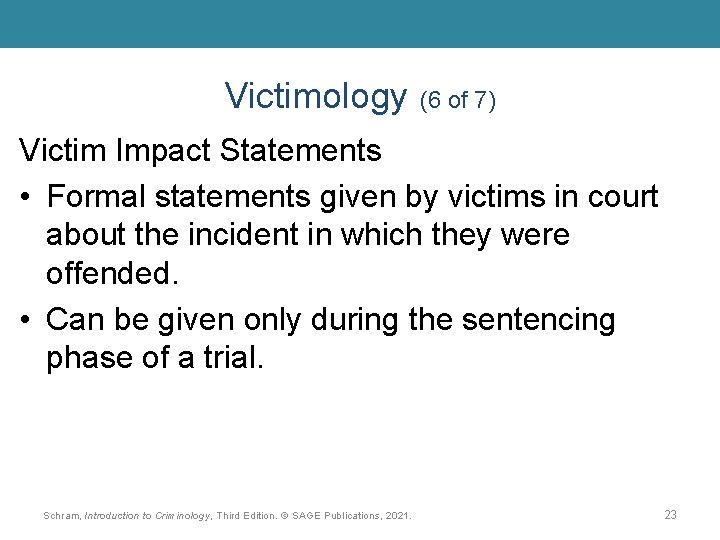
Victimology (6 of 7) Victim Impact Statements • Formal statements given by victims in court about the incident in which they were offended. • Can be given only during the sentencing phase of a trial. Schram, Introduction to Criminology, Third Edition. © SAGE Publications, 2021. 23
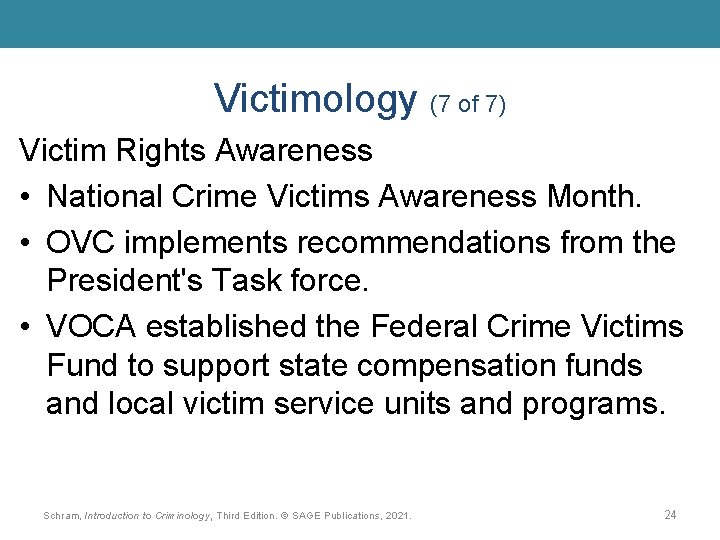
Victimology (7 of 7) Victim Rights Awareness • National Crime Victims Awareness Month. • OVC implements recommendations from the President's Task force. • VOCA established the Federal Crime Victims Fund to support state compensation funds and local victim service units and programs. Schram, Introduction to Criminology, Third Edition. © SAGE Publications, 2021. 24