
Chapter 1 Introduction to Corporate Finance Key Concepts

- Slides: 18
Chapter 1 Introduction to Corporate Finance
Key Concepts and Skills Know the basic types of financial management decisions and the role of the Financial Manager q Know the financial implications of the various forms of business organization q Know the goal of financial management q q Some topics will be assigned as Homework and/or Self Reading q Understand the conflicts of interest that can arise between owners and managers q Understand the various regulations that firms face 1 -1
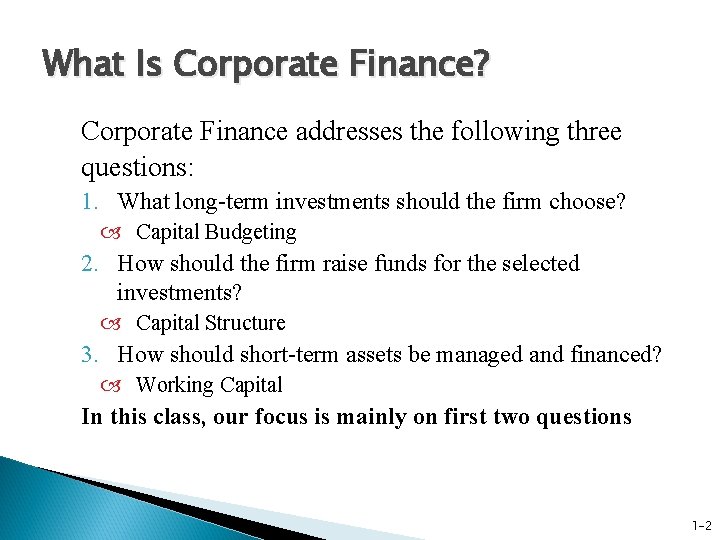
What Is Corporate Finance? Corporate Finance addresses the following three questions: 1. What long-term investments should the firm choose? Capital Budgeting 2. How should the firm raise funds for the selected investments? Capital Structure 3. How should short-term assets be managed and financed? Working Capital In this class, our focus is mainly on first two questions 1 -2
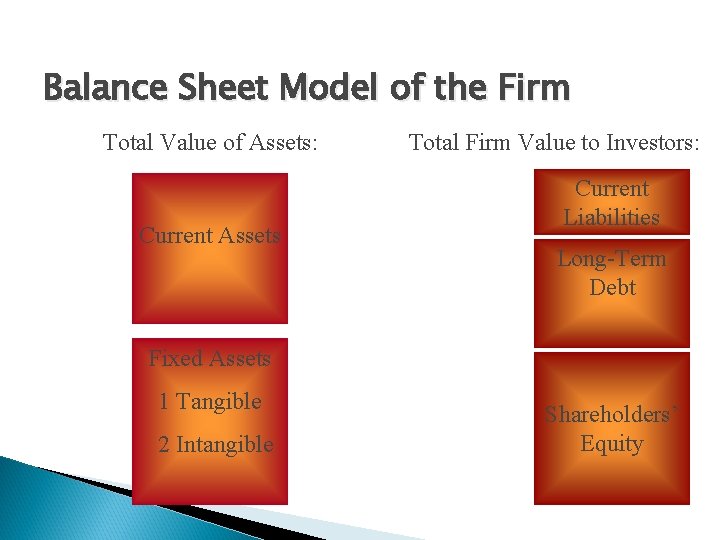
Balance Sheet Model of the Firm Total Value of Assets: Current Assets Total Firm Value to Investors: Current Liabilities Long-Term Debt Fixed Assets 1 Tangible 2 Intangible Shareholders’ Equity 1 -3
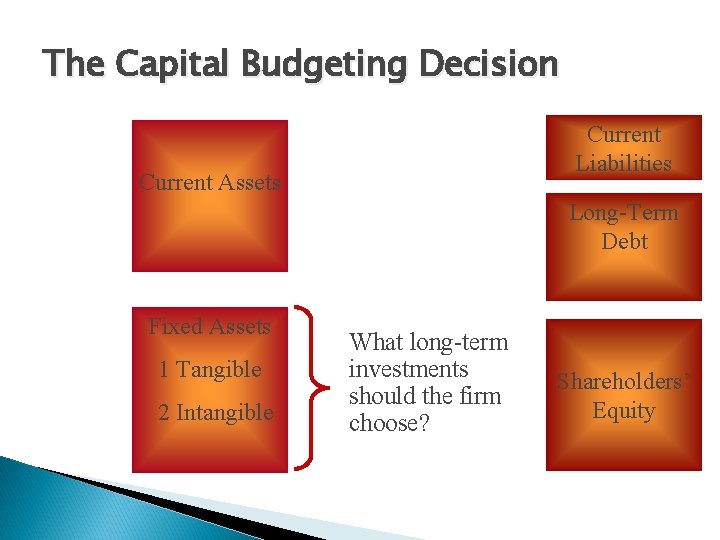
The Capital Budgeting Decision Current Liabilities Current Assets Long-Term Debt Fixed Assets 1 Tangible 2 Intangible What long-term investments should the firm choose? Shareholders’ Equity 1 -4
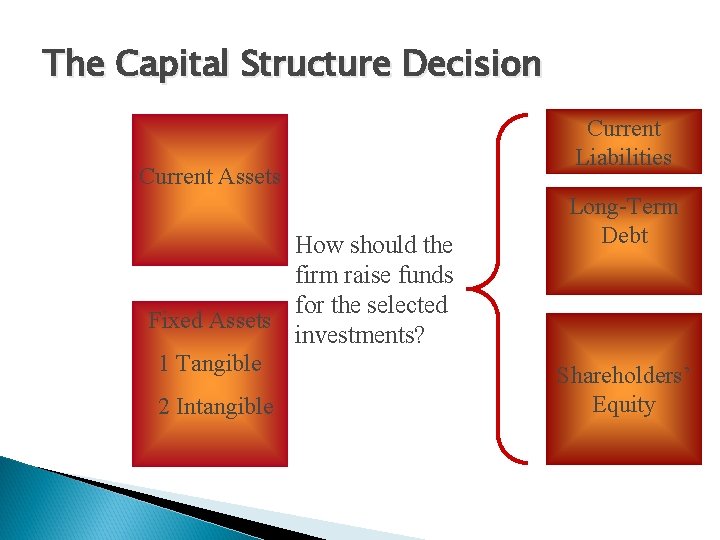
The Capital Structure Decision Current Assets How should the firm raise funds for the selected Fixed Assets investments? 1 Tangible 2 Intangible Current Liabilities Long-Term Debt Shareholders’ Equity 1 -5
Short-Term Asset Management Current Assets Fixed Assets 1 Tangible 2 Intangible Current Liabilities Net Working Capital How should short -term assets be managed and financed? Long-Term Debt Shareholders’ Equity Copyright © 2016 Mc. Graw-Hill Education. All rights reserved. No reproduction or distribution without the prior written consent of Mc. Graw-Hill Education. . 1 -6
The Financial Manager’s primary goal is to increase the value of the firm by: 1. Selecting value creating projects 2. Making smart financing decisions Copyright © 2016 Mc. Graw-Hill Education. All rights reserved. No reproduction or distribution without the prior written consent of Mc. Graw-Hill Education. 1 -7
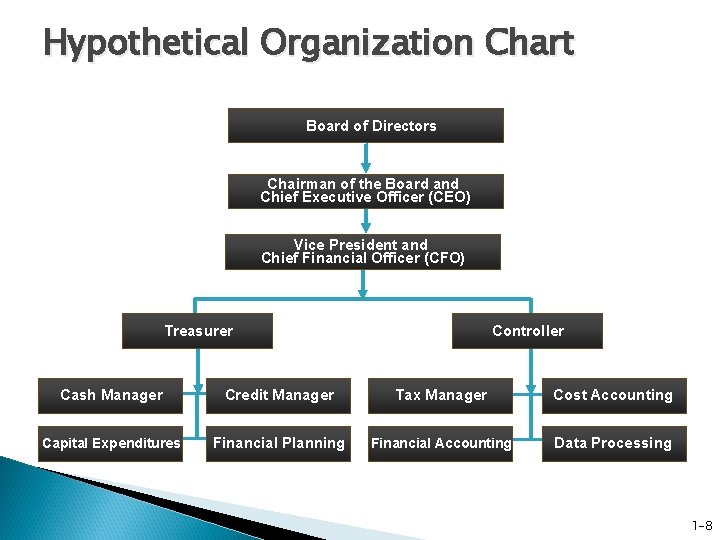
Hypothetical Organization Chart Board of Directors Chairman of the Board and Chief Executive Officer (CEO) Vice President and Chief Financial Officer (CFO) Treasurer Controller Cash Manager Credit Manager Tax Manager Cost Accounting Capital Expenditures Financial Planning Financial Accounting Data Processing 1 -8
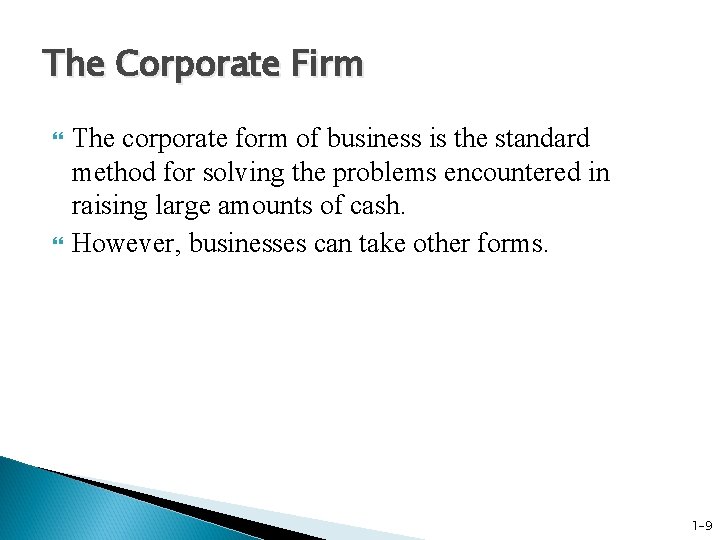
The Corporate Firm The corporate form of business is the standard method for solving the problems encountered in raising large amounts of cash. However, businesses can take other forms. 1 -9
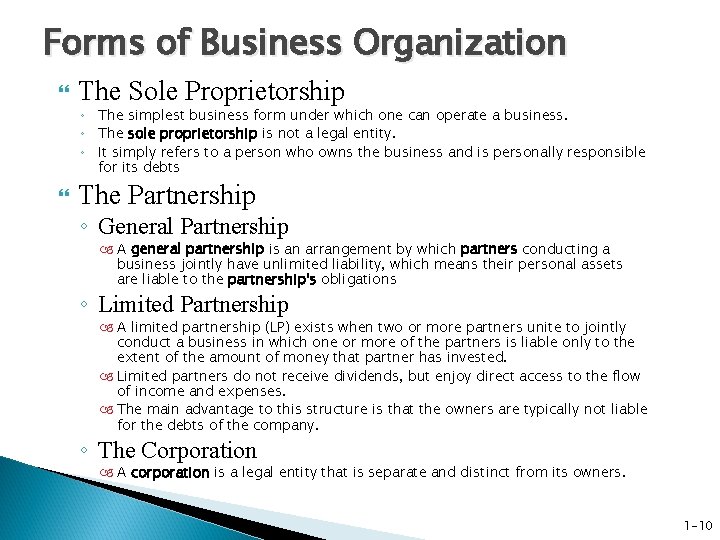
Forms of Business Organization The Sole Proprietorship ◦ The simplest business form under which one can operate a business. ◦ The sole proprietorship is not a legal entity. ◦ It simply refers to a person who owns the business and is personally responsible for its debts The Partnership ◦ General Partnership A general partnership is an arrangement by which partners conducting a business jointly have unlimited liability, which means their personal assets are liable to the partnership's obligations ◦ Limited Partnership A limited partnership (LP) exists when two or more partners unite to jointly conduct a business in which one or more of the partners is liable only to the extent of the amount of money that partner has invested. Limited partners do not receive dividends, but enjoy direct access to the flow of income and expenses. The main advantage to this structure is that the owners are typically not liable for the debts of the company. ◦ The Corporation A corporation is a legal entity that is separate and distinct from its owners. 1 -10
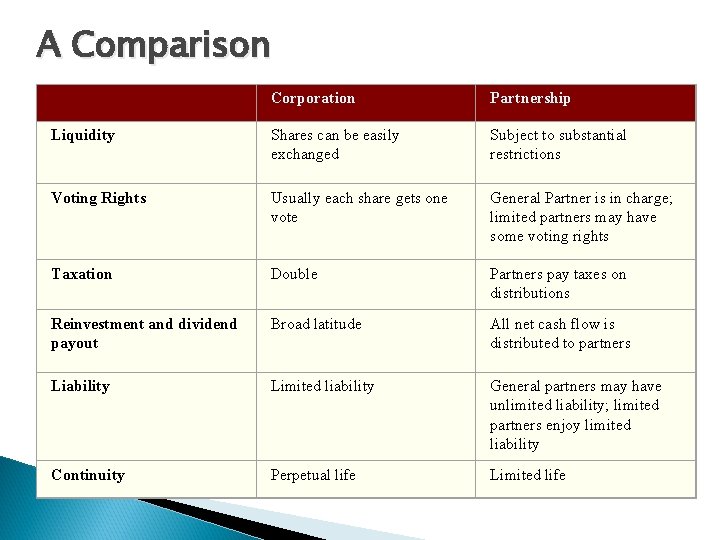
A Comparison Corporation Partnership Liquidity Shares can be easily exchanged Subject to substantial restrictions Voting Rights Usually each share gets one vote General Partner is in charge; limited partners may have some voting rights Taxation Double Partners pay taxes on distributions Reinvestment and dividend payout Broad latitude All net cash flow is distributed to partners Liability Limited liability General partners may have unlimited liability; limited partners enjoy limited liability Continuity Perpetual life Limited life 1 -11
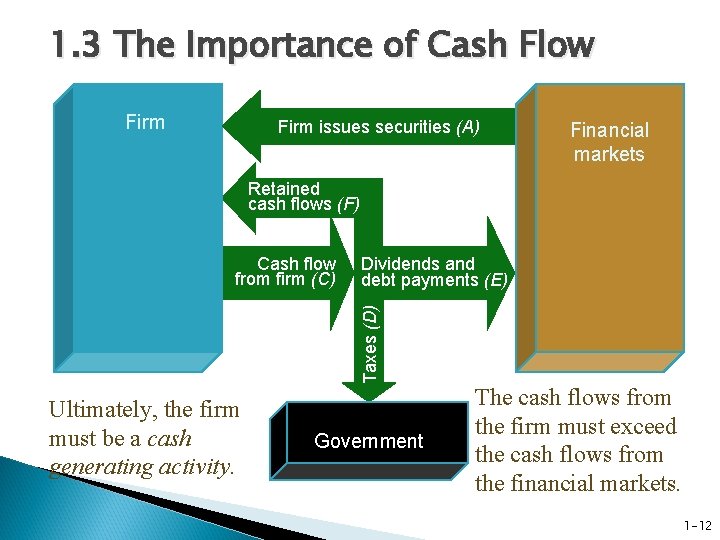
1. 3 The Importance of Cash Flow Firm issues securities (A) Invests in assets (B) Retained cash flows (F) Short-term debt Cash flow from firm (C) Dividends and debt payments (E) Taxes (D) Current assets Fixed assets Financial markets Ultimately, the firm must be a cash generating activity. Government Long-term debt Equity shares The cash flows from the firm must exceed the cash flows from the financial markets. 1 -12
The Goal of Financial Management What is the correct goal? ◦ ◦ Maximize profit? Minimize costs? Maximize market share? Maximize shareholder wealth? 1 -13
1. 5 The Agency Problem Agency relationship ◦ Principal hires an agent to represent his/her interest ◦ Stockholders (principals) hire managers (agents) to run the company Agency problem ◦ Conflict of interest between principal and agent 1 -14
Managerial Goals Managerial goals may be different from shareholder goals ◦ Expensive perquisites ◦ Survival ◦ Independence Increased growth and size are not necessarily equivalent to increased shareholder wealth 1 -15
Managing Managers Managerial compensation ◦ Incentives can be used to align management and stockholder interests ◦ The incentives need to be structured carefully to make sure that they achieve their intended goal Corporate control ◦ The threat of a takeover may result in better management Other stakeholders 1 -16
Regulation The Securities Act of 1933 and the Securities Exchange Act of 1934 ◦ Issuance of Securities (1933) ◦ Creation of SEC and reporting requirements (1934) Sarbanes-Oxley (“Sarbox”) ◦ Increased reporting requirements and responsibility of corporate directors To improve financial disclosures from corporations and prevent accounting fraud. 1 -17