
Chapter 1 Introduction to Consumer Behaviour Canadian Edition
Chapter 1 Introduction to Consumer Behaviour Canadian Edition Schiffman/Kanuk/Das

Opening Vignettes n Tim Horton’s started in 1964 • Merged with Wendy’s in 1999 • Has operations in several states in the US • Mercedes Who is likely to be the typical buyer of Smart? Copyright © 2006 Pearson Education Canada Inc. 2

Consumer Behaviour The behaviour that consumers display in searching for, purchasing, using, evaluating, and disposing of products and services that they expect will satisfy their needs. Copyright © 2006 Pearson Education Canada Inc. 3

Personal Consumer The individual who buys goods and services for his or her own use, for household use, for the use of a family member, or for a friend. Copyright © 2006 Pearson Education Canada Inc. 4
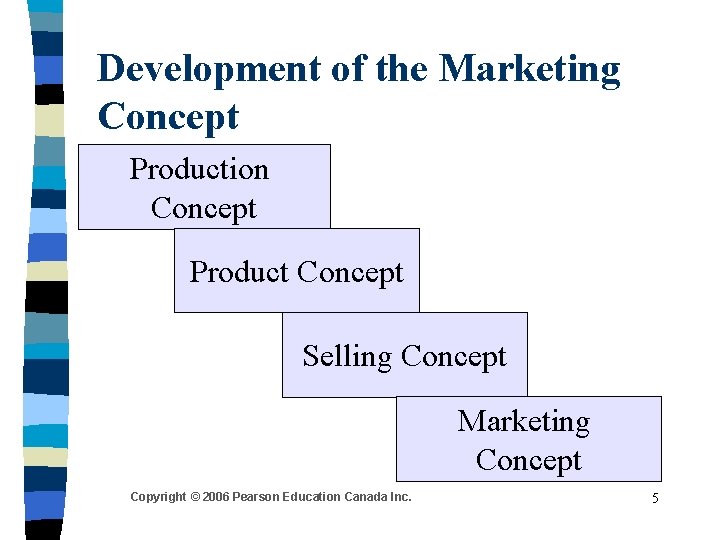
Development of the Marketing Concept Production Concept Product Concept Selling Concept Marketing Concept Copyright © 2006 Pearson Education Canada Inc. 5
The Production Concept n Assumes that consumers are interested primarily in product availability at low prices n Marketing objectives: – Cheap, efficient production – Intensive distribution – Market expansion Copyright © 2006 Pearson Education Canada Inc. 6

The Product Concept n Assumes that consumers will buy the product that offers them the highest quality, the best performance, and the most features n Marketing objectives: – Quality improvement – Addition of features n Tendency toward Marketing Copyright © 2006 Pearson Education Canada Inc. Myopia 7
The Selling Concept n Assumes that consumers are unlikely to buy a product unless they are aggressively persuaded to do so n Marketing objectives: – Sell, sell n Lack of concern for customer needs and satisfaction Copyright © 2006 Pearson Education Canada Inc. 8
The Marketing Concept n Assumes that to be successful, a company must determine the needs and wants of specific target markets and deliver the desired satisfactions better than the competition n Marketing objectives: – Profits through customer satisfaction Copyright © 2006 Pearson Education Canada Inc. 9
Business Leaders Who Understood Consumer Behaviour n Alfred Sloan, General Motors n Colonel Sanders, KFC n Ray Kroc, Mc. Donald’s Copyright © 2006 Pearson Education Canada Inc. 10
Implementing the Marketing Concept n Consumer Research n Segmentation n Targeting n Positioning Copyright © 2006 Pearson Education Canada Inc. 11
Segmentation, Targeting, and Positioning n Segmentation: process of dividing the market into subsets of consumers with common needs or characteristics n Targeting: selecting one ore more of the segments to pursue n Positioning: developing a distinct image for the product in the mind of the consumer Copyright © 2006 Pearson Education Canada Inc. 12
Successful Positioning n Communicating the benefits of the product, rather than its features n Communicating a Unique Selling Proposition for the product Copyright © 2006 Pearson Education Canada Inc. 13
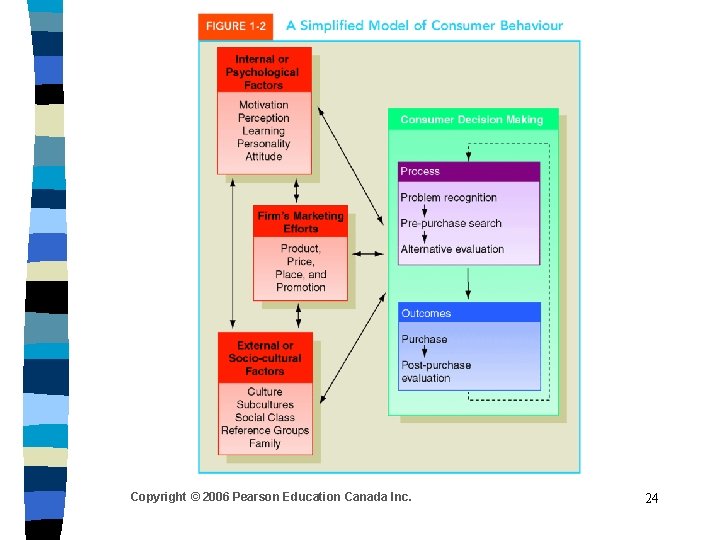
The Marketing Mix n Product n Price n Place n Promotion Copyright © 2006 Pearson Education Canada Inc. 14
The Societal Marketing Concept n All companies prosper when society prospers. n Companies, as well as individuals, would be better off if social responsibility was an integral component of every marketing decision. n Requires all marketers adhere to principles of social responsibility. Copyright © 2006 Pearson Education Canada Inc. 15
Digital Revolution in the Marketplace n Allows customization of products, services, and promotional messages like never before n Enhances relationships with customers more effectively and efficiently n Has increased the power of customers and given them access to more information Copyright © 2006 Pearson Education Canada Inc. 16
Digital Revolution in the Marketplace - Continued n The exchange between consumers and marketers has become more interactive n May affect the way marketing is done Copyright © 2006 Pearson Education Canada Inc. 17
Changes brought on by the digital revolution n Changes in segmentation strategies n Re-evaluation of promotional budgets – reduced impact of television? – More internet-based promotion? n Integrated marketing becomes critical – Using off-line promotions to drive consumers to company’s website (and vice-a-versa) Copyright © 2006 Pearson Education Canada Inc. 18 » Continued
Changes brought on by the digital revolution - continued n Revamping distribution systems – Direct distribution becomes more of an option n Pricing methods may need to be reevaluated – Comparison shopping made easier n Consumer research methods may change – How do you measure web-based promotions? Copyright © 2006 Pearson Education Canada Inc. 19
Why study consumer behaviour? n Understanding consumer behaviour will help you become better marketers as it is the foundation for § Segmenting markets § Positioning products § Developing an appropriate marketing § continued Copyright © 2006 Pearson Education Canada Inc. 20

Why study consumer behaviour? n Knowledge of consumer behaviour is essential for non-profit organizations – Non profits have different customers to please – Donors, users, volunteers, general public, government » continued Copyright © 2006 Pearson Education Canada Inc. 21
Why study consumer behaviour? n Public service initiatives have to be based on an understanding of consumer behaviour – Canada’s largest advertiser is the federal government – Most government initiatives (e. g. , antismoking campaigns) need a knowledge of consumer behaviour to succeed » continued Copyright © 2006 Pearson Education Canada Inc. 22
Why study consumer behaviour? n Better understanding of our own consumption behaviour Copyright © 2006 Pearson Education Canada Inc. 23
Copyright © 2006 Pearson Education Canada Inc. 24
- Slides: 24