
Chapter 1 Introduction to Computers Prebell Day 1
Chapter 1 Introduction to Computers

Prebell Day 1 –Week 3 and Objective • • Objective: Identify computer terminology & components Prebell Question: Describe how you use a computer CREATE A SENTENCE WITH VOC. WORDS Vocabulary: annihilate—kill in large numbers MCT 2 Word: Explain—tell how
Prebell Day 2 Week 3 and Objective • Objective: The student will identify types of computers and the functions of computer hardware. • Prebell Question: Describe one part of the computer. Vocabulary Word-antagonize-provoke the hostility MCT 2 Word-Summarize-give me the short version. • •
Day 3 Objective –Week 3 Prebell Question –Voc. • OBJECTIVE: The student will identify the operating system and how it works. • PREBELL QUESTION –DAY 3 DESCRIBE ONE COMPUTER JOB SUCH AS A TECHNICIAN OR PROGRAMMER • • • VOCABULARY WORD—congested: become obstructed or blocked MCT 2 WORD: COMPARE—all the ways they are alike
Day 4 Objective Prebell Questions- Week 3 Vocabulary • Objective: The student will demonstrate precautions when using computer system. • PRE-BELL QUESTION –DAY 4 Why are safety precautions are so important when using a computer system. • • • Vocabulary Word—Day 4 dwindle—become smaller MCT 2 word—Contrast-they are different
Day 5 OBJECTIVE-PREBELL QUESTION • Objective: The student will demonstrate their strengths and weaknesses on computer components and safety skills • Pre Bell Question: Why is computer skills so important in the World of Work? Explain No Vocabulary on Friday • •
OBJECTIVE-TUES --BELLWORK • Tuesday Objective: • The student will discuss and demonstrate setting up a simple computer • Prebell Question-Tuesday • Explain computer components –input devices and output devices from last week’s lessons. CREATE A SENTENCE WITH EACH WORD. Voc. Word: hospitable-favorable; treat guest with cordiality MCT 2 Word: predict-what will happen next • • •
OBJECTIVE-WED. --BELLWORK • Wednesday Objective: • The student will demonstrate mastery of terminology related to computer application. • PREBELL QUESTION--Explain the storage device component. • CREATE A SENTENCE WITH EACH WORD-Voc. Word: insulated—protected from heat, cold, noise with insulated material MCT 2 word—trace—list in steps •
OBJECTIVE-THURS. --BELLWORK • Thursday Objective: • The student will identify factors that go into decisions on how to purchase computer equipments. • PREBELL QUESTION--Explain the term “Windows” means in computer language CREATE A SENTENCE WITH EACH WORD-Voc. Word: literary—relating to or dealing with good literature. MCT 2 word—analyze—break apart • •
FRIDAY OBJECTIVE-BELL WORK • OBJECTIVE: THE STUDENT WILL DEMONSTRATE MASTERY OF COMPUTER APPLICATION TERMINOLOGY. • BELL WORK QUESTION: DESCRIBE THE STEPS FOR SETTING UP A COMPUTER—SEE 1 ST HOMEWORK PAGE THIS WEEK • NO VOCABULARY ON FRIDAY
WORD BANK FOR TEST Week 4 • • • CLICK DOUBLE CLICK RIGHT CLICK DRAG WINDOWS MINIMIZE MAXIMIZE RESTORE ICON FILE NAME
Chapter 1 Objectives Recognize the importance of computer literacy Distinguish between system software and application software Define the term, computer Describe the categories of computers Identify the components of a computer Discuss the advantages and disadvantages of using computers Identify the elements of an information system Describe the various types of computer users Recognize the purpose of a network Discuss the uses of the Internet and World Wide Web Discuss various computer applications in society Next
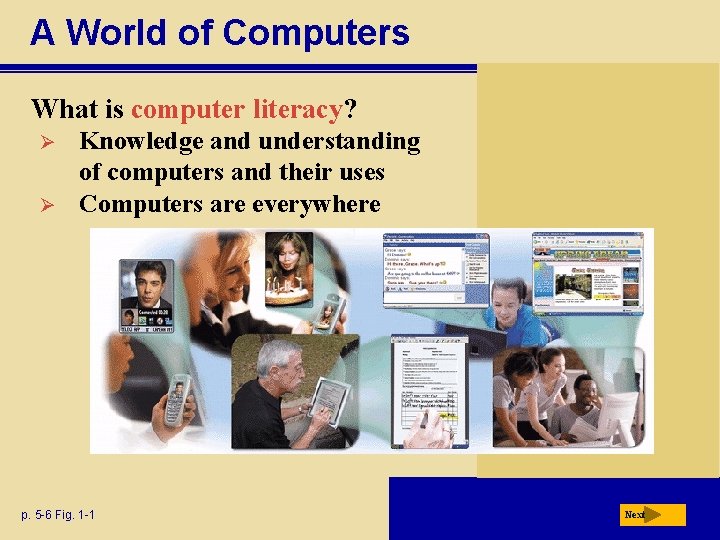
A World of Computers What is computer literacy? Ø Ø Knowledge and understanding of computers and their uses Computers are everywhere p. 5 -6 Fig. 1 -1 Next
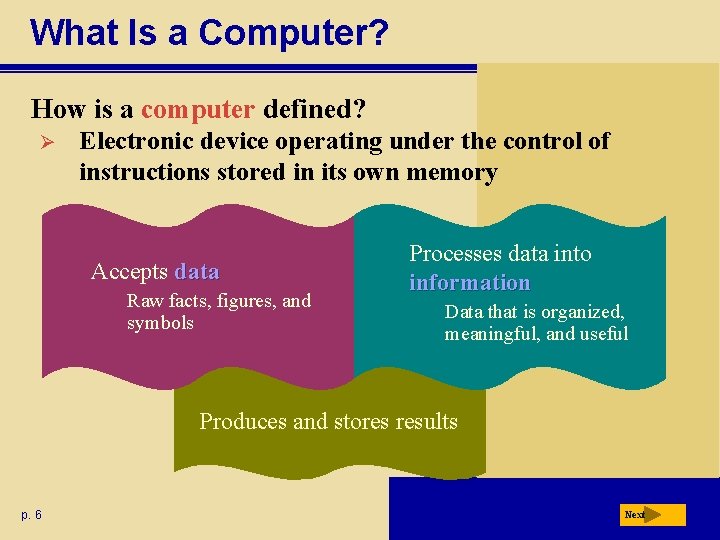
What Is a Computer? How is a computer defined? Ø Electronic device operating under the control of instructions stored in its own memory Accepts data Raw facts, figures, and symbols Processes data into information Data that is organized, meaningful, and useful Produces and stores results p. 6 Next
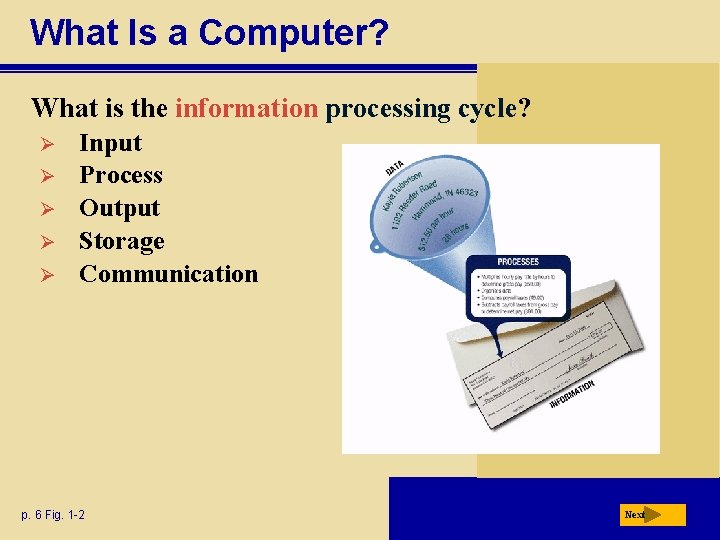
What Is a Computer? What is the information processing cycle? Ø Ø Ø Input Process Output Storage Communication p. 6 Fig. 1 -2 Next
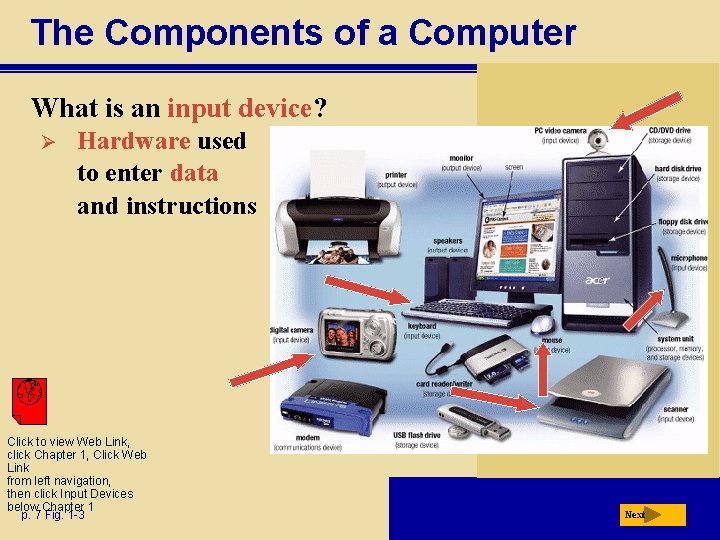
The Components of a Computer What is an input device? Ø Hardware used to enter data and instructions Click to view Web Link, click Chapter 1, Click Web Link from left navigation, then click Input Devices below Chapter 1 p. 7 Fig. 1 -3 Next
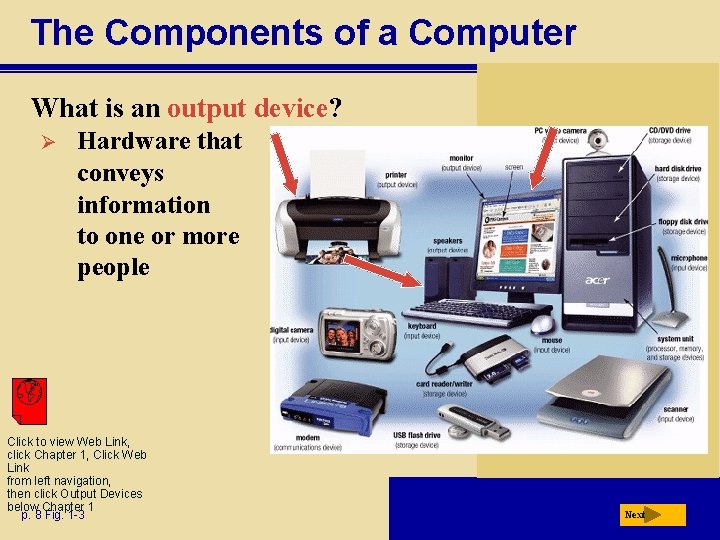
The Components of a Computer What is an output device? Ø Hardware that conveys information to one or more people Click to view Web Link, click Chapter 1, Click Web Link from left navigation, then click Output Devices below Chapter 1 p. 8 Fig. 1 -3 Next
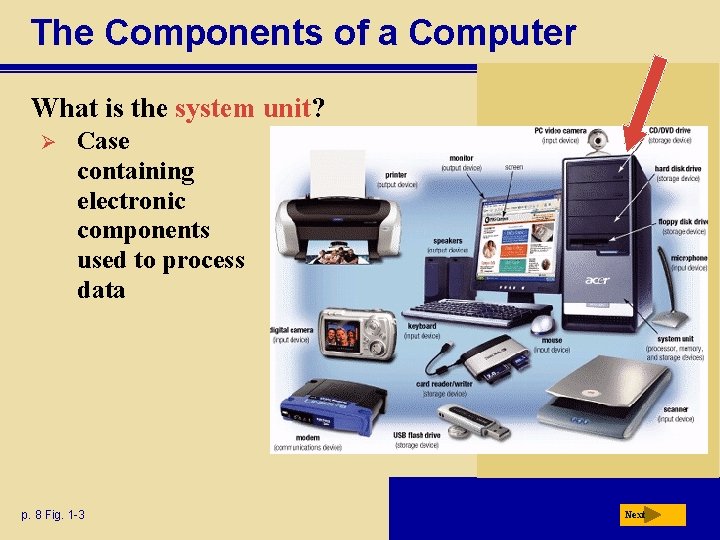
The Components of a Computer What is the system unit? Ø Case containing electronic components used to process data p. 8 Fig. 1 -3 Next
The Components of a Computer What are two main components on the motherboard? Central Processing Unit (CPU) Also called a processor The electronic component that interprets and carries out the basic instructions that operate the computer Memory Consists of electronic components that store instructions waiting to be executed and data needed by those instructions p. 8 Next
The Components of a Computer What is storage? Ø Holds data, instructions, and information for future use Storage media Physical material on which data, instructions, and information are stored Storage device Records and retrieves items to and from a storage medium p. 8 Next
The Components of a Computer What is storage media? Digital cameras Portable, thin memory cards used in: p. 8 Handheld computers Next
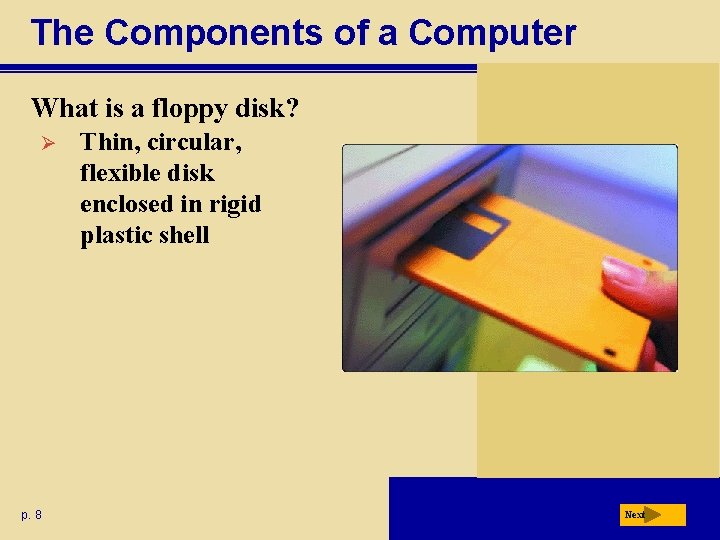
The Components of a Computer What is a floppy disk? Ø p. 8 Thin, circular, flexible disk enclosed in rigid plastic shell Next
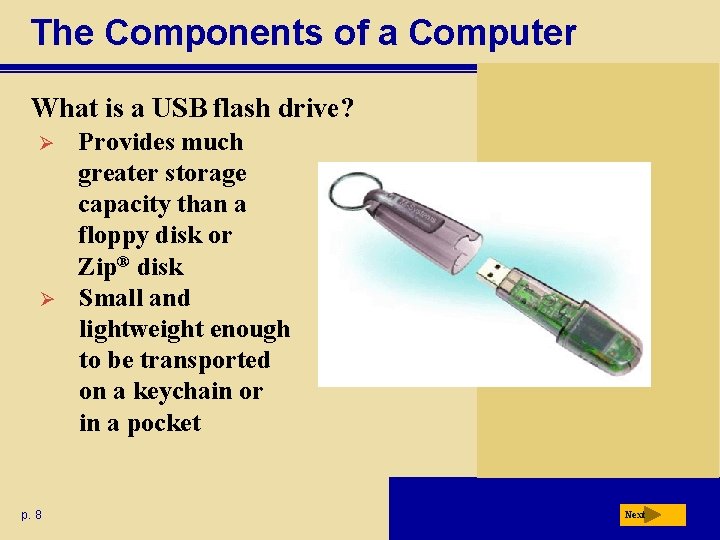
The Components of a Computer What is a USB flash drive? Ø Ø p. 8 Provides much greater storage capacity than a floppy disk or Zip® disk Small and lightweight enough to be transported on a keychain or in a pocket Next
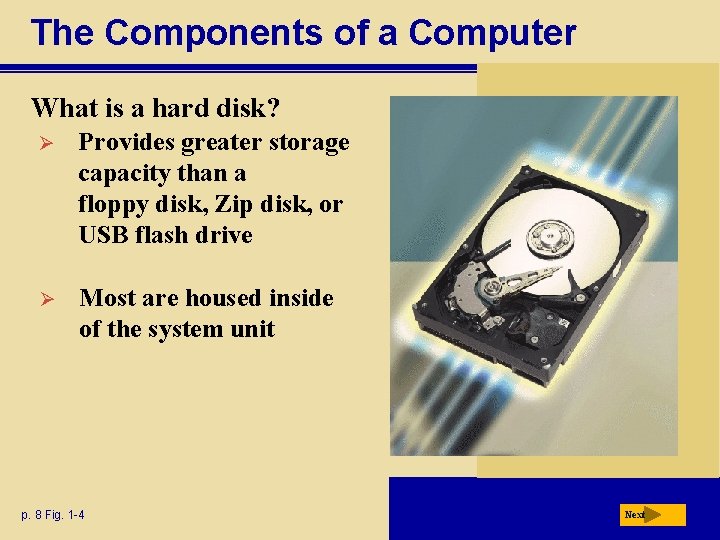
The Components of a Computer What is a hard disk? Ø Provides greater storage capacity than a floppy disk, Zip disk, or USB flash drive Ø Most are housed inside of the system unit p. 8 Fig. 1 -4 Next
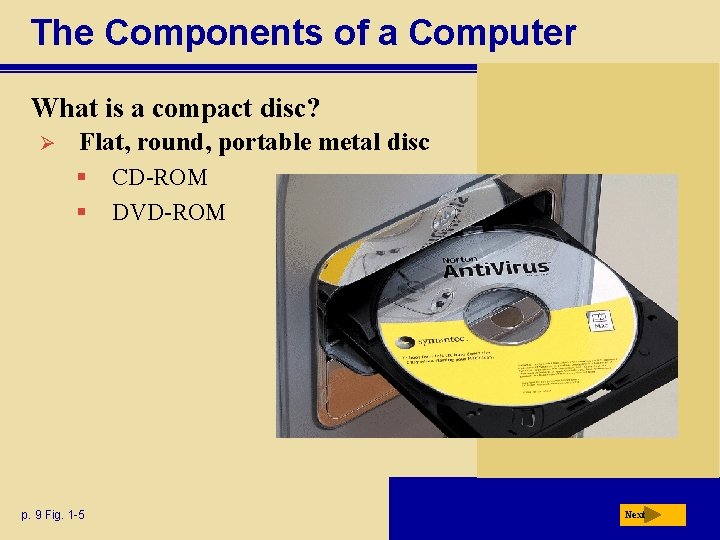
The Components of a Computer What is a compact disc? Ø Flat, round, portable metal disc § § p. 9 Fig. 1 -5 CD-ROM DVD-ROM Next
The Components of a Computer What is a communications device? Hardware component that enables a computer to send and receive data, instructions, and information Click to view Web Link, click Chapter 1, Click Web Link from left navigation, then click Communications Devices below Chapter 1 p. 9 Occurs over cables, telephone lines, cellular radio networks, satellites, and other transmission media Next
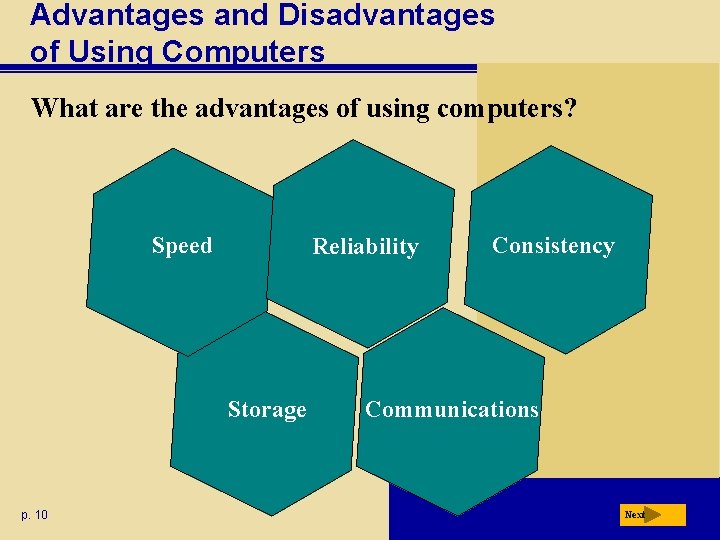
Advantages and Disadvantages of Using Computers What are the advantages of using computers? Speed Reliability Storage p. 10 Consistency Communications Next
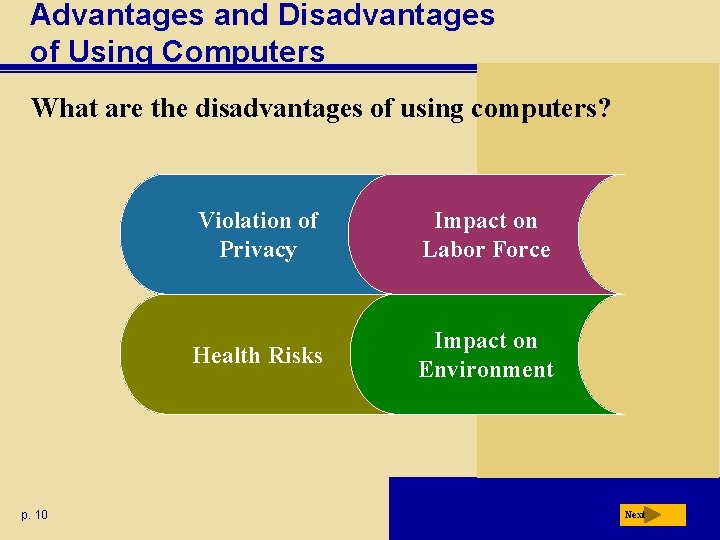
Advantages and Disadvantages of Using Computers What are the disadvantages of using computers? p. 10 Violation of Privacy Impact on Labor Force Health Risks Impact on Environment Next
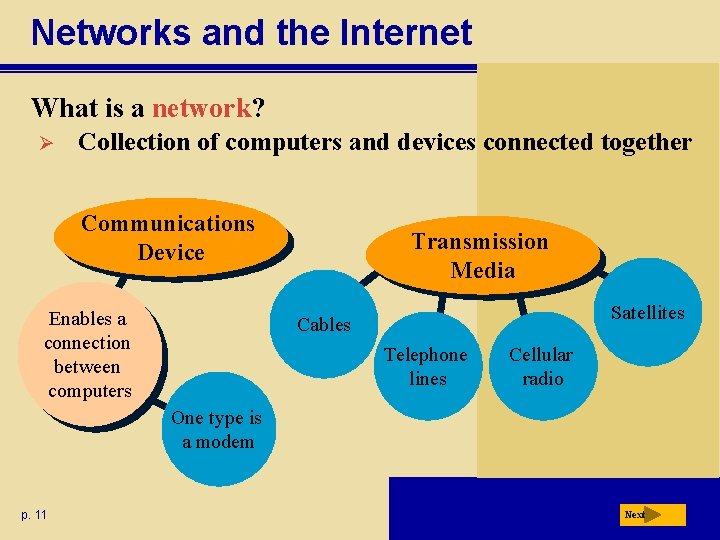
Networks and the Internet What is a network? Ø Collection of computers and devices connected together Communications Device Enables a connection between computers Transmission Media Satellites Cables Telephone lines Cellular radio One type is a modem p. 11 Next
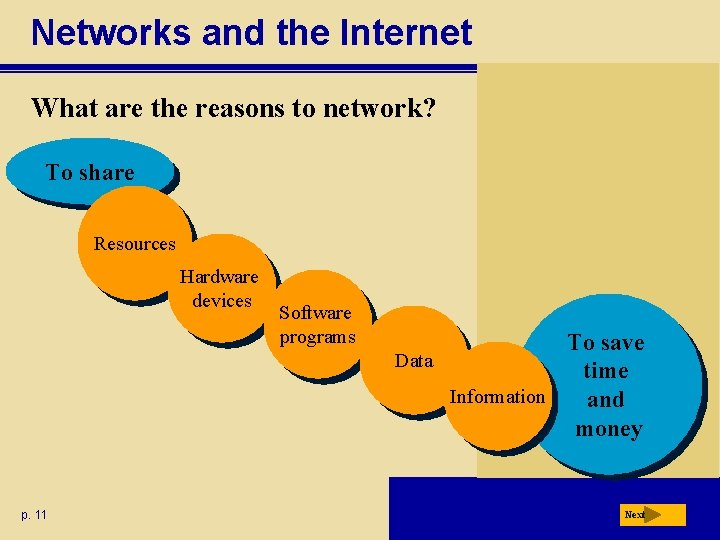
Networks and the Internet What are the reasons to network? To share Resources Hardware devices p. 11 Software programs To save Data time Information and money Next
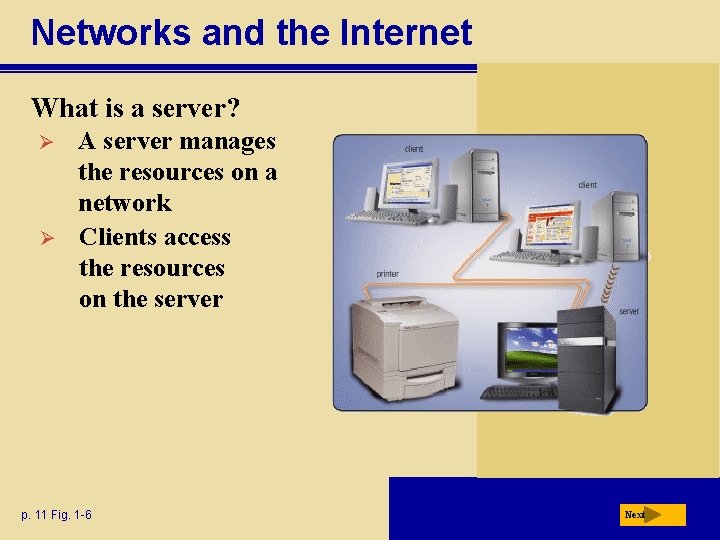
Networks and the Internet What is a server? Ø Ø A server manages the resources on a network Clients access the resources on the server p. 11 Fig. 1 -6 Next
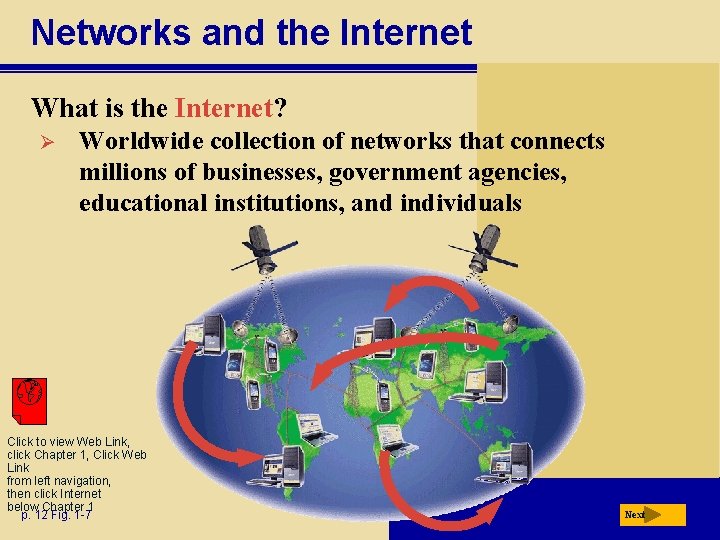
Networks and the Internet What is the Internet? Ø Worldwide collection of networks that connects millions of businesses, government agencies, educational institutions, and individuals Click to view Web Link, click Chapter 1, Click Web Link from left navigation, then click Internet below Chapter 1 p. 12 Fig. 1 -7 Next
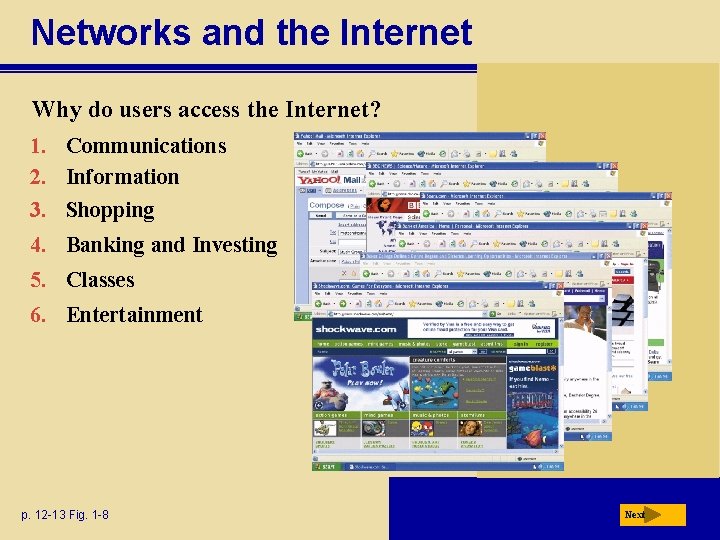
Networks and the Internet Why do users access the Internet? 1. Communications 2. Information 3. Shopping 4. Banking and Investing 5. Classes 6. Entertainment p. 12 -13 Fig. 1 -8 Next
Networks and the Internet What is the Web? Ø Billions of documents, called Web pages, available to anyone connected to the Internet A Web site is a collection of related Web pages p. 12 A Web page contains text, graphics, sound, video, and links to other Web pages You can share information by creating Web pages or posting photos on a photo sharing community Next
Computer Software What is software? Consists of a series of instructions that tells the computer what to do Click to view Web Link, click Chapter 1, Click Web Link from left navigation, then click Computer Programs below Chapter 1 p. 15 Also called a program Next
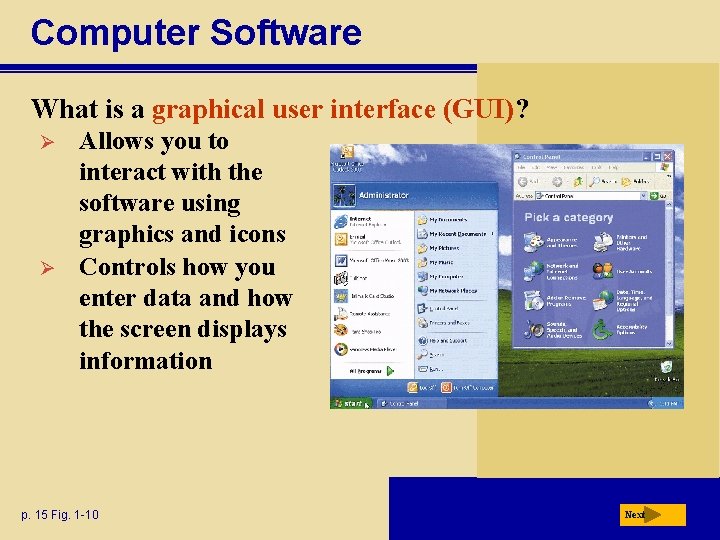
Computer Software What is a graphical user interface (GUI)? Ø Ø Allows you to interact with the software using graphics and icons Controls how you enter data and how the screen displays information p. 15 Fig. 1 -10 Next
Computer Software What is system software? Ø Programs that control or maintain the operations of the computer and its devices Operating System (OS) is a set of programs that coordinates all activities among computer hardware devices and allows users to run application software p. 15 -16 Utility Programs allow the user to perform maintenance-type tasks usually related to managing a computer, its devices or its programs Next
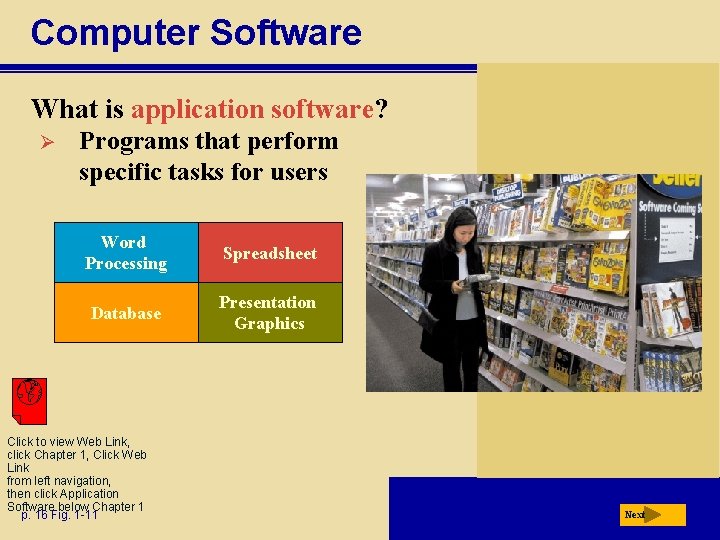
Computer Software What is application software? Ø Programs that perform specific tasks for users Word Processing Spreadsheet Database Presentation Graphics Click to view Web Link, click Chapter 1, Click Web Link from left navigation, then click Application Software below Chapter 1 p. 16 Fig. 1 -11 Next
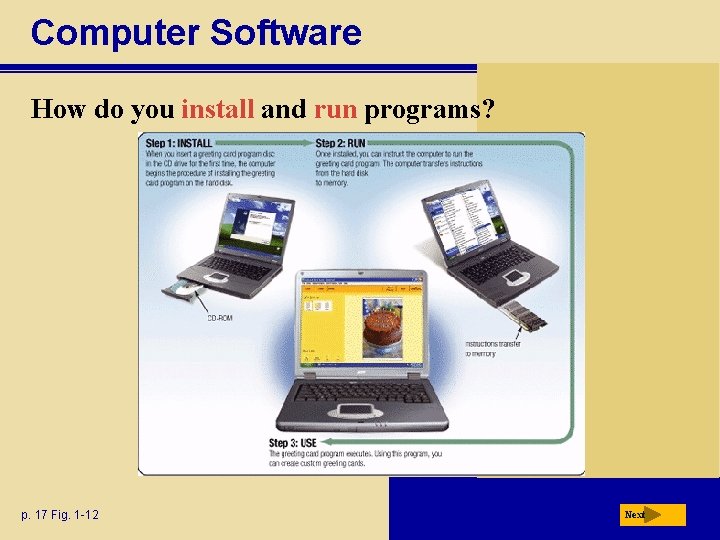
Computer Software How do you install and run programs? p. 17 Fig. 1 -12 Next
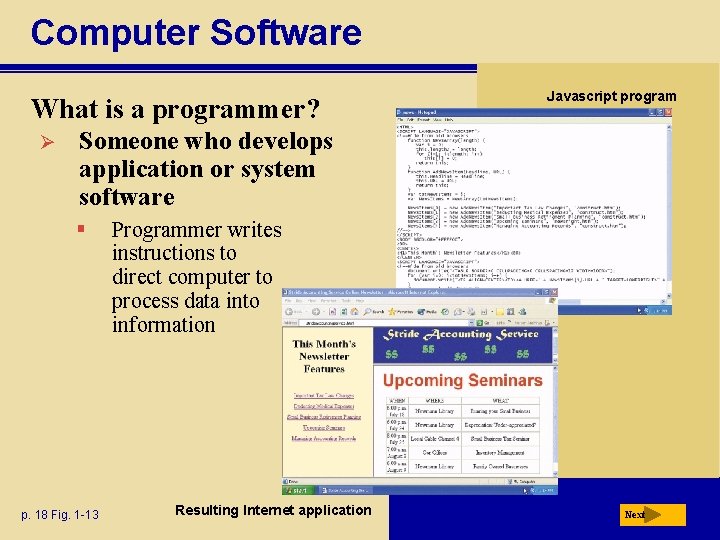
Computer Software What is a programmer? Ø Javascript program Someone who develops application or system software § p. 18 Fig. 1 -13 Programmer writes instructions to direct computer to process data into information Resulting Internet application Next
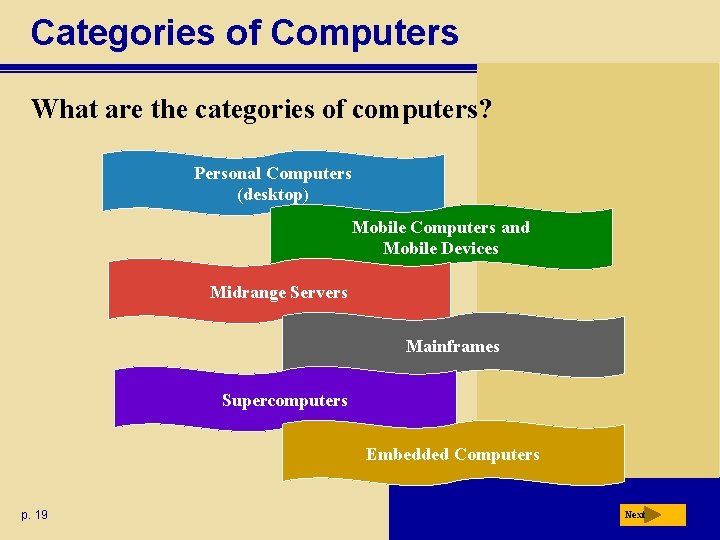
Categories of Computers What are the categories of computers? Personal Computers (desktop) Mobile Computers and Mobile Devices Midrange Servers Mainframes Supercomputers Embedded Computers p. 19 Next
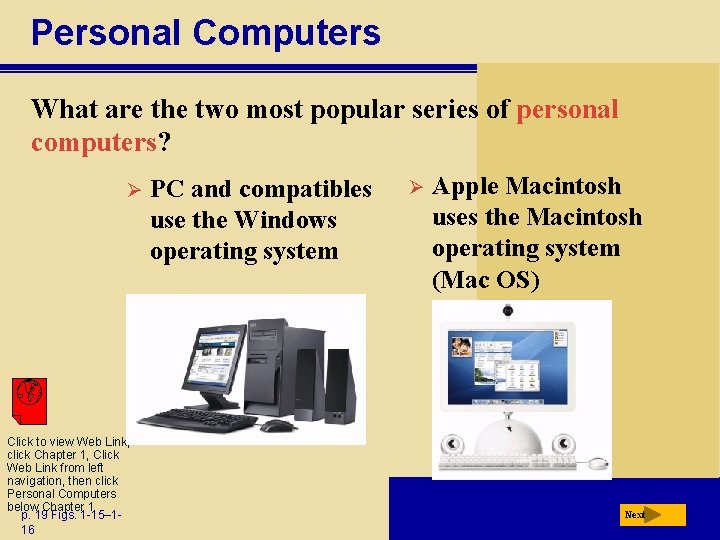
Personal Computers What are the two most popular series of personal computers? Ø Click to view Web Link, click Chapter 1, Click Web Link from left navigation, then click Personal Computers below Chapter 1 p. 19 Figs. 1 -15– 116 PC and compatibles use the Windows operating system Ø Apple Macintosh uses the Macintosh operating system (Mac OS) Next
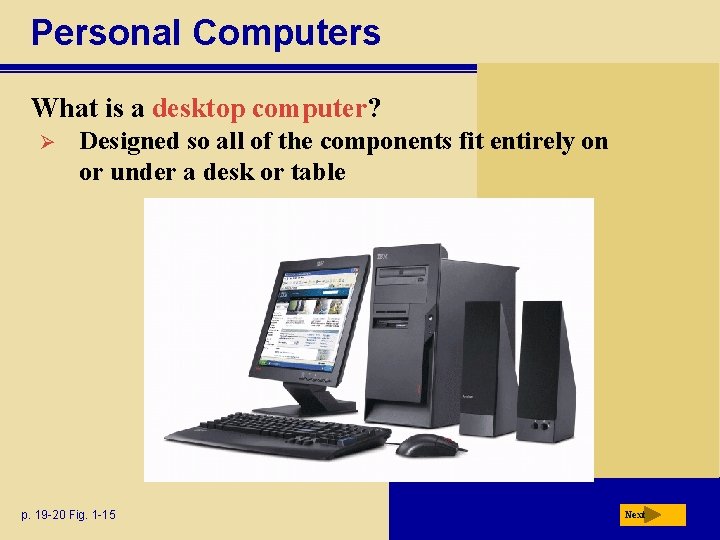
Personal Computers What is a desktop computer? Ø Designed so all of the components fit entirely on or under a desk or table p. 19 -20 Fig. 1 -15 Next
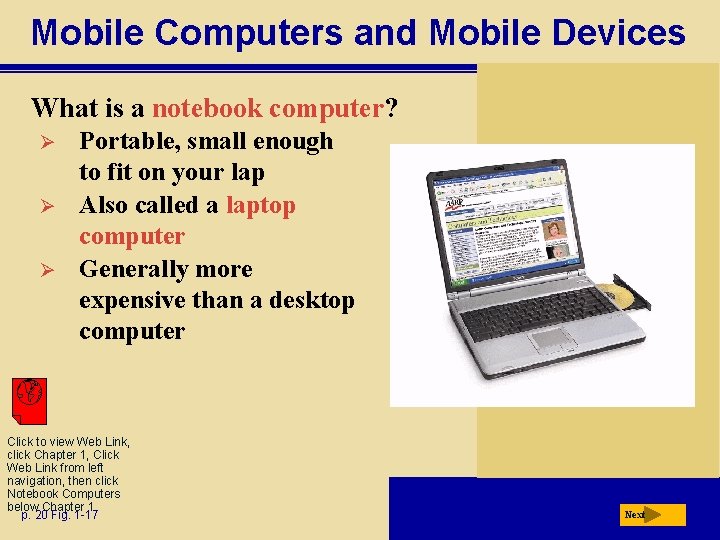
Mobile Computers and Mobile Devices What is a notebook computer? Ø Ø Ø Portable, small enough to fit on your lap Also called a laptop computer Generally more expensive than a desktop computer Click to view Web Link, click Chapter 1, Click Web Link from left navigation, then click Notebook Computers below Chapter 1 p. 20 Fig. 1 -17 Next
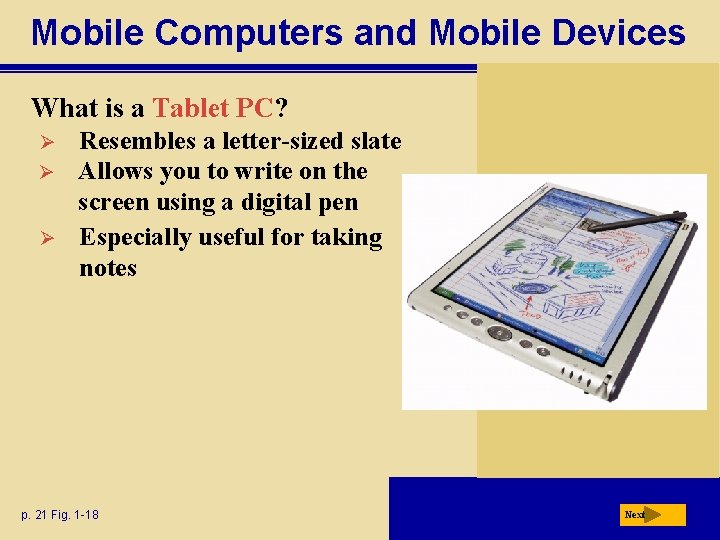
Mobile Computers and Mobile Devices What is a Tablet PC? Ø Ø Ø Resembles a letter-sized slate Allows you to write on the screen using a digital pen Especially useful for taking notes p. 21 Fig. 1 -18 Next
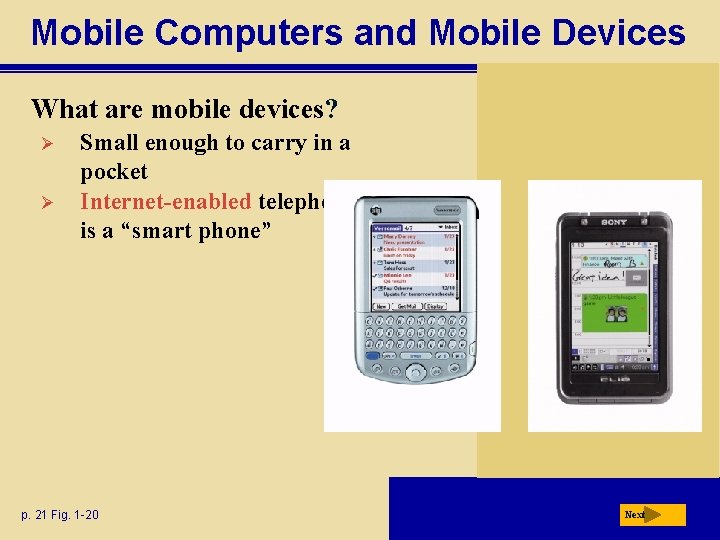
Mobile Computers and Mobile Devices What are mobile devices? Ø Ø Small enough to carry in a pocket Internet-enabled telephone is a “smart phone” p. 21 Fig. 1 -20 Next
Mobile Computers and Mobile Devices What is a handheld computer? Small enough to fit in one hand p. 21 Used by mobile employees such as meter readers and delivery people Next
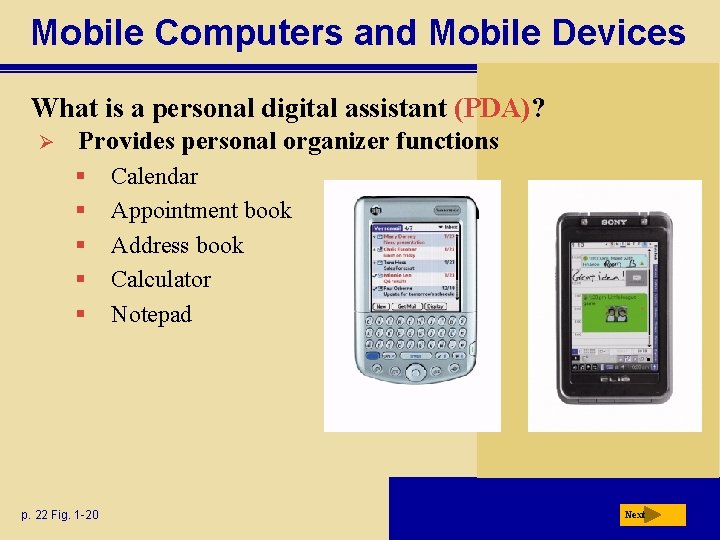
Mobile Computers and Mobile Devices What is a personal digital assistant (PDA)? Ø Provides personal organizer functions § § § p. 22 Fig. 1 -20 Calendar Appointment book Address book Calculator Notepad Next
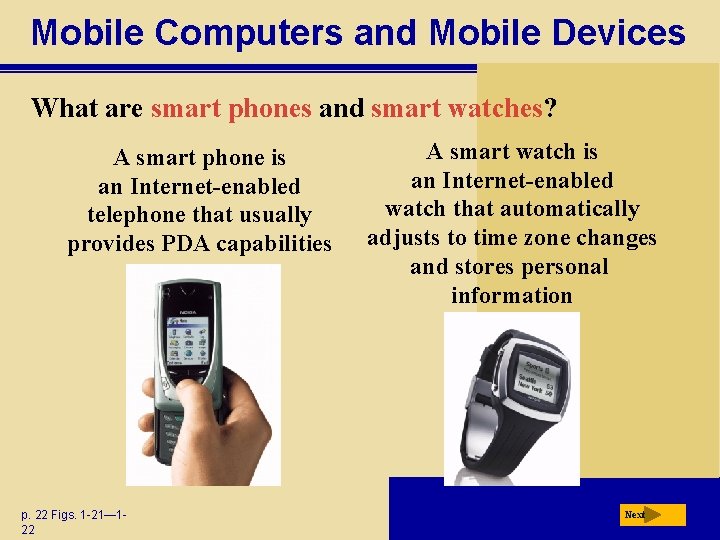
Mobile Computers and Mobile Devices What are smart phones and smart watches? A smart phone is an Internet-enabled telephone that usually provides PDA capabilities p. 22 Figs. 1 -21— 122 A smart watch is an Internet-enabled watch that automatically adjusts to time zone changes and stores personal information Next
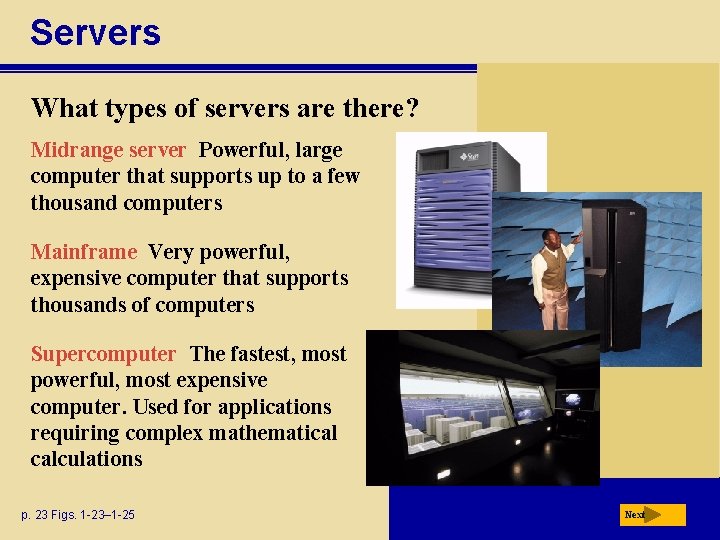
Servers What types of servers are there? Midrange server Powerful, large computer that supports up to a few thousand computers Mainframe Very powerful, expensive computer that supports thousands of computers Supercomputer The fastest, most powerful, most expensive computer. Used for applications requiring complex mathematical calculations p. 23 Figs. 1 -23– 1 -25 Next
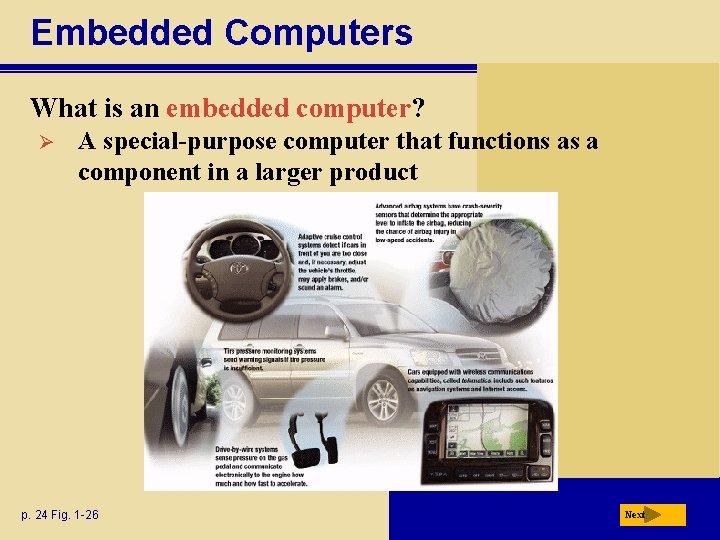
Embedded Computers What is an embedded computer? Ø A special-purpose computer that functions as a component in a larger product p. 24 Fig. 1 -26 Next
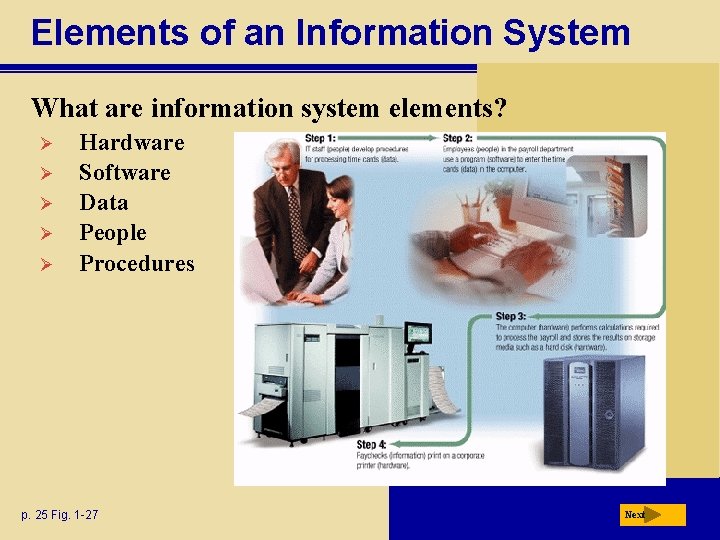
Elements of an Information System What are information system elements? Ø Ø Ø Hardware Software Data People Procedures p. 25 Fig. 1 -27 Next
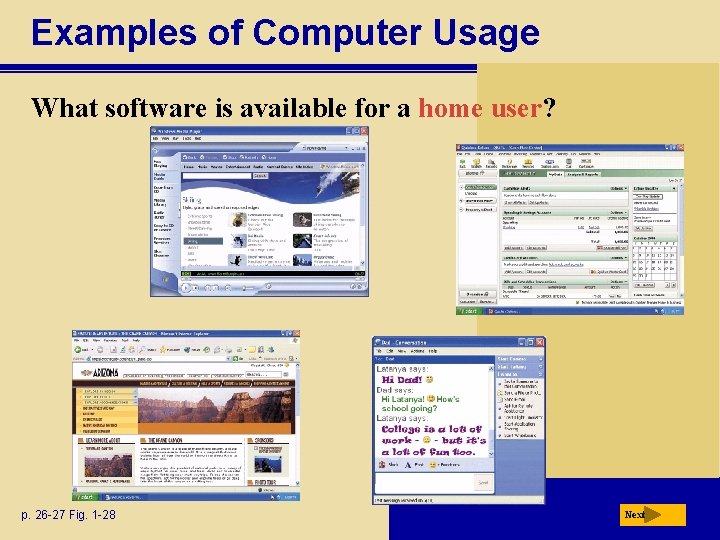
Examples of Computer Usage What software is available for a home user? p. 26 -27 Fig. 1 -28 Next
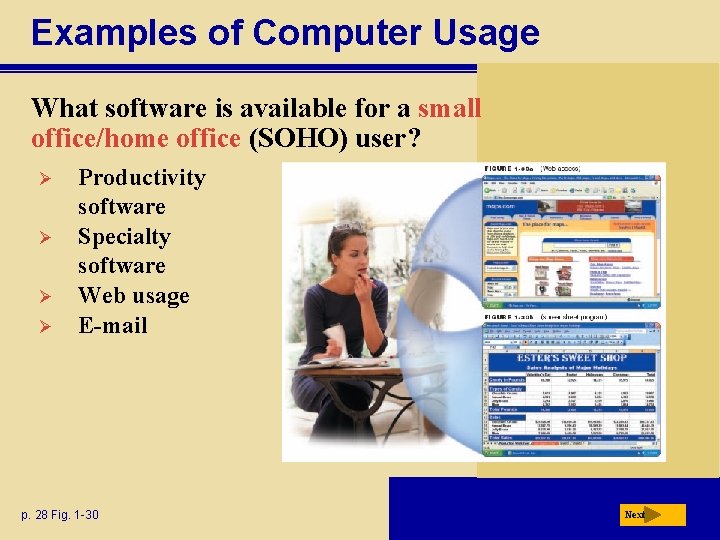
Examples of Computer Usage What software is available for a small office/home office (SOHO) user? Ø Ø Productivity software Specialty software Web usage E-mail p. 28 Fig. 1 -30 Next
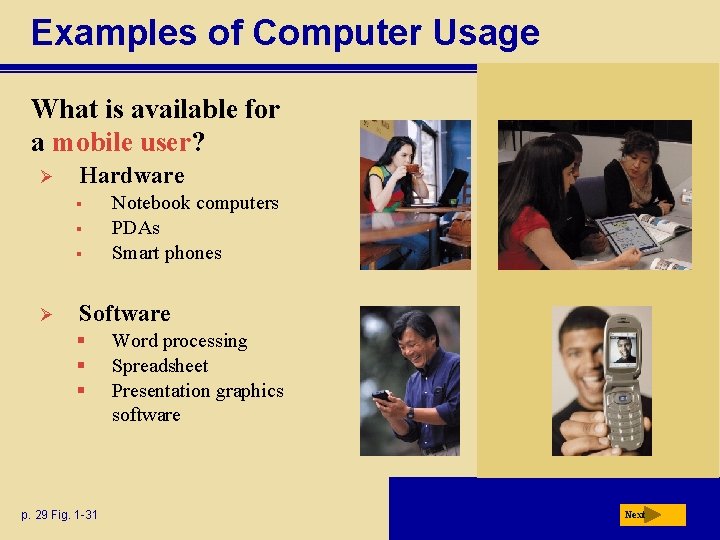
Examples of Computer Usage What is available for a mobile user? Ø Hardware § § § Ø Notebook computers PDAs Smart phones Software § § § p. 29 Fig. 1 -31 Word processing Spreadsheet Presentation graphics software Next
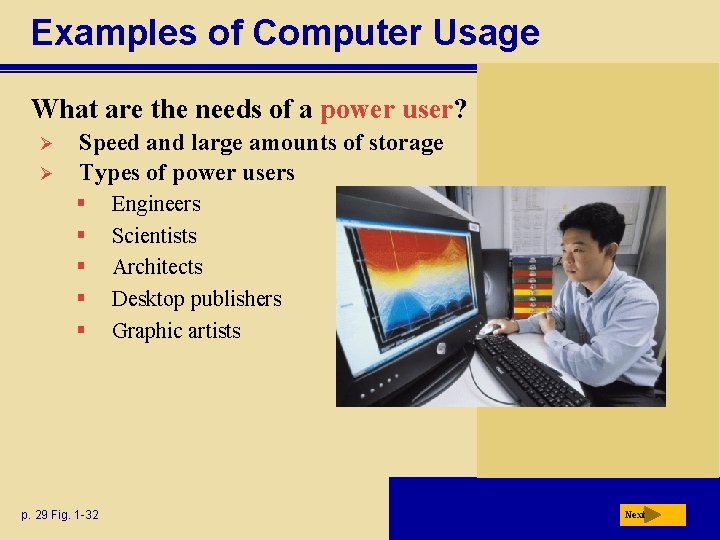
Examples of Computer Usage What are the needs of a power user? Ø Ø Speed and large amounts of storage Types of power users § § § p. 29 Fig. 1 -32 Engineers Scientists Architects Desktop publishers Graphic artists Next
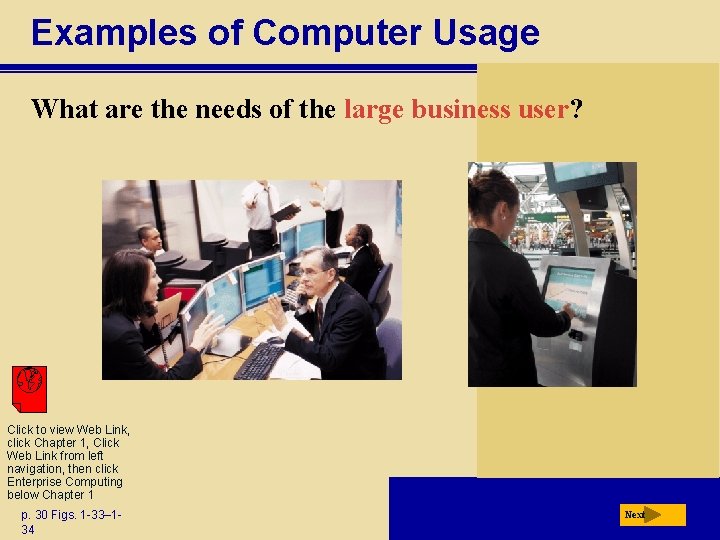
Examples of Computer Usage What are the needs of the large business user? Click to view Web Link, click Chapter 1, Click Web Link from left navigation, then click Enterprise Computing below Chapter 1 p. 30 Figs. 1 -33– 134 Next
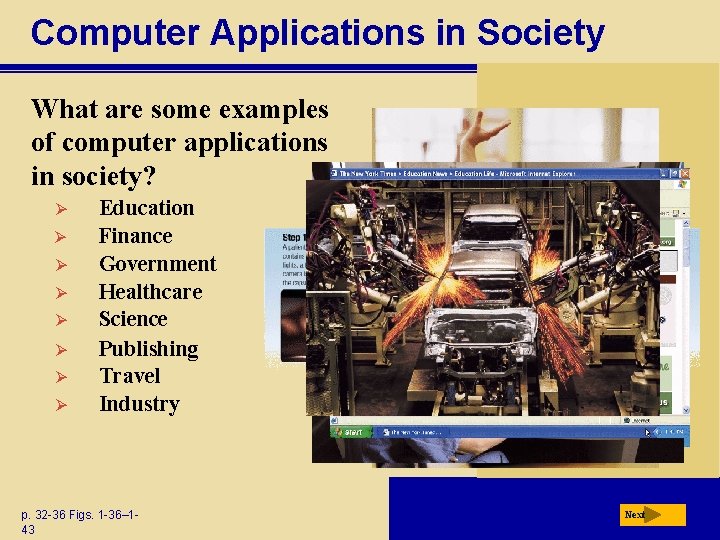
Computer Applications in Society What are some examples of computer applications in society? Ø Ø Ø Ø Education Finance Government Healthcare Science Publishing Travel Industry p. 32 -36 Figs. 1 -36– 143 Next
Summary of Introduction to Computers The importance of computer literacy The term, computer System software and application software Categories of computers The components of a computer The advantages and disadvantages of using computers Elements of an information system Types of computer users The purpose of a network The uses of the Internet and World Wide Web Chapter 1 Complete Computer applications in society
- Slides: 59