
Chapter 1 Introduction to Computers Internet and World

- Slides: 29
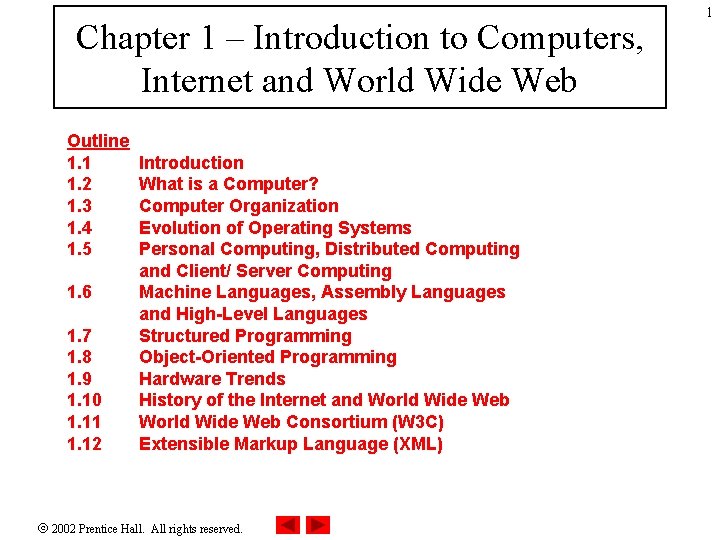
Chapter 1 – Introduction to Computers, Internet and World Wide Web Outline 1. 1 1. 2 1. 3 1. 4 1. 5 1. 6 1. 7 1. 8 1. 9 1. 10 1. 11 1. 12 Introduction What is a Computer? Computer Organization Evolution of Operating Systems Personal Computing, Distributed Computing and Client/ Server Computing Machine Languages, Assembly Languages and High-Level Languages Structured Programming Object-Oriented Programming Hardware Trends History of the Internet and World Wide Web Consortium (W 3 C) Extensible Markup Language (XML) 2002 Prentice Hall. All rights reserved. 1
Chapter 1 – Introduction to Computers, Internet and World Wide Web Outline 1. 13 1. 14 1. 15 1. 16 Open-Source Software Revolution History of Python Modules General Notes about Python and This Book 2002 Prentice Hall. All rights reserved. 2
4 1. 2 What is a Computer? • Computer – Device capable of • Performing computations • Making logical decisions – Works billions of times faster than human beings – Fastest supercomputers today • Perform hundreds of billions of additions per second 2002 Prentice Hall. All rights reserved.
5 1. 2 What is a Computer? (II) • Programs – Sets of instructions that process data – Guide computer through orderly sets of actions specified by computer programmers • Computer system – Comprised of various hardware devices • • • Keyboard Screen (monitor) Disks Memory Processing Units 2002 Prentice Hall. All rights reserved.
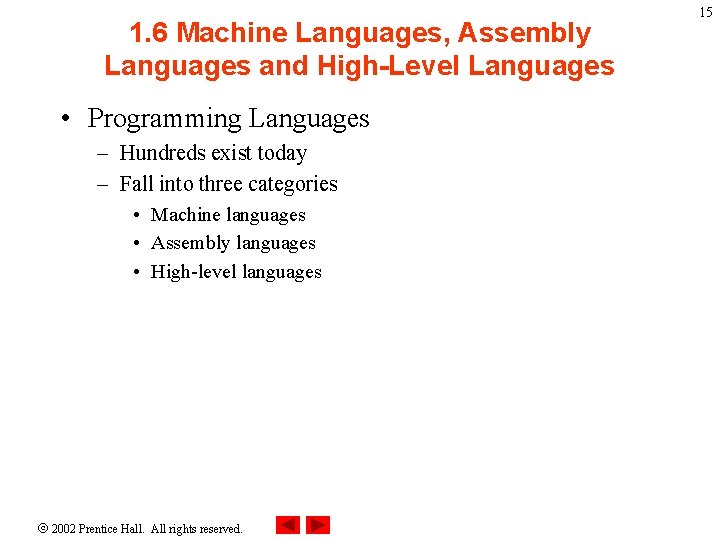
1. 6 Machine Languages, Assembly Languages and High-Level Languages • Programming Languages – Hundreds exist today – Fall into three categories • Machine languages • Assembly languages • High-level languages 2002 Prentice Hall. All rights reserved. 15
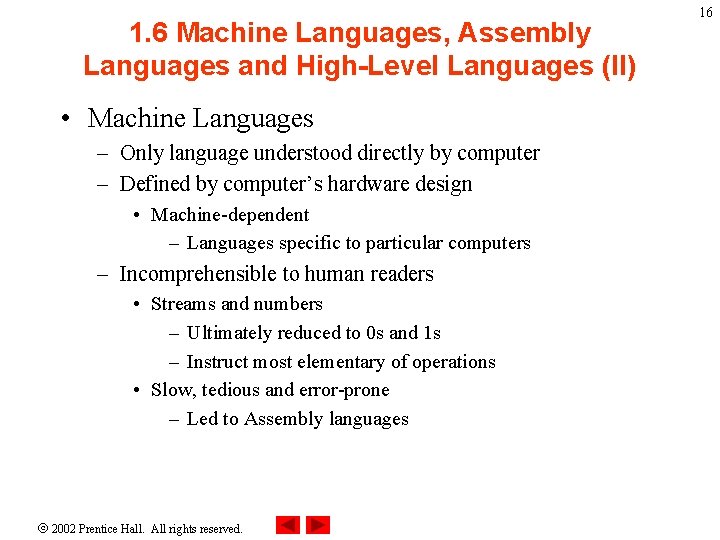
1. 6 Machine Languages, Assembly Languages and High-Level Languages (II) • Machine Languages – Only language understood directly by computer – Defined by computer’s hardware design • Machine-dependent – Languages specific to particular computers – Incomprehensible to human readers • Streams and numbers – Ultimately reduced to 0 s and 1 s – Instruct most elementary of operations • Slow, tedious and error-prone – Led to Assembly languages 2002 Prentice Hall. All rights reserved. 16
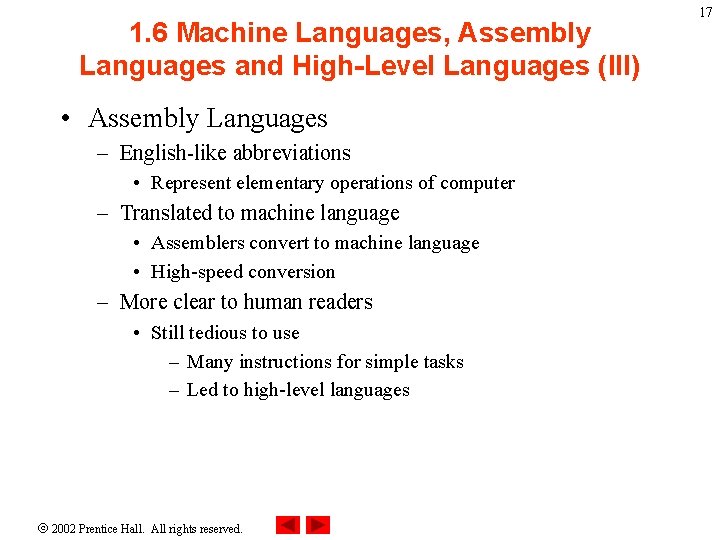
1. 6 Machine Languages, Assembly Languages and High-Level Languages (III) • Assembly Languages – English-like abbreviations • Represent elementary operations of computer – Translated to machine language • Assemblers convert to machine language • High-speed conversion – More clear to human readers • Still tedious to use – Many instructions for simple tasks – Led to high-level languages 2002 Prentice Hall. All rights reserved. 17
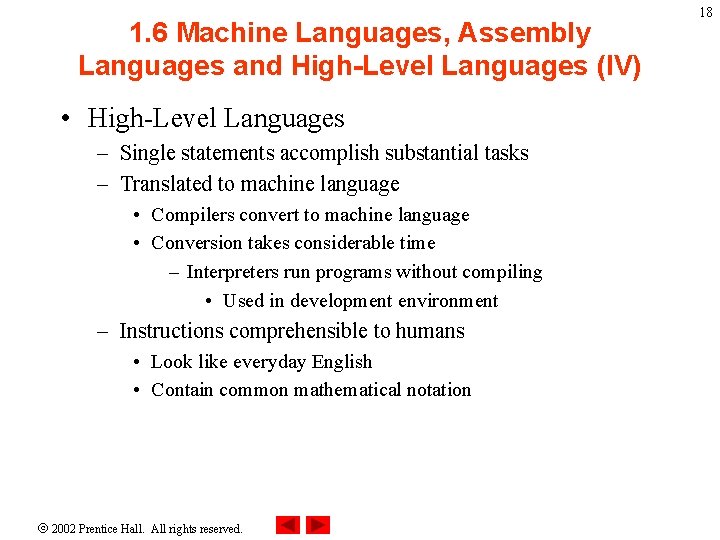
1. 6 Machine Languages, Assembly Languages and High-Level Languages (IV) • High-Level Languages – Single statements accomplish substantial tasks – Translated to machine language • Compilers convert to machine language • Conversion takes considerable time – Interpreters run programs without compiling • Used in development environment – Instructions comprehensible to humans • Look like everyday English • Contain common mathematical notation 2002 Prentice Hall. All rights reserved. 18
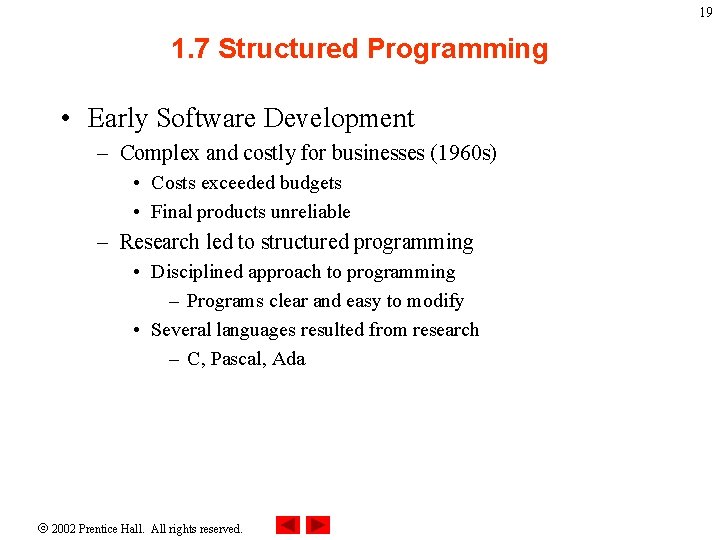
19 1. 7 Structured Programming • Early Software Development – Complex and costly for businesses (1960 s) • Costs exceeded budgets • Final products unreliable – Research led to structured programming • Disciplined approach to programming – Programs clear and easy to modify • Several languages resulted from research – C, Pascal, Ada 2002 Prentice Hall. All rights reserved.
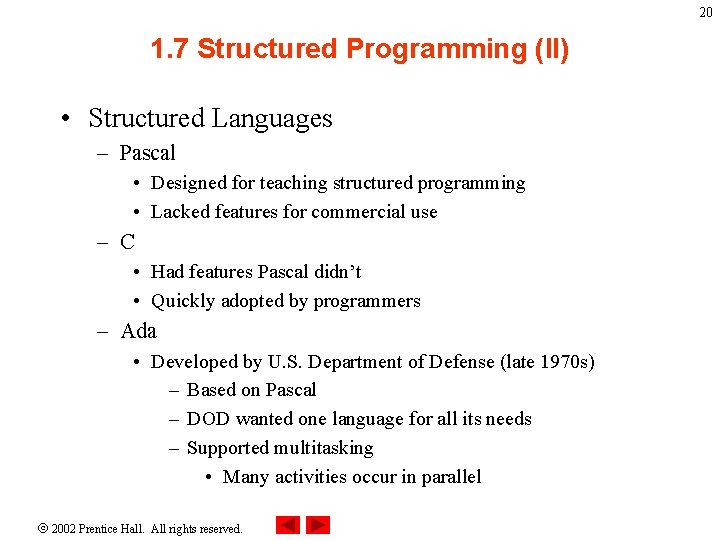
20 1. 7 Structured Programming (II) • Structured Languages – Pascal • Designed for teaching structured programming • Lacked features for commercial use – C • Had features Pascal didn’t • Quickly adopted by programmers – Ada • Developed by U. S. Department of Defense (late 1970 s) – Based on Pascal – DOD wanted one language for all its needs – Supported multitasking • Many activities occur in parallel 2002 Prentice Hall. All rights reserved.
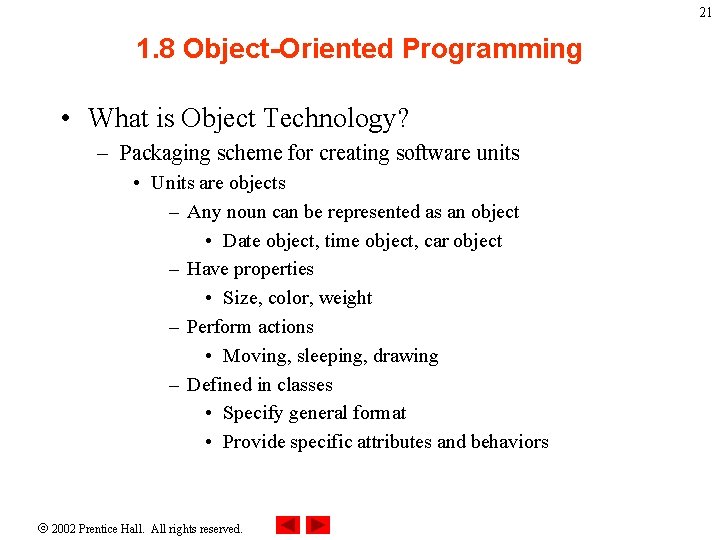
21 1. 8 Object-Oriented Programming • What is Object Technology? – Packaging scheme for creating software units • Units are objects – Any noun can be represented as an object • Date object, time object, car object – Have properties • Size, color, weight – Perform actions • Moving, sleeping, drawing – Defined in classes • Specify general format • Provide specific attributes and behaviors 2002 Prentice Hall. All rights reserved.
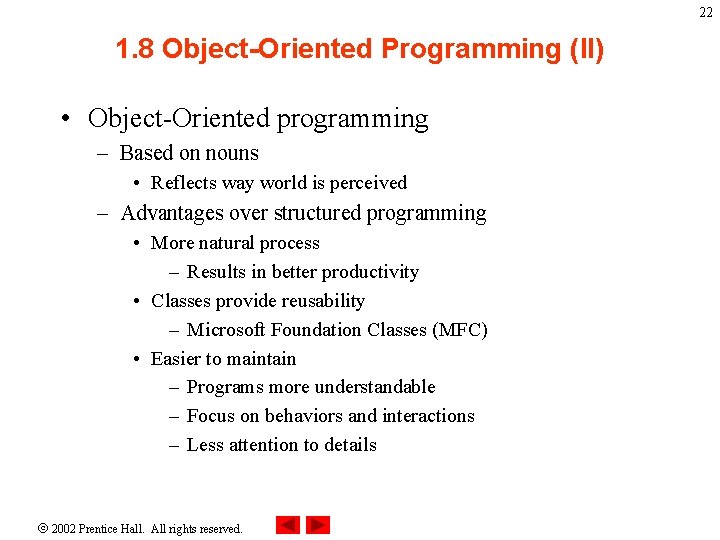
22 1. 8 Object-Oriented Programming (II) • Object-Oriented programming – Based on nouns • Reflects way world is perceived – Advantages over structured programming • More natural process – Results in better productivity • Classes provide reusability – Microsoft Foundation Classes (MFC) • Easier to maintain – Programs more understandable – Focus on behaviors and interactions – Less attention to details 2002 Prentice Hall. All rights reserved.
23 1. 9 Hardware Trends • Improving technologies – Internet community thrives on improvements of • Hardware • Software • Communications – Cost of products and services • Consistently dropping over the decades – Computer capacity and speed • Doubles every two years (on average) – Microprocessor chip • Laid groundwork in late 1970 s and 1980 s for productivity improvements of the 1990 s 2002 Prentice Hall. All rights reserved.
1. 10 History of the Internet and World Wide Web • ARPAnet – Implemented in late 1960’s by ARPA (Advanced Research Projects Agency of DOD) – Networked computer systems of a dozen universities and institutions with 56 KB communications lines – Grandparent of today’s Internet – Intended to allow computers to be shared – Became clear that key benefit was allowing fast communication between researchers – electronic-mail (email) 2002 Prentice Hall. All rights reserved. 24
1. 10 History of the Internet and World Wide Web (II) • ARPA’s goals – Allow multiple users to send and receive info at same time – Network operated packet switching technique • Digital data sent in small packages called packets • Packets contained data, address info, error-control info and sequencing info • Greatly reduced transmission costs of dedicated communications lines – Network designed to be operated without centralized control • If portion of network fails, remaining portions still able to route packets 2002 Prentice Hall. All rights reserved. 25
1. 10 History of the Internet and World Wide Web (III) • Transmission Control Protocol (TCP) – Name of protocols for communicating over ARPAnet – Ensured that messages were properly routed and that they arrived intact • Organizations implemented own networks – Used both for intra-organization and communication 2002 Prentice Hall. All rights reserved. 26
1. 10 History of the Internet and World Wide Web (IV) • Huge variety of networking hardware and software appeared – ARPA achieved inter-communication between all platforms with development of the IP • Internetworking Protocol • Current architecture of Internet – Combined set of protocols called TCP/IP • The Internet – Limited to universities and research institutions – Military became big user – Next, government decided to access Internet for commercial purposes 2002 Prentice Hall. All rights reserved. 27
1. 10 History of the Internet and World Wide Web (V) • Internet traffic grew – Businesses spent heavily to improve Internet • Better service their clients – Fierce competition among communications carriers and hardware and software suppliers – Result • Bandwidth (info carrying capacity) of Internet increased tremendously • Costs plummeted 2002 Prentice Hall. All rights reserved. 28
1. 10 History of the Internet and World Wide Web (VI) • WWW – Allows computer users to locate and view multimedia-based documents – Introduced in 1990 by Tim Berners-Lee • Developed information system based on hyperlinked text documents – Hyper. Text Markup Language (HTML) – Developed communication protocols as backbone • WWW today – Makes information instantly accessible – Merges computing and communication technologies 2002 Prentice Hall. All rights reserved. 29
30 1. 11 World Wide Web Consortium (W 3 C) • W 3 C – Founded in 1994 by Tim Berners-Lee • Devoted to developing non-proprietary and interoperable technologies for the World Wide Web and making the Web universally accessible – Standardization • W 3 C Recommendations: technologies standardized by W 3 C – include Extensible Hyper. Text Markup Language (XHTML), Cascading Style Sheets (CSS) and the Extensible Markup Language (XML) • Document must pass through Working Draft, Candidate Recommendation and Proposed Recommendation phases before considered for W 3 C Recommendation 2002 Prentice Hall. All rights reserved.
31 1. 11 World Wide Web Consortium (W 3 C) (II) • W 3 C Structure – 3 Hosts • Massachusetts Institute of Technology (MIT) • INRIA (Institut National de Recherche en Informatique et Automatique) • Keio University of Japan – 400 Members (including Deitel & Associates) • W 3 C homepage at www. w 3. org • W 3 C Goals – User Interface Domain – Technology and Society Domain – Architecture Domain and Web Accessibility Initiatives 2002 Prentice Hall. All rights reserved.
32 1. 12 Extensible Markup Language (XML) • HTML limitations – Lack of extensibility • Inability to add or change features – Developers become frustrated – Code becomes erroneous – Led to more development on HTML • W 3 C created Cascading Style Sheets as temporary solution – New technology formatting documents • Led to research for a standardized extensible language – W 3 C developed Extensible Markup Language (XML) • Combined power of SGML with simplicity of HTML • Developed XML-based standards for style-sheets and advanced hyperlinking 2002 Prentice Hall. All rights reserved.
33 1. 12 Extensible Markup Language (XML) (II) • XML features – Data independence • Separation of content from its presentation – Allows any application to conceivably process XML documents – Improves Web functionality and interoperability – Reduces server load and network traffic • Integration with applications other than Web services – Communication between applications employing XML – Structure allows easy integration with database applications 2002 Prentice Hall. All rights reserved.
34 1. 12 Extensible Markup Language (XML) (III) • Communication using XML – Simple Object Access Protocol (SOAP) • Framework for expressing application semantics, encoding that data and packing it in modules • Structured into three parts – Envelope • Describes content and recipient of SOAP message – Encoding rules • XML-based – Remote Procedure Call (RPC) representation • Commands other computers to perform a task 2002 Prentice Hall. All rights reserved.
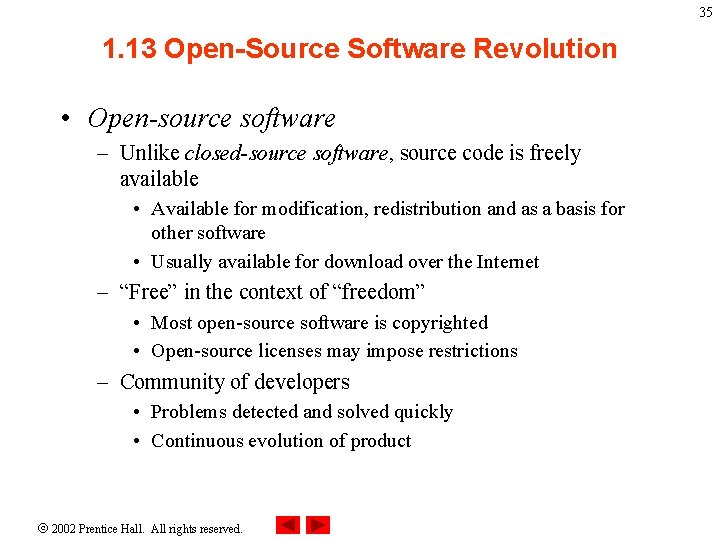
35 1. 13 Open-Source Software Revolution • Open-source software – Unlike closed-source software, source code is freely available • Available for modification, redistribution and as a basis for other software • Usually available for download over the Internet – “Free” in the context of “freedom” • Most open-source software is copyrighted • Open-source licenses may impose restrictions – Community of developers • Problems detected and solved quickly • Continuous evolution of product 2002 Prentice Hall. All rights reserved.
36 1. 13 Open-Source Software Revolution (II) • Python is part of the open-source community – License available at www. python. org/2. 2/license. html – Python developers newsgroup: comp. lang. python • Commercial support for open-source projects – IBM, Red Hat and Sun all support open-source projects – Some take open-source applications and sell them commercially • Provide additional support, software, training, etc. • Open Source Initiative’s Web site at www. opensource. org 2002 Prentice Hall. All rights reserved.
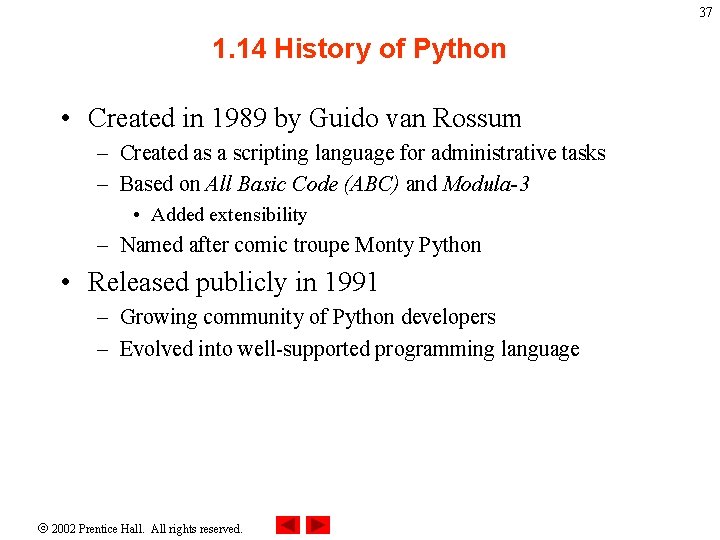
37 1. 14 History of Python • Created in 1989 by Guido van Rossum – Created as a scripting language for administrative tasks – Based on All Basic Code (ABC) and Modula-3 • Added extensibility – Named after comic troupe Monty Python • Released publicly in 1991 – Growing community of Python developers – Evolved into well-supported programming language 2002 Prentice Hall. All rights reserved.
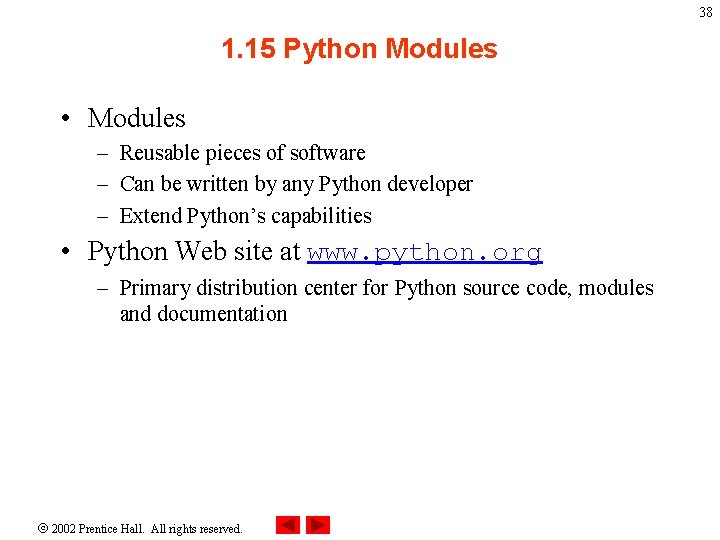
38 1. 15 Python Modules • Modules – Reusable pieces of software – Can be written by any Python developer – Extend Python’s capabilities • Python Web site at www. python. org – Primary distribution center for Python source code, modules and documentation 2002 Prentice Hall. All rights reserved.
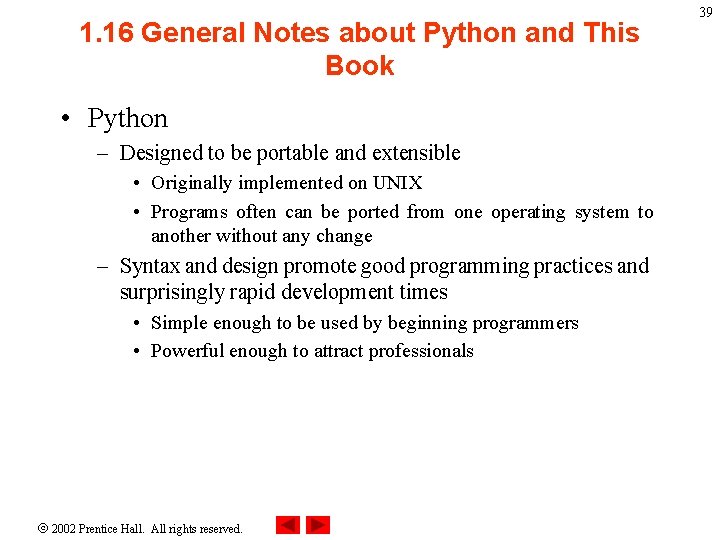
1. 16 General Notes about Python and This Book • Python – Designed to be portable and extensible • Originally implemented on UNIX • Programs often can be ported from one operating system to another without any change – Syntax and design promote good programming practices and surprisingly rapid development times • Simple enough to be used by beginning programmers • Powerful enough to attract professionals 2002 Prentice Hall. All rights reserved. 39