
Chapter 1 Introduction to Chemistry 1 Section 1
- Slides: 21
Chapter 1 Introduction to Chemistry 1
Section 1. 1 Chemistry • Objectives – Identify 5 traditional areas of chemistry – Relate pure chemistry to applied chemistry – Identify reasons to study chemistry 2
What is Chemistry? • Chemistry – The study of the composition, structure, and properties of matter and the changes matter undergoes • Matter – Anything that has mass and takes up space. You don’t have to be able to see it and it can be living or nonliving – Examples: you, desk, I-pod, cell phone, air you breath – Chemistry affects all aspects of life and most natural events because matter is living and non -living 3
5 Major Areas of Chemistry 1. 2. 3. 4. 5. Organic Chemistry – study of all chemicals containing carbon Inorganic Chemistry – study of chemicals that in general do not contain carbon Biochemistry – study of processes that take place in organisms • Examples – Analytical Chemistry – study that focuses on composition of matter • Measuring level of lead in drinking water Physical Chemistry –deals with mechanism, rate and energy transfer that occurs when matter undergoes change • Boundaries of areas are not firm and many overlap and interact 4
Pure and Applied Chemistry • Pure Chemistry – Gathering of chemical knowledge for its own sake • Applied Chemistry – Using chemistry to attain a certain goal, in fields like medicine, agriculture, and manufacturing • Example: – Nylon – Aspirin – Technology 5
Why Study Chemistry? – Everyone and everything around us involves chemistry – It explains our world – Helps you make better, more informed decisions – Possible career in your future – Used to attain a specific goal 6
Why Study Chemistry? • Chemistry explains why… – – Apples turn brown after cutting Sugar dissolves faster in hot water Adding yeast to bread dough makes it rise Plants release oxygen • Consider your daily activities… – Think of 4 activities or items that in some way do not involve chemistry 7
Section 1. 2 – Chemistry Far and Wide • Objectives – Identify some areas of research affected by chemistry – Discuss some examples of research in chemistry – Distinguish between macroscopic and microscopic views 8
Materials • Chemists design materials to fit specific needs – Velcro, perfume, steel, ceramics, plastics, rubber, paints, nonstick utensils, fiberglass… – 2 different ways to view the world • Macroscopic – large enough to see with the unaided eye • Microscopic – can be seen only under magnification 9
Energy • We need energy to meet the needs of our modern society – The need is constantly increasing – We can conserve, produce and store energy to help meet these demands • Conserve – insulation! • Production – oil from soybeans to make biodiesel • Storage – rechargeable batteries 10
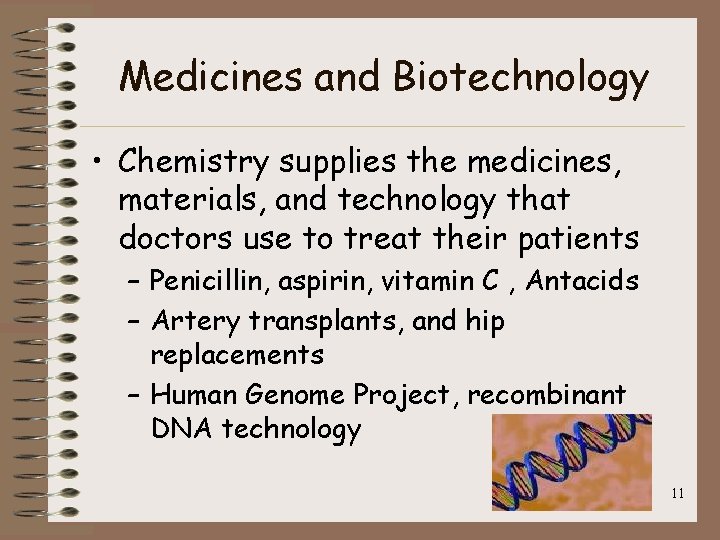
Medicines and Biotechnology • Chemistry supplies the medicines, materials, and technology that doctors use to treat their patients – Penicillin, aspirin, vitamin C , Antacids – Artery transplants, and hip replacements – Human Genome Project, recombinant DNA technology 11
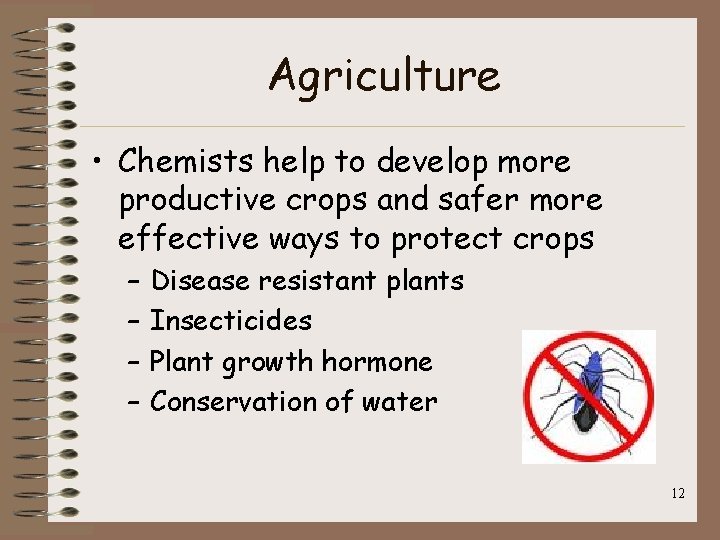
Agriculture • Chemists help to develop more productive crops and safer more effective ways to protect crops – – Disease resistant plants Insecticides Plant growth hormone Conservation of water 12
The Environment • Chemists help to identify pollutants and prevent pollution – Pollutants need to be identified and prevented • • • Lead paint Leaded gasoline Drinking water Carbon dioxide Ozone Global warming 13
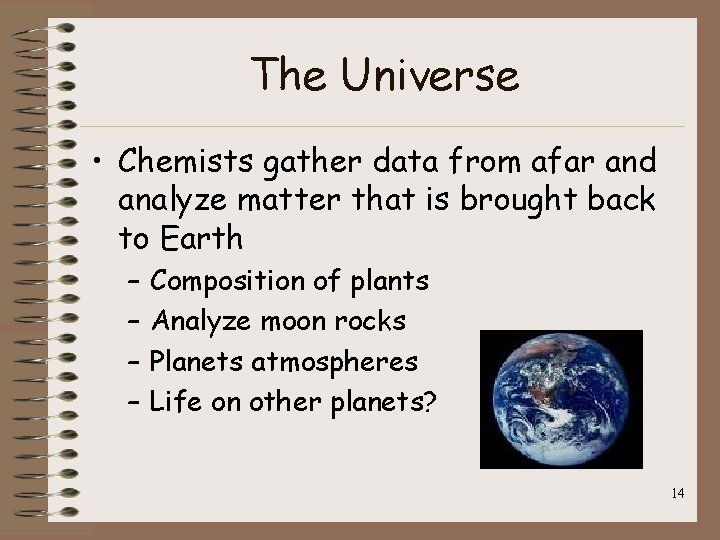
The Universe • Chemists gather data from afar and analyze matter that is brought back to Earth – – Composition of plants Analyze moon rocks Planets atmospheres Life on other planets? 14
Section 1. 3 – Thinking like a Scientist • Objectives – Describe how Lavoisier transformed chemistry – Identify three steps in the scientific method – Explain how collaboration and communication are important in science 15
A Little History… • Alchemy – The word chemistry comes from alchemy – Developed tools and techniques for working with chemistry 16
A Little History… • An Experimental Approach – In the 1500’s a shift started from alchemy to science – King Charles II was a supporter of the sciences – Encouraged scientists to use more experimental evidence and not philosophical debates 17
A Little History… • Lavoisier – In the late 1700’s Antoine Lavoisier helped transform chemistry from a science of observation to a science of measurement • This is still used today • He settled a long-standing debate about burning… – Oxygen is required 18
The Scientific Method – A logical approach to solving problems or answering questions – Starts with observation • Noting and recording information and facts – Hypothesis • A proposed explanation for the observation • Must be tested – Developing theories 19
Steps in the Scientific Method 1. Observations (uses your senses) – – – Quantitative involves numbers = 95 degrees Celsius Qualitative is a word description = hot Leads to questions 2. Formulating hypothesis • • Possible explanation for the observed set of facts Educated guess 3. Performing Experiments – Gather new information to help decide whether the hypothesis is valid 20
Scientific Method – Controlled Experiments • Designed to test the hypothesis • Only two possible answers – Hypothesis is supported – Hypothesis is refuted – We gather data and observations by doing the experiment – Modify the hypothesis if needed and repeat the cycle 21