
Chapter 1 Introduction to Business Analytics Methods Models
Chapter 1: Introduction to Business Analytics: Methods, Models, and Decisions, 1 st edition James R. Evans Copyright © 2013 Pearson Education, Inc. publishing as Prentice Hall 1 -1
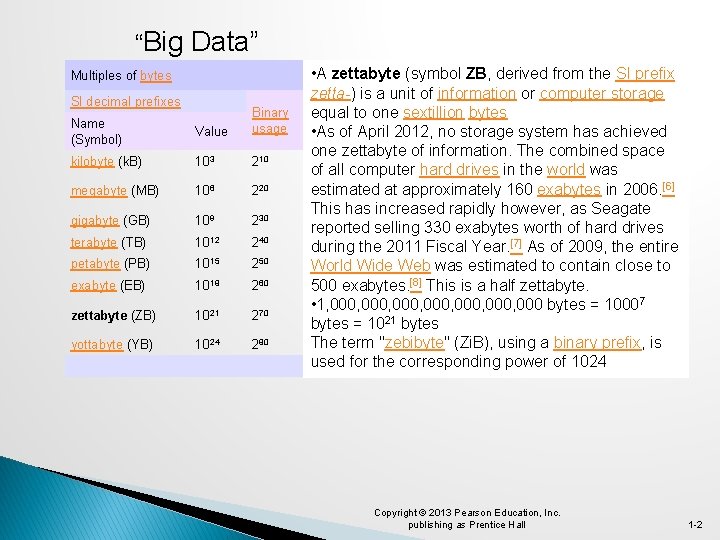
“Big Data” Multiples of bytes SI decimal prefixes Name (Symbol) Value Binary usage kilobyte (k. B) 103 210 megabyte (MB) 106 220 gigabyte (GB) 109 230 terabyte (TB) 1012 240 petabyte (PB) 1015 250 exabyte (EB) 1018 260 zettabyte (ZB) 1021 270 yottabyte (YB) 1024 280 • A zettabyte (symbol ZB, derived from the SI prefix zetta-) is a unit of information or computer storage equal to one sextillion bytes • As of April 2012, no storage system has achieved one zettabyte of information. The combined space of all computer hard drives in the world was estimated at approximately 160 exabytes in 2006. [6] This has increased rapidly however, as Seagate reported selling 330 exabytes worth of hard drives during the 2011 Fiscal Year. [7] As of 2009, the entire World Wide Web was estimated to contain close to 500 exabytes. [8] This is a half zettabyte. • 1, 000, 000, 000 bytes = 10007 bytes = 1021 bytes The term "zebibyte" (Zi. B), using a binary prefix, is used for the corresponding power of 1024 Copyright © 2013 Pearson Education, Inc. publishing as Prentice Hall 1 -2
What is Business Analytics? Analytics is the use of: data, information technology, statistical analysis, quantitative methods, and mathematical or computer-based models to help managers gain improved insight about their business operations and make better, fact-based decisions. Copyright © 2013 Pearson Education, Inc. publishing as Prentice Hall 1 -3
What is Business Analytics? Business Analytics Applications � Management of customer relationships � Financial and marketing activities � Supply chain management � Human resource planning � Pricing decisions � Sport team game strategies Copyright © 2013 Pearson Education, Inc. publishing as Prentice Hall 1 -4

What is Business Analytics? Importance of Business Analytics � There is a strong relationship of BA with: - profitability of businesses - revenue of businesses - shareholder return � BA enhances understanding of data � BA is vital for businesses to remain competitive � BA enables creation of informative reports Copyright © 2013 Pearson Education, Inc. publishing as Prentice Hall 1 -5

Scope of Business Analytics � Descriptive analytics - uses data to understand past and present � Predictive analytics - analyzes past performance � Prescriptive analytics - uses optimization techniques Copyright © 2013 Pearson Education, Inc. publishing as Prentice Hall 1 -6
Scope of Business Analytics Example 1. 1 Retail Markdown Decisions � Most department stores clear seasonal inventory by reducing prices. � The question is: When to reduce the price and by how much? � Descriptive analytics: examine historical data for similar products (prices, units sold, advertising, …) � Predictive analytics: predict sales based on price � Prescriptive analytics: find the best sets of pricing and advertising to maximize sales revenue Copyright © 2013 Pearson Education, Inc. publishing as Prentice Hall 1 -7
Data for Business Analytics � DATA - collected facts and figures � DATABASE - collection of computer files containing data � INFORMATION - comes from analyzing data Copyright © 2013 Pearson Education, Inc. publishing as Prentice Hall 1 -8
Data for Business Analytics � Metrics are used to quantify performance. � Measures are numerical values of metrics. � Discrete metrics involve counting - on time or not on time - number or proportion of on time deliveries � Continuous metrics are measured on a continuum - delivery time - package weight - purchase price Copyright © 2013 Pearson Education, Inc. publishing as Prentice Hall 1 -9

Data for Business Analytics Example 1. 2 A Sales Transaction Database File Records Figure 1. 1 Entities Fields or Attributes Copyright © 2013 Pearson Education, Inc. publishing as Prentice Hall 1 -10
Data for Business Analytics Four Types Data Based on Measurement Scale: � Categorical (nominal) data � Ordinal data � Interval data � Ratio data Copyright © 2013 Pearson Education, Inc. publishing as Prentice Hall 1 -11

Data for Business Analytics Example 1. 3 Classifying Data Elements in a Purchasing Database Figure 1. 2 Copyright © 2013 Pearson Education, Inc. publishing as Prentice Hall 1 -12

Data for Business Analytics Example 1. 3 (continued) Classifying Data Elements in a Purchasing Database l va Copyright © 2013 Pearson Education, Inc. publishing as Prentice Hall r te In al rv te In io at R l al ric o eg at C a ic l a ic r go e at C r go e at l a ic r go e at C C Figure 1. 2 1 -13
Data for Business Analytics Categorical (nominal) Data � Data placed in categories according to a specified characteristic � Categories bear no quantitative relationship to one another � Examples: - customer’s location (America, Europe, Asia) - employee classification (manager, supervisor, associate) Copyright © 2013 Pearson Education, Inc. publishing as Prentice Hall 1 -14

Data for Business Analytics Ordinal Data � Data that is ranked or ordered according to some relationship with one another � No fixed units of measurement � Examples: - college football rankings - survey responses (poor, average, good, very good, excellent) Copyright © 2013 Pearson Education, Inc. publishing as Prentice Hall 1 -15
Data for Business Analytics Interval Data � Ordinal data but with constant differences between observations � Ratios are not meaningful � Examples: - temperature readings - SAT scores Copyright © 2013 Pearson Education, Inc. publishing as Prentice Hall 1 -16
Data for Business Analytics Ratio Data � Continuous values and have a natural zero point � Ratios are meaningful � Examples: - monthly sales - delivery times Copyright © 2013 Pearson Education, Inc. publishing as Prentice Hall 1 -17
Decision Models Model: � An abstraction or representation of a real system, idea, or object � Captures the most important features � Can be a written or verbal description, a visual display, a mathematical formula, or a spreadsheet representation Copyright © 2013 Pearson Education, Inc. publishing as Prentice Hall 1 -18
Decision Models Example 1. 4 Three Forms of a Model The sales of a new produce, such as a firstgeneration i. Pad or 3 D television, often follow a common pattern. • Sales might grow at an increasing rate over time as positive customer feedback spreads. (See the S-shaped curve on the following slide. ) • A mathematical model of the S-curve can be identified; for example, S = aebect, where S is sales, t is time, e is the base of natural logarithms, and a, b and c are constants. Copyright © 2013 Pearson Education, Inc. publishing as Prentice Hall 1 -23
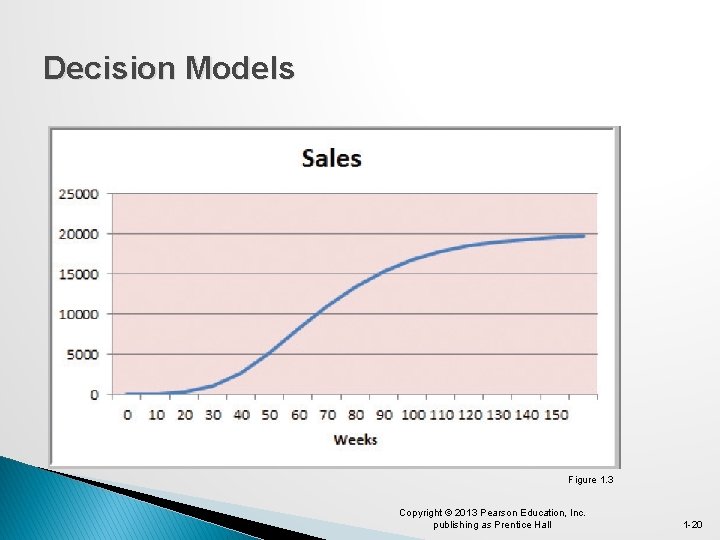
Decision Models Figure 1. 3 Copyright © 2013 Pearson Education, Inc. publishing as Prentice Hall 1 -20
Decision Models �A decision model is a model used to understand, analyze, or facilitate decision making. � Types of model input - data - uncontrollable variables - decision variables (controllable) � Types of model output - performance measures - behavioral measures Copyright © 2013 Pearson Education, Inc. publishing as Prentice Hall 1 -21
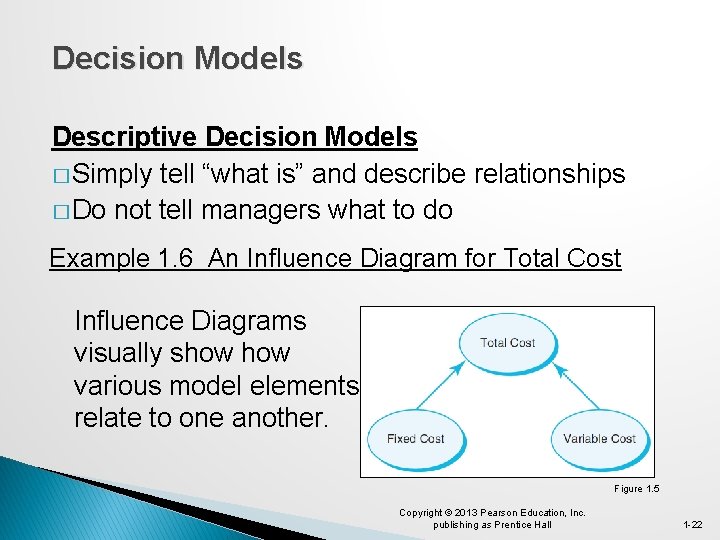
Decision Models Descriptive Decision Models � Simply tell “what is” and describe relationships � Do not tell managers what to do Example 1. 6 An Influence Diagram for Total Cost Influence Diagrams visually show various model elements relate to one another. Figure 1. 5 Copyright © 2013 Pearson Education, Inc. publishing as Prentice Hall 1 -22
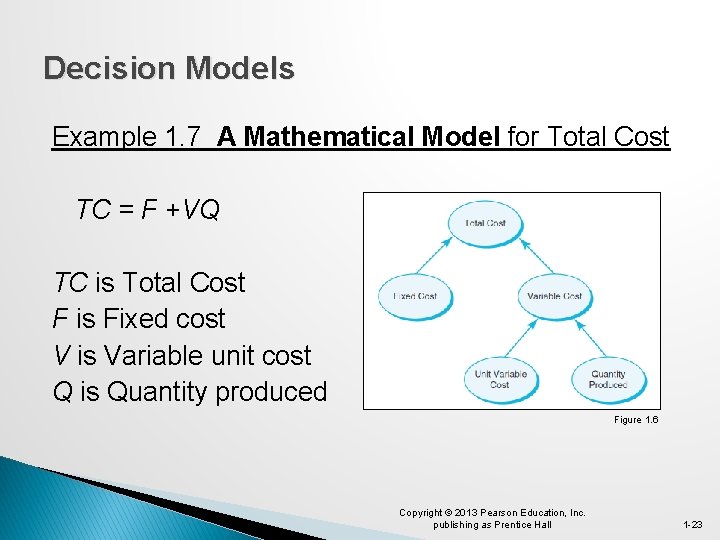
Decision Models Example 1. 7 A Mathematical Model for Total Cost TC = F +VQ TC is Total Cost F is Fixed cost V is Variable unit cost Q is Quantity produced Figure 1. 6 Copyright © 2013 Pearson Education, Inc. publishing as Prentice Hall 1 -23
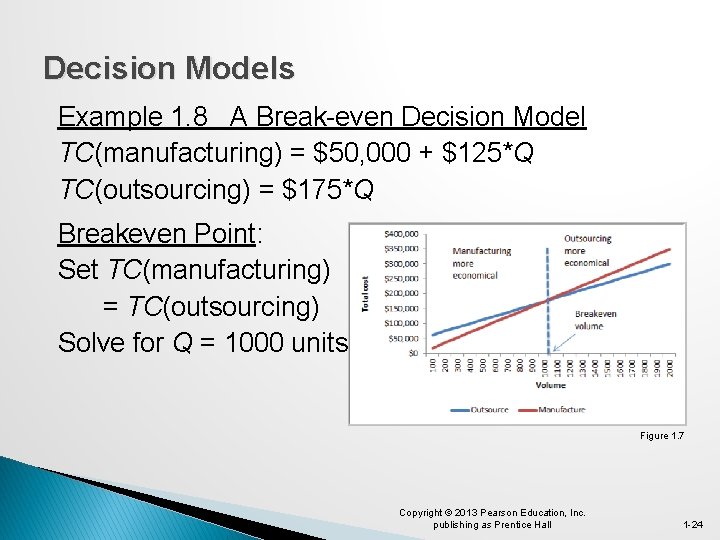
Decision Models Example 1. 8 A Break-even Decision Model TC(manufacturing) = $50, 000 + $125*Q TC(outsourcing) = $175*Q Breakeven Point: Set TC(manufacturing) = TC(outsourcing) Solve for Q = 1000 units Figure 1. 7 Copyright © 2013 Pearson Education, Inc. publishing as Prentice Hall 1 -24
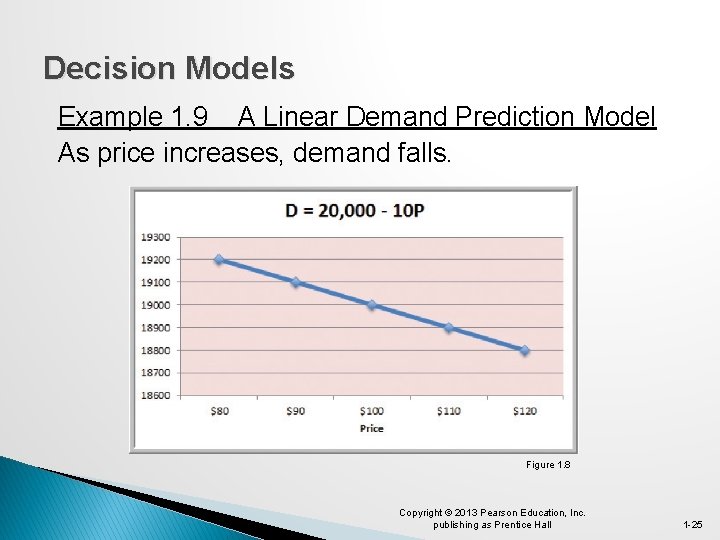
Decision Models Example 1. 9 A Linear Demand Prediction Model As price increases, demand falls. Figure 1. 8 Copyright © 2013 Pearson Education, Inc. publishing as Prentice Hall 1 -25
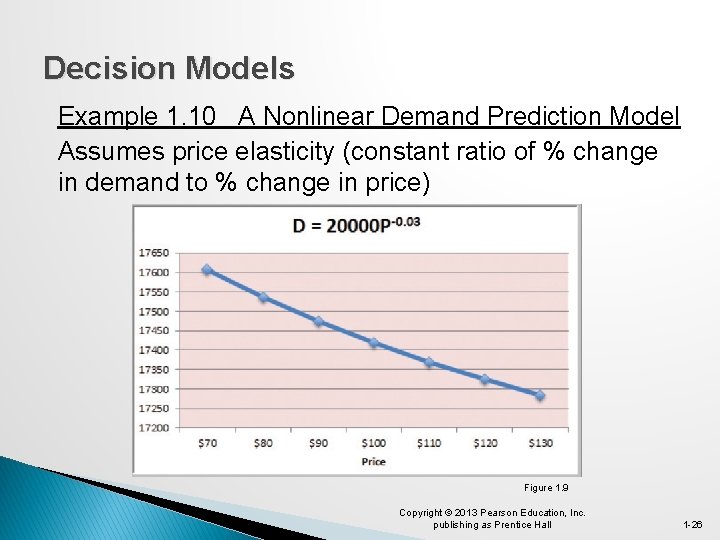
Decision Models Example 1. 10 A Nonlinear Demand Prediction Model Assumes price elasticity (constant ratio of % change in demand to % change in price) Figure 1. 9 Copyright © 2013 Pearson Education, Inc. publishing as Prentice Hall 1 -26
Decision Models Predictive Decision Models often incorporate uncertainty to help managers analyze risk. Aim to predict what will happen in the future. Uncertainty is imperfect knowledge of what will happen in the future. Risk is associated with the consequences of what actually happens. Copyright © 2013 Pearson Education, Inc. publishing as Prentice Hall 1 -27
Decision Models Prescriptive Decision Models help decision makers identify the best solution. � Optimization - finding values of decision variables that minimize (or maximize) something such as cost (or profit). � Objective function - the equation that minimizes (or maximizes) the quantity of interest. � Constraints - limitations or restrictions. � Optimal solution - values of the decision variables at the minimum (or maximum) point. Copyright © 2013 Pearson Education, Inc. publishing as Prentice Hall 1 -28
- Slides: 28