
Chapter 1 Introduction to Biopharmaceutics Pharmacokinetics by Dr
Chapter 1 Introduction to Biopharmaceutics & Pharmacokinetics by Dr. Arshad Ali Khan Faculty of Engineering Technology arshad@ump. edu. my By Dr. Arshad Ali Khan
Biopharmaceutics • “Biopharmaceutics is the study of the factors influencing the bioavailability of a drug in man and animals and the use of this information to optimize pharmacological and therapeutics activity of drug products” (American Pharmaceutical Association, 1972). By Dr. Arshad Ali Khan
Bioavailability Amount of a chemical substance becomes available to the systemic circulation or target organs after the administration to living organisms via any route of administration such as oral, parenteral and topical route etc. By Dr. Arshad Ali Khan
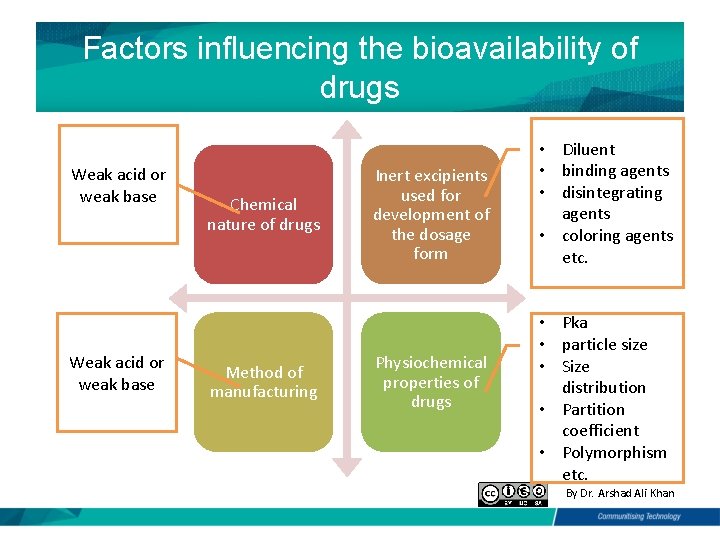
Factors influencing the bioavailability of drugs Weak acid or weak base Chemical nature of drugs Method of manufacturing Inert excipients used for development of the dosage form Physiochemical properties of drugs • Diluent • binding agents • disintegrating agents • coloring agents etc. • Pka • particle size • Size distribution • Partition coefficient • Polymorphism etc. By Dr. Arshad Ali Khan
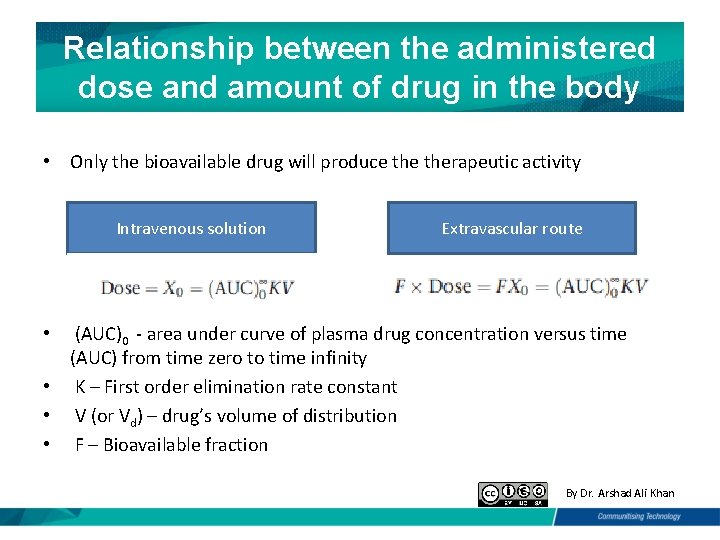
Relationship between the administered dose and amount of drug in the body • Only the bioavailable drug will produce therapeutic activity Intravenous solution Extravascular route (AUC)0 - area under curve of plasma drug concentration versus time (AUC) from time zero to time infinity • K – First order elimination rate constant • V (or Vd) – drug’s volume of distribution • F – Bioavailable fraction • By Dr. Arshad Ali Khan
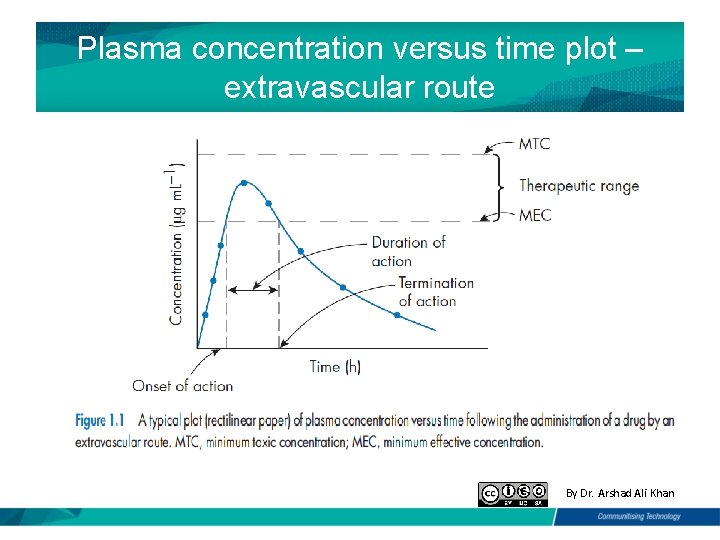
Plasma concentration versus time plot – extravascular route By Dr. Arshad Ali Khan
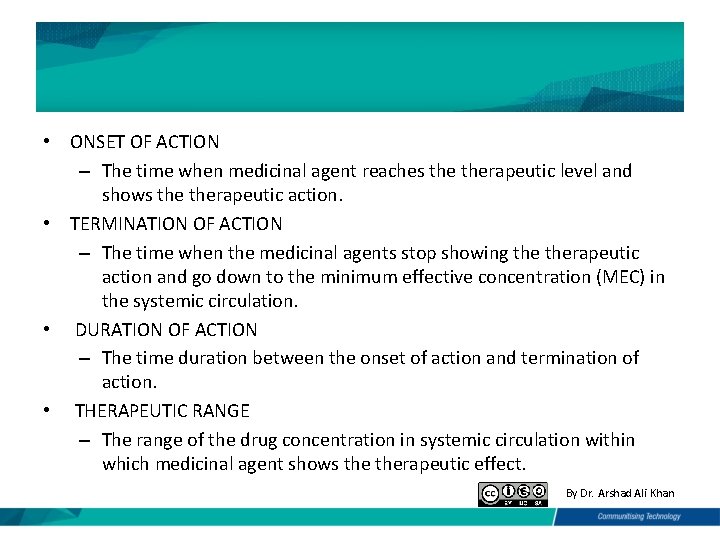
• ONSET OF ACTION – The time when medicinal agent reaches therapeutic level and shows therapeutic action. • TERMINATION OF ACTION – The time when the medicinal agents stop showing therapeutic action and go down to the minimum effective concentration (MEC) in the systemic circulation. • DURATION OF ACTION – The time duration between the onset of action and termination of action. • THERAPEUTIC RANGE – The range of the drug concentration in systemic circulation within which medicinal agent shows therapeutic effect. By Dr. Arshad Ali Khan
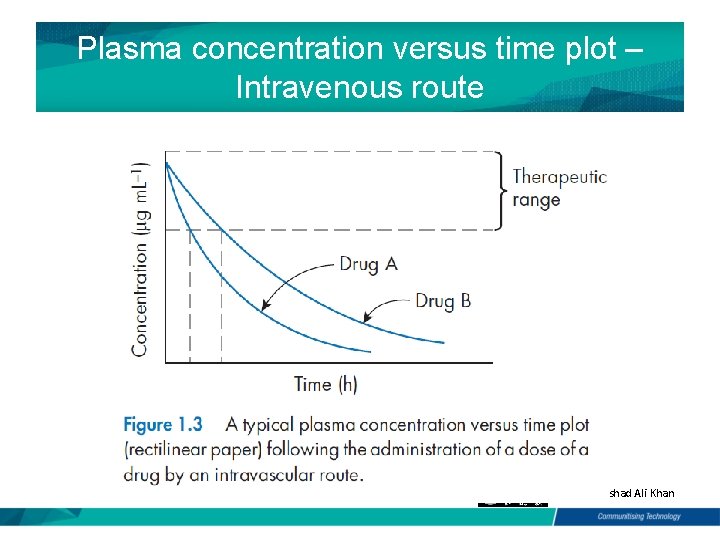
Plasma concentration versus time plot – Intravenous route By Dr. Arshad Ali Khan
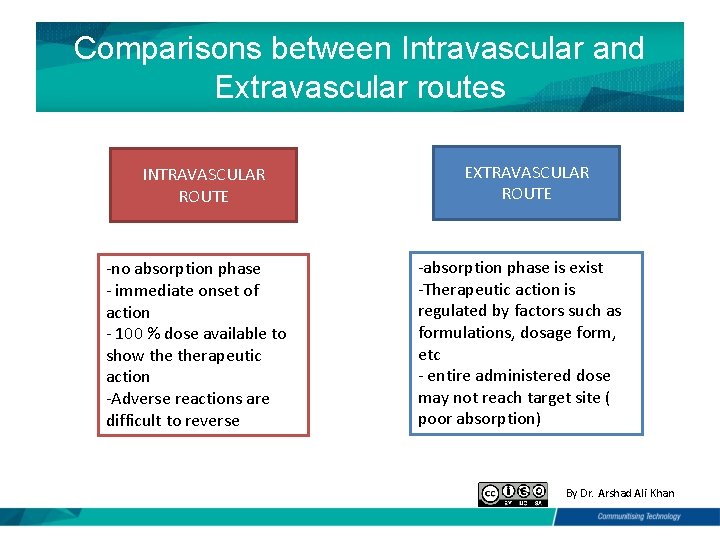
Comparisons between Intravascular and Extravascular routes INTRAVASCULAR ROUTE -no absorption phase - immediate onset of action - 100 % dose available to show therapeutic action -Adverse reactions are difficult to reverse EXTRAVASCULAR ROUTE -absorption phase is exist -Therapeutic action is regulated by factors such as formulations, dosage form, etc - entire administered dose may not reach target site ( poor absorption) By Dr. Arshad Ali Khan
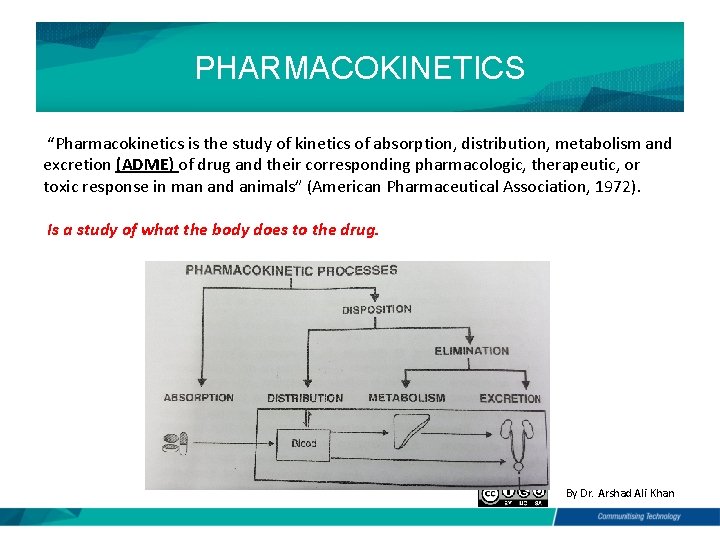
PHARMACOKINETICS “Pharmacokinetics is the study of kinetics of absorption, distribution, metabolism and excretion (ADME) of drug and their corresponding pharmacologic, therapeutic, or toxic response in man and animals” (American Pharmaceutical Association, 1972). Is a study of what the body does to the drug. By Dr. Arshad Ali Khan
Absorption • It is process of drug transportation from site of administration to the measurement site such as blood and plasma etc. By Dr. Arshad Ali Khan 11
Distribution • Distribution is the process of reversible transfer of drug to and form the site of measurement (usually blood or plasma) • The rate and extent of this process is evaluated by – Blood circulation in tissue and organs – Drug binding to tissues and plasma proteins – Drug permeability to the tissue membrane By Dr. Arshad Ali Khan 12
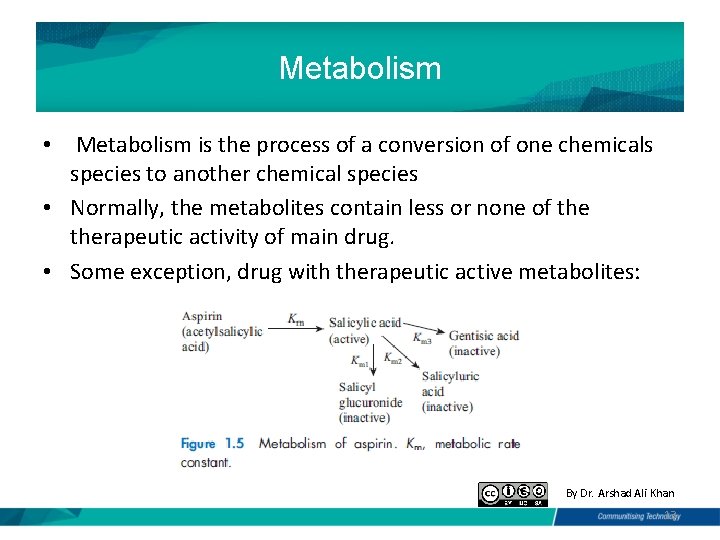
Metabolism • Metabolism is the process of a conversion of one chemicals species to another chemical species • Normally, the metabolites contain less or none of therapeutic activity of main drug. • Some exception, drug with therapeutic active metabolites: By Dr. Arshad Ali Khan 13
Elimination • It is a process of irreversible depletion of drug from the site of action. • It can occurs by: – metabolism – excretion By Dr. Arshad Ali Khan 14
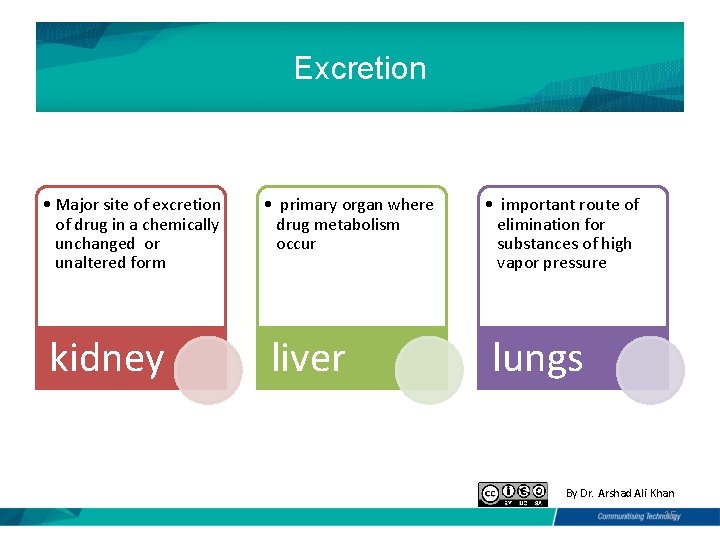
Excretion • Major site of excretion of drug in a chemically unchanged or unaltered form kidney • primary organ where drug metabolism occur liver • important route of elimination for substances of high vapor pressure lungs By Dr. Arshad Ali Khan 15
Exercise • Group discussion • Extract information's related to biopharmaceutics & pharmacokinetics from the given articles By Dr. Arshad Ali Khan 16
Rate Processes • After a drug is administered, it is subjected to a number of processes (ADME) whose rates control the concentration of drug in the elusive region known as “site of action”. • ü ü ü These processes affects: Onset of action, Duration of pharmacological response Intensity of pharmacological response. By Dr. Arshad Ali Khan 17
Rate Processes Suppose symbol Y a some function that changes with time (t) Y = dependent variables t = independent variables • Y – can be either – Drug mass in the body (X) – Drug mass in the urine (Xu) – concentration of drug concentration in biological fluid such as plasma or serum (Cp or Cs) By Dr. Arshad Ali Khan 18
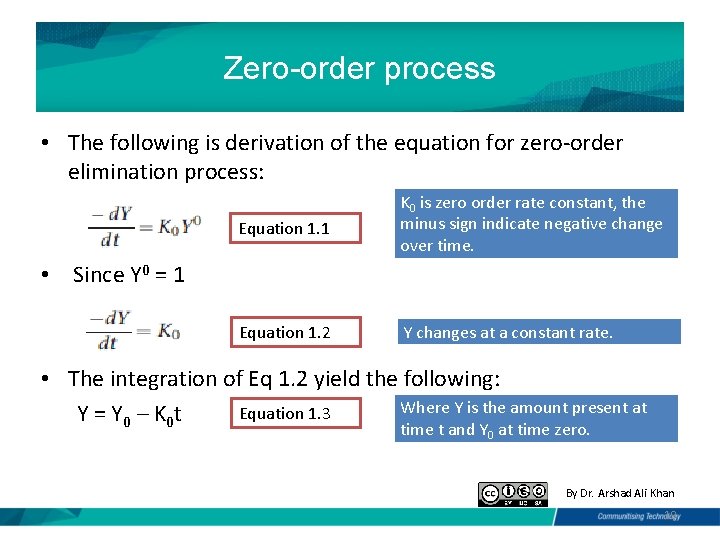
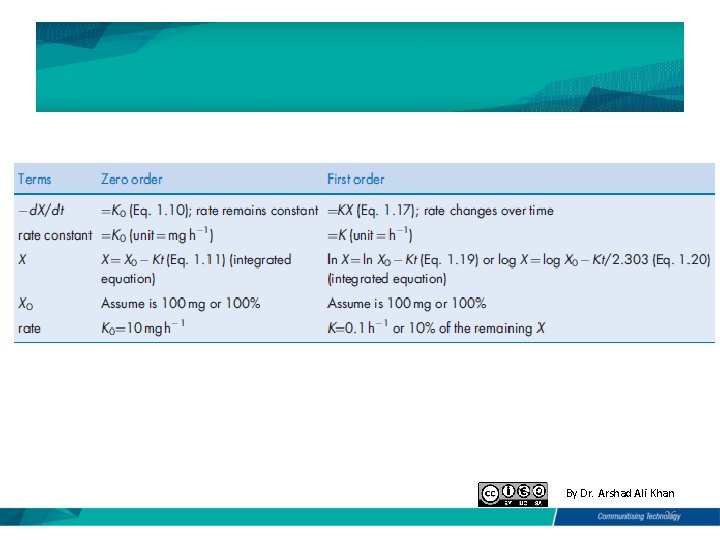
Zero-order process • The following is derivation of the equation for zero-order elimination process: Equation 1. 1 K 0 is zero order rate constant, the minus sign indicate negative change over time. Equation 1. 2 Y changes at a constant rate. • Since Y 0 = 1 • The integration of Eq 1. 2 yield the following: Where Y is the amount present at Equation 1. 3 Y = Y 0 – K 0 t time t and Y 0 at time zero. By Dr. Arshad Ali Khan 19
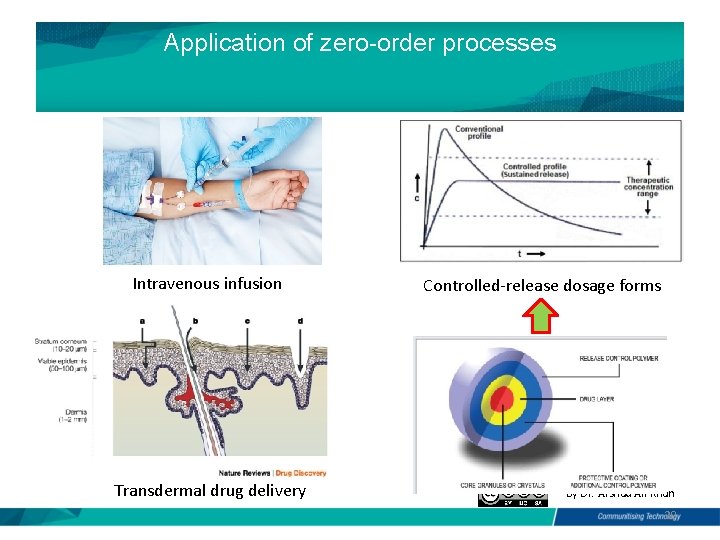
Application of zero-order processes Intravenous infusion Controlled-release dosage forms • Transdermal drug delivery By Dr. Arshad Ali Khan 20
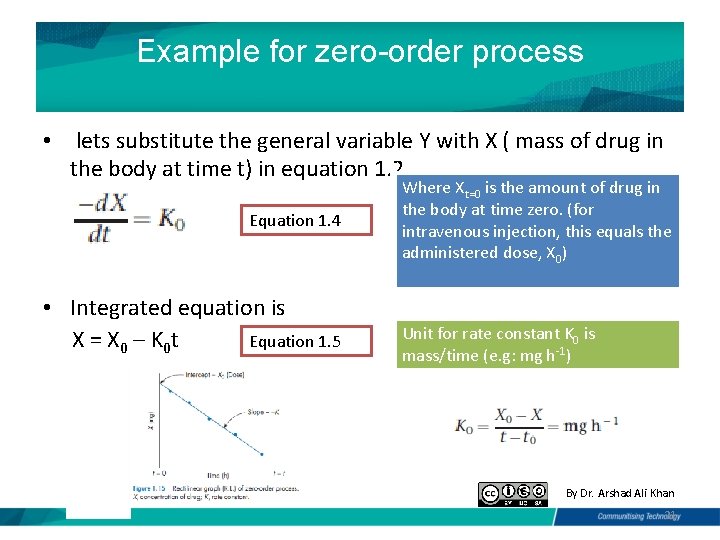
Example for zero-order process • lets substitute the general variable Y with X ( mass of drug in the body at time t) in equation 1. 2 Equation 1. 4 • Integrated equation is Equation 1. 5 X = X 0 – K 0 t Where Xt=0 is the amount of drug in the body at time zero. (for intravenous injection, this equals the administered dose, X 0) Unit for rate constant K 0 is mass/time (e. g: mg h-1) By Dr. Arshad Ali Khan 21
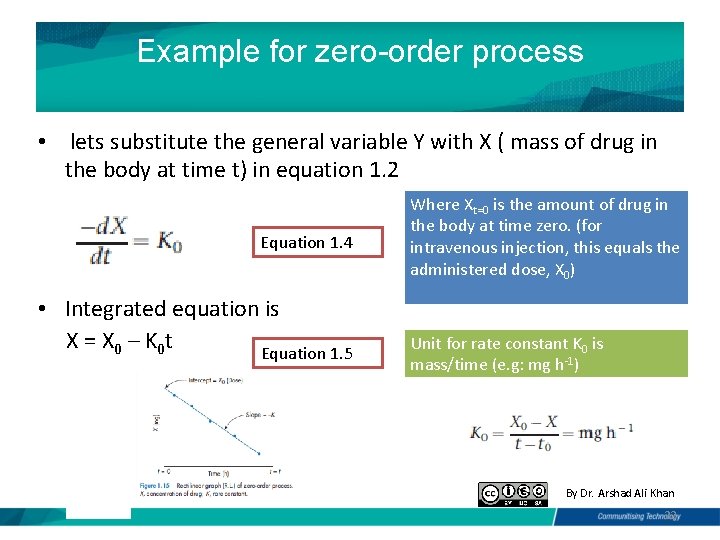
Example for zero-order process • lets substitute the general variable Y with X ( mass of drug in the body at time t) in equation 1. 2 Equation 1. 4 • Integrated equation is X = X 0 – K 0 t Equation 1. 5 Where Xt=0 is the amount of drug in the body at time zero. (for intravenous injection, this equals the administered dose, X 0) Unit for rate constant K 0 is mass/time (e. g: mg h-1) By Dr. Arshad Ali Khan 22
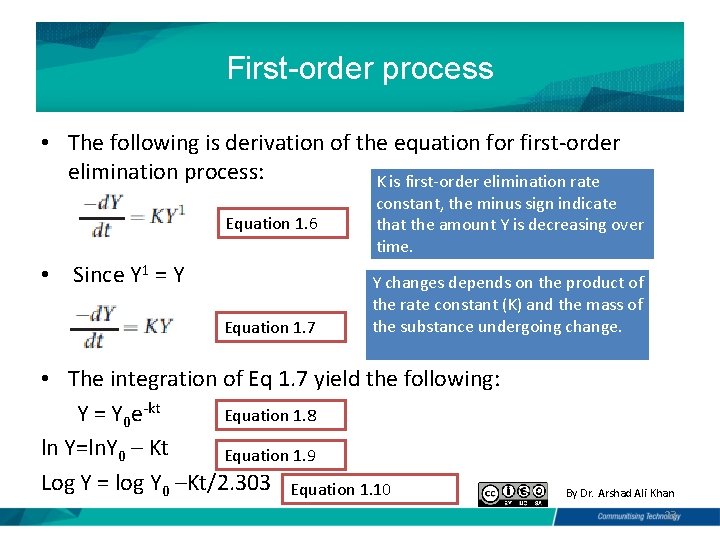
First-order process • The following is derivation of the equation for first-order elimination process: K is first-order elimination rate Equation 1. 6 • Since Y 1 = Y Equation 1. 7 constant, the minus sign indicate that the amount Y is decreasing over time. Y changes depends on the product of the rate constant (K) and the mass of the substance undergoing change. • The integration of Eq 1. 7 yield the following: Y = Y 0 e-kt Equation 1. 8 ln Y=ln. Y 0 – Kt Equation 1. 9 Log Y = log Y 0 –Kt/2. 303 Equation 1. 10 By Dr. Arshad Ali Khan 23
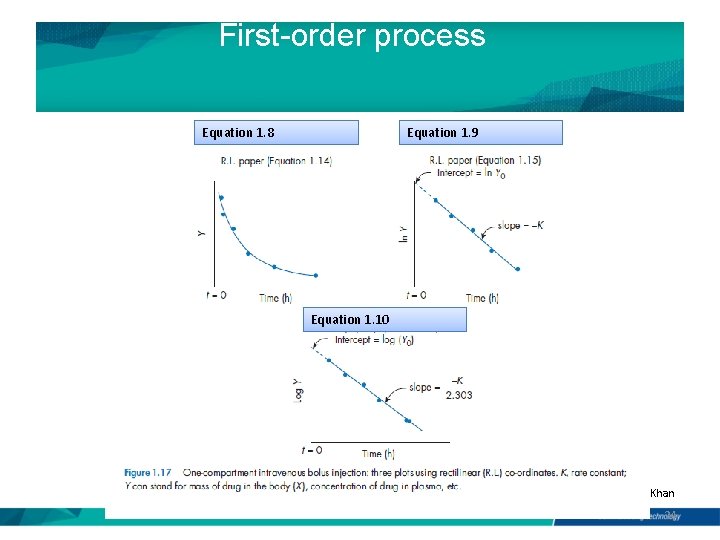
First-order process Equation 1. 8 Equation 1. 9 Equation 1. 10 By Dr. Arshad Ali Khan 24
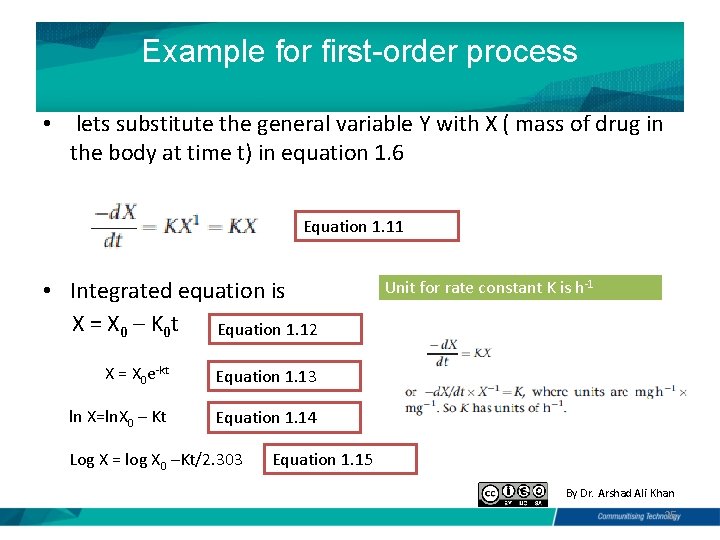
Example for first-order process • lets substitute the general variable Y with X ( mass of drug in the body at time t) in equation 1. 6 Equation 1. 11 • Integrated equation is X = X 0 – K 0 t Equation 1. 12 X = X 0 e-kt Equation 1. 13 ln X=ln. X 0 – Kt Equation 1. 14 Log X = log X 0 –Kt/2. 303 Unit for rate constant K is h-1 Equation 1. 15 By Dr. Arshad Ali Khan 25
By Dr. Arshad Ali Khan 26
Thank you By Dr. Arshad Ali Khan
- Slides: 27