
CHAPTER 1 INTRODUCTION NETWORKING WHAT IS A NETWORK



- Slides: 37
CHAPTER 1 INTRODUCTION NETWORKING
WHAT IS A NETWORK? • A network is simply two or more computers that are linked together. • In short, networks, which consist of computers connected together so that they can communicate, enhance both business and personal productivity by enabling users to share resources. • Computer networks allow users to share data and hardware. They also allow people from all over the world to communicate and collaborate in a variety of ways.
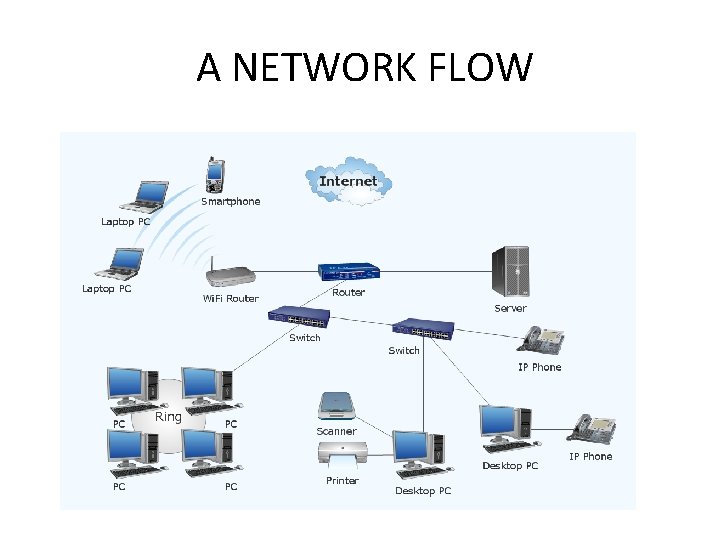
A NETWORK FLOW
TYPES OF NETWORKS • The most common types of networks are: • Personal Area Networks (PAN) • Local Area Networks (LANS) and • Metropolitan area network (MAN) • Wide Area Networks (WANS).
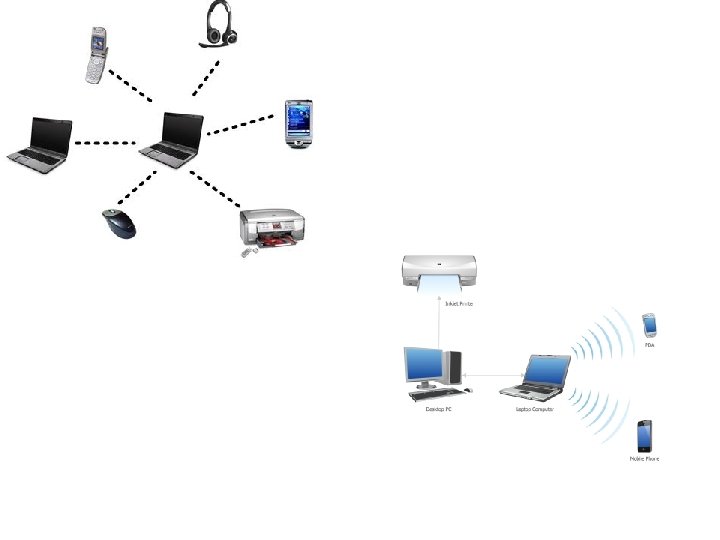
Personal Area Networks (PAN) • A personal area network (PAN) is a computer network used for communication among computer devices, including telephones and personal digital assistants, in proximity to an individual's body. • The devices may or may not belong to the person in question. The reach of a PAN is typically a few meters. • PANs can be used for communication among the personal devices themselves (intrapersonal communication), or for connecting to a higher level network and the Internet (an uplink). • Personal area networks may be wired with computer buses such as USB and Fire. Wire. • A wireless personal area network (WPAN) can also be made possible with wireless network technologies such as Ir. DA, Bluetooth, Wireless USB, Z-Wave and Zig. Bee.
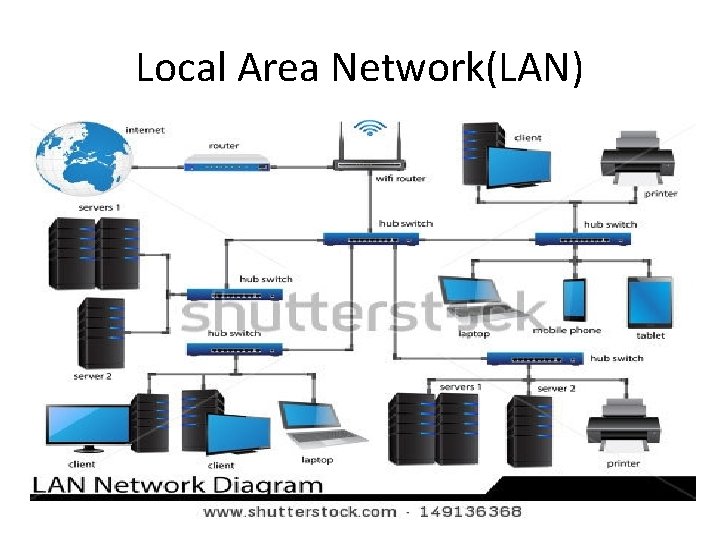
LOCAL AREA NETWORK • Local Area Network (LAN) – a network that spans a small area such as a building or an office. – Software applications and other resources are stored on a file server. – Print servers enable multiple users to share the same printer. • Local Area Network (LAN) គជ Network ដ លម នទហតចគ ចរ នបរ កនង small to Medium Office កនងផទ ។ ប សនជ ល សព 100 ន កឬ Computer ល សព 100 គរ ង ហ យបរវ ងពចងមខ ងន Network ទ ចងមខ ងទ តល សព 1000 Feet (បរវ ង 300 m (ន គ តរវត LAN ជ មយដ លគ ហ LAN ន ថ internetwork (Network of network) ។
Local Area Network(LAN)
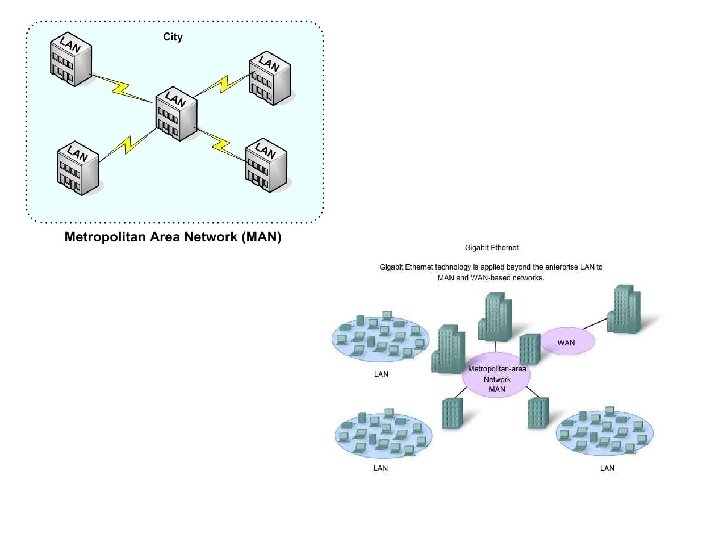
Metropolitan area network(MAN) • A Metropolitan Area Network (MAN) is a network that is utilized across multiple buildings • Commonly used in school campuses or large companies with multiple buildings • Is larger than a LAN, but smaller than a WAN • Is also used to mean the interconnection of several LANs by bridging them together. This sort of network is also referred to as a campus network
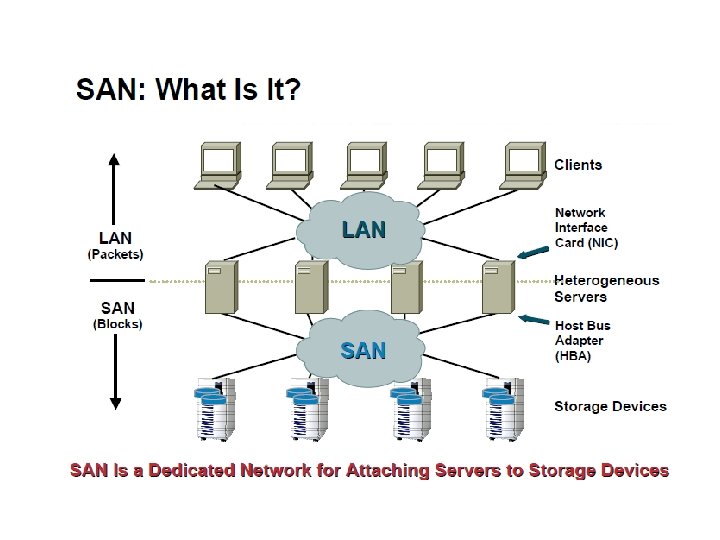
Storage Area Network(SAN) • A SAN (Storage Area Network) is a network designed to transfer data from servers to targets, and it is alternative to a directly attached target architecture, where the storage is connected to the servers on general purpose networks • Additional definitions of a SAN imply that the SAN should also be highly performing, and should be such to enable storage devices to communicate with one another and with computer systems
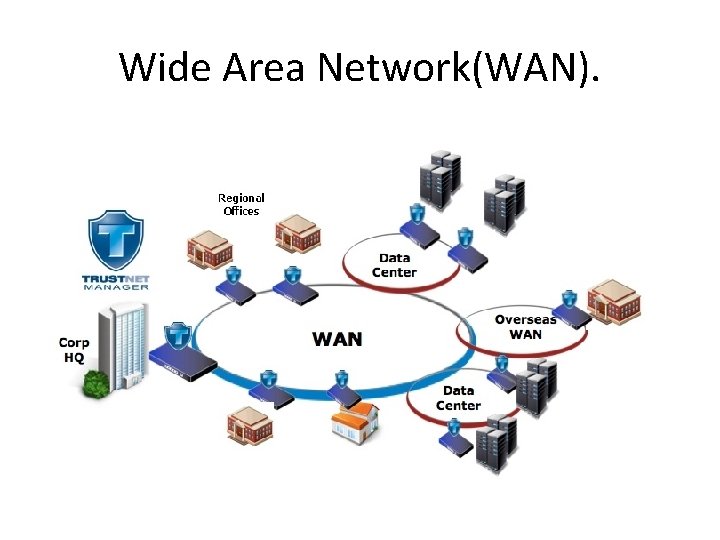
Wide Area Network(WAN). • Wide Area Network (WAN) – a network that spans a wide geographical area; there are several types of WANS – Campus Area Network(CAN) - a network spanning multiple LANs but smaller than a MAN, such as on a university or local business campus. – Storage Area Network(SAN) - connects servers to data storage devices through a technology like Fibre Channel. – Metropolitan Area Network(MAN)- a network spanning a physical area larger than a LAN but smaller than a WAN, such as a city. A MAN is typically owned an operated by a single entity such as a government body or large corporation.
Wide Area Network(WAN).
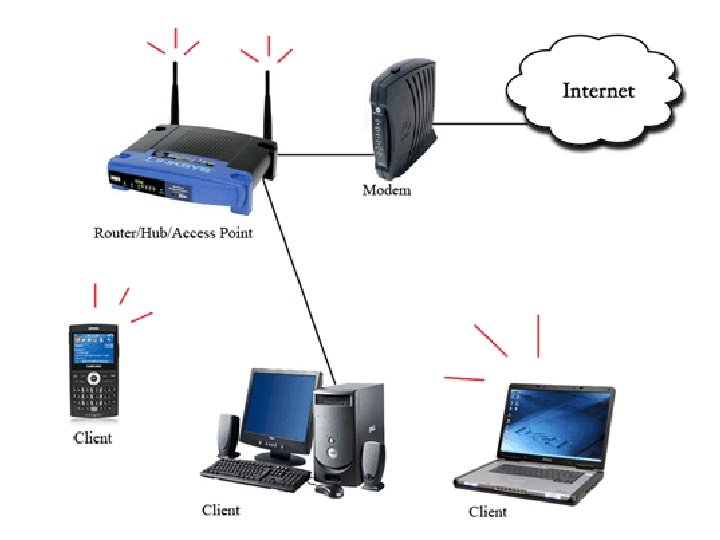
Wireless LAN • A wireless local area network(LAN) is a flexible data communications system implemented as an extension to, or as an alternative for, a wired LAN. – Using radio frequency (RF) technology, wireless LANs transmit and receive data over the air, minimizing the need for wired connections. • Thus, combining data connectivity with user mobility.
TYPES OF NETWORK (cont) • Intranet – An intranet is a private LAN designed for use by everyone within an organization. An intranet might consist of an internal e-mail system, a message board and one or more Web site portals that contain company news, forms, and personnel information. Access to an intranet’s web site is restricted by a firewall. • Extranet – a network that connects people within your company with people who are outside your company--all within a secure, password-protected network that can be accessed from anywhere.
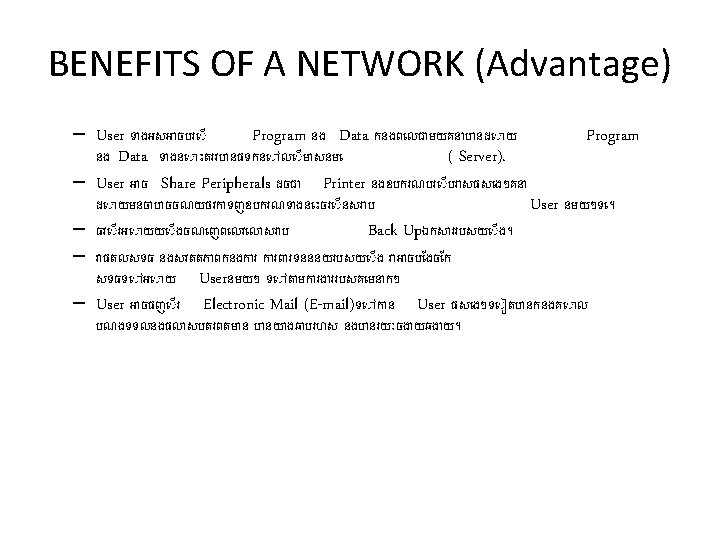
BENEFITS OF A NETWORK (Advantage) • ស រ បរយ ជនន បរពនធ Network – Information sharing: Authorized users can use other computers on the network to access and share information and data. This could include special group projects, databases, etc. – Hardware sharing: One device connected to a network, such as a printer or scanner, can be shared by many users. – Software sharing: Instead of purchasing and installing a software program on each computer, it can be installed on the server. All of the users can then access the program from a single location. – Collaborative environment: Users can work together on group projects by combining the power and capabilities of diverse equipment.
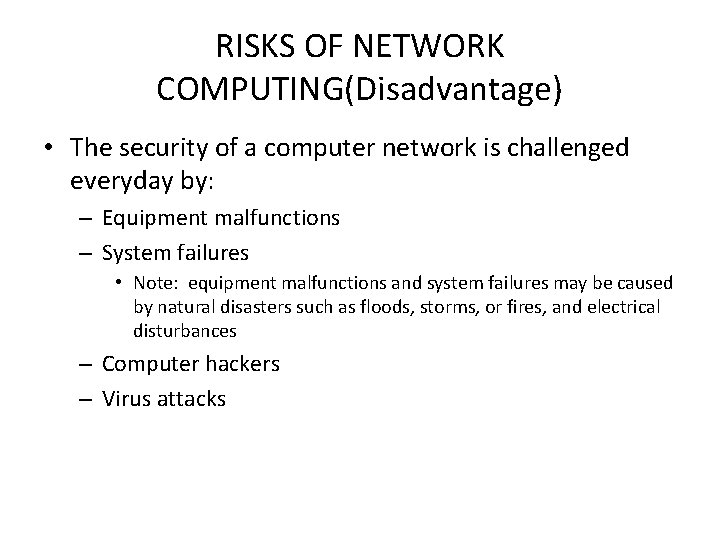
RISKS OF NETWORK COMPUTING(Disadvantage) • The security of a computer network is challenged everyday by: – Equipment malfunctions – System failures • Note: equipment malfunctions and system failures may be caused by natural disasters such as floods, storms, or fires, and electrical disturbances – Computer hackers – Virus attacks
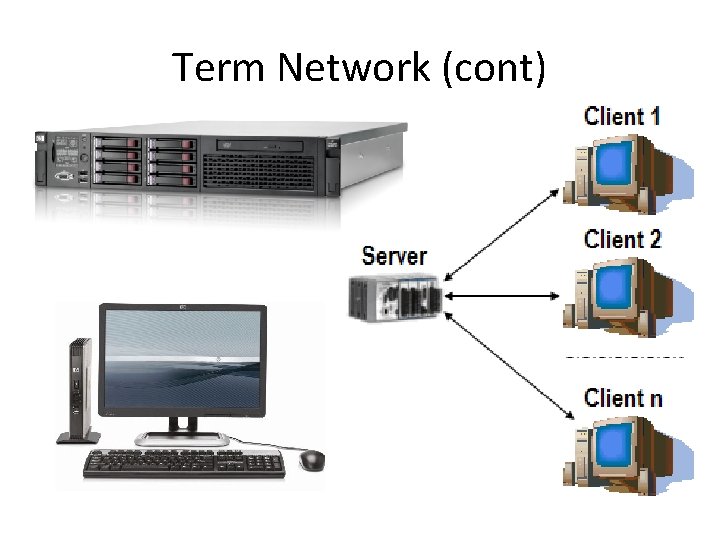
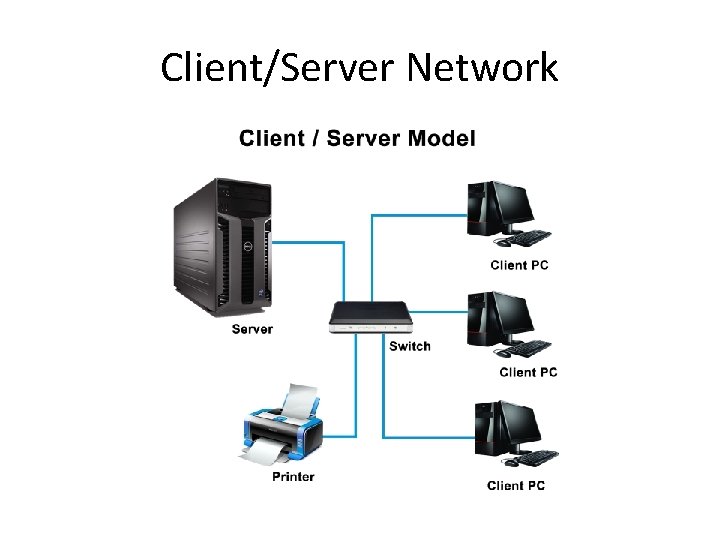
Network Terms • Client is a piece of computer hardware or software that accesses a service made available by a server, in which case the client accesses the service by way of a network. The term applies to programs or devices that are part of a client–server model. • Server is a computer that stores and provides resources, data, and services to the network.
Term Network (cont)
HOW ARE NETWORKS CATEGORIZED? • Networks are usually classified using three properties: • Topology • Protocol • Architecture
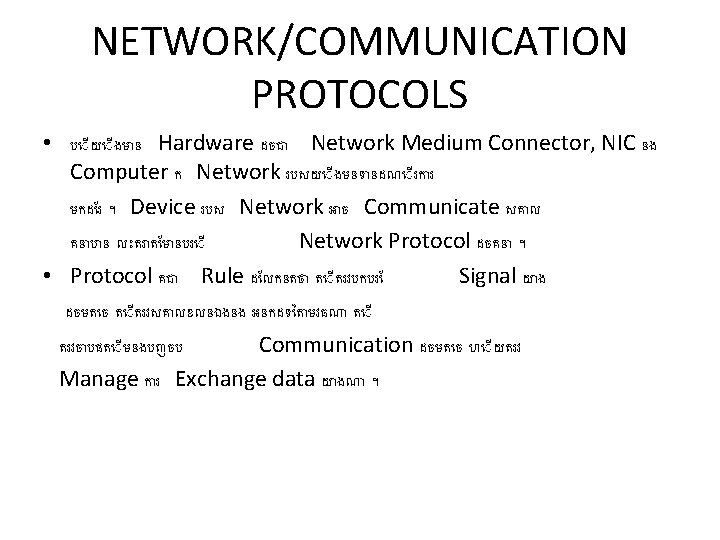
NETWORK/COMMUNICATION PROTOCOLS • A protocol is simply an agreed-on set of rules and procedures for transmitting data between two or more devices. • Features determined by the protocol are: – How the sending device indicates it has finished sending the message. – How the receiving device indicates it has received the message. – The type of error checking to be used.
NETWORK/COMMUNICATIONS PROTOCOLS • Most networks use Ethernet, but some network may use IBM’s Token Ring protocol. • On the Internet, the major protocol is TCP/IP (an acronym for Transmission Control Protocol/Internet Protocol).
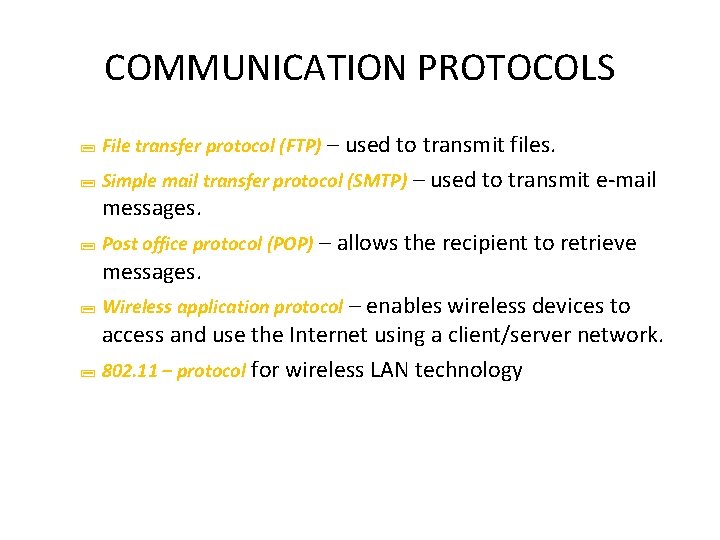
COMMUNICATION PROTOCOLS ; File transfer protocol (FTP) – used to transmit files. ; Simple mail transfer protocol (SMTP) – used to transmit e-mail messages. ; Post office protocol (POP) – allows the recipient to retrieve messages. ; Wireless application protocol – enables wireless devices to access and use the Internet using a client/server network. ; 802. 11 – protocol for wireless LAN technology
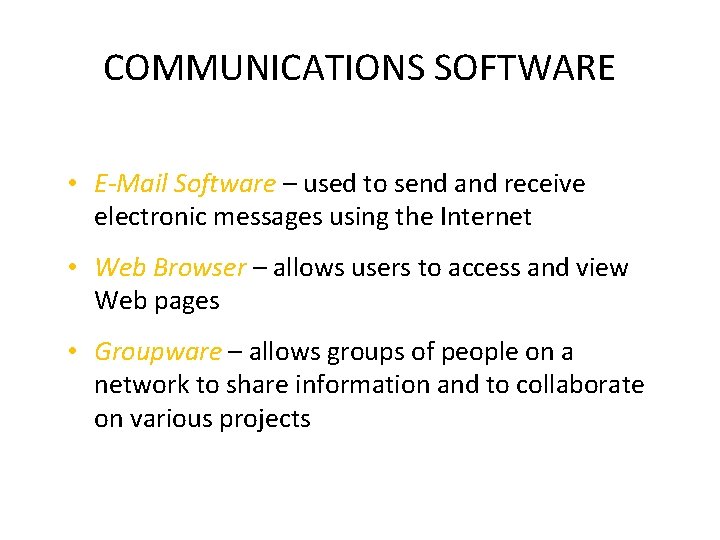
COMMUNICATIONS SOFTWARE • E-Mail Software – used to send and receive electronic messages using the Internet • Web Browser – allows users to access and view Web pages • Groupware – allows groups of people on a network to share information and to collaborate on various projects
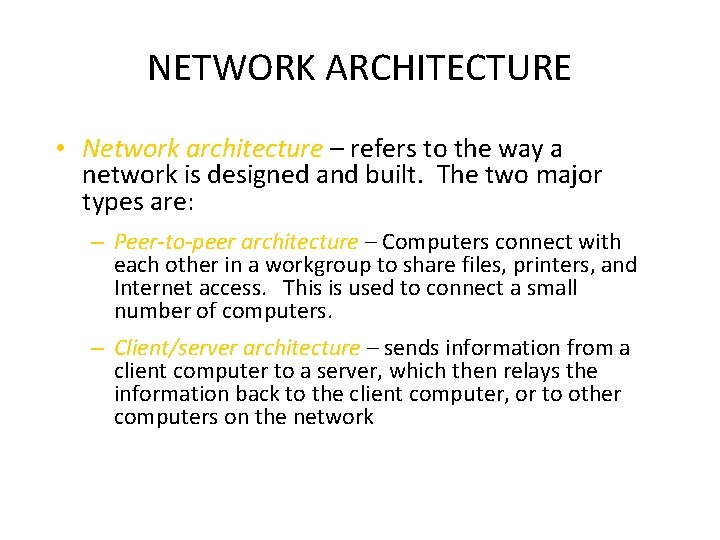
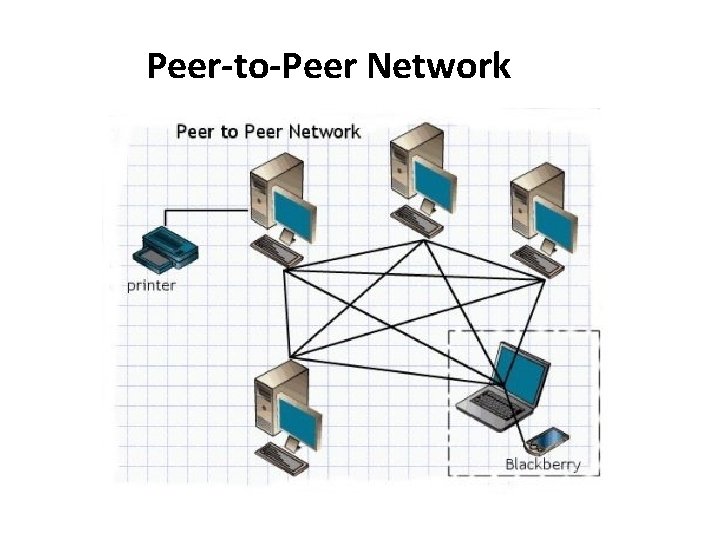
NETWORK ARCHITECTURE • Network architecture – refers to the way a network is designed and built. The two major types are: – Peer-to-peer architecture – Computers connect with each other in a workgroup to share files, printers, and Internet access. This is used to connect a small number of computers. – Client/server architecture – sends information from a client computer to a server, which then relays the information back to the client computer, or to other computers on the network
Peer-to-Peer Network
Client/Server Network