
Chapter 1 Introduction Mathematics Review Sections 1 1
- Slides: 18
Chapter 1 Introduction Mathematics Review Sections 1. 1, 1. 2 1
Outline • Why does program execution time for large inputs matter? • Basic mathematical background 2
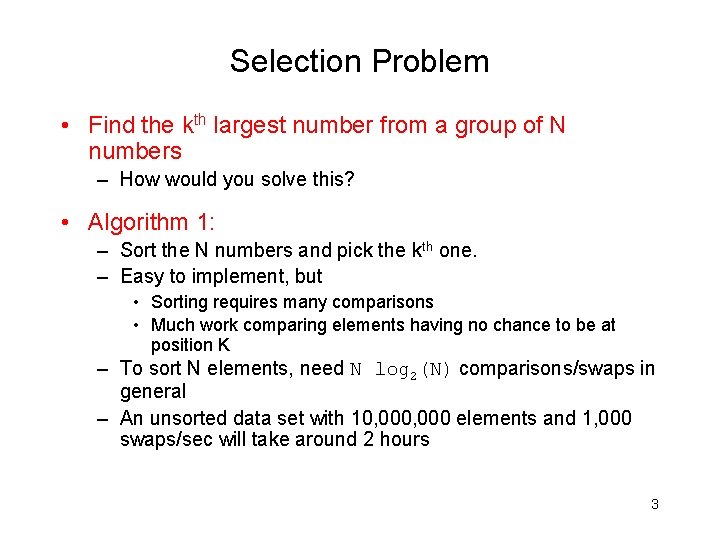
Selection Problem • Find the kth largest number from a group of N numbers – How would you solve this? • Algorithm 1: – Sort the N numbers and pick the kth one. – Easy to implement, but • Sorting requires many comparisons • Much work comparing elements having no chance to be at position K – To sort N elements, need N log 2(N) comparisons/swaps in general – An unsorted data set with 10, 000 elements and 1, 000 swaps/sec will take around 2 hours 3
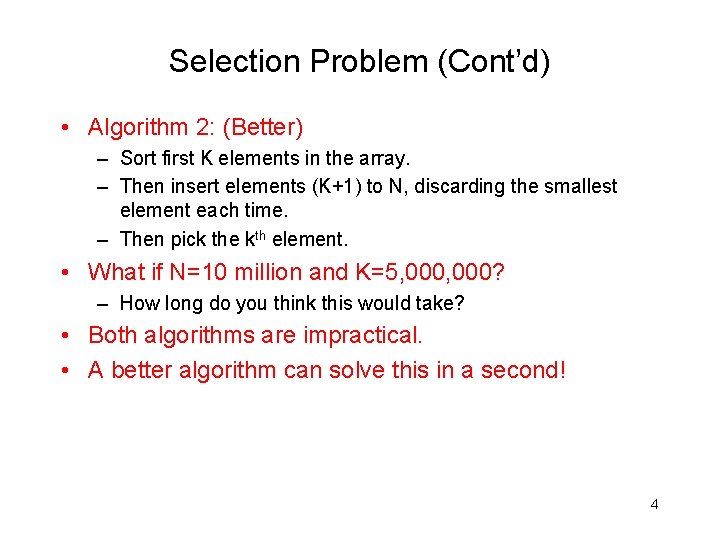
Selection Problem (Cont’d) • Algorithm 2: (Better) – Sort first K elements in the array. – Then insert elements (K+1) to N, discarding the smallest element each time. – Then pick the kth element. • What if N=10 million and K=5, 000? – How long do you think this would take? • Both algorithms are impractical. • A better algorithm can solve this in a second! 4
Mathematics Review • • • Exponents Logarithms Series Modular arithmetic Proof techniques 5
Exponents 6
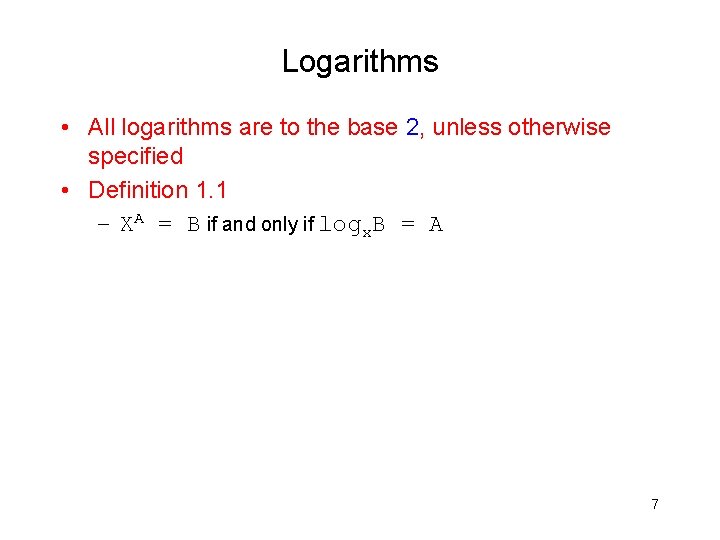
Logarithms • All logarithms are to the base 2, unless otherwise specified • Definition 1. 1 – XA = B if and only if logx. B = A 7
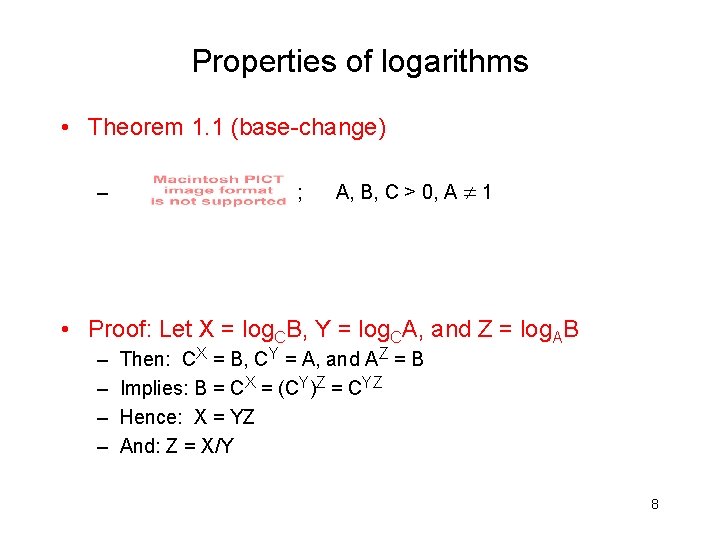
Properties of logarithms • Theorem 1. 1 (base-change) – ; A, B, C > 0, A 1 • Proof: Let X = log. CB, Y = log. CA, and Z = log. AB – – Then: CX = B, CY = A, and AZ = B Implies: B = CX = (CY)Z = CYZ Hence: X = YZ And: Z = X/Y 8
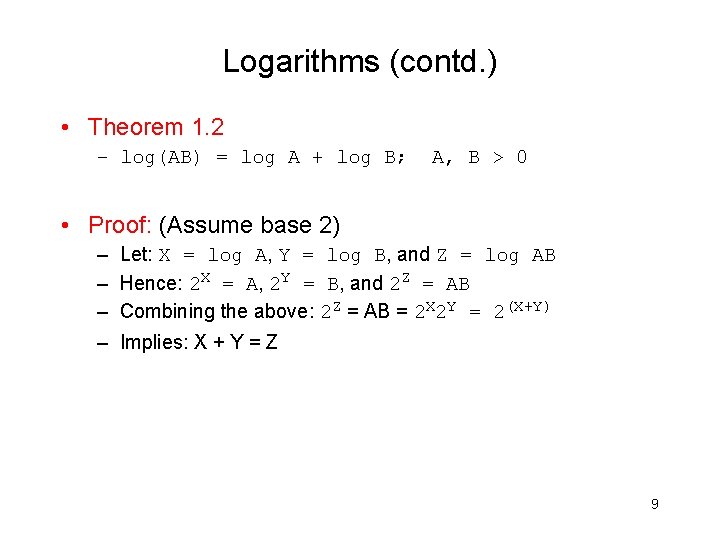
Logarithms (contd. ) • Theorem 1. 2 – log(AB) = log A + log B; A, B > 0 • Proof: (Assume base 2) – – Let: X = log A, Y = log B, and Z = log AB Hence: 2 X = A, 2 Y = B, and 2 Z = AB Combining the above: 2 Z = AB = 2 X 2 Y = 2(X+Y) Implies: X + Y = Z 9
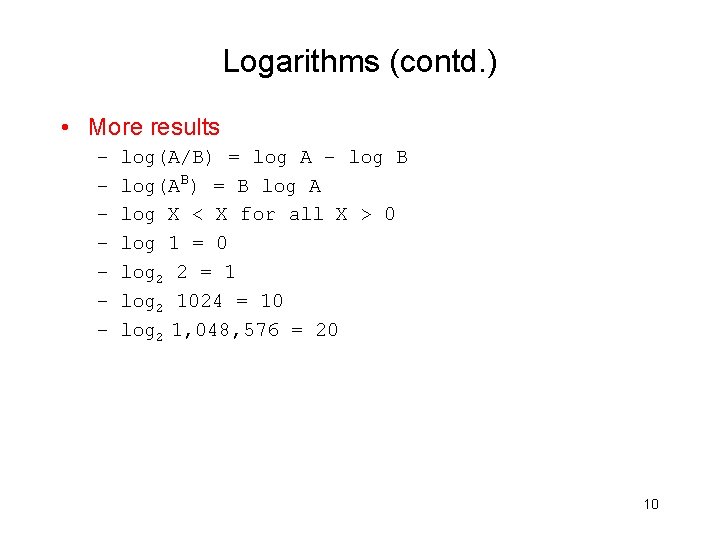
Logarithms (contd. ) • More results – – – – log(A/B) = log A – log B log(AB) = B log A log X < X for all X > 0 log 1 = 0 log 2 2 = 1 log 2 1024 = 10 log 2 1, 048, 576 = 20 10
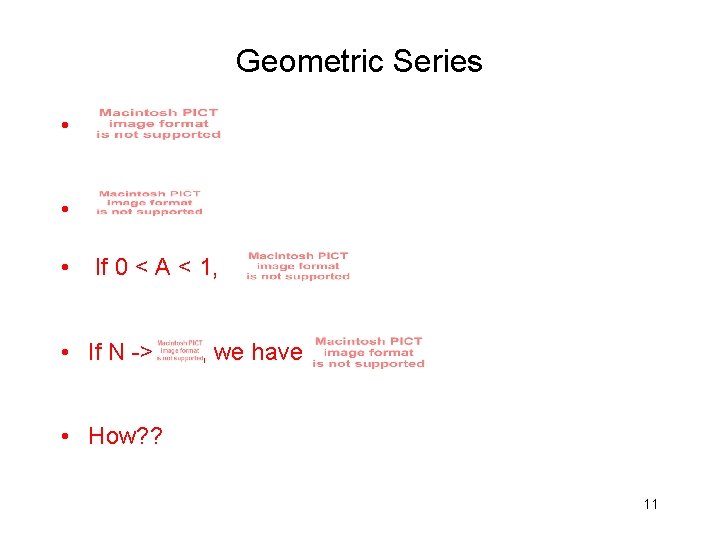
Geometric Series • • • If 0 < A < 1, • If N -> , we have • How? ? 11
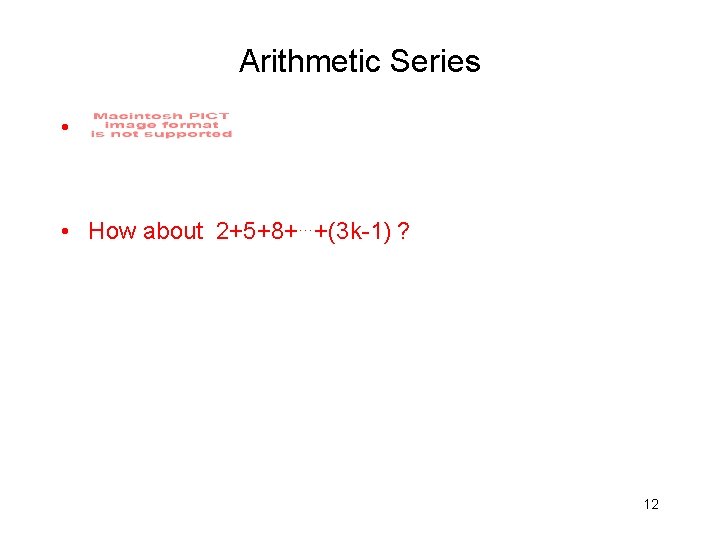
Arithmetic Series • • How about 2+5+8+…+(3 k-1) ? 12
Modular Arithmetic • We say that A is congruent to B modulo N – Written as (mod N) – If N divides (A-B) • In other words, the remainder is the same if either A or B are divided by N • E. g. – (mod 10) • Similar to equality, if – (mod N), then (mod N), and (mod N) 13
Proof techniques • Two common proof techniques in data structure and algorithm analysis (and in CS, in general) – Proof by induction – Proof by contradiction – Another common technique • Proof a statement false with a counterexample 14
Proof by Induction • Given a theorem • First prove a base case – Show theorem is true for some small degenerate values • Next assume an inductive hypothesis – Assume theorem is true for all cases up to some limit k • Then prove that theorem holds for the next value (k+1) 15
Proof by Induction - example • Fibonacci Series – F 0 = 1, F 1 = 1, Fi = F(i-1) + F(i-2), for i>1 • Show that – Fi < (5/3)i, for i>0 • Base case: – F 1 = 1 < 5/3 – F 2 = 2 < (5/3)2=25/9 • Inductive Hypothesis – Assuming: Fi < (5/3) i , i = 1, 2, . . . , k 16
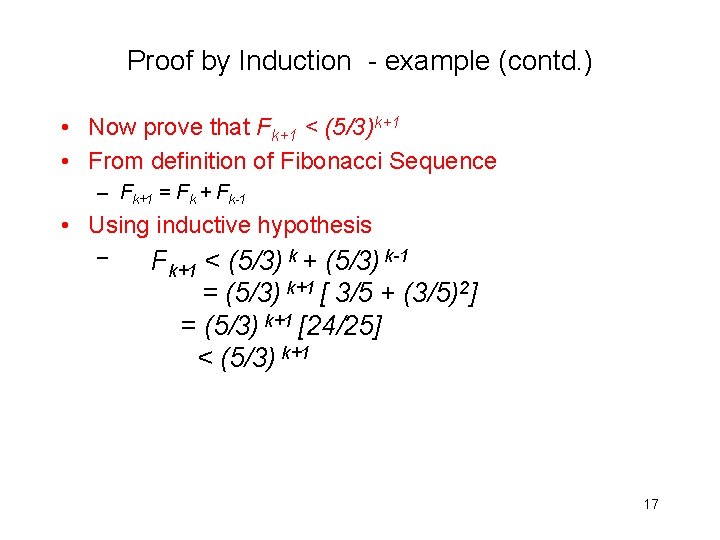
Proof by Induction - example (contd. ) • Now prove that Fk+1 < (5/3)k+1 • From definition of Fibonacci Sequence – Fk+1 = Fk + Fk-1 • Using inductive hypothesis – Fk+1 < (5/3) k + (5/3) k-1 = (5/3) k+1 [ 3/5 + (3/5)2] = (5/3) k+1 [24/25] < (5/3) k+1 17
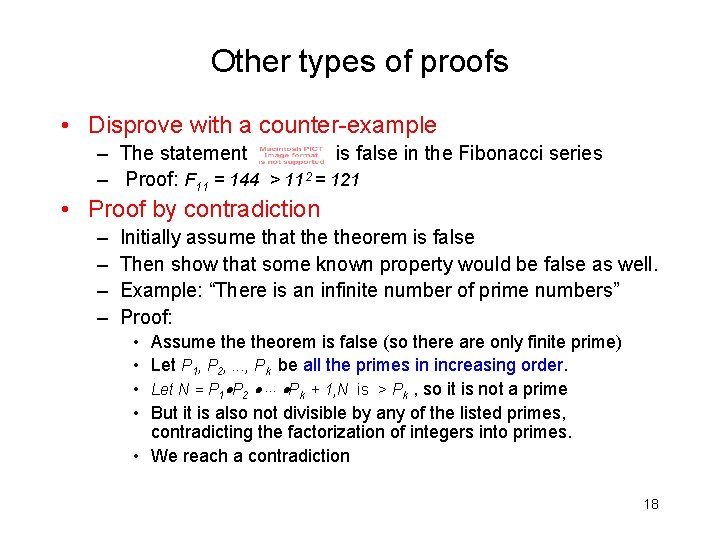
Other types of proofs • Disprove with a counter-example – The statement is false in the Fibonacci series – Proof: F 11 = 144 > 112 = 121 • Proof by contradiction – – Initially assume that theorem is false Then show that some known property would be false as well. Example: “There is an infinite number of prime numbers” Proof: • Assume theorem is false (so there are only finite prime) • Let P 1, P 2, . . . , Pk be all the primes in increasing order. • Let N = P 1 P 2 Pk + 1, N is > Pk , so it is not a prime • But it is also not divisible by any of the listed primes, contradicting the factorization of integers into primes. • We reach a contradiction 18