
Chapter 1 Introduction Managers and Managing Management Key
- Slides: 25
Chapter 1 Introduction Managers and Managing
Management Key Concepts • Organizations: People working together and coordinating their actions to achieve specific goals. • Goal: A desired future condition that the organization seeks to achieve.
Management: • The process of using organizational resources to achieve the organization’s goals by. . . – Planning, Organizing, Leading, and Controlling
Additional Key Concepts • Resources are organizational assets which include: • People. • Machines. • Raw materials. • Information, skills. • Financial capital.
Managers : Managers are the people responsible for supervising the use of an organization’s resources to meet its goals.
Organizational Performance • Organizational Performance Measures how efficiently and effectively managers use resources to satisfy customers and achieve goals. 1. Efficiency ( )ﻛﻔﺎﺀﻩ : “Doing things right” – A measure of how well resources are used to achieve a goal. Ø Usually, managers must try to minimize the input of resources to achieve the same goal.
Organizational Performance 2. Effectiveness (������ ): “Doing the right things” – A measure of the rightness of the goals chosen (are these the right goals? ), and the degree to which they are achieved. Ø Organizations are more effective when managers choose the correct goals and then achieve them.
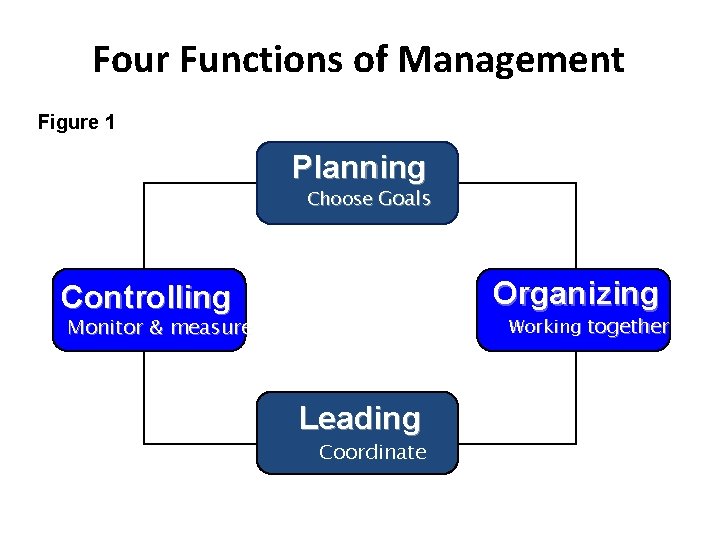
Managerial Functions • Managers at all levels in all organizations perform each of the four essential managerial functions of • Planning. • Organizing. • Leading. • Controlling. 1 -8
Four Functions of Management Figure 1 Planning Choose Goals Organizing Controlling Working together Monitor & measure Leading Coordinate
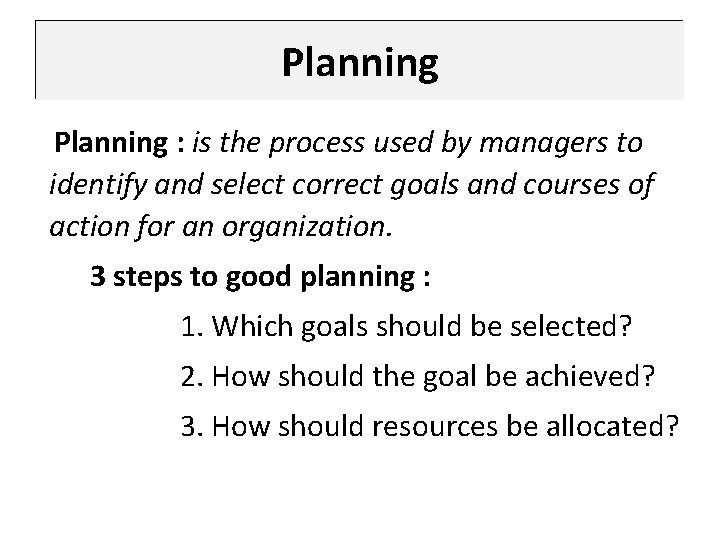
Planning : is the process used by managers to identify and select correct goals and courses of action for an organization. 3 steps to good planning : 1. Which goals should be selected? 2. How should the goal be achieved? 3. How should resources be allocated?
Planning • The planning function determines how effective and efficient the organization is and determines the strategy of the organization.
Organizing • In organizing, managers create the structure of working relationships between organizational members that best allows them to work together and achieve goals. • Managers will group people into departments according to the tasks performed. Ø Managers will also lay out lines of authority and responsibility for members.
Organizing • An organizational structure is the outcome of organizing. Ø This structure coordinates and motivates employees so that they work together to achieve goals.
Leading • In leading, managers determine direction, state a clear vision for employees to follow, and help employees understand the role they play in attaining goals. Ø Leadership involves a manager using power, influence, vision, persuasion, and communication skills.
Leading • The outcome of the leading function is a high level of motivation and commitment from employees to the organization.
Controlling • In controlling, managers evaluate how well the organization is achieving its goals and takes corrective action to improve performance. • Managers will check individuals, departments, and the organization to determine if desired performance has been reached. ØManagers will also take action to increase performance as required.
Controlling • The outcome of the controlling function is the accurate measurement of performance and regulation of efficiency and effectiveness.
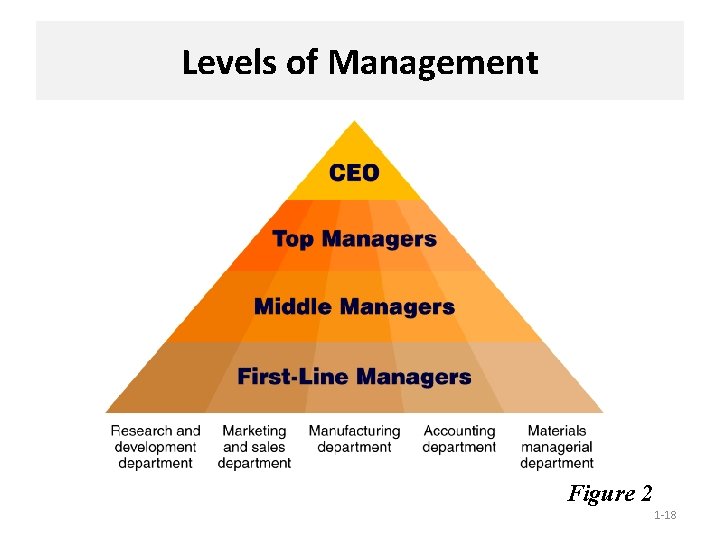
Levels of Management Figure 2 1 -18
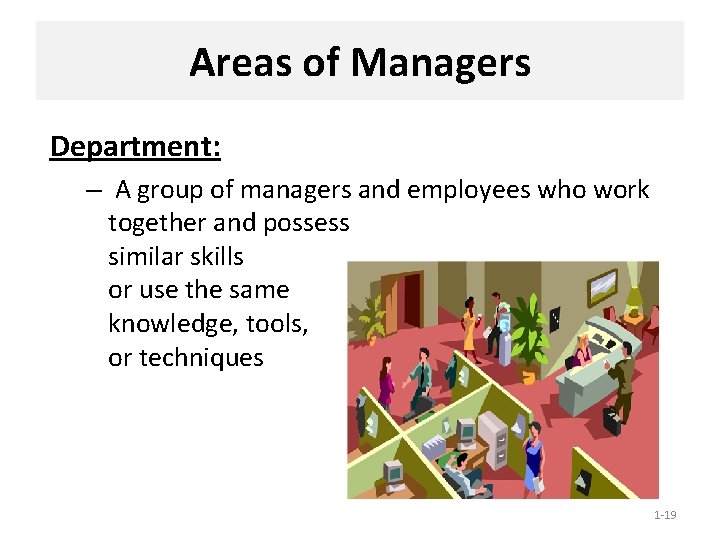
Areas of Managers Department: – A group of managers and employees who work together and possess similar skills or use the same knowledge, tools, or techniques 1 -19
Levels of Management • First line managers - Responsible for daily supervision of the non-managerial employees who perform many of the specific activities necessary to produce goods and services. • Middle managers - Supervise first-line managers. Responsible for finding the best way to organize human and other resources to achieve organizational goals 1 -20
Levels of Management Top managers – Responsible for the performance of all departments and have cross-departmental responsibility. • Establish organizational goals and monitor middle managers. • Decide how different departments should interact. • Ultimately responsible for the success or failure of an organization. 1 -21
Levels of Management • Chief executive officer (CEO) is company’s most senior and important manager • Central concern is creation of a smoothly functioning top-management team 1 -22
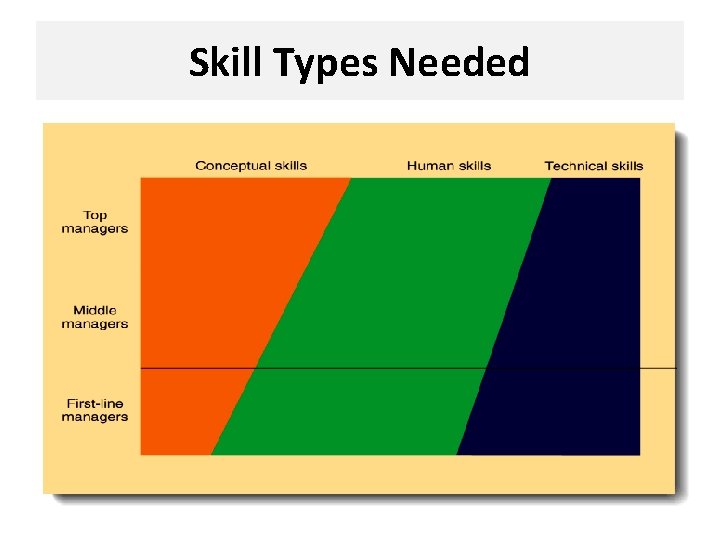
Managerial Skills There are three skill sets that managers need to perform effectively. 1. Conceptual skills: the ability to analyze and diagnose a situation and find the cause and effect. 2. Human skills: the ability to understand, lead, and control people’s behavior. 3. Technical skills: the job-specific knowledge required to perform a task. Common examples include marketing, accounting, and manufacturing. Ø All three skills are enhanced through formal training, reading, and practice.
Skill Types Needed
Management Challenges • Increasing number of global organizations. • Building competitive advantage through superior efficiency, quality, innovation, and responsiveness. • Increasing performance while remaining ethical managers. • Managing an increasingly diverse work force. • Using new technologies.