
Chapter 1 Introduction Kyung Hee University 1 1




- Slides: 25
Chapter 1 Introduction Kyung Hee University 1
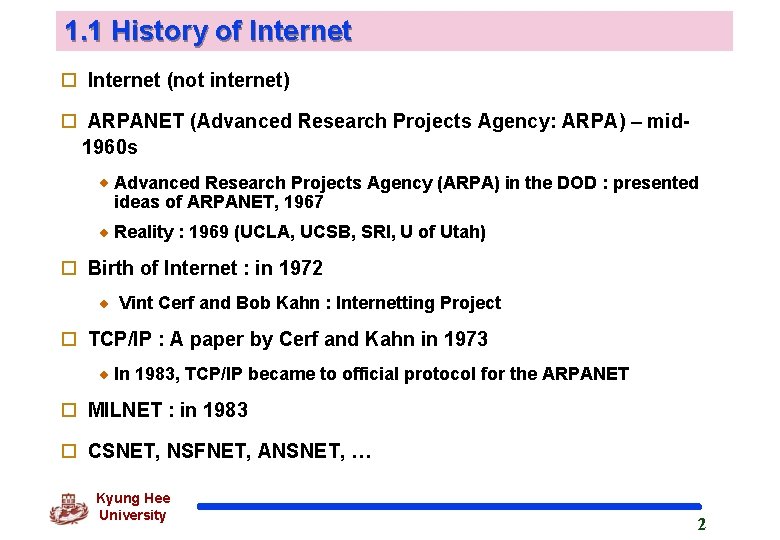
1. 1 History of Internet o Internet (not internet) o ARPANET (Advanced Research Projects Agency: ARPA) – mid 1960 s Advanced Research Projects Agency (ARPA) in the DOD : presented ideas of ARPANET, 1967 Reality : 1969 (UCLA, UCSB, SRI, U of Utah) o Birth of Internet : in 1972 Vint Cerf and Bob Kahn : Internetting Project o TCP/IP : A paper by Cerf and Kahn in 1973 In 1983, TCP/IP became to official protocol for the ARPANET o MILNET : in 1983 o CSNET, NSFNET, ANSNET, … Kyung Hee University 2
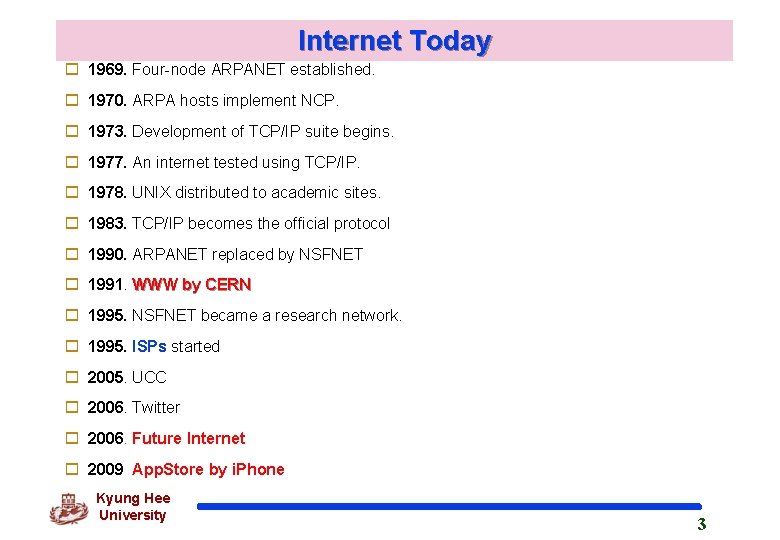
Internet Today o 1969. Four-node ARPANET established. o 1970. ARPA hosts implement NCP. o 1973. Development of TCP/IP suite begins. o 1977. An internet tested using TCP/IP. o 1978. UNIX distributed to academic sites. o 1983. TCP/IP becomes the official protocol o 1990. ARPANET replaced by NSFNET o 1991. WWW by CERN o 1995. NSFNET became a research network. o 1995. ISPs started o 2005. UCC o 2006. Twitter o 2006. Future Internet o 2009 App. Store by i. Phone Kyung Hee University 3
Internet Today (cont’d) Kyung Hee University 4
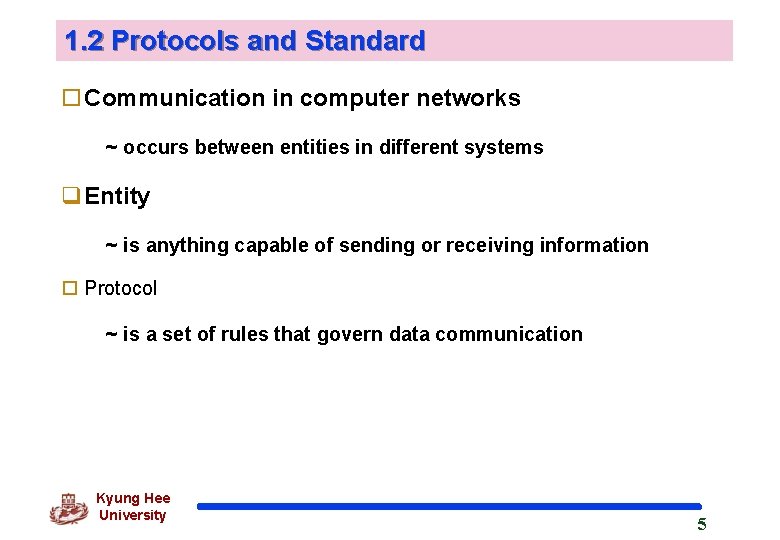
1. 2 Protocols and Standard o Communication in computer networks ~ occurs between entities in different systems q Entity ~ is anything capable of sending or receiving information o Protocol ~ is a set of rules that govern data communication Kyung Hee University 5
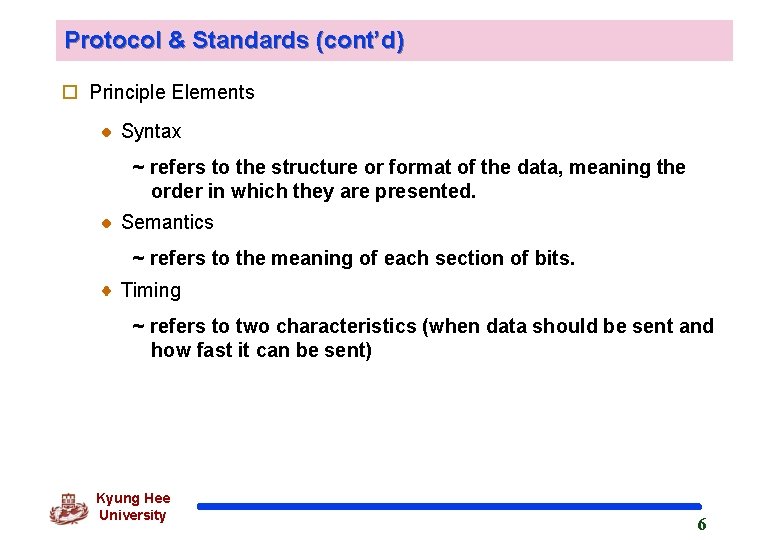
Protocol & Standards (cont’d) o Principle Elements Syntax ~ refers to the structure or format of the data, meaning the order in which they are presented. Semantics ~ refers to the meaning of each section of bits. Timing ~ refers to two characteristics (when data should be sent and how fast it can be sent) Kyung Hee University 6
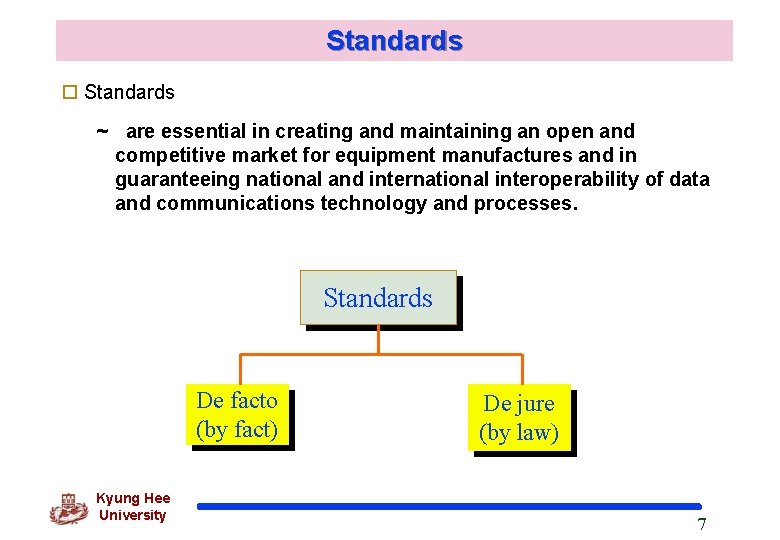
Standards o Standards ~ are essential in creating and maintaining an open and competitive market for equipment manufactures and in guaranteeing national and international interoperability of data and communications technology and processes. Standards De facto (by fact) Kyung Hee University De jure (by law) 7
1. 3 Standards Organizations o Standard Creation Committees ISO (The International Standard Organization) ~ created in 1947 ~ voluntary organization ~ is an organization dedicated to worldwide agreement on international standards in a variety of fields (scientific, technological, economic activity) Kyung Hee University 8
Standards Organizations (cont’d) ITU-T(International Telecommunications Union Telecommunications Standards Sector) ~ is an international standards organization related to the United Nations that develops standards for telecommunications. l Two popular standards developed by ITU-T are the V series (data transmission over phone lines) and the X series (transmission over public digital networks) Kyung Hee University 9
Standards Organizations (cont’d) ANSI (American National Standard Institute) ~ is a nonprofit organization and is the U. S. voting representative to be both the ISO and the ITU-T IEEE (Institute of Electrical and Electronic Engineers) ~ is the largest national professional group involved in developing standards for computing, communication, electrical engineering, and electronics) EIA (Electronic Industries Association) ~ is an association of electronics manufactures in the United States. (EIA-232 -D, EIA-530 standards) Kyung Hee University 10
Standards Organizations (cont’d) o. Forums ~ consist of representatives from corporation that test, evaluate and standardize new technologies. l Frame Relay Forum l ATM Forum and ATM consortium o Regulatory agencies FCC (Federal Communications Commission) KCC (Korea Communications Commission) & MSIP (Ministry of Science, ICT and Future Planning) Kyung Hee University 11
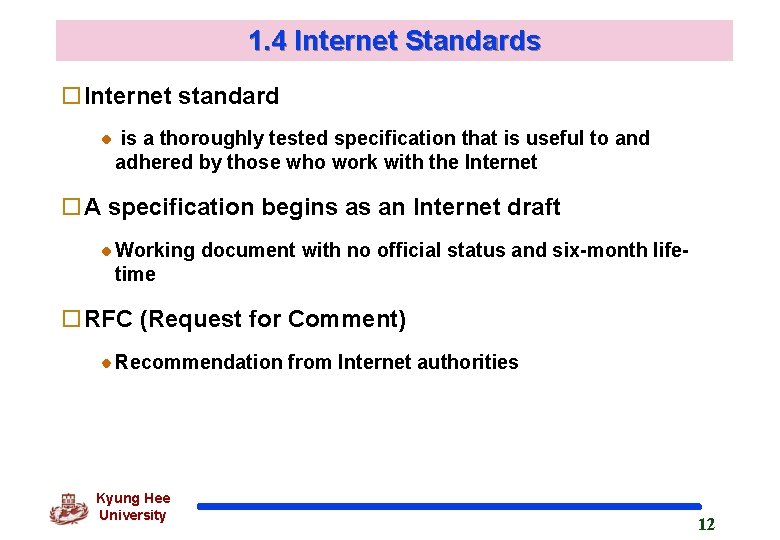
1. 4 Internet Standards o. Internet standard is a thoroughly tested specification that is useful to and adhered by those who work with the Internet o. A specification begins as an Internet draft Working document with no official status and six-month lifetime o. RFC (Request for Comment) Recommendation from Internet authorities Kyung Hee University 12
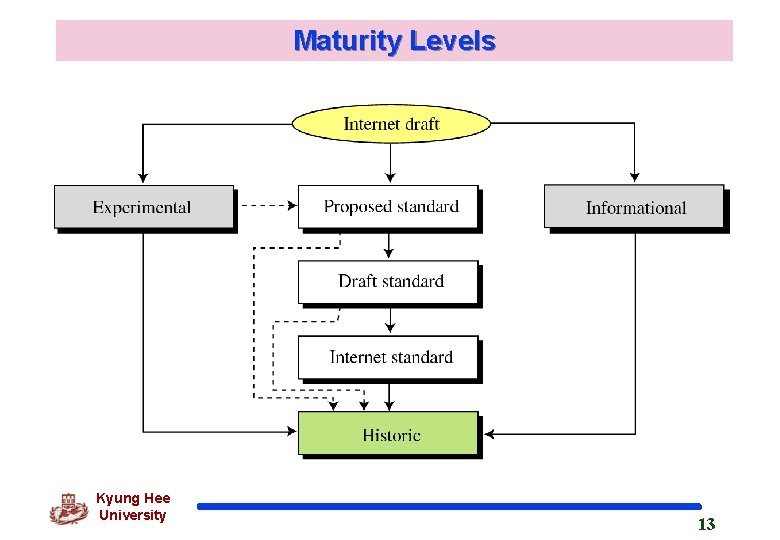
Maturity Levels Kyung Hee University 13
Maturity Levels (cont’d) o Proposed Standard Is a specification that is stable, well understood, and of sufficient interest to the Internet community. o Draft Standard Proposed is elevated to draft standard status after at least two successful independent and interoperable implementations With modification, normally becomes an Internet standard o Internet Standard A draft standard reaches Internet standard status after demonstrations of successful Implementation Kyung Hee University 14
Maturity Levels (cont’d) o Historic RFCs Superseded by later specifications or never passed the necessary maturity levels to become an Internet standard o Experimental RFCs Not implemented in any functional Internet service o Informational RFCs Containing general, historical, or tutorial information related to the Internet Kyung Hee University 15
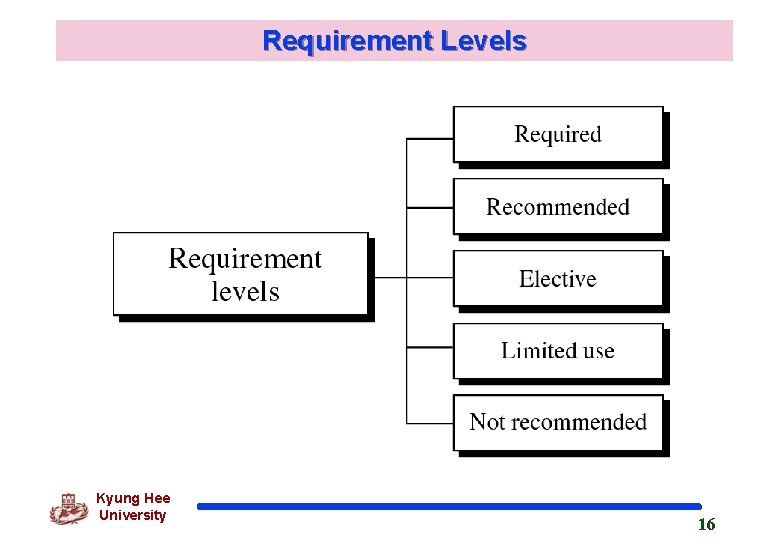
Requirement Levels Kyung Hee University 16
Requirement Levels (cont’d) o Required protocols (RFCs) Must be implemented by all Internet systems to achieve minimum conformance For example, IP and ICMP o Recommended protocols Not required for minimum conformance; it is recommended because of its usefulness For example, FTP and Telnet o Elective protocols Not required and not recommended; but a system can use it to its own benefit. o Limited Use protocols Used only in limited situations; most of the experimental RFCs fall under this category o Not Recommended Inappropriate for general use; normally a historic (obsolete) RFC may fall under this category Kyung Hee University 17
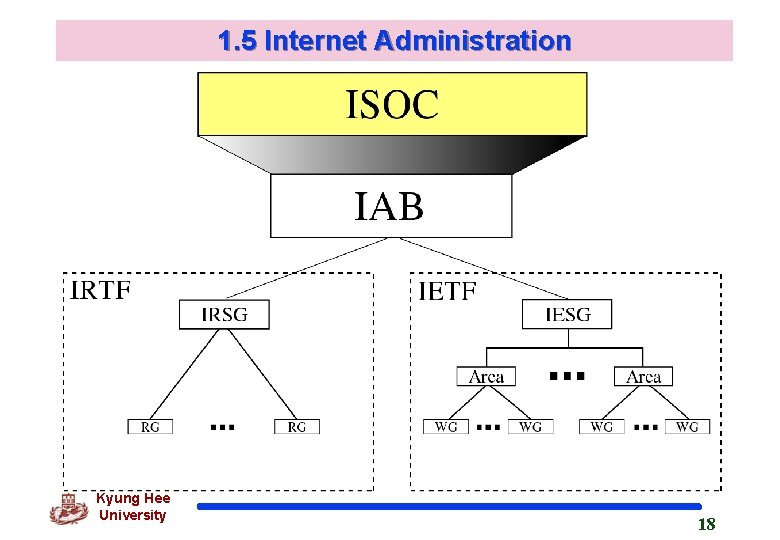
1. 5 Internet Administration Kyung Hee University 18
1. 5 Internet Administration (cont’d) o Internet Society (ISOC) An international, nonprofit organization formed in 1992 o Internet Architecture Board (IAB) Technical advisor to the ISOC Liaison between the Internet other standards organizations and forums Oversee the continuing development of the TCP/IP Protocol Suites o Internet Engineering Task Force (IETF) A forum of working groups managed by the Internet Engineering Steering Group (IESG) Eight Areas Applications Area – General Area – Internet Area – Operations and Management Area – Routing Area – Security Area – Transport Area Kyung Hee– User Services Area University – 19
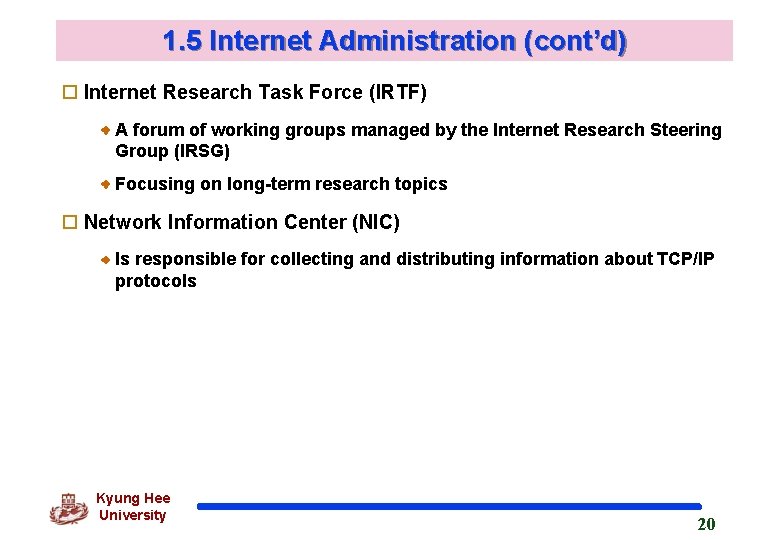
1. 5 Internet Administration (cont’d) o Internet Research Task Force (IRTF) A forum of working groups managed by the Internet Research Steering Group (IRSG) Focusing on long-term research topics o Network Information Center (NIC) Is responsible for collecting and distributing information about TCP/IP protocols Kyung Hee University 20
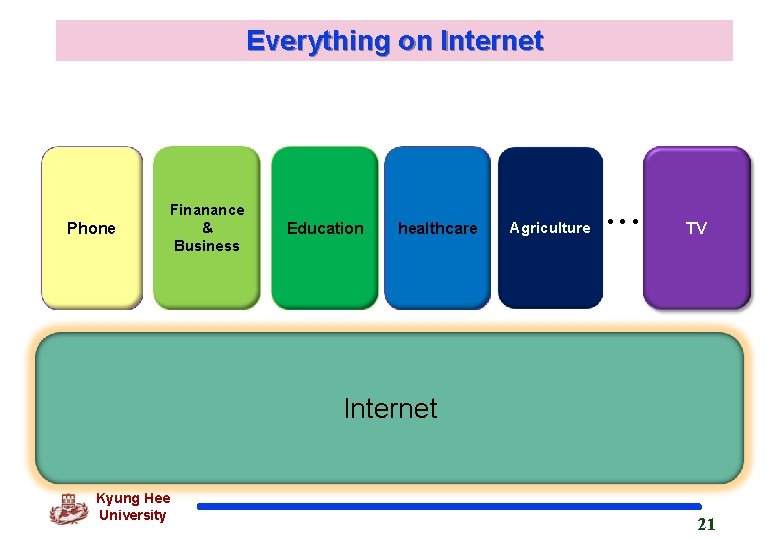
Everything on Internet Phone Finanance & Business Education healthcare Agriculture • • • • TV Internet Kyung Hee University 21
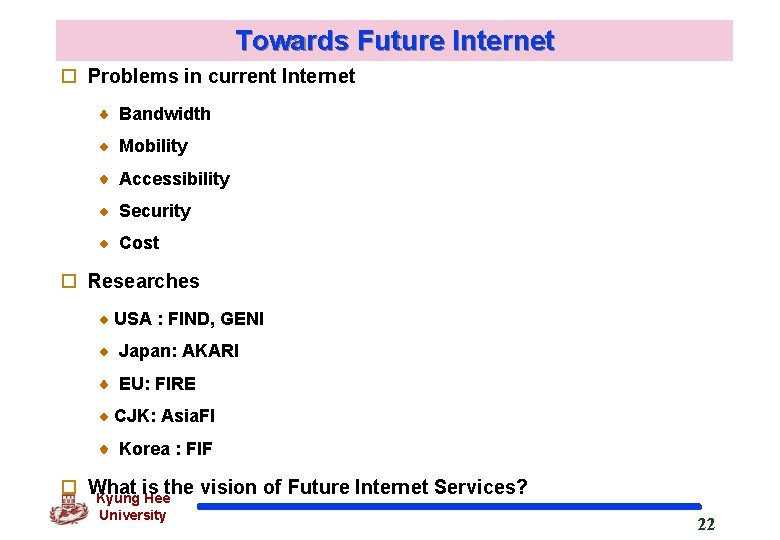
Towards Future Internet o Problems in current Internet Bandwidth Mobility Accessibility Security Cost o Researches USA : FIND, GENI Japan: AKARI EU: FIRE CJK: Asia. FI Korea : FIF o What is the vision of Future Internet Services? Kyung Hee University 22
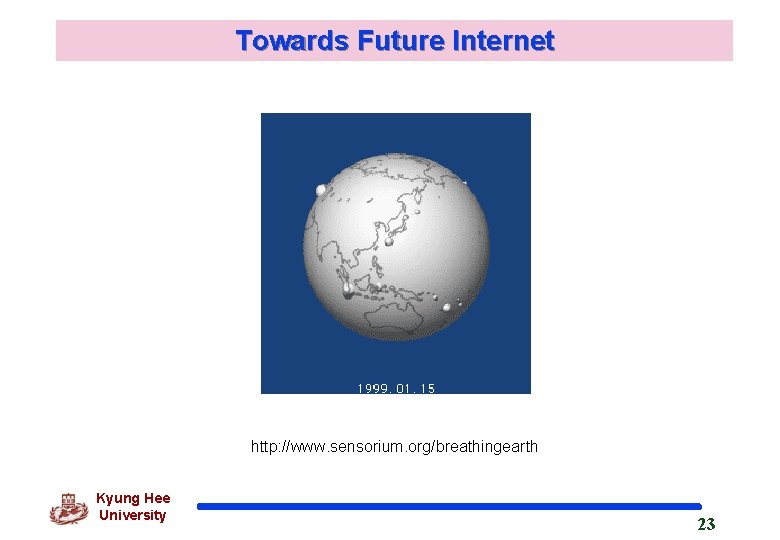
Towards Future Internet http: //www. sensorium. org/breathingearth Kyung Hee University 23
Summary o The Internet is a collection of hundreds of thousands of separate networks o What is ISPs? o Internet Standards: RFCs in IETF o IRTF for long-term research for Internet o ICANN : the Internet Corporation for Assigned Names and Numbers is responsible for the management of Internet domain names and addresses o Future Internet Kyung Hee University 24
Q and A Kyung Hee University 25