
CHAPTER 1 INTRODUCTION Introduction The mechanical precision Lab

CHAPTER 1 INTRODUCTION

Introduction The mechanical precision & Lab is an important fundamental course to the students majored in mechanical, automotive and aeronautical engineering. A clear definition of mechanical precision is essential in the mechanical drawings, it is very important for student to learn how to design and use it.

Purpose of the Course In order to meet the needs of bilingual education for Chinese students, this course is taught in English. More over, this course can also be used for the engineering education of foreign students studying in china.
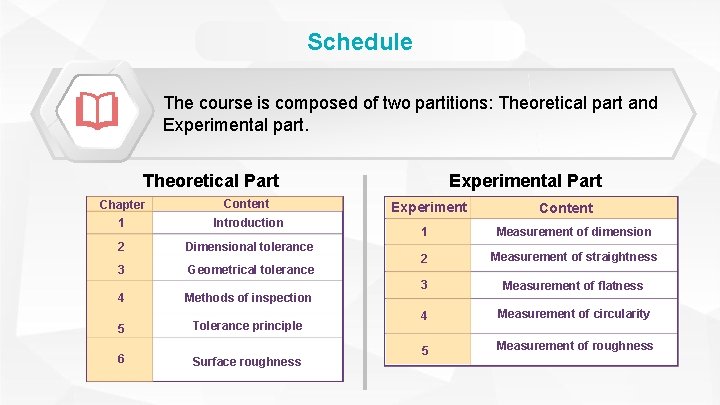
Schedule The course is composed of two partitions: Theoretical part and Experimental part. Experimental Part Theoretical Part Chapter Content 1 Introduction 2 Dimensional tolerance 3 Geometrical tolerance 4 Methods of inspection 5 Tolerance principle 6 Surface roughness Experiment Content 1 Measurement of dimension 2 Measurement of straightness 3 Measurement of flatness 4 Measurement of circularity 5 Measurement of roughness

1. 1 Interchangeability is very important in mass manufacturing, because it can greatly increase efficiency and reduce costs. Car assembly line
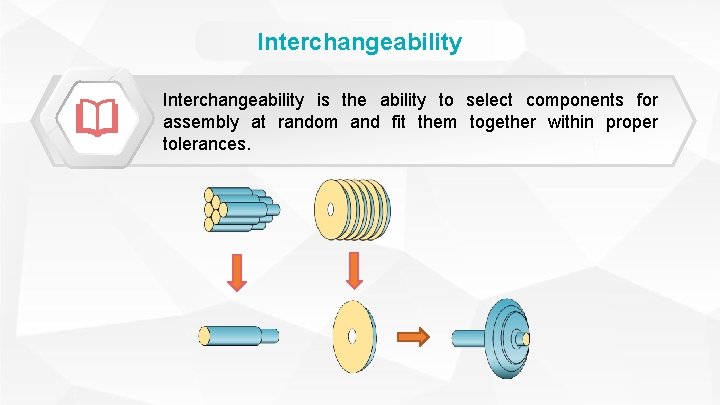
Interchangeability is the ability to select components for assembly at random and fit them together within proper tolerances.

Merit of Interchangeability Both producer and user can benefit from interchangeability. For producer l Mass manufacturing, assembly line, cost down. l Saving the time of design, manufacture and parts replacement. l For user l Expanding the selection range of industry production’s price and performance. l Saving the time and cost for repairs. l Easy to assemble new devices. Specialization in production.

Interchangeability is crucial to the Modern Production. Interchangeability is possible only when certain standard are strictly followed.
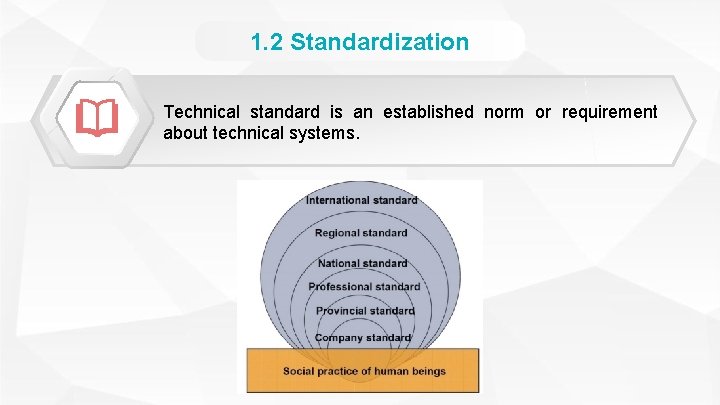
1. 2 Standardization Technical standard is an established norm or requirement about technical systems.
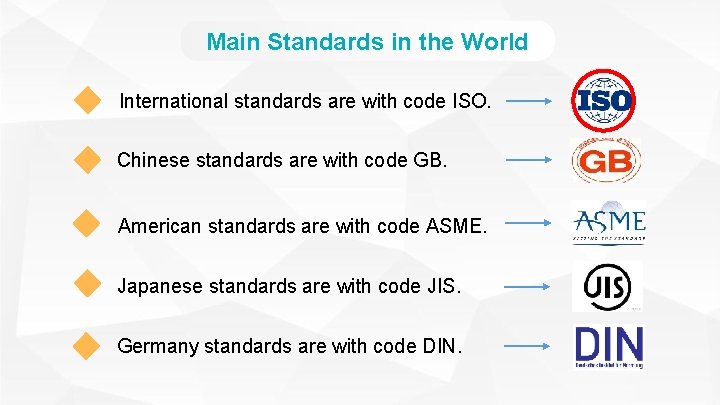
Main Standards in the World International standards are with code ISO. Chinese standards are with code GB. American standards are with code ASME. Japanese standards are with code JIS. Germany standards are with code DIN.
ISO Standards Although many countries have their own standards, it can be said that the underlying concepts of these standards are almost the same since they are all written in reference to ISO standards on geometrical interchangeability are included in GPS (Geometrical Production Specification) standard. Notice: this GPS is not the abbreviation of Global Positioning System.
Related GPS Standards In this course, the following fundamental GPS standards are introduced. ISO 286 Tolerances, Deviations and Fits ISO 1101 Tolerance of Form, Orientation, Location and Run-out ISO 4287 Surface texture: Profile method
Measurement Technology In this course, the fundamentals of measurement technology are also introduced. Measurement technology provides technical support for interchangeability. The measurement technology here is mainly geometric measurement.
- Slides: 13