
Chapter 1 Introduction Design and Analysis of Algorithms
![Other methods for gcd(m, n) [cont. ] Middle-school procedure Step 1 Step 2 Step](https://slidetodoc.com/presentation_image_h2/ce2c7b72dba548cdcdacbe526f156401/image-12.jpg "Other methods for gcd(m, n) [cont. ] Middle-school procedure Step 1 Step 2 Step")
![Example 4: Gaussian elimination Algorithm Gaussian. Elimination(A[0. . n-1, 0. . n]) //Implements Gaussian](https://slidetodoc.com/presentation_image_h2/ce2c7b72dba548cdcdacbe526f156401/image-70.jpg "Example 4: Gaussian elimination Algorithm Gaussian. Elimination(A[0. . n-1, 0. . n]) //Implements Gaussian")
- Slides: 78
Chapter 1 Introduction Design and Analysis of Algorithms – Unit I 1 -0
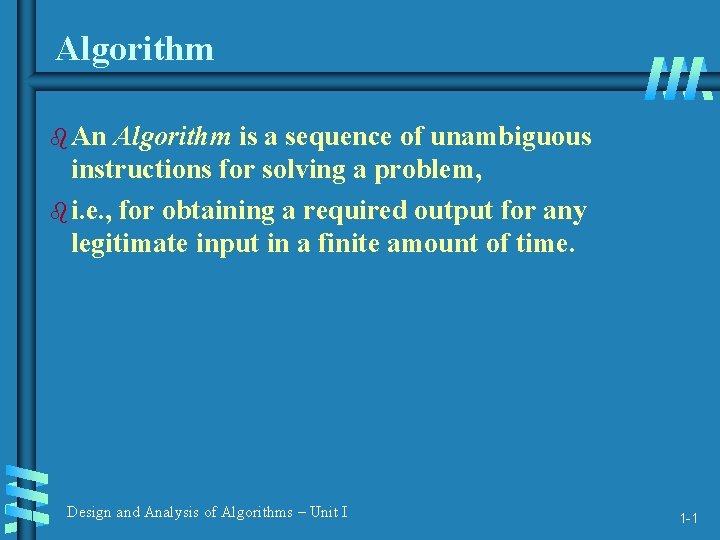
Algorithm b An Algorithm is a sequence of unambiguous instructions for solving a problem, b i. e. , for obtaining a required output for any legitimate input in a finite amount of time. Design and Analysis of Algorithms – Unit I 1 -1
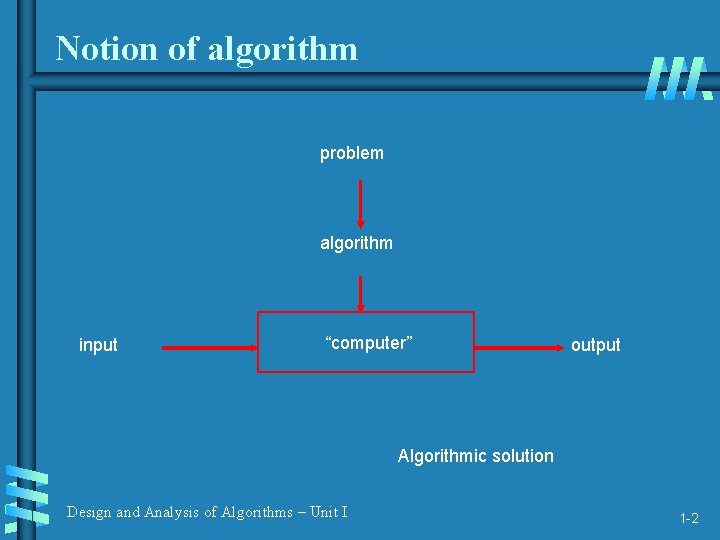
Notion of algorithm problem algorithm input “computer” output Algorithmic solution Design and Analysis of Algorithms – Unit I 1 -2
PSEUDOCODE b Pseudocode (pronounced SOO-doh-kohd) is a detailed yet readable description of what a computer program or algorithm must do, expressed in a formally-styled natural language rather than in a programming language. b It is sometimes used as a detailed step in the process of developing a program. b It allows programmers to express the design in great detail and provides programmers a detailed template for the next step of writing code in a specific programming language. Design and Analysis of Algorithms – Unit I 1 -3
Formatting and Conventions in Pseudocoding b b INDENTATION in pseudocode should be identical to its implementation in a programming language. Try to indent at least four spaces. The pseudocode entries are to be cryptic, AND SHOULD NOT BE PROSE. NO SENTENCES. No flower boxes in pseudocode. Do not include data declarations in pseudocode. Design and Analysis of Algorithms – Unit I 1 -4
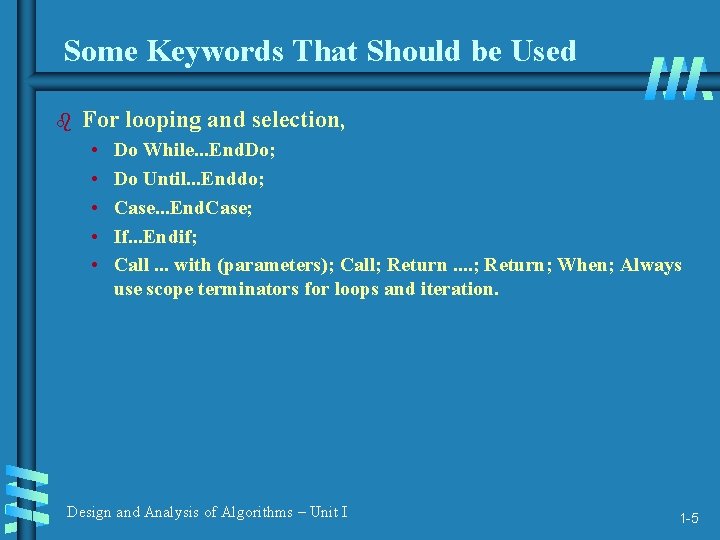
Some Keywords That Should be Used b For looping and selection, • • • Do While. . . End. Do; Do Until. . . Enddo; Case. . . End. Case; If. . . Endif; Call. . . with (parameters); Call; Return. . ; Return; When; Always use scope terminators for loops and iteration. Design and Analysis of Algorithms – Unit I 1 -5
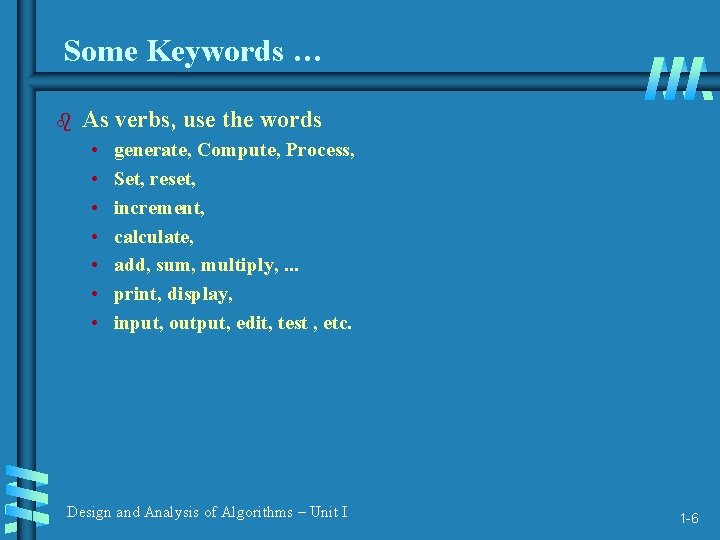
Some Keywords … b As verbs, use the words • • generate, Compute, Process, Set, reset, increment, calculate, add, sum, multiply, . . . print, display, input, output, edit, test , etc. Design and Analysis of Algorithms – Unit I 1 -6
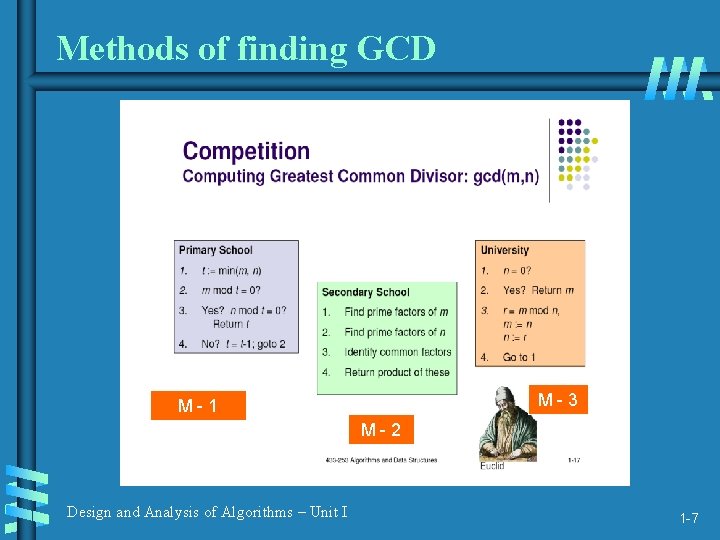
Methods of finding GCD M-3 M-1 M-2 Design and Analysis of Algorithms – Unit I 1 -7
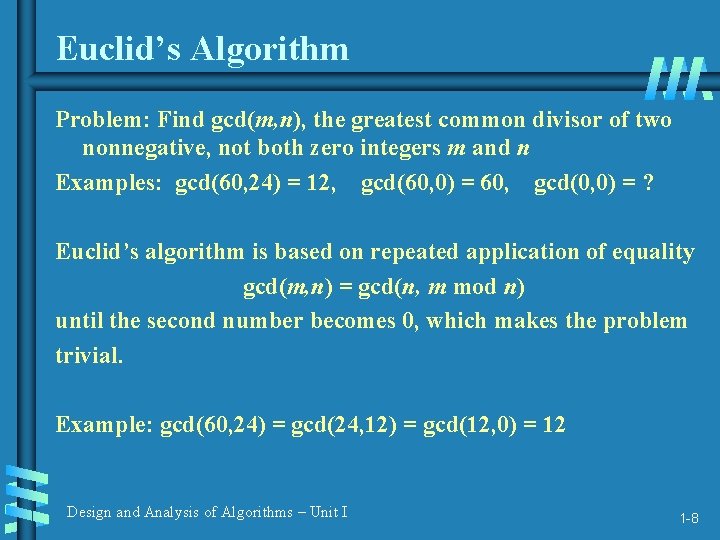
Euclid’s Algorithm Problem: Find gcd(m, n), the greatest common divisor of two nonnegative, not both zero integers m and n Examples: gcd(60, 24) = 12, gcd(60, 0) = 60, gcd(0, 0) = ? Euclid’s algorithm is based on repeated application of equality gcd(m, n) = gcd(n, m mod n) until the second number becomes 0, which makes the problem trivial. Example: gcd(60, 24) = gcd(24, 12) = gcd(12, 0) = 12 Design and Analysis of Algorithms – Unit I 1 -8
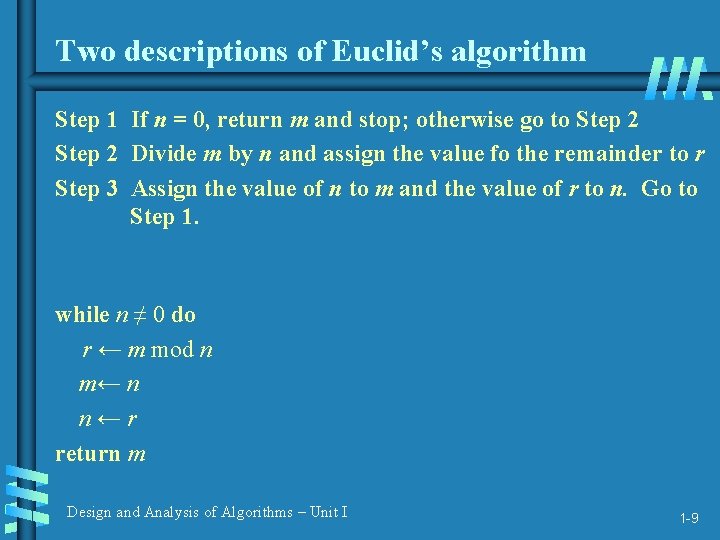
Two descriptions of Euclid’s algorithm Step 1 If n = 0, return m and stop; otherwise go to Step 2 Divide m by n and assign the value fo the remainder to r Step 3 Assign the value of n to m and the value of r to n. Go to Step 1. while n ≠ 0 do r ← m mod n m← n n←r return m Design and Analysis of Algorithms – Unit I 1 -9
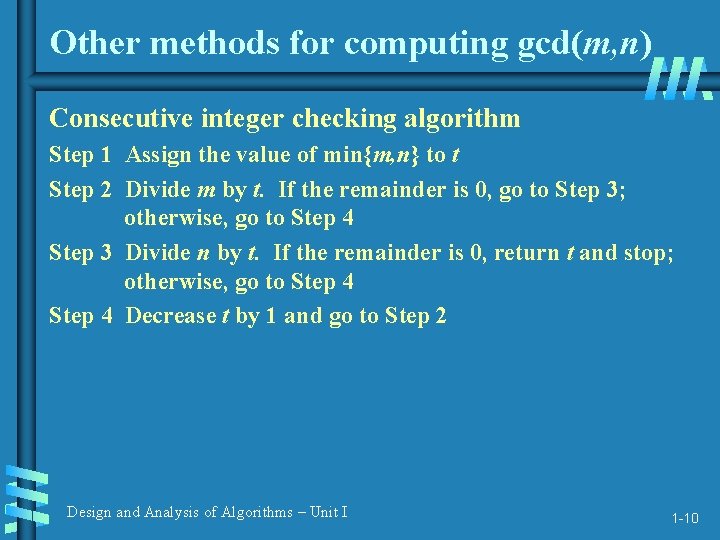
Other methods for computing gcd(m, n) Consecutive integer checking algorithm Step 1 Assign the value of min{m, n} to t Step 2 Divide m by t. If the remainder is 0, go to Step 3; otherwise, go to Step 4 Step 3 Divide n by t. If the remainder is 0, return t and stop; otherwise, go to Step 4 Decrease t by 1 and go to Step 2 Design and Analysis of Algorithms – Unit I 1 -10
Other methods for gcd(m, n) [cont. ] Middle-school procedure Step 1 Step 2 Step 3 Step 4 Find the prime factorization of m Find the prime factorization of n Find all the common prime factors Compute the product of all the common prime factors and return it as gcd(m, n) Is this an algorithm? Design and Analysis of Algorithms – Unit I 1 -11
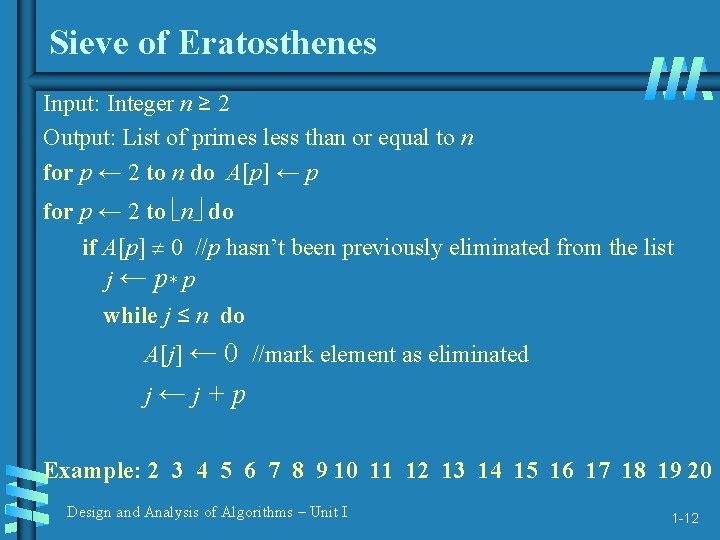
Sieve of Eratosthenes Input: Integer n ≥ 2 Output: List of primes less than or equal to n for p ← 2 to n do A[p] ← p for p ← 2 to n do if A[p] 0 //p hasn’t been previously eliminated from the list j ← p* p while j ≤ n do A[j] ← 0 //mark element as eliminated j←j+p Example: 2 3 4 5 6 7 8 9 10 11 12 13 14 15 16 17 18 19 20 Design and Analysis of Algorithms – Unit I 1 -12
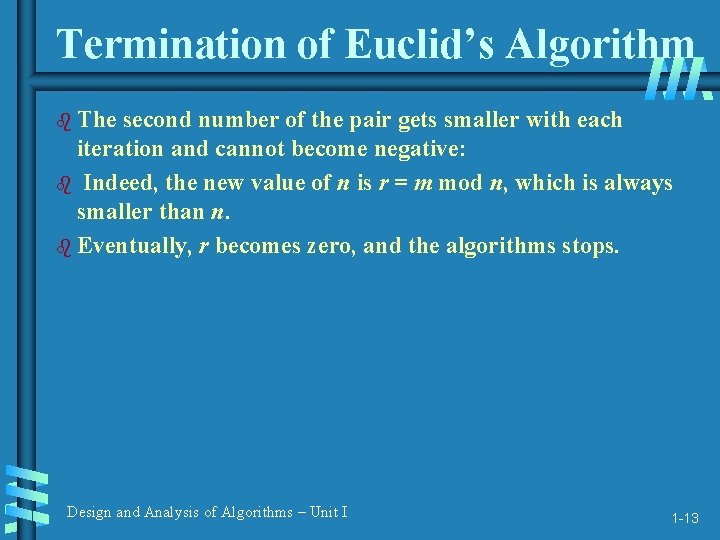
Termination of Euclid’s Algorithm b The second number of the pair gets smaller with each iteration and cannot become negative: b Indeed, the new value of n is r = m mod n, which is always smaller than n. b Eventually, r becomes zero, and the algorithms stops. Design and Analysis of Algorithms – Unit I 1 -13
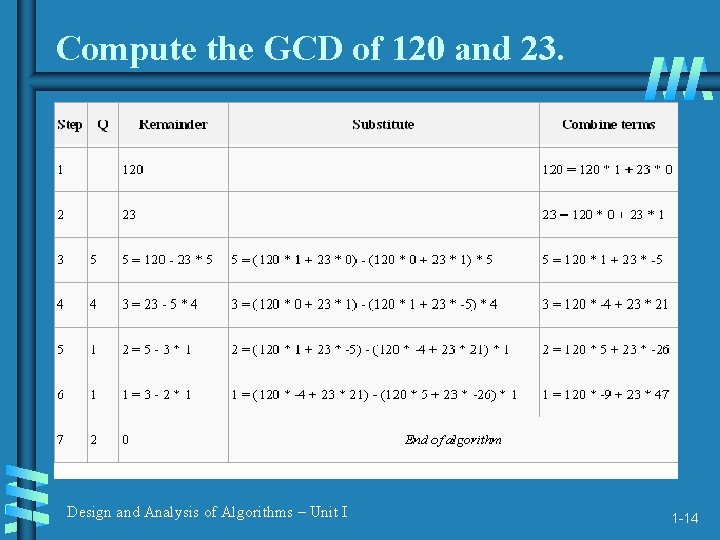
Compute the GCD of 120 and 23. Design and Analysis of Algorithms – Unit I 1 -14
Fundamentals of Algorithmic Problem Solving Design and Analysis of Algorithms – Unit I 1 -15
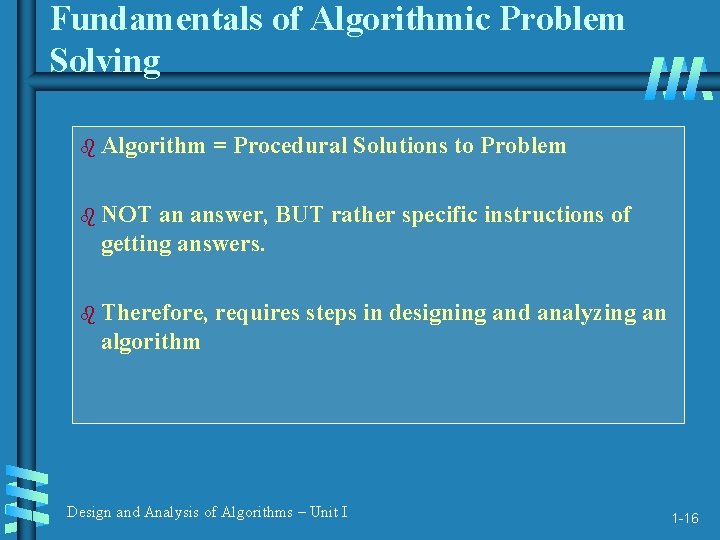
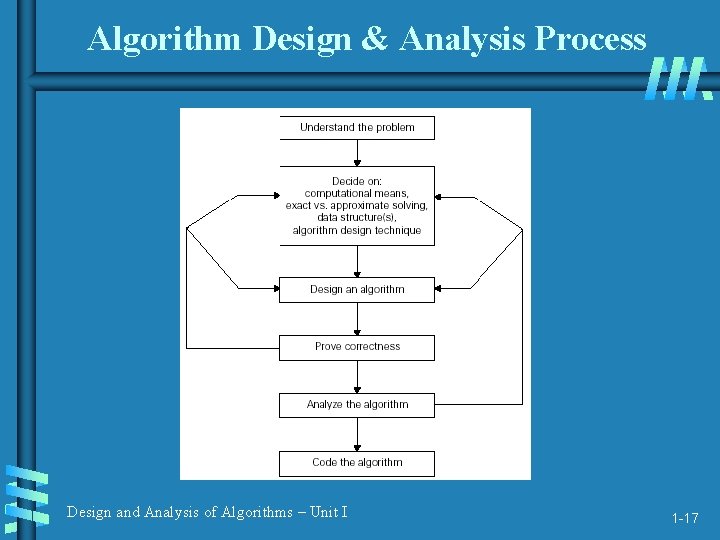
Fundamentals of Algorithmic Problem Solving b Algorithm = Procedural Solutions to Problem b NOT an answer, BUT rather specific instructions of getting answers. b Therefore, requires steps in designing and analyzing an algorithm Design and Analysis of Algorithms – Unit I 1 -16
Algorithm Design & Analysis Process Design and Analysis of Algorithms – Unit I 1 -17
Step 1: Understand the Problem Before designing an algorithm - understand completely the problem given. Read the problem’s description carefully and ask questions if you have any doubts about the problem, Do a few small examples by hand, think about special cases, and ask questions again if needed. Design and Analysis of Algorithms – Unit I 1 -18
Step 1: Understand the Problem An input to an algorithm specifies an instance of the problem the algorithm solves. It is very important to specify exactly the range of instances the algorithm needs to handle. Failing which – the algorithm works correctly for some inputs , but crashes on some boundary values. Remember that a correct algorithm is not one that works most of the time but one that works correctly for all legitimate inputs. Design and Analysis of Algorithms – Unit I 1 -19
Step 2: Ascertaining the capabilities of a computational device b Algorithms designed to be executed on machines that executes intstructions one after another are called sequential algorithms. b Algorithms that take advantage of computers that can execute operations concurrently are called parallel algorithms. Design and Analysis of Algorithms – Unit I 1 -20
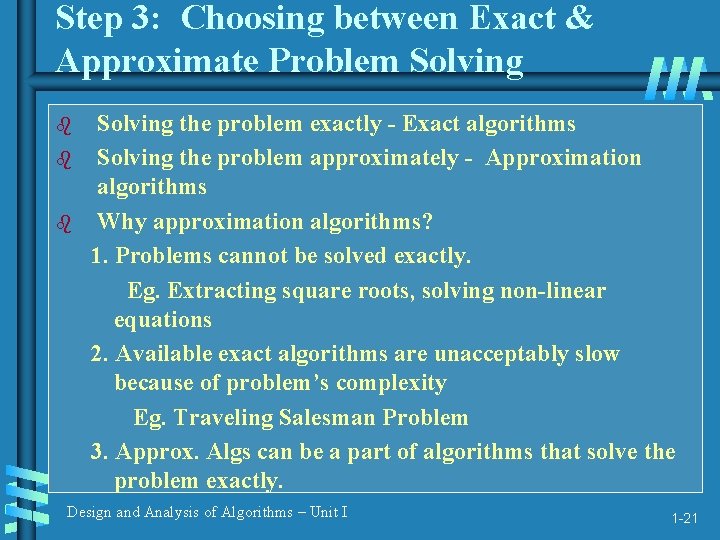
Step 3: Choosing between Exact & Approximate Problem Solving b b b Solving the problem exactly - Exact algorithms Solving the problem approximately - Approximation algorithms Why approximation algorithms? 1. Problems cannot be solved exactly. Eg. Extracting square roots, solving non-linear equations 2. Available exact algorithms are unacceptably slow because of problem’s complexity Eg. Traveling Salesman Problem 3. Approx. Algs can be a part of algorithms that solve the problem exactly. Design and Analysis of Algorithms – Unit I 1 -21
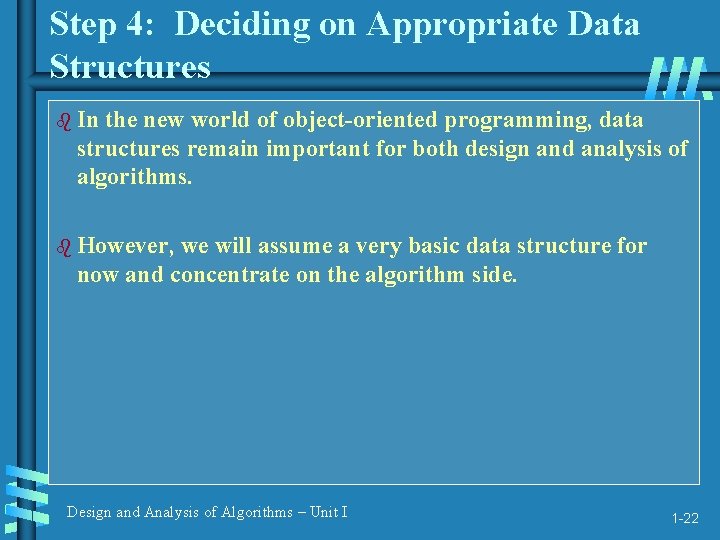
Step 4: Deciding on Appropriate Data Structures b In the new world of object-oriented programming, data structures remain important for both design and analysis of algorithms. b However, we will assume a very basic data structure for now and concentrate on the algorithm side. Design and Analysis of Algorithms – Unit I 1 -22
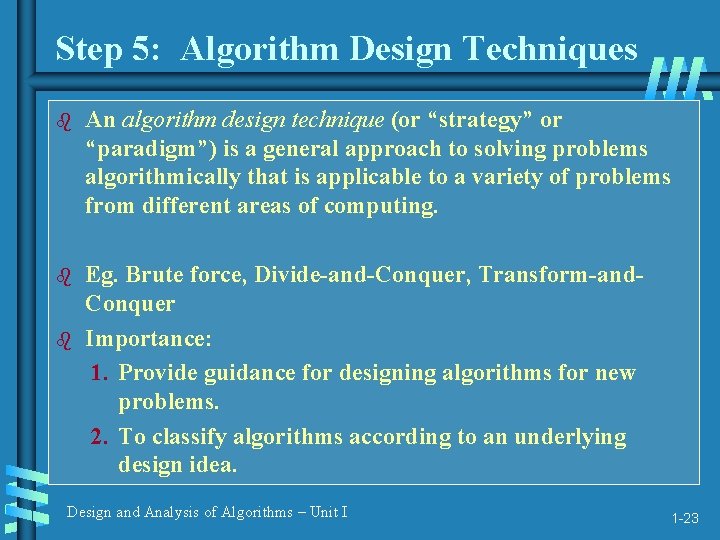
Step 5: Algorithm Design Techniques b An algorithm design technique (or “strategy” or “paradigm”) is a general approach to solving problems algorithmically that is applicable to a variety of problems from different areas of computing. b Eg. Brute force, Divide-and-Conquer, Transform-and. Conquer Importance: 1. Provide guidance for designing algorithms for new problems. 2. To classify algorithms according to an underlying design idea. b Design and Analysis of Algorithms – Unit I 1 -23
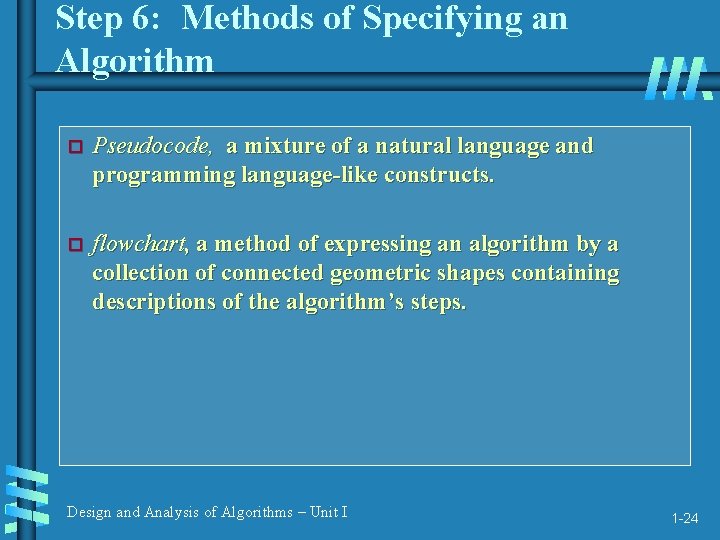
Step 6: Methods of Specifying an Algorithm Pseudocode, a mixture of a natural language and programming language-like constructs. flowchart, a method of expressing an algorithm by a collection of connected geometric shapes containing descriptions of the algorithm’s steps. Design and Analysis of Algorithms – Unit I 1 -24
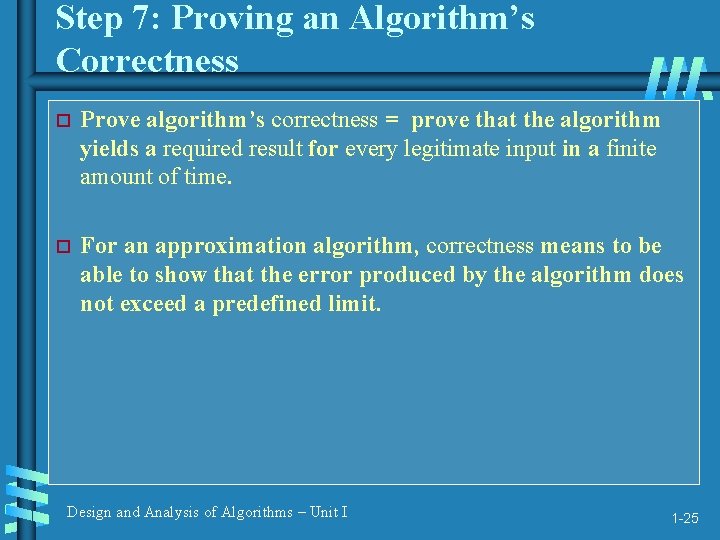
Step 7: Proving an Algorithm’s Correctness Prove algorithm’s correctness = prove that the algorithm yields a required result for every legitimate input in a finite amount of time. For an approximation algorithm, correctness means to be able to show that the error produced by the algorithm does not exceed a predefined limit. Design and Analysis of Algorithms – Unit I 1 -25
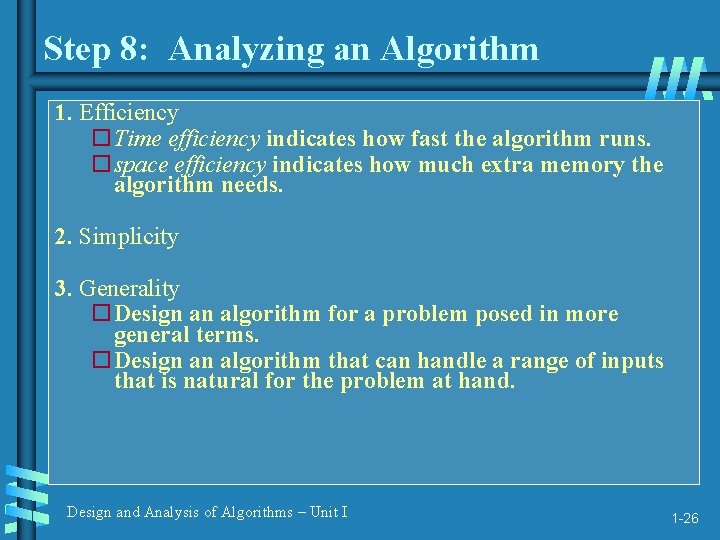
Step 8: Analyzing an Algorithm 1. Efficiency Time efficiency indicates how fast the algorithm runs. space efficiency indicates how much extra memory the algorithm needs. 2. Simplicity 3. Generality Design an algorithm for a problem posed in more general terms. Design an algorithm that can handle a range of inputs that is natural for the problem at hand. Design and Analysis of Algorithms – Unit I 1 -26
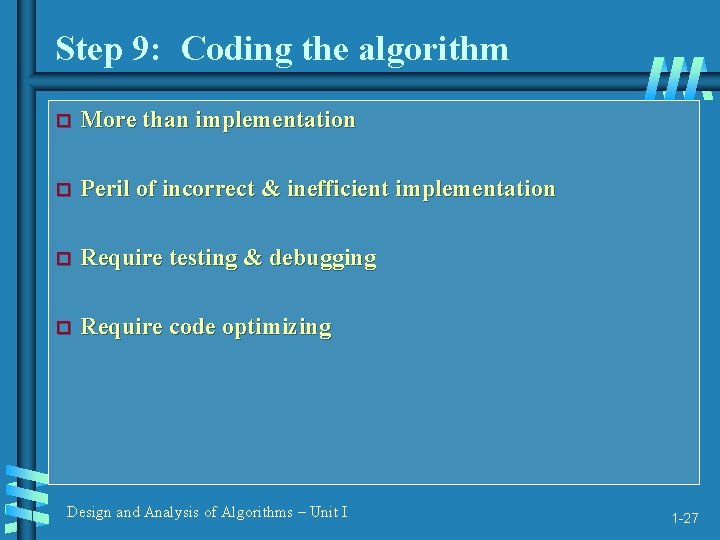
Step 9: Coding the algorithm More than implementation Peril of incorrect & inefficient implementation Require testing & debugging Require code optimizing Design and Analysis of Algorithms – Unit I 1 -27
Important Problem Types Design and Analysis of Algorithms – Unit I 1 -28
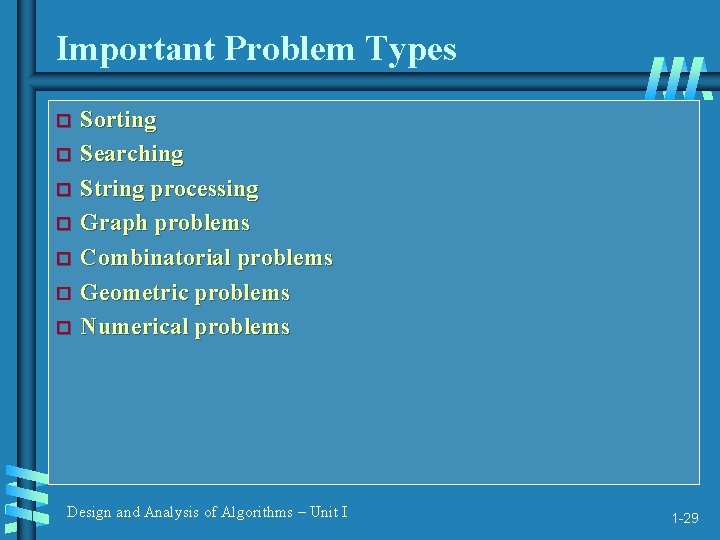
Important Problem Types Sorting Searching String processing Graph problems Combinatorial problems Geometric problems Numerical problems Design and Analysis of Algorithms – Unit I 1 -29
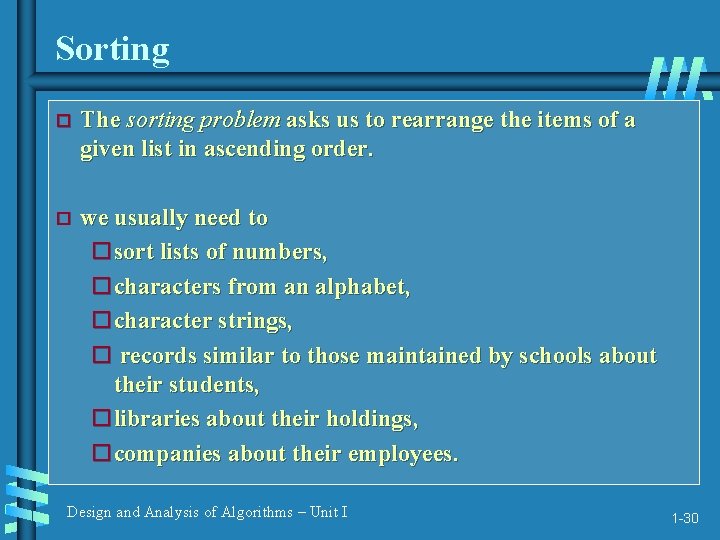
Sorting The sorting problem asks us to rearrange the items of a given list in ascending order. we usually need to sort lists of numbers, characters from an alphabet, character strings, records similar to those maintained by schools about their students, libraries about their holdings, companies about their employees. Design and Analysis of Algorithms – Unit I 1 -30
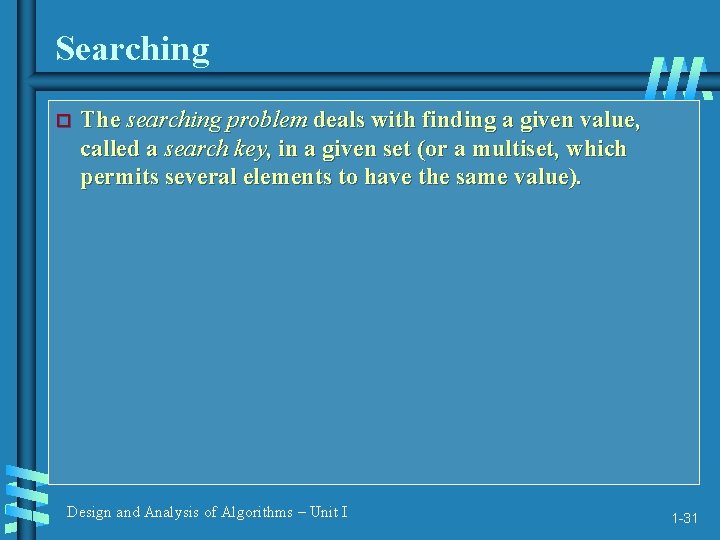
Searching The searching problem deals with finding a given value, called a search key, in a given set (or a multiset, which permits several elements to have the same value). Design and Analysis of Algorithms – Unit I 1 -31
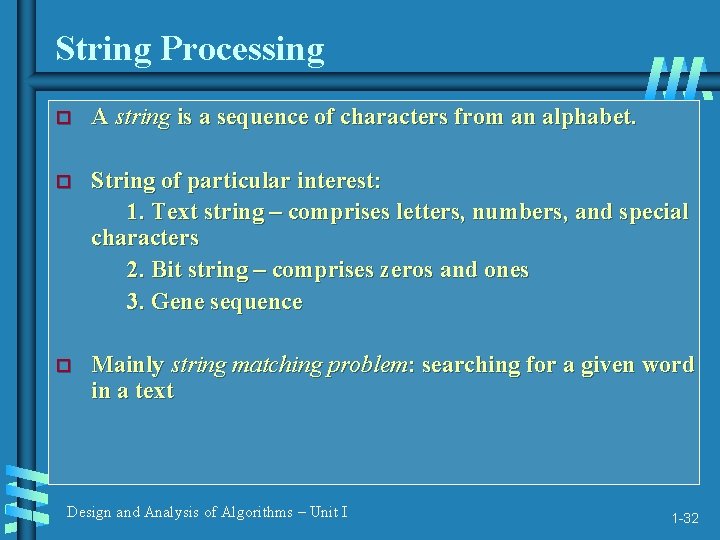
String Processing A string is a sequence of characters from an alphabet. String of particular interest: 1. Text string – comprises letters, numbers, and special characters 2. Bit string – comprises zeros and ones 3. Gene sequence Mainly string matching problem: searching for a given word in a text Design and Analysis of Algorithms – Unit I 1 -32
Graph Problems A graph can be thought of as a collection of points called vertices, some of which are connected by line segments called edges. Used for modeling a wide variety of real-life applications. Basic graph algorithms include: 1. Graph traversal algorithms - How can one visit all the points in a network? 2. Shortest-path algorithms - What is the best Introduction route between two cities? 3. Topological sorting for graphs with directed edges Design and Analysis of Algorithms – Unit I 1 -33
Combinatorial Problems combinatorial problems: problems that ask (explicitly or implicitly) to find a combinatorial object—such as a permutation, a combination, or a subset—that satisfies certain constraints and has some desired property (e. g. , maximizes a value or minimizes a cost). 1. Combinatorial grows extremely fast with problem size 2. No known algorithm solving most such problems exactly in an acceptable amount of time. Design and Analysis of Algorithms – Unit I 1 -34
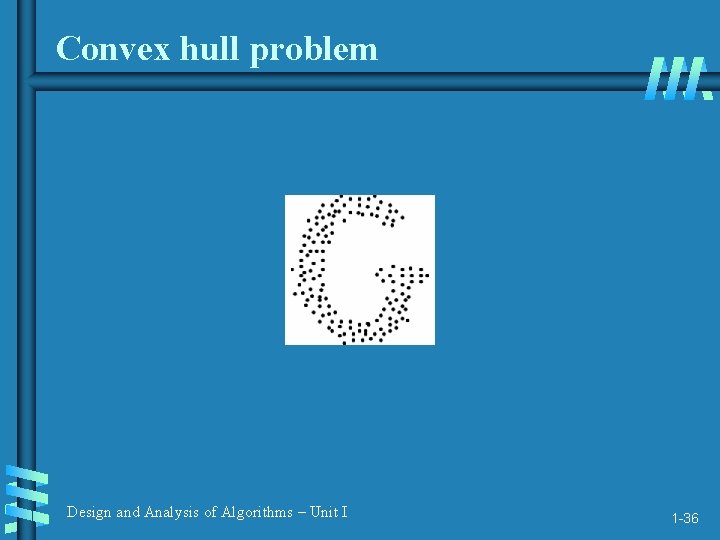
Geometric Problems Geometric algorithms deal with geometric objects such as points, lines, and polygons. 2 class problems: The closest pair problem: given n points in the plane, find the closest pair among them. The convex hull problem asks to find the smallest convex polygon that would include all the points of a given set. If Design and Analysis of Algorithms – Unit I 1 -35
Convex hull problem Design and Analysis of Algorithms – Unit I 1 -36
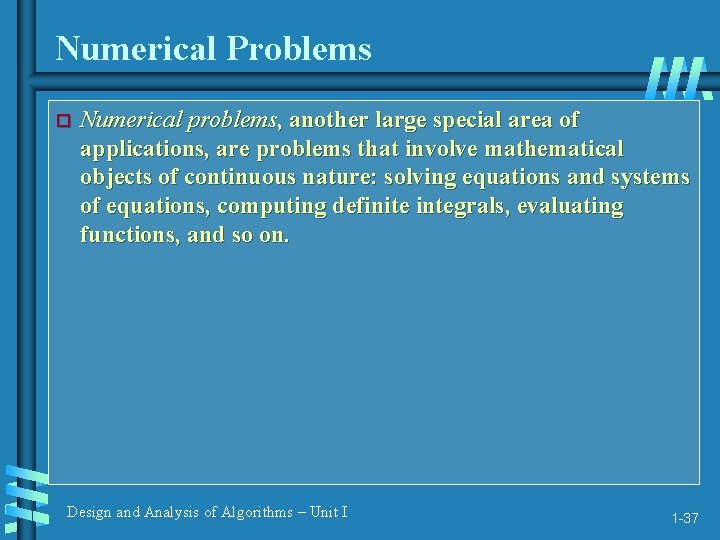
Numerical Problems Numerical problems, another large special area of applications, are problems that involve mathematical objects of continuous nature: solving equations and systems of equations, computing definite integrals, evaluating functions, and so on. Design and Analysis of Algorithms – Unit I 1 -37
Fundamentals of Analysis of algorithm efficiency Design and Analysis of Algorithms – Unit I 1 -38
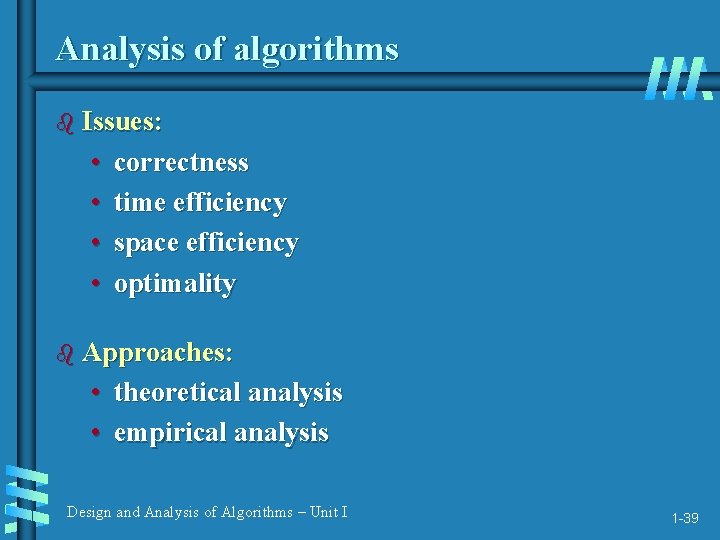
Analysis of algorithms b Issues: • • correctness time efficiency space efficiency optimality b Approaches: • theoretical analysis • empirical analysis Design and Analysis of Algorithms – Unit I 1 -39
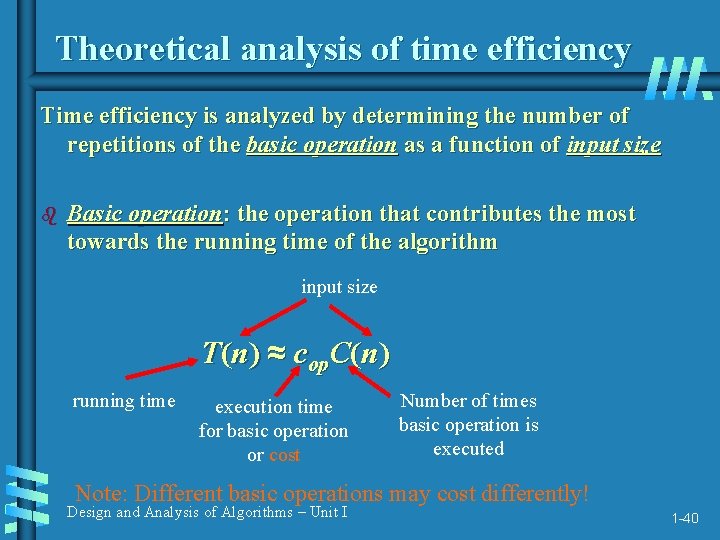
Theoretical analysis of time efficiency Time efficiency is analyzed by determining the number of repetitions of the basic operation as a function of input size b Basic operation: the operation that contributes the most towards the running time of the algorithm input size T(n) ≈ cop. C(n) running time execution time for basic operation or cost Number of times basic operation is executed Note: Different basic operations may cost differently! Design and Analysis of Algorithms – Unit I 1 -40
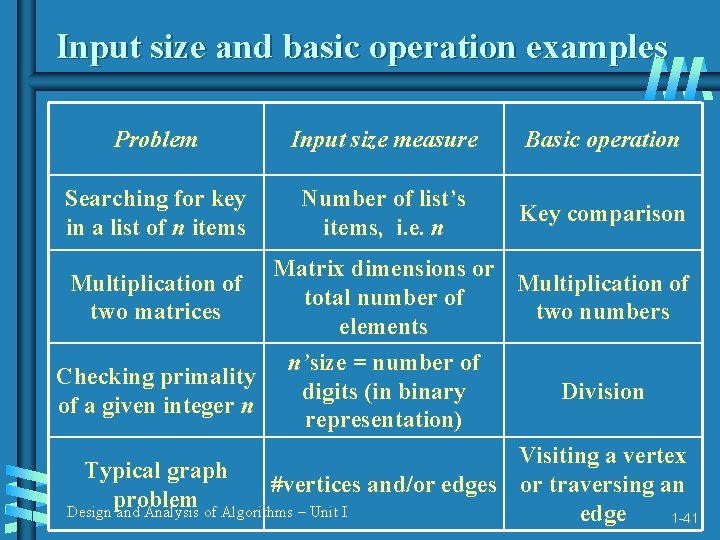
Input size and basic operation examples Problem Input size measure Basic operation Searching for key in a list of n items Number of list’s items, i. e. n Key comparison Matrix dimensions or Multiplication of total number of two numbers elements n’size = number of Checking primality Division digits (in binary of a given integer n representation) Multiplication of two matrices Visiting a vertex Typical graph #vertices and/or edges or traversing an problem Design and Analysis of Algorithms – Unit I edge 1 -41
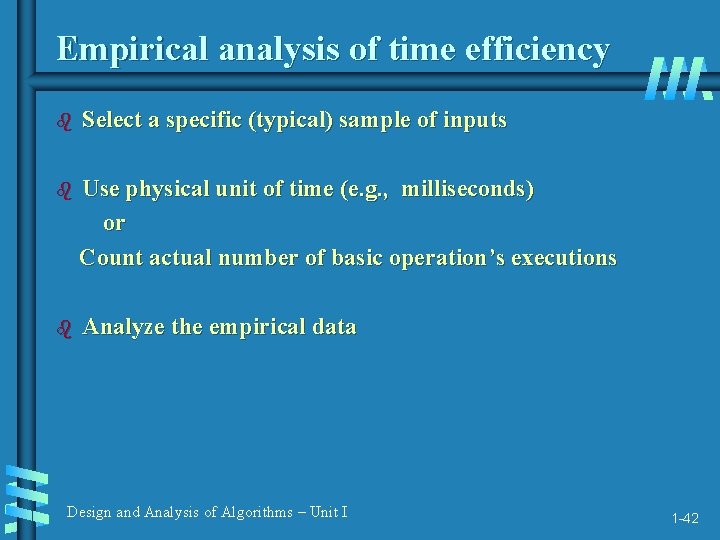
Empirical analysis of time efficiency b Select a specific (typical) sample of inputs b Use physical unit of time (e. g. , milliseconds) or Count actual number of basic operation’s executions b Analyze the empirical data Design and Analysis of Algorithms – Unit I 1 -42
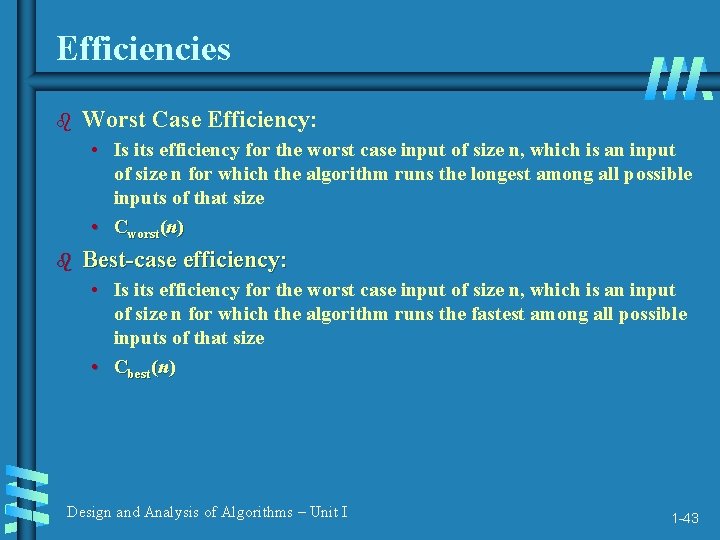
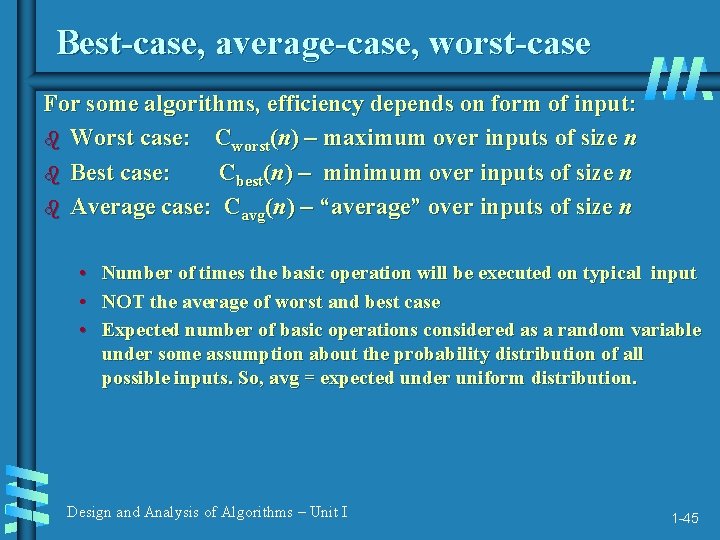
Efficiencies b Worst Case Efficiency: • Is its efficiency for the worst case input of size n, which is an input of size n for which the algorithm runs the longest among all possible inputs of that size • Cworst(n) b Best-case efficiency: • Is its efficiency for the worst case input of size n, which is an input of size n for which the algorithm runs the fastest among all possible inputs of that size • Cbest(n) Design and Analysis of Algorithms – Unit I 1 -43
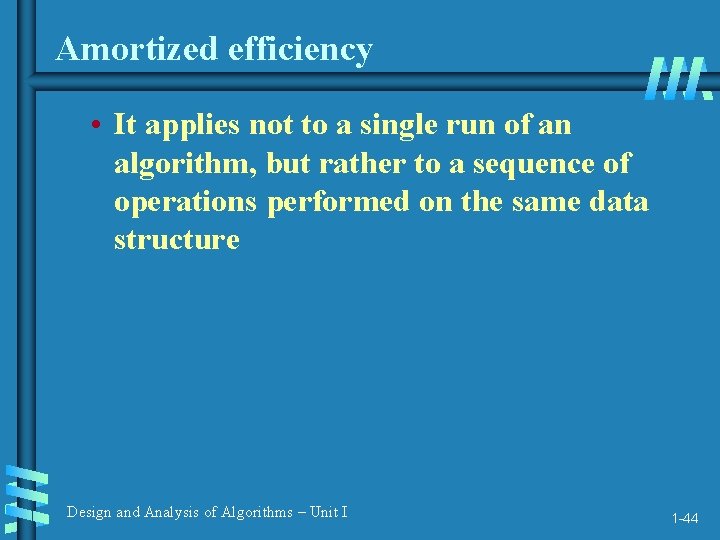
Amortized efficiency • It applies not to a single run of an algorithm, but rather to a sequence of operations performed on the same data structure Design and Analysis of Algorithms – Unit I 1 -44
Best-case, average-case, worst-case For some algorithms, efficiency depends on form of input: b Worst case: Cworst(n) – maximum over inputs of size n b Best case: Cbest(n) – minimum over inputs of size n b Average case: Cavg(n) – “average” over inputs of size n • • • Number of times the basic operation will be executed on typical input NOT the average of worst and best case Expected number of basic operations considered as a random variable under some assumption about the probability distribution of all possible inputs. So, avg = expected under uniform distribution. Design and Analysis of Algorithms – Unit I 1 -45
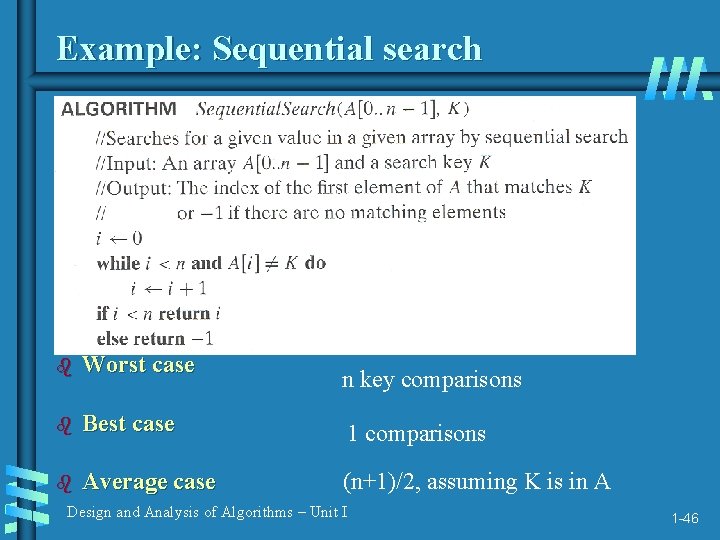
Example: Sequential search b Worst case b Best case 1 comparisons b Average case (n+1)/2, assuming K is in A n key comparisons Design and Analysis of Algorithms – Unit I 1 -46
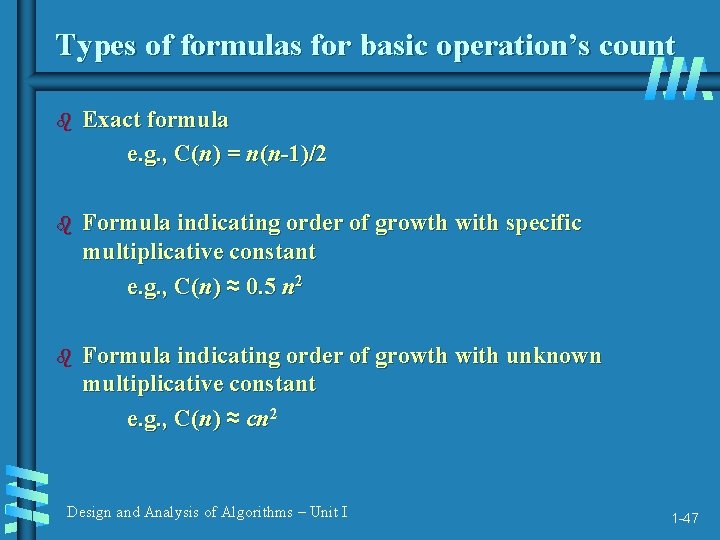
Types of formulas for basic operation’s count b Exact formula e. g. , C(n) = n(n-1)/2 b Formula indicating order of growth with specific multiplicative constant e. g. , C(n) ≈ 0. 5 n 2 b Formula indicating order of growth with unknown multiplicative constant e. g. , C(n) ≈ cn 2 Design and Analysis of Algorithms – Unit I 1 -47
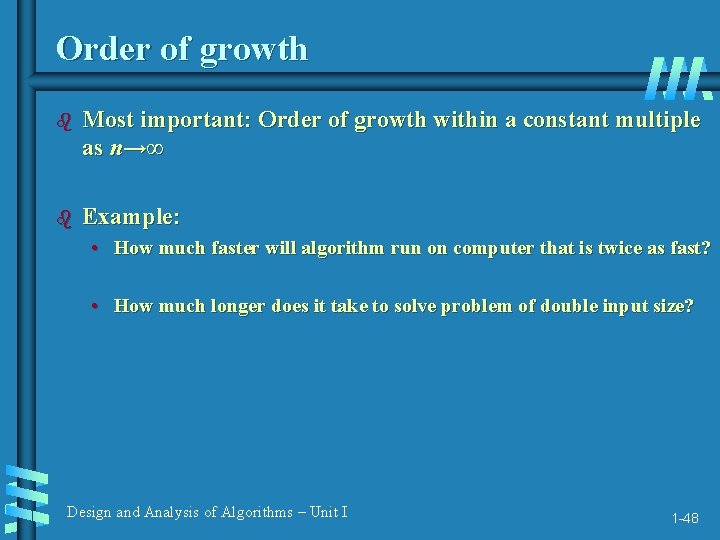
Order of growth b Most important: Order of growth within a constant multiple as n→∞ b Example: • How much faster will algorithm run on computer that is twice as fast? • How much longer does it take to solve problem of double input size? Design and Analysis of Algorithms – Unit I 1 -48
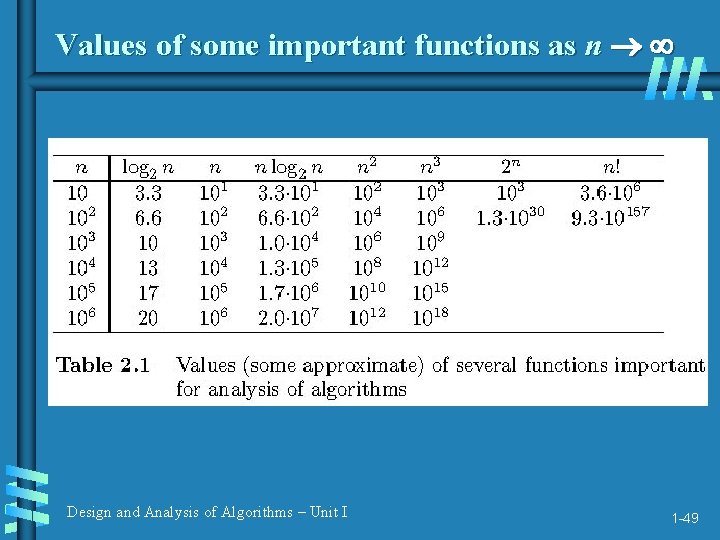
Values of some important functions as n Design and Analysis of Algorithms – Unit I 1 -49
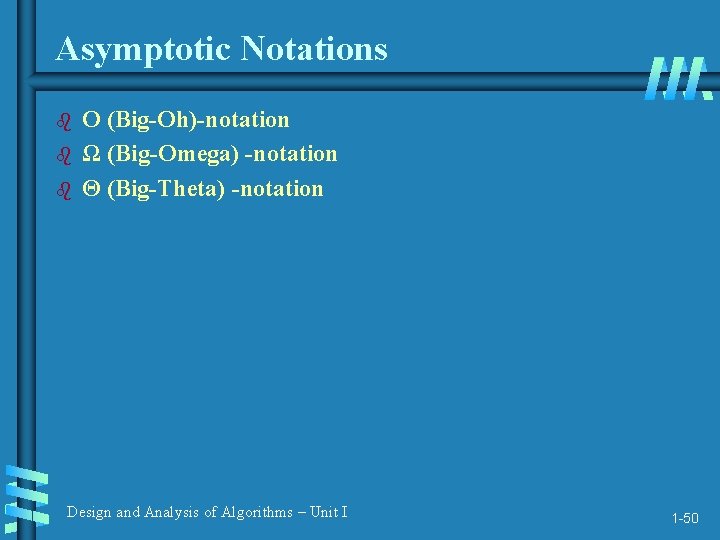
Asymptotic Notations b b b O (Big-Oh)-notation Ω (Big-Omega) -notation Θ (Big-Theta) -notation Design and Analysis of Algorithms – Unit I 1 -50
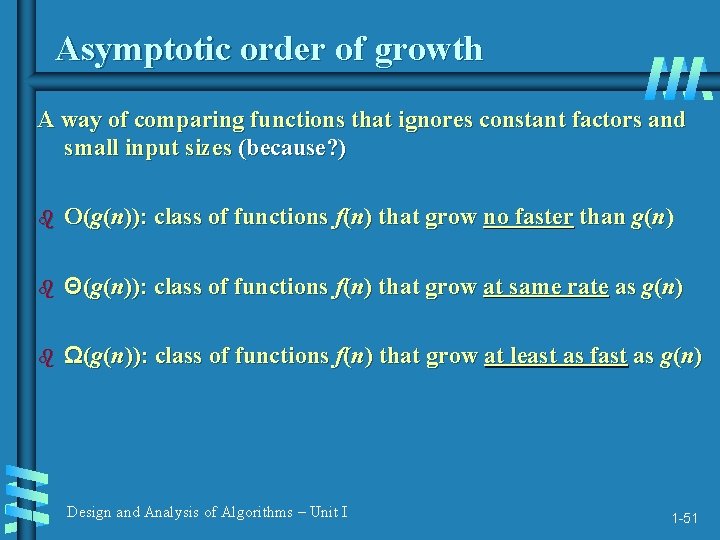
Asymptotic order of growth A way of comparing functions that ignores constant factors and small input sizes (because? ) b O(g(n)): class of functions f(n) that grow no faster than g(n) b Θ(g(n)): class of functions f(n) that grow at same rate as g(n) b Ω(g(n)): class of functions f(n) that grow at least as fast as g(n) Design and Analysis of Algorithms – Unit I 1 -51
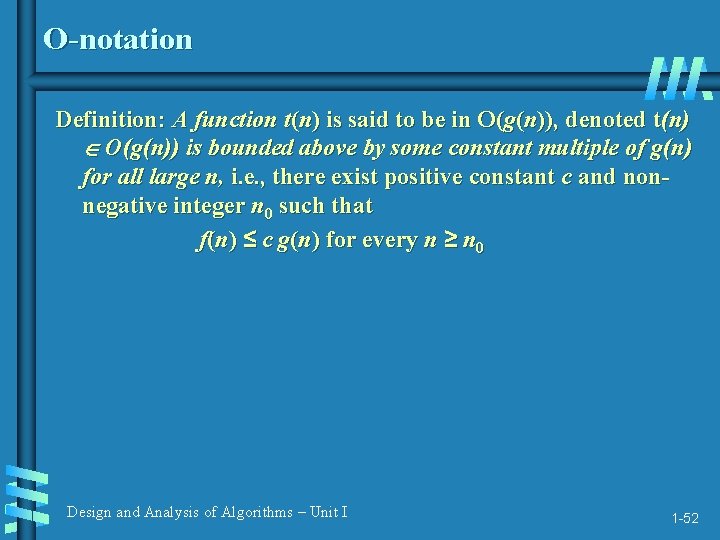
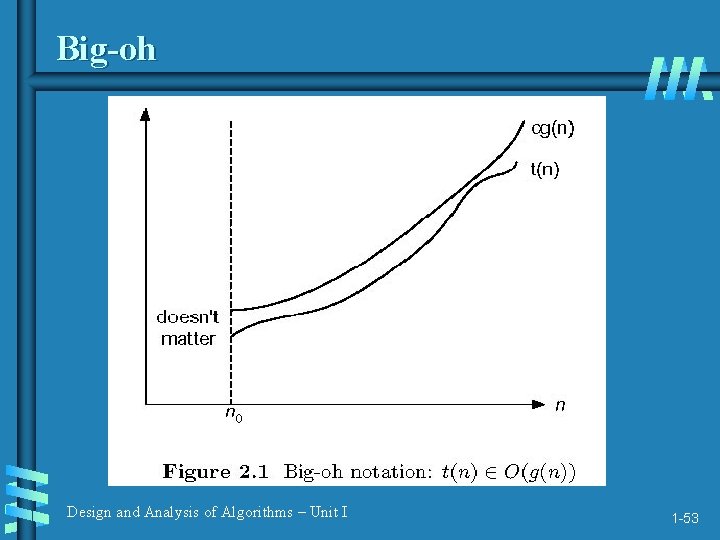
O-notation Definition: A function t(n) is said to be in O(g(n)), denoted t(n) O(g(n)) is bounded above by some constant multiple of g(n) for all large n, i. e. , there exist positive constant c and nonnegative integer n 0 such that f(n) ≤ c g(n) for every n ≥ n 0 Design and Analysis of Algorithms – Unit I 1 -52
Big-oh Design and Analysis of Algorithms – Unit I 1 -53
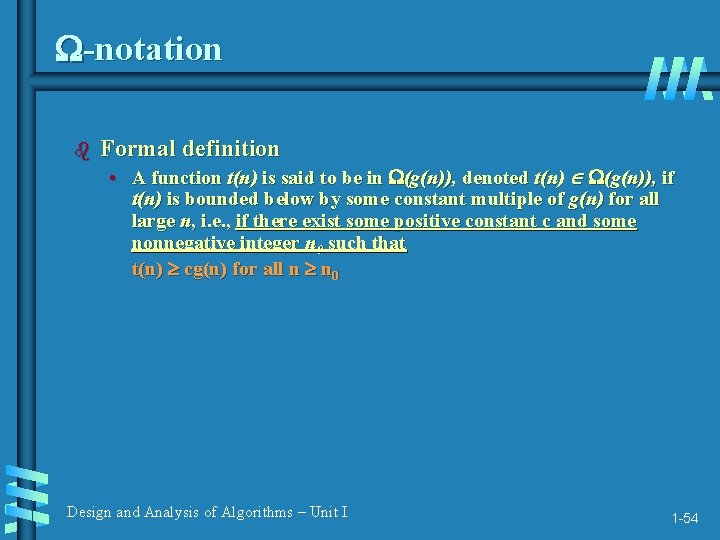
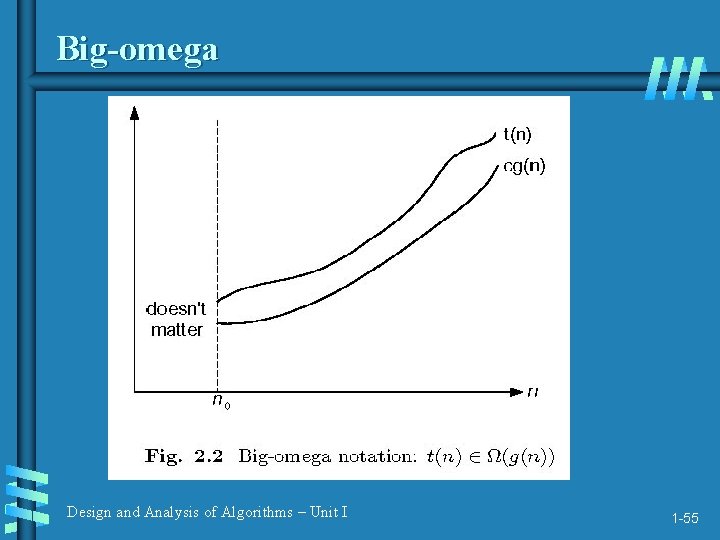
-notation b Formal definition • A function t(n) is said to be in (g(n)), denoted t(n) (g(n)), if t(n) is bounded below by some constant multiple of g(n) for all large n, i. e. , if there exist some positive constant c and some nonnegative integer n 0 such that t(n) cg(n) for all n n 0 Design and Analysis of Algorithms – Unit I 1 -54
Big-omega Design and Analysis of Algorithms – Unit I 1 -55
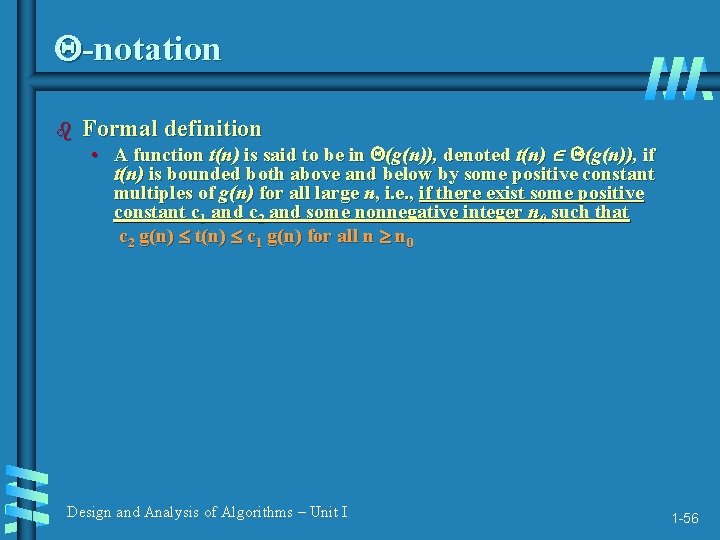
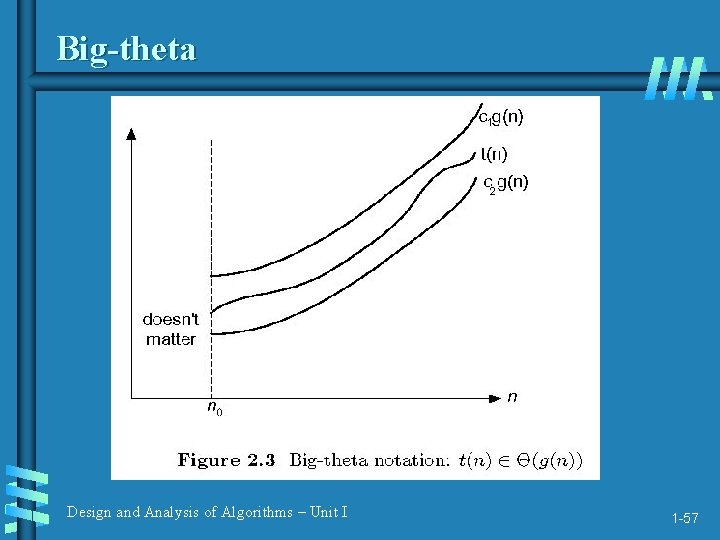
-notation b Formal definition • A function t(n) is said to be in (g(n)), denoted t(n) (g(n)), if t(n) is bounded both above and below by some positive constant multiples of g(n) for all large n, i. e. , if there exist some positive constant c 1 and c 2 and some nonnegative integer n 0 such that c 2 g(n) t(n) c 1 g(n) for all n n 0 Design and Analysis of Algorithms – Unit I 1 -56
Big-theta Design and Analysis of Algorithms – Unit I 1 -57
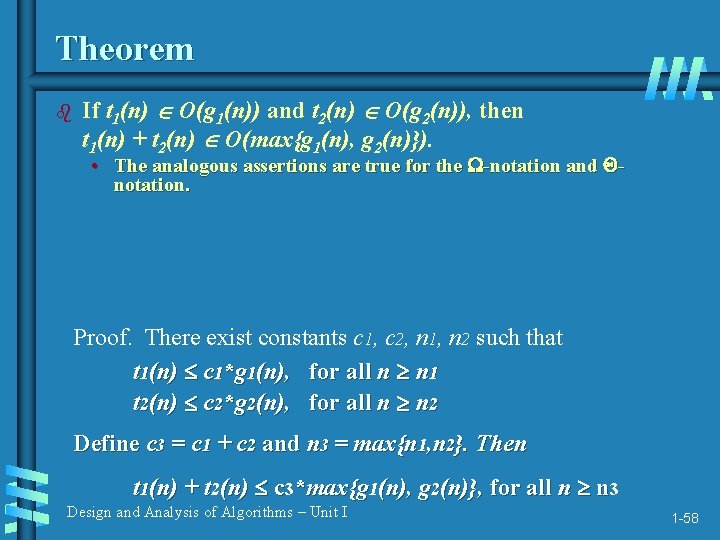
Theorem b If t 1(n) O(g 1(n)) and t 2(n) O(g 2(n)), then t 1(n) + t 2(n) O(max{g 1(n), g 2(n)}). • The analogous assertions are true for the -notation and notation. Proof. There exist constants c 1, c 2, n 1, n 2 such that t 1(n) c 1*g 1(n), for all n n 1 t 2(n) c 2*g 2(n), for all n n 2 Define c 3 = c 1 + c 2 and n 3 = max{n 1, n 2}. Then t 1(n) + t 2(n) c 3*max{g 1(n), g 2(n)}, for all n n 3 Design and Analysis of Algorithms – Unit I 1 -58
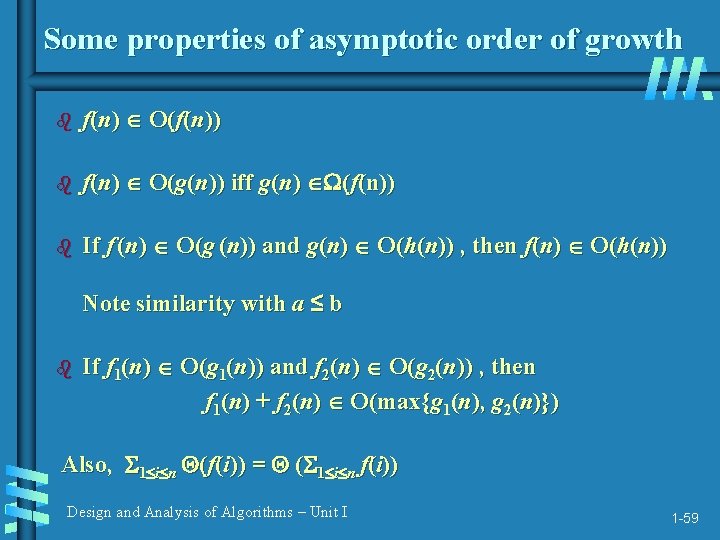
Some properties of asymptotic order of growth b f(n) O(f(n)) b f(n) O(g(n)) iff g(n) (f(n)) b If f (n) O(g (n)) and g(n) O(h(n)) , then f(n) O(h(n)) Note similarity with a ≤ b b If f 1(n) O(g 1(n)) and f 2(n) O(g 2(n)) , then f 1(n) + f 2(n) O(max{g 1(n), g 2(n)}) Also, 1 i n (f(i)) = ( 1 i n f(i)) Design and Analysis of Algorithms – Unit I 1 -59
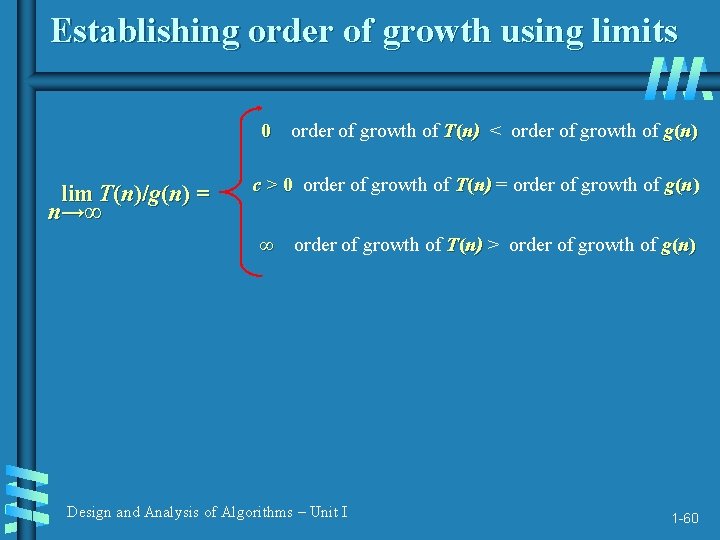
Establishing order of growth using limits 0 order of growth of T(n) < order of growth of g(n) lim T(n)/g(n) = n→∞ c > 0 order of growth of T(n) = order of growth of g(n) ∞ order of growth of T(n) > order of growth of g(n) Design and Analysis of Algorithms – Unit I 1 -60
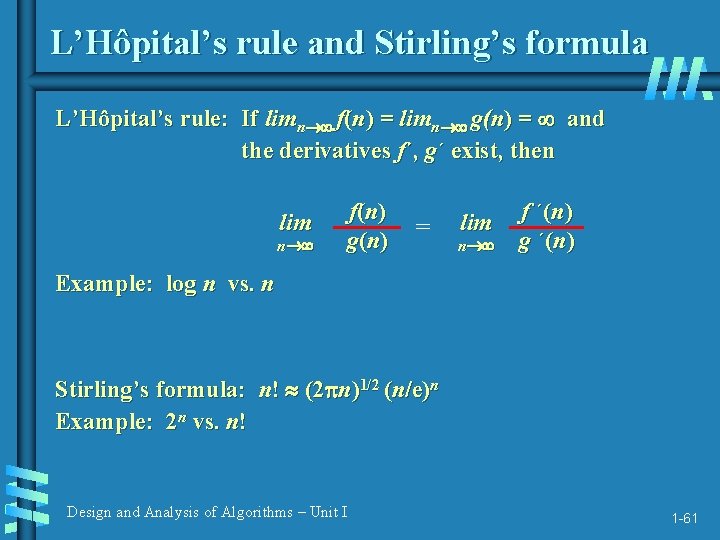
L’Hôpital’s rule and Stirling’s formula L’Hôpital’s rule: If limn f(n) = limn g(n) = and the derivatives f´, g´ exist, then lim n f(n ) g(n) = lim n f ´(n) g ´(n) Example: log n vs. n Stirling’s formula: n! (2 n)1/2 (n/e)n Example: 2 n vs. n! Design and Analysis of Algorithms – Unit I 1 -61
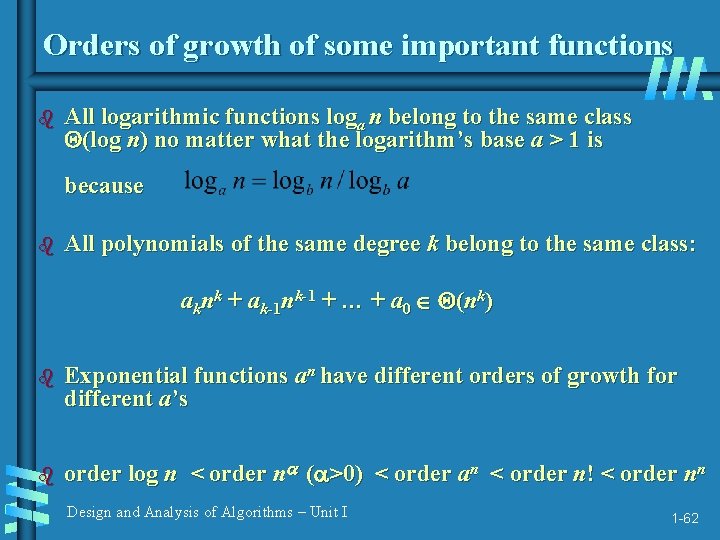
Orders of growth of some important functions b All logarithmic functions loga n belong to the same class (log n) no matter what the logarithm’s base a > 1 is because b All polynomials of the same degree k belong to the same class: aknk + ak-1 nk-1 + … + a 0 (nk) b Exponential functions an have different orders of growth for different a’s b order log n < order n ( >0) < order an < order n! < order nn Design and Analysis of Algorithms – Unit I 1 -62
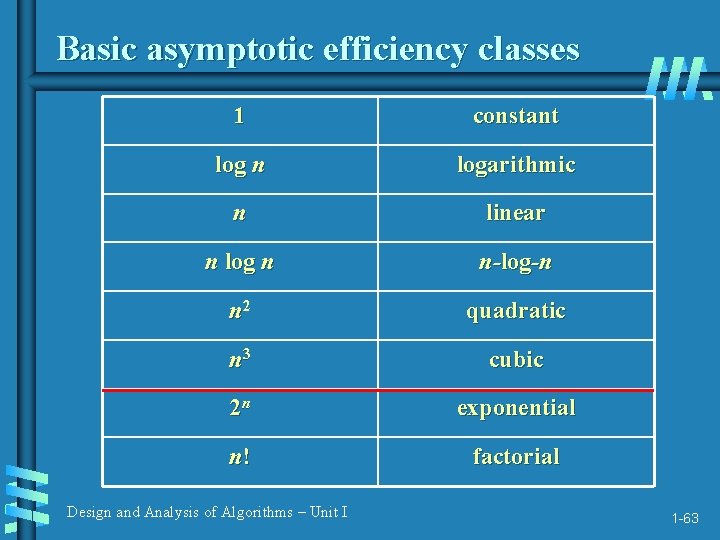
Basic asymptotic efficiency classes 1 constant log n logarithmic n linear n log n n-log-n n 2 quadratic n 3 cubic 2 n exponential n! factorial Design and Analysis of Algorithms – Unit I 1 -63
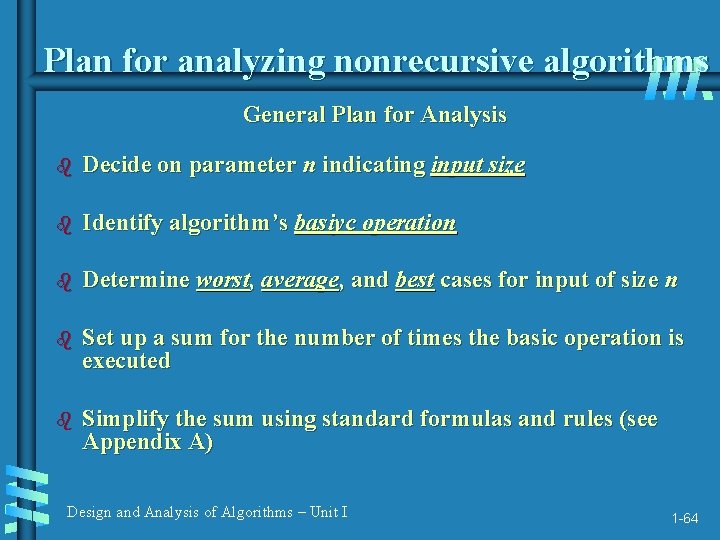
Plan for analyzing nonrecursive algorithms General Plan for Analysis b Decide on parameter n indicating input size b Identify algorithm’s basiyc operation b Determine worst, average, and best cases for input of size n b Set up a sum for the number of times the basic operation is executed b Simplify the sum using standard formulas and rules (see Appendix A) Design and Analysis of Algorithms – Unit I 1 -64
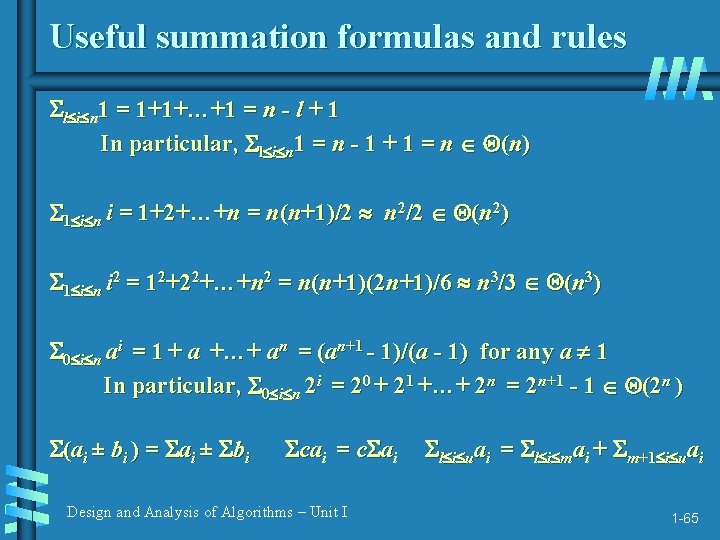
Useful summation formulas and rules l i n 1 = 1+1+…+1 = n - l + 1 In particular, l i n 1 = n - 1 + 1 = n (n) 1 i n i = 1+2+…+n = n(n+1)/2 n 2/2 (n 2) 1 i n i 2 = 12+22+…+n 2 = n(n+1)(2 n+1)/6 n 3/3 (n 3) 0 i n ai = 1 + a +…+ an = (an+1 - 1)/(a - 1) for any a 1 In particular, 0 i n 2 i = 20 + 21 +…+ 2 n = 2 n+1 - 1 (2 n ) (ai ± bi ) = ai ± bi cai = c ai Design and Analysis of Algorithms – Unit I l i uai = l i mai + m+1 i uai 1 -65
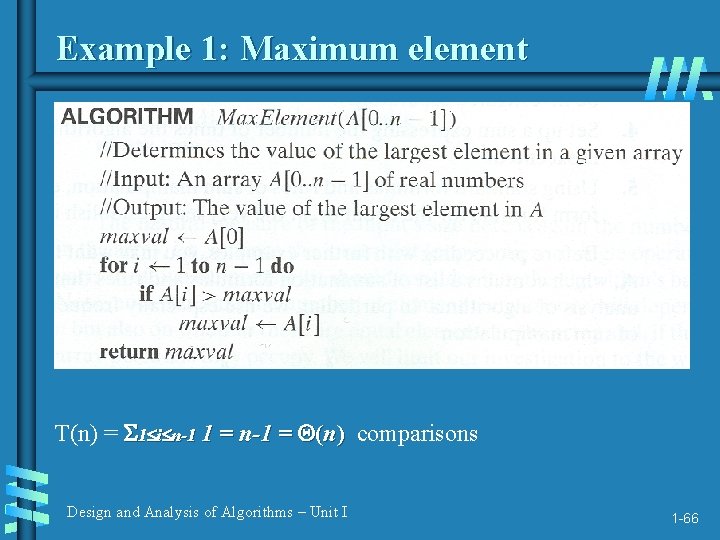
Example 1: Maximum element T(n) = 1 i n-1 1 = n-1 = (n) comparisons Design and Analysis of Algorithms – Unit I 1 -66
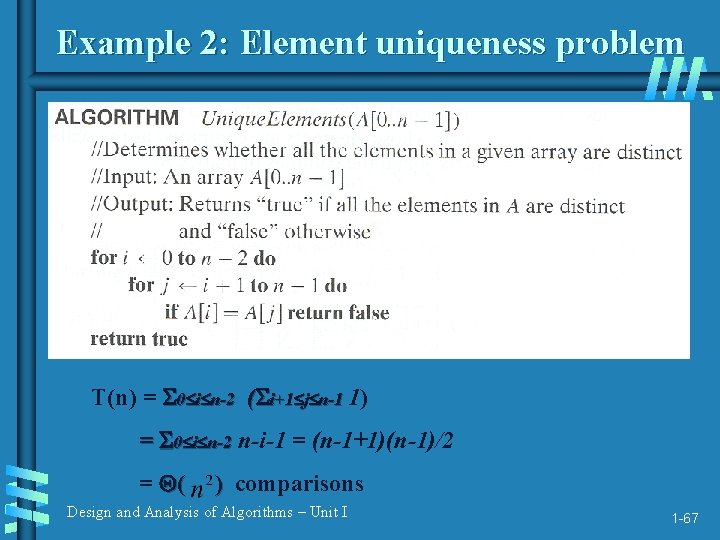
Example 2: Element uniqueness problem T(n) = 0 i n-2 ( i+1 j n-1 1) = 0 i n-2 n-i-1 = (n-1+1)(n-1)/2 = ( ) comparisons Design and Analysis of Algorithms – Unit I 1 -67
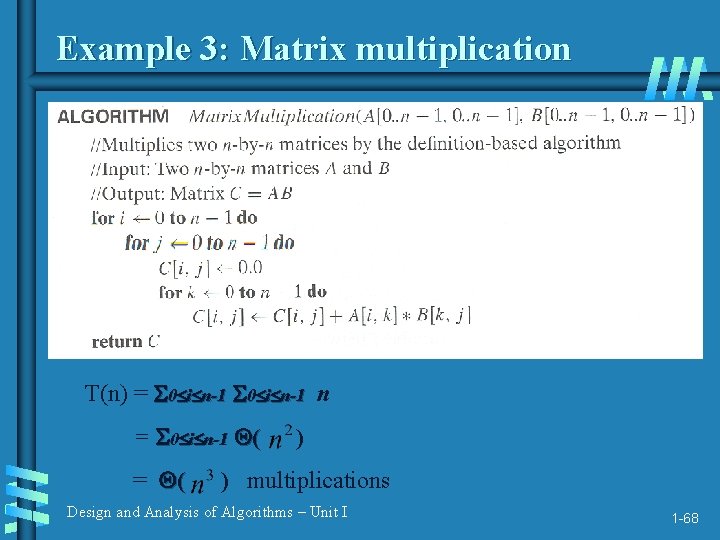
Example 3: Matrix multiplication T(n) = 0 i n-1 n = 0 i n-1 ( = ( ) ) multiplications Design and Analysis of Algorithms – Unit I 1 -68
Example 4: Gaussian elimination Algorithm Gaussian. Elimination(A[0. . n-1, 0. . n]) //Implements Gaussian elimination on an n-by-(n+1) matrix A for i 0 to n - 2 do for j i + 1 to n - 1 do for k i to n do A[j, k] - A[i, k] A[j, i] / A[i, i] Find the efficiency class and a constant factor improvement. for i 0 to n - 2 do for j i + 1 to n - 1 do B A[j, i] / A[i, i] for k i to n do A[j, k] – A[i, k] * B Design and Analysis of Algorithms – Unit I 1 -69
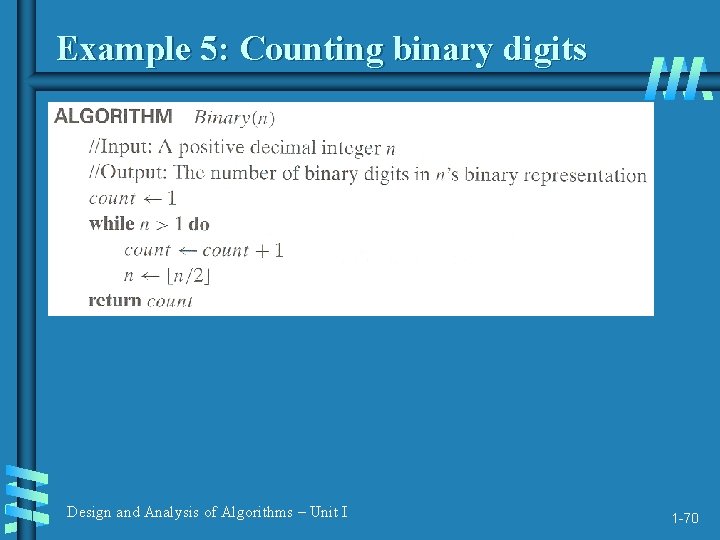
Example 5: Counting binary digits Design and Analysis of Algorithms – Unit I 1 -70
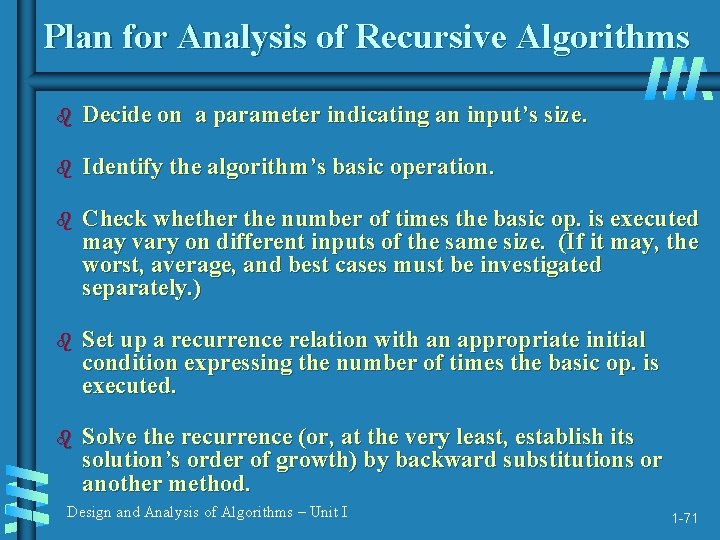
Plan for Analysis of Recursive Algorithms b Decide on a parameter indicating an input’s size. b Identify the algorithm’s basic operation. b Check whether the number of times the basic op. is executed may vary on different inputs of the same size. (If it may, the worst, average, and best cases must be investigated separately. ) b Set up a recurrence relation with an appropriate initial condition expressing the number of times the basic op. is executed. b Solve the recurrence (or, at the very least, establish its solution’s order of growth) by backward substitutions or another method. Design and Analysis of Algorithms – Unit I 1 -71
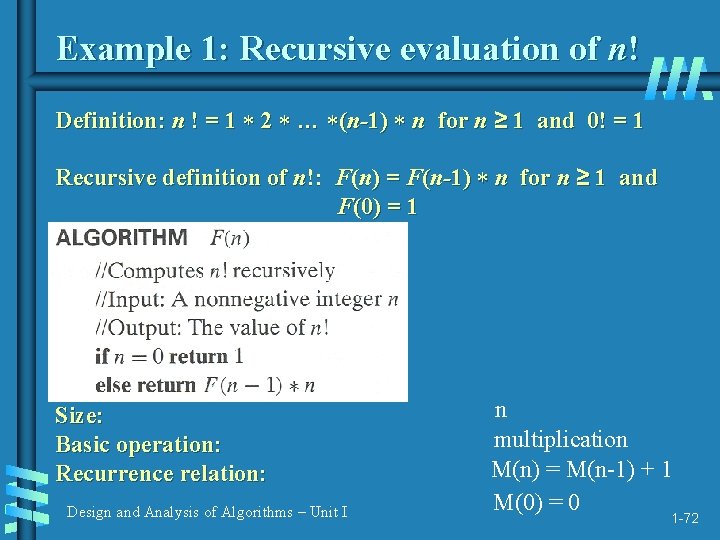
Example 1: Recursive evaluation of n! Definition: n ! = 1 2 … (n-1) n for n ≥ 1 and 0! = 1 Recursive definition of n!: F(n) = F(n-1) n for n ≥ 1 and F(0) = 1 Size: Basic operation: Recurrence relation: Design and Analysis of Algorithms – Unit I n multiplication M(n) = M(n-1) + 1 M(0) = 0 1 -72
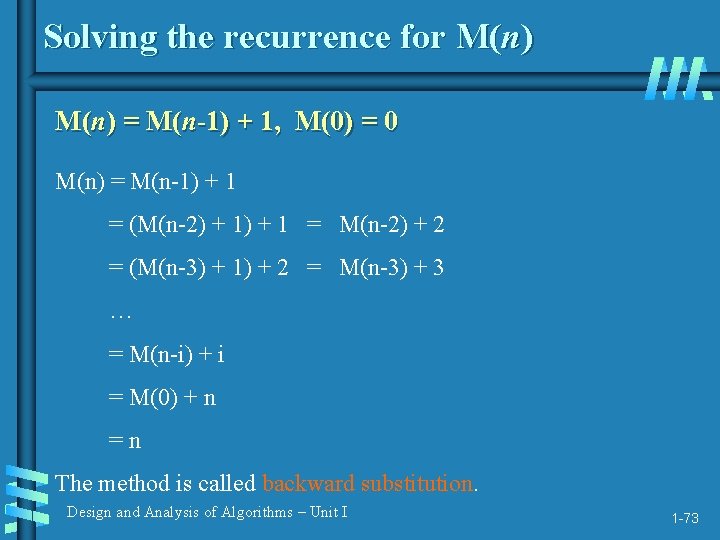
Solving the recurrence for M(n) = M(n-1) + 1, M(0) = 0 M(n) = M(n-1) + 1 = (M(n-2) + 1 = M(n-2) + 2 = (M(n-3) + 1) + 2 = M(n-3) + 3 … = M(n-i) + i = M(0) + n =n The method is called backward substitution. Design and Analysis of Algorithms – Unit I 1 -73
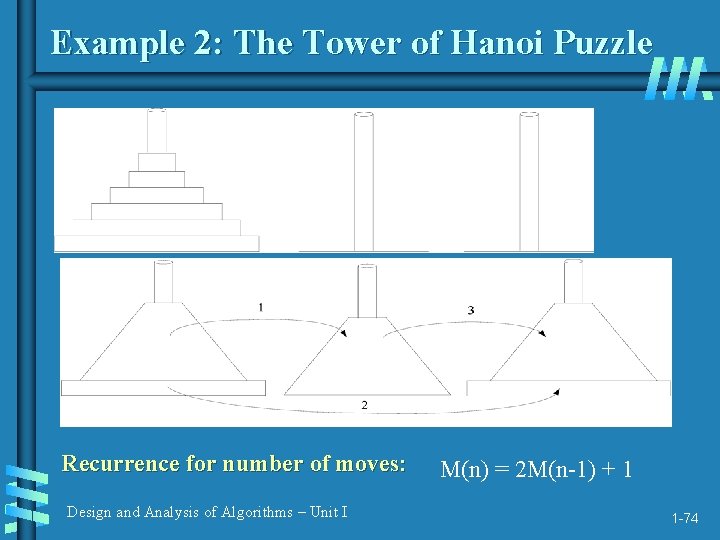
Example 2: The Tower of Hanoi Puzzle Recurrence for number of moves: Design and Analysis of Algorithms – Unit I M(n) = 2 M(n-1) + 1 1 -74
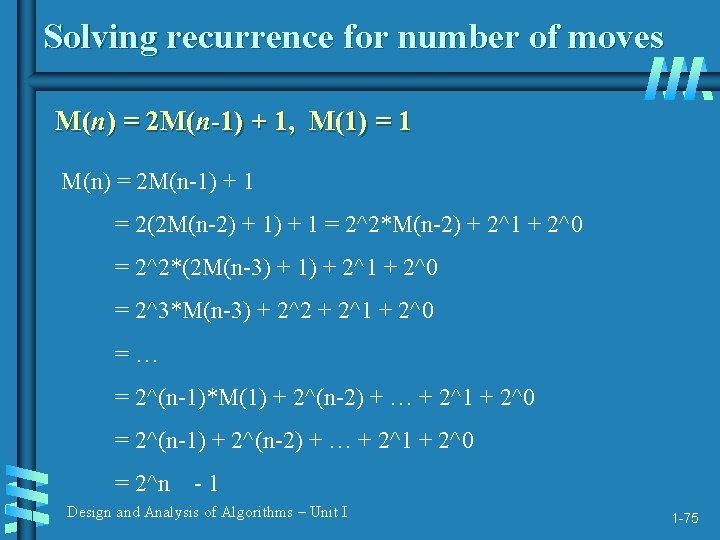
Solving recurrence for number of moves M(n) = 2 M(n-1) + 1, M(1) = 1 M(n) = 2 M(n-1) + 1 = 2(2 M(n-2) + 1 = 2^2*M(n-2) + 2^1 + 2^0 = 2^2*(2 M(n-3) + 1) + 2^1 + 2^0 = 2^3*M(n-3) + 2^2 + 2^1 + 2^0 =… = 2^(n-1)*M(1) + 2^(n-2) + … + 2^1 + 2^0 = 2^(n-1) + 2^(n-2) + … + 2^1 + 2^0 = 2^n -1 Design and Analysis of Algorithms – Unit I 1 -75
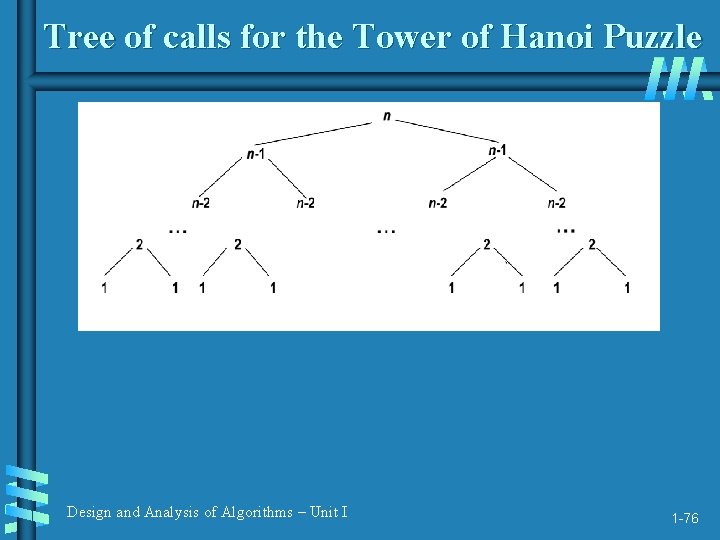
Tree of calls for the Tower of Hanoi Puzzle Design and Analysis of Algorithms – Unit I 1 -76
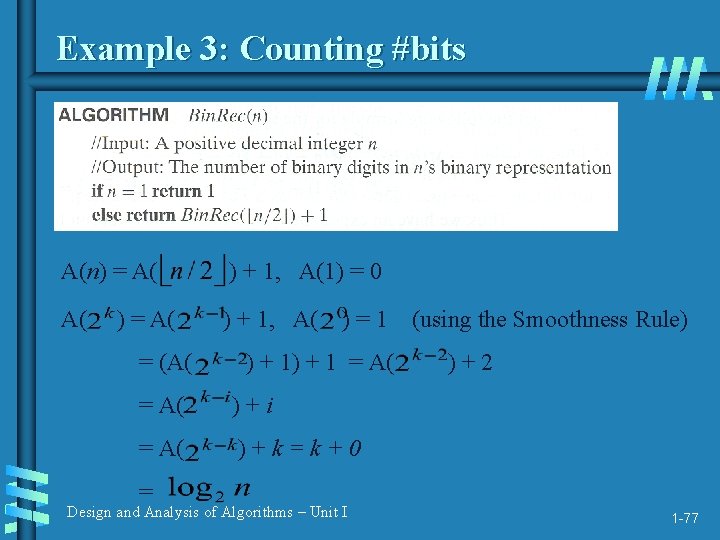
Example 3: Counting #bits A(n) = A( ) + 1, A(1) = 0 A( ) + 1, A( ) = A( = (A( )=1 ) + 1 = A( )+i = A( )+k=k+0 (using the Smoothness Rule) )+2 = Design and Analysis of Algorithms – Unit I 1 -77