
Chapter 1 Introduction Computer Networking A Top Down
- Slides: 97
Chapter 1 Introduction Computer Networking: A Top Down Approach 6 th edition Jim Kurose, Keith Ross Addison-Wesley March 2012 Modified form the following All material copyright 1996 -2012 J. F Kurose and K. W. Ross, All Rights Reserved Introduction 1 -1
Chapter 1: introduction Goal: v get “feel” and terminology v more depth, detail later in course v approach: § use Internet as example overview: v v v v what’s the Internet? what’s a protocol? network edge; hosts, access net, physical media network core: packet/circuit switching, Internet structure performance: loss, delay, throughput security protocol layers, service models history Introduction 1 -2
Chapter 1: roadmap 1. 1 what is the Internet? 1. 2 network edge § end systems, access networks, links 1. 3 network core § packet switching, circuit switching, network structure 1. 4 delay, loss, throughput in networks 1. 5 protocol layers, service models 1. 6 networks under attack: security 1. 7 history Introduction 1 -3
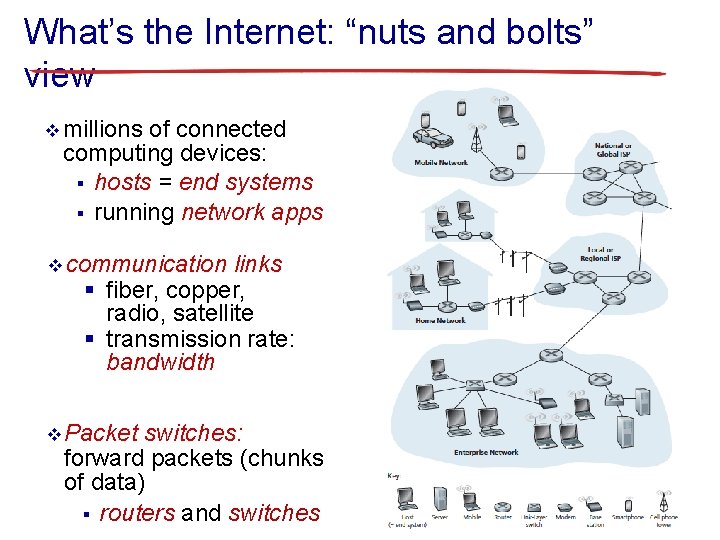
What’s the Internet: “nuts and bolts” view v millions of connected computing devices: § hosts = end systems § running network apps v communication links § fiber, copper, radio, satellite § transmission rate: bandwidth v Packet switches: forward packets (chunks of data) § routers and switches Introduction 1 -4
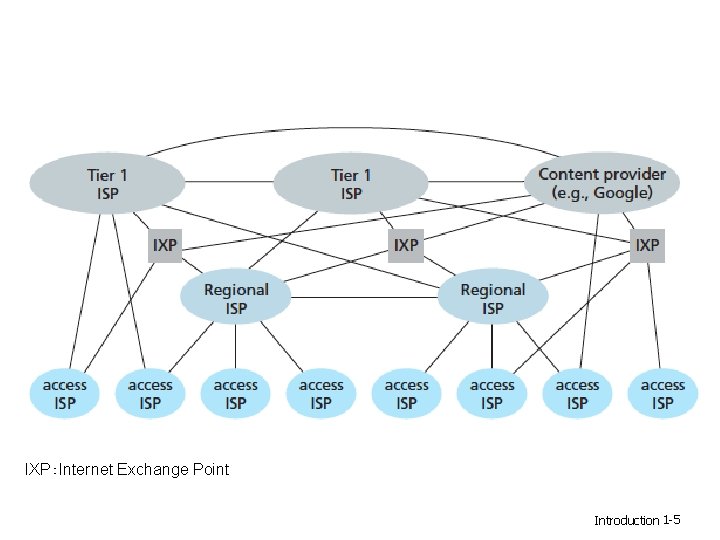
IXP:Internet Exchange Point Introduction 1 -5
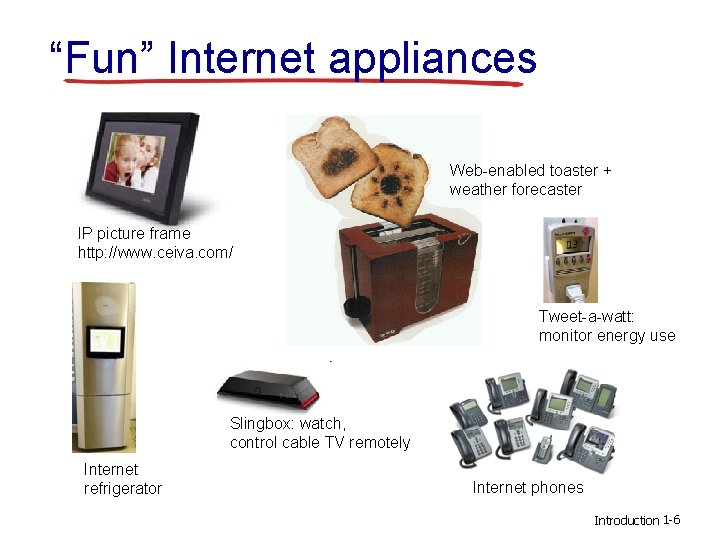
“Fun” Internet appliances Web-enabled toaster + weather forecaster IP picture frame http: //www. ceiva. com/ Tweet-a-watt: monitor energy use Slingbox: watch, control cable TV remotely Internet refrigerator Internet phones Introduction 1 -6
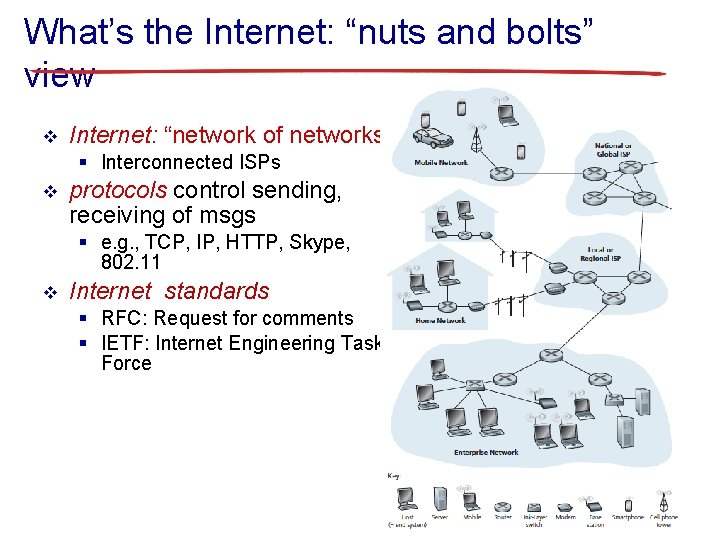
What’s the Internet: “nuts and bolts” view v Internet: “network of networks” § Interconnected ISPs v protocols control sending, receiving of msgs § e. g. , TCP, IP, HTTP, Skype, 802. 11 v Internet standards § RFC: Request for comments § IETF: Internet Engineering Task Force Introduction 1 -7
Note: Request for Comments (RFC) v v v A publication of the Internet Engineering Task Force (IETF) and the Internet Society, the principal technical development and standards-setting bodies for the Internet. Authored by engineers and computer scientists in the form of a memorandum describing methods, behaviors, research, or innovations applicable to the working of the Internet and Internet-connected systems. It is submitted either for peer review or simply to convey new concepts, information, or (occasionally) engineering humor. The IETF adopts some of the proposals published as RFCs as Internet standards. RFCs documents were invented by Steve Crocker in 1969 to help record unofficial notes on the development of ARPANET. RFCs have since become official documents of Internet specifications, communications Introduction 1 -8
Note: Internet Engineering Task Force (IETF) v v Develops and promotes voluntary Internet standards, in particular the standards that comprise the Internet protocol suite (TCP/IP). It is an open standards organization, with no formal membership or membership requirements. All participants and managers are volunteers, though their work is usually funded by their employers or sponsors. The IETF started out as an activity supported by the US federal government, but since 1993 it has operated as a standards development function under the auspices of the Internet Society, an international membership-based non-profit organization. Introduction 1 -9
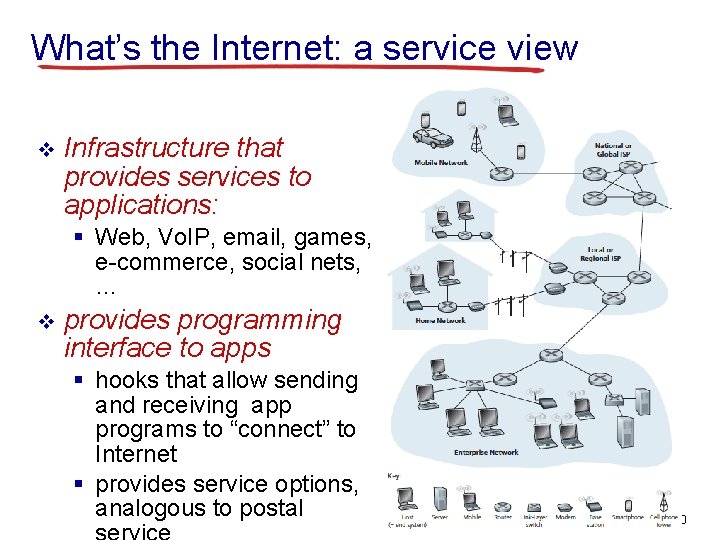
What’s the Internet: a service view v Infrastructure that provides services to applications: § Web, Vo. IP, email, games, e-commerce, social nets, … v provides programming interface to apps § hooks that allow sending and receiving app programs to “connect” to Internet § provides service options, analogous to postal Introduction 1 -10
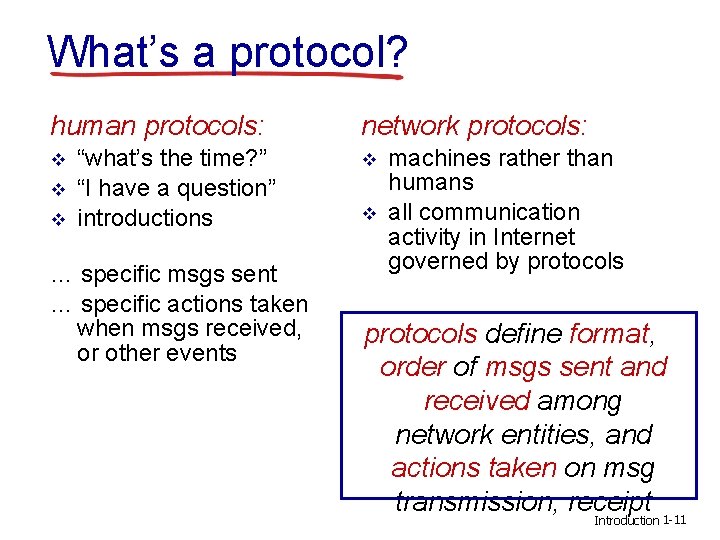
What’s a protocol? human protocols: v v v “what’s the time? ” “I have a question” introductions … specific msgs sent … specific actions taken when msgs received, or other events network protocols: v v machines rather than humans all communication activity in Internet governed by protocols define format, order of msgs sent and received among network entities, and actions taken on msg transmission, receipt Introduction 1 -11
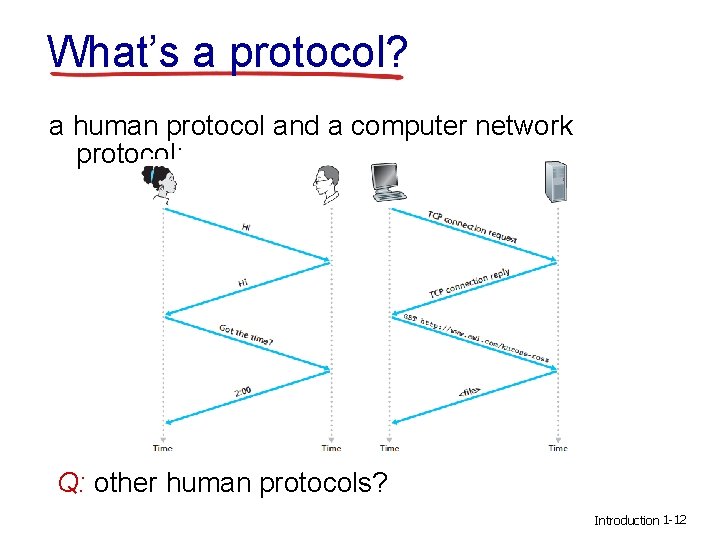
What’s a protocol? a human protocol and a computer network protocol: Q: other human protocols? Introduction 1 -12
Chapter 1: roadmap 1. 1 what is the Internet? 1. 2 network edge § end systems, access networks, links 1. 3 network core § packet switching, circuit switching, network structure 1. 4 delay, loss, throughput in networks 1. 5 protocol layers, service models 1. 6 networks under attack: security 1. 7 history Introduction 1 -13
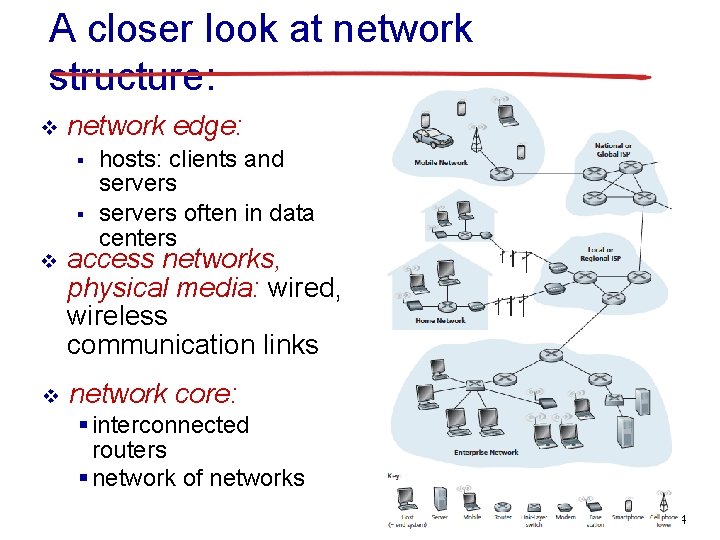
A closer look at network structure: v network edge: § § hosts: clients and servers often in data centers v access networks, physical media: wired, wireless communication links v network core: § interconnected routers § network of networks Introduction 1 -14
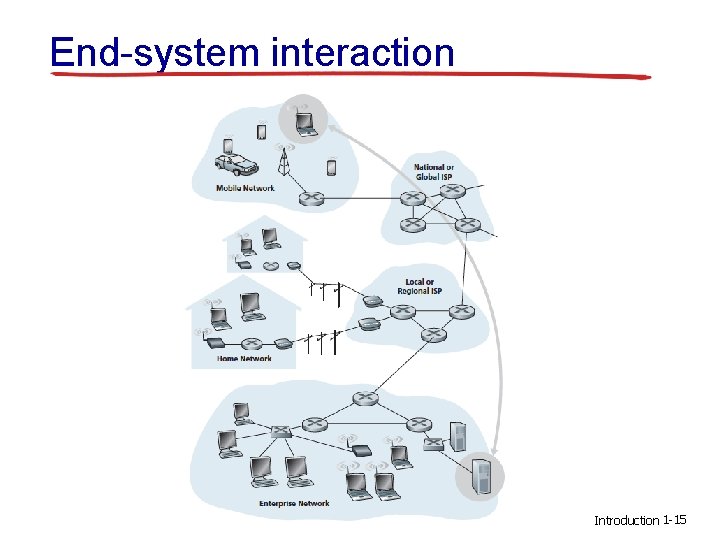
End-system interaction Introduction 1 -15
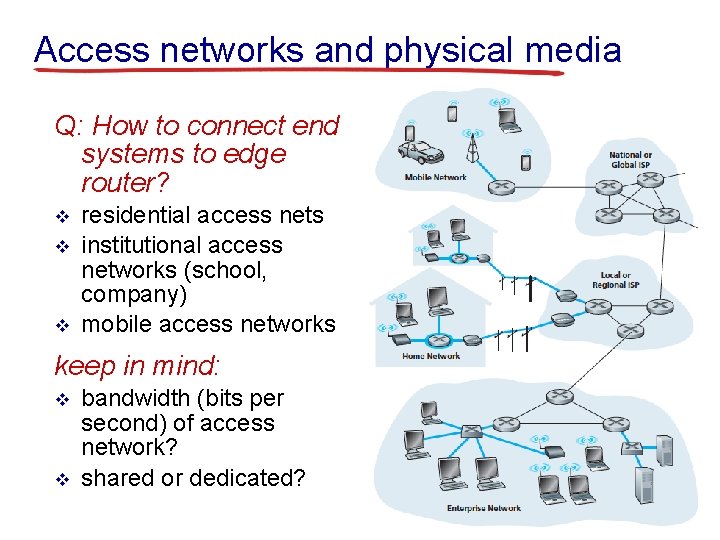
Access networks and physical media Q: How to connect end systems to edge router? v v v residential access nets institutional access networks (school, company) mobile access networks keep in mind: v v bandwidth (bits per second) of access network? shared or dedicated? Introduction 1 -16
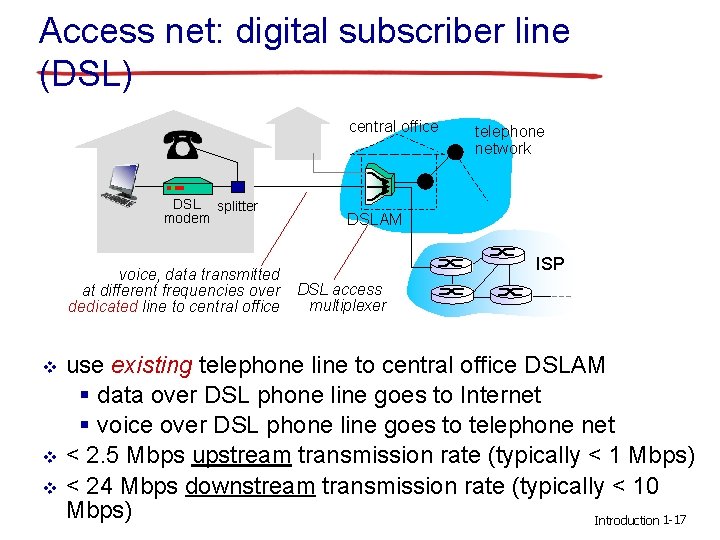
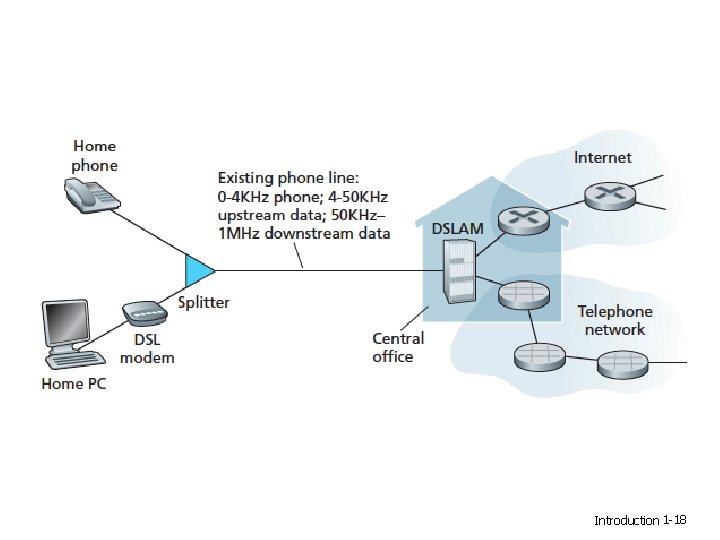
Access net: digital subscriber line (DSL) central office DSL splitter modem voice, data transmitted at different frequencies over dedicated line to central office v v v telephone network DSLAM ISP DSL access multiplexer use existing telephone line to central office DSLAM § data over DSL phone line goes to Internet § voice over DSL phone line goes to telephone net < 2. 5 Mbps upstream transmission rate (typically < 1 Mbps) < 24 Mbps downstream transmission rate (typically < 10 Mbps) Introduction 1 -17
Introduction 1 -18
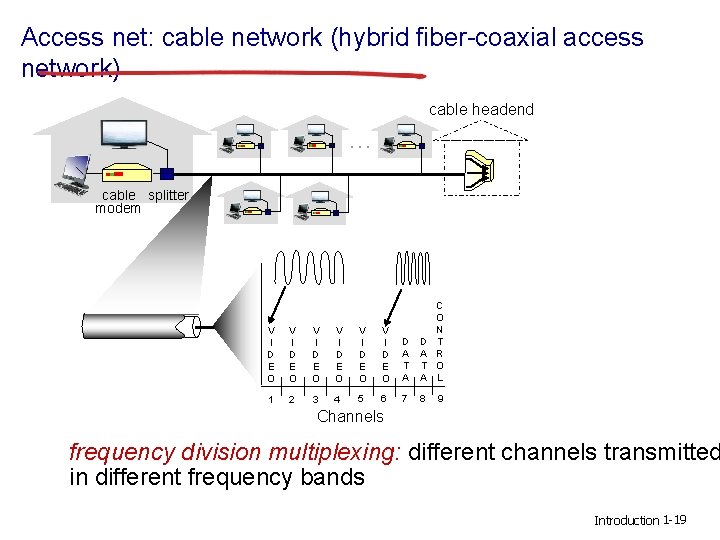
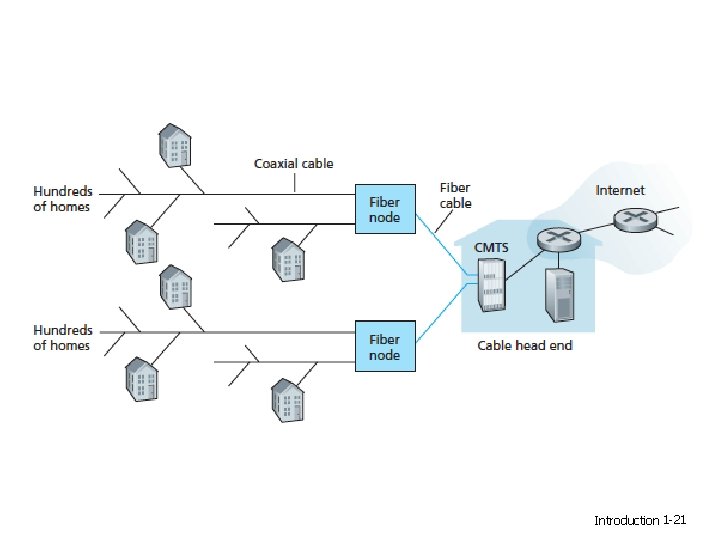
Access net: cable network (hybrid fiber-coaxial access network) cable headend … cable splitter modem V I D E O V I D E O D A T A C O N T R O L 1 2 3 4 5 6 7 8 9 Channels frequency division multiplexing: different channels transmitted in different frequency bands Introduction 1 -19
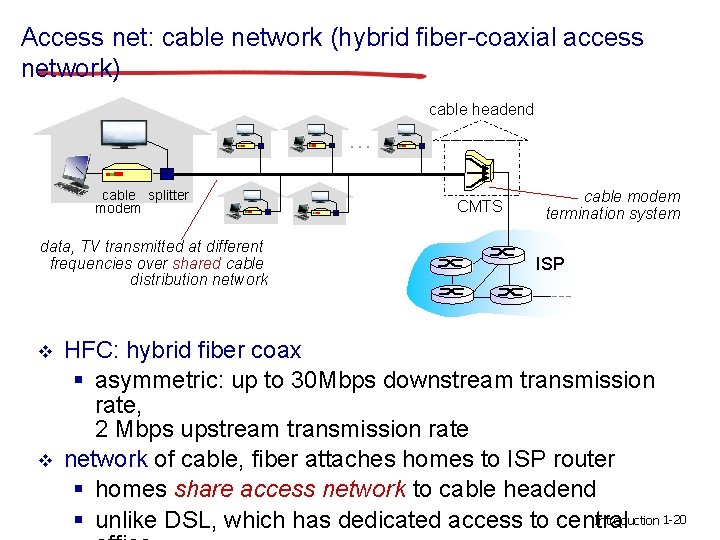
Access net: cable network (hybrid fiber-coaxial access network) cable headend … cable splitter modem data, TV transmitted at different frequencies over shared cable distribution network v v CMTS cable modem termination system ISP HFC: hybrid fiber coax § asymmetric: up to 30 Mbps downstream transmission rate, 2 Mbps upstream transmission rate network of cable, fiber attaches homes to ISP router § homes share access network to cable headend Introduction 1 -20 § unlike DSL, which has dedicated access to central
Introduction 1 -21
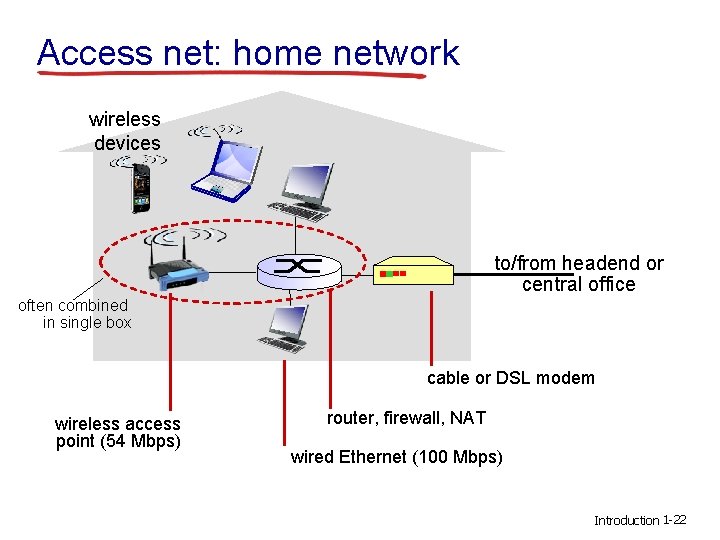
Access net: home network wireless devices to/from headend or central office often combined in single box cable or DSL modem wireless access point (54 Mbps) router, firewall, NAT wired Ethernet (100 Mbps) Introduction 1 -22
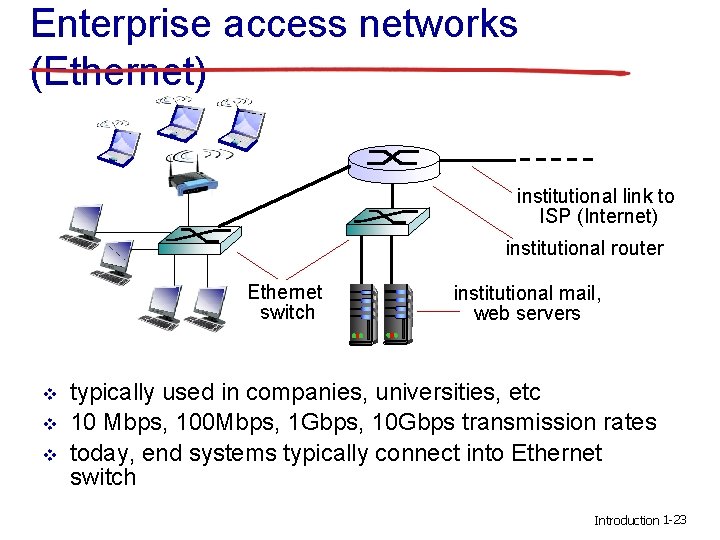
Enterprise access networks (Ethernet) institutional link to ISP (Internet) institutional router Ethernet switch v v v institutional mail, web servers typically used in companies, universities, etc 10 Mbps, 100 Mbps, 1 Gbps, 10 Gbps transmission rates today, end systems typically connect into Ethernet switch Introduction 1 -23
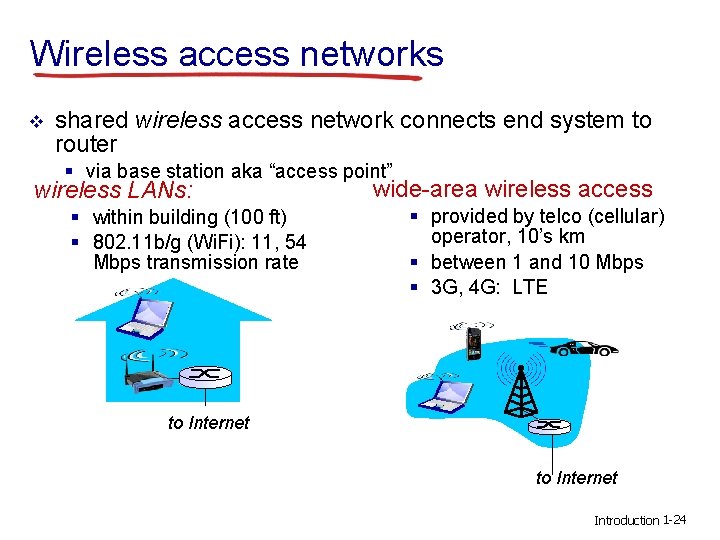
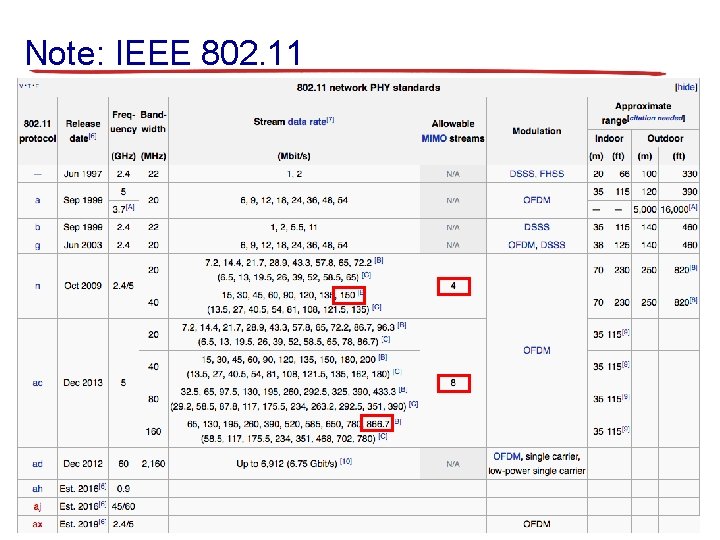
Wireless access networks v shared wireless access network connects end system to router § via base station aka “access point” wireless LANs: § within building (100 ft) § 802. 11 b/g (Wi. Fi): 11, 54 Mbps transmission rate wide-area wireless access § provided by telco (cellular) operator, 10’s km § between 1 and 10 Mbps § 3 G, 4 G: LTE to Internet Introduction 1 -24
Note: IEEE 802. 11 Introduction 1 -25
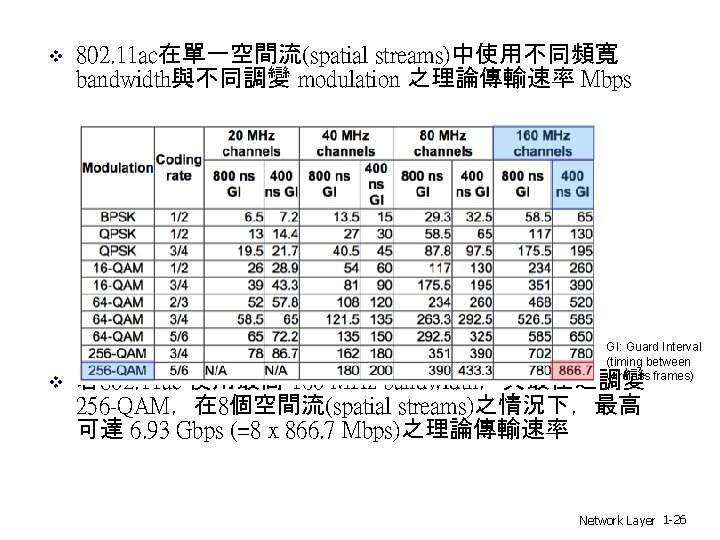
v v 802. 11 ac在單一空間流(spatial streams)中使用不同頻寬 bandwidth與不同調變 modulation 之理論傳輸速率 Mbps GI: Guard Interval (timing between wireless frames) 若 802. 11 ac 使用最高 160 MHz bandwidth,與最佳之調變 256 -QAM,在 8個空間流(spatial streams)之情況下,最高 可達 6. 93 Gbps (=8 x 866. 7 Mbps)之理論傳輸速率 Network Layer 1 -26
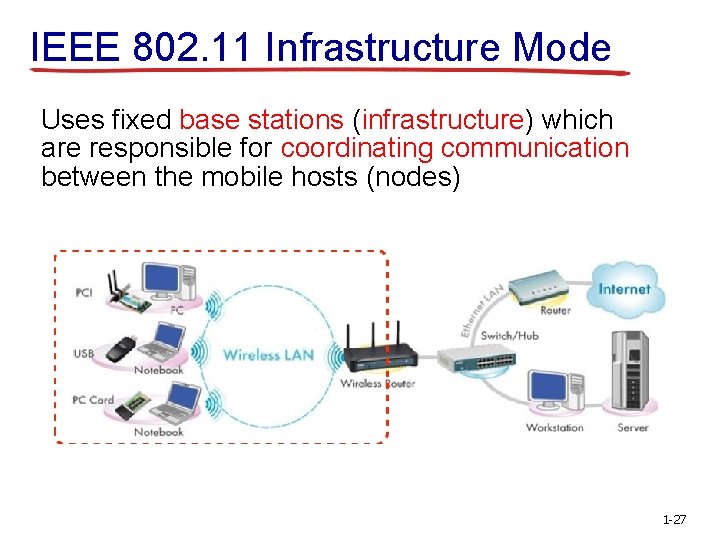
IEEE 802. 11 Infrastructure Mode Uses fixed base stations (infrastructure) which are responsible for coordinating communication between the mobile hosts (nodes) 1 -27
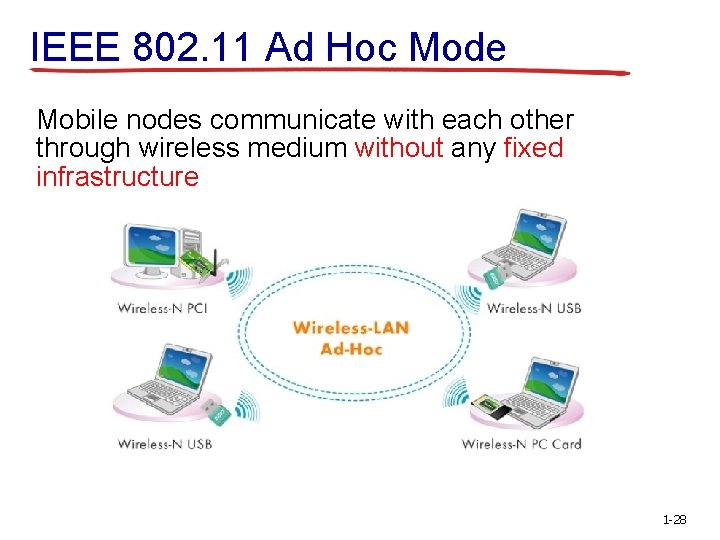
IEEE 802. 11 Ad Hoc Mode Mobile nodes communicate with each other through wireless medium without any fixed infrastructure 1 -28
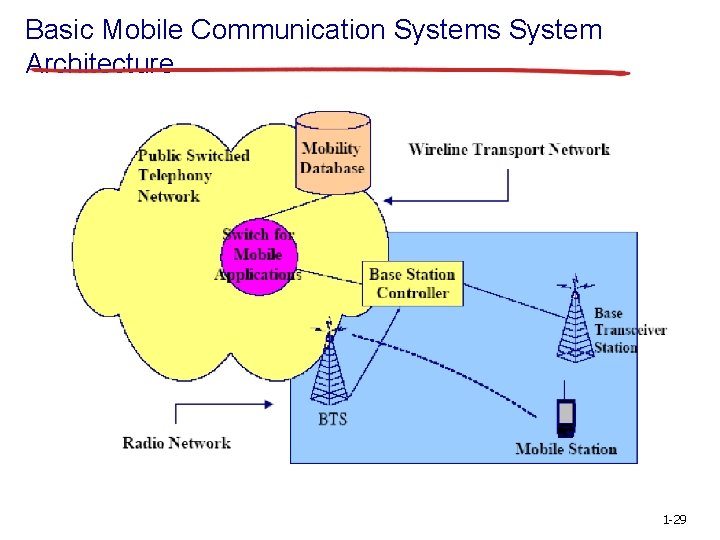
Basic Mobile Communication Systems System Architecture 1 -29
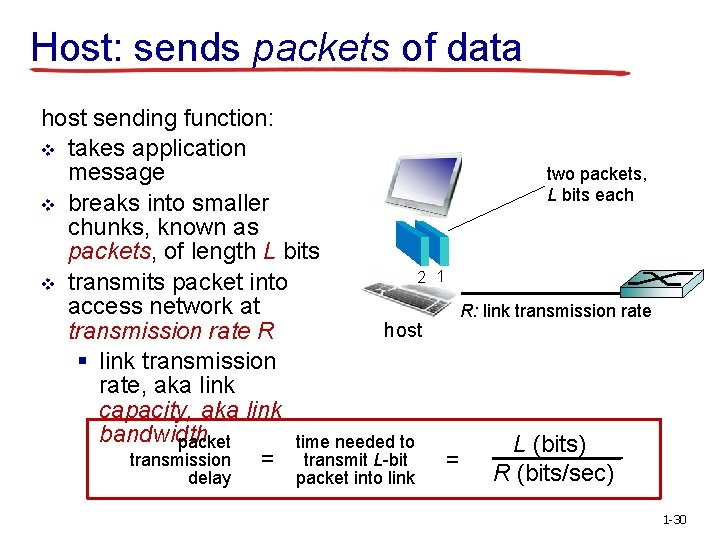
Host: sends packets of data host sending function: v takes application two packets, message L bits each v breaks into smaller chunks, known as packets, of length L bits 2 1 v transmits packet into access network at R: link transmission rate host transmission rate R § link transmission rate, aka link capacity, aka link bandwidth time needed to packet L (bits) transmission = transmit L-bit = R (bits/sec) packet into link delay 1 -30
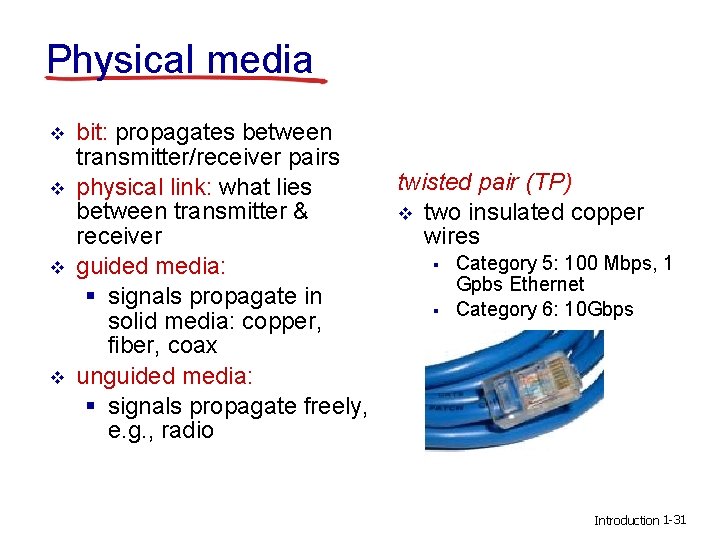
Physical media v v bit: propagates between transmitter/receiver pairs physical link: what lies between transmitter & receiver guided media: § signals propagate in solid media: copper, fiber, coax unguided media: § signals propagate freely, e. g. , radio twisted pair (TP) v two insulated copper wires § § Category 5: 100 Mbps, 1 Gpbs Ethernet Category 6: 10 Gbps Introduction 1 -31
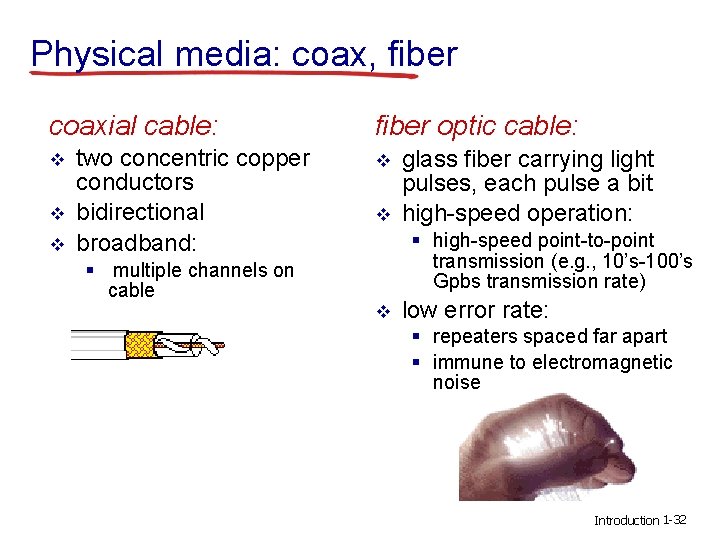
Physical media: coax, fiber coaxial cable: v v v two concentric copper conductors bidirectional broadband: § multiple channels on cable § HFC fiber optic cable: v v glass fiber carrying light pulses, each pulse a bit high-speed operation: § high-speed point-to-point transmission (e. g. , 10’s-100’s Gpbs transmission rate) v low error rate: § repeaters spaced far apart § immune to electromagnetic noise Introduction 1 -32
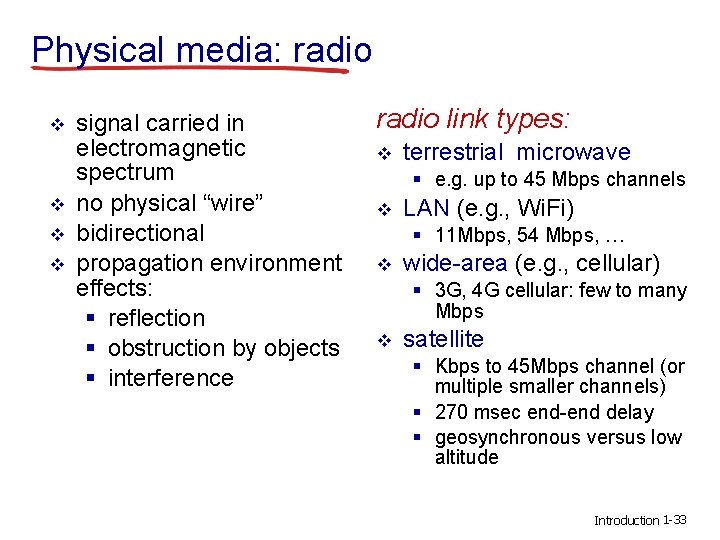
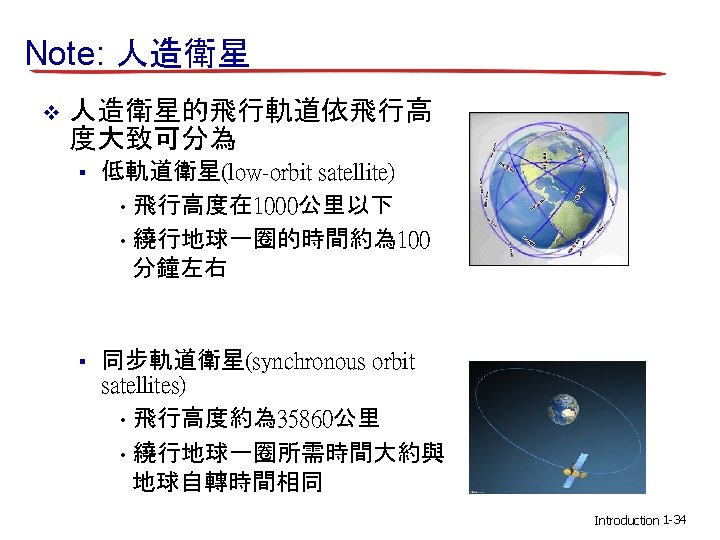
Physical media: radio v v signal carried in electromagnetic spectrum no physical “wire” bidirectional propagation environment effects: § reflection § obstruction by objects § interference radio link types: v terrestrial microwave § e. g. up to 45 Mbps channels v LAN (e. g. , Wi. Fi) § 11 Mbps, 54 Mbps, … v wide-area (e. g. , cellular) § 3 G, 4 G cellular: few to many Mbps v satellite § Kbps to 45 Mbps channel (or multiple smaller channels) § 270 msec end-end delay § geosynchronous versus low altitude Introduction 1 -33
Chapter 1: roadmap 1. 1 what is the Internet? 1. 2 network edge § end systems, access networks, links 1. 3 network core § packet switching, circuit switching, network structure 1. 4 delay, loss, throughput in networks 1. 5 protocol layers, service models 1. 6 networks under attack: security 1. 7 history Introduction 1 -35
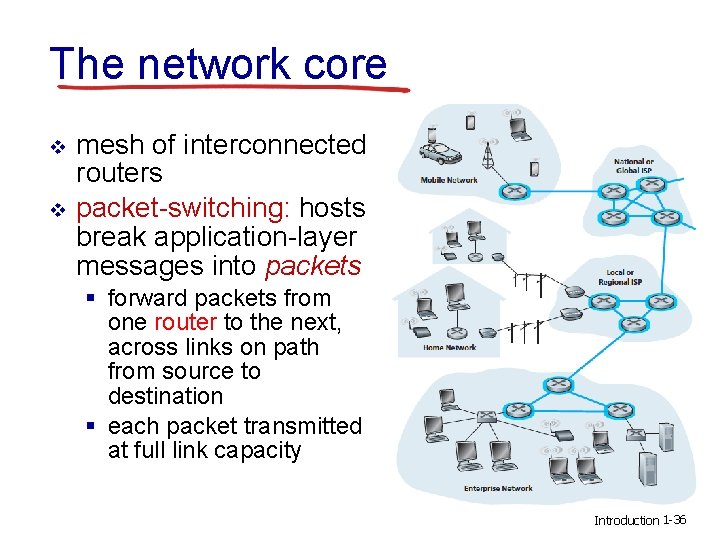
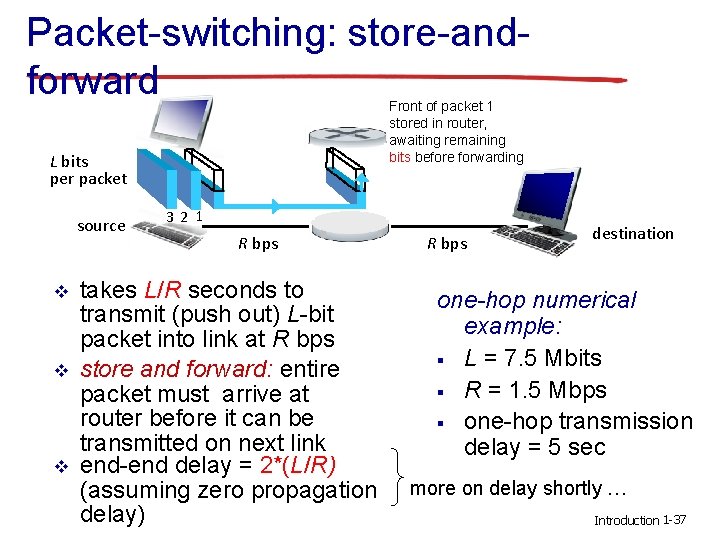
The network core v v mesh of interconnected routers packet-switching: hosts break application-layer messages into packets § forward packets from one router to the next, across links on path from source to destination § each packet transmitted at full link capacity Introduction 1 -36
Packet-switching: store-andforward Front of packet 1 stored in router, awaiting remaining bits before forwarding L bits per packet source v v v 3 2 1 R bps takes L/R seconds to transmit (push out) L-bit packet into link at R bps store and forward: entire packet must arrive at router before it can be transmitted on next link end-end delay = 2*(L/R) (assuming zero propagation delay) R bps destination one-hop numerical example: § L = 7. 5 Mbits § R = 1. 5 Mbps § one-hop transmission delay = 5 sec more on delay shortly … Introduction 1 -37
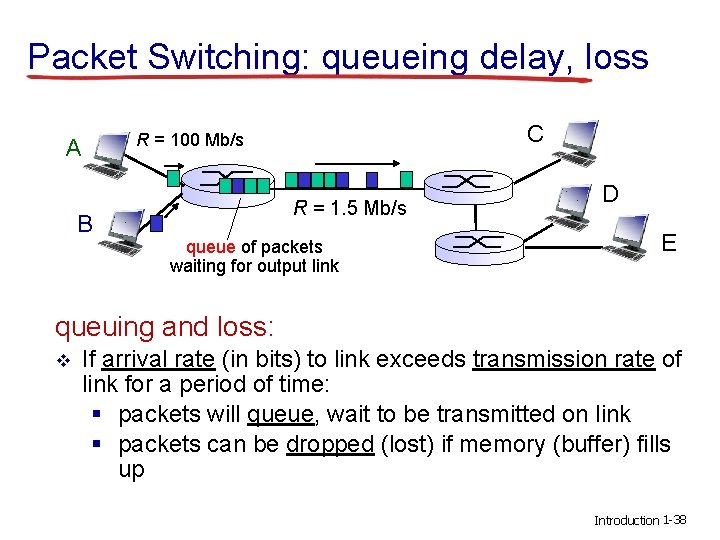
Packet Switching: queueing delay, loss A B C R = 100 Mb/s R = 1. 5 Mb/s queue of packets waiting for output link D E queuing and loss: v If arrival rate (in bits) to link exceeds transmission rate of link for a period of time: § packets will queue, wait to be transmitted on link § packets can be dropped (lost) if memory (buffer) fills up Introduction 1 -38
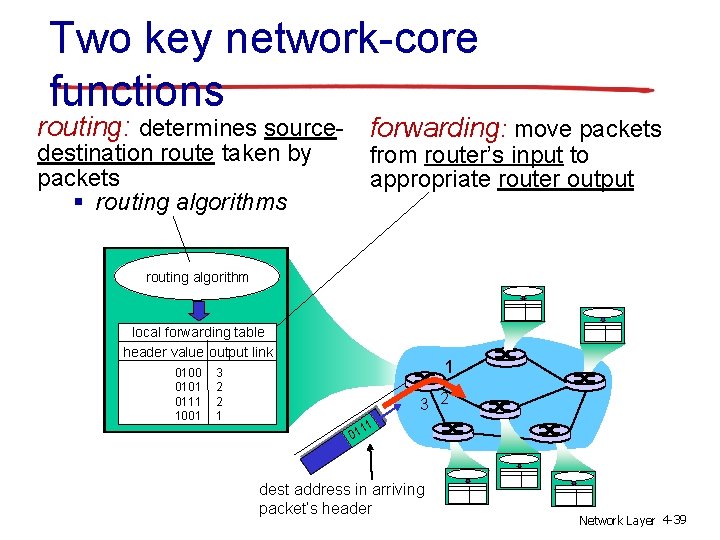
Two key network-core functions routing: determines source- forwarding: move packets destination route taken by packets § routing algorithms from router’s input to appropriate router output routing algorithm local forwarding table header value output link 0100 0101 0111 1001 1 3 2 2 1 3 2 11 01 dest address in arriving packet’s header Network Layer 4 -39
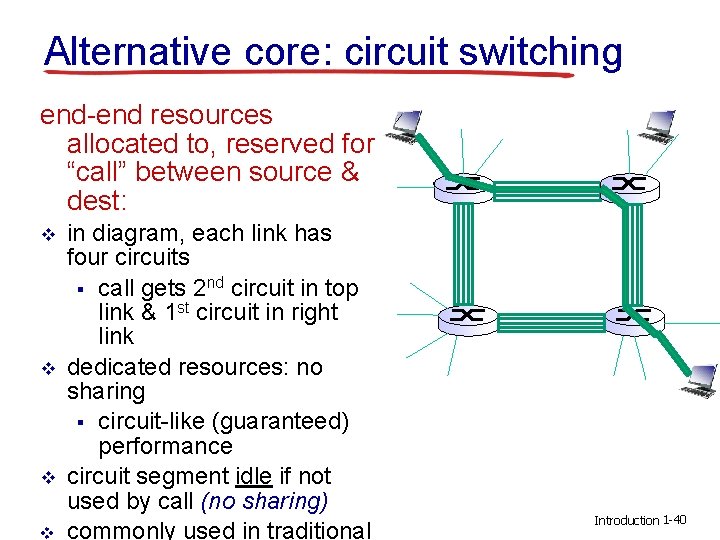
Alternative core: circuit switching end-end resources allocated to, reserved for “call” between source & dest: v v in diagram, each link has four circuits § call gets 2 nd circuit in top link & 1 st circuit in right link dedicated resources: no sharing § circuit-like (guaranteed) performance circuit segment idle if not used by call (no sharing) commonly used in traditional Introduction 1 -40
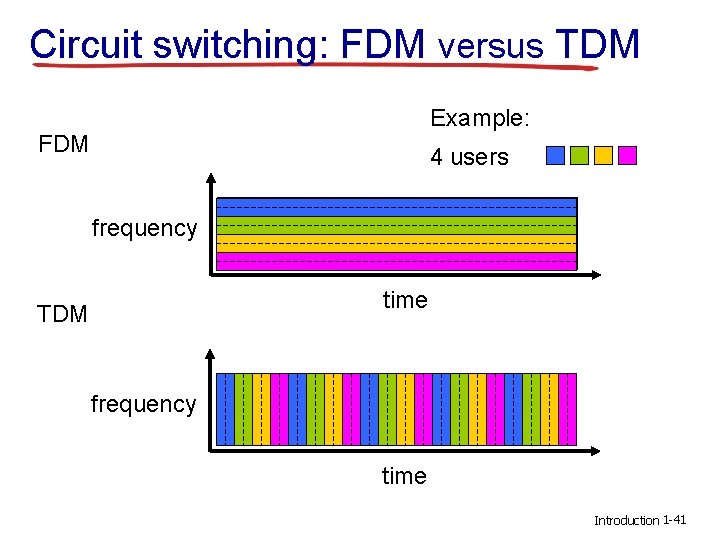
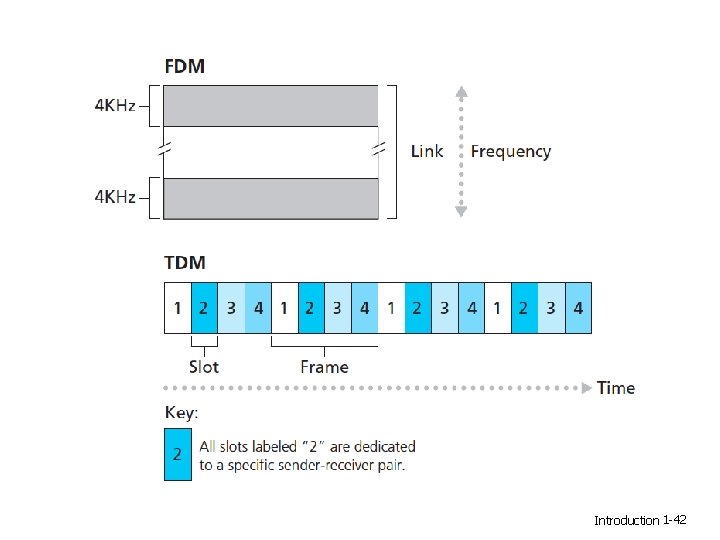
Circuit switching: FDM versus TDM Example: FDM 4 users frequency time TDM frequency time Introduction 1 -41
Introduction 1 -42
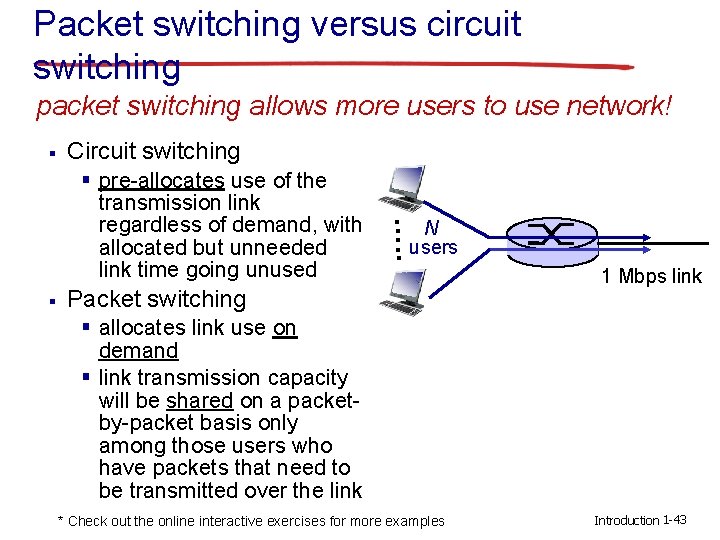
Packet switching versus circuit switching packet switching allows more users to use network! § Circuit switching § N users …. . § pre-allocates use of the transmission link regardless of demand, with allocated but unneeded link time going unused Packet switching 1 Mbps link § allocates link use on demand § link transmission capacity will be shared on a packetby-packet basis only among those users who have packets that need to be transmitted over the link * Check out the online interactive exercises for more examples Introduction 1 -43
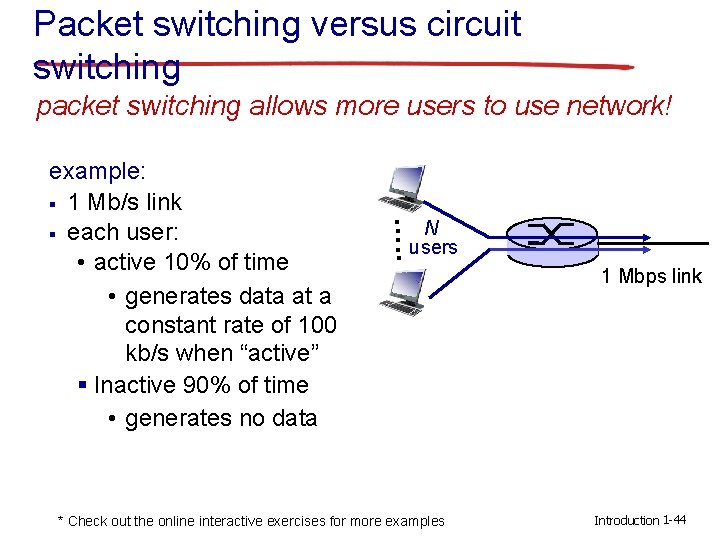
Packet switching versus circuit switching packet switching allows more users to use network! N users …. . example: § 1 Mb/s link § each user: • active 10% of time • generates data at a constant rate of 100 kb/s when “active” § Inactive 90% of time • generates no data * Check out the online interactive exercises for more examples 1 Mbps link Introduction 1 -44
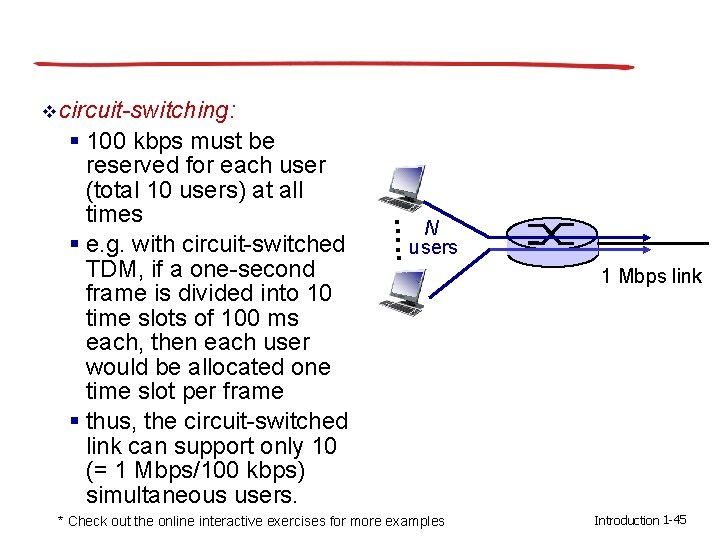
v circuit-switching: N users …. . § 100 kbps must be reserved for each user (total 10 users) at all times § e. g. with circuit-switched TDM, if a one-second frame is divided into 10 time slots of 100 ms each, then each user would be allocated one time slot per frame § thus, the circuit-switched link can support only 10 (= 1 Mbps/100 kbps) simultaneous users. * Check out the online interactive exercises for more examples 1 Mbps link Introduction 1 -45
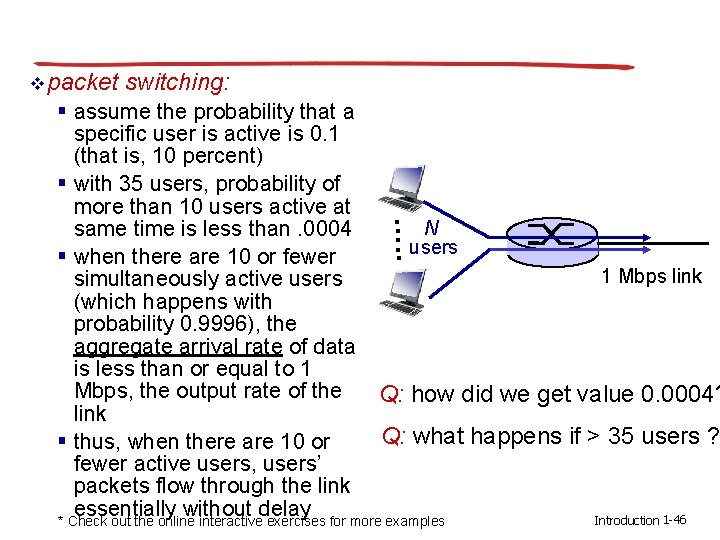
v packet switching: …. . § assume the probability that a specific user is active is 0. 1 (that is, 10 percent) § with 35 users, probability of more than 10 users active at N same time is less than. 0004 users § when there are 10 or fewer 1 Mbps link simultaneously active users (which happens with probability 0. 9996), the aggregate arrival rate of data is less than or equal to 1 Mbps, the output rate of the Q: how did we get value 0. 0004? link Q: what happens if > 35 users ? § thus, when there are 10 or fewer active users, users’ packets flow through the link essentially without delay Introduction 1 -46 * Check out the online interactive exercises for more examples
Packet switching versus circuit switching is packet switching a “slam dunk winner? ” v v v great for bursty data § resource sharing § simpler, no call setup excessive congestion possible: packet delay and loss § protocols needed for reliable data transfer, congestion control Q: How to provide circuit-like behavior? § bandwidth guarantees needed for audio/video apps § still an unsolved problem (chapter 7) Q: human analogies of reserved resources (circuit switching) versus on-demand allocation (packet-switching)? Introduction 1 -47
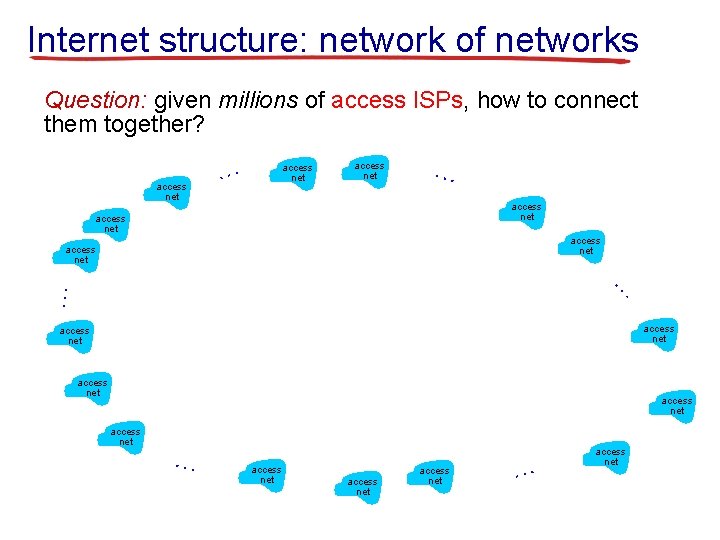
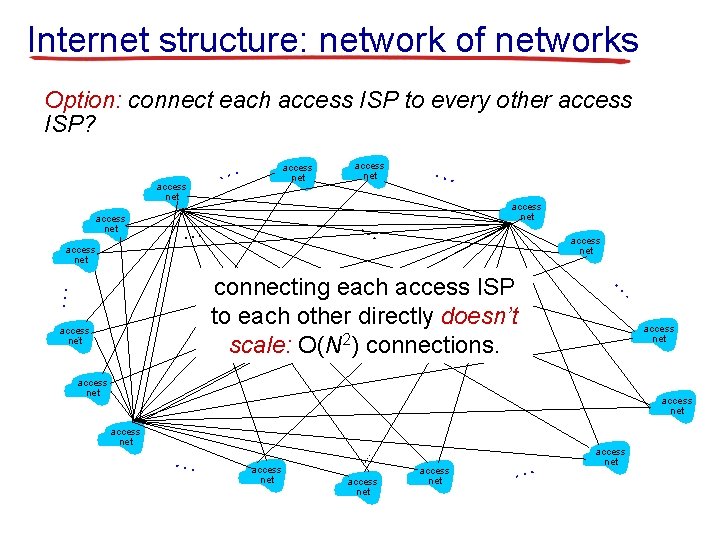
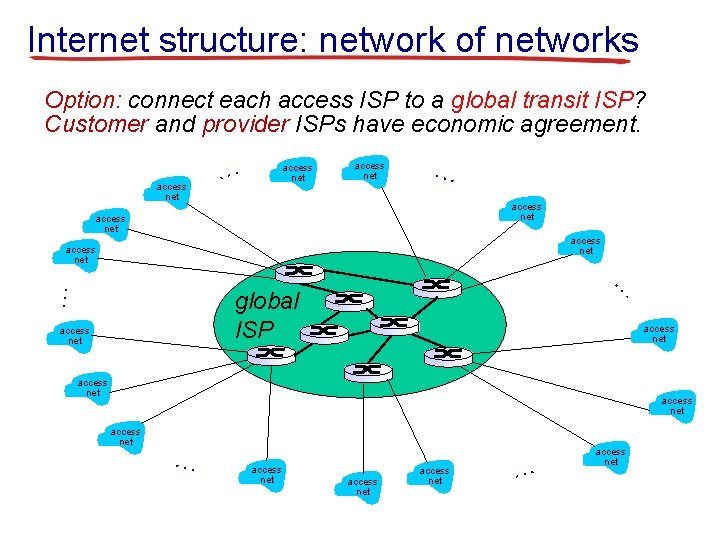
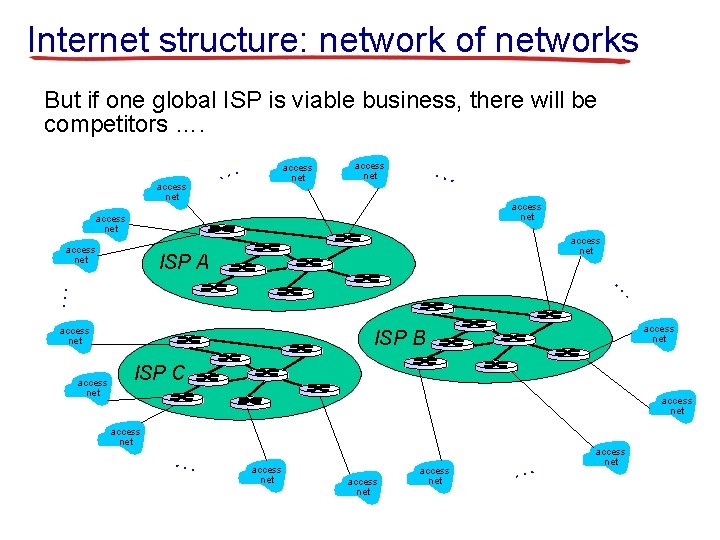
Internet structure: network of networks v v End systems connect to Internet via access ISPs (Internet Service Providers) § Residential, company and university ISPs Access ISPs in turn must be interconnected v So that any two hosts can send packets to each other Resulting network of networks is very complex v Evolution was driven by economics and national policies Let’s take a stepwise approach to describe current Internet structure
Internet structure: network of networks Question: given millions of access ISPs, how to connect them together? access net … access net … … access net access net … access net …
Internet structure: network of networks Option: connect each access ISP to every other access ISP? access net … access net … … connecting each access ISP to each other directly doesn’t scale: O(N 2) connections. … … access net access net … … access net …
Internet structure: network of networks Option: connect each access ISP to a global transit ISP? Customer and provider ISPs have economic agreement. access net … access net … … access net global ISP access net access net … access net …
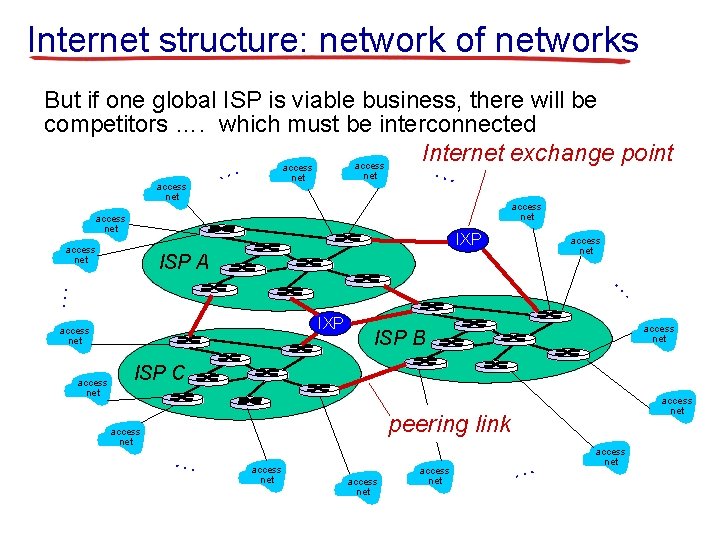
Internet structure: network of networks But if one global ISP is viable business, there will be competitors …. access net … access net access net … … ISP A access net ISP B ISP C access net access net … … access net
Internet structure: network of networks But if one global ISP is viable business, there will be competitors …. which must be interconnected Internet exchange point access net … … net access net IXP access net … … ISP A IXP access net ISP B ISP C access net peering link access net … … access net
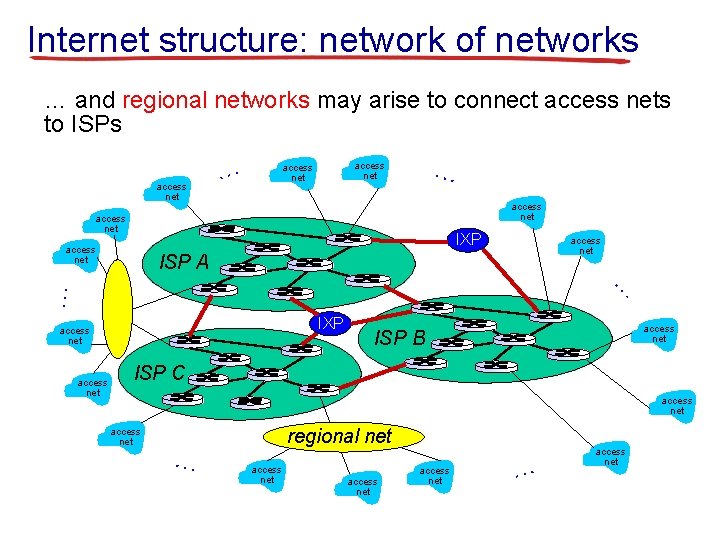
Internet structure: network of networks … and regional networks may arise to connect access nets to ISPs access net … … access net IXP access net … … ISP A IXP access net ISP B ISP C access net regional net access net … … access net
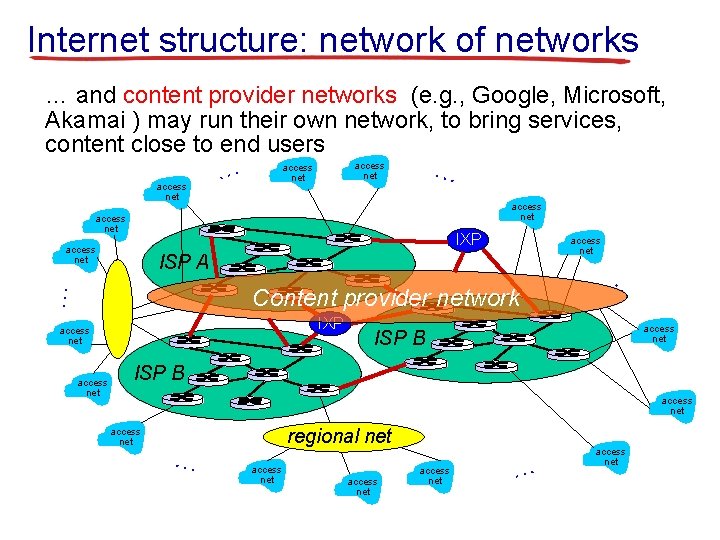
Internet structure: network of networks … and content provider networks (e. g. , Google, Microsoft, Akamai ) may run their own network, to bring services, content close to end users access net … … access net IXP access net Content provider network IXP access net ISP B access net regional net access net … … access net … … ISP A access net
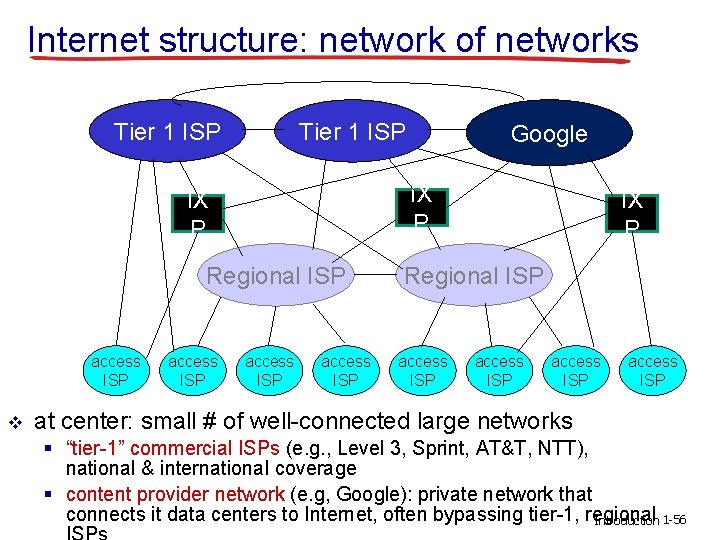
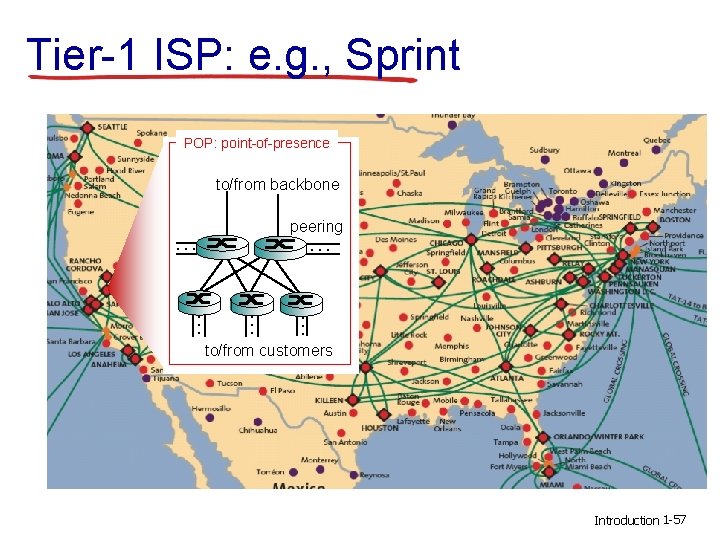
Internet structure: network of networks Tier 1 ISP IX P Regional ISP access ISP v access ISP Google access ISP IX P Regional ISP access ISP at center: small # of well-connected large networks § “tier-1” commercial ISPs (e. g. , Level 3, Sprint, AT&T, NTT), national & international coverage § content provider network (e. g, Google): private network that connects it data centers to Internet, often bypassing tier-1, regional Introduction 1 -56
Tier-1 ISP: e. g. , Sprint POP: point-of-presence to/from backbone peering … … … to/from customers Introduction 1 -57
Chapter 1: roadmap 1. 1 what is the Internet? 1. 2 network edge § end systems, access networks, links 1. 3 network core § packet switching, circuit switching, network structure 1. 4 delay, loss, throughput in networks 1. 5 protocol layers, service models 1. 6 networks under attack: security 1. 7 history Introduction 1 -58
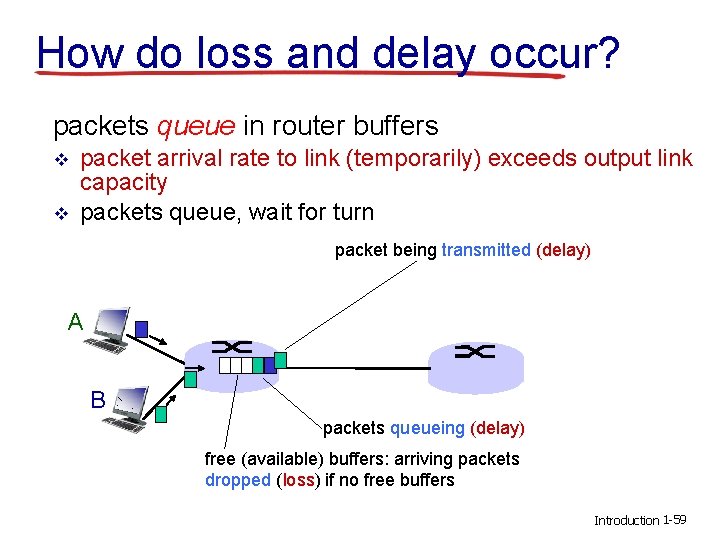
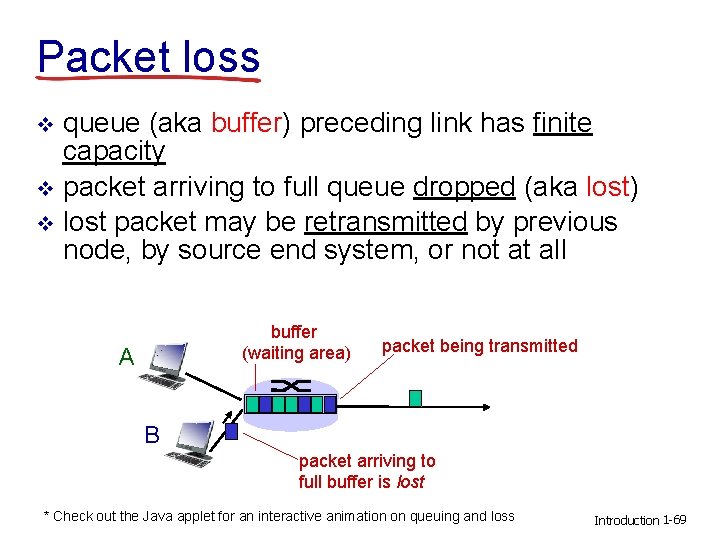
How do loss and delay occur? packets queue in router buffers v v packet arrival rate to link (temporarily) exceeds output link capacity packets queue, wait for turn packet being transmitted (delay) A B packets queueing (delay) free (available) buffers: arriving packets dropped (loss) if no free buffers Introduction 1 -59
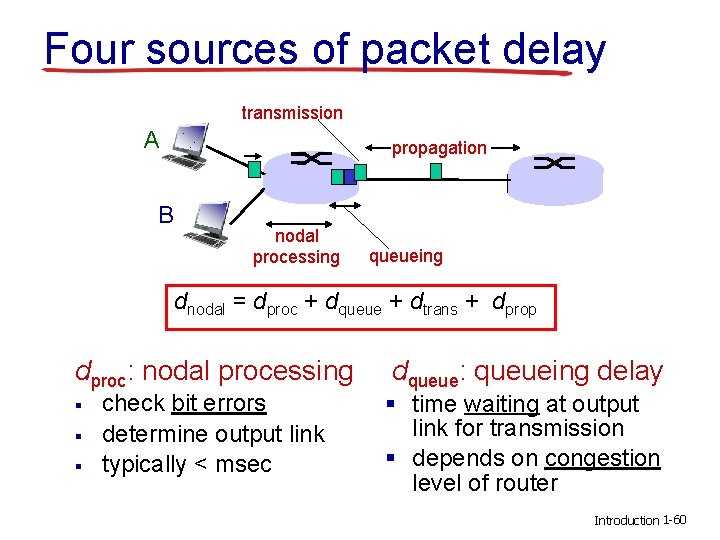
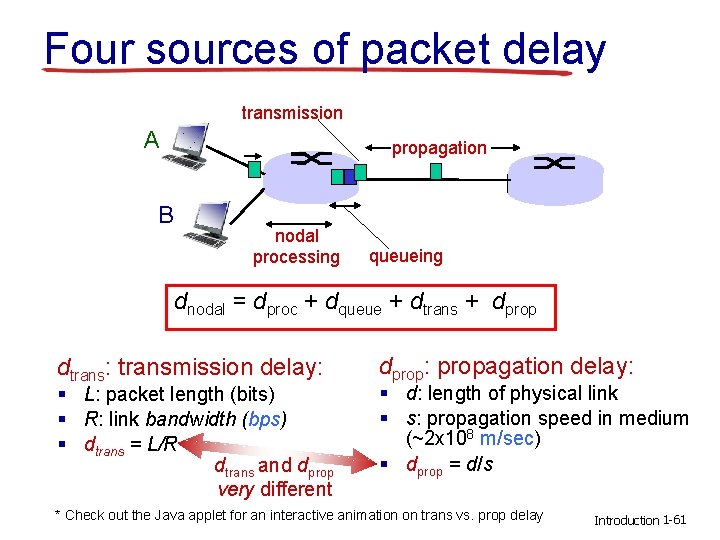
Four sources of packet delay transmission A propagation B nodal processing queueing dnodal = dproc + dqueue + dtrans + dprop dproc: nodal processing § § § check bit errors determine output link typically < msec dqueue: queueing delay § time waiting at output link for transmission § depends on congestion level of router Introduction 1 -60
Four sources of packet delay transmission A propagation B nodal processing queueing dnodal = dproc + dqueue + dtrans + dprop dtrans: transmission delay: § L: packet length (bits) § R: link bandwidth (bps) § dtrans = L/R dtrans and dprop very different dprop: propagation delay: § d: length of physical link § s: propagation speed in medium (~2 x 10⁸ m/sec) § dprop = d/s * Check out the Java applet for an interactive animation on trans vs. prop delay Introduction 1 -61
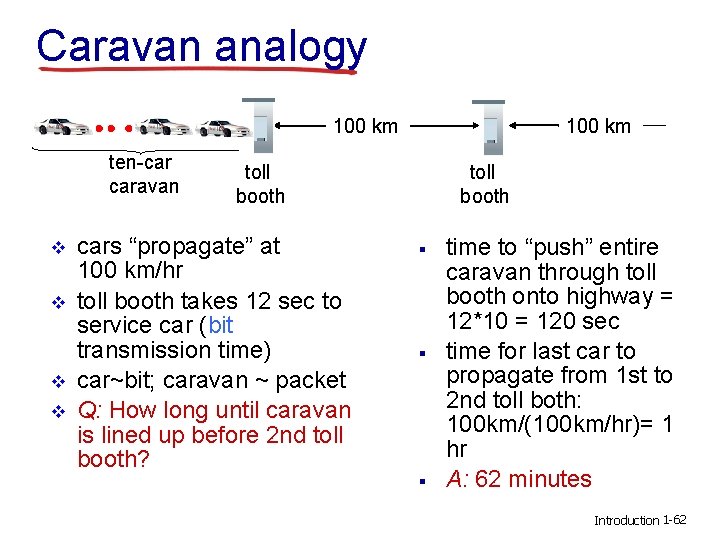
Caravan analogy 100 km ten-car caravan v v 100 km toll booth cars “propagate” at 100 km/hr toll booth takes 12 sec to service car (bit transmission time) car~bit; caravan ~ packet Q: How long until caravan is lined up before 2 nd toll booth? toll booth § § § time to “push” entire caravan through toll booth onto highway = 12*10 = 120 sec time for last car to propagate from 1 st to 2 nd toll both: 100 km/(100 km/hr)= 1 hr A: 62 minutes Introduction 1 -62
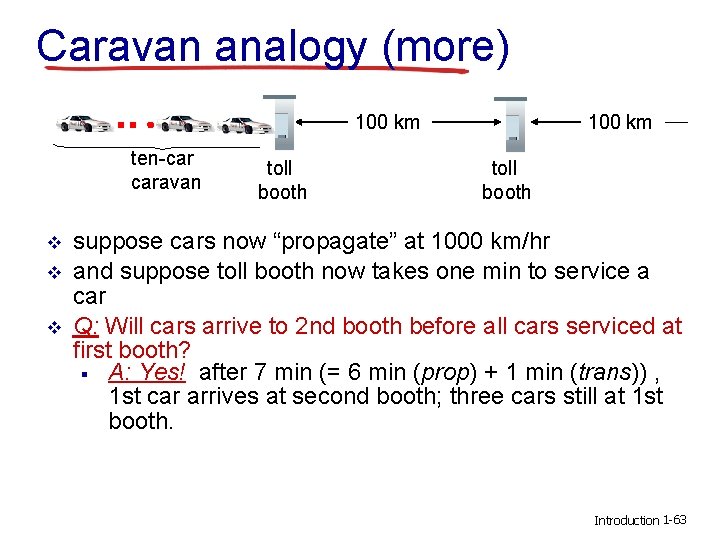
Caravan analogy (more) 100 km ten-car caravan v v v toll booth 100 km toll booth suppose cars now “propagate” at 1000 km/hr and suppose toll booth now takes one min to service a car Q: Will cars arrive to 2 nd booth before all cars serviced at first booth? § A: Yes! after 7 min (= 6 min (prop) + 1 min (trans)) , 1 st car arrives at second booth; three cars still at 1 st booth. Introduction 1 -63
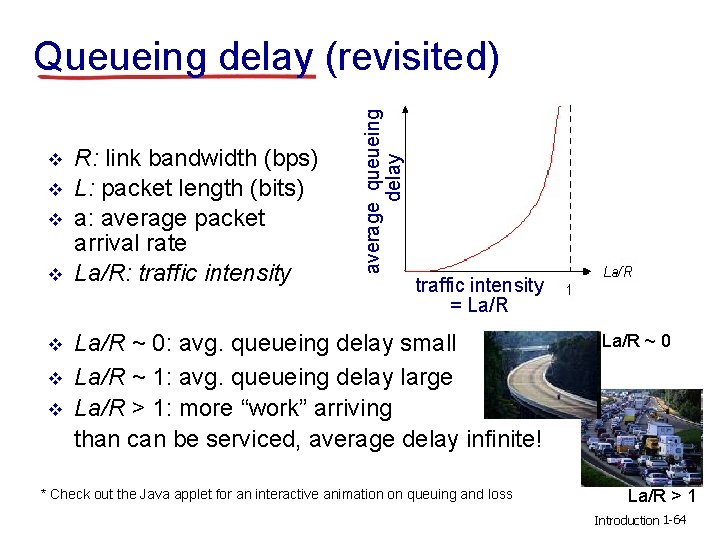
v v v v R: link bandwidth (bps) L: packet length (bits) a: average packet arrival rate La/R: traffic intensity average queueing delay Queueing delay (revisited) traffic intensity = La/R ~ 0: avg. queueing delay small La/R ~ 1: avg. queueing delay large La/R > 1: more “work” arriving than can be serviced, average delay infinite! * Check out the Java applet for an interactive animation on queuing and loss La/R ~ 0 La/R > 1 Introduction 1 -64
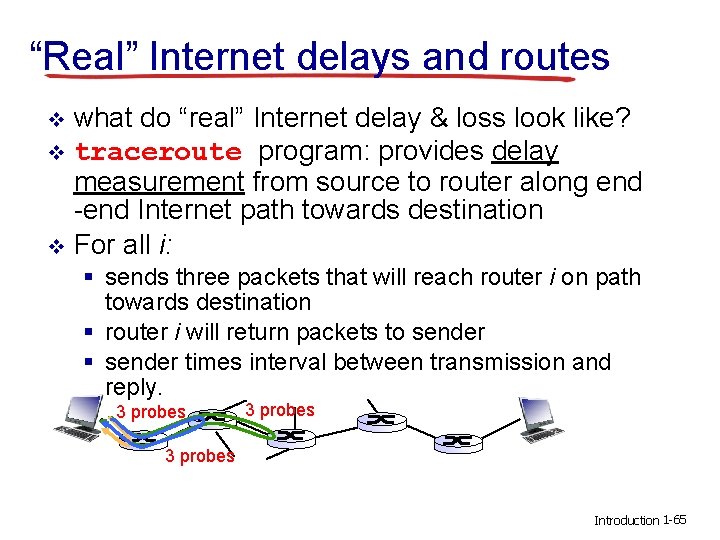
“Real” Internet delays and routes what do “real” Internet delay & loss look like? v traceroute program: provides delay measurement from source to router along end -end Internet path towards destination v For all i: v § sends three packets that will reach router i on path towards destination § router i will return packets to sender § sender times interval between transmission and reply. 3 probes Introduction 1 -65
Note: traceroute v v v Traceroute is a simple program that can run in any Internet host. When the user specifies a destination hostname, the program in the source host sends multiple, special packets toward that destination. As these packets work their way toward the destination, they pass through a series of routers. When a router receives one of these special packets, it sends back to the source a short message that contains the name and address of the router. Suppose there are N-1 routers between the source and the destination. Then the source will send N special packets into the network, with each packet addressed to the ultimate destination. Introduction 1 -66
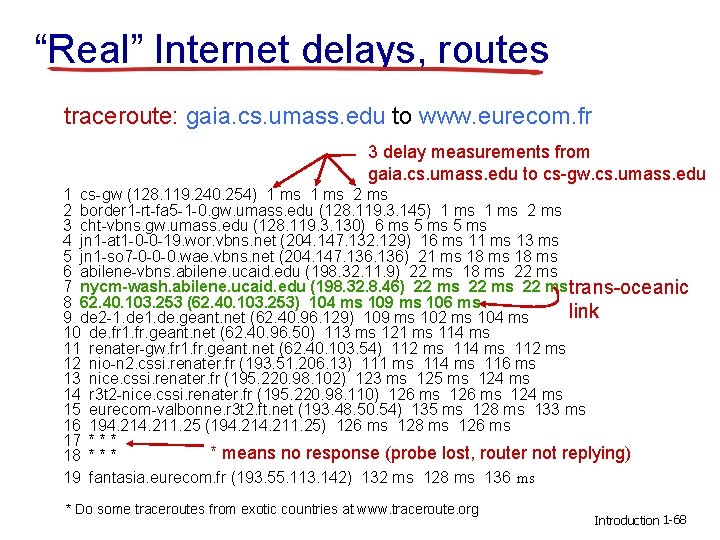
v v v These N special packets are marked 1 through N, with the first packet marked 1 and the last packet marked N. When the Nth router receives the Nth packet marked N, the router does not forward the packet toward its destination, but instead sends a message back to the source. When the destination host receives the Nth packet, it too returns a message back to the source. The source records the time that elapses between when it sends a packet and when it receives the corresponding return message; it also records the name and address of the router (or the destination host) that returns the message. In this manner, the source can reconstruct the route taken by packets flowing from source to destination, and the source can determine the round-trip delays to all the intervening routers. Traceroute actually repeats the experiment just described three times, so the source actually sends 3 N packets to the destination. Introduction 1 -67
“Real” Internet delays, routes traceroute: gaia. cs. umass. edu to www. eurecom. fr 3 delay measurements from gaia. cs. umass. edu to cs-gw. cs. umass. edu 1 cs-gw (128. 119. 240. 254) 1 ms 2 border 1 -rt-fa 5 -1 -0. gw. umass. edu (128. 119. 3. 145) 1 ms 2 ms 3 cht-vbns. gw. umass. edu (128. 119. 3. 130) 6 ms 5 ms 4 jn 1 -at 1 -0 -0 -19. wor. vbns. net (204. 147. 132. 129) 16 ms 11 ms 13 ms 5 jn 1 -so 7 -0 -0 -0. wae. vbns. net (204. 147. 136) 21 ms 18 ms 6 abilene-vbns. abilene. ucaid. edu (198. 32. 11. 9) 22 ms 18 ms 22 ms 7 nycm-wash. abilene. ucaid. edu (198. 32. 8. 46) 22 ms trans-oceanic 8 62. 40. 103. 253 (62. 40. 103. 253) 104 ms 109 ms 106 ms link 9 de 2 -1. de. geant. net (62. 40. 96. 129) 109 ms 102 ms 104 ms 10 de. fr 1. fr. geant. net (62. 40. 96. 50) 113 ms 121 ms 114 ms 11 renater-gw. fr 1. fr. geant. net (62. 40. 103. 54) 112 ms 114 ms 112 ms 12 nio-n 2. cssi. renater. fr (193. 51. 206. 13) 111 ms 114 ms 116 ms 13 nice. cssi. renater. fr (195. 220. 98. 102) 123 ms 125 ms 124 ms 14 r 3 t 2 -nice. cssi. renater. fr (195. 220. 98. 110) 126 ms 124 ms 15 eurecom-valbonne. r 3 t 2. ft. net (193. 48. 50. 54) 135 ms 128 ms 133 ms 16 194. 211. 25 (194. 211. 25) 126 ms 128 ms 126 ms 17 * * means no response (probe lost, router not replying) 18 * * * 19 fantasia. eurecom. fr (193. 55. 113. 142) 132 ms 128 ms 136 ms * Do some traceroutes from exotic countries at www. traceroute. org Introduction 1 -68
Packet loss queue (aka buffer) preceding link has finite capacity v packet arriving to full queue dropped (aka lost) v lost packet may be retransmitted by previous node, by source end system, or not at all v buffer (waiting area) A packet being transmitted B packet arriving to full buffer is lost * Check out the Java applet for an interactive animation on queuing and loss Introduction 1 -69
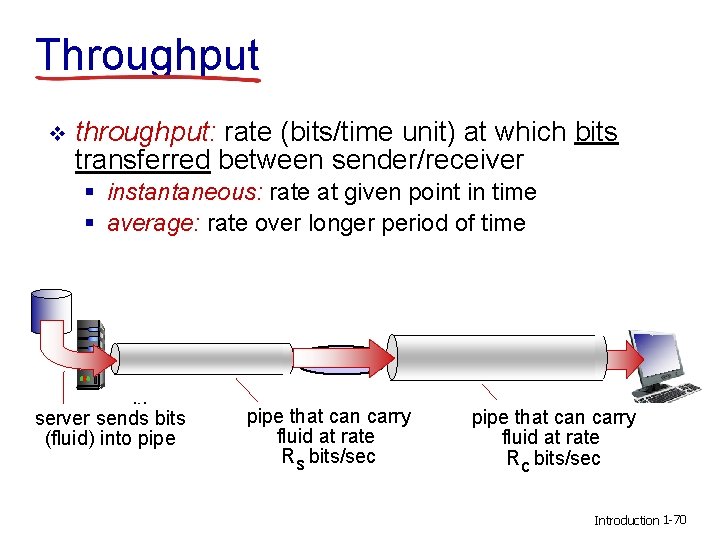
Throughput v throughput: rate (bits/time unit) at which bits transferred between sender/receiver § instantaneous: rate at given point in time § average: rate over longer period of time server, with bits server sends file of into F bits (fluid) pipe to send to client linkpipe capacity that can carry Rs bits/sec fluid at rate Rs bits/sec linkpipe capacity that can carry Rc bits/sec fluid at rate Rc bits/sec Introduction 1 -70
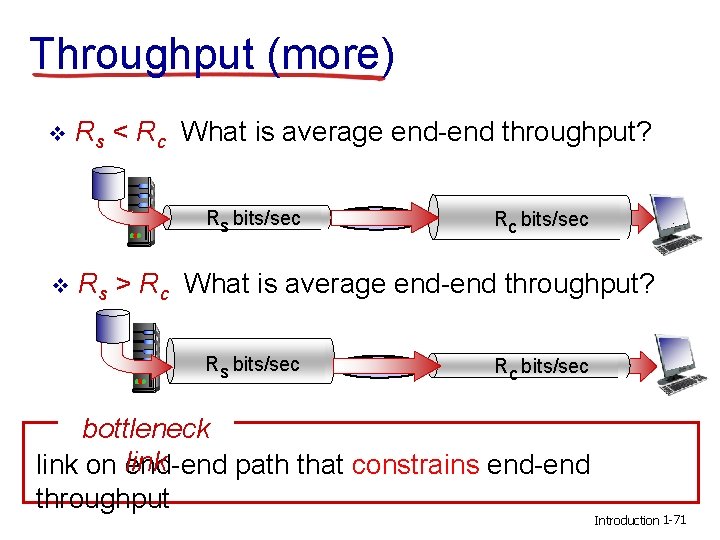
Throughput (more) v Rs < Rc What is average end-end throughput? Rs bits/sec v Rc bits/sec Rs > Rc What is average end-end throughput? Rs bits/sec Rc bits/sec bottleneck link on end-end path that constrains end-end throughput Introduction 1 -71
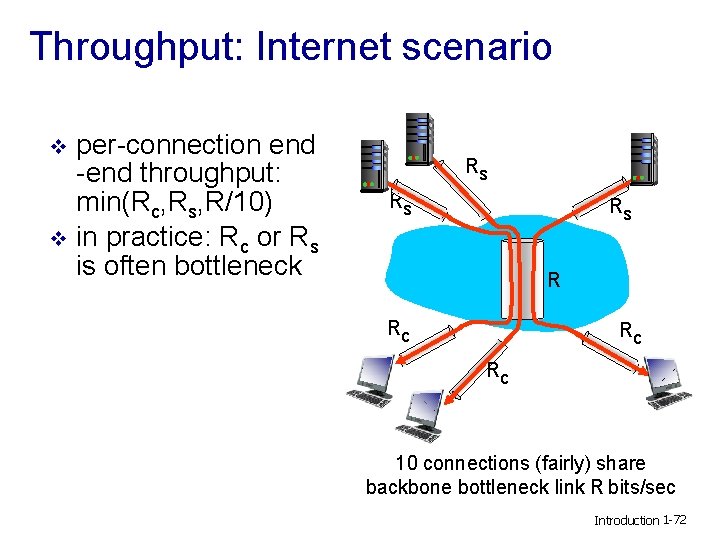
Throughput: Internet scenario per-connection end -end throughput: min(Rc, Rs, R/10) v in practice: Rc or Rs is often bottleneck v Rs Rs Rs R Rc Rc Rc 10 connections (fairly) share backbone bottleneck link R bits/sec Introduction 1 -72
Chapter 1: roadmap 1. 1 what is the Internet? 1. 2 network edge § end systems, access networks, links 1. 3 network core § packet switching, circuit switching, network structure 1. 4 delay, loss, throughput in networks 1. 5 protocol layers, service models 1. 6 networks under attack: security 1. 7 history Introduction 1 -73
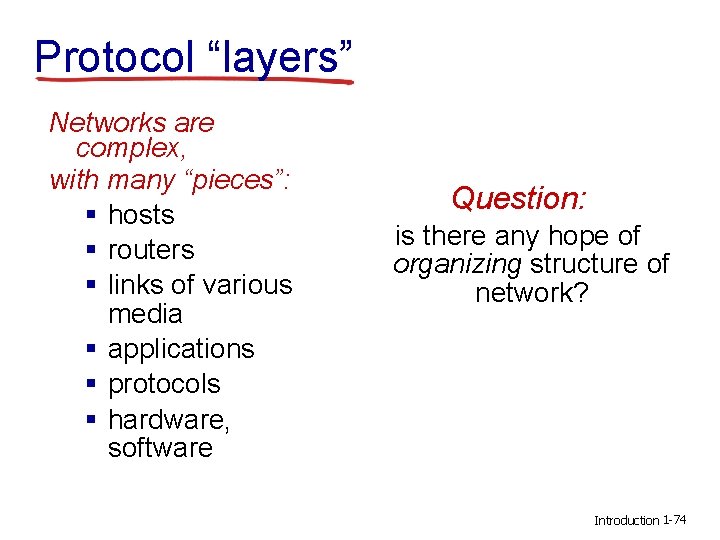
Protocol “layers” Networks are complex, with many “pieces”: § hosts § routers § links of various media § applications § protocols § hardware, software Question: is there any hope of organizing structure of network? Introduction 1 -74
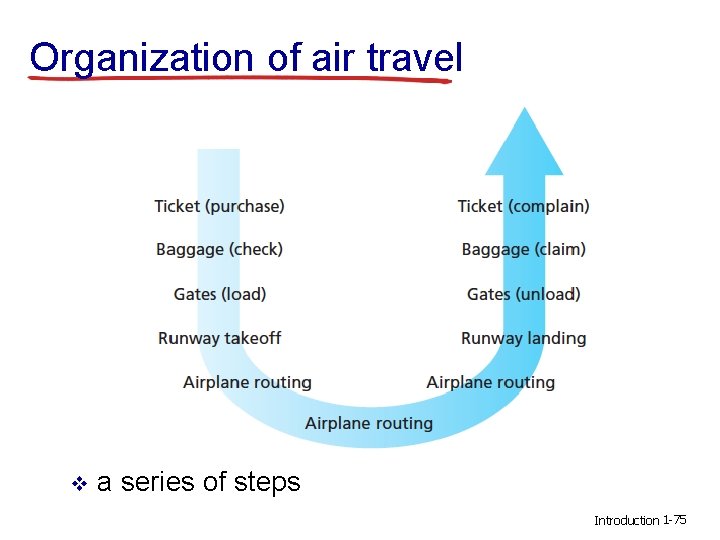
Organization of air travel v a series of steps Introduction 1 -75
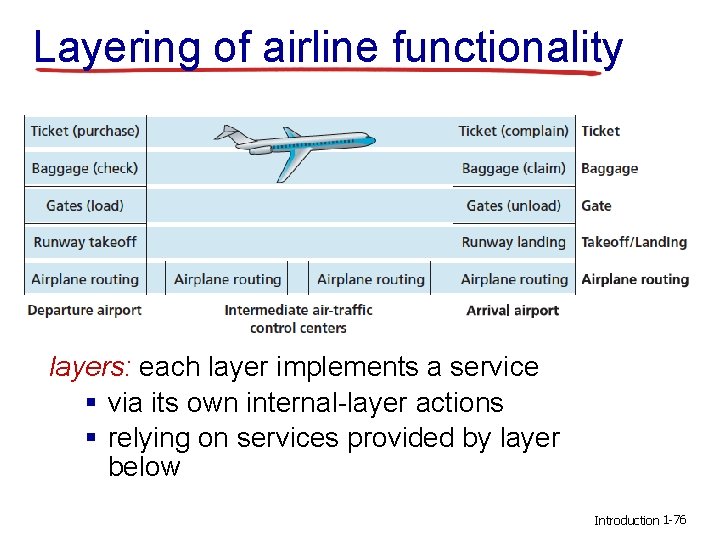
Layering of airline functionality layers: each layer implements a service § via its own internal-layer actions § relying on services provided by layer below Introduction 1 -76
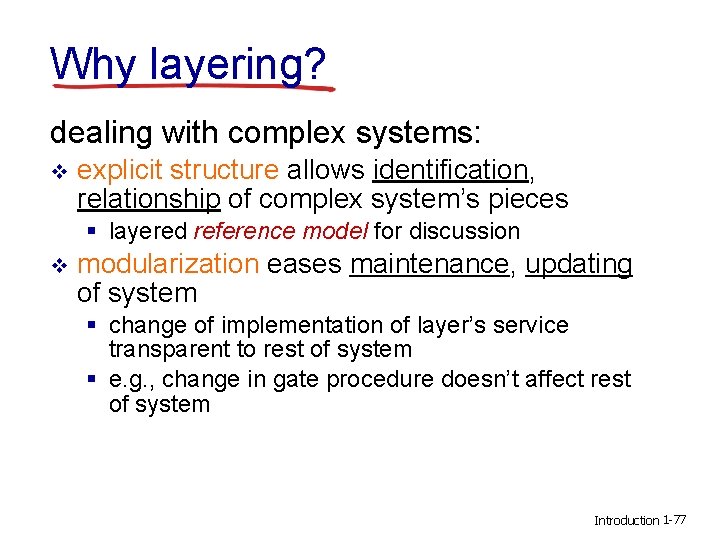
Why layering? dealing with complex systems: v explicit structure allows identification, relationship of complex system’s pieces § layered reference model for discussion v modularization eases maintenance, updating of system § change of implementation of layer’s service transparent to rest of system § e. g. , change in gate procedure doesn’t affect rest of system Introduction 1 -77
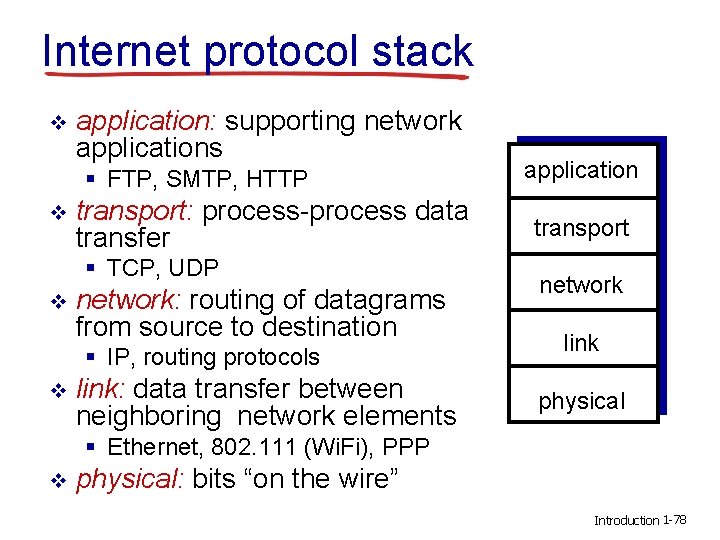
Internet protocol stack v application: supporting network applications § FTP, SMTP, HTTP v transport: process-process data transfer § TCP, UDP v network: routing of datagrams from source to destination § IP, routing protocols v link: data transfer between neighboring network elements application transport network link physical § Ethernet, 802. 111 (Wi. Fi), PPP v physical: bits “on the wire” Introduction 1 -78
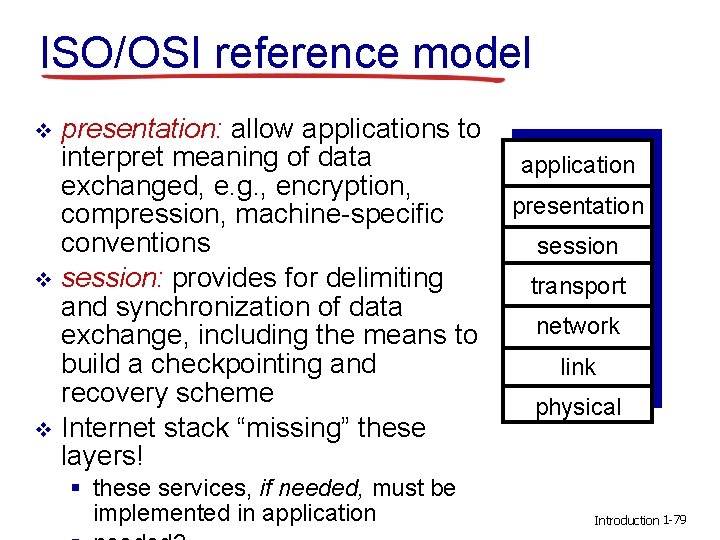
ISO/OSI reference model presentation: allow applications to interpret meaning of data exchanged, e. g. , encryption, compression, machine-specific conventions v session: provides for delimiting and synchronization of data exchange, including the means to build a checkpointing and recovery scheme v Internet stack “missing” these layers! v § these services, if needed, must be implemented in application presentation session transport network link physical Introduction 1 -79
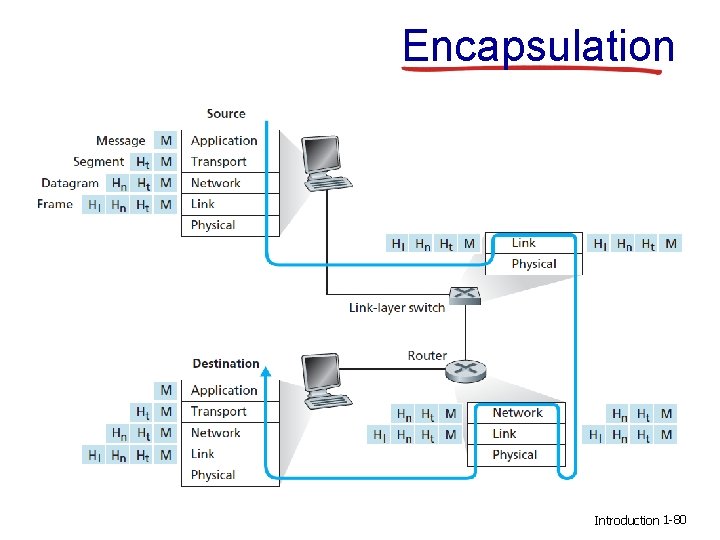
Encapsulation Introduction 1 -80
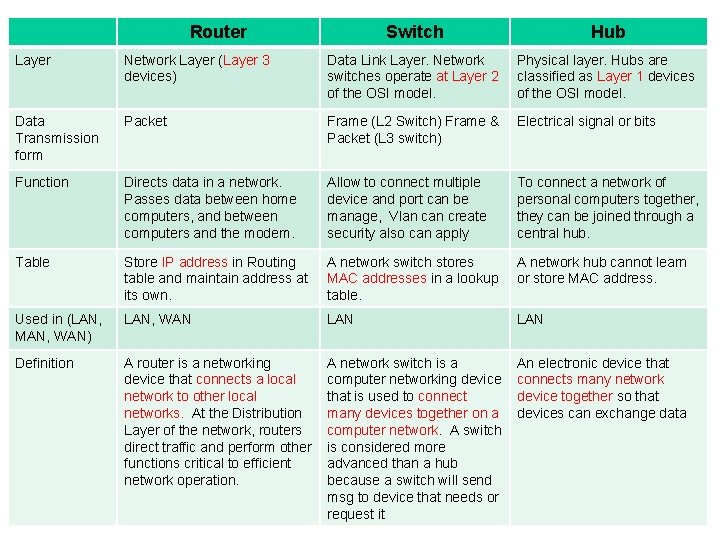
Router Switch Hub Layer Network Layer (Layer 3 devices) Data Link Layer. Network switches operate at Layer 2 of the OSI model. Physical layer. Hubs are classified as Layer 1 devices of the OSI model. Data Transmission form Packet Frame (L 2 Switch) Frame & Packet (L 3 switch) Electrical signal or bits Function Directs data in a network. Passes data between home computers, and between computers and the modem. Allow to connect multiple device and port can be manage, Vlan create security also can apply To connect a network of personal computers together, they can be joined through a central hub. Table Store IP address in Routing table and maintain address at its own. A network switch stores MAC addresses in a lookup table. A network hub cannot learn or store MAC address. Used in (LAN, MAN, WAN) LAN, WAN LAN Definition A router is a networking device that connects a local network to other local networks. At the Distribution Layer of the network, routers direct traffic and perform other functions critical to efficient network operation. A network switch is a computer networking device that is used to connect many devices together on a computer network. A switch is considered more advanced than a hub because a switch will send msg to device that needs or request it An electronic device that connects many network device together so that devices can exchange data Introduction 1 -81
Chapter 1: roadmap 1. 1 what is the Internet? 1. 2 network edge § end systems, access networks, links 1. 3 network core § packet switching, circuit switching, network structure 1. 4 delay, loss, throughput in networks 1. 5 protocol layers, service models 1. 6 networks under attack: security 1. 7 history Introduction 1 -82
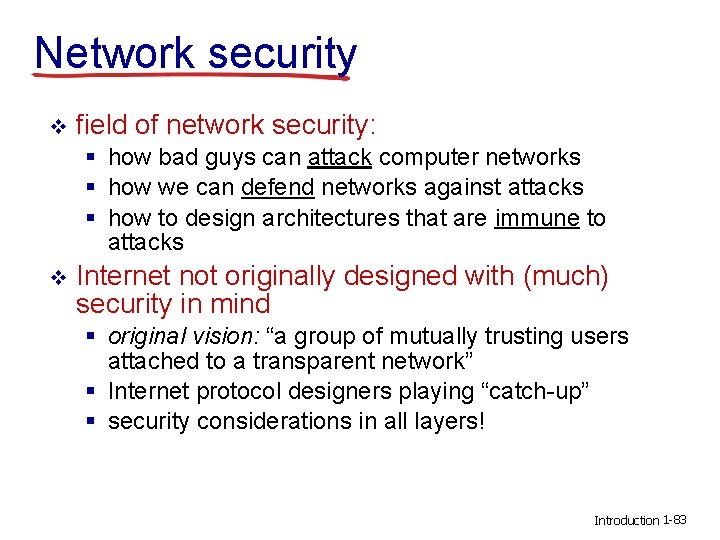
Network security v field of network security: § how bad guys can attack computer networks § how we can defend networks against attacks § how to design architectures that are immune to attacks v Internet not originally designed with (much) security in mind § original vision: “a group of mutually trusting users attached to a transparent network” § Internet protocol designers playing “catch-up” § security considerations in all layers! Introduction 1 -83
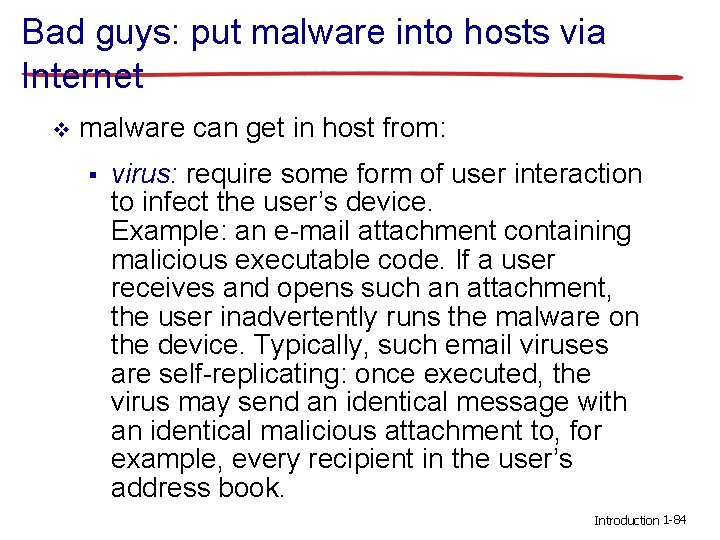
Bad guys: put malware into hosts via Internet v malware can get in host from: § virus: require some form of user interaction to infect the user’s device. Example: an e-mail attachment containing malicious executable code. If a user receives and opens such an attachment, the user inadvertently runs the malware on the device. Typically, such email viruses are self-replicating: once executed, the virus may send an identical message with an identical malicious attachment to, for example, every recipient in the user’s address book. Introduction 1 -84
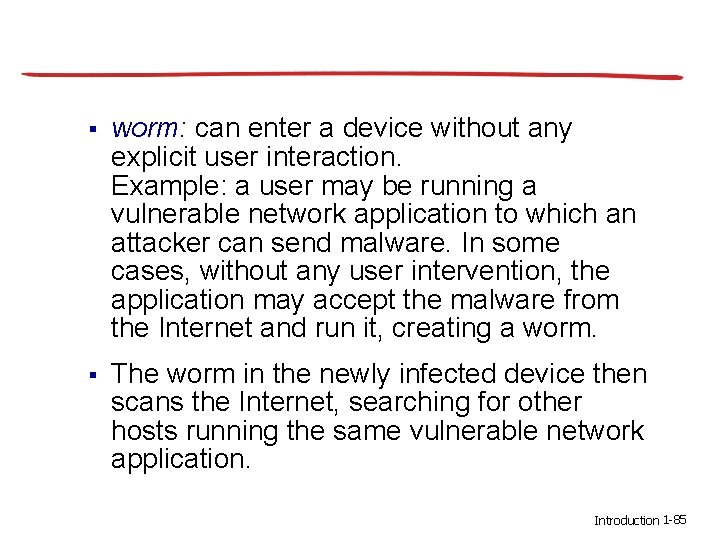
§ worm: can enter a device without any explicit user interaction. Example: a user may be running a vulnerable network application to which an attacker can send malware. In some cases, without any user intervention, the application may accept the malware from the Internet and run it, creating a worm. § The worm in the newly infected device then scans the Internet, searching for other hosts running the same vulnerable network application. Introduction 1 -85
v spyware malware can record keystrokes, web sites visited, upload info to collection site v infected host can be enrolled in botnet, used for spam. DDo. S attacks § botnet: a collection of Internet-connected programs communicating with other similar programs in order to perform tasks. It could be used to send spam email or participate in distributed denial-of-service attacks. The word botnet is a combination of the words robot and network. The term is usually used with a negative or malicious connotation. Introduction 1 -86
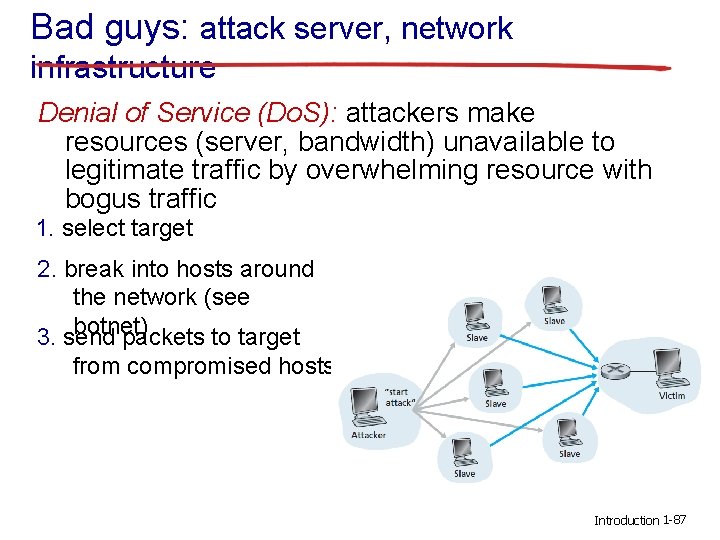
Bad guys: attack server, network infrastructure Denial of Service (Do. S): attackers make resources (server, bandwidth) unavailable to legitimate traffic by overwhelming resource with bogus traffic 1. select target 2. break into hosts around the network (see botnet) 3. send packets to target from compromised hosts Introduction 1 -87
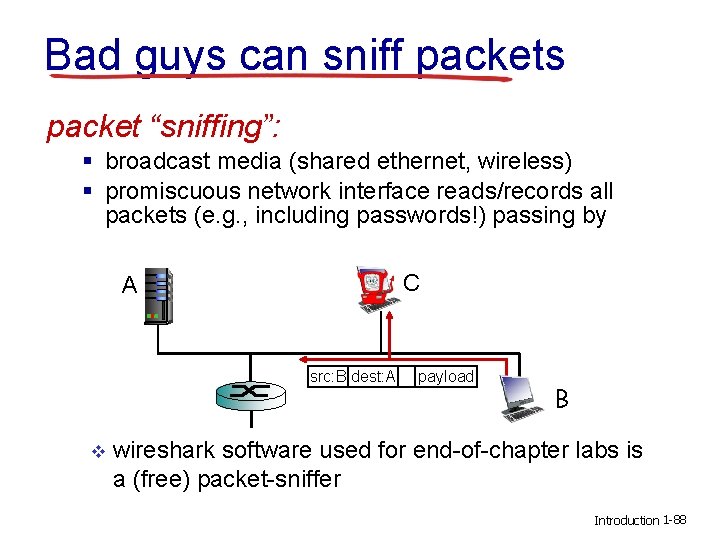
Bad guys can sniff packets packet “sniffing”: § broadcast media (shared ethernet, wireless) § promiscuous network interface reads/records all packets (e. g. , including passwords!) passing by C A src: B dest: A v payload B wireshark software used for end-of-chapter labs is a (free) packet-sniffer Introduction 1 -88
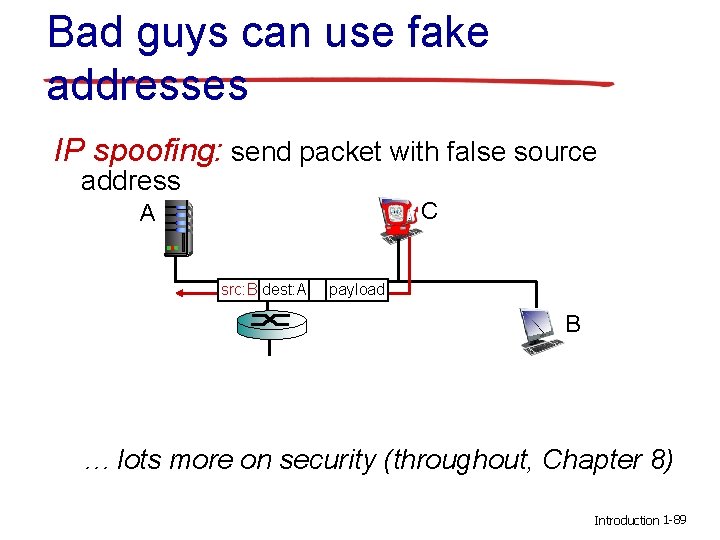
Bad guys can use fake addresses IP spoofing: send packet with false source address C A src: B dest: A payload B … lots more on security (throughout, Chapter 8) Introduction 1 -89
Chapter 1: roadmap 1. 1 what is the Internet? 1. 2 network edge § end systems, access networks, links 1. 3 network core § packet switching, circuit switching, network structure 1. 4 delay, loss, throughput in networks 1. 5 protocol layers, service models 1. 6 networks under attack: security 1. 7 history Introduction 1 -90
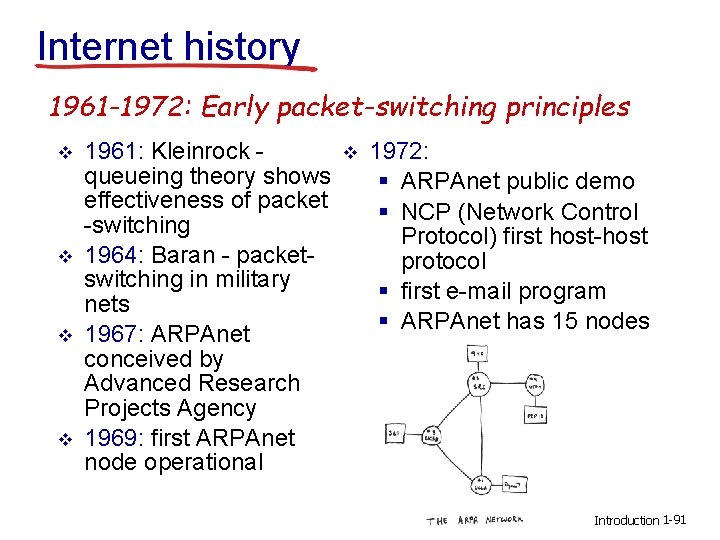
Internet history 1961 -1972: Early packet-switching principles v v 1961: Kleinrock queueing theory shows effectiveness of packet -switching 1964: Baran - packetswitching in military nets 1967: ARPAnet conceived by Advanced Research Projects Agency 1969: first ARPAnet node operational v 1972: § ARPAnet public demo § NCP (Network Control Protocol) first host-host protocol § first e-mail program § ARPAnet has 15 nodes Introduction 1 -91
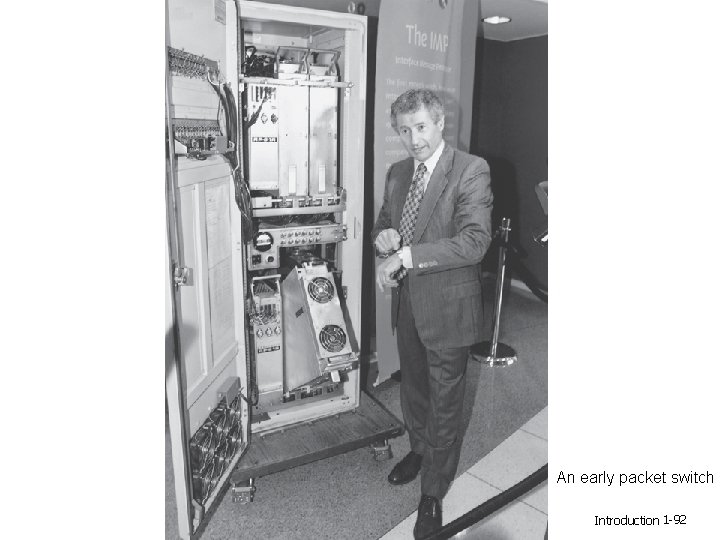
An early packet switch Introduction 1 -92
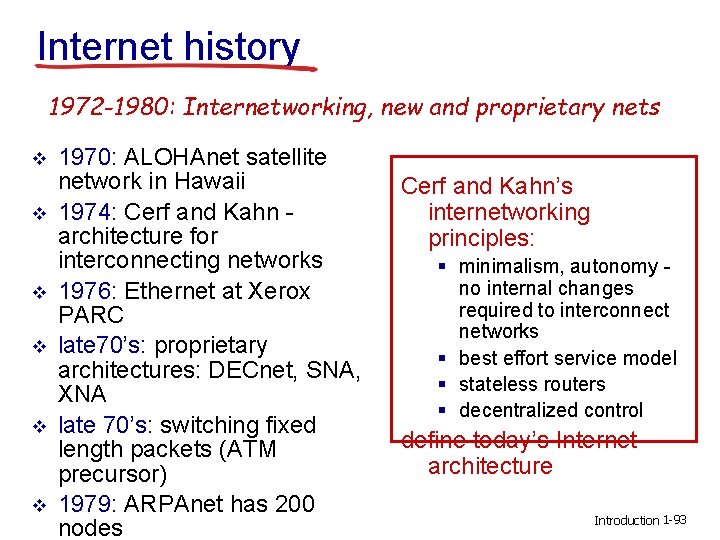
Internet history 1972 -1980: Internetworking, new and proprietary nets v v v 1970: ALOHAnet satellite network in Hawaii 1974: Cerf and Kahn architecture for interconnecting networks 1976: Ethernet at Xerox PARC late 70’s: proprietary architectures: DECnet, SNA, XNA late 70’s: switching fixed length packets (ATM precursor) 1979: ARPAnet has 200 nodes Cerf and Kahn’s internetworking principles: § minimalism, autonomy no internal changes required to interconnect networks § best effort service model § stateless routers § decentralized control define today’s Internet architecture Introduction 1 -93
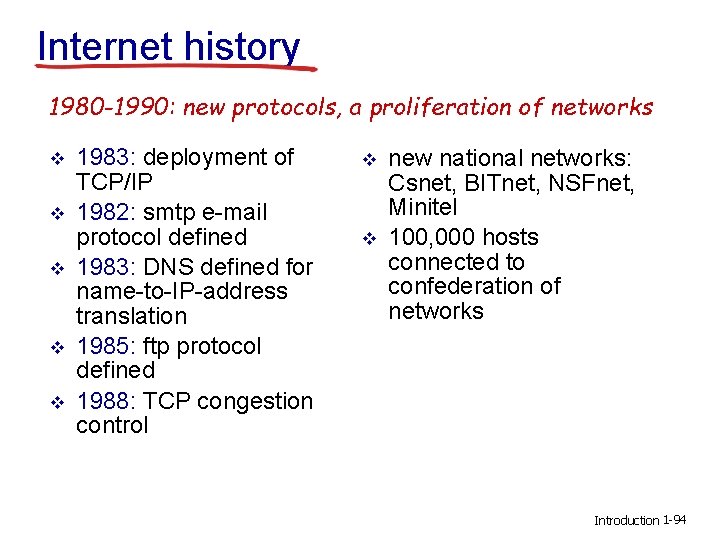
Internet history 1980 -1990: new protocols, a proliferation of networks v v v 1983: deployment of TCP/IP 1982: smtp e-mail protocol defined 1983: DNS defined for name-to-IP-address translation 1985: ftp protocol defined 1988: TCP congestion control v v new national networks: Csnet, BITnet, NSFnet, Minitel 100, 000 hosts connected to confederation of networks Introduction 1 -94
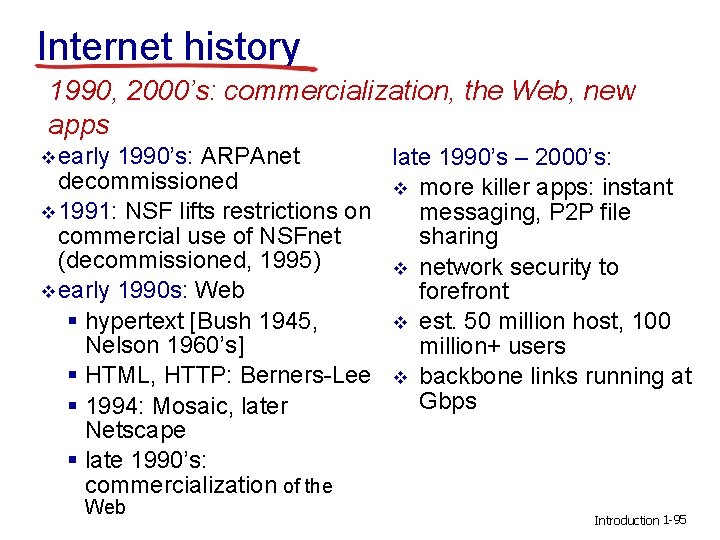
Internet history 1990, 2000’s: commercialization, the Web, new apps v early 1990’s: ARPAnet late 1990’s – 2000’s: decommissioned v more killer apps: instant v 1991: NSF lifts restrictions on messaging, P 2 P file commercial use of NSFnet sharing (decommissioned, 1995) v network security to v early 1990 s: Web forefront § hypertext [Bush 1945, v est. 50 million host, 100 Nelson 1960’s] million+ users § HTML, HTTP: Berners-Lee v backbone links running at Gbps § 1994: Mosaic, later Netscape § late 1990’s: commercialization of the Web Introduction 1 -95
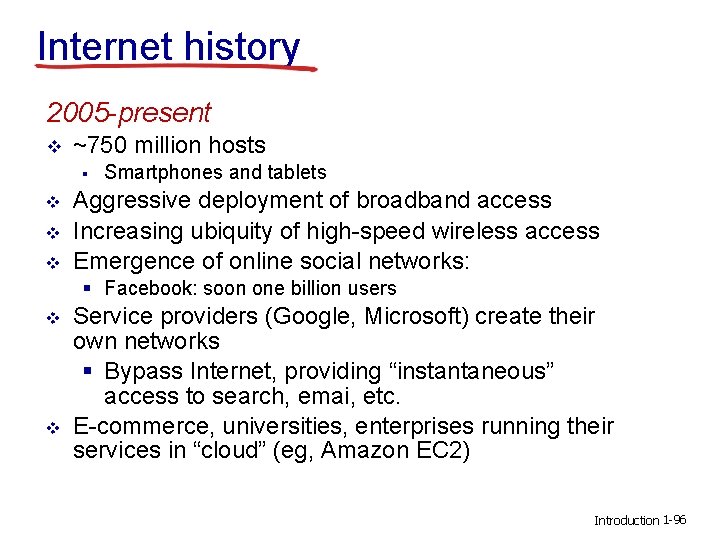
Internet history 2005 -present v ~750 million hosts § v v v Smartphones and tablets Aggressive deployment of broadband access Increasing ubiquity of high-speed wireless access Emergence of online social networks: § Facebook: soon one billion users v v Service providers (Google, Microsoft) create their own networks § Bypass Internet, providing “instantaneous” access to search, emai, etc. E-commerce, universities, enterprises running their services in “cloud” (eg, Amazon EC 2) Introduction 1 -96
Introduction: summary covered a “ton” of material! v v v v Internet overview what’s a protocol? network edge, core, access network § packet-switching versus circuit-switching § Internet structure performance: loss, delay, throughput layering, service models security history you now have: v v context, overview, “feel” of networking more depth, detail to follow! Introduction 1 -97