
Chapter 1 INTRODUCTION AND OVERVIEW OF CRIME AND

- Slides: 29
Chapter 1 INTRODUCTION AND OVERVIEW OF CRIME AND CRIMINOLOGY
What is Criminology? � Criminology: An interdisciplinary science that gathers and analyzes data on crime and criminal behavior. �Criminologists use the scientific method to answer questions such as: ○ Why do crime rates vary across time or by culture? ○ Why do some individuals commit more crime than others? ○ Why do crime rates vary by age, gender, and race/ethnicity? ○ Why are some harmful acts criminalized but not others? ○ What can be done to prevent crime? Walsh, Criminology 3 e. SAGE Publishing, 2018. 2
What is Crime? � Crime: An act in violation of a criminal law for which a punishment is prescribed, committed with intention and without defense or justification. �What constitutes as crime will vary across time and place. �Only the state has the power to define crime. �Legislative bodies are continually revising, adding to, and deleting from, their criminal statutes. Walsh, Criminology 3 e. SAGE Publishing, 2018. 3
Crime as a Moving Target � Laws vary within the same culture from time to time as well as across different cultures. � What constitutes “crime” is constantly changing, as it can be defined in and out of existence by the courts or by legislators. � While “crime” is a socially constructed concept, it carries meaning as a subcategory of social harm. Walsh, Criminology 3 e. SAGE Publishing, 2018. 4
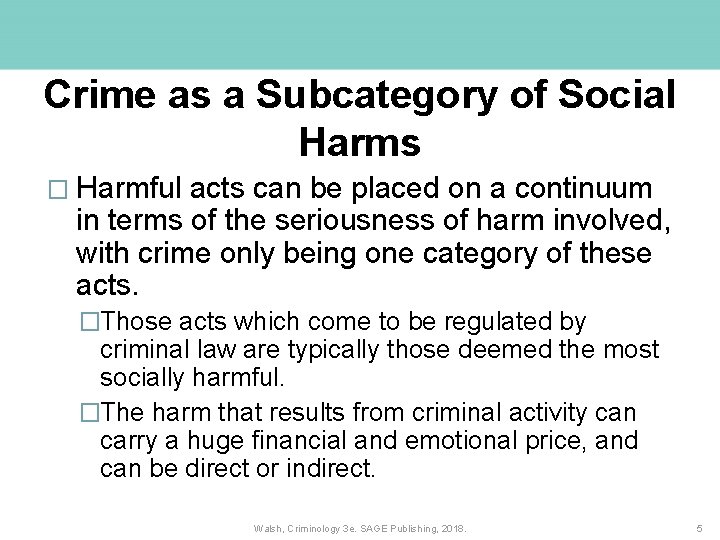
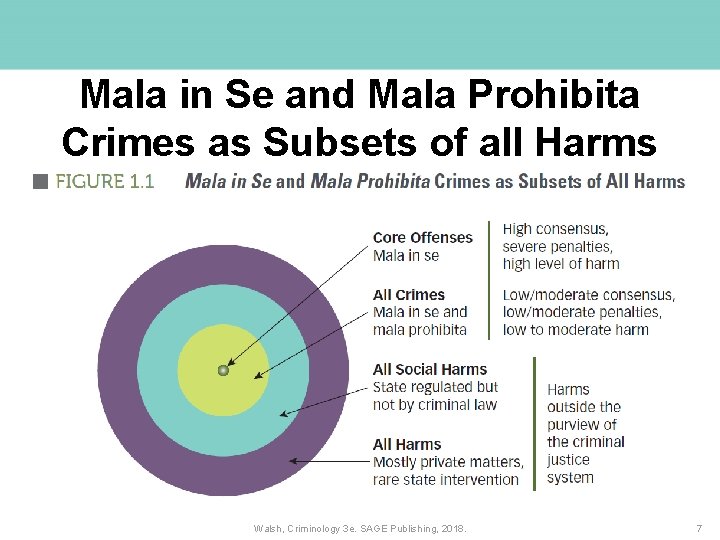
Crime as a Subcategory of Social Harms � Harmful acts can be placed on a continuum in terms of the seriousness of harm involved, with crime only being one category of these acts. �Those acts which come to be regulated by criminal law are typically those deemed the most socially harmful. �The harm that results from criminal activity can carry a huge financial and emotional price, and can be direct or indirect. Walsh, Criminology 3 e. SAGE Publishing, 2018. 5
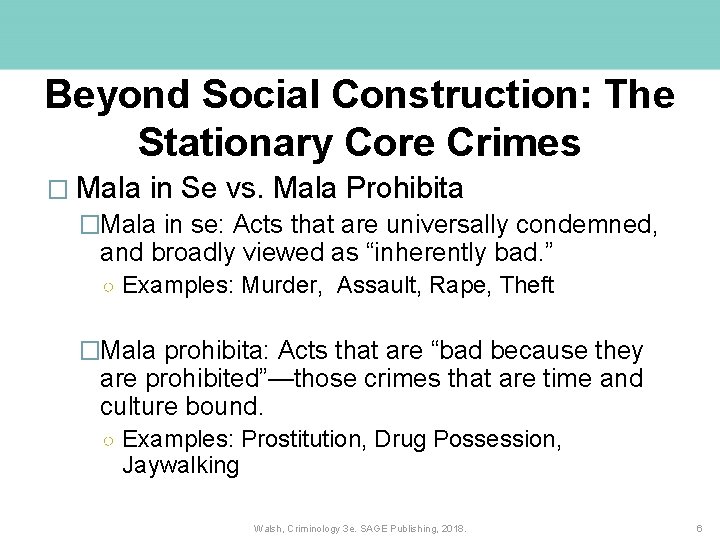
Beyond Social Construction: The Stationary Core Crimes � Mala in Se vs. Mala Prohibita �Mala in se: Acts that are universally condemned, and broadly viewed as “inherently bad. ” ○ Examples: Murder, Assault, Rape, Theft �Mala prohibita: Acts that are “bad because they are prohibited”—those crimes that are time and culture bound. ○ Examples: Prostitution, Drug Possession, Jaywalking Walsh, Criminology 3 e. SAGE Publishing, 2018. 6
Mala in Se and Mala Prohibita Crimes as Subsets of all Harms Walsh, Criminology 3 e. SAGE Publishing, 2018. 7
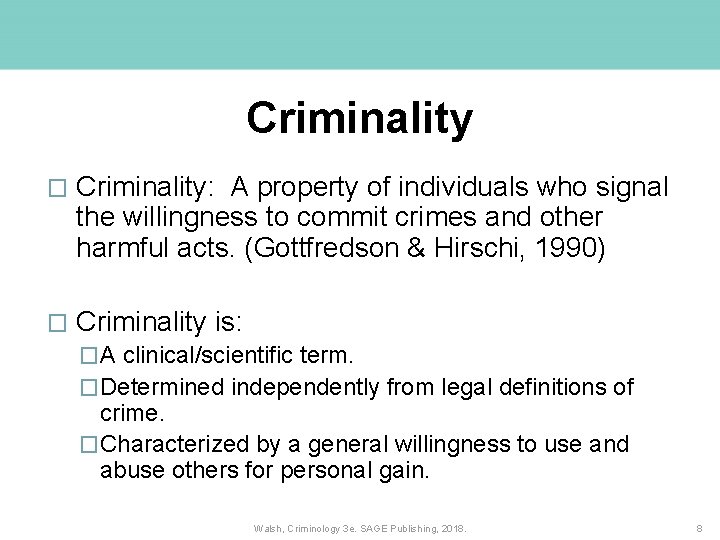
Criminality � Criminality: A property of individuals who signal the willingness to commit crimes and other harmful acts. (Gottfredson & Hirschi, 1990) � Criminality is: �A clinical/scientific term. �Determined independently from legal definitions of crime. �Characterized by a general willingness to use and abuse others for personal gain. Walsh, Criminology 3 e. SAGE Publishing, 2018. 8
The Legal Making of a Criminal �A criminal is defined by law. �The label may only be applied when a person has been arrested and convicted. Walsh, Criminology 3 e. SAGE Publishing, 2018. 9
What Constitutes a Crime � Corpus Delicti �Latin for “body of the crime”. �The elements that must be present for an act to be legally defined as a crime. �There are five principles but only actus rea and mens rea are required. Walsh, Criminology 3 e. SAGE Publishing, 2018. 10
Five Elements of Corpus Delicti � Actus rea: “guilty act” �A person must commit a forbidden act or neglect a mandatory act. � Mens rea: “guilty mind” �The wrongful purpose in mind when carrying out an act. �Lack of intent does not mean it cannot be illegal. Walsh, Criminology 3 e. SAGE Publishing, 2018. 11
Five Elements of Corpus Delicti � Concurrence �The act and the mental state must occur together. � Causation �There must be a causal link between the criminal act and the harm suffered. � Harm �Negative impact that a crime has to individual victims or the general public. Walsh, Criminology 3 e. SAGE Publishing, 2018. 12
An Excursion Through the American Criminal Justice System � Arrest �Occurs when a person has been legally detained to answer to criminal charges. �May be based on arrest warrant or probable cause. Walsh, Criminology 3 e. SAGE Publishing, 2018. 13
An Excursion Through the American Criminal Justice System � Preliminary Hearing �Occurs after arrest and booking. �It has two purposes: ○ to advise the suspect of his or her constitutional rights and the charges against the suspect. ○ to determine if bail should be set. Walsh, Criminology 3 e. SAGE Publishing, 2018. 14
An Excursion Through the American Criminal Justice System � Preliminary arraignment �A hearing before a magistrate or judge to decide: ○ whether or not a crime was actually committed. ○ Whether or not there are reasonable grounds to believe that the person before the bench committed it. ○ Whether or not the crime was committed in the jurisdiction of the court. Walsh, Criminology 3 e. SAGE Publishing, 2018. 15
An Excursion Through the American Criminal Justice System � Grand jury �It is composed of between 7 and 23 citizens. �It is required by some states. �It may issue an indictment, which formally charges the suspect with a specific crime/crimes. Walsh, Criminology 3 e. SAGE Publishing, 2018. 16
An Excursion Through the American Criminal Justice System � Trial �The adversarial aspect of the justice system means that both the prosecution and defense want to win the case. �The prosecutor must prove the case beyond a reasonable doubt. Walsh, Criminology 3 e. SAGE Publishing, 2018. 17
An Excursion Through the American Criminal Justice System � Probation �One of the most common outcomes of a guilty verdict. �It is a suspended commitment to jail or prison. Walsh, Criminology 3 e. SAGE Publishing, 2018. 18
An Excursion Through the American Criminal Justice System � Incarceration �Incarceration is a commitment to jail, prison, or county work release program. � Parole �Parole is a conditional release from prison prior to completion of one’s full sentence. Walsh, Criminology 3 e. SAGE Publishing, 2018. 19
A Short History of Criminology � The Supernatural Era �Religious and spiritual explanations of bad behavior predominated. � The Renaissance (approx. 1450 to 1600) �There was a move toward human-centered naturalism. �Some argued that criminality could be identified through personal appearance. ○ della Porta’s physiognomy Walsh, Criminology 3 e. SAGE Publishing, 2018. 20
A Short History of Criminology � The Enlightenment (approx. 1650 to 1800) �Members of the “classical school, ” such as Beccaria, emphasized human rationality and free will. � Industrial Revolution �The “positivist school” held that science could provide answers for everything. ○ Phrenology ○ Atavism/ “Born Criminal” (Lombroso) Walsh, Criminology 3 e. SAGE Publishing, 2018. 21
The Role of Theory in Criminology � Criminologists are interested in finding out factors that cause criminal behavior. � The first step is to identify correlates, which are factors that vary along with the phenomenon of interest. � Theorists must then establish whether correlates have a causative influence on crime. Walsh, Criminology 3 e. SAGE Publishing, 2018. 22
What is a Theory? Theory: A set of logically interconnected propositions explaining the relationships among phenomena. � Hypotheses: Statements about relationships between and among factors that we expect to find based on the logic of our theories. � Theories help us to make sense of a diversity of seemingly unrelated facts and propositions. � Theories are devised to look for causal relations, rather than simple associations. � �Probabilities, not absolutes Walsh, Criminology 3 e. SAGE Publishing, 2018. 23
What is a Good Theory? � Many competing theories in criminology �Term “truth” is never used, rather, what is more useful �Criteria for judging merits of a theory ○ Predictive accuracy - Theory has merit and is useful to the extent that it accurately predicts what is observed. - Most important criterion ○ Predictive scope - Refers to scope or range of theory and thus scope or range of the hypothesis that can derived from it Walsh, Criminology 3 e. SAGE Publishing, 2018. 24
What is a Good Theory? �Criteria for judging merits of a theory ○ Simplicity - If two competing theories are essentially equal in terms of the first two criteria, the less complicated theory is considered more “elegant” ○ Falsifiability - A theory is never proven true, but must have the quality of being falsifiable or disprovable Walsh, Criminology 3 e. SAGE Publishing, 2018. 25
How to Think About Theories � Different theories use different levels of analysis (the segment of the phenomenon of interest that is measured analyzed) to explain changes in the crime rate. � Levels of analysis include whole societies, subcultures, neighborhoods, families, or individuals. � Questions of cause and effect must be answered at the same level of analysis at which they were posed. Causal explanations are also offered at different temporal levels � Theory testing looks for causal explanations rather than simple descriptions. � Walsh, Criminology 3 e. SAGE Publishing, 2018. 26
Ideology in Criminological Theory Ideology: A way of looking at the world; a general emotional picture of how things “should be. ” � A theory of criminal behavior is at least partly shaped by the ideological vision of the person who formulated it. � As you read about various criminological theories, consider the ideological underpinnings of theorists. � For example, Sowell (1987) identified two visions that have shaped thoughts on human behavior: � ○ Constrained Vision ○ Unconstrained Vision Walsh, Criminology 3 e. SAGE Publishing, 2018. 27
Connecting Theory and Social Policy � To identify conditions that affect crime implies that changing those conditions can reduce or prevent crime; thus, every theory has potential policy implications � Policy: A selected course of action designed to solve a problem. ▪ While theories give us a starting point, only policy choices that are ideologically palatable are likely to be implemented. � Every theory has policy implications deducible from its primary assumptions and propositions. Walsh, Criminology 3 e. SAGE Publishing, 2018. 28
Open-Access Student Resources � Quizzes � Flashcards � SAGE Journal Articles � Multimedia Resources � And more at: study. sagepub. com/Walsh 3 e Walsh, Criminology 3 e. SAGE Publishing, 2018. 29