
Chapter 1 Introduction 1 1 Entrepreneur and Entrepreneurship
- Slides: 34
Chapter 1. Introduction 1. 1 Entrepreneur and Entrepreneurship in the Agricultural sector • The word entrepreneur is derived from the French word, 'Entreprendre' in the beginning of the 16 th Century. Ø which means to 'undertake', i. e. , the person who undertakes the risk of new enterprise. • Who is an entrepreneur? An entrepreneur can be defined as Ø one who initiates and establishes an economic activity. Ø someone who is able to balance the economically desirable with the technologically/operationally feasible, Ø someone who takes a calculated risk to seize (take) an opportunity or meet an unsatisfied need in hopes of establishing a sustainable business. 1/17/2022 Prepared By: Kassahun K. 1
• An entrepreneur is an individual who creates, develops, and manages a business venture, assuming the accompanying financial, psychological and social risks for a potential profit, satisfaction and independence. • It can be relating to üpursuits in agriculture such as procurement and distribution of seeds; üfisheries such as processing and packaging of fishes; üinformation technology; ümanufacturing of building materials such as hollow blocks for example, it can be buying and selling of construction materials and so on. 1/17/2022 Prepared By: Kassahun K. 2
• An entrepreneur with a science and technology background can introduce new technologies, develop substitutes for imported components. • As an entrepreneur you establish your enterprise, work for yourself, set high targets or goals and achieve them. • Thus the expressions: agricultural entrepreneur, rural entrepreneur, etc. • The term rural entrepreneur is used especially to designate/indicate that its base is village or rural area. 1/17/2022 Prepared By: Kassahun K. 3
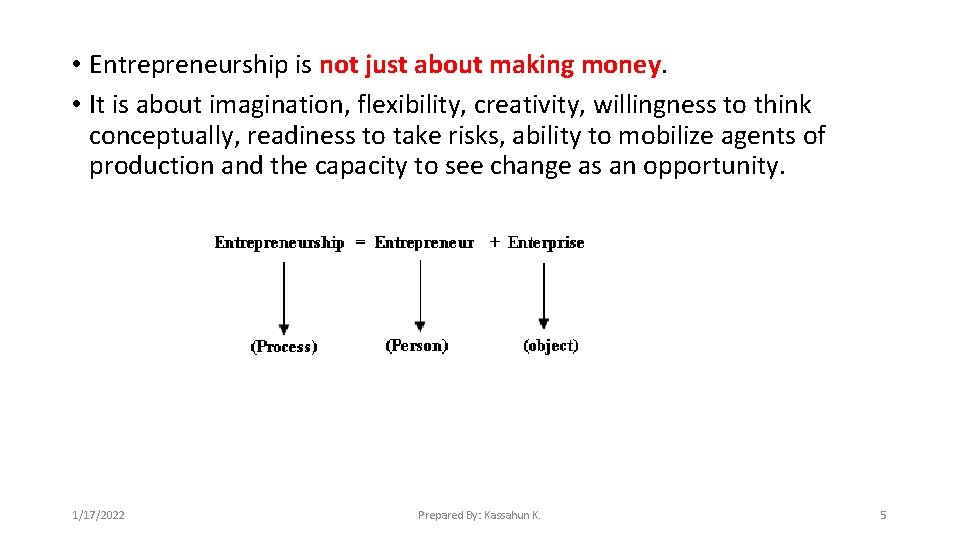
• Entrepreneurship: The concept of entrepreneurship is a complex phenomenon. • Broadly, it relates to entrepreneur, his vision and its implementation. • Entrepreneurship is the propensity (tendency, ability) of mind to take calculated risks with confidence to achieve a pre determined business objective. • In substance, it is the risk taking ability of the individual, broadly coupled with correct decision making. 1/17/2022 Prepared By: Kassahun K. 4
• Entrepreneurship is not just about making money. • It is about imagination, flexibility, creativity, willingness to think conceptually, readiness to take risks, ability to mobilize agents of production and the capacity to see change as an opportunity. 1/17/2022 Prepared By: Kassahun K. 5
1. 2 Agricultural Entrepreneurship: Definition , concepts and characteristics • Entrepreneurship is a process of producing goods and services using certain specific inputs, technologies and manufacturing procedures. • Agricultural entrepreneurship, in the traditional sense, is construed as the economic activity characterised with features like • ease of entry, • reliance on indigenous sources, • small scale operation, • adopted technology and • skills acquired outside the formal schooling system. 1/17/2022 Prepared By: Kassahun K. 6
• The concept of ‘Agricultural Entrepreneurship’ encompasses facilitating avenues of employment in farm and non-farm related activities on a widely dispersed basis nearer to the place of living of the poor. • In brief we must understand that Agricultural entrepreneurship in a narrow sense includes those activities that have direct bearing on agriculture o such as seed production, seeds distribution, provision of agricultural implements, production and sale of bio manure, etc. • But, in a broader sense, it can extend to include non-farm related rural and cottage industries that depend on local agricultural produces as the main raw materials. 1/17/2022 Prepared By: Kassahun K. 7
1. 3 Differences between general entrepreneurship and agricultural entrepreneurship 1/17/2022 Prepared By: Kassahun K. 8
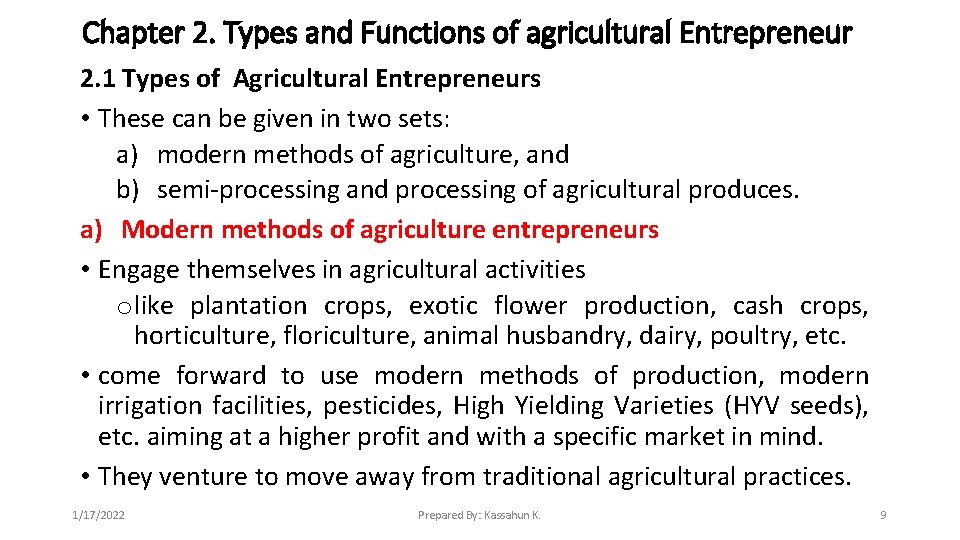
Chapter 2. Types and Functions of agricultural Entrepreneur 2. 1 Types of Agricultural Entrepreneurs • These can be given in two sets: a) modern methods of agriculture, and b) semi processing and processing of agricultural produces. a) Modern methods of agriculture entrepreneurs • Engage themselves in agricultural activities o like plantation crops, exotic flower production, cash crops, horticulture, floriculture, animal husbandry, dairy, poultry, etc. • come forward to use modern methods of production, modern irrigation facilities, pesticides, High Yielding Varieties (HYV seeds), etc. aiming at a higher profit and with a specific market in mind. • They venture to move away from traditional agricultural practices. 1/17/2022 Prepared By: Kassahun K. 9
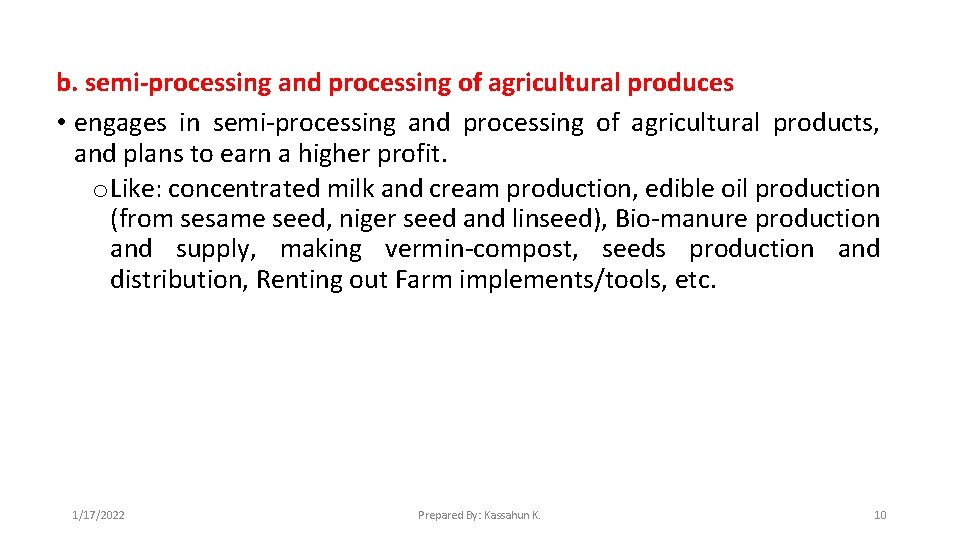
b. semi-processing and processing of agricultural produces • engages in semi processing and processing of agricultural products, and plans to earn a higher profit. o Like: concentrated milk and cream production, edible oil production (from sesame seed, niger seed and linseed), Bio manure production and supply, making vermin compost, seeds production and distribution, Renting out Farm implements/tools, etc. 1/17/2022 Prepared By: Kassahun K. 10
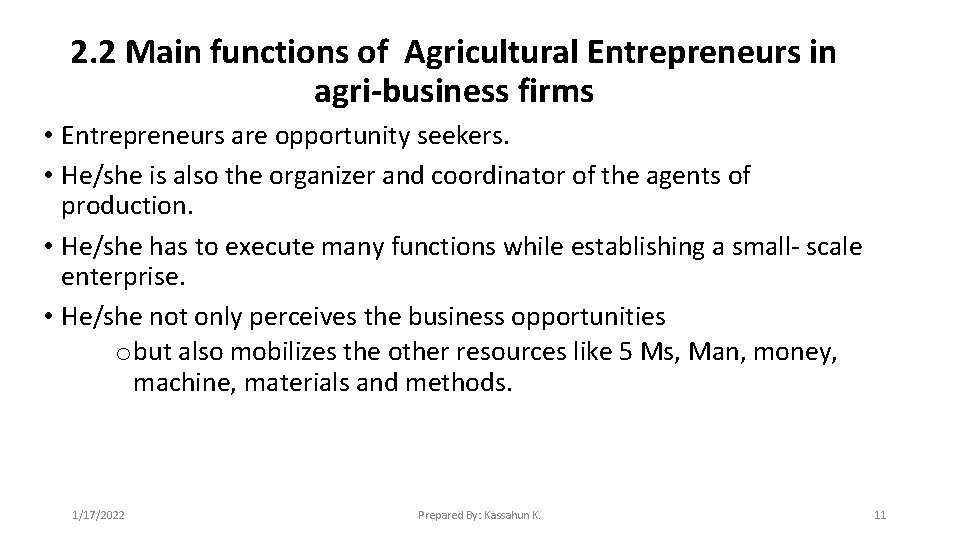
2. 2 Main functions of Agricultural Entrepreneurs in agri-business firms • Entrepreneurs are opportunity seekers. • He/she is also the organizer and coordinator of the agents of production. • He/she has to execute many functions while establishing a small scale enterprise. • He/she not only perceives the business opportunities o but also mobilizes the other resources like 5 Ms, Man, money, machine, materials and methods. 1/17/2022 Prepared By: Kassahun K. 11
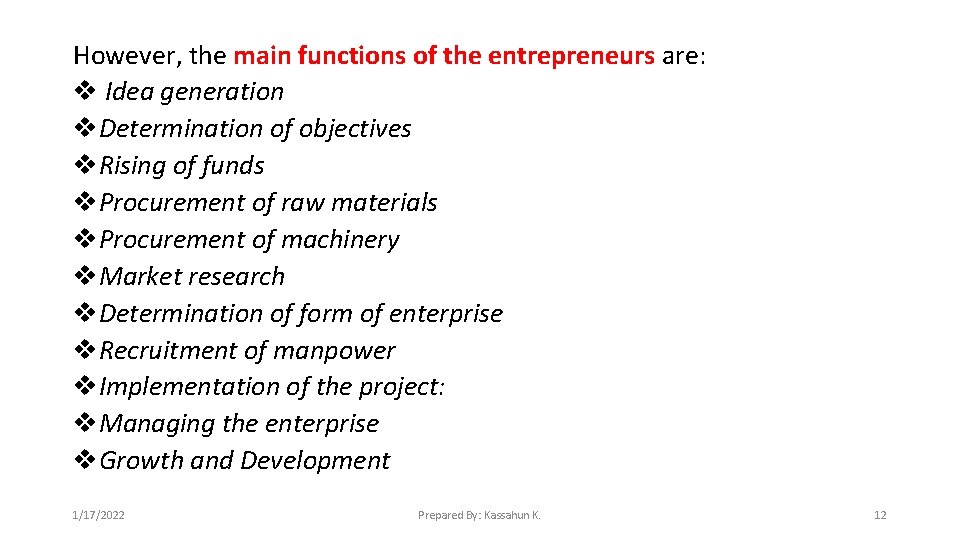
However, the main functions of the entrepreneurs are: v Idea generation v. Determination of objectives v. Rising of funds v. Procurement of raw materials v. Procurement of machinery v. Market research v. Determination of form of enterprise v. Recruitment of manpower v. Implementation of the project: v. Managing the enterprise v. Growth and Development 1/17/2022 Prepared By: Kassahun K. 12
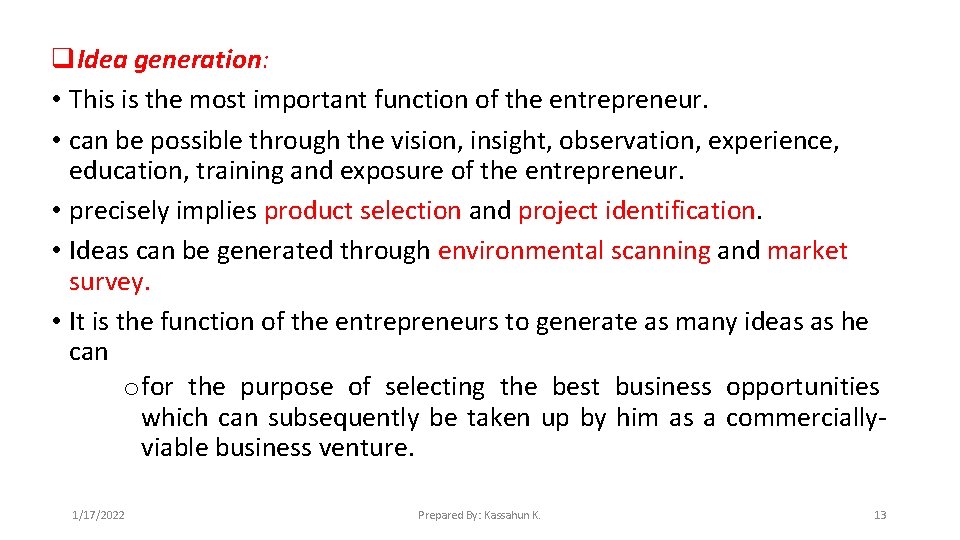
q. Idea generation: • This is the most important function of the entrepreneur. • can be possible through the vision, insight, observation, experience, education, training and exposure of the entrepreneur. • precisely implies product selection and project identification. • Ideas can be generated through environmental scanning and market survey. • It is the function of the entrepreneurs to generate as many ideas as he can o for the purpose of selecting the best business opportunities which can subsequently be taken up by him as a commercially viable business venture. 1/17/2022 Prepared By: Kassahun K. 13
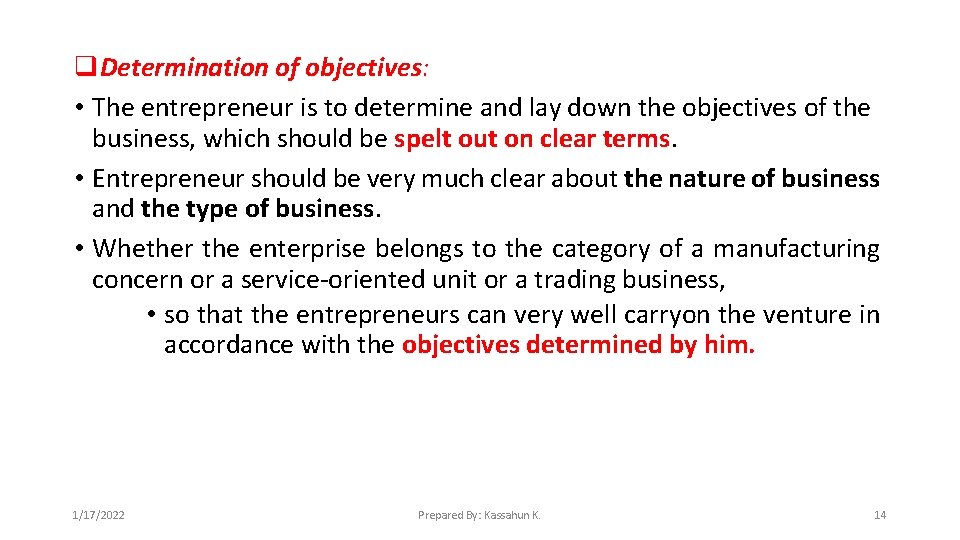
q. Determination of objectives: • The entrepreneur is to determine and lay down the objectives of the business, which should be spelt out on clear terms. • Entrepreneur should be very much clear about the nature of business and the type of business. • Whether the enterprise belongs to the category of a manufacturing concern or a service oriented unit or a trading business, • so that the entrepreneurs can very well carryon the venture in accordance with the objectives determined by him. 1/17/2022 Prepared By: Kassahun K. 14
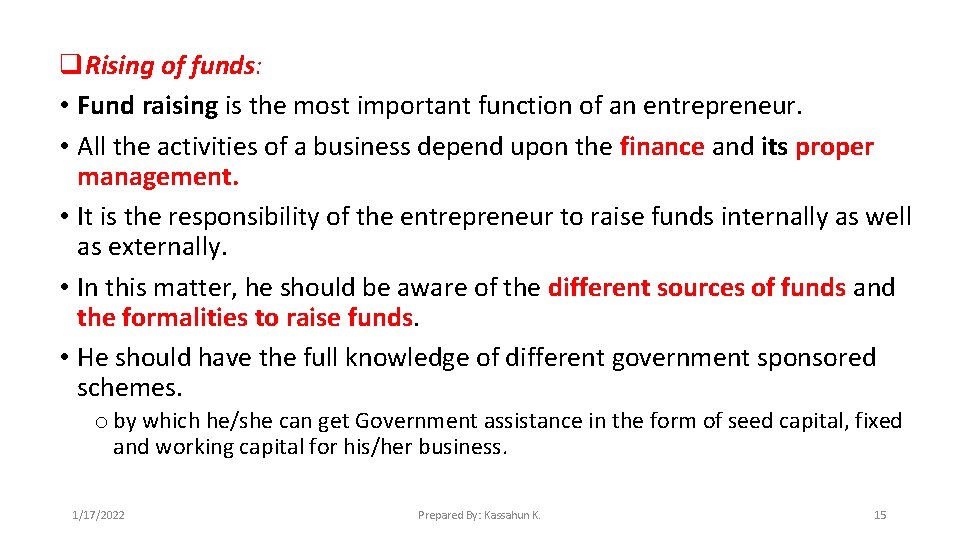
q. Rising of funds: • Fund raising is the most important function of an entrepreneur. • All the activities of a business depend upon the finance and its proper management. • It is the responsibility of the entrepreneur to raise funds internally as well as externally. • In this matter, he should be aware of the different sources of funds and the formalities to raise funds. • He should have the full knowledge of different government sponsored schemes. o by which he/she can get Government assistance in the form of seed capital, fixed and working capital for his/her business. 1/17/2022 Prepared By: Kassahun K. 15
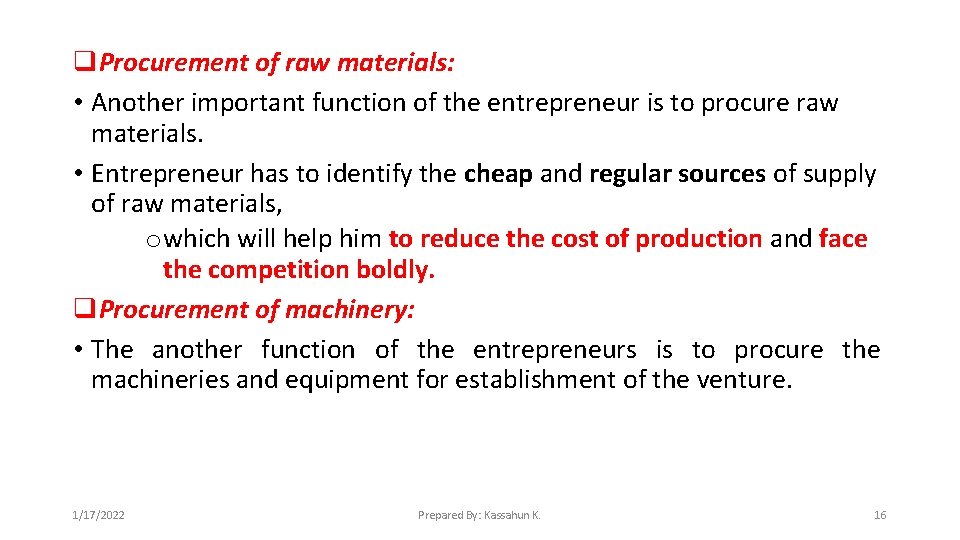
q. Procurement of raw materials: • Another important function of the entrepreneur is to procure raw materials. • Entrepreneur has to identify the cheap and regular sources of supply of raw materials, o which will help him to reduce the cost of production and face the competition boldly. q. Procurement of machinery: • The another function of the entrepreneurs is to procure the machineries and equipment for establishment of the venture. 1/17/2022 Prepared By: Kassahun K. 16
q. Market research • The important function of the entrepreneur is market research and product analysis. • is the systematic collection of data regarding the product which the entrepreneur wants to manufacture. • Entrepreneur has to undertake market research persistently in order to know the details of the intending product, • For example: üthe demand for the product, üthe supply of the product, üthe price of the product, üthe size of the customers, etc. while starting an enterprise. 1/17/2022 Prepared By: Kassahun K. 17
q. Determination of form of enterprise: • The function of an entrepreneur in determining the form of enterprise is also important. • Entrepreneur has to decide the form of enterprise based upon the vnature of the product, vvolume of investment, vnature of activities, vtypes of product, vquality of human resources, etc. • The chief forms of ownership organizations are sole proprietorship, partnership, joint stock company and cooperative society. • Determination of ownership right is essential on the part of the entrepreneur to acquire legal title to assets. 1/17/2022 Prepared By: Kassahun K. 18
q. Recruitment of manpower: • Entrepreneur has to perform the following activities while undertaking this function: üestimating manpower need of the organization, ülaying down of selection procedure, üdevising scheme of compensation, ülaying down the rules of training and development. 1/17/2022 Prepared By: Kassahun K. 19
q. Implementation of the project: • Entrepreneur has to work on the implementation schedule or the action plan of the project. • The identified project is to be implemented in a time bound manner. • All the activities from the conception stage to the commissioning stage are to be accomplished by him in accordance with the implementation schedule Øto avoid cost, Ø time overrun, Øas well as competition. • Thus, implementation of the project is an important function of the entrepreneur. 1/17/2022 Prepared By: Kassahun K. 20
q. Managing the enterprise: • One of the important functions of an entrepreneur is to run the enterprise. • He has to manage men, material, and finance; and organize production of goods and services. • He has to market each product and service, after ensuring appropriate returns (profits) of the investment. • Only a properly managed organization yields desired results. q. Growth and Development: • Once the enterprise achieves its desired results, § the entrepreneur has to explore another higher goal for its proper growth and development. • The entrepreneur is not satisfied only with achieving a set goal but constantly strives for achieving excellence. 1/17/2022 Prepared By: Kassahun K. 21
Quiz 1 (5%) 1. Write at least six function of agricultural entrepreneurs in agribusiness firms (3%) 2. What are the categories of agricultural entrepreneurs? Give example? (2%) 1/17/2022 Prepared By: Kassahun K. 22
2. 3 Roles of Agricultural Entrepreneur/Entrepreneurship in economic development • The industrial health of a society depends on the level of entrepreneurship existing in it. • A country might remain backward not because of lack of natural resources or dearth of capital übut because of lack of entrepreneurial talents or the inability to tap the latent entrepreneurial talents existing in that society. • Entrepreneurs historically have altered the direction of national economies, industry or markets like Japan, Singapore, Korea, Taiwan to name a few. 1/17/2022 Prepared By: Kassahun K. 23
• Entrepreneurship is basically concerned with creating wealth through production of goods and services. • This results in a process of upward change whereby the real per capita income of a country rises overtime or in other words economic development takes place. • Thus, entrepreneurial development is the key to economic development. • In fact it is one of the most critical inputs in the economic development of a region. • It speeds up the process of activating factors of production leading to a higher rate of economic growth, dispersal of economic activities and development of backward regions. 1/17/2022 Prepared By: Kassahun K. 24
• If a region is unable to throw up a sufficient number of entrepreneurs then alien entrepreneurs usually step in to provide goods and services needed by the people. • However the profits earned by these entrepreneurs are usually not ploughed back but repatriated to their place of origin. • As a result development in that region cannot take place. 1/17/2022 Prepared By: Kassahun K. 25
• Entrepreneurship begets and also injects entrepreneurship by starting a chain reaction when the entrepreneur continuously tries to improve the quality of existing goods and services and add new ones. • E. g. when computers came into the market there was continuous improvement in the models, their functions etc. like first generation computers, personal computers, laptops, palmtops etc. • Not only had this fostered the development of the software industry, computer education institutes, computer maintenance and stationery units etc. • but also other industries like banking, railways, education, travel, films, medical and legal transcriptions, business process outsourcing [BPOs] etc. • In this manner by harnessing the entrepreneurial talent a society comes out of traditional lethargy to modern industrial culture. • Ethiopia needs entrepreneurs to capitalize on new opportunities and to create wealth and new jobs. 1/17/2022 Prepared By: Kassahun K. 26
• Therefore, growth of entrepreneurship and development of entrepreneurial culture in underdeveloped and developing countries are imperatively needed not only for employment generation but also for infusing entrepreneurial culture in the society which is not so far exposed to it. • Entrepreneurship may also help in skill formation and technological up gradation in developing countries. • Efforts made by a group of entrepreneurs in motivating the youths to change their attitude for self employment, thus, may lead to further creation of wealth through enterprise creation. 1/17/2022 Prepared By: Kassahun K. 27
The important roles that an entrepreneur plays are: üEntrepreneur as an Innovator in Economic Growth (Role of innovation) üEntrepreneur in Generation of Employment Opportunities üCapital Formation through the mobilization of idle savings üImprovement in per capital income üBalanced regional development üImprovement in living standards üEconomic independence (National self reliance) üBackward and forward linkage 1/17/2022 Prepared By: Kassahun K. 28
Chapter 3. Theories and Models of Entrepreneurship 3. 1 Introduction • An entrepreneur is someone who runs a business as a sole owner with the aim of making profit even though they encounter a lot of challenges. • Theories of entrepreneurship are very essential as they help to explain what entrepreneurship entails. • In this article, you will find valuable information about several theories of entrepreneurship. • It also defines theories of entrepreneurship. https: //www. tuko. co. ke/283663 theories entrepreneurship. html 1/17/2022 Prepared By: Kassahun K. 29
Different theories of entrepreneurship • Economic theories of entrepreneurship • Sociological theories of entrepreneurship • Entrepreneurship Innovation theory • Cultural Theories of Entrepreneurship • Psychological theory • Theory of high achievement/Theory of achievement motivation • Resource based theories • Opportunity based theory • Status withdrawal theory 1/17/2022 Prepared By: Kassahun K. 30
• 3. 2 Sociological Theories of Entrepreneurship • This is also among the contemporary theories of entrepreneurship. • It argues that the success of an entrepreneur is affected by their social culture. • They are more likely to achieve growth in particular social settings. • Among the social aspects that affect an entrepreneur include the social values, customs, taboos, religious beliefs and other cultural activities. • He or she has to conform to the social expectations when carrying out their business. 1/17/2022 Prepared By: Kassahun K. 31
3. 3 Economic Theories of Entrepreneurship • The economic theory is among the main economic theories of entrepreneurship. • This theory asserts that the economy and entrepreneurship are closely linked together. • Entrepreneurship and economic growth can only work when the economic conditions are favorable. • As such, it is usually hard for entrepreneurs to realize growth when the economy is doing poorly. • This theory further states that entrepreneurs find motivation in the presence of economic incentives which include industrial policy, policies of taxation, financial and resources, availability of infrastructure, investment opportunities, marketing opportunities, availability of information regarding the conditions of the market and technology among others. • An entrepreneur is therefore a risk taker because he can never fully predict about the favorability of the economic conditions in future. 1/17/2022 Prepared By: Kassahun K. 32
• 3. 4 Cultural Theories of Entrepreneurship • Cultural theories pointed out that entrepreneurship is the product of the culture. • Entrepreneurial talents come from cultural values and cultural systems embedded into the cultural environment. 1/17/2022 Prepared By: Kassahun K. 33
• 3. 5 Psychological Theories Entrepreneurship • According to this theory, an entrepreneur experiences growth when the society has several individuals with the necessary psychological characteristics. • These characteristics include having a vision, being able to face opposition and having the need to achieve highly. • A person can only possess these traits during their upbringing, when they excel, when they are self reliant and when there is low father dominance 1/17/2022 Prepared By: Kassahun K. 34