
Chapter 1 Introduction 1 1 Bit and data
Chapter 1 Introduction 1 -1
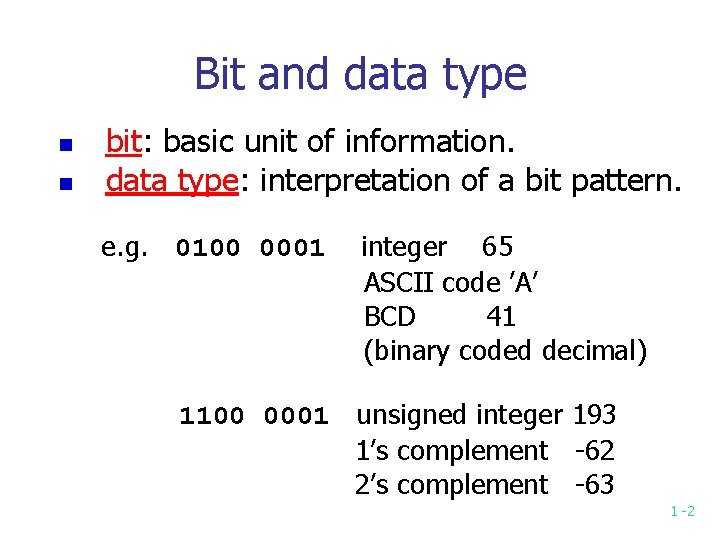
Bit and data type n n bit: basic unit of information. data type: interpretation of a bit pattern. e. g. 0100 0001 integer 65 ASCII code ’A’ BCD 41 (binary coded decimal) 1100 0001 unsigned integer 193 1’s complement -62 2’s complement -63 1 -2
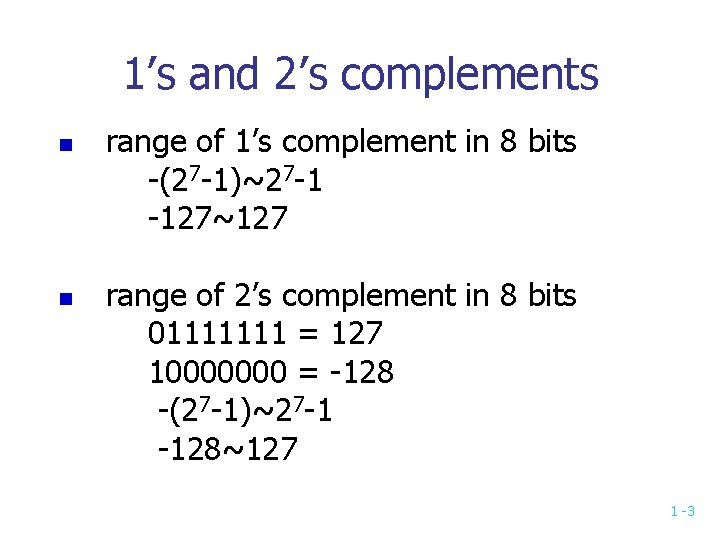
1’s and 2’s complements n n range of 1’s complement in 8 bits -(27 -1)~27 -1 -127~127 range of 2’s complement in 8 bits 01111111 = 127 10000000 = -128 -(27 -1)~27 -1 -128~127 1 -3
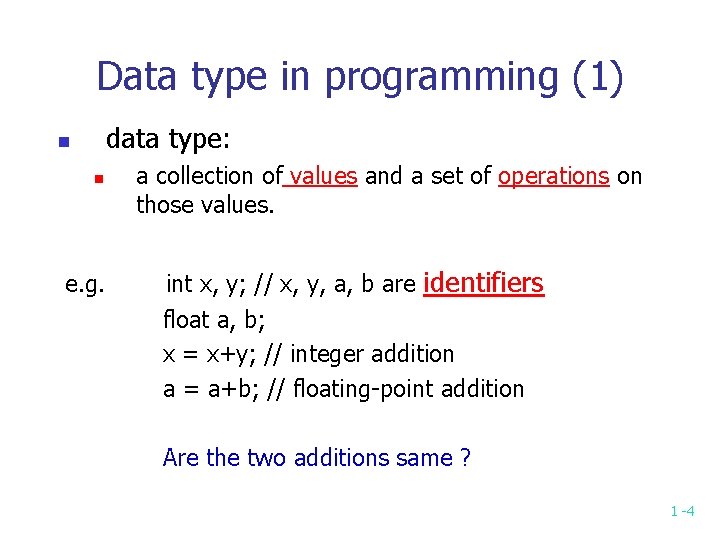
Data type in programming (1) data type: n n e. g. a collection of values and a set of operations on those values. int x, y; // x, y, a, b are identifiers float a, b; x = x+y; // integer addition a = a+b; // floating-point addition Are the two additions same ? 1 -4
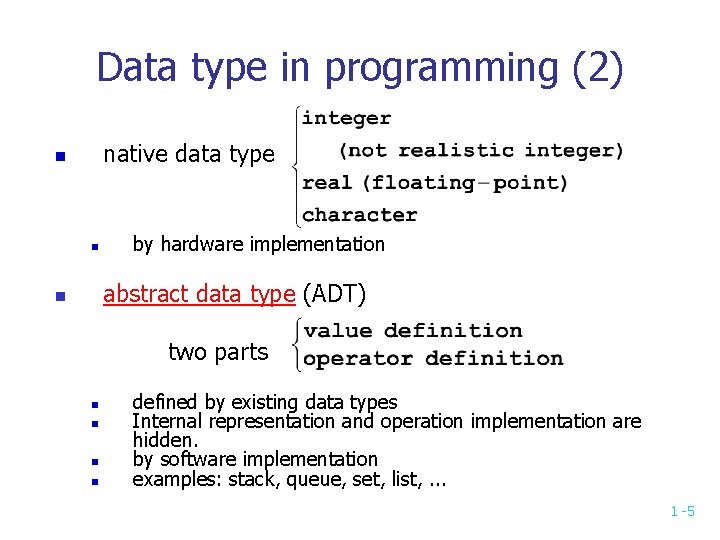
Data type in programming (2) native data type n n by hardware implementation abstract data type (ADT) n two parts n n defined by existing data types Internal representation and operation implementation are hidden. by software implementation examples: stack, queue, set, list, . . . 1 -5
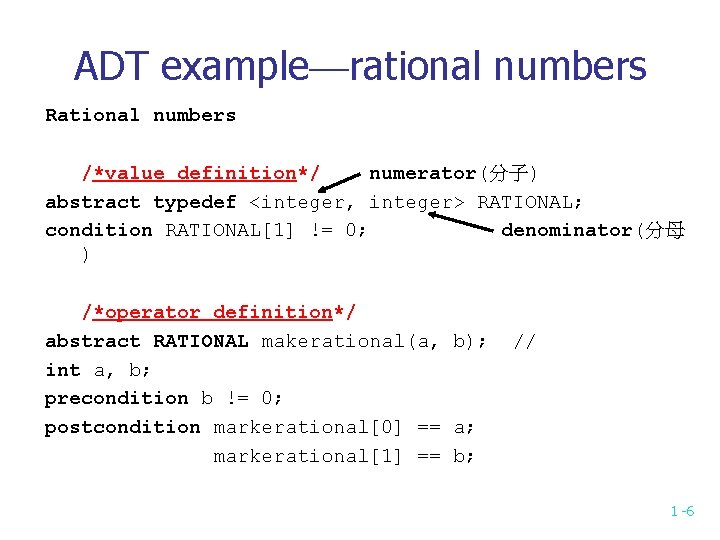
ADT example—rational numbers Rational numbers /*value definition*/ numerator(分子) abstract typedef <integer, integer> RATIONAL; condition RATIONAL[1] != 0; denominator(分母 ) /*operator definition*/ abstract RATIONAL makerational(a, b); int a, b; precondition b != 0; postcondition markerational[0] == a; markerational[1] == b; // 1 -6
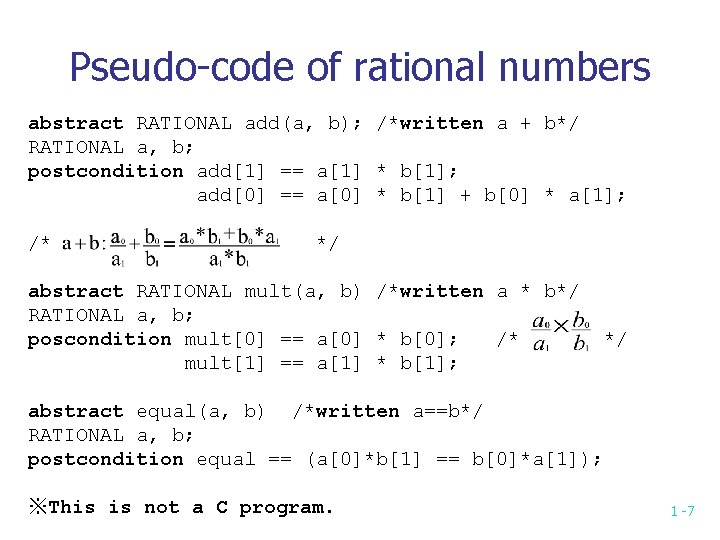
Pseudo-code of rational numbers abstract RATIONAL add(a, b); /*written a + b*/ RATIONAL a, b; postcondition add[1] == a[1] * b[1]; add[0] == a[0] * b[1] + b[0] * a[1]; /* */ abstract RATIONAL mult(a, b) /*written a * b*/ RATIONAL a, b; poscondition mult[0] == a[0] * b[0]; /* mult[1] == a[1] * b[1]; */ abstract equal(a, b) /*written a==b*/ RATIONAL a, b; postcondition equal == (a[0]*b[1] == b[0]*a[1]); ※This is not a C program. 1 -7
Sequence representation in ADT sequence: an order set of elements e. g. s = <s 0, s 1, …, Sn-1> abstract typedef <<int>> intseq; /* sequence of integers of any length */ abstract typedef <integer, char, float> seq 3; /* sequence of length 3 consisting of an integer, a character and a floating-point number */ abstract typedef <<int, 10>> intseq; /* sequence of 10 integers */ abstract typedef <<, 2>> pair; /* arbitrary sequence of length 2 */ 1 -8
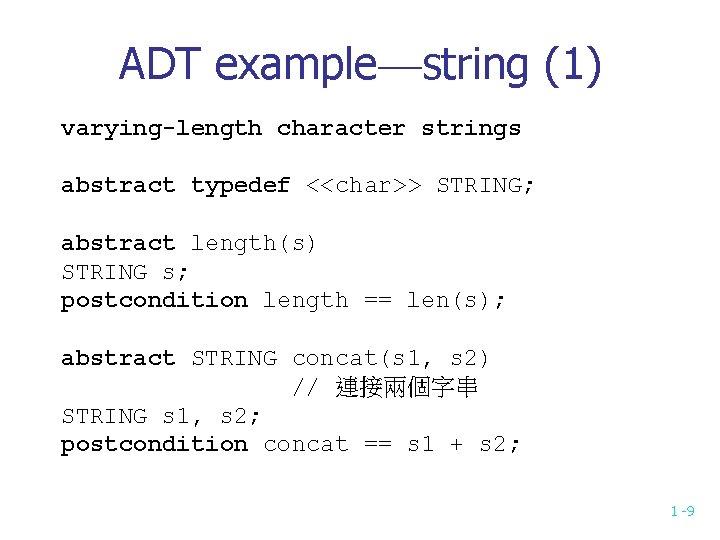
ADT example—string (1) varying-length character strings abstract typedef <<char>> STRING; abstract length(s) STRING s; postcondition length == len(s); abstract STRING concat(s 1, s 2) // 連接兩個字串 STRING s 1, s 2; postcondition concat == s 1 + s 2; 1 -9

ADT example—string (2) abstract STRING substr(s 1, i, j); //從位置i起, 長度為j, 找出子字串 STRING s 1; int i, j; precondition 0 <= i < len(s 1); 0 <= j <= len(s 1) –i; postcondition substr == sub(s 1, i, j); 1 -10
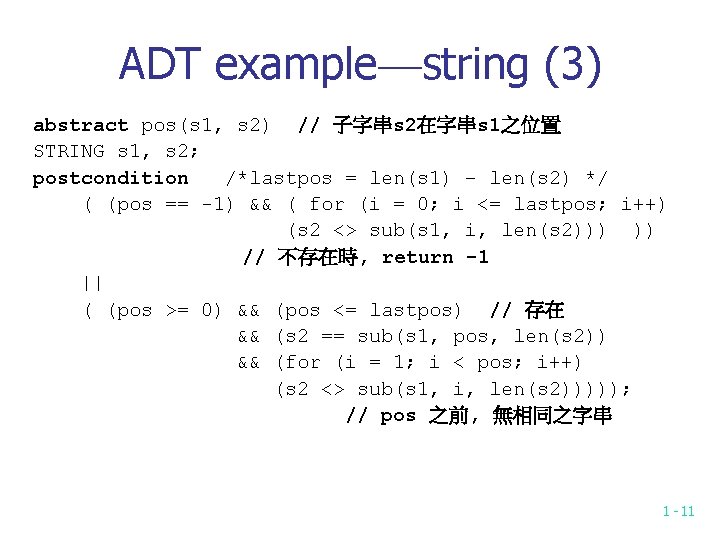
ADT example—string (3) abstract pos(s 1, s 2) // 子字串s 2在字串s 1之位置 STRING s 1, s 2; postcondition /*lastpos = len(s 1) – len(s 2) */ ( (pos == -1) && ( for (i = 0; i <= lastpos; i++) (s 2 <> sub(s 1, i, len(s 2))) )) // 不存在時, return -1 || ( (pos >= 0) && (pos <= lastpos) // 存在 && (s 2 == sub(s 1, pos, len(s 2)) && (for (i = 1; i < pos; i++) (s 2 <> sub(s 1, i, len(s 2))))); // pos 之前, 無相同之字串 1 -11
![The length of a string #define STRSi. ZE 80 char string[STRSi. ZE]; strlen(string) char](http://slidetodoc.com/presentation_image_h2/b13c3e41e9ab8084a0f3f931fab462b6/image-12.jpg "The length of a string #define STRSi. ZE 80 char string[STRSi. ZE]; strlen(string) char")
The length of a string #define STRSi. ZE 80 char string[STRSi. ZE]; strlen(string) char string[]; { int i; for (i = 0; string[i] != ’’; i++); /* 字串結尾是 ’’ */ return(i); }/* end strlen */ 1 -12
![String matching int strpos(char s 1[], char s 2[]) //找子字串s 2在字串s 1之位置 { int](http://slidetodoc.com/presentation_image_h2/b13c3e41e9ab8084a0f3f931fab462b6/image-13.jpg "String matching int strpos(char s 1[], char s 2[]) //找子字串s 2在字串s 1之位置 { int")
String matching int strpos(char s 1[], char s 2[]) //找子字串s 2在字串s 1之位置 { int len 1, len 2; int i, j 1, j 2; len 1 = strlen(s 1); len 2 = strlen(s 2); for (i = 0; i + len 2 <= len 1; i++) for (j 1 = i, j 2 = 0; j 2<= len 2 && s 1[j 1] == s 2[j 2]; j 1++, j 2++) if (j 2 == len 2) return(i); return(-1); /* 未找到 */ } /* end strpos */ 1 -13
![Concatenation of two strings void strcat(char s 1[], char s 2[]) /* s 1=](http://slidetodoc.com/presentation_image_h2/b13c3e41e9ab8084a0f3f931fab462b6/image-14.jpg "Concatenation of two strings void strcat(char s 1[], char s 2[]) /* s 1=")
Concatenation of two strings void strcat(char s 1[], char s 2[]) /* s 1= s 1+s 2 */ { int i, j; for (i=0; s 1[i] != ’’; i++) ; for (j = 0; s 2[j] != ’’; s 1[i++] = s 2[j++]) ; } /* end strcat */ 1 -14
![Getting a substring void substr(char s 1[], int i, int j, char s 2[])](http://slidetodoc.com/presentation_image_h2/b13c3e41e9ab8084a0f3f931fab462b6/image-15.jpg "Getting a substring void substr(char s 1[], int i, int j, char s 2[])")
Getting a substring void substr(char s 1[], int i, int j, char s 2[]) /* 在s 1中, 從 i 起, 長度j, 放入s 2 */ { int k, m; for (k=i, m = 0; m < j; s 2[m++] = s 1[k++]) ; s 2[m] = ’’; } /*end substr */ 1 -15
![Programming skills int a[100]; for (i = 0; i < 100; a[i++] = 0);](http://slidetodoc.com/presentation_image_h2/b13c3e41e9ab8084a0f3f931fab462b6/image-16.jpg "Programming skills int a[100]; for (i = 0; i < 100; a[i++] = 0);")
Programming skills int a[100]; for (i = 0; i < 100; a[i++] = 0); Better: Constants defined by identifiers #define NUMELTS 100 int a[NUMELTS]; for (i = 0; i < NUMELTS; a[i++] = 0); 1 -16
![Two-dimensional arrays e. g. int a[3][5]; // declaration Position of a[2][3] Logical view: Column](http://slidetodoc.com/presentation_image_h2/b13c3e41e9ab8084a0f3f931fab462b6/image-17.jpg "Two-dimensional arrays e. g. int a[3][5]; // declaration Position of a[2][3] Logical view: Column")
Two-dimensional arrays e. g. int a[3][5]; // declaration Position of a[2][3] Logical view: Column 0 Row 1 Row 2 Column 1 Column 2 Column 3 Column 4 a[0][0] a[0][1] a[0][2] a[0][3] a[0][4] a[1][0] a[1][1] a[1][2] a[1][3] a[1][4] a[2][0] a[2][1] a[2][2] a[2][3] a[2][4] 1 -17
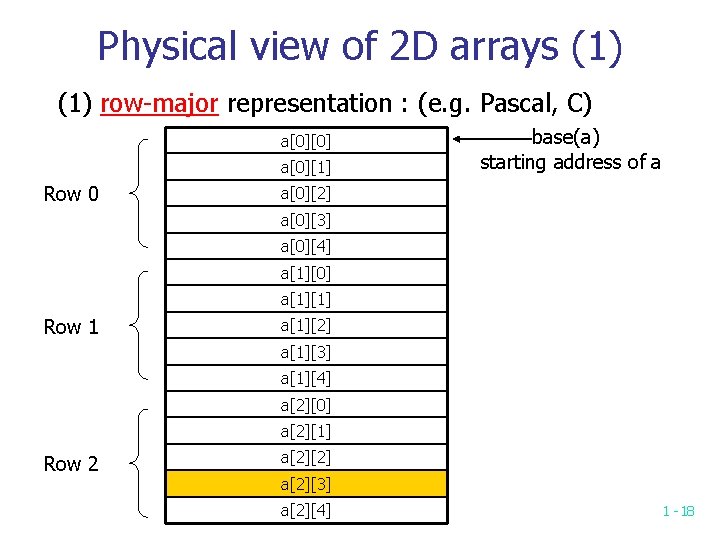
Physical view of 2 D arrays (1) row-major representation : (e. g. Pascal, C) a[0][0] a[0][1] Row 0 base(a) starting address of a a[0][2] a[0][3] a[0][4] a[1][0] a[1][1] Row 1 a[1][2] a[1][3] a[1][4] a[2][0] a[2][1] Row 2 a[2][2] a[2][3] a[2][4] 1 -18
![Physical view of 2 D arrays (2) column-major representation : (e. g. Fortran) a[0][0]](http://slidetodoc.com/presentation_image_h2/b13c3e41e9ab8084a0f3f931fab462b6/image-19.jpg "Physical view of 2 D arrays (2) column-major representation : (e. g. Fortran) a[0][0]")
Physical view of 2 D arrays (2) column-major representation : (e. g. Fortran) a[0][0] column 0 a[1][0] base(a) starting address of a a[2][0] a[0][1] column 1 a[1][1] a[2][1] a[0][2] column 2 a[1][2] a[2][2] a[0][3] column 3 a[1][3] a[2][3] column 4 a[0][4] a[1][4] a[2][4] 1 -19
![Address calculation of 2 D arrays int ar[r 1][r 2]; (1) row-major: address of](http://slidetodoc.com/presentation_image_h2/b13c3e41e9ab8084a0f3f931fab462b6/image-20.jpg "Address calculation of 2 D arrays int ar[r 1][r 2]; (1) row-major: address of")
Address calculation of 2 D arrays int ar[r 1][r 2]; (1) row-major: address of ar[i 1][i 2]: base(ar) + (i 1*r 2 + i 2)* element size /* base(ar) : address of ar[0][0] starting address of array ar */ e. g. a[2][3] : base(a) + (2*5+3)*4 1 -20
![Address calculation of 2 D array (2) column-major address of ar[i 1][i 2]; base(ar)](http://slidetodoc.com/presentation_image_h2/b13c3e41e9ab8084a0f3f931fab462b6/image-21.jpg "Address calculation of 2 D array (2) column-major address of ar[i 1][i 2]; base(ar)")
Address calculation of 2 D array (2) column-major address of ar[i 1][i 2]; base(ar) + (i 1 + i 2*r 1)* element size e. g. a[2][3] : base(a) + (2+3*3)*4 1 -21
![Structures in C struct atype{ int f 1; float f 2; char f 3[10];](http://slidetodoc.com/presentation_image_h2/b13c3e41e9ab8084a0f3f931fab462b6/image-22.jpg "Structures in C struct atype{ int f 1; float f 2; char f 3[10];")
Structures in C struct atype{ int f 1; float f 2; char f 3[10]; }; struct atype r; assumption: integer: 4 bytes floating point: 8 bytes 1 char: 1 byte starting address of r: 200 offset: the location of a field – starting address 1 -22
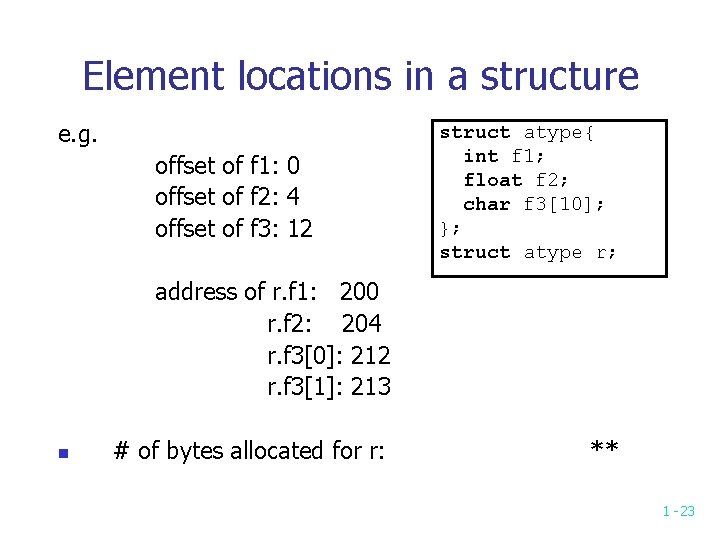
Element locations in a structure e. g. offset of f 1: 0 offset of f 2: 4 offset of f 3: 12 struct atype{ int f 1; float f 2; char f 3[10]; }; struct atype r; address of r. f 1: 200 r. f 2: 204 r. f 3[0]: 212 r. f 3[1]: 213 n # of bytes allocated for r: ** 1 -23
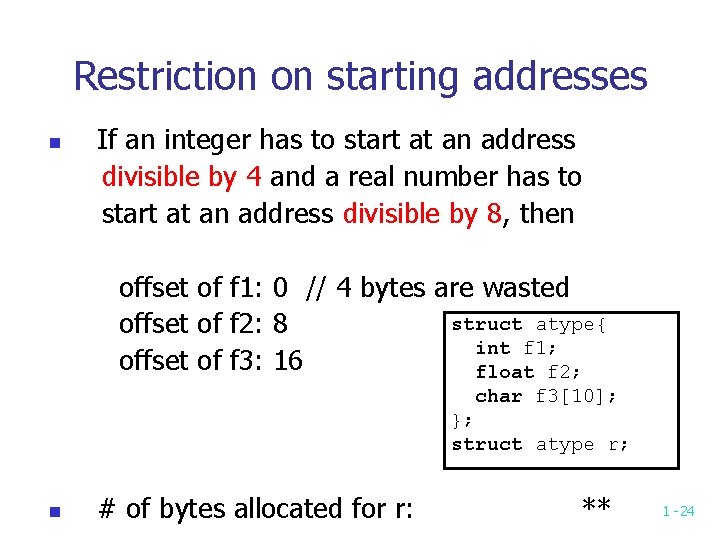
Restriction on starting addresses n If an integer has to start at an address divisible by 4 and a real number has to start at an address divisible by 8, then offset of f 1: 0 // 4 bytes are wasted struct atype{ offset of f 2: 8 int f 1; offset of f 3: 16 float f 2; char f 3[10]; }; struct atype r; n # of bytes allocated for r: ** 1 -24
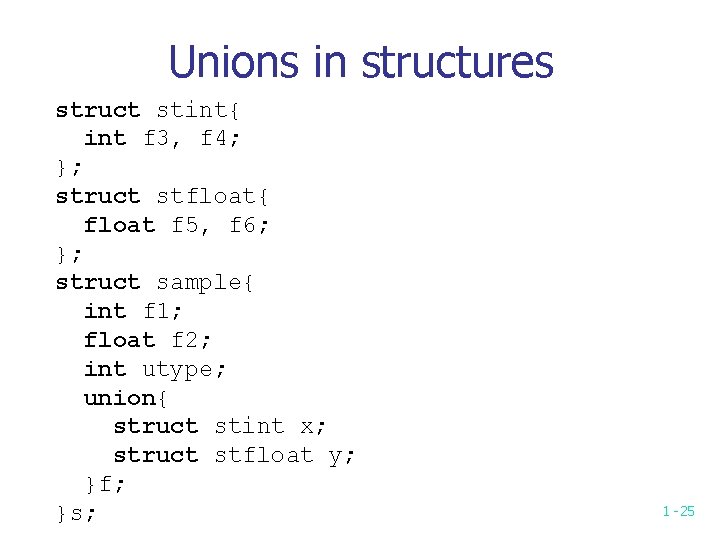
Unions in structures struct stint{ int f 3, f 4; }; struct stfloat{ float f 5, f 6; }; struct sample{ int f 1; float f 2; int utype; union{ struct stint x; struct stfloat y; }f; }s; 1 -25
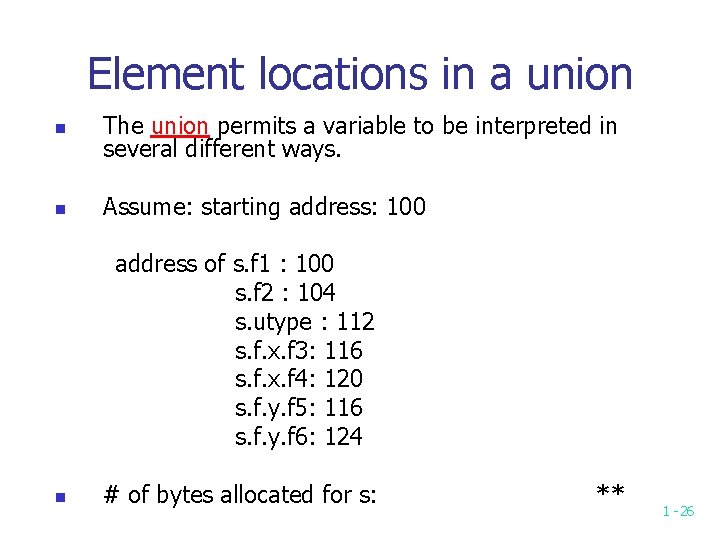
Element locations in a union n The union permits a variable to be interpreted in several different ways. n Assume: starting address: 100 address of s. f 1 : 100 s. f 2 : 104 s. utype : 112 s. f. x. f 3: 116 s. f. x. f 4: 120 s. f. y. f 5: 116 s. f. y. f 6: 124 n # of bytes allocated for s: ** 1 -26
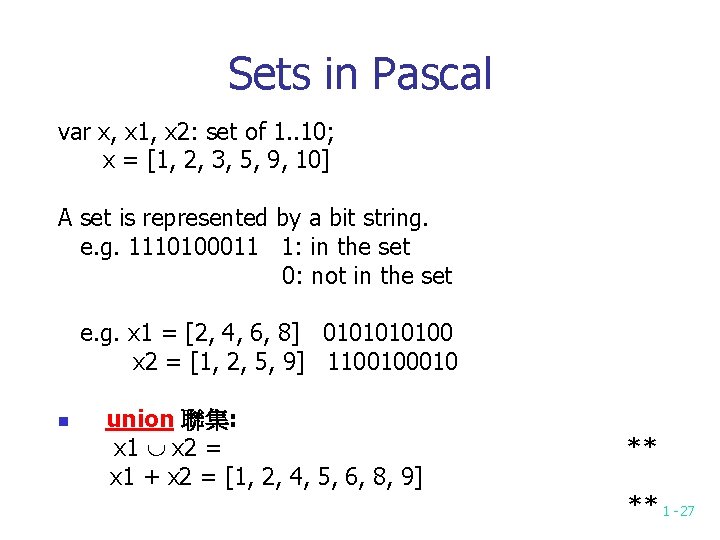
Sets in Pascal var x, x 1, x 2: set of 1. . 10; x = [1, 2, 3, 5, 9, 10] A set is represented by a bit string. e. g. 1110100011 1: in the set 0: not in the set e. g. x 1 = [2, 4, 6, 8] 010100 x 2 = [1, 2, 5, 9] 110010 n union 聯集: x 1 x 2 = x 1 + x 2 = [1, 2, 4, 5, 6, 8, 9] ** ** 1 -27
![Intersection 交集: x 1 x 2 = x 1 * x 2 = [2]](http://slidetodoc.com/presentation_image_h2/b13c3e41e9ab8084a0f3f931fab462b6/image-28.jpg "Intersection 交集: x 1 x 2 = x 1 * x 2 = [2]")
Intersection 交集: x 1 x 2 = x 1 * x 2 = [2] x 1 = [2, 4, 6, 8] 010100 x 2 = [1, 2, 5, 9] 110010 ** ** difference 差集: x 1 – x 2 = [4, 6, 8] ** ** contain 包含: x 1 x 2 a in x 1 n The size of a set is limited. ** 1 -28
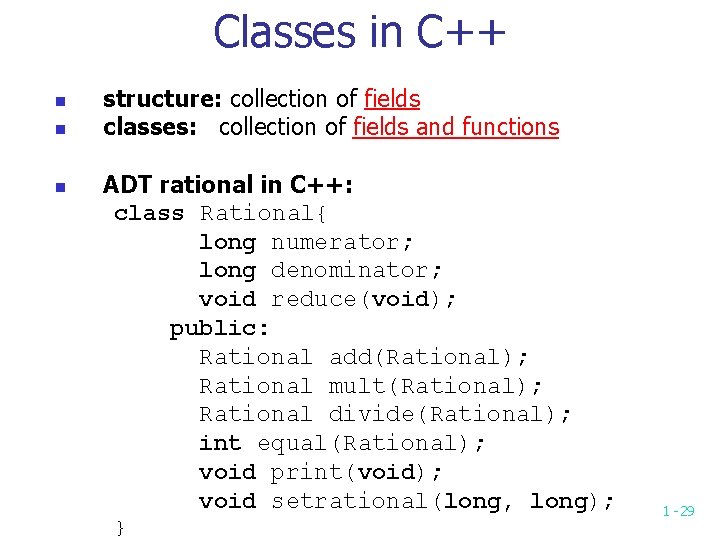
Classes in C++ n n n structure: collection of fields classes: collection of fields and functions ADT rational in C++: class Rational{ long numerator; long denominator; void reduce(void); public: Rational add(Rational); Rational mult(Rational); Rational divide(Rational); int equal(Rational); void print(void); void setrational(long, long); } 1 -29
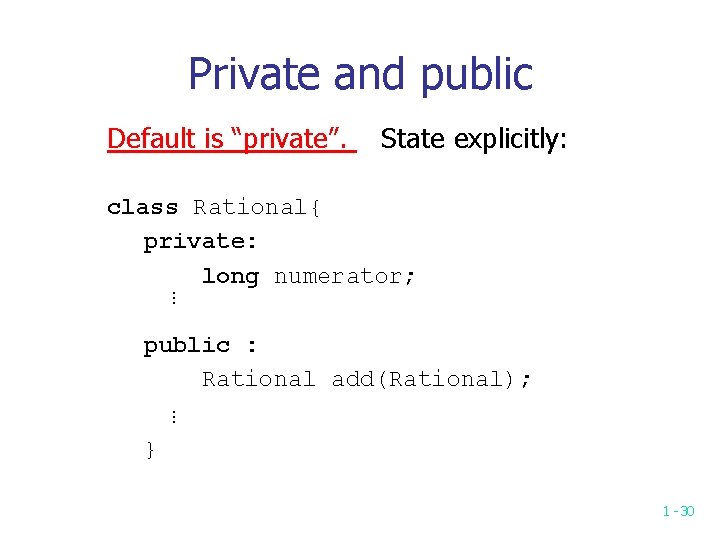
Private and public Default is “private”. State explicitly: class Rational{ private: long numerator; … public : Rational add(Rational); … } 1 -30
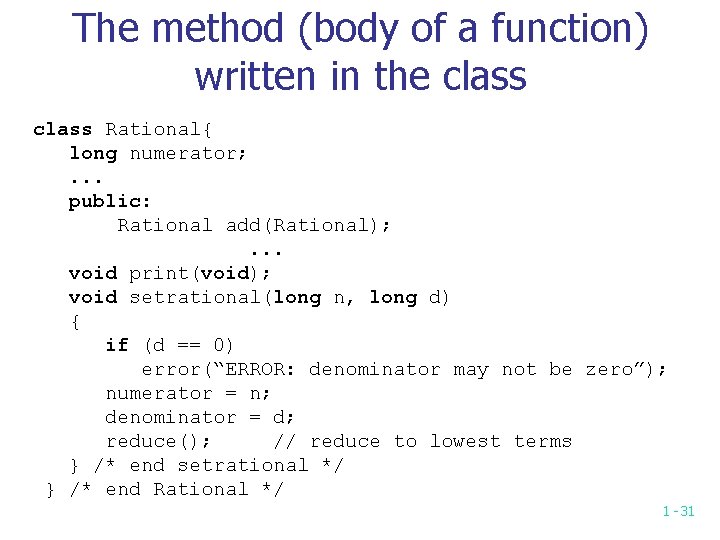
The method (body of a function) written in the class Rational{ long numerator; . . . public: Rational add(Rational); . . . void print(void); void setrational(long n, long d) { if (d == 0) error(“ERROR: denominator may not be zero”); numerator = n; denominator = d; reduce(); // reduce to lowest terms } /* end setrational */ } /* end Rational */ 1 -31
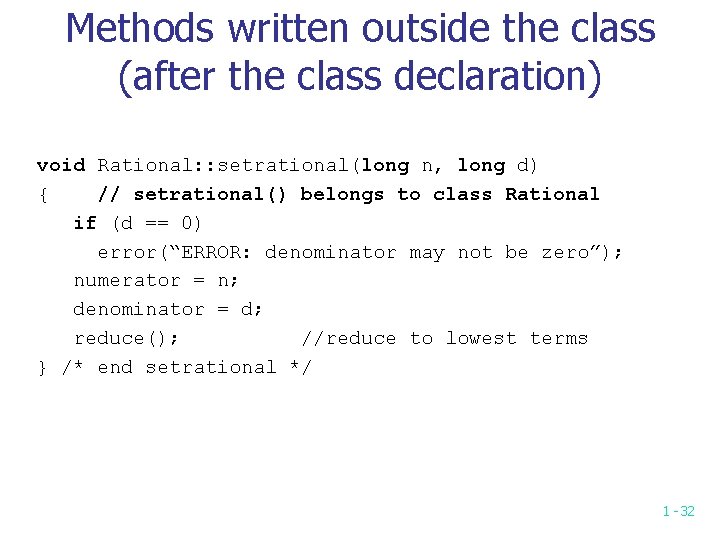
Methods written outside the class (after the class declaration) void Rational: : setrational(long n, long d) { // setrational() belongs to class Rational if (d == 0) error(“ERROR: denominator may not be zero”); numerator = n; denominator = d; reduce(); //reduce to lowest terms } /* end setrational */ 1 -32
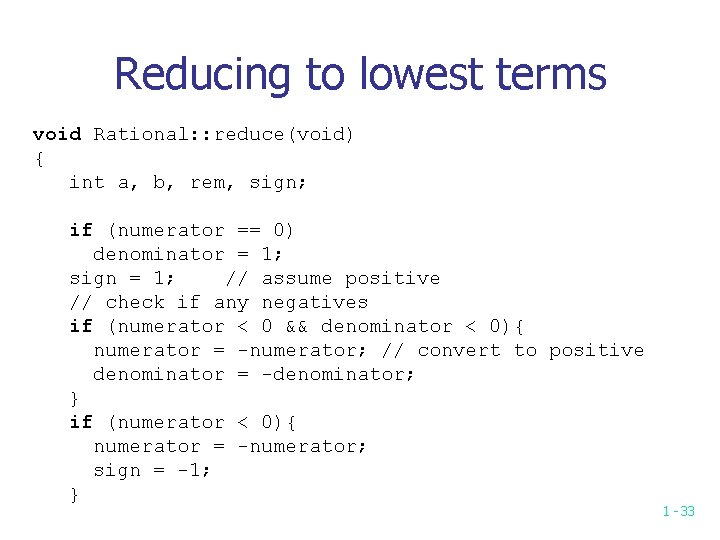
Reducing to lowest terms void Rational: : reduce(void) { int a, b, rem, sign; if (numerator == 0) denominator = 1; sign = 1; // assume positive // check if any negatives if (numerator < 0 && denominator < 0){ numerator = -numerator; // convert to positive denominator = -denominator; } if (numerator < 0){ numerator = -numerator; sign = -1; } 1 -33
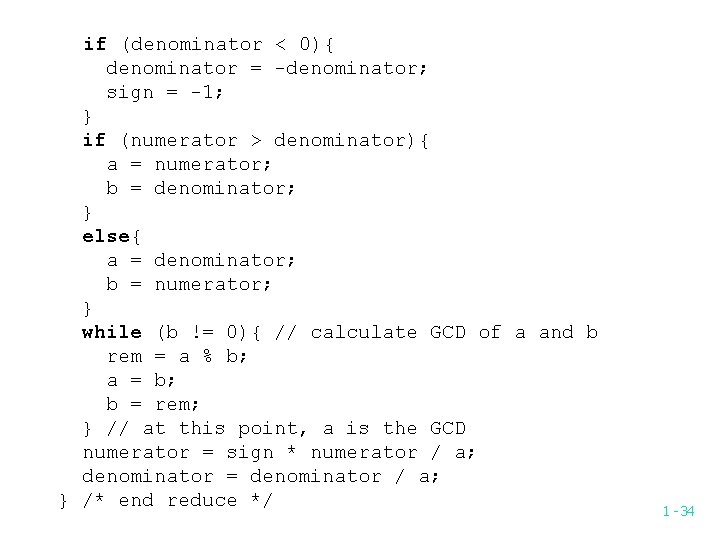
if (denominator < 0){ denominator = -denominator; sign = -1; } if (numerator > denominator){ a = numerator; b = denominator; } else{ a = denominator; b = numerator; } while (b != 0){ // calculate GCD of a and b rem = a % b; a = b; b = rem; } // at this point, a is the GCD numerator = sign * numerator / a; denominator = denominator / a; } /* end reduce */ 1 -34
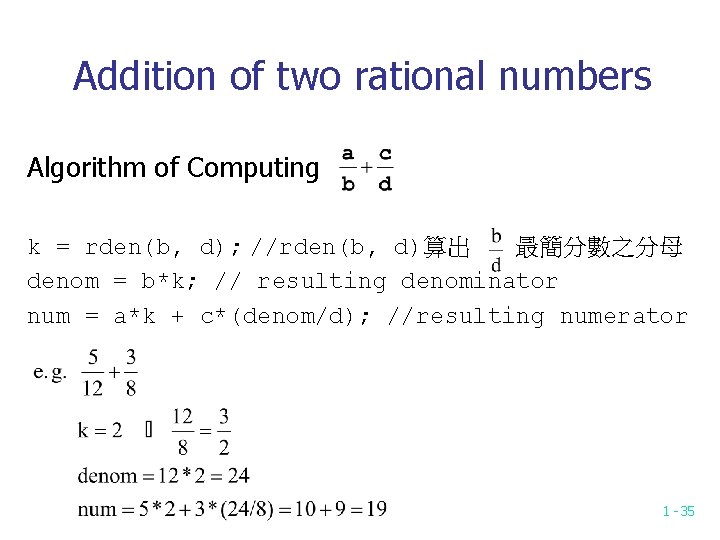
Addition of two rational numbers Algorithm of Computing k = rden(b, d); //rden(b, d)算出 最簡分數之分母 denom = b*k; // resulting denominator num = a*k + c*(denom/d); //resulting numerator 1 -35
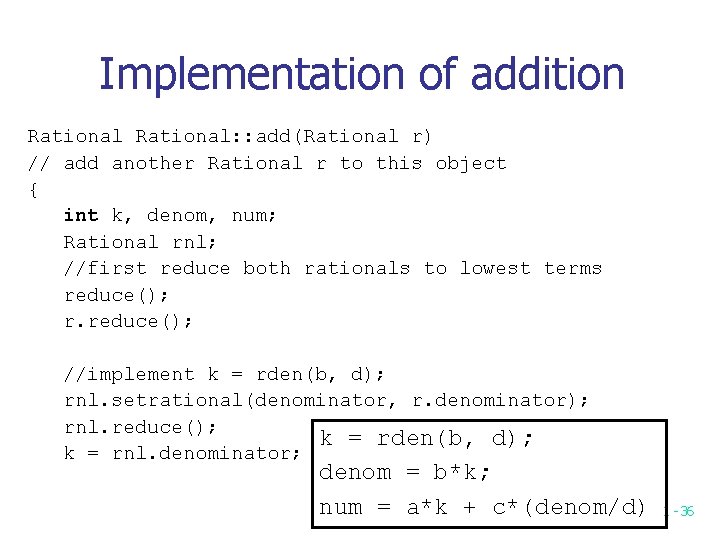
Implementation of addition Rational: : add(Rational r) // add another Rational r to this object { int k, denom, num; Rational rnl; //first reduce both rationals to lowest terms reduce(); r. reduce(); //implement k = rden(b, d); rnl. setrational(denominator, r. denominator); rnl. reduce(); k = rden(b, d); k = rnl. denominator; denom = b*k; num = a*k + c*(denom/d) 1 -36
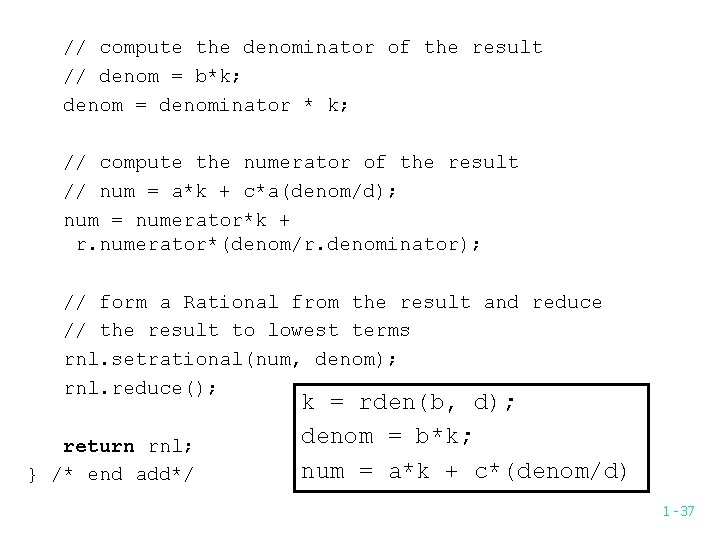
// compute the denominator of the result // denom = b*k; denom = denominator * k; // compute the numerator of the result // num = a*k + c*a(denom/d); num = numerator*k + r. numerator*(denom/r. denominator); // form a Rational from the result and reduce // the result to lowest terms rnl. setrational(num, denom); rnl. reduce(); return rnl; } /* end add*/ k = rden(b, d); denom = b*k; num = a*k + c*(denom/d) 1 -37
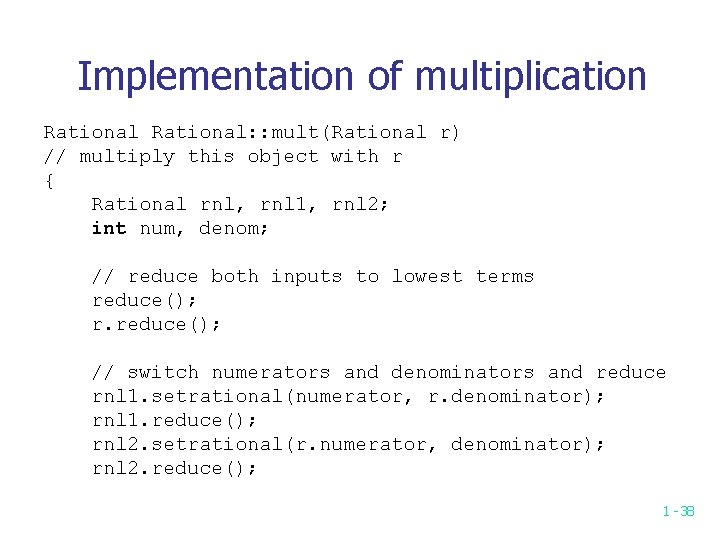
Implementation of multiplication Rational: : mult(Rational r) // multiply this object with r { Rational rnl, rnl 1, rnl 2; int num, denom; // reduce both inputs to lowest terms reduce(); r. reduce(); // switch numerators and denominators and reduce rnl 1. setrational(numerator, r. denominator); rnl 1. reduce(); rnl 2. setrational(r. numerator, denominator); rnl 2. reduce(); 1 -38
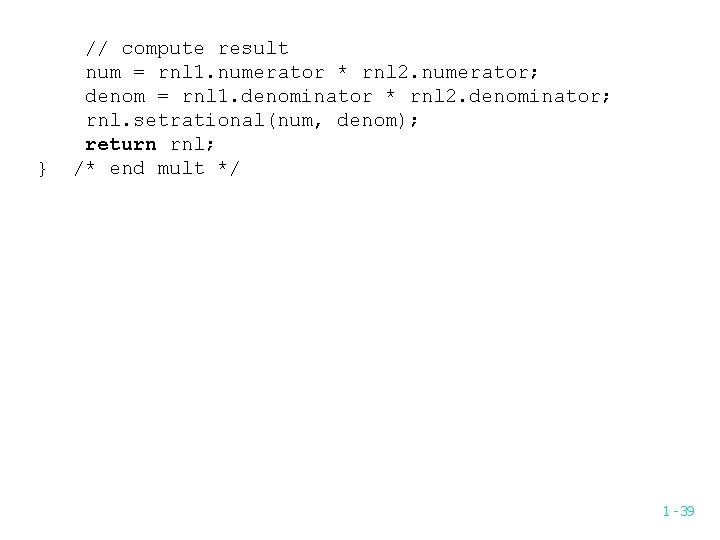
} // compute result num = rnl 1. numerator * rnl 2. numerator; denom = rnl 1. denominator * rnl 2. denominator; rnl. setrational(num, denom); return rnl; /* end mult */ 1 -39
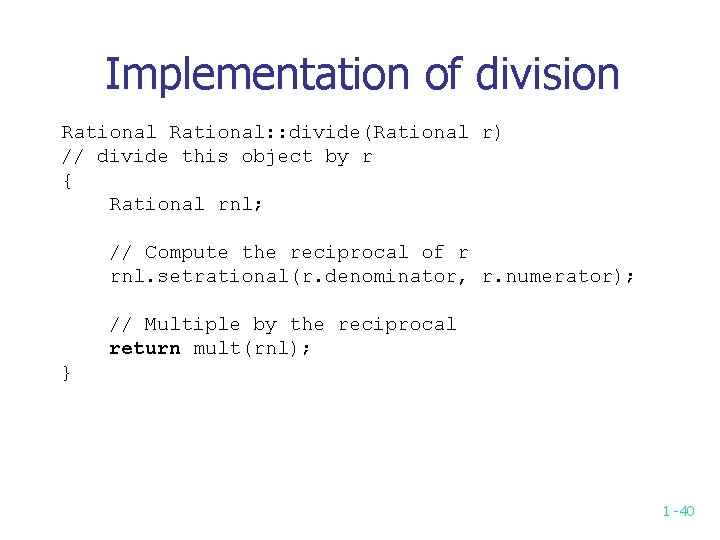
Implementation of division Rational: : divide(Rational r) // divide this object by r { Rational rnl; // Compute the reciprocal of r rnl. setrational(r. denominator, r. numerator); // Multiple by the reciprocal return mult(rnl); } 1 -40
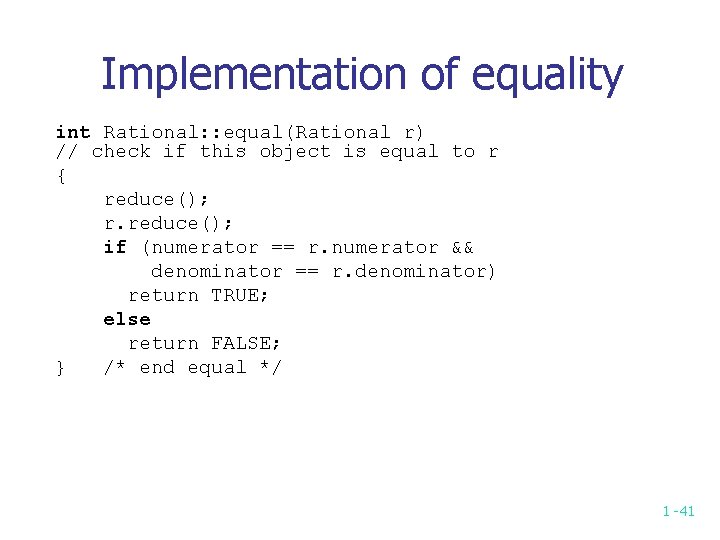
Implementation of equality int Rational: : equal(Rational r) // check if this object is equal to r { reduce(); r. reduce(); if (numerator == r. numerator && denominator == r. denominator) return TRUE; else return FALSE; } /* end equal */ 1 -41
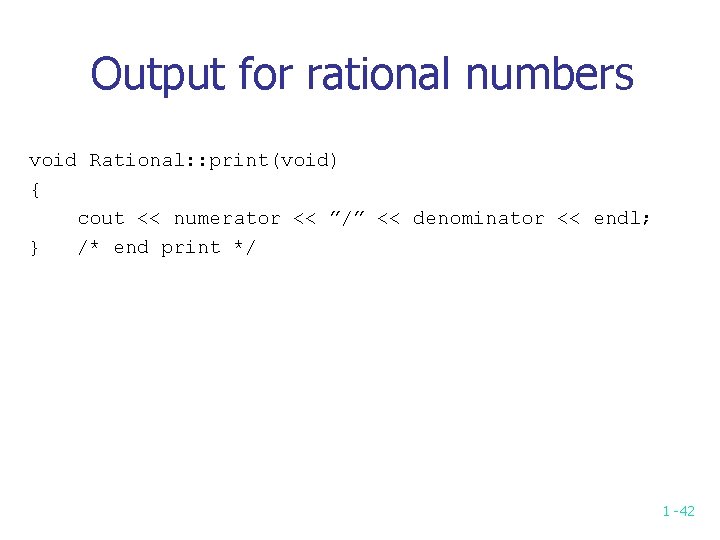
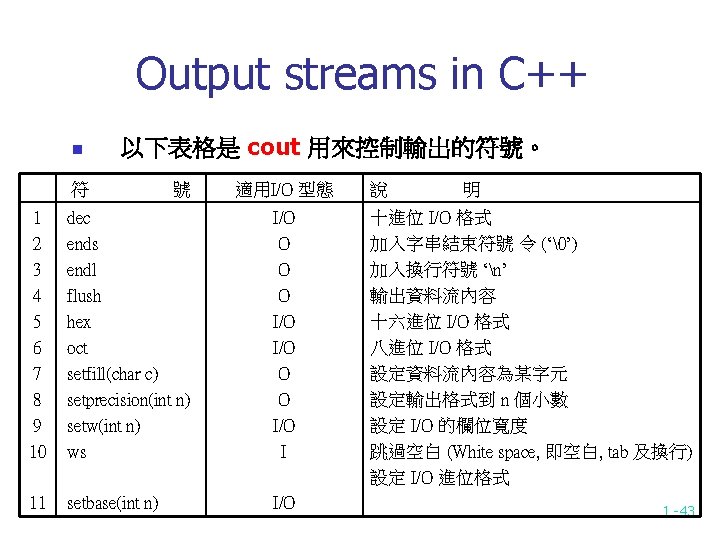
Output for rational numbers void Rational: : print(void) { cout << numerator << ”/” << denominator << endl; } /* end print */ 1 -42
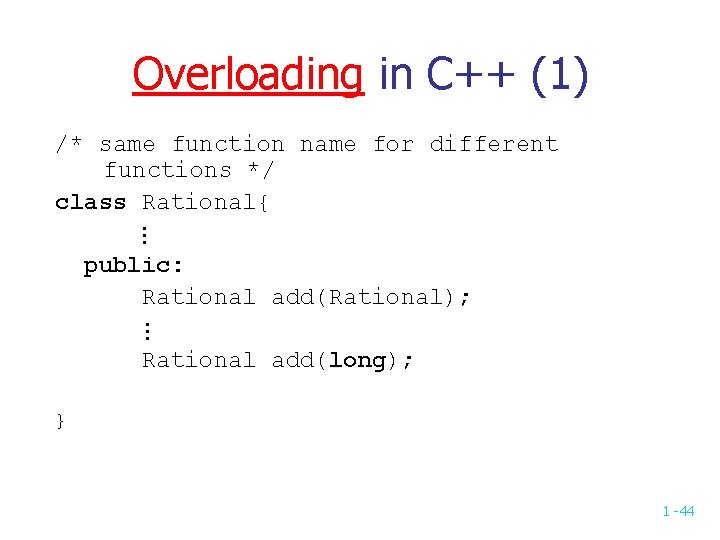
Overloading in C++ (1) /* same function name for different functions */ class Rational{ … public: Rational add(Rational); … Rational add(long); } 1 -44
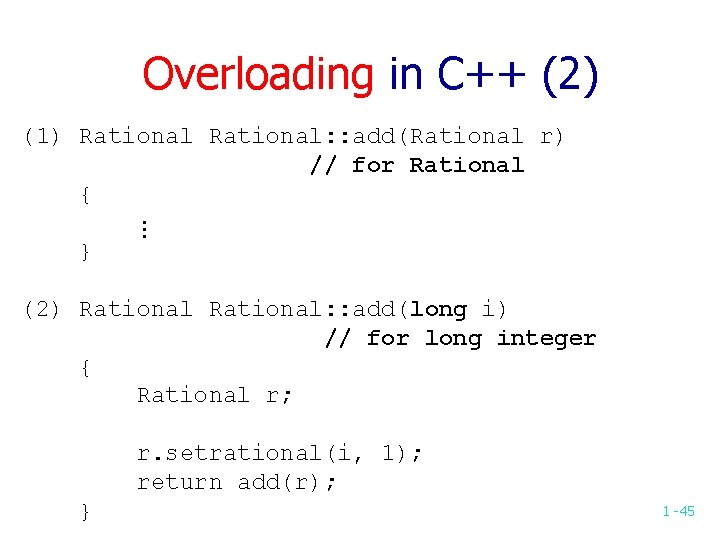
Overloading in C++ (2) (1) Rational: : add(Rational r) // for Rational { … } (2) Rational: : add(long i) // for long integer { Rational r; r. setrational(i, 1); return add(r); } 1 -45
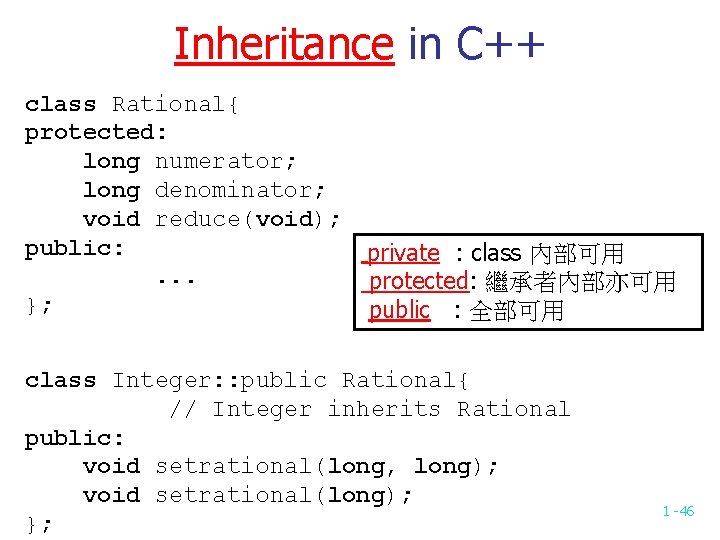
Inheritance in C++ class Rational{ protected: long numerator; long denominator; void reduce(void); public: . . . }; private : class 內部可用 protected: 繼承者內部亦可用 public : 全部可用 class Integer: : public Rational{ // Integer inherits Rational public: void setrational(long, long); void setrational(long); }; 1 -46
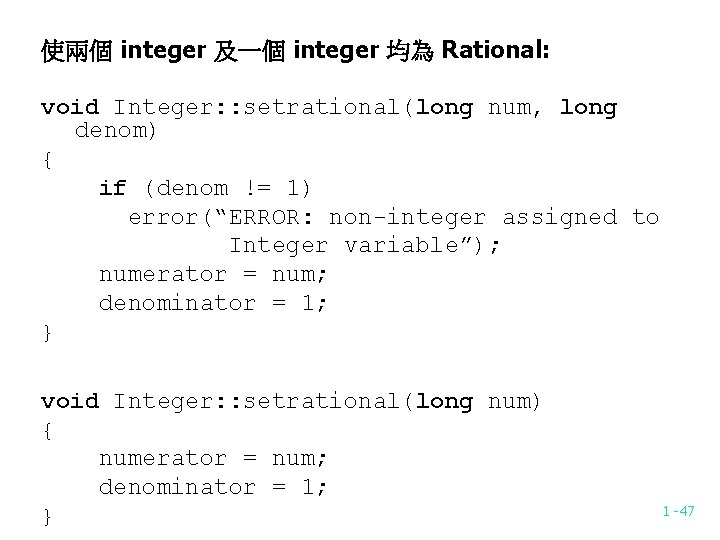
使兩個 integer 及一個 integer 均為 Rational: void Integer: : setrational(long num, long denom) { if (denom != 1) error(“ERROR: non-integer assigned to Integer variable”); numerator = num; denominator = 1; } void Integer: : setrational(long num) { numerator = num; denominator = 1; } 1 -47
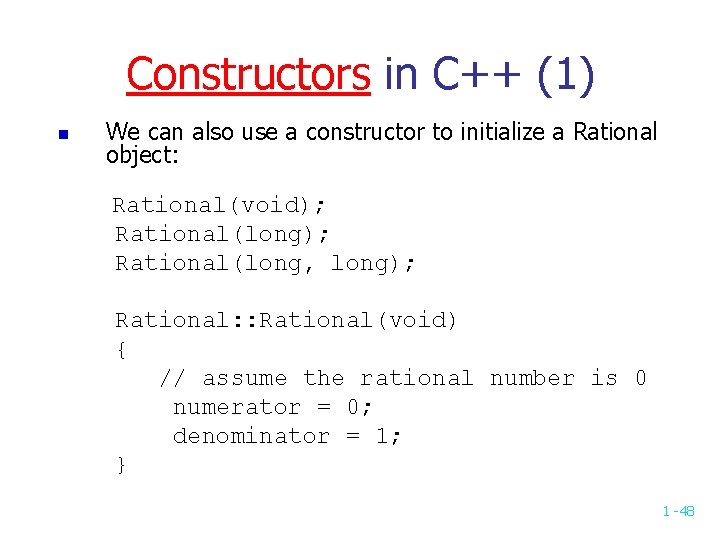
Constructors in C++ (1) n We can also use a constructor to initialize a Rational object: Rational(void); Rational(long, long); Rational: : Rational(void) { // assume the rational number is 0 numerator = 0; denominator = 1; } 1 -48
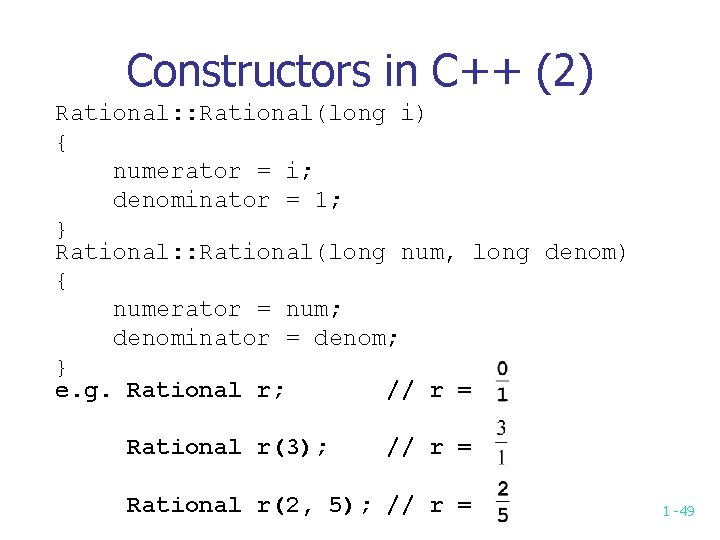
Constructors in C++ (2) Rational: : Rational(long i) { numerator = i; denominator = 1; } Rational: : Rational(long num, long denom) { numerator = num; denominator = denom; } e. g. Rational r; // r = Rational r(3); // r = Rational r(2, 5); // r = 1 -49
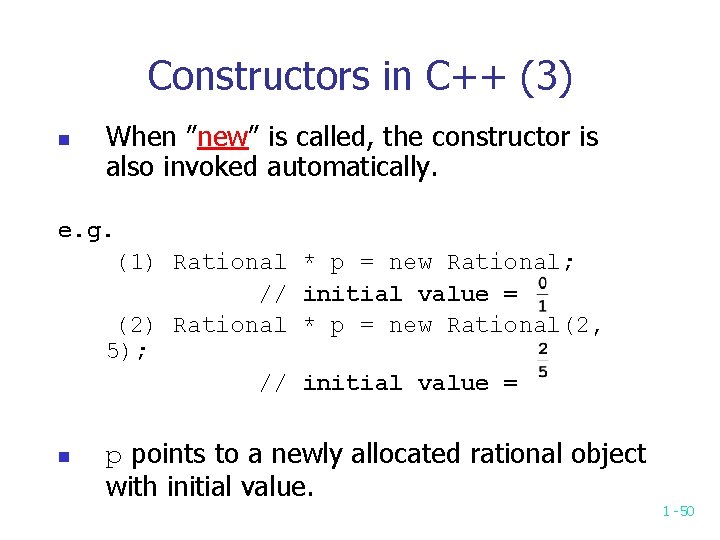
Constructors in C++ (3) n When ”new” is called, the constructor is also invoked automatically. e. g. (1) Rational // (2) Rational 5); // n * p = new Rational; initial value = * p = new Rational(2, initial value = p points to a newly allocated rational object with initial value. 1 -50
- Slides: 50