
Chapter 1 Information Systems in Business Today How
Chapter 1 Information Systems in Business Today
� How information systems are transforming business Increase in wireless technology use, Web sites Cloud computing, mobile digital platform allow more distributed work, decision-making, and collaboration � Globalization opportunities Internet has drastically reduced costs of operating on global scale Presents both challenges and opportunities Management Information Systems: Managing the Digital Firm, 12 e Authors: Kenneth C. Laudon and Jane P. Laudon Copyright © 2013 Dorling Kindersley (India) Pvt. Ltd. The Role of Information Systems in Business Today
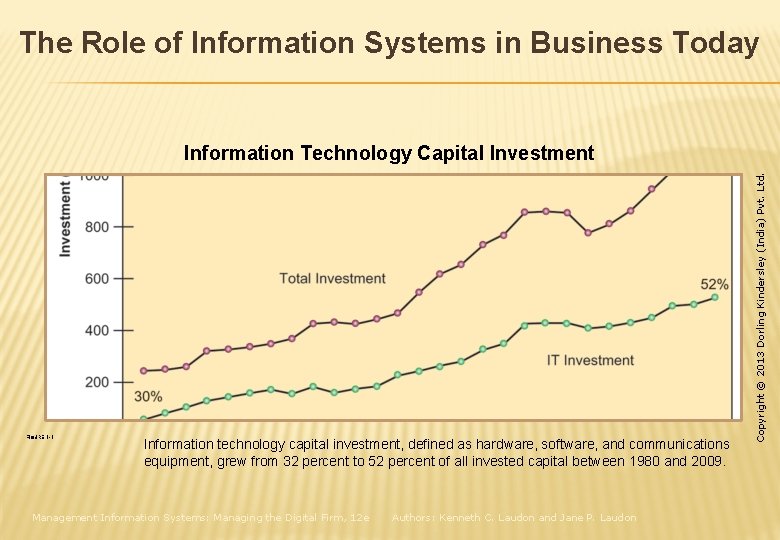
The Role of Information Systems in Business Today FIGURE 1 -1 Information technology capital investment, defined as hardware, software, and communications equipment, grew from 32 percent to 52 percent of all invested capital between 1980 and 2009. Management Information Systems: Managing the Digital Firm, 12 e Authors: Kenneth C. Laudon and Jane P. Laudon Copyright © 2013 Dorling Kindersley (India) Pvt. Ltd. Information Technology Capital Investment
� In the emerging, fully digital firm Significant business relationships are digitally enabled and mediated Core business processes are accomplished through digital networks Key corporate assets are managed digitally � Digital firms offer greater flexibility in organization and management Time shifting, space shifting Management Information Systems: Managing the Digital Firm, 12 e Authors: Kenneth C. Laudon and Jane P. Laudon Copyright © 2013 Dorling Kindersley (India) Pvt. Ltd. The Role of Information Systems in Business Today
� Growing interdependence between ability to use information technology and ability to implement corporate strategies and achieve corporate goals � Business firms invest heavily in information systems to achieve six strategic business objectives: Operational excellence New products, services, and business models Customer and supplier intimacy Improved decision making Competitive advantage Survival Management Information Systems: Managing the Digital Firm, 12 e Authors: Kenneth C. Laudon and Jane P. Laudon Copyright © 2013 Dorling Kindersley (India) Pvt. Ltd. The Role of Information Systems in Business Today
� Operational excellence: Improvement of efficiency to attain higher profitability Information systems, technology an important tool in achieving greater efficiency and productivity Walmart’s Retail. Link system links suppliers to stores for superior replenishment system Management Information Systems: Managing the Digital Firm, 12 e Authors: Kenneth C. Laudon and Jane P. Laudon Copyright © 2013 Dorling Kindersley (India) Pvt. Ltd. The Role of Information Systems in Business Today
� New products, services, and business models: Business model: describes how company produces, delivers, and sells product or service to create wealth Information systems and technology a major enabling tool for new products, services, business models § Examples: Apple’s i. Pod, i. Tunes, i. Phone, i. Pad, Google’s Android OS, and Netflix Management Information Systems: Managing the Digital Firm, 12 e Authors: Kenneth C. Laudon and Jane P. Laudon Copyright © 2013 Dorling Kindersley (India) Pvt. Ltd. The Role of Information Systems in Business Today
� Customer and supplier intimacy: Serving customers well leads to customers returning, which raises revenues and profits § Example: High-end hotels that use computers to track customer preferences and use to monitor and customize environment Intimacy with suppliers allows them to provide vital inputs, which lowers costs § Example: J. C. Penney’s information system which links sales records to contract manufacturer Management Information Systems: Managing the Digital Firm, 12 e Authors: Kenneth C. Laudon and Jane P. Laudon Copyright © 2013 Dorling Kindersley (India) Pvt. Ltd. The Role of Information Systems in Business Today

� Improved decision making Without accurate information: § Managers must use forecasts, best guesses, luck § Leads to: q Overproduction, underproduction of goods and services q Misallocation of resources q Poor response times § q Poor outcomes raise costs, lose customers Example: Verizon’s Web-based digital dashboard to provide managers with realtime data on customer complaints, network performance, line outages, etc. Management Information Systems: Managing the Digital Firm, 12 e Authors: Kenneth C. Laudon and Jane P. Laudon Copyright © 2013 Dorling Kindersley (India) Pvt. Ltd. The Role of Information Systems in Business Today
� Competitive advantage Delivering better performance Charging less for superior products Responding to customers and suppliers in real time Examples: Apple, Walmart, UPS Management Information Systems: Managing the Digital Firm, 12 e Authors: Kenneth C. Laudon and Jane P. Laudon Copyright © 2013 Dorling Kindersley (India) Pvt. Ltd. The Role of Information Systems in Business Today
� Survival Information technologies as necessity of business May be: § Industry-level changes, e. g. Citibank’s introduction of ATMs § Governmental regulations requiring record-keeping q Examples: Toxic Substances Control Act, Sarbanes-Oxley Act Management Information Systems: Managing the Digital Firm, 12 e Authors: Kenneth C. Laudon and Jane P. Laudon Copyright © 2013 Dorling Kindersley (India) Pvt. Ltd. The Role of Information Systems in Business Today
� Information system: Set of interrelated components Collect, process, store, and distribute information Support decision making, coordination, and control � Information vs. data Data are streams of raw facts Information is data shaped into meaningful form Management Information Systems: Managing the Digital Firm, 12 e Authors: Kenneth C. Laudon and Jane P. Laudon Copyright © 2013 Dorling Kindersley (India) Pvt. Ltd. Perspectives on Information Systems
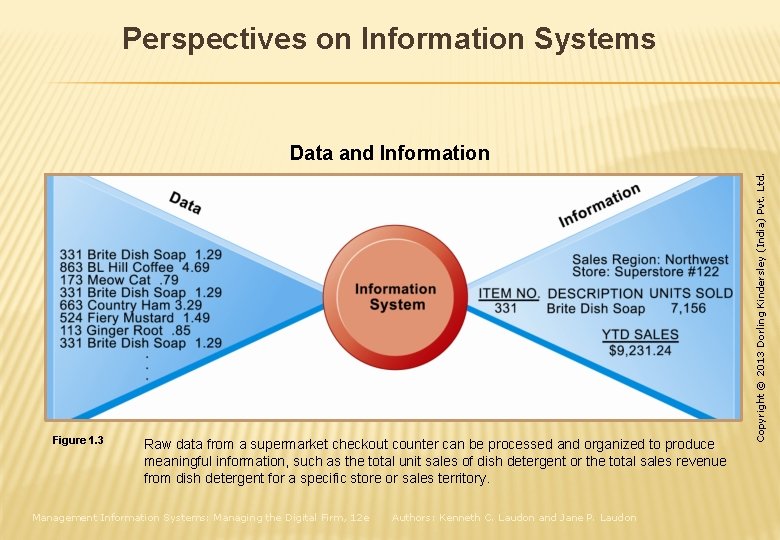
Perspectives on Information Systems Figure 1. 3 Raw data from a supermarket checkout counter can be processed and organized to produce meaningful information, such as the total unit sales of dish detergent or the total sales revenue from dish detergent for a specific store or sales territory. Management Information Systems: Managing the Digital Firm, 12 e Authors: Kenneth C. Laudon and Jane P. Laudon Copyright © 2013 Dorling Kindersley (India) Pvt. Ltd. Data and Information
� Three activities of information systems produce information organizations need Input: Captures raw data from organization or external environment Processing: Converts raw data into meaningful form Output: Transfers processed information to people or activities that use it Management Information Systems: Managing the Digital Firm, 12 e Authors: Kenneth C. Laudon and Jane P. Laudon Copyright © 2013 Dorling Kindersley (India) Pvt. Ltd. Perspectives on Information Systems
� Feedback: Output returned to appropriate members of organization to help evaluate or correct input stage � Computer/Computer program vs. information system Computers and software technical foundation and tools, similar to the material and tools used to build a house Management Information Systems: Managing the Digital Firm, 12 e Authors: Kenneth C. Laudon and Jane P. Laudon Copyright © 2013 Dorling Kindersley (India) Pvt. Ltd. Perspectives on Information Systems
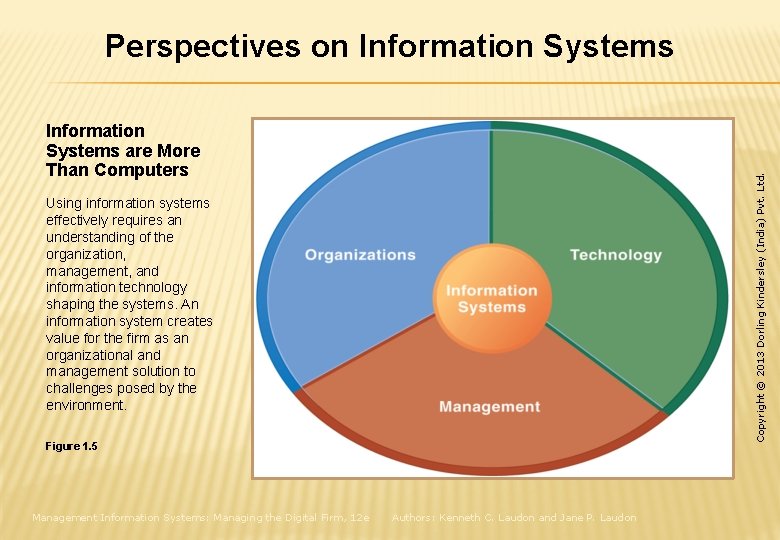
Perspectives on Information Systems Copyright © 2013 Dorling Kindersley (India) Pvt. Ltd. Information Systems are More Than Computers Using information systems effectively requires an understanding of the organization, management, and information technology shaping the systems. An information system creates value for the firm as an organizational and management solution to challenges posed by the environment. Figure 1. 5 Management Information Systems: Managing the Digital Firm, 12 e Authors: Kenneth C. Laudon and Jane P. Laudon
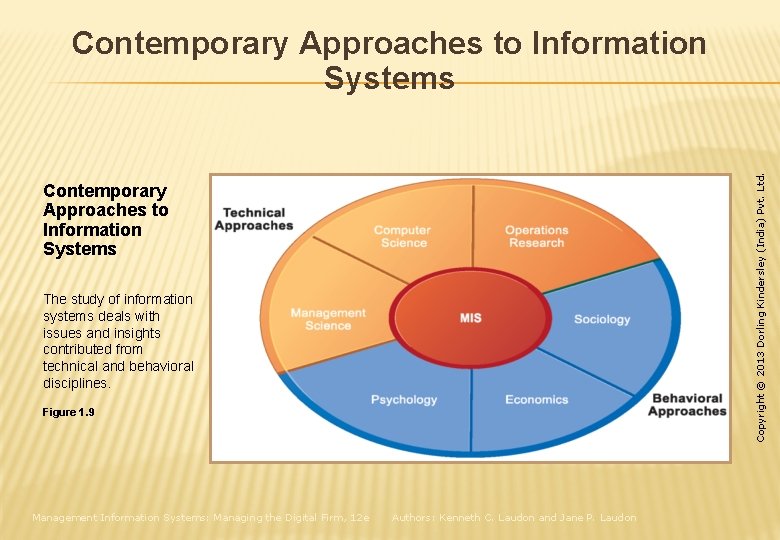
Copyright © 2013 Dorling Kindersley (India) Pvt. Ltd. Contemporary Approaches to Information Systems The study of information systems deals with issues and insights contributed from technical and behavioral disciplines. Figure 1. 9 Management Information Systems: Managing the Digital Firm, 12 e Authors: Kenneth C. Laudon and Jane P. Laudon
� Technical approach Emphasizes mathematically based models Computer science, management science, operations research � Behavioral approach Behavioral issues (strategic business integration, implementation, etc. ) Psychology, economics, sociology Management Information Systems: Managing the Digital Firm, 12 e Authors: Kenneth C. Laudon and Jane P. Laudon Copyright © 2013 Dorling Kindersley (India) Pvt. Ltd. Contemporary Approaches to Information Systems
� Management Information Systems Combines computer science, management science, operations research and practical orientation with behavioral issues � Four main actors Suppliers of hardware and software Business firms Managers and employees Firm’s environment (legal, social, cultural context) Management Information Systems: Managing the Digital Firm, 12 e Authors: Kenneth C. Laudon and Jane P. Laudon Copyright © 2013 Dorling Kindersley (India) Pvt. Ltd. Contemporary Approaches to Information Systems
- Slides: 19