
CHAPTER 1 http web nutn edu twelgjhwangindex html

CHAPTER 1 人 智慧與專家系統簡介 http: //web. nutn. edu. tw/el/gjhwang/index. html 人 智慧與專家系統 S. S. Tseng & G. J. Hwang
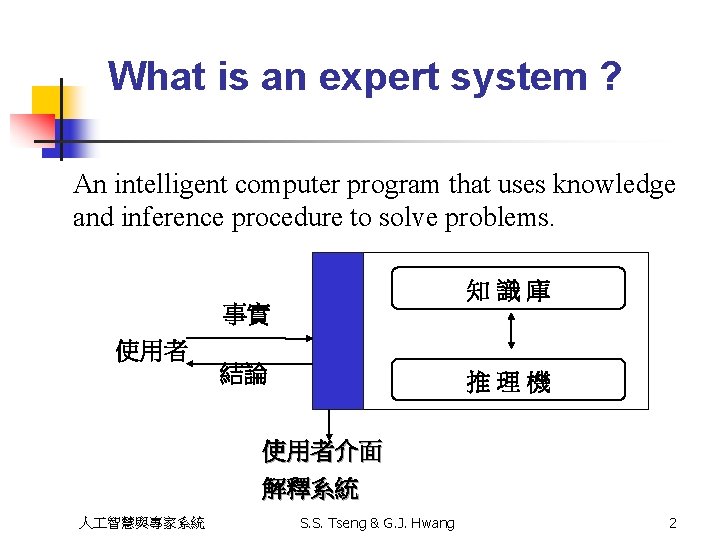
What is an expert system ? An intelligent computer program that uses knowledge and inference procedure to solve problems. 知識庫 事實 使用者 結論 推理機 使用者介面 解釋系統 人 智慧與專家系統 S. S. Tseng & G. J. Hwang 2
參與成員 § § Users Experts • An expert’s knowledge is specific to one problem domain, as opposed to knowledge about general problem-solving techniques • The expert’s knowledge about specific problems is called the knowledge domain of the expert. § Knowledge Engineers 人 智慧與專家系統 S. S. Tseng & G. J. Hwang 3
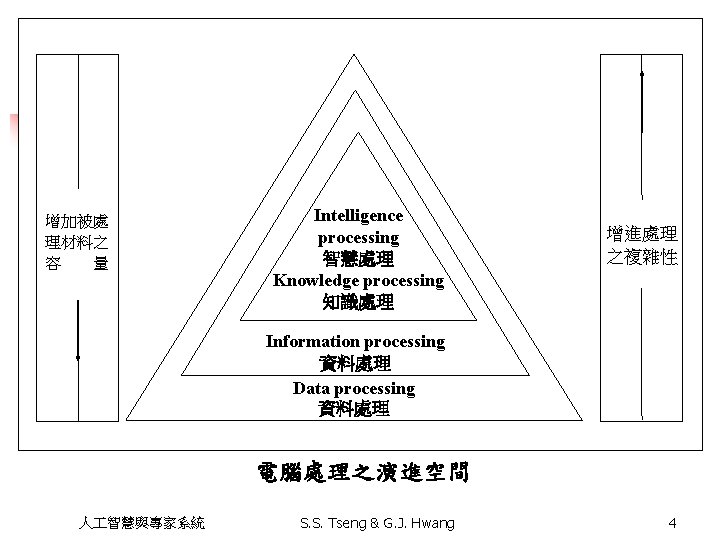
增加被處 理材料之 容 量 Intelligence processing 智慧處理 Knowledge processing 知識處理 增進處理 之複雜性 Information processing 資料處理 Data processing 資料處理 電腦處理之演進空間 人 智慧與專家系統 S. S. Tseng & G. J. Hwang 4
Complexity of Computations 1. Problem size influences computation time. 2. There is a functional relationship T(n) between problem size n and computation time T. 3. Different algorithms for the same problem may have vastly different time complexity T(n). 4. Time complexity influences the size problem we can afford to solve. 人 智慧與專家系統 S. S. Tseng & G. J. Hwang 5
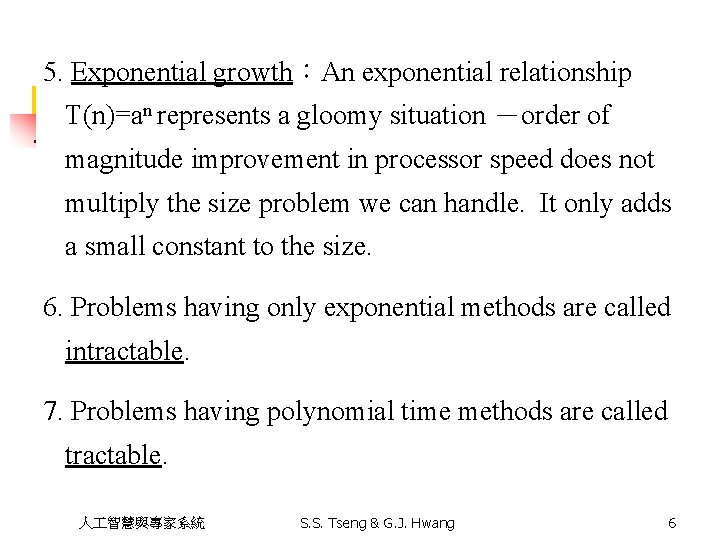
5. Exponential growth:An exponential relationship T(n)=an represents a gloomy situation -order of magnitude improvement in processor speed does not multiply the size problem we can handle. It only adds a small constant to the size. 6. Problems having only exponential methods are called intractable. 7. Problems having polynomial time methods are called tractable. 人 智慧與專家系統 S. S. Tseng & G. J. Hwang 6
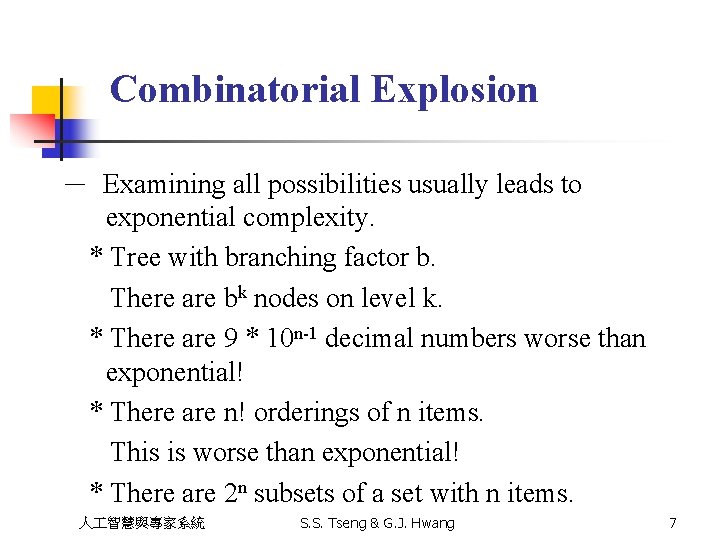
Combinatorial Explosion - Examining all possibilities usually leads to exponential complexity. * Tree with branching factor b. There are bk nodes on level k. * There are 9 * 10 n-1 decimal numbers worse than exponential! * There are n! orderings of n items. This is worse than exponential! * There are 2 n subsets of a set with n items. 人 智慧與專家系統 S. S. Tseng & G. J. Hwang 7
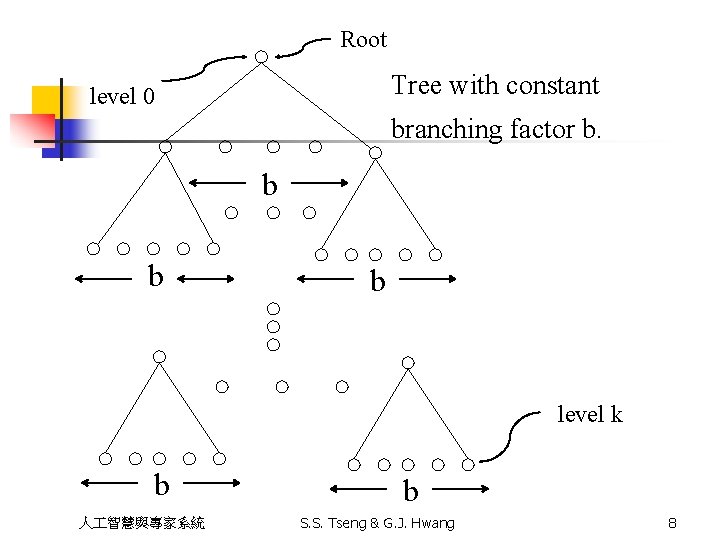
Root Tree with constant level 0 branching factor b. b b b level k b 人 智慧與專家系統 b S. S. Tseng & G. J. Hwang 8
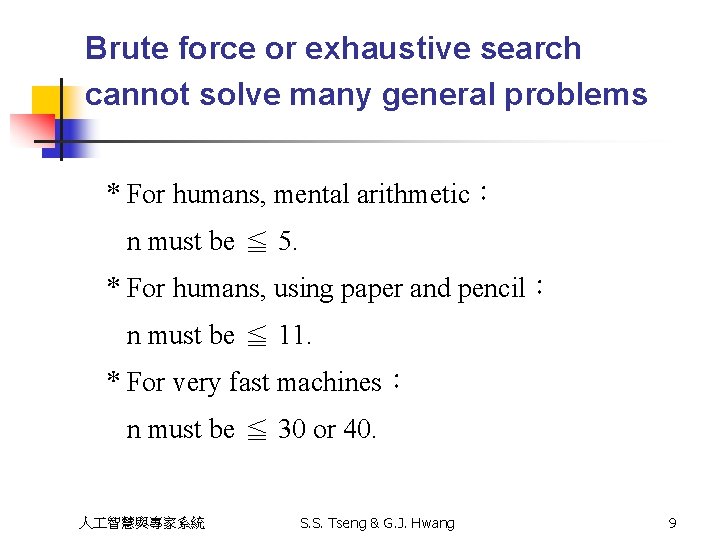
Brute force or exhaustive search cannot solve many general problems * For humans, mental arithmetic: n must be ≦ 5. * For humans, using paper and pencil: n must be ≦ 11. * For very fast machines: n must be ≦ 30 or 40. 人 智慧與專家系統 S. S. Tseng & G. J. Hwang 9
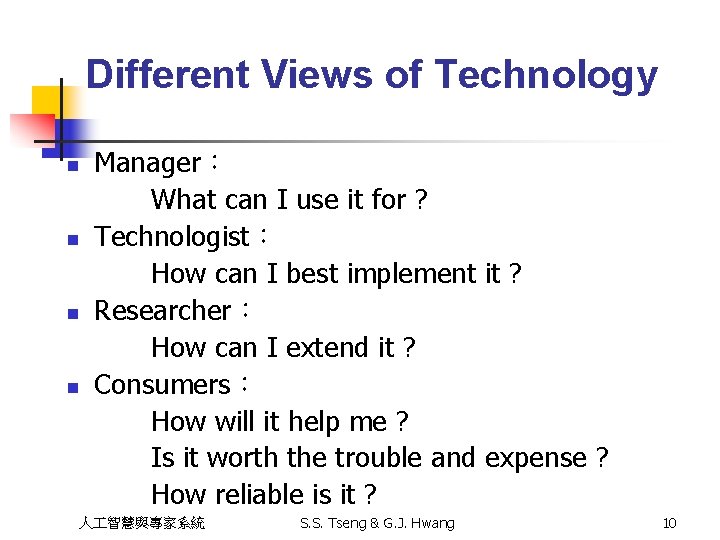
Different Views of Technology Manager: What can I use it for ? n Technologist: How can I best implement it ? n Researcher: How can I extend it ? n Consumers: How will it help me ? Is it worth the trouble and expense ? How reliable is it ? n 人 智慧與專家系統 S. S. Tseng & G. J. Hwang 10
Basic Concepts n n Professor Edward Feigenbaum of Stamford Univ. , defined an expert system as “an intelligent computer program that uses knowledge and inference procedures to solve problems that are difficult enough to require significant human expertise for their solutions”. A program that emulates the decision-making ability of a human expert. 人 智慧與專家系統 S. S. Tseng & G. J. Hwang 11
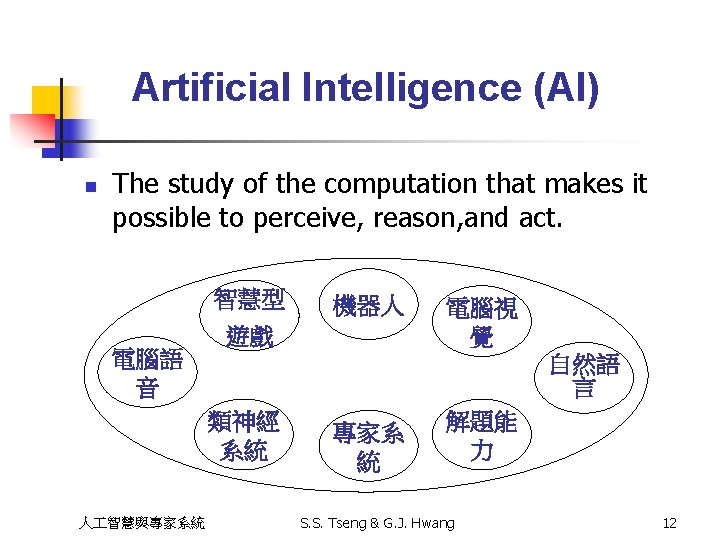
Artificial Intelligence (AI) n The study of the computation that makes it possible to perceive, reason, and act. 智慧型 電腦語 音 遊戲 電腦視 覺 自然語 言 類神經 系統 人 智慧與專家系統 機器人 專家系 統 解題能 力 S. S. Tseng & G. J. Hwang 12
Expert Systems and AI n n Expert system is a branch of AI that makes extensive use of specialized knowledge to solve problems at the level of a human expert by restricting the problem domain. The terms “expert system”, “knowledge-based system”, or “knowledge-based expert system” are used to represent the same thing. 人 智慧與專家系統 S. S. Tseng & G. J. Hwang 13
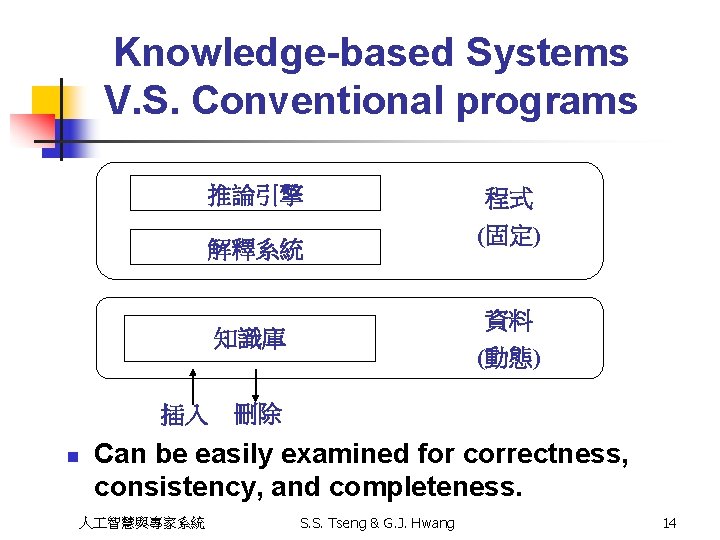
Knowledge-based Systems V. S. Conventional programs 推論引擎 解釋系統 n (固定) 資料 知識庫 插入 程式 (動態) 刪除 Can be easily examined for correctness, consistency, and completeness. 人 智慧與專家系統 S. S. Tseng & G. J. Hwang 14
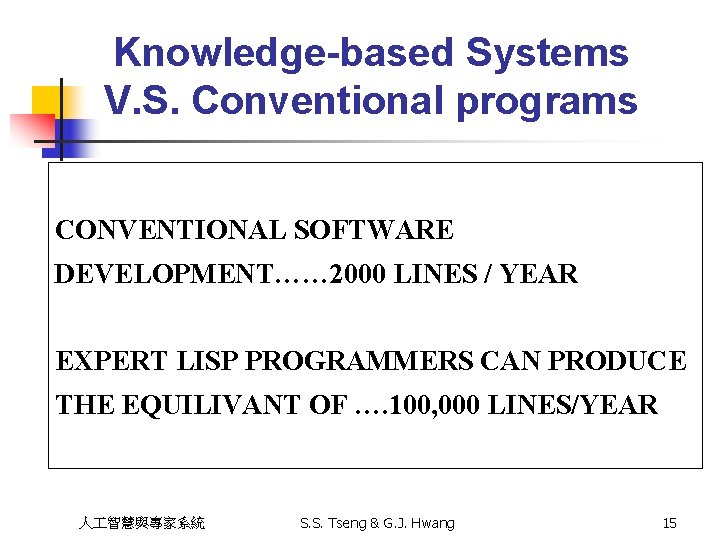
Knowledge-based Systems V. S. Conventional programs CONVENTIONAL SOFTWARE DEVELOPMENT…… 2000 LINES / YEAR EXPERT LISP PROGRAMMERS CAN PRODUCE THE EQUILIVANT OF …. 100, 000 LINES/YEAR 人 智慧與專家系統 S. S. Tseng & G. J. Hwang 15
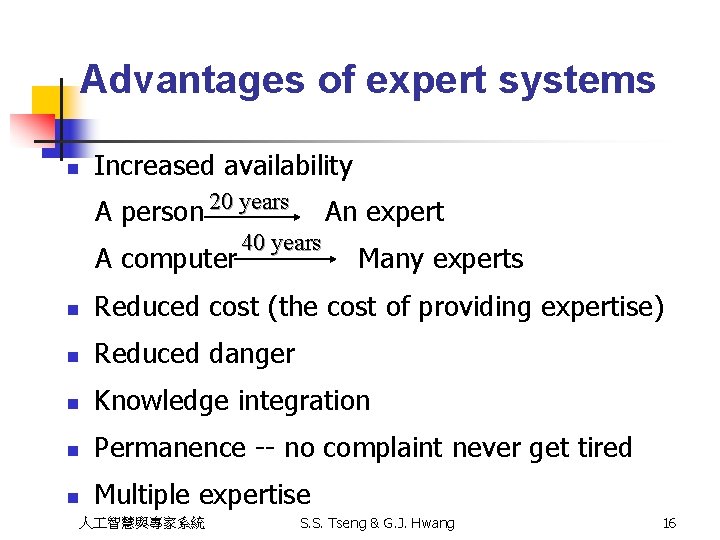
Advantages of expert systems n Increased availability 20 years An expert A person 40 years A computer Many experts n Reduced cost (the cost of providing expertise) n Reduced danger n Knowledge integration n Permanence -- no complaint never get tired n Multiple expertise 人 智慧與專家系統 S. S. Tseng & G. J. Hwang 16
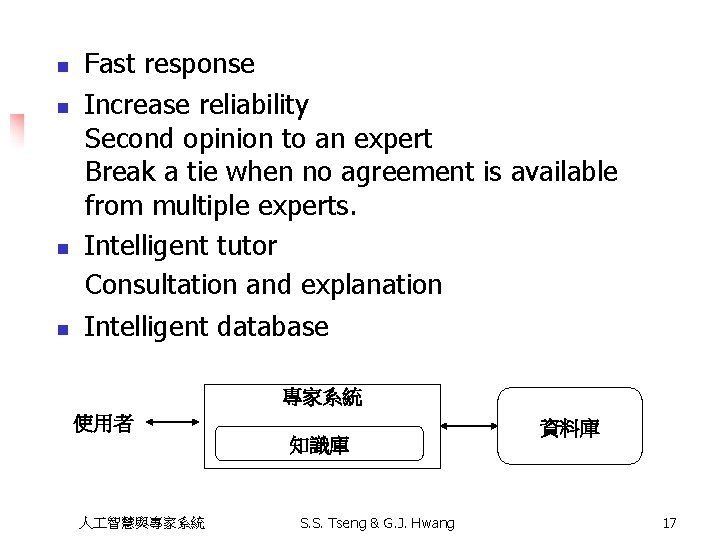
Fast response n Increase reliability Second opinion to an expert Break a tie when no agreement is available from multiple experts. n Intelligent tutor Consultation and explanation n Intelligent database n 專家系統 使用者 知識庫 人 智慧與專家系統 S. S. Tseng & G. J. Hwang 資料庫 17
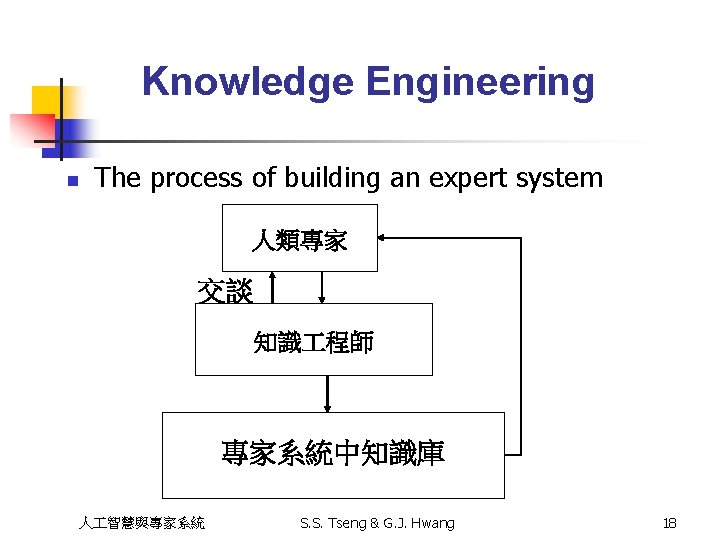
Knowledge Engineering n The process of building an expert system 人類專家 交談 知識 程師 專家系統中知識庫 人 智慧與專家系統 S. S. Tseng & G. J. Hwang 18
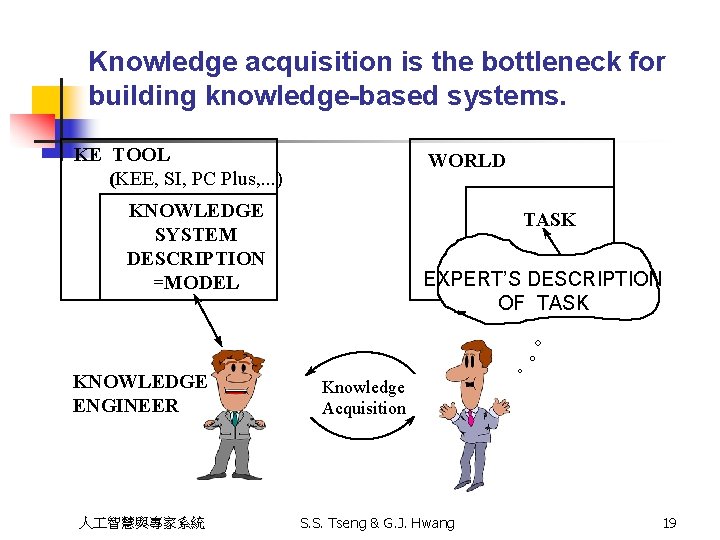
Knowledge acquisition is the bottleneck for building knowledge-based systems. KE TOOL (KEE, SI, PC Plus, . . . ) WORLD KNOWLEDGE SYSTEM DESCRIPTION =MODEL TASK EXPERT’S DESCRIPTION OF TASK ○ ○ KNOWLEDGE ENGINEER 人 智慧與專家系統 ○ Knowledge Acquisition S. S. Tseng & G. J. Hwang 19
Three approaches of Knowledge acquisition n By a knowledge engineer (知識 程師) n By a knowledge acquisition tool n By machine learning (機器學習) approaches e. g. , learn rules by example, through rule induction, in which the system create rules from tables of data. 人 智慧與專家系統 S. S. Tseng & G. J. Hwang 20
Limitations of Expert Systems n n Lack of causal knowledge (因果的知識) -the expert system do not really have an understanding of the underlying causes and effects in a system. Cannot generalize their knowledge by using analogy to reason about new situations the way people can (limited to the problem domain). Building is very time-consuming It is much easier to program expert system with shallow knowledge (淺層知識). 人 智慧與專家系統 S. S. Tseng & G. J. Hwang 21
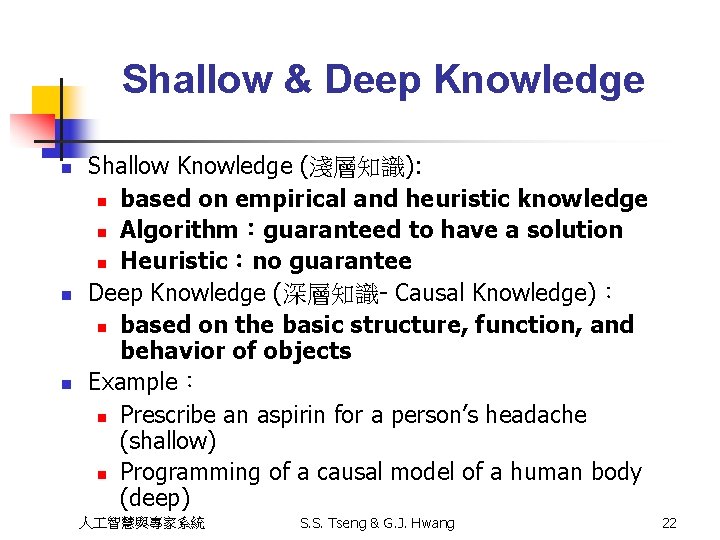
Shallow & Deep Knowledge n n n Shallow Knowledge (淺層知識): n based on empirical and heuristic knowledge n Algorithm:guaranteed to have a solution n Heuristic:no guarantee Deep Knowledge (深層知識- Causal Knowledge): n based on the basic structure, function, and behavior of objects Example: n Prescribe an aspirin for a person’s headache (shallow) n Programming of a causal model of a human body (deep) 人 智慧與專家系統 S. S. Tseng & G. J. Hwang 22
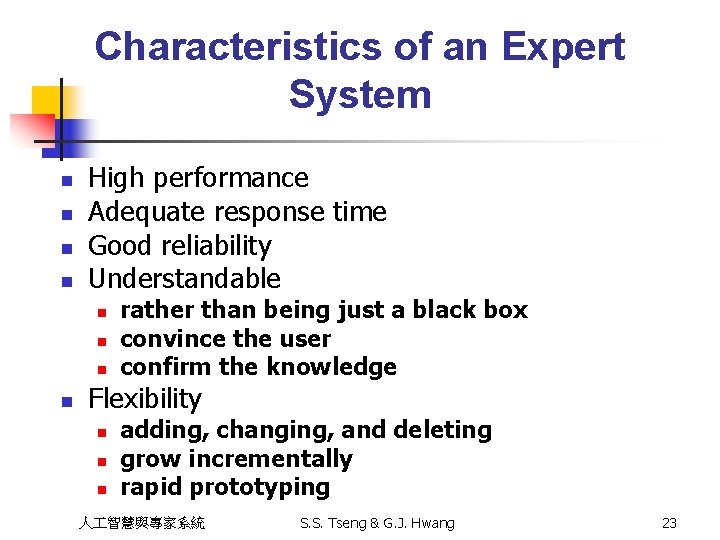
Characteristics of an Expert System n n High performance Adequate response time Good reliability Understandable n n rather than being just a black box convince the user confirm the knowledge Flexibility n n n adding, changing, and deleting grow incrementally rapid prototyping 人 智慧與專家系統 S. S. Tseng & G. J. Hwang 23
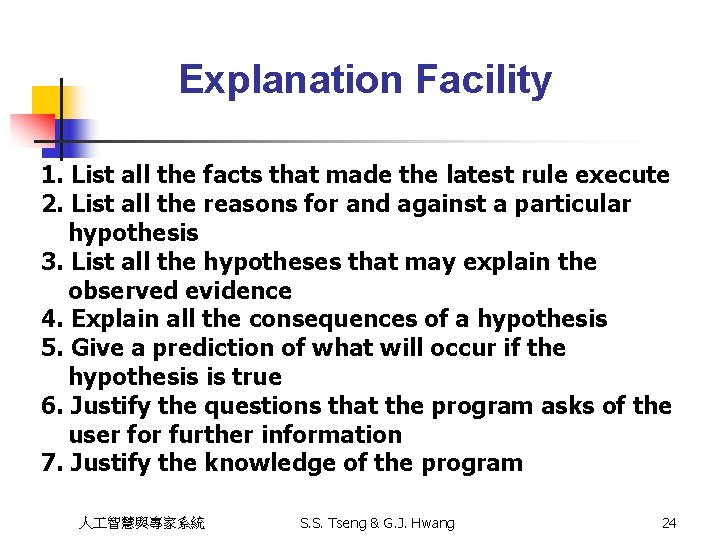
Explanation Facility 1. List all the facts that made the latest rule execute 2. List all the reasons for and against a particular hypothesis 3. List all the hypotheses that may explain the observed evidence 4. Explain all the consequences of a hypothesis 5. Give a prediction of what will occur if the hypothesis is true 6. Justify the questions that the program asks of the user for further information 7. Justify the knowledge of the program 人 智慧與專家系統 S. S. Tseng & G. J. Hwang 24
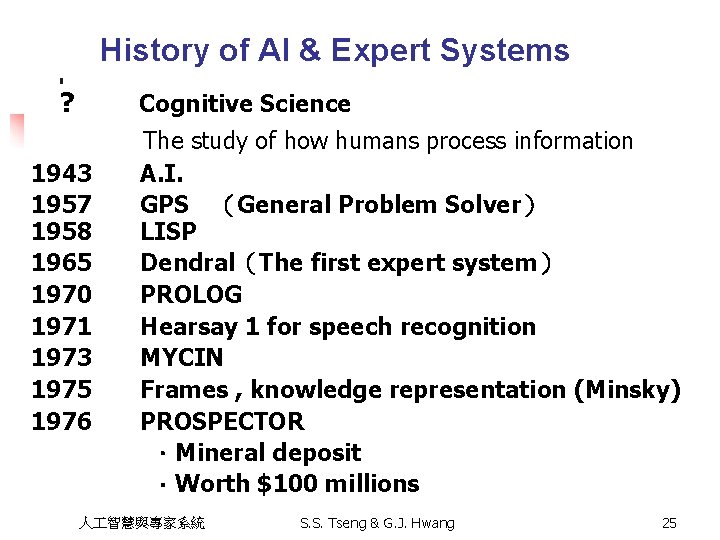
History of AI & Expert Systems ? Cognitive Science The study of how humans process information 1943 A. I. 1957 GPS (General Problem Solver) 1958 LISP 1965 Dendral(The first expert system) 1970 PROLOG 1971 Hearsay 1 for speech recognition 1973 MYCIN 1975 Frames , knowledge representation (Minsky) 1976 PROSPECTOR .Mineral deposit .Worth $100 millions 人 智慧與專家系統 S. S. Tseng & G. J. Hwang 25
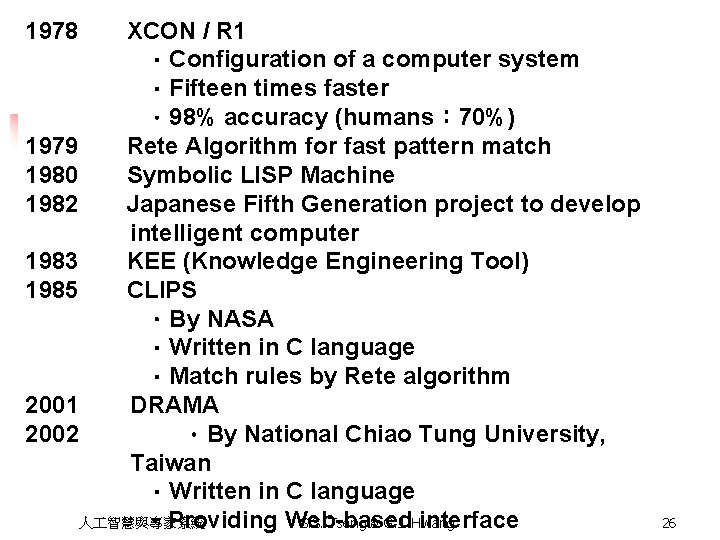
1978 XCON / R 1 .Configuration of a computer system .Fifteen times faster .98% accuracy (humans: 70%) 1979 Rete Algorithm for fast pattern match 1980 Symbolic LISP Machine 1982 Japanese Fifth Generation project to develop intelligent computer 1983 KEE (Knowledge Engineering Tool) 1985 CLIPS .By NASA .Written in C language .Match rules by Rete algorithm 2001 DRAMA 2002 .By National Chiao Tung University, Taiwan .Written in C language 人 智慧與專家系統 S. S. Tseng & G. J. Hwang .Providing Web-based interface 26
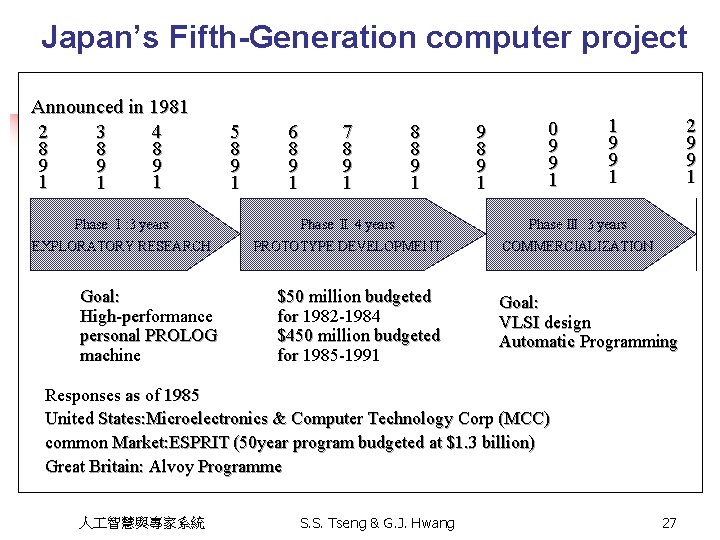
Japan’s Fifth-Generation computer project Announced in 1981 2 4 3 8 8 8 9 9 9 1 1 1 5 8 9 1 6 8 9 1 7 8 9 1 8 8 9 1 9 8 9 1 0 9 9 1 1 9 9 1 Phase Ⅰ: 3 years Phase Ⅱ: 4 years Phase Ⅲ : 3 years EXPLORATORY RESEARCH PROTOTYPE DEVELOPMENT COMMERCIALIZATION Goal: High-performance personal PROLOG machine $50 million budgeted for 1982 -1984 $450 million budgeted for 1985 -1991 2 9 9 1 Goal: VLSI design Automatic Programming Responses as of 1985 United States: Microelectronics & Computer Technology Corp (MCC) common Market: ESPRIT (50 year program budgeted at $1. 3 billion) Great Britain: Alvoy Programme 人 智慧與專家系統 S. S. Tseng & G. J. Hwang 27
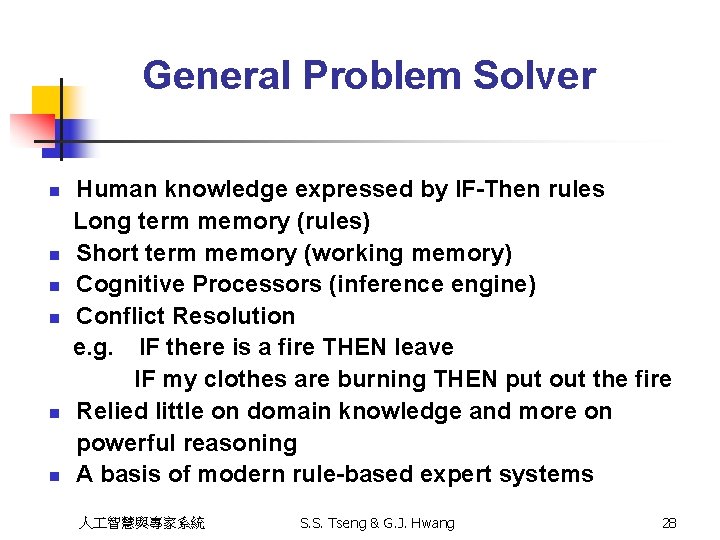
General Problem Solver Human knowledge expressed by IF-Then rules Long term memory (rules) n Short term memory (working memory) n Cognitive Processors (inference engine) n Conflict Resolution e. g. IF there is a fire THEN leave IF my clothes are burning THEN put out the fire n Relied little on domain knowledge and more on powerful reasoning n A basis of modern rule-based expert systems n 人 智慧與專家系統 S. S. Tseng & G. J. Hwang 28
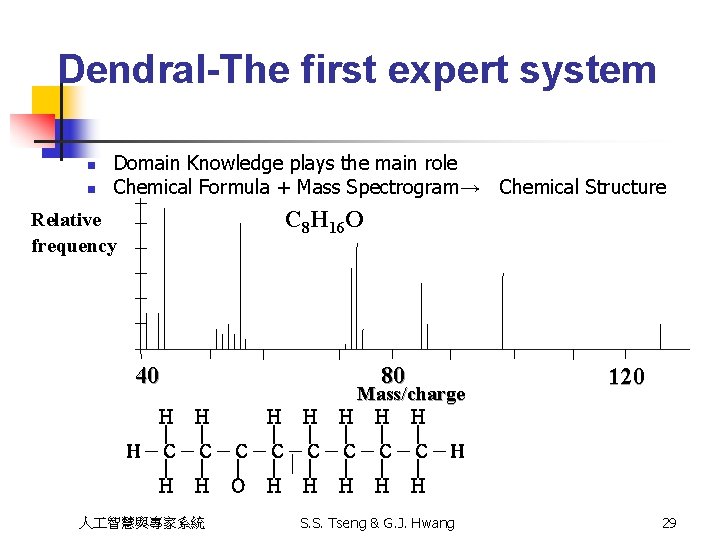
Dendral-The first expert system n n Domain Knowledge plays the main role Chemical Formula + Mass Spectrogram→ Chemical Structure C 8 H 16 O Relative frequency 40 80 Mass/charge 120 H H H H H | | | | | H-C-C-C-C-H | | | | H H O H H H 人 智慧與專家系統 S. S. Tseng & G. J. Hwang 29
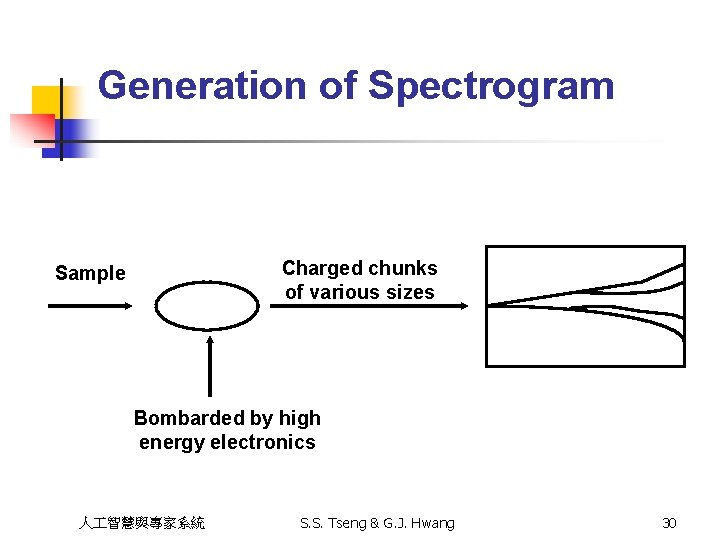
Generation of Spectrogram Charged chunks of various sizes Sample Bombarded by high energy electronics 人 智慧與專家系統 S. S. Tseng & G. J. Hwang 30
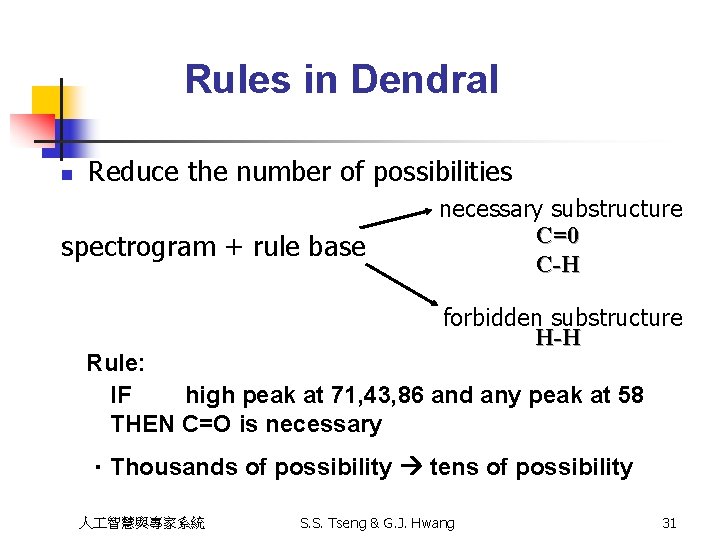
Rules in Dendral n Reduce the number of possibilities spectrogram + rule base necessary substructure C=0 C-H forbidden substructure H-H Rule: IF high peak at 71, 43, 86 and any peak at 58 THEN C=O is necessary .Thousands of possibility tens of possibility 人 智慧與專家系統 S. S. Tseng & G. J. Hwang 31
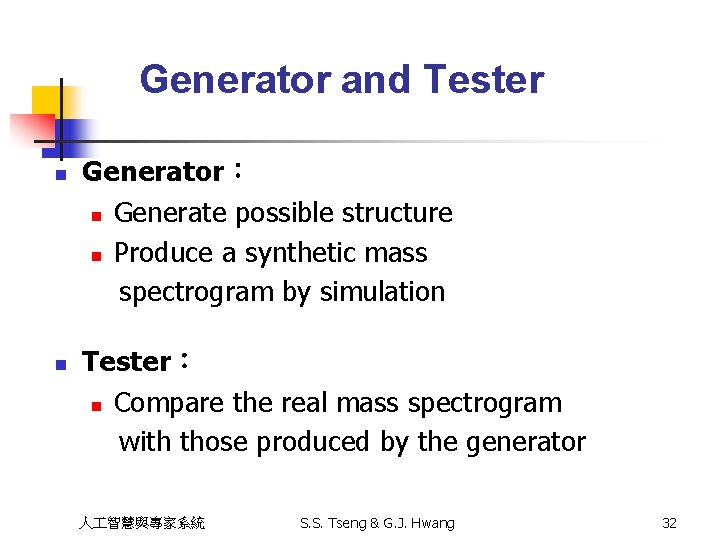
Generator and Tester n n Generator: n Generate possible structure n Produce a synthetic mass spectrogram by simulation Tester: n Compare the real mass spectrogram with those produced by the generator 人 智慧與專家系統 S. S. Tseng & G. J. Hwang 32
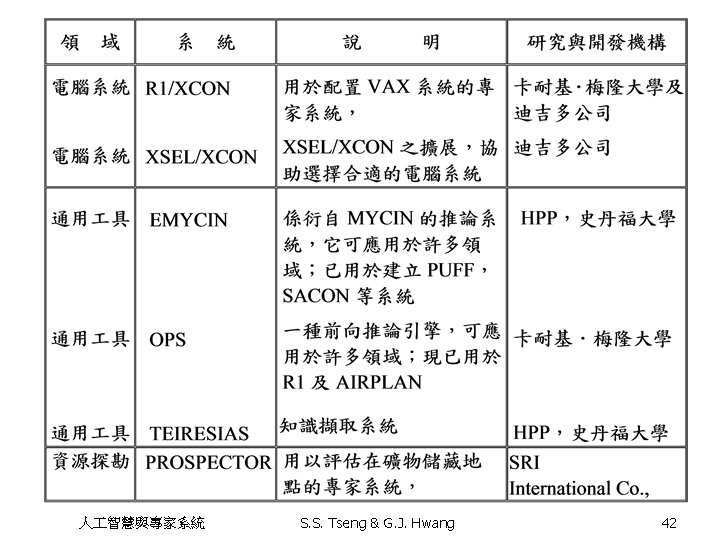
MYCIN n n n n For bacterial infection diagnosis Explanation facility Automatic acquisition of knowledge Intelligent tutoring Feasibility of SHELL(EMYCIN) Separate the knowledge base from the inference engine Backward Chaining 人 智慧與專家系統 S. S. Tseng & G. J. Hwang 33
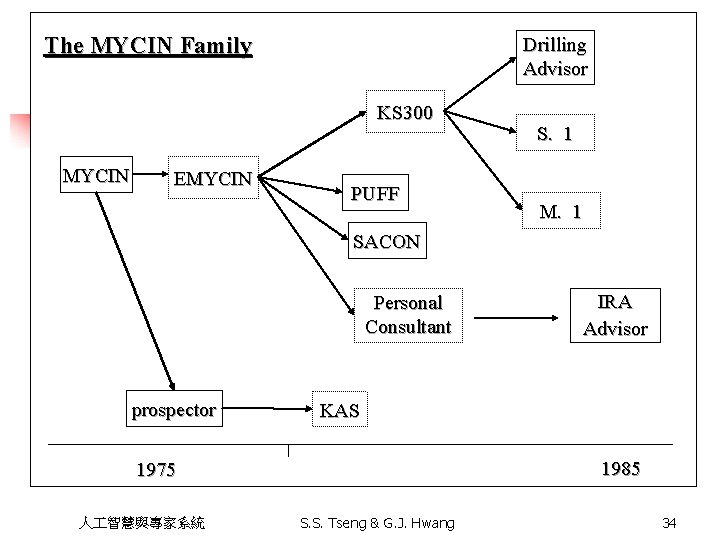
The MYCIN Family Drilling Advisor KS 300 MYCIN EMYCIN PUFF S. 1 M. 1 SACON Personal Consultant prospector KAS 1985 1975 人 智慧與專家系統 IRA Advisor S. S. Tseng & G. J. Hwang 34
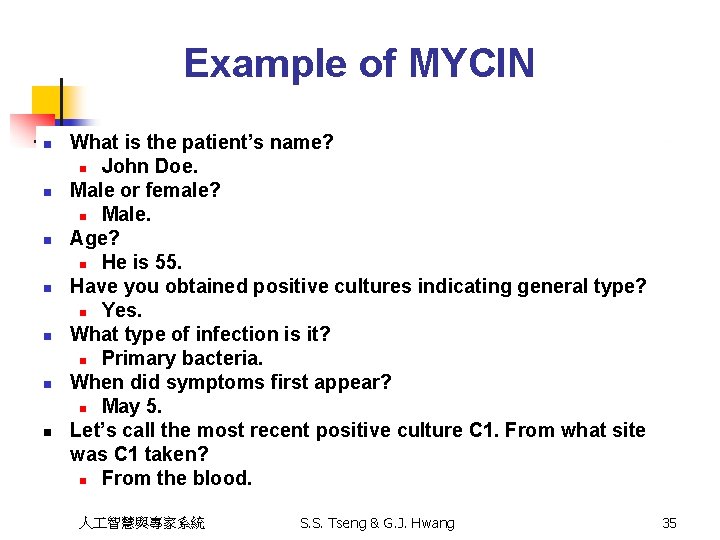
Example of MYCIN n n n n What is the patient’s name? n John Doe. Male or female? n Male. Age? n He is 55. Have you obtained positive cultures indicating general type? n Yes. What type of infection is it? n Primary bacteria. When did symptoms first appear? n May 5. Let’s call the most recent positive culture C 1. From what site was C 1 taken? n From the blood. 人 智慧與專家系統 S. S. Tseng & G. J. Hwang 35
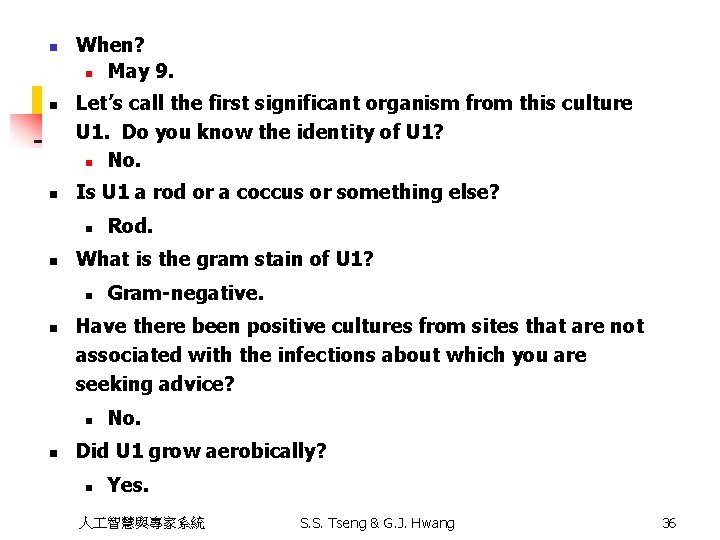
n n n When? n May 9. Let’s call the first significant organism from this culture U 1. Do you know the identity of U 1? n No. Is U 1 a rod or a coccus or something else? n n What is the gram stain of U 1? n n Gram-negative. Have there been positive cultures from sites that are not associated with the infections about which you are seeking advice? n n Rod. No. Did U 1 grow aerobically? n Yes. 人 智慧與專家系統 S. S. Tseng & G. J. Hwang 36
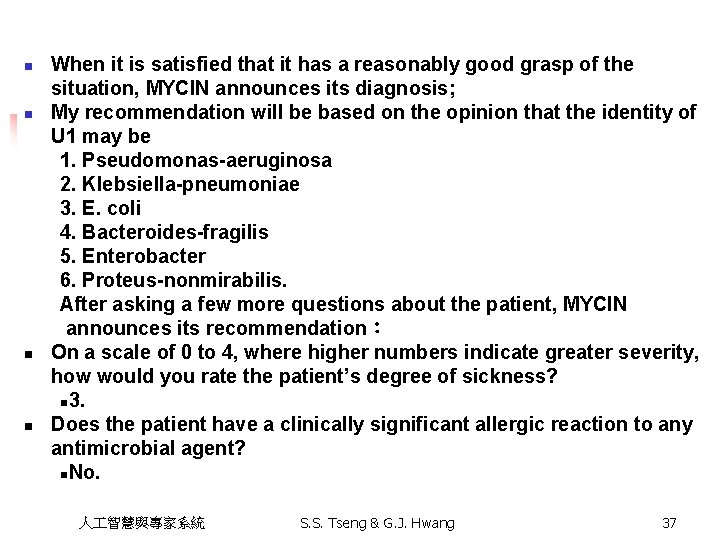
n n When it is satisfied that it has a reasonably good grasp of the situation, MYCIN announces its diagnosis; My recommendation will be based on the opinion that the identity of U 1 may be 1. Pseudomonas-aeruginosa 2. Klebsiella-pneumoniae 3. E. coli 4. Bacteroides-fragilis 5. Enterobacter 6. Proteus-nonmirabilis. After asking a few more questions about the patient, MYCIN announces its recommendation: On a scale of 0 to 4, where higher numbers indicate greater severity, how would you rate the patient’s degree of sickness? n 3. Does the patient have a clinically significant allergic reaction to any antimicrobial agent? n. No. 人 智慧與專家系統 S. S. Tseng & G. J. Hwang 37
n How much does the patient weigh? n n n 70 kilograms. My first recommendation is as follows:to cover for items 1, 2, 3, 5, and 6, give gentamycin using a dose of 119 mg (1. 7 mg/kg) q 8 h IV [or IM] for 10 days. Modify dose in renal failure. Also, to cover for item 4, give clindamycin using a dose of 595 mg (8. 5 mg/kg) q 6 h IV [or IM] for 14 days. If diarrhea or other gastrointestinal symptoms develop, check for pseudomembranous colitis. MYCIN’s pool of knowledge consists of approximately 500 antecedent-consequent rules, which give MYCIN the ability to recognize about 100 causes of bacterial infections. The following rules is typical: n M 88: IF ? x’s type is primary bacteremia the suspected entry point of ? x is the gastrointestinal tract THYEN there is evidence that ? x is bacteroides 人 智慧與專家系統 S. S. Tseng & G. J. Hwang 38
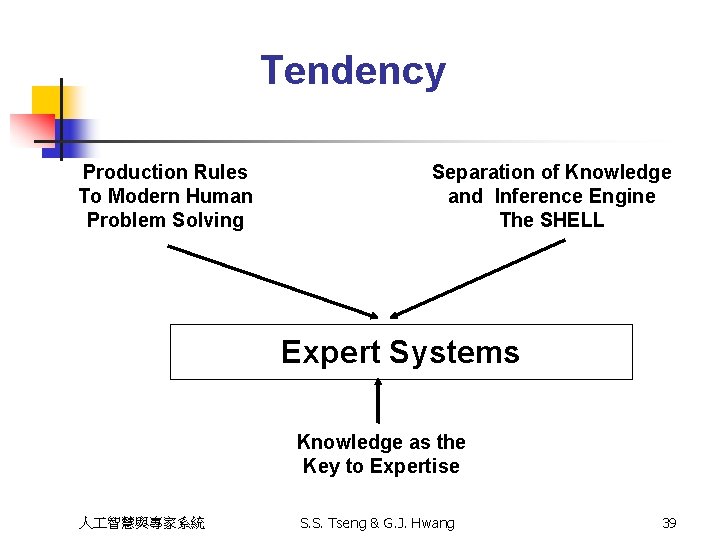
Tendency Production Rules To Modern Human Problem Solving Separation of Knowledge and Inference Engine The SHELL Expert Systems Knowledge as the Key to Expertise 人 智慧與專家系統 S. S. Tseng & G. J. Hwang 39
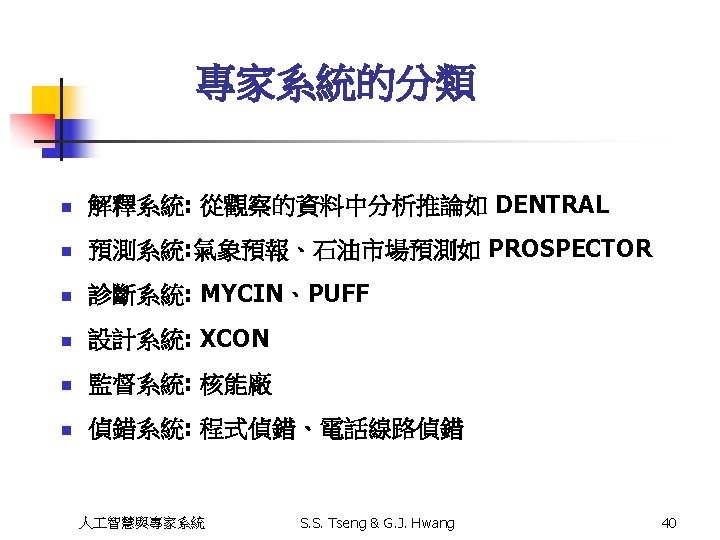
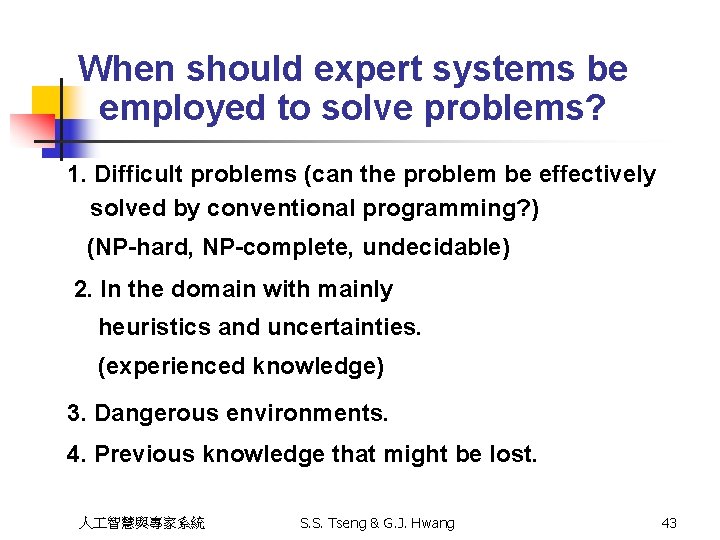
When should expert systems be employed to solve problems? 1. Difficult problems (can the problem be effectively solved by conventional programming? ) (NP-hard, NP-complete, undecidable) 2. In the domain with mainly heuristics and uncertainties. (experienced knowledge) 3. Dangerous environments. 4. Previous knowledge that might be lost. 人 智慧與專家系統 S. S. Tseng & G. J. Hwang 43
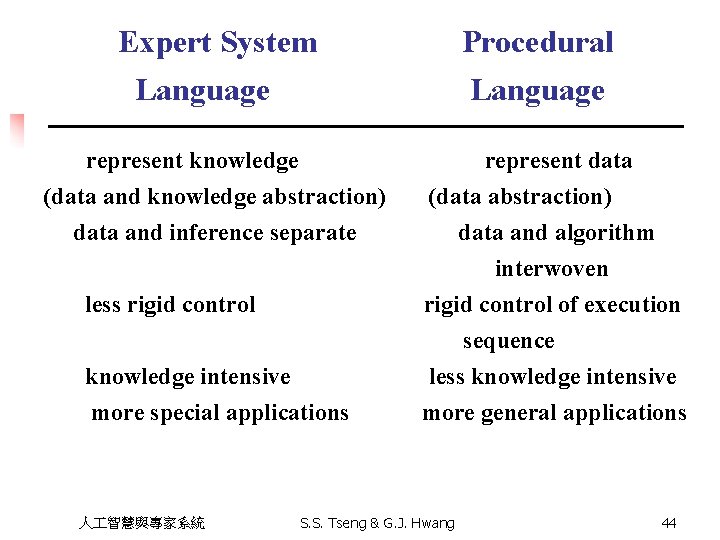
Expert System Procedural Language Language represent knowledge represent data (data and knowledge abstraction) data and inference separate (data abstraction) data and algorithm interwoven less rigid control rigid control of execution sequence knowledge intensive less knowledge intensive more special applications more general applications 人 智慧與專家系統 S. S. Tseng & G. J. Hwang 44
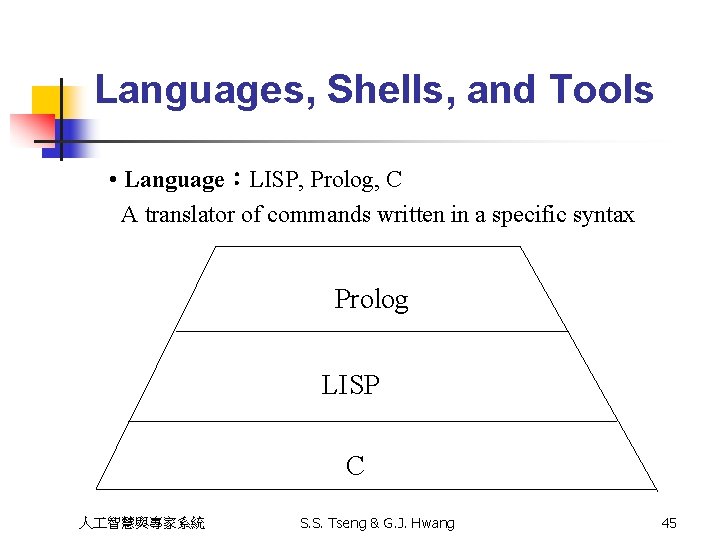
Languages, Shells, and Tools • Language:LISP, Prolog, C A translator of commands written in a specific syntax Prolog LISP C 人 智慧與專家系統 S. S. Tseng & G. J. Hwang 45
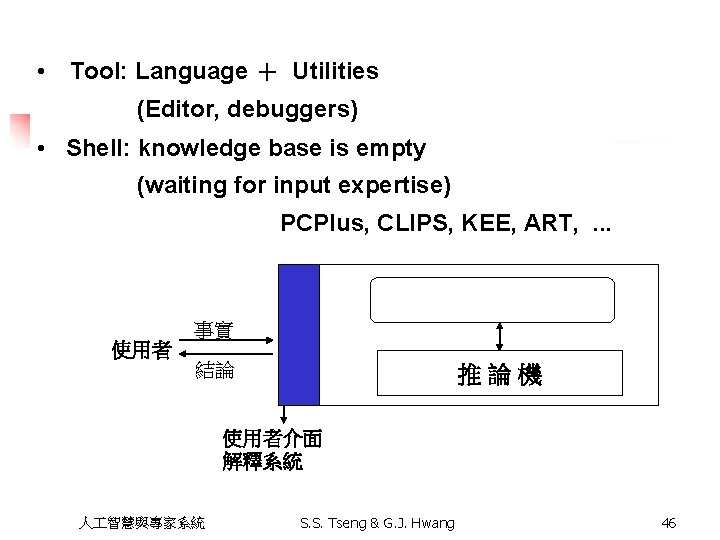
• Tool: Language + Utilities (Editor, debuggers) • Shell: knowledge base is empty (waiting for input expertise) PCPlus, CLIPS, KEE, ART, . . . 使用者 事實 結論 推論機 使用者介面 解釋系統 人 智慧與專家系統 S. S. Tseng & G. J. Hwang 46
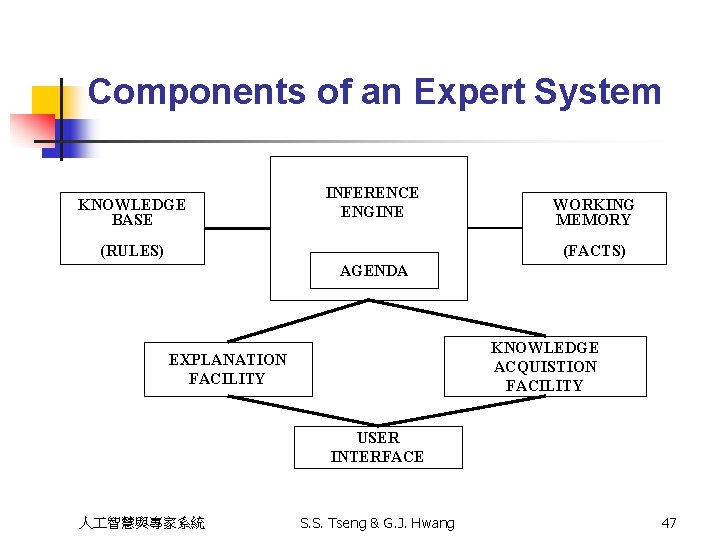
Components of an Expert System KNOWLEDGE BASE INFERENCE ENGINE (RULES) WORKING MEMORY (FACTS) AGENDA KNOWLEDGE ACQUISTION FACILITY EXPLANATION FACILITY USER INTERFACE 人 智慧與專家系統 S. S. Tseng & G. J. Hwang 47
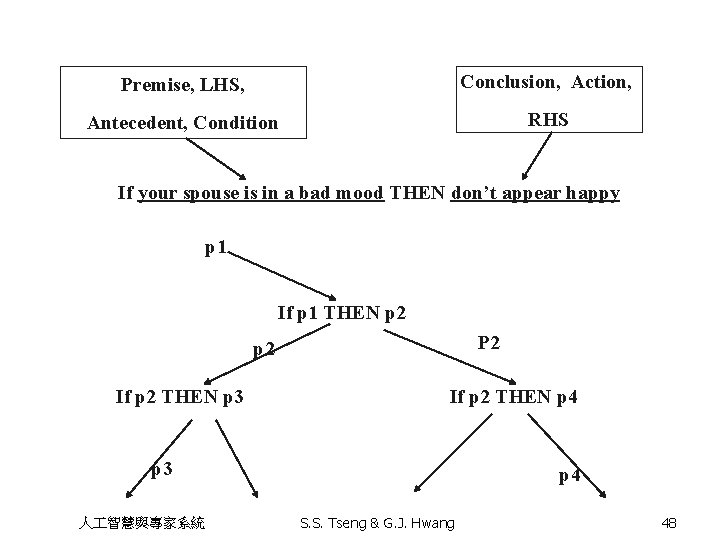
Premise, LHS, Conclusion, Action, Antecedent, Condition RHS If your spouse is in a bad mood THEN don’t appear happy p 1 If p 1 THEN p 2 P 2 p 2 If p 2 THEN p 3 If p 2 THEN p 4 p 3 人 智慧與專家系統 p 4 S. S. Tseng & G. J. Hwang 48
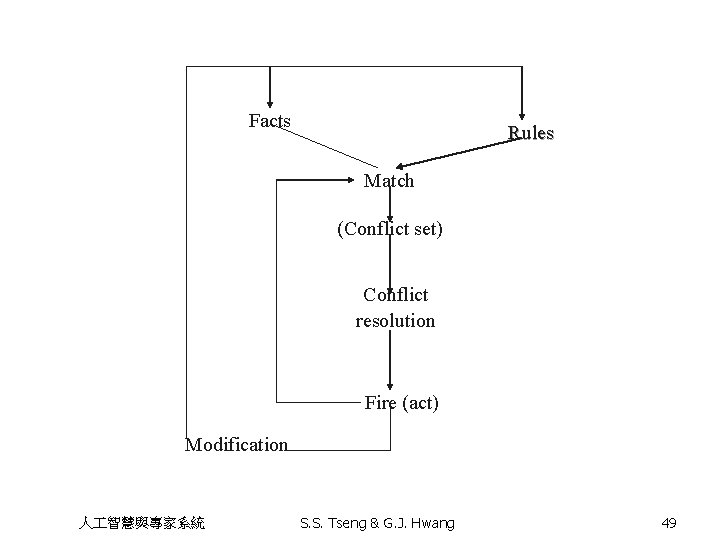
Facts Rules Match (Conflict set) Conflict resolution Fire (act) Modification 人 智慧與專家系統 S. S. Tseng & G. J. Hwang 49
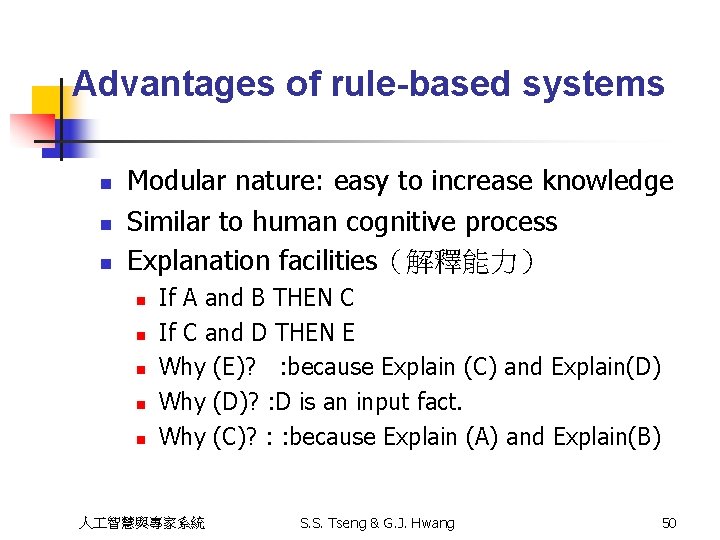
Advantages of rule-based systems n n n Modular nature: easy to increase knowledge Similar to human cognitive process Explanation facilities(解釋能力) n n n If A and B THEN C If C and D THEN E Why (E)? : because Explain (C) and Explain(D) Why (D)? : D is an input fact. Why (C)? : : because Explain (A) and Explain(B) 人 智慧與專家系統 S. S. Tseng & G. J. Hwang 50
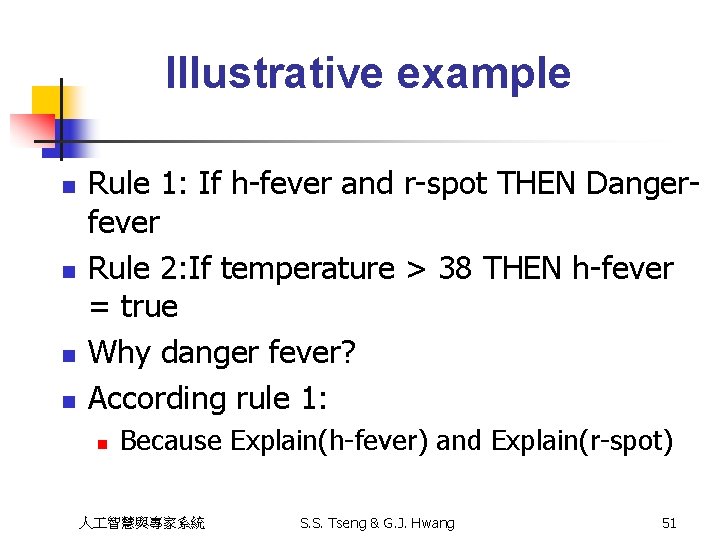
Illustrative example n n Rule 1: If h-fever and r-spot THEN Dangerfever Rule 2: If temperature > 38 THEN h-fever = true Why danger fever? According rule 1: n Because Explain(h-fever) and Explain(r-spot) 人 智慧與專家系統 S. S. Tseng & G. J. Hwang 51
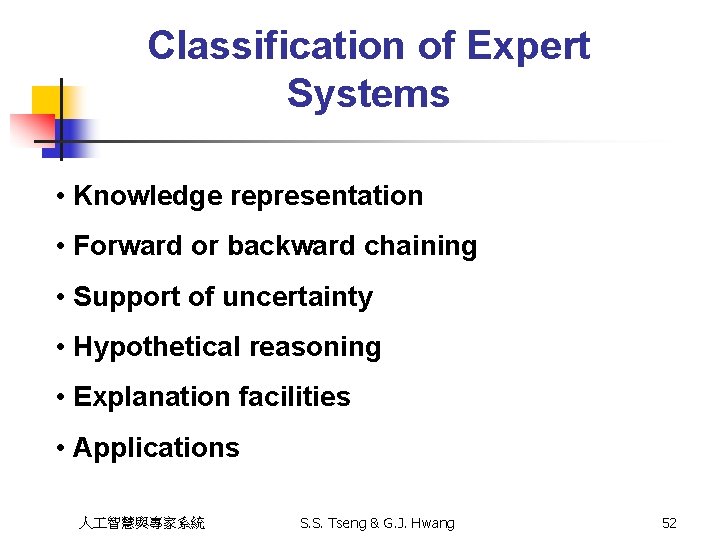
Classification of Expert Systems • Knowledge representation • Forward or backward chaining • Support of uncertainty • Hypothetical reasoning • Explanation facilities • Applications 人 智慧與專家系統 S. S. Tseng & G. J. Hwang 52
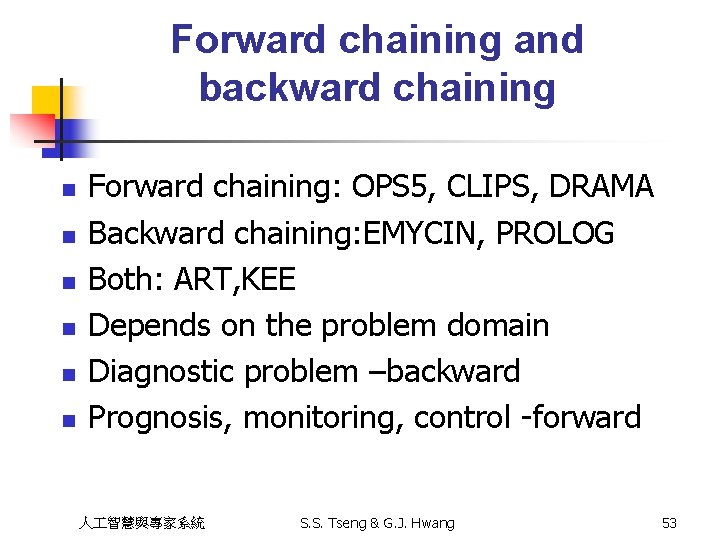
Forward chaining and backward chaining n n n Forward chaining: OPS 5, CLIPS, DRAMA Backward chaining: EMYCIN, PROLOG Both: ART, KEE Depends on the problem domain Diagnostic problem –backward Prognosis, monitoring, control -forward 人 智慧與專家系統 S. S. Tseng & G. J. Hwang 53
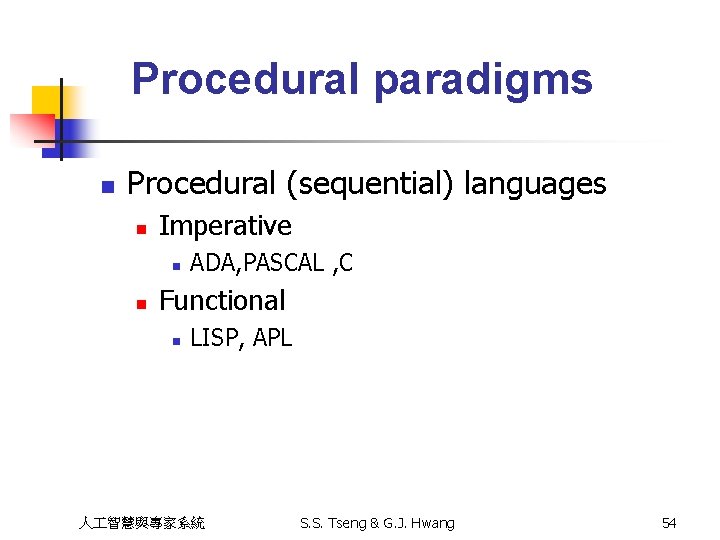
Procedural paradigms n Procedural (sequential) languages n Imperative n n ADA, PASCAL , C Functional n LISP, APL 人 智慧與專家系統 S. S. Tseng & G. J. Hwang 54
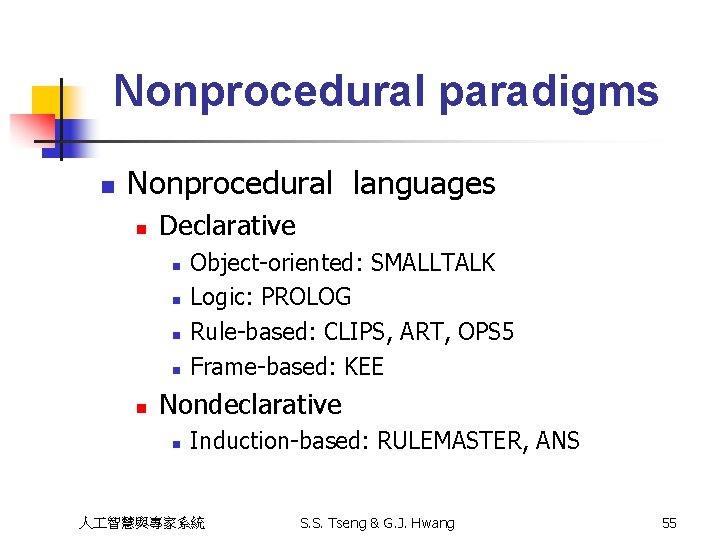
Nonprocedural paradigms n Nonprocedural languages n Declarative n n n Object-oriented: SMALLTALK Logic: PROLOG Rule-based: CLIPS, ART, OPS 5 Frame-based: KEE Nondeclarative n Induction-based: RULEMASTER, ANS 人 智慧與專家系統 S. S. Tseng & G. J. Hwang 55
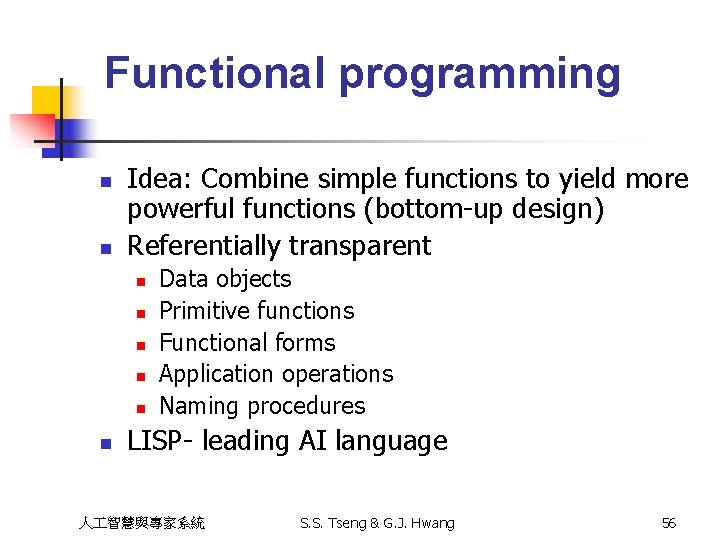
Functional programming n n Idea: Combine simple functions to yield more powerful functions (bottom-up design) Referentially transparent n n n Data objects Primitive functions Functional forms Application operations Naming procedures LISP- leading AI language 人 智慧與專家系統 S. S. Tseng & G. J. Hwang 56
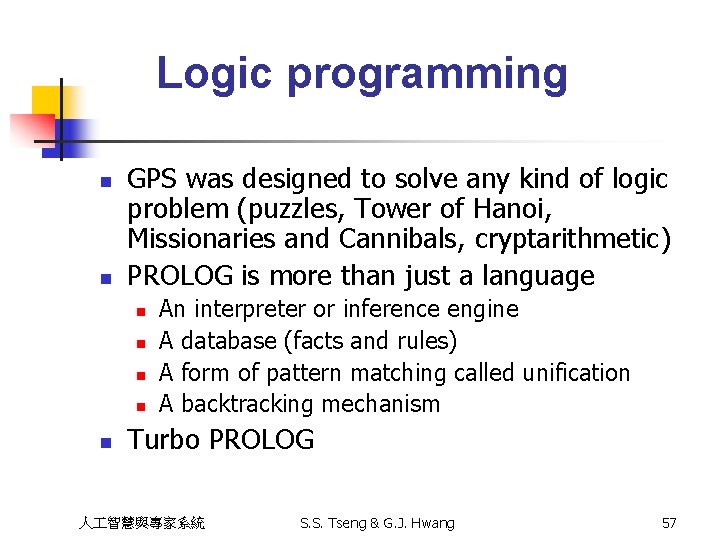
Logic programming n n GPS was designed to solve any kind of logic problem (puzzles, Tower of Hanoi, Missionaries and Cannibals, cryptarithmetic) PROLOG is more than just a language n n n An interpreter or inference engine A database (facts and rules) A form of pattern matching called unification A backtracking mechanism Turbo PROLOG 人 智慧與專家系統 S. S. Tseng & G. J. Hwang 57
Artificial Neural Systems n n ANS based on how the brain processes information Connectionist (neural network) models are attracting interest as useful tools for AI. The “perceptron model” is the simplest, and quite suitable for implementing classification systems Two main disadvantages: n It is very time-consuming when the training set is large n It is only suitable for a linearly separable training set 人 智慧與專家系統 S. S. Tseng & G. J. Hwang 59
習 題(1/2) 1. Identify a person other than yourself who is considered either an expert or very knowledgeable. Interview this expert and discuss how well this person’s expertise would be modeled by an expert system in terms of each criterion in “advantages of Expert Systems” n n Write ten nontrivial rules expressing the knowledge of the expert in the above problem. Show that each of the ten rules gives the correct advice. 人 智慧與專家系統 S. S. Tseng & G. J. Hwang 63
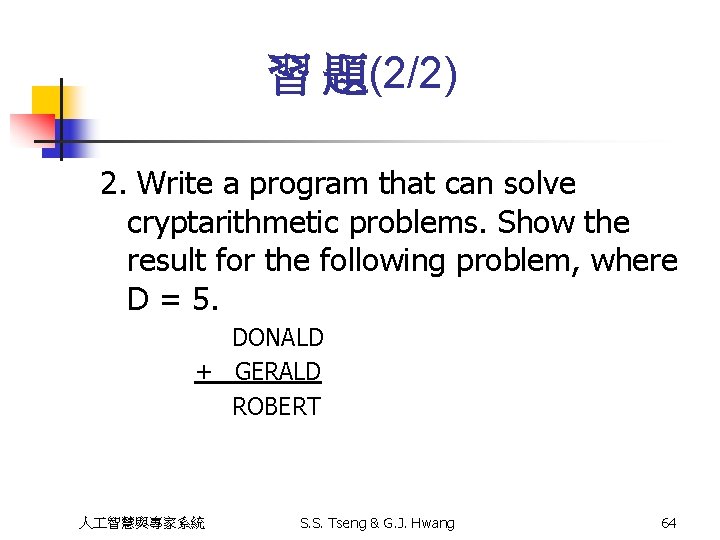
習 題(2/2) 2. Write a program that can solve cryptarithmetic problems. Show the result for the following problem, where D = 5. DONALD + GERALD ROBERT 人 智慧與專家系統 S. S. Tseng & G. J. Hwang 64
- Slides: 64