
Chapter 1 Global Politics Matters Chapter 1 Global
Chapter 1 Global Politics Matters

Chapter 1 Global Politics Matters Topics • Why Global Politics Matters • Global Politics • Grappling with Global Complexity © 2018 2
Chapter 1 Learning Objectives • 1. 1 Discuss the ways that global politics directly and indirectly affects you and your world. • 1. 2 Discuss the complexity of global politics within the context of history and the changing types and roles of global actors. Theory will help shape that discussion throughout this book © 2018 3
Why Global Politics Matters 1 of 7 • Global challenges impact your life and your local community. • The history, theories, and practices of global politics. © 2018 4
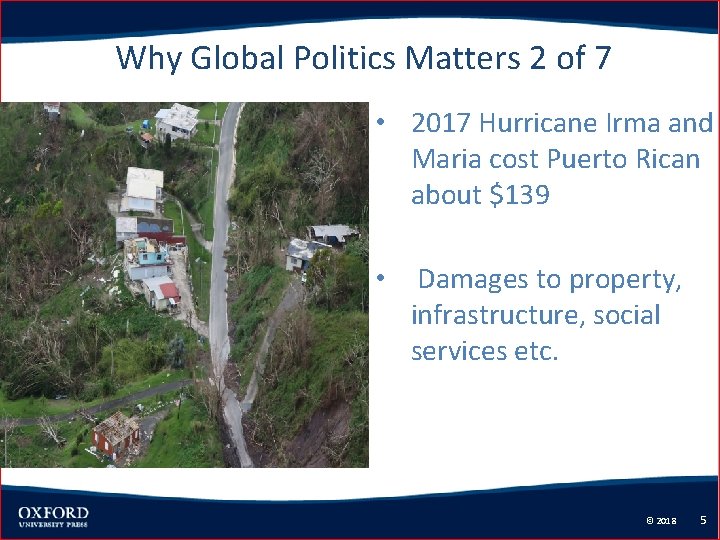
Why Global Politics Matters 2 of 7 • 2017 Hurricane Irma and Maria cost Puerto Rican about $139 • Damages to property, infrastructure, social services etc. © 2018 5
Why Global Politics Matters 3 of 7 Global economic issues often affect national affairs • The 2015 Canadian election • The 2016 Brexit vote in the United Kingdom • The 2016 U. S. presidential election • The 2018 election of Jair Bolsonaro in Brazil © 2018 6
Why Global Politics Matters 4 of 7 Global Politics and Climate Change • 2018 UN report; 0. 5°C of warm could expose tens of millions • Life-threatening heat waves, water shortages, and coastal flooding • Impact physical environment for e. g. air quality, drinking water, food © 2018 7
Why Global Politics Matters 5 of 7 © 2018 8
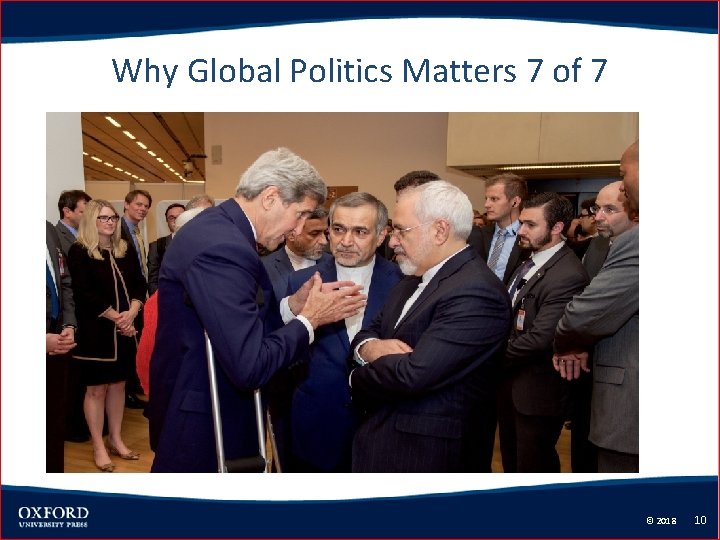
Why Global Politics Matters 6 of 7 Global Politics affects your personal security • Diseases and potential violence are high-value, low-probability problems • The 2015 Iran nuclear deal is an example of a high-value, low-probability challenge • Individually and collectively problems © 2018 9
Why Global Politics Matters 7 of 7 © 2018 10
Grappling with Global Complexity 1 of 16 • Less support for U. S. military action in Iraq and Afghanistan 2000 s compared to 1990 s • Globally commitment to environmental sustainability but fail to deliver • impossible to get consensus on economic policies © 2018 11
Grappling with Global Complexity 2 of 16 The Study of Global Politics • Topics of IR dates back millennium in ancient India and biblical times • Focus on modern IR oriented to the responses to World War I • The study of global politics evolves and grow © 2018 12
Grappling with Global Complexity 3 of 16 The Study of Global Politics • The current actors in global affairs are constantly changing • Term global better capture the scope of global interactions • The term better captures the multifaceted process of Globalization © 2018 13
Grappling with Global Complexity 4 of 16 Global Actors • Most actors in global politics are organizations • States or countries Primary types of organizational actors • Sovereignty central organizing principle of all states • Lack of central governing authority is anarchy • States engage in the global system in different and asymmetrical ways. © 2018 14
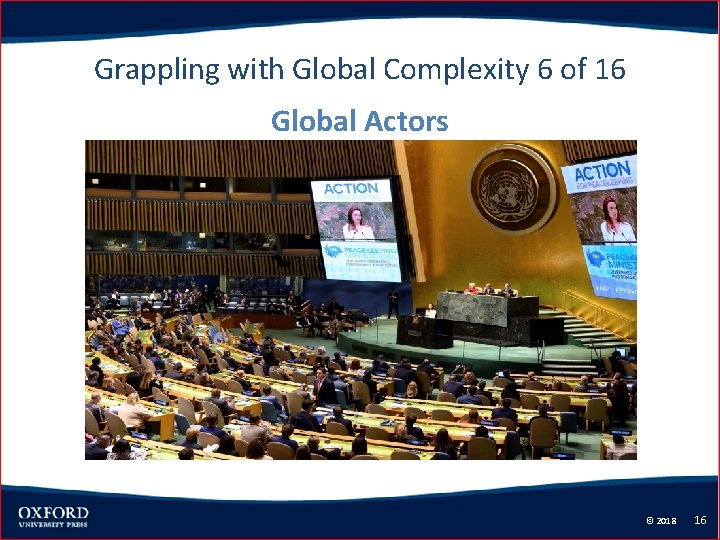
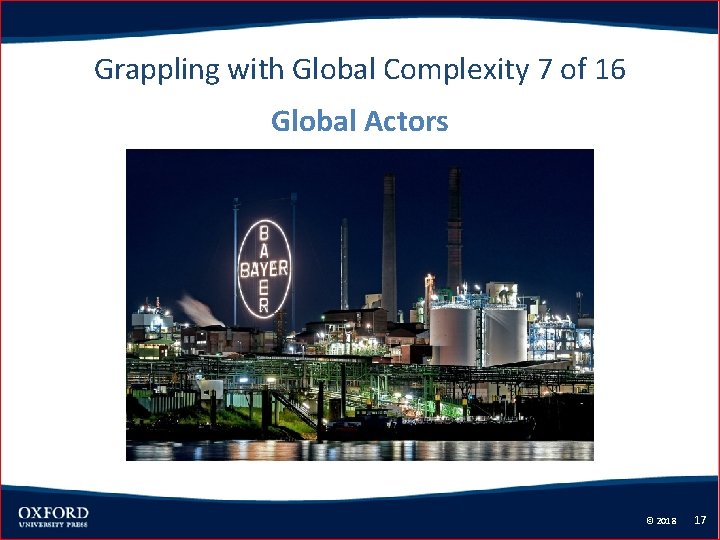
Grappling with Global Complexity 5 of 16 Global Actors • • • International Organizations Actors that are surrounded on a particular issue about 300 prominent (IGOs) Lack of central governing authority is anarchy NGOs; formal, legal entities distinct from the state MNCs; are private enterprises © 2018 15
Grappling with Global Complexity 6 of 16 Global Actors © 2018 16
Grappling with Global Complexity 7 of 16 Global Actors © 2018 17
Grappling with Global Complexity 8 of 16 Global History in Context • Leaders and communities must learn from the past • History provides details on critical events • History help foster generalizations © 2018 18
Grappling with Global Complexity 9 of 16 Global History in Context © 2018 19
Grappling with Global Complexity 10 of 16 Global History in Context • • • The Peace of Westphalia of 1648 Sovereignty to most small states in Europe Ending the ruling Holy Roman Empire Monarchs were able to decide their domestic policies States became the primary actors post-Westphalian States are still the most dominant actors © 2018 20
Grappling with Global Complexity 11 of 16 Global History in Context • • • The dominance of states in IR theory Realism; state as the main actor in global affairs Realism; polarity or concentration of power Cold War; bipolar system Multipolar system characterized in the 1990 s Realism’s dominance began to breakdown early 20 th © 2018 21
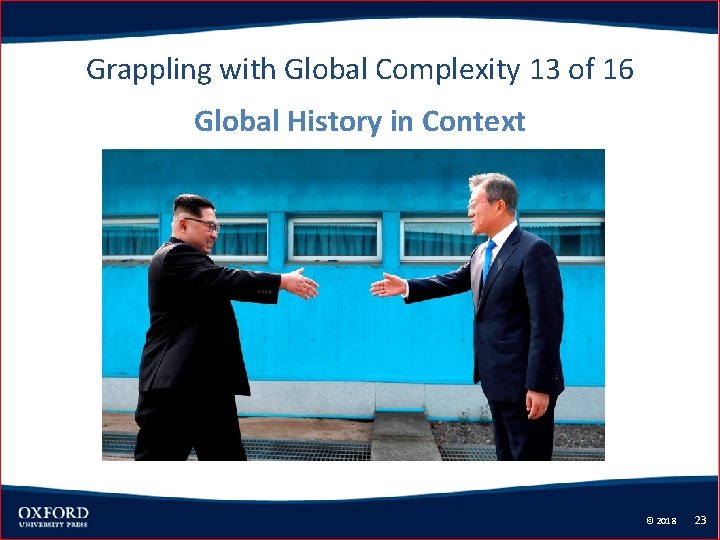
Grappling with Global Complexity 12 of 16 Global History in Context • • • The dominance of states in IR theory IR early 20 th ; economic issues and non-state actors Imperial Western collapsed post World War II The Global North – Global South Divide continues North and South Korea still at Korean War Globalization has empowered non-state actors © 2018 22
Grappling with Global Complexity 13 of 16 Global History in Context © 2018 23
Grappling with Global Complexity 14 of 16 Interpreting Global Politics • Traditionally, global politics has been tumultuous and often violent • 2017 report Global Peace Index; world is more peaceful • Traditional conceptions of analyzing global politics are not as they once were in academia or in policy © 2018 24
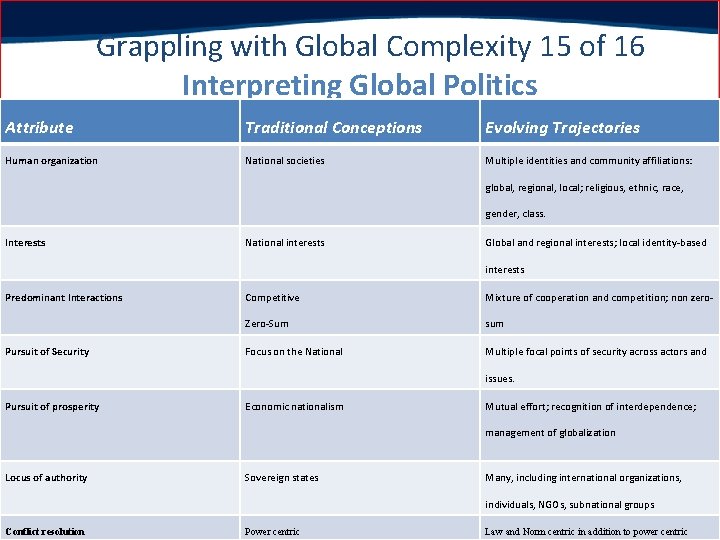
Grappling with Global Complexity 15 of 16 Interpreting Global Politics Attribute Traditional Conceptions Evolving Trajectories Human organization National societies Multiple identities and community affiliations: global, regional, local; religious, ethnic, race, gender, class. Interests National interests Global and regional interests; local identity-based interests Predominant Interactions Pursuit of Security Competitive Mixture of cooperation and competition; non zero- Zero-Sum sum Focus on the National Multiple focal points of security across actors and issues. Pursuit of prosperity Economic nationalism Mutual effort; recognition of interdependence; management of globalization Locus of authority Sovereign states Many, including international organizations, individuals, NGOs, subnational groups Conflict resolution Power centric © 2018 Law and Norm centric in addition to power centric 25
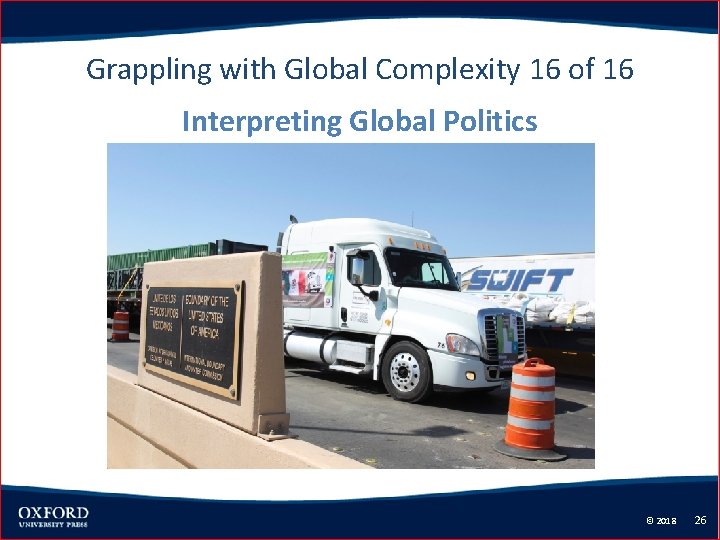
Grappling with Global Complexity 16 of 16 Interpreting Global Politics © 2018 26
Thinking Theoretically 1 of Tools for Studying Global Politics • Understanding world allows us to make sense of what is going on • Several theoretical perspectives • The on-going Brexit situation; UK and EU conflicted history © 2018 27
Thinking Theoretically 1 of Tools for Studying Global Politics • Draw on history and theory to help think critically about the world • Theory allows us to describe, explain, and even predict phenomena • Theory helps build knowledge © 2018 28
Thinking Theoretically 1 of Tools for Studying Global Politics Five different theoretical perspectives • Realism and Liberalism (the dominant theories) • World Systems, Feminism, and Constructivism (provoking challenges to their dominant theories) © 2018 29
Thinking Theoretically 1 of Tools for Studying Global Politics • Each theory has numerous variations • Realists do not necessarily see things as they “really” are • liberal” here with left-of-center political parties in American domestic politics. • No theories discussed are truly comprehensive • Liberal are not left-of-center political parties in U. S. • Liberalism is more closely tied to the writing of 18 th and 19 th © 2018 30
Chapter 1 Review of Learning Objectives • 1. 1 Discuss the ways that global politics directly and indirectly affects you and your world. • 1. 2 Discuss the complexity of global politics within the context of history and the changing types and roles of global actors. Theory will help shape that discussion throughout this book © 2018 31
- Slides: 31