
Chapter 1 Foundations of Information Systems in Business
Chapter 1 Foundations of Information Systems in Business James A. O'Brien, and George Marakas. Management Information Systems with MISource 2007, 8 th ed. Boston, MA: Mc. Graw-Hill, Inc. , 2007. ISBN: 13 9780073323091
Foundation Concepts n Why study information systems and information technology? ¨ Vital component of successful businesses ¨ Helps businesses expand compete ¨ Improves efficiency and effectiveness of business processes ¨ Facilitates managerial decision making and workgroup collaboration Chapter 1 Foundations of Information Systems in Business 2
What is a System? n n A set of interrelated components With a clearly defined boundary Working together To achieve a common set of objectives Chapter 1 Foundations of Information Systems in Business 3
What is an Information System? n n An organized combination of… ¨ People ¨ Hardware and software ¨ Communication networks ¨ Data resources ¨ Policies and procedures This system… ¨ Stores, retrieves, transforms, and disseminates information in an organization Chapter 1 Foundations of Information Systems in Business 4
Information Technologies n n n Information Systems ¨ All the components and resources necessary to deliver information and functions to the organization ¨ Could be paper based Information Technologies ¨ Hardware, software, networking, data management Our focus will be on computer-based information systems (CBIS) Chapter 1 Foundations of Information Systems in Business 5
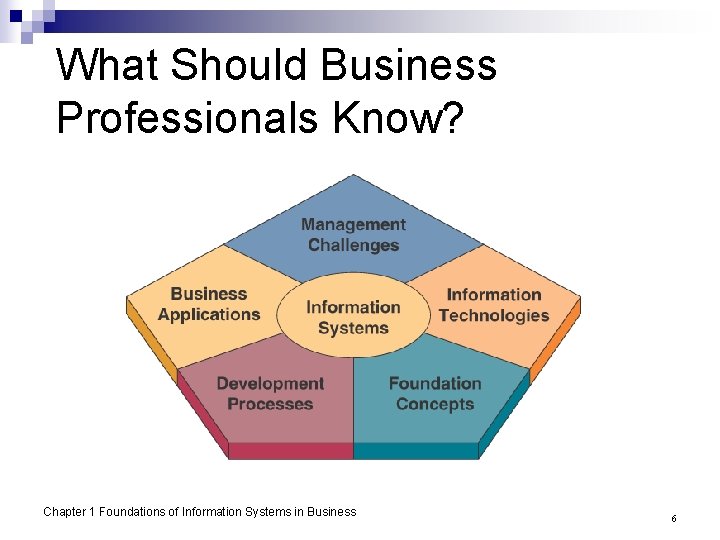
What Should Business Professionals Know? Chapter 1 Foundations of Information Systems in Business 6
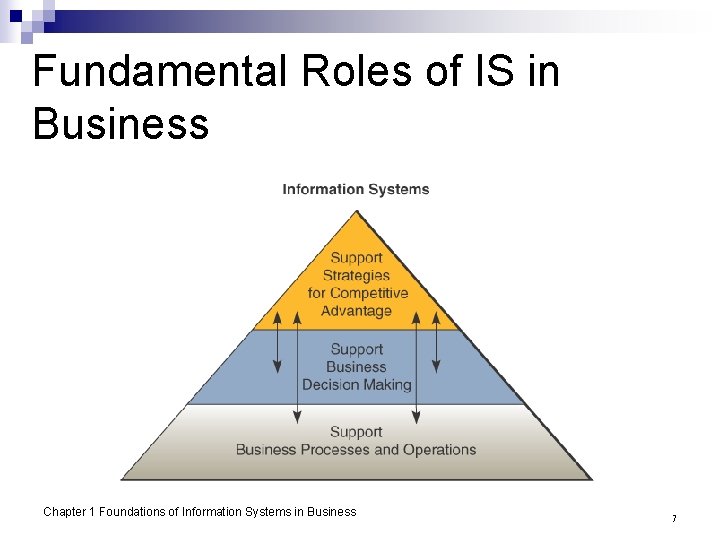
Fundamental Roles of IS in Business Chapter 1 Foundations of Information Systems in Business 7
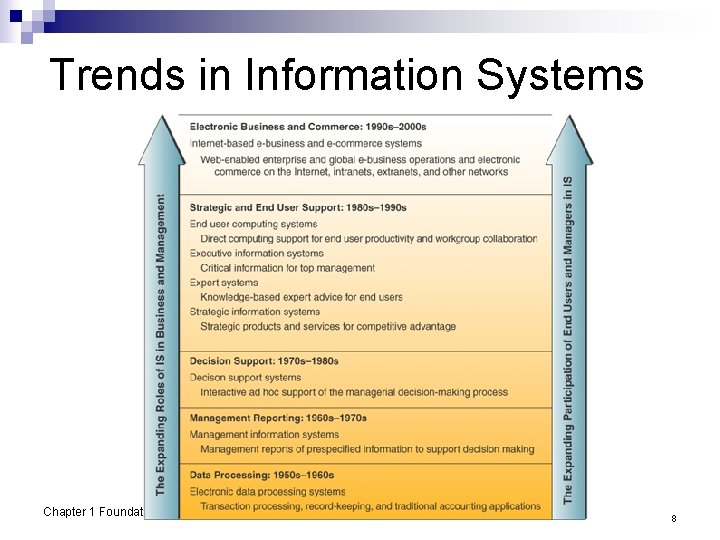
Trends in Information Systems Chapter 1 Foundations of Information Systems in Business 8
What is E-Business? n n Using Internet technologies to empower… ¨ Business processes ¨ Electronic commerce ¨ Collaboration within a company ¨ Collaboration with customers, suppliers, and other business stakeholders In essence, an online exchange of value Chapter 1 Foundations of Information Systems in Business 9
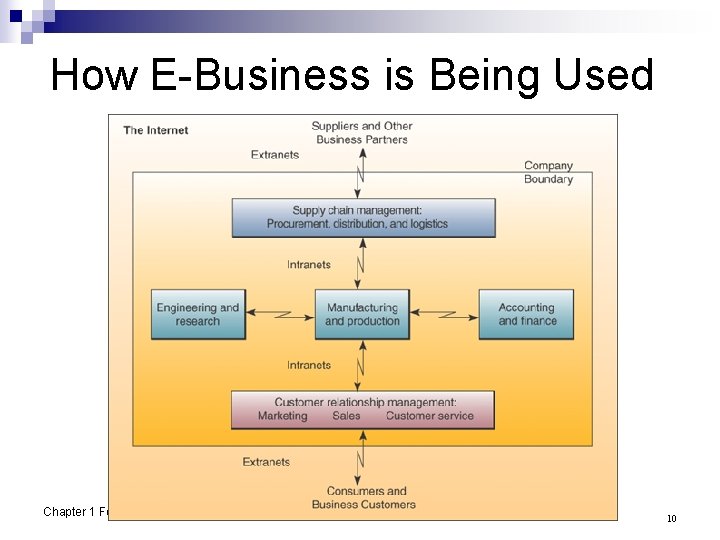
How E-Business is Being Used Chapter 1 Foundations of Information Systems in Business 10
E-Business Use n n n Reengineering ¨ Internal business processes Enterprise collaboration systems ¨ Support communications, coordination and coordination among teams and work groups Electronic commerce ¨ Buying, selling, marketing, and servicing of products and services over networks Chapter 1 Foundations of Information Systems in Business 11
Types of Information Systems n n Operations Support Systems ¨ Efficiently process business transactions ¨ Control industrial processes ¨ Support communication and collaboration ¨ Update corporate databases Management Support Systems ¨ Provide information as reports and displays ¨ Give direct computer support to managers during decision-making Chapter 1 Foundations of Information Systems in Business 12
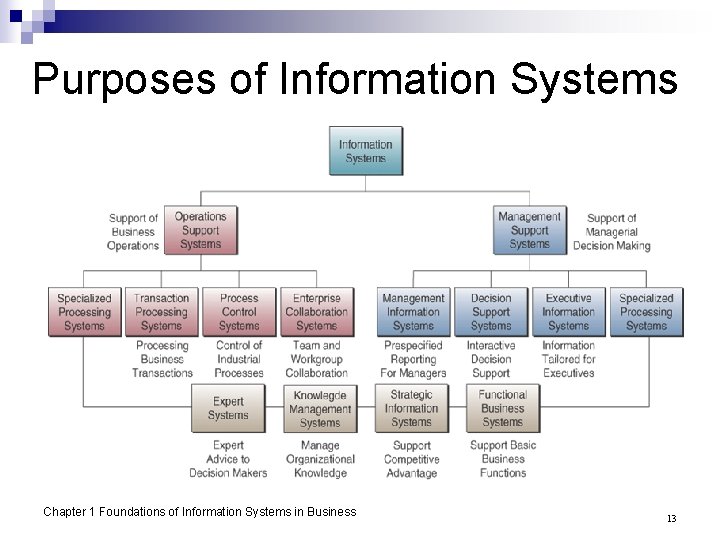
Purposes of Information Systems Chapter 1 Foundations of Information Systems in Business 13
Operations Support Systems n What do they do? ¨ Efficiently process business transactions ¨ Control industrial processes ¨ Support communications and collaboration ¨ Update corporate databases Chapter 1 Foundations of Information Systems in Business 14
Types of OSS n n n Transaction Processing Systems ¨ Record and process business transactions ¨ Example: sales processing, inventory systems, accounting systems Process Control Systems ¨ Monitor and control physical processes ¨ Example: using sensors to monitor chemical processes in a petroleum refinery Enterprise Collaboration Systems ¨ Enhance team and workgroup communication ¨ Example: email, video conferencing Chapter 1 Foundations of Information Systems in Business 15
Two Ways to Process Transactions n Batch Processing ¨ Accumulate transactions over time and process periodically ¨ Example: a bank processes all checks received in a batch at night n Online Processing ¨ Process transactions immediately ¨ Example: a bank processes an ATM withdrawal immediately Chapter 1 Foundations of Information Systems in Business 16
Management Support Systems n What do they do? ¨ Provide information and support for effective decision making by managers n Management information systems n Decision support systems n Executive information systems Chapter 1 Foundations of Information Systems in Business 17
Types of Management Support Systems n n n Management Information Systems (MIS) ¨ Reports and displays ¨ Example: daily sales analysis reports Decision Support Systems (DSS) ¨ Interactive and ad hoc support ¨ Example: a what-if analysis to determine where to spend advertising dollars Executive Information Systems (EIS) ¨ Critical information for executives and managers ¨ Example: easy access to actions of competitors Chapter 1 Foundations of Information Systems in Business 18
Other Information Systems n n Expert Systems - provide expert advice ¨ Example: credit application advisor Knowledge Management Systems - support creation, organization, and dissemination of business knowledge throughout company ¨ Example: intranet access to best business practices Strategic Information Systems - help get a strategic advantage over customer ¨ Example: shipment tracking, e-commerce Web systems Functional Business Systems - focus on operational and managerial applications of basic business functions ¨ Example: accounting, finance, or marketing Chapter 1 Foundations of Information Systems in Business 19
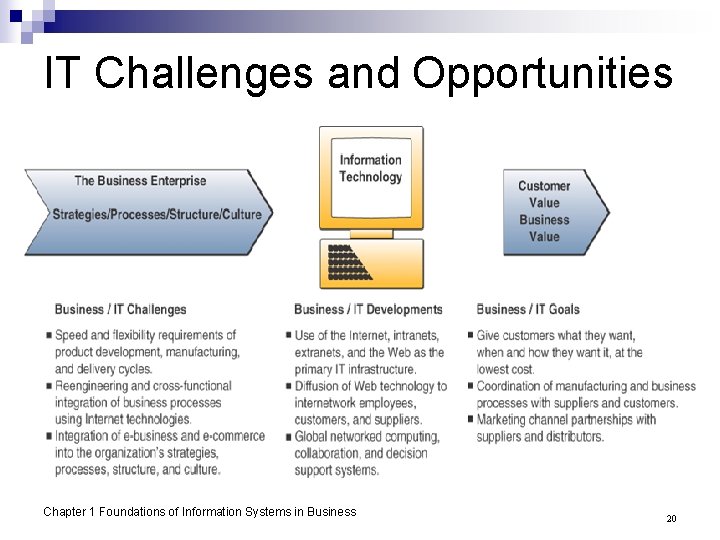
IT Challenges and Opportunities Chapter 1 Foundations of Information Systems in Business 20
Measuring IT Success n Efficiency ¨ Minimize cost, time, and use of information resources n Effectiveness ¨ Support business strategies ¨ Enable business processes ¨ Enhance organizational structure and culture ¨ Increase customer and business value Chapter 1 Foundations of Information Systems in Business 21
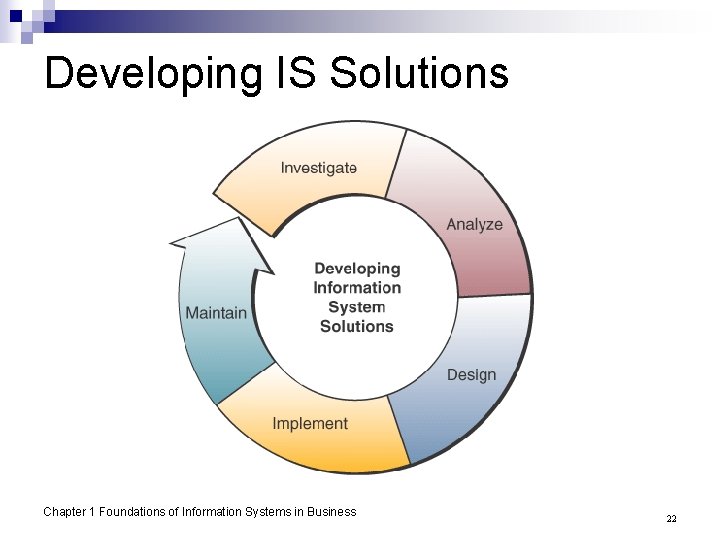
Developing IS Solutions Chapter 1 Foundations of Information Systems in Business 22
Challenges and Ethics of IT n n Application of IT ¨ Customer relationship management ¨ Human resources management ¨ Business intelligence systems Potential Harm ¨ Infringements on privacy ¨ Inaccurate information ¨ Collusion Potential Risks ¨ Consumer boycotts ¨ Work stoppages ¨ Government intervention Possible Responses ¨ Codes of ethics ¨ Incentives ¨ Certification Chapter 1 Foundations of Information Systems in Business 23
Ethical Responsibilities n n n What uses of IT might be considered improper or harmful to other individuals or society? What is the proper business use of the Internet or a company’s IT resources? How can you protect yourself from computer crime? Chapter 1 Foundations of Information Systems in Business 24
IT Careers n n n Economic downturns have affected all job sectors, including IT Rising labor costs are pushing jobs to India, the Middle East, and Asia-Pacific countries However, IT employment opportunities are strong, with new jobs emerging daily Shortages of IT personnel are frequent The long-term job outlook is positive and exciting Figure Chapter 1 Foundations of Information Systems in Business 25
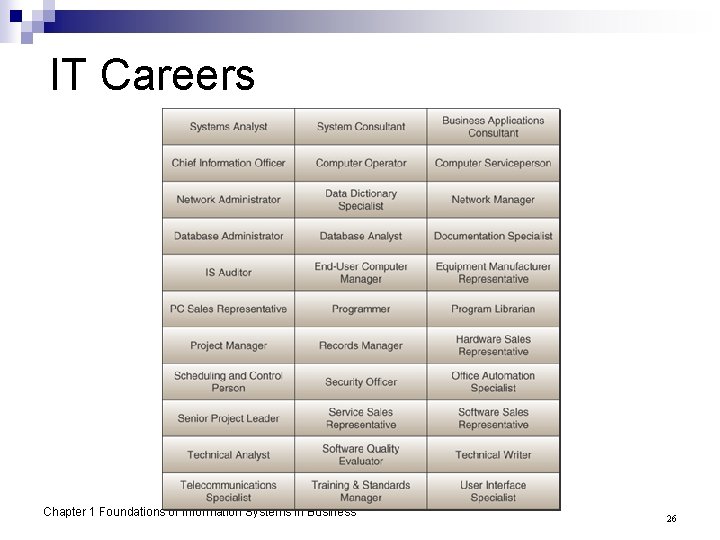
IT Careers Chapter 1 Foundations of Information Systems in Business 26
IT Careers n Job increases will be driven by… ¨ Rapid growth in computer system design and related services ¨ The need to backfill positions ¨ Information sharing and client/server environments ¨ The need for those with problem-solving skills ¨ Falling hardware and software prices, which will fuel expanded computerization of operations Chapter 1 Foundations of Information Systems in Business 27
The IS Function n The IS function is… ¨ A major functional area of business ¨ An important contributor to operational efficiency, employee productivity, morale, customer service and satisfaction ¨ A major source of information and support for decision making ¨ A vital ingredient in developing competitive products and services in the global marketplace ¨ A dynamic and challenging career opportunity ¨ A key component of today’s networked business Chapter 1 Foundations of Information Systems in Business 28
System Concepts: A Foundation n System concepts help us understand… ¨ Technology: hardware, software, data management, telecommunications networks ¨ Applications: to support inter-connected information systems ¨ Development: developing ways to use information technology includes designing the basic components of information systems ¨ Management: emphasizes the quality, strategic business value, and security of an organization’s information systems Chapter 1 Foundations of Information Systems in Business 29
What is a System? n A system is… ¨ A set of interrelated components ¨ With a clearly defined boundary ¨ Working together ¨ To achieve a common set of objectives ¨ By accepting inputs and producing outputs ¨ In an organized transformation process Chapter 1 Foundations of Information Systems in Business 30
Basic Functions of a System n n n Input ¨ Capturing and assembling elements that enter the system to be processed Processing ¨ Transformation process that converts input into output Output ¨ Transferring transformed elements to their ultimate destination Chapter 1 Foundations of Information Systems in Business 31
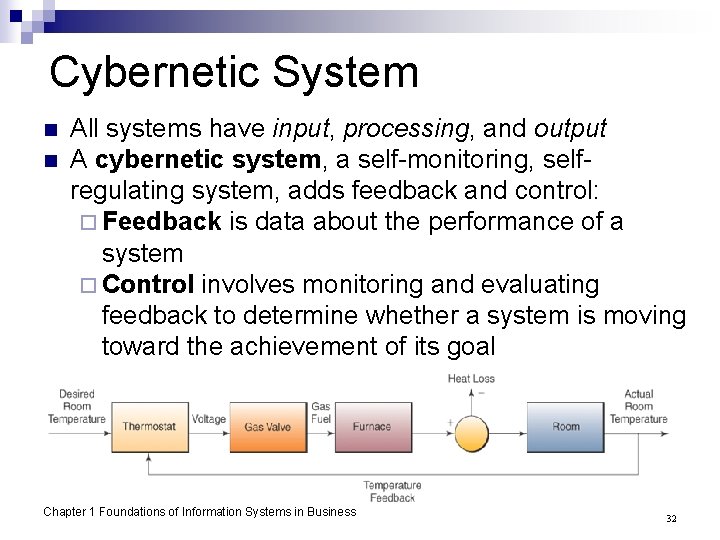
Cybernetic System n n All systems have input, processing, and output A cybernetic system, a self-monitoring, selfregulating system, adds feedback and control: ¨ Feedback is data about the performance of a system ¨ Control involves monitoring and evaluating feedback to determine whether a system is moving toward the achievement of its goal Chapter 1 Foundations of Information Systems in Business 32
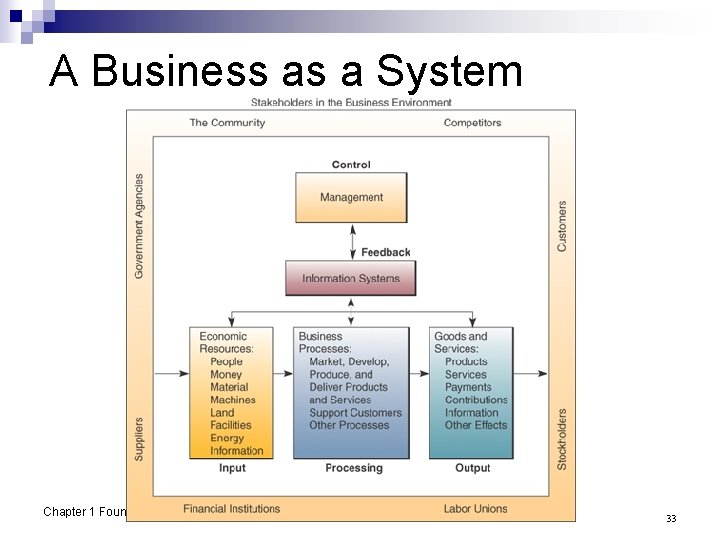
A Business as a System Chapter 1 Foundations of Information Systems in Business 33
Other System Characteristics n n n If a system is one of the components of a larger system, it is a subsystem ¨ The larger system is an environment Several systems may share the same environment ¨ Some may be connected via a shared boundary, or interface Types of systems… ¨ Open ¨ Adaptive Chapter 1 Foundations of Information Systems in Business 34
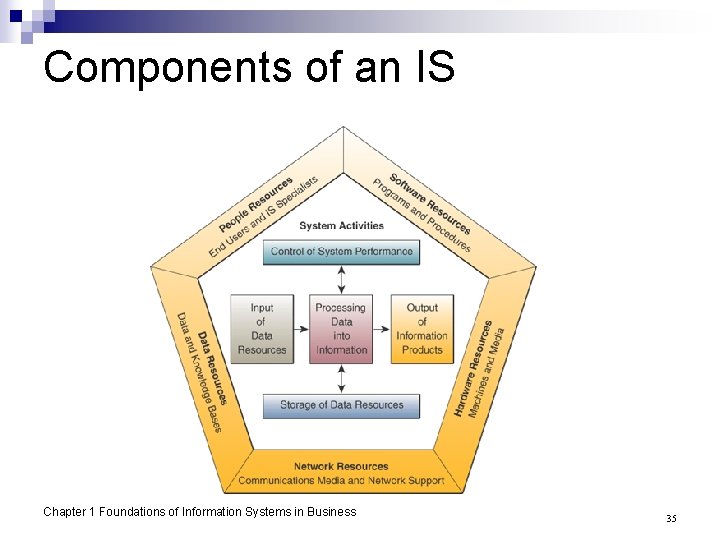
Components of an IS Chapter 1 Foundations of Information Systems in Business 35
Information System Resources n n n People Resources ¨ Specialists ¨ End users Hardware Resources ¨ Machines ¨ Media Software Resources ¨ Programs ¨ Procedures Data Resources ¨ Product descriptions, customer records, employee files, inventory databases Network Resources ¨ Communications media, communications processors, network access and control software Information Resources ¨ Management reports and business documents using text and graphics displays, audio responses, and paper forms Chapter 1 Foundations of Information Systems in Business 36
Data Versus Information n Data are raw facts about physical phenomena or business transactions Information is data that has been converted into meaningful and useful context for end users Example: ¨ Sales data is names, quantities, and dollar amounts ¨ Sales information is amount of sales by product type, sales territory, or salesperson Chapter 1 Foundations of Information Systems in Business 37
IS Activities n n n Input of data resources ¨ Data entry activities Processing of data into information ¨ Calculations, comparisons, sorting, and so on Output of information products ¨ Messages, reports, forms, graphic images Storage of data resources ¨ Data elements and databases Control of system performance ¨ Monitoring and evaluating feedback Chapter 1 Foundations of Information Systems in Business 38
Recognizing IS n Business professionals should be able to look at an information system and identify… ¨ The people, hardware, software, data, and network resources they use ¨ The type of information products they produce ¨ The way they perform input, processing, output, storage, and control activities Chapter 1 Foundations of Information Systems in Business 39
- Slides: 41