
Chapter 1 Forming a Personal Philosophy about Literacy
Chapter 1 Forming a Personal Philosophy about Literacy Assessment and Intervention
Examples of the Importance of Literacy Warning signs Disclaimers Instructional manuals and directions Road signs Help-wanted ads Tax forms Insurance policies Information on the Internet What are some others?
Theories Related to Literacy Constructivist theory Zone of proximal development Hierarchy of human needs Critical literacy theory
Basic Human Needs Physiological: oxygen, water, food, shelter, etc. Safety: security in one’s present environment Love and belonging: acceptance by others Esteem: feeling good about oneself and having the respect of others Self-actualization: knowledge that one has fulfilled one’s potential As a teacher, what is your role in helping to meet your students’ needs?
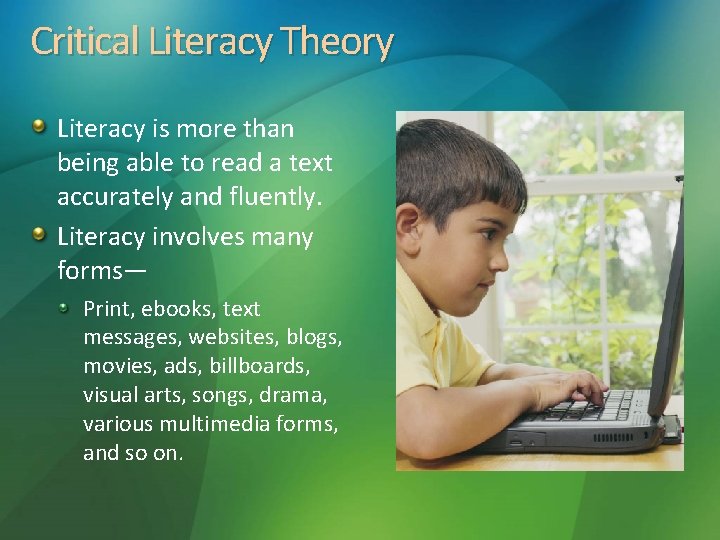
Critical Literacy Theory Literacy is more than being able to read a text accurately and fluently. Literacy involves many forms— Print, ebooks, text messages, websites, blogs, movies, ads, billboards, visual arts, songs, drama, various multimedia forms, and so on.
Critical Literacy Classrooms are “places in which students should come to understand how and why knowledge and power are constructed. ” Lloyd, 2003, p. 1 Teachers’ ultimate critical literacy goal: to help students find their voices and take action against social injustices.
Critical Literacy Questions to Consider When Reading/Viewing Text How are meanings assigned to figures or events? How does the text get readers to accept its constructs? What is the purpose of the text? Whose interests are, or are not, served by the dissemination of this text? What view of the world is put forth by the ideas in this text? What views are not? What are some other possible constructions of the world?
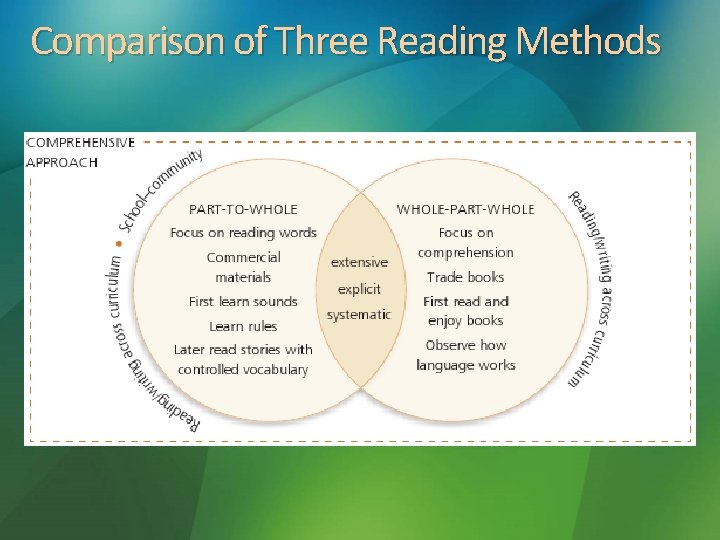
Comparison of Three Reading Methods
Reflections on Being the Most Effective Teacher You Can Be How will you teach reading and writing to students who do not speak English? How will you teach reading and writing to an autistic child? How will you challenge a student who has been identified as gifted but struggles with reading and writing? How will you work with students who have learning disabilities? How will you work with students who lack motivation?
Some Statistics About English Learners In 2007, 5 percent of K– 12 students were English learners. By 2050, this is expected to increase to 40 percent. Center for Public Education, 2010 a; IRA, 2001 Only 13 percent of the schools with English learners have an ESL or bilingual program. IRA, 2004.
Stages of English Language Development Silent stage Early production stage Productive stage Intermediate fluency language stage
Effective Practices When Working with English Learners Be respectful of their culture Base lessons on students’ interests Provide well-qualified tutors Provide meaningful, challenging learning tasks When possible, teach in both the student’s native language and English Allow students to talk and ask questions in a risk-free environment Display cognates on a word wall Provide social settings so English learners can learn from communicating with peers
Other Theories and Approaches for Working with English Learners I + 1 Theory Visual scaffolding Total physical response Sheltered instruction Choral reading Interactive writing Language experience approach Using audio books Shared reading
Your Personal Views of Reading Instruction How do you view reading? As a set of skills? As a holistic event?
Historical Overview of Reading Reforms Federal law mandates quality instruction that ensures that all children―regardless of race, gender, or ability―will reach their potential. Elementary and Secondary Education Act of 1966 The America Reads Challenge Act, 1997 The National Reading Panel Act, 1997 No Child Left Behind Act, 2001 Continuing emphasis on scientifically based research Response to Intervention, 2004
“Five Missing Pillars of Scientific Reading Instruction” (Allington, 2006) Students need access to, and a choice of, a wide variety of interesting narrative and informational texts on their reading level. Students need to be given text they can read. Writing and reading are reciprocal. Students vary greatly in their reading abilities at every grade level and instruction must recognize these differences. Many students need tutoring from an expert if they are to accelerate their reading development.
Guiding Principles for RTI Instruction Responsive teaching and differentiation Assessment Collaboration Systemic and comprehensive program Expertise
A Sample RTI Process Establish benchmarks Provide intervention in the areas of greatest need Monitor and record student progress Offer more intense intervention—either individualized or in very small groups After a long period of time, assess the student again
Multimodal Literacy Four basic literacies: Technological literacy Visual literacy Media literacy Informational literacy Students are motivated to develop multiliteracy skills because: Technology fosters interaction Learning becomes social
Examples of New Technologies for Learning www. funbrain. com Social networking sites Web. Quests Creating one’s own website Editing Wikipedia articles
Effective Teachers. . . Understand the era in which they are teaching Strive to help all students grow in their reading and overall literacy abilities Develop a philosophy of teaching through study, observation, and practice Are knowledgeable about learning theories and reading models What else would you add?
Related Video Presentations You can see video interviews with a primary teacher and an intermediate teacher about assessment and intervention strategies.
- Slides: 22