
Chapter 1 Financial Accounting Fundamentals 1 What is
- Slides: 23
Chapter 1 Financial Accounting Fundamentals 1
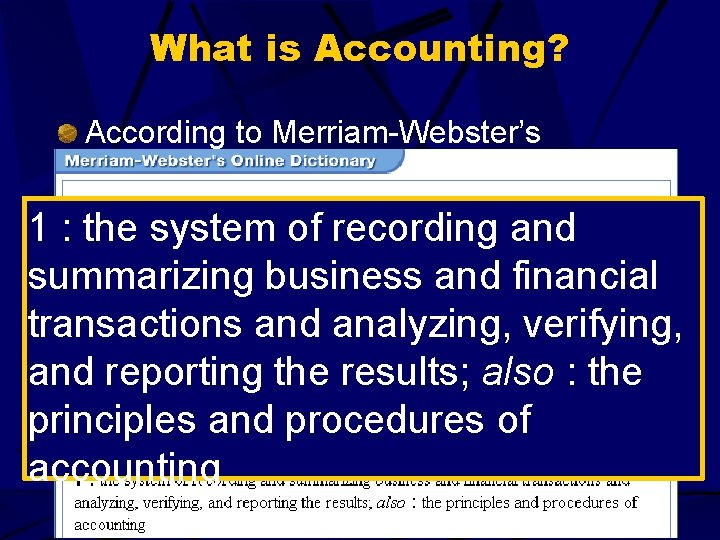
What is Accounting? According to Merriam-Webster’s dictionary accounting is … 1 : the system of recording and summarizing business and financial transactions and analyzing, verifying, and reporting the results; also : the principles and procedures of accounting 2
What is Accounting? Does accounting only apply in the business world? What day-to-day activities are related to accounting? Can you think of any games that would lend themselves to the world of accounting? 3
Five Main Activities? 1. Gathering financial information. 2. Preparing and collecting permanent records. 3. Rearranging, summarizing, and classifying financial information. 4
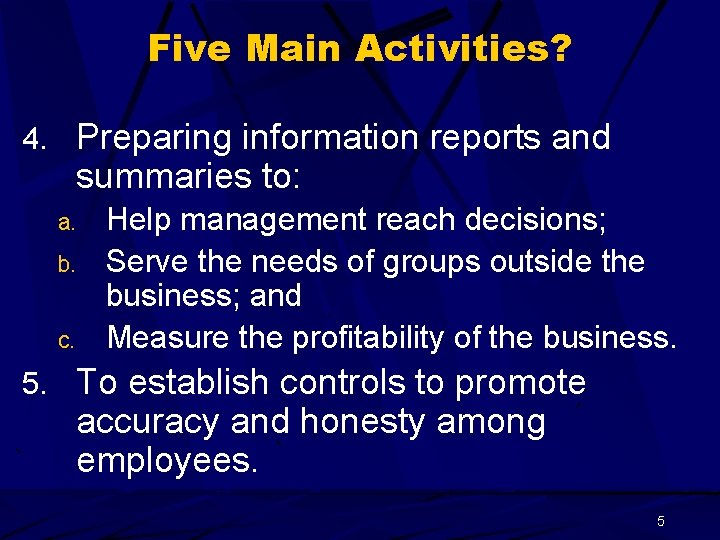
Five Main Activities? 4. Preparing information reports and summaries to: a. b. c. Help management reach decisions; Serve the needs of groups outside the business; and Measure the profitability of the business. 5. To establish controls to promote accuracy and honesty among employees. 5
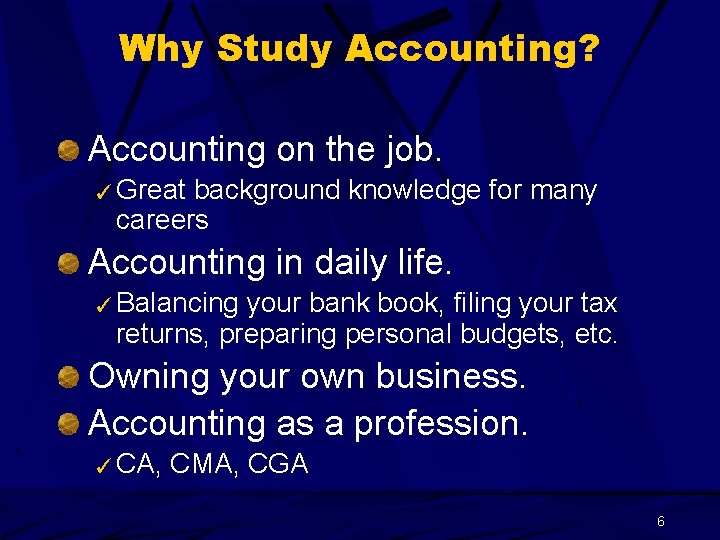
Why Study Accounting? Accounting on the job. ✓ Great background knowledge for many careers Accounting in daily life. ✓ Balancing your bank book, filing your tax returns, preparing personal budgets, etc. Owning your own business. Accounting as a profession. ✓ CA, CMA, CGA 6
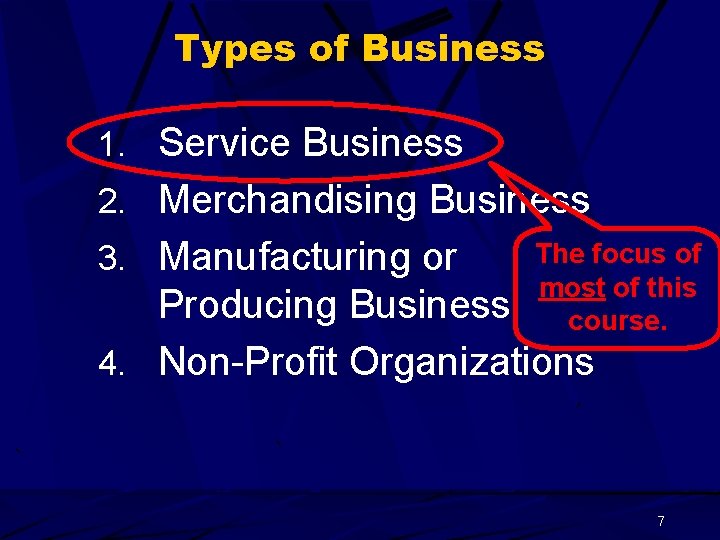
Types of Business 1. Service Business 2. Merchandising Business 3. Manufacturing or The focus of most of this course. Producing Business 4. Non-Profit Organizations 7
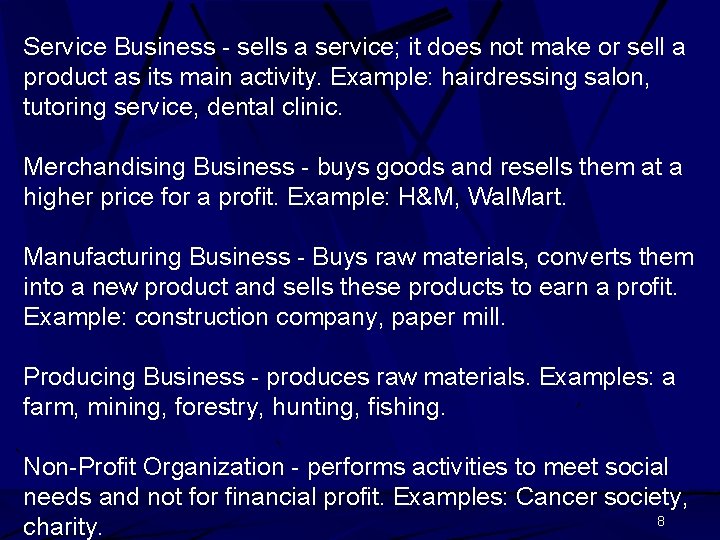
Service Business - sells a service; it does not make or sell a product as its main activity. Example: hairdressing salon, tutoring service, dental clinic. Merchandising Business - buys goods and resells them at a higher price for a profit. Example: H&M, Wal. Mart. Manufacturing Business - Buys raw materials, converts them into a new product and sells these products to earn a profit. Example: construction company, paper mill. Producing Business - produces raw materials. Examples: a farm, mining, forestry, hunting, fishing. Non-Profit Organization - performs activities to meet social needs and not for financial profit. Examples: Cancer society, 8 charity.
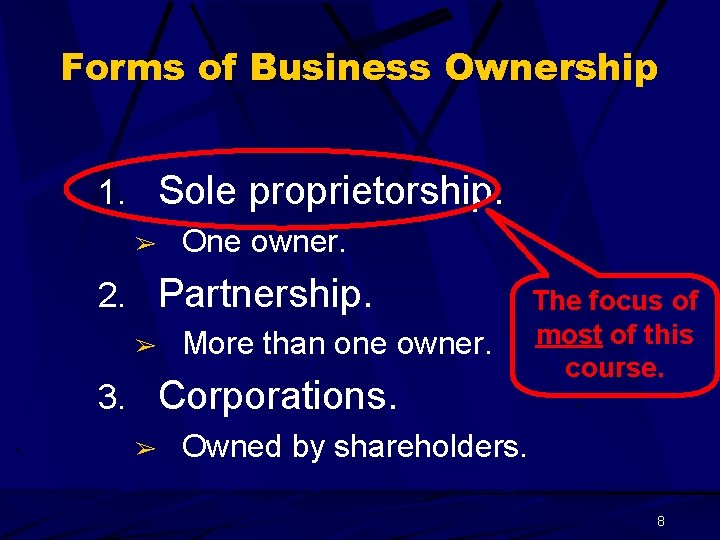
Forms of Business Ownership 1. Sole proprietorship. ➢ One owner. 2. Partnership. ➢ More than one owner. 3. Corporations. ➢ The focus of most of this course. Owned by shareholders. 8
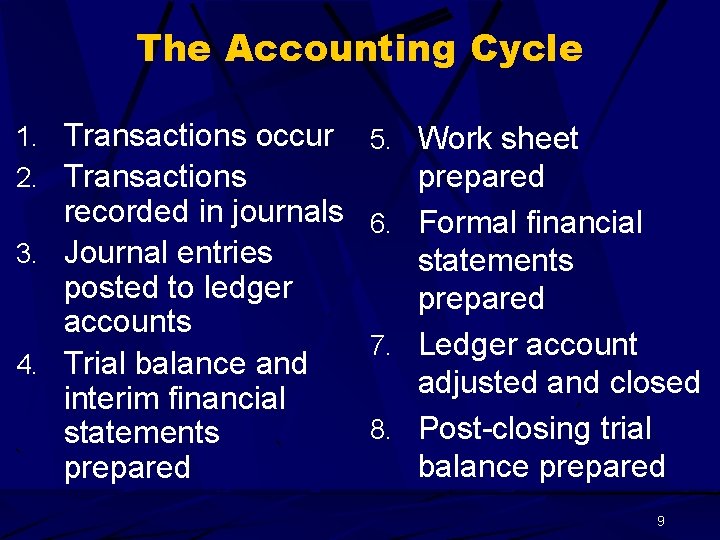
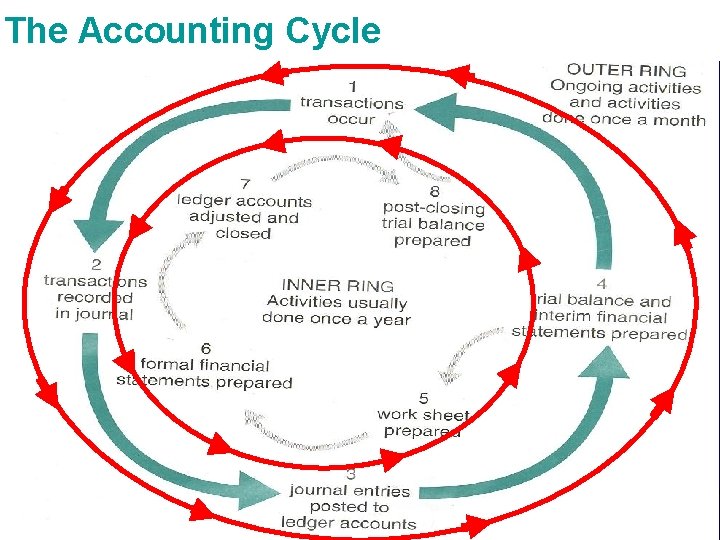
The Accounting Cycle 1. Transactions occur 5. Work sheet prepared recorded in journals 6. Formal financial 3. Journal entries statements posted to ledger prepared accounts 7. Ledger account 4. Trial balance and adjusted and closed interim financial 8. Post-closing trial statements balance prepared 2. Transactions 9
The Accounting Cycle 10
Roles in Accounting The Accounting Clerk vs. The Accountant 11
Roles in Accounting The Accounting Clerk ❑ Records transactions with necessary supporting documents ❑ Records accounting entries and balances ledgers ❑ Perform payroll calculations, prepares payroll cheques and related records ❑ Carry out all banking transactions. 12
Roles in Accounting The Accountant ❑ Develop systems to ensure that correct data is entered into accounting systems ❑ Ensure GAAP are met ❑ Interpret data produced by accounting systems ❑ Prepare reports based on output from systems ❑ Participate in decision making ❑ Supervise the work of accounting staff 13
Accounting Designations There are three recognized accounting designations in Canada 1. CA – Chartered Accountant : 2. CMA – Certified Management Accountant : 3. www. cica. ca www. cma-canada. org CGA – Certified General Accountant : www. cga-canada. org 14
Class / Homework The following slides reflect Review Exercises … Page 11 Exercise 1 Page 12 Exercise 2 & 3 15
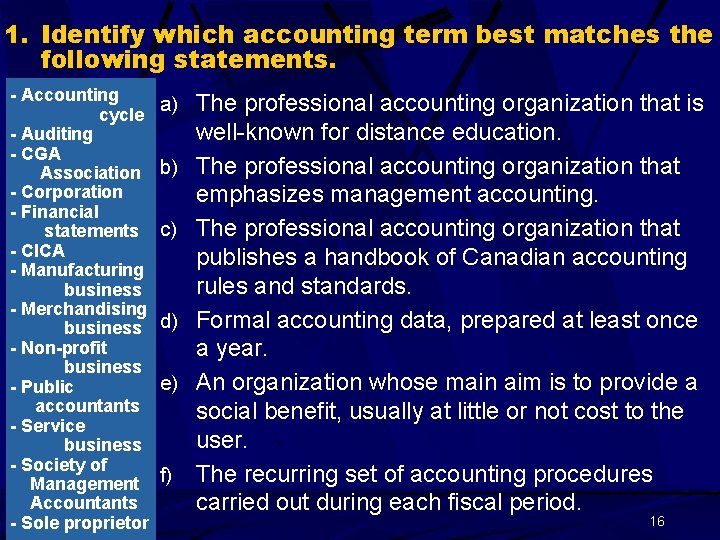
1. Identify which accounting term best matches the following statements. - Accounting cycle - Auditing - CGA Association - Corporation - Financial statements - CICA - Manufacturing business - Merchandising business - Non-profit business - Public accountants - Service business - Society of Management Accountants - Sole proprietor a) The professional accounting organization that is b) c) d) e) f) well-known for distance education. The professional accounting organization that emphasizes management accounting. The professional accounting organization that publishes a handbook of Canadian accounting rules and standards. Formal accounting data, prepared at least once a year. An organization whose main aim is to provide a social benefit, usually at little or not cost to the user. The recurring set of accounting procedures carried out during each fiscal period. 16
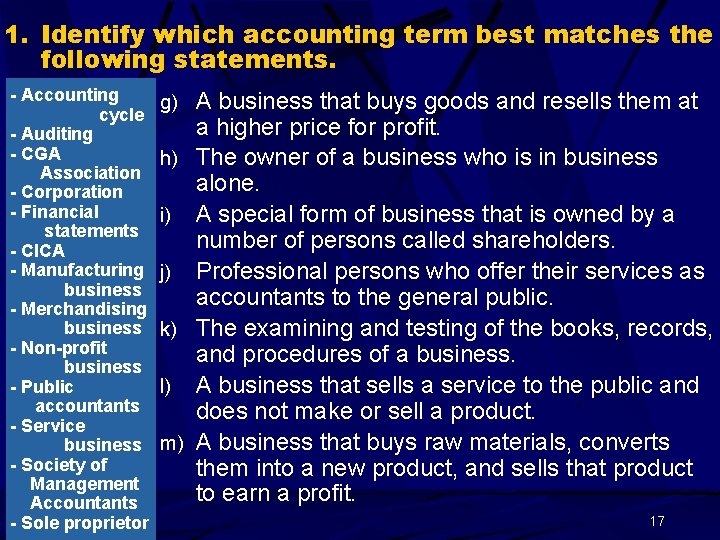
1. Identify which accounting term best matches the following statements. - Accounting cycle - Auditing - CGA Association - Corporation - Financial statements - CICA - Manufacturing business - Merchandising business - Non-profit business - Public accountants - Service business - Society of Management Accountants - Sole proprietor g) A business that buys goods and resells them at a higher price for profit. h) The owner of a business who is in business alone. i) A special form of business that is owned by a number of persons called shareholders. j) Professional persons who offer their services as accountants to the general public. k) The examining and testing of the books, records, and procedures of a business. l) A business that sells a service to the public and does not make or sell a product. m) A business that buys raw materials, converts them into a new product, and sells that product to earn a profit. 17
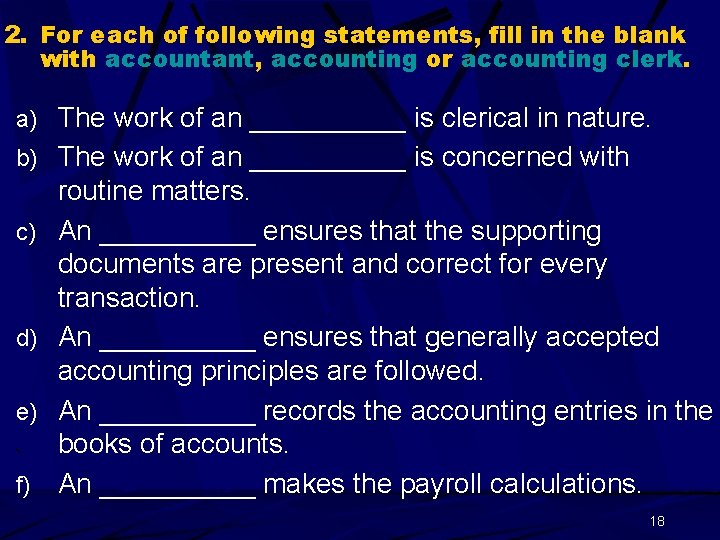
2. For each of following statements, fill in the blank with accountant, accounting or accounting clerk. a) The work of an _____ is clerical in nature. b) The work of an _____ is concerned with c) d) e) f) routine matters. An _____ ensures that the supporting documents are present and correct for every transaction. An _____ ensures that generally accepted accounting principles are followed. An _____ records the accounting entries in the books of accounts. An _____ makes the payroll calculations. 18
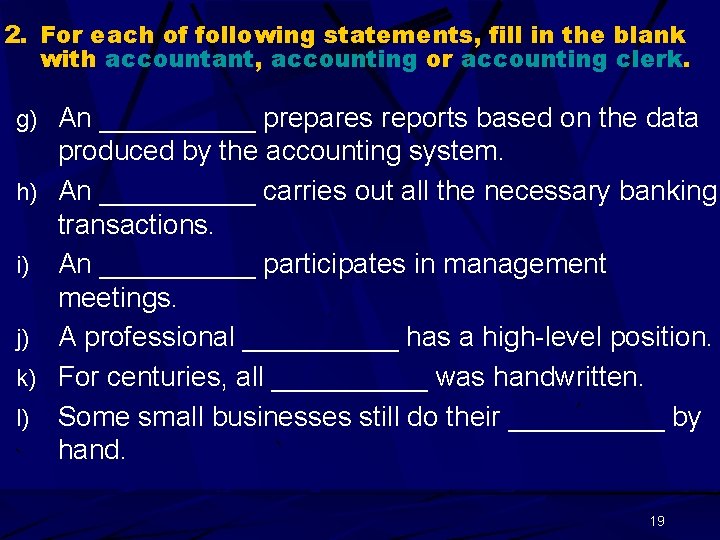
2. For each of following statements, fill in the blank with accountant, accounting or accounting clerk. g) An _____ prepares reports based on the data produced by the accounting system. h) An _____ carries out all the necessary banking transactions. i) An _____ participates in management meetings. j) A professional _____ has a high-level position. k) For centuries, all _____ was handwritten. l) Some small businesses still do their _____ by hand. 19
3. Multiple choice: 1. Which of the following statements does not fit the job title of an accounting clerk? a. b. c. d. Verifies source documents. Ensures that the ledger balances. Works neatly to guard against errors. Studies tax bulletins to keep up to date. 2. Which of the following statements does not fit the job title of an accounting clerk? a. Works out accounting entries. b. Together with the owner, compares this year’s and last year’s income statements. c. Records accounting entries in the books. d. Inquires about a suspected error made by the bank. 20
3. Multiple choice: 3. Which of the following statements does not fit the job title of an accountant? a. b. c. d. Is a professional person. Has a broad knowledge of accounting. Ensures the accuracy of the payroll deductions. Discusses the business’s “cash flow” with the owners. 4. Which of the following statements does not fit the job title of an accountant? a. Works out accounting entries. b. Together with the owner, compares this year’s and last year’s income statements. c. Records accounting entries in the books. d. Inquires about a suspected error made by the bank. 21
3. Multiple choice: 5. Which of the following does not fit the facts about computers? a. b. c. d. 4. Ideal machine for use in an accounting environment. Handles large quantities of data. Produce better profit figures. Provide information for management very quickly. Homework Assignment: Log on to the various accounting association websites (www. cica. ca www. cma-canada. org www. cga-canada. org ) and investigate the “focus” of the various designations, the educational / work experience requirements and how to become an accountant. 22