
Chapter 1 Exploring Data Section 1 1 Analyzing
- Slides: 24
+ Chapter 1: Exploring Data Section 1. 1 Analyzing Categorical Data The Practice of Statistics, 4 th edition - For AP* STARNES, YATES, MOORE
+ Chapter 1 Exploring Data n Introduction: Data Analysis: Making Sense of Data n 1. 1 Analyzing Categorical Data n 1. 2 Displaying Quantitative Data with Graphs n 1. 3 Describing Quantitative Data with Numbers
+ Section 1. 1 Analyzing Categorical Data Learning Objectives After this section, you should be able to… ü CONSTRUCT and INTERPRET bar graphs and pie charts ü RECOGNIZE “good” and “bad” graphs ü CONSTRUCT and INTERPRET two-way tables ü DESCRIBE relationships between two categorical variables ü ORGANIZE statistical problems
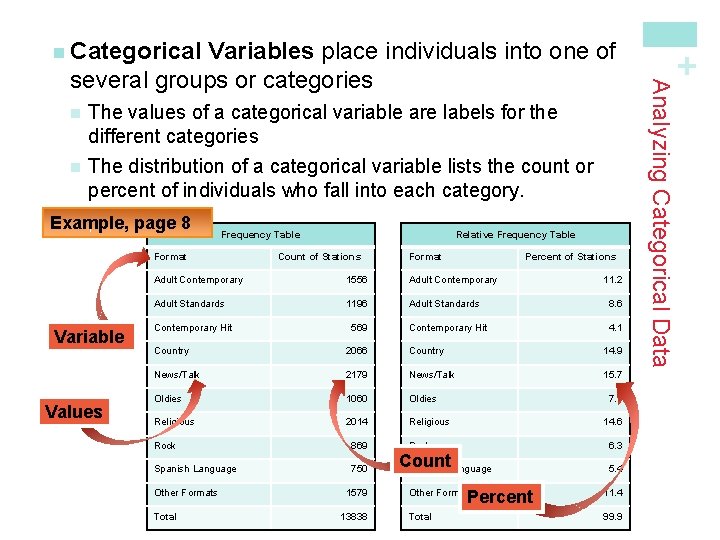
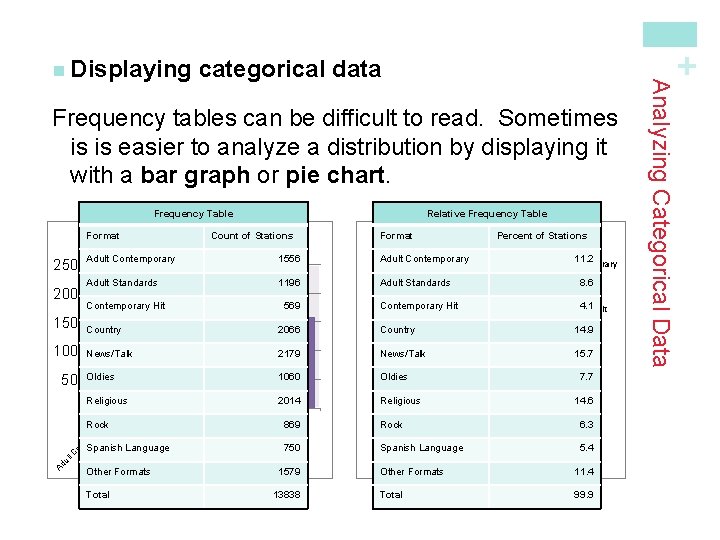
individuals into one of n n The values of a categorical variable are labels for the different categories The distribution of a categorical variable lists the count or percent of individuals who fall into each category. Example, page 8 Frequency Table Format Variable Values Relative Frequency Table Count of Stations Format Percent of Stations Adult Contemporary 1556 Adult Contemporary Adult Standards 1196 Adult Standards 8. 6 Contemporary Hit 4. 1 Contemporary Hit 569 11. 2 Country 2066 Country 14. 9 News/Talk 2179 News/Talk 15. 7 Oldies 1060 Oldies Religious 2014 Religious Rock 869 Spanish Language 750 Other Formats Total 1579 13838 7. 7 14. 6 Rock Count Spanish Language 6. 3 5. 4 Other Formats 11. 4 Total 99. 9 Percent Analyzing Categorical Data several groups or categories + n Categorical Variables place
+ Frequency tables can be difficult to read. Sometimes is is easier to analyze a distribution by displaying it with a bar graph or pie chart. Frequency Table Relative Frequency Table Count of Stations Format Percent of Stations Adult Contemporary 1556 Adult Contemporary Adult Standards 1196 Adult Standards 8. 6 Adult Standards 4. 1 hit Contemporary 2500 2000 1500 Country 2066 Contemporary Hit 11% Country 5% 1000 News/Talk 2179 6% News/Talk 1060 Oldies 15% 2014 869 Religious 8% Rock 750 500 Oldies Religious Ad ul t Spanish Language Ad ul t. C on te Other Formats Total R sh an i Sp m po ra ry S C ta on nd te ar m po ds ra ry hi t C ou nt N ew ry s/ Ta lk O ld ie s R el ig io us Rock oc k 0 er 569 O th Contemporary Hit 1579 13838 11. 2 Adult Contemporary Country 14. 9 9% 4% 15. 7 News/Talk Oldies 7. 7 Religious 14. 6 16% Rock 6. 3 Spanish Language Spanish 5. 4 Other Formats Other Total 11. 4 99. 9 Analyzing Categorical Data n Displaying categorical data
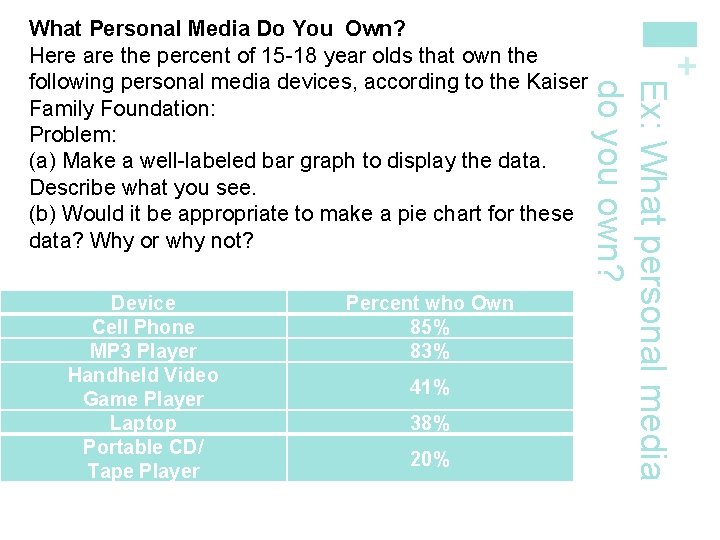
Device Cell Phone MP 3 Player Handheld Video Game Player Laptop Portable CD/ Tape Player Percent who Own 85% 83% 41% 38% 20% + Ex: What personal media do you own? What Personal Media Do You Own? Here are the percent of 15 -18 year olds that own the following personal media devices, according to the Kaiser Family Foundation: Problem: (a) Make a well-labeled bar graph to display the data. Describe what you see. (b) Would it be appropriate to make a pie chart for these data? Why or why not?
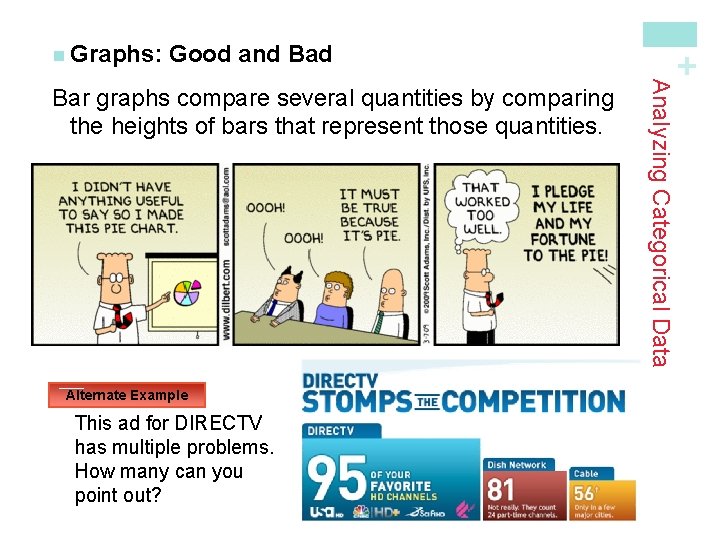
Our eyes react to the area of the bars as well as height. Be sure to make your bars equally wide. Avoid the temptation to replace the bars with pictures for greater appeal…this can be misleading! Alternate Example This ad for DIRECTV has multiple problems. How many can you point out? Analyzing Categorical Data Bar graphs compare several quantities by comparing the heights of bars that represent those quantities. + n Graphs: Good and Bad
stop for now. + n. Let’s n. Textbook page 22 n. Problems: 10 -18 (even) Homework n. Homework:
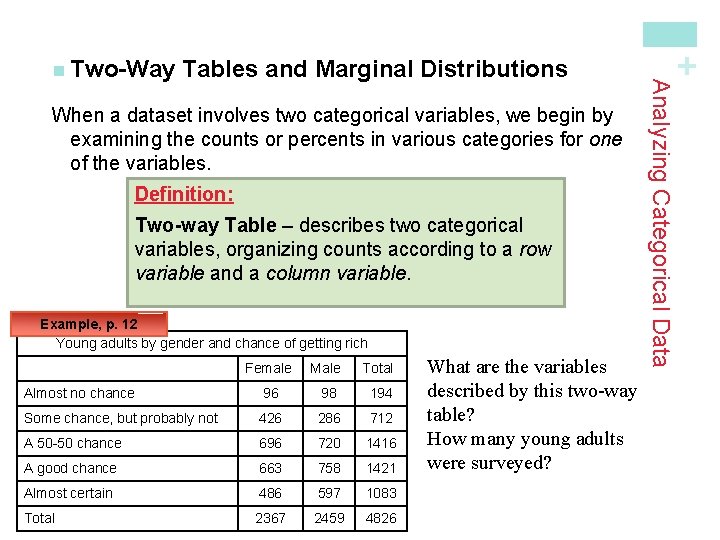
When a dataset involves two categorical variables, we begin by examining the counts or percents in various categories for one of the variables. Definition: Two-way Table – describes two categorical variables, organizing counts according to a row variable and a column variable. Example, p. 12 Young adults by gender and chance of getting rich Female Male Total Almost no chance 96 98 194 Some chance, but probably not 426 286 712 A 50 -50 chance 696 720 1416 A good chance 663 758 1421 Almost certain 486 597 1083 Total 2367 2459 4826 What are the variables described by this two-way table? How many young adults were surveyed? + Analyzing Categorical Data n Two-Way Tables and Marginal Distributions
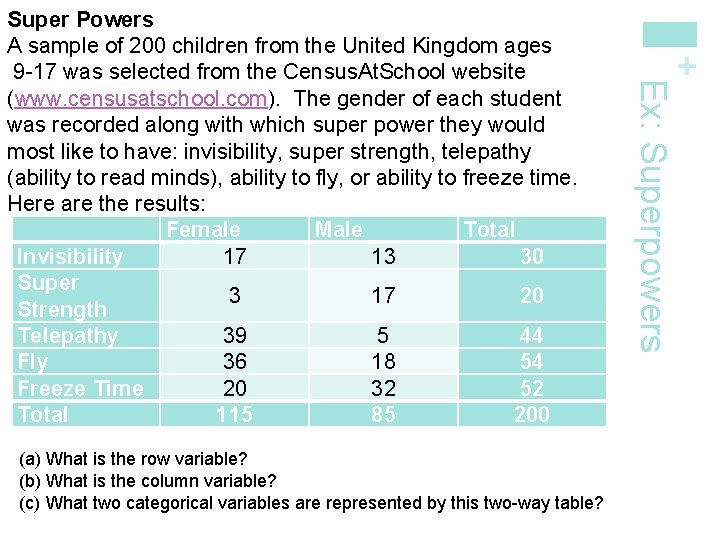
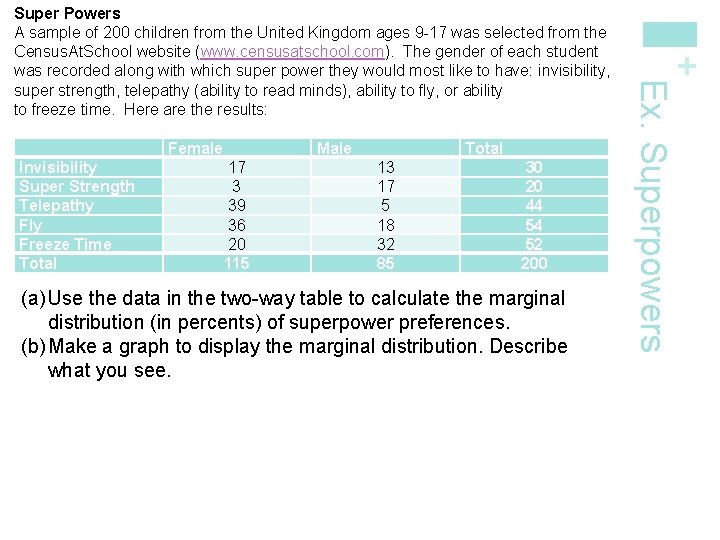
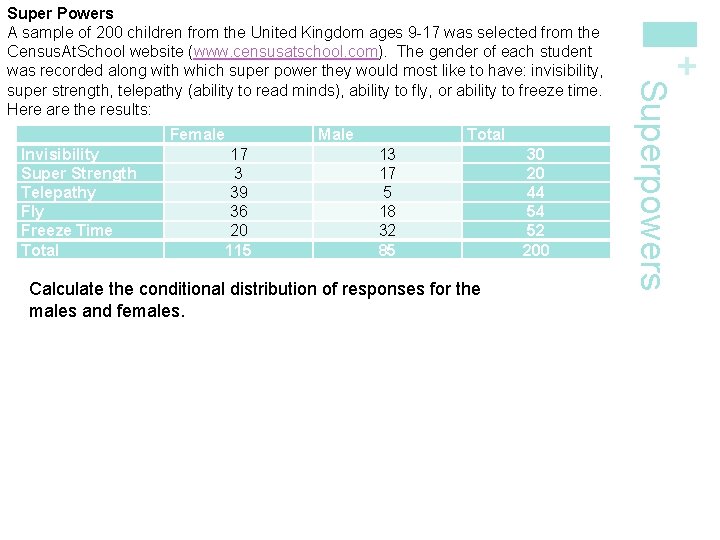
(a) What is the row variable? (b) What is the column variable? (c) What two categorical variables are represented by this two-way table? + Ex: Superpowers Super Powers A sample of 200 children from the United Kingdom ages 9 -17 was selected from the Census. At. School website (www. censusatschool. com). The gender of each student was recorded along with which super power they would most like to have: invisibility, super strength, telepathy (ability to read minds), ability to fly, or ability to freeze time. Here are the results: Female Male Total Invisibility 17 13 30 Super 3 17 20 Strength Telepathy 39 5 44 Fly 36 18 54 Freeze Time 20 32 52 Total 115 85 200
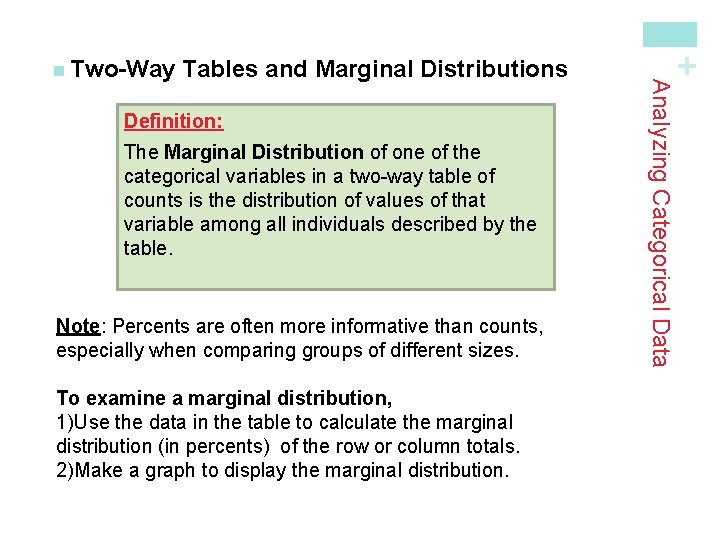
Definition: The Marginal Distribution of one of the categorical variables in a two-way table of counts is the distribution of values of that variable among all individuals described by the table. Note: Percents are often more informative than counts, especially when comparing groups of different sizes. To examine a marginal distribution, 1)Use the data in the table to calculate the marginal distribution (in percents) of the row or column totals. 2)Make a graph to display the marginal distribution. + Analyzing Categorical Data n Two-Way Tables and Marginal Distributions
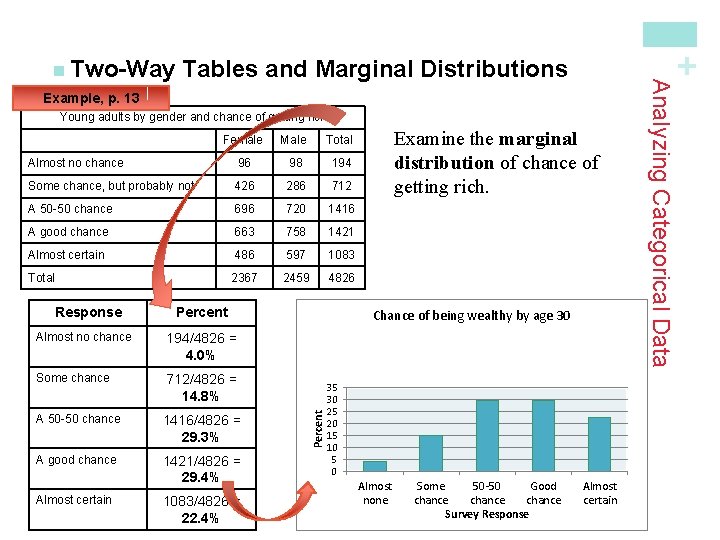
+ Example, p. 13 Young adults by gender and chance of getting rich Female Male Total Almost no chance 96 98 194 Some chance, but probably not 426 286 712 A 50 -50 chance 696 720 1416 A good chance 663 758 1421 Almost certain 486 597 1083 Total 2367 2459 4826 Percent Almost no chance 194/4826 = 4. 0% Some chance 712/4826 = 14. 8% A 50 -50 chance 1416/4826 = 29. 3% A good chance 1421/4826 = 29. 4% Almost certain 1083/4826 = 22. 4% Chance of being wealthy by age 30 Percent Response Examine the marginal distribution of chance of getting rich. 35 30 25 20 15 10 5 0 Almost none Some 50 -50 Good chance Survey Response Almost certain Analyzing Categorical Data n Two-Way Tables and Marginal Distributions
Invisibility Super Strength Telepathy Fly Freeze Time Total Female Male 17 3 39 36 20 115 Total 13 17 5 18 32 85 30 20 44 54 52 200 (a) Use the data in the two-way table to calculate the marginal distribution (in percents) of superpower preferences. (b) Make a graph to display the marginal distribution. Describe what you see. + Ex. Superpowers Super Powers A sample of 200 children from the United Kingdom ages 9 -17 was selected from the Census. At. School website (www. censusatschool. com). The gender of each student was recorded along with which super power they would most like to have: invisibility, super strength, telepathy (ability to read minds), ability to fly, or ability to freeze time. Here are the results:
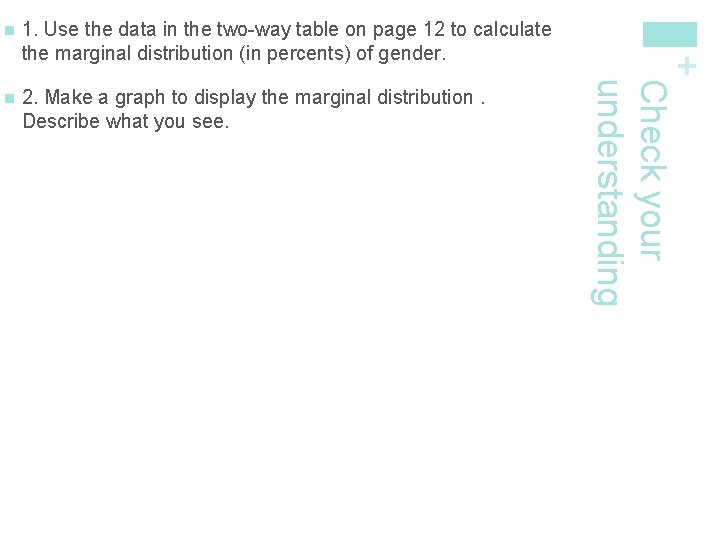
n 2. Make a graph to display the marginal distribution. Describe what you see. + 1. Use the data in the two-way table on page 12 to calculate the marginal distribution (in percents) of gender. Check your understanding n
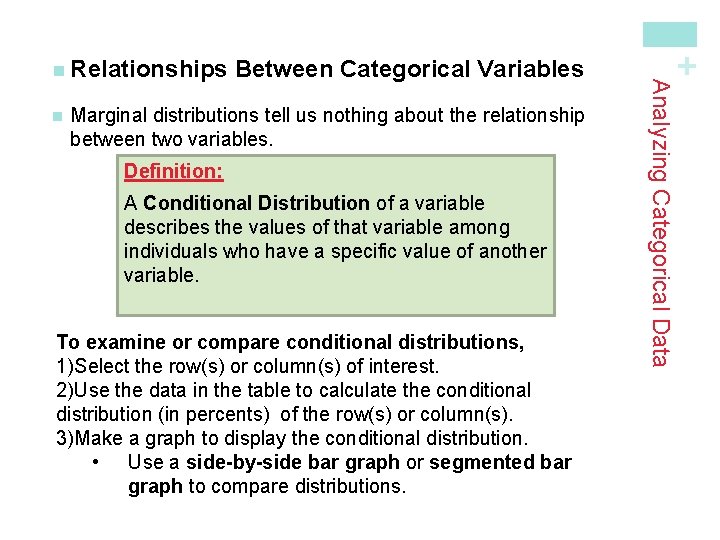
n Marginal distributions tell us nothing about the relationship between two variables. Definition: A Conditional Distribution of a variable describes the values of that variable among individuals who have a specific value of another variable. To examine or compare conditional distributions, 1)Select the row(s) or column(s) of interest. 2)Use the data in the table to calculate the conditional distribution (in percents) of the row(s) or column(s). 3)Make a graph to display the conditional distribution. • Use a side-by-side bar graph or segmented bar graph to compare distributions. + Analyzing Categorical Data n Relationships Between Categorical Variables
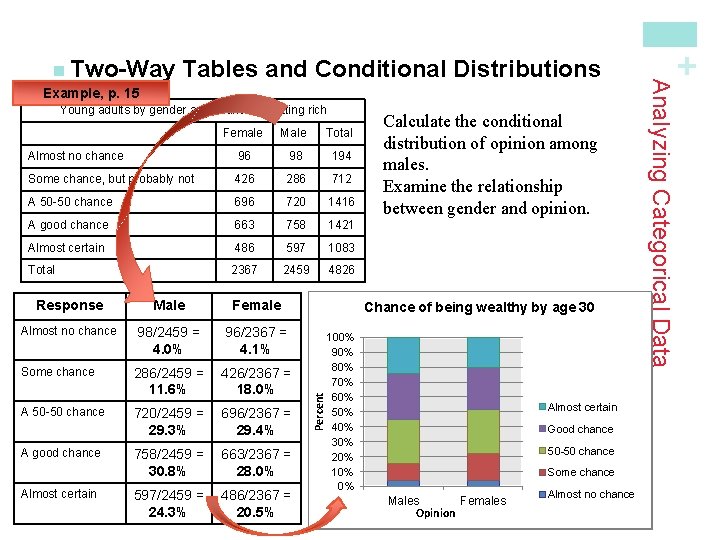
Example, p. 15 Young adults by gender and chance of getting rich Female Male Total Almost no chance 96 98 194 Some chance, but probably not 426 286 712 A 50 -50 chance 696 720 1416 A good chance 663 758 1421 Almost certain 486 597 1083 Total 2367 2459 4826 Male Female Almost no chance 98/2459 = 4. 0% 96/2367 = 4. 1% Some chance 286/2459 = 11. 6% 426/2367 = 18. 0% A 50 -50 chance 720/2459 = 29. 3% 696/2367 = 29. 4% 758/2459 = 30. 8% 663/2367 = 28. 0% 597/2459 = 24. 3% 486/2367 = 20. 5% A good chance Almost certain Chance of being wealthy by age 30 100% 90% 80% 70% 35 35 30 60% 30 25 25 50% 20 20 40% 15 15 10 10 30% 55 20% 00 10%Almost no Some chance 0% chance Percent Response Calculate the conditional distribution of opinion among males. Examine the relationship between gender and opinion. Almost certain Good chance Males 50 -50 chance Good chance Males Females Opinion Females Almost Some chance Almost certain Almost no chance + Analyzing Categorical Data n Two-Way Tables and Conditional Distributions
Invisibility Super Strength Telepathy Fly Freeze Time Total Female Male 17 3 39 36 20 115 Total 13 17 5 18 32 85 Calculate the conditional distribution of responses for the males and females. 30 20 44 54 52 200 + Superpowers Super Powers A sample of 200 children from the United Kingdom ages 9 -17 was selected from the Census. At. School website (www. censusatschool. com). The gender of each student was recorded along with which super power they would most like to have: invisibility, super strength, telepathy (ability to read minds), ability to fly, or ability to freeze time. Here are the results:
Check your understanding Find the conditional distributions of gender among each of the other four opinion categories (book did “almost certain” on pg 16). Use figure 1. 5 or 1. 6 to check that your answers are approximately correct. + n
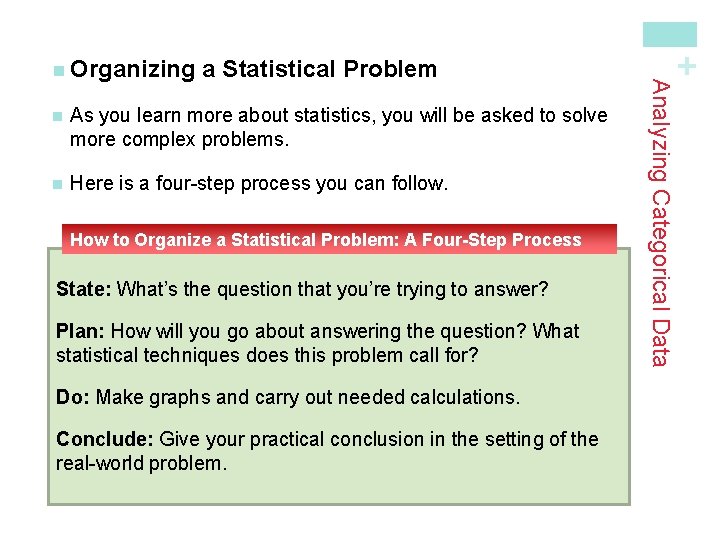
n As you learn more about statistics, you will be asked to solve more complex problems. n Here is a four-step process you can follow. How to Organize a Statistical Problem: A Four-Step Process State: What’s the question that you’re trying to answer? Plan: How will you go about answering the question? What statistical techniques does this problem call for? Do: Make graphs and carry out needed calculations. Conclude: Give your practical conclusion in the setting of the real-world problem. + Analyzing Categorical Data n Organizing a Statistical Problem
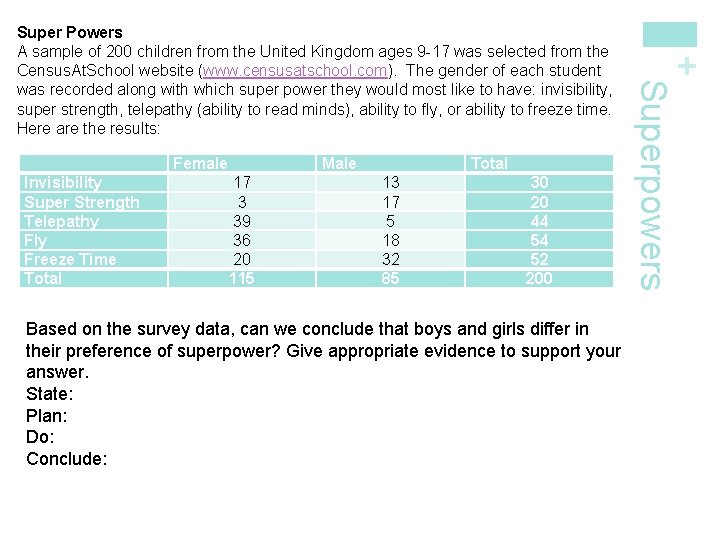
Invisibility Super Strength Telepathy Fly Freeze Time Total Female Male 17 3 39 36 20 115 Total 13 17 5 18 32 85 30 20 44 54 52 200 Based on the survey data, can we conclude that boys and girls differ in their preference of superpower? Give appropriate evidence to support your answer. State: Plan: Do: Conclude: + Superpowers Super Powers A sample of 200 children from the United Kingdom ages 9 -17 was selected from the Census. At. School website (www. censusatschool. com). The gender of each student was recorded along with which super power they would most like to have: invisibility, super strength, telepathy (ability to read minds), ability to fly, or ability to freeze time. Here are the results:
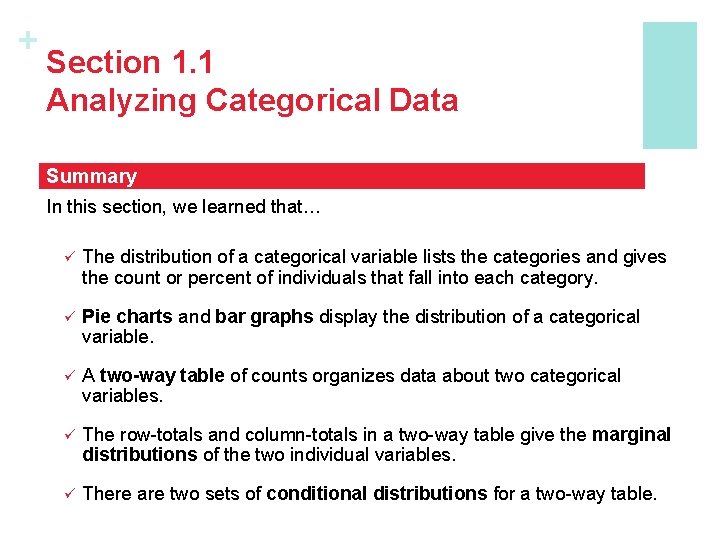
+ Section 1. 1 Analyzing Categorical Data Summary In this section, we learned that… ü The distribution of a categorical variable lists the categories and gives the count or percent of individuals that fall into each category. ü Pie charts and bar graphs display the distribution of a categorical variable. ü A two-way table of counts organizes data about two categorical variables. ü The row-totals and column-totals in a two-way table give the marginal distributions of the two individual variables. ü There are two sets of conditional distributions for a two-way table.
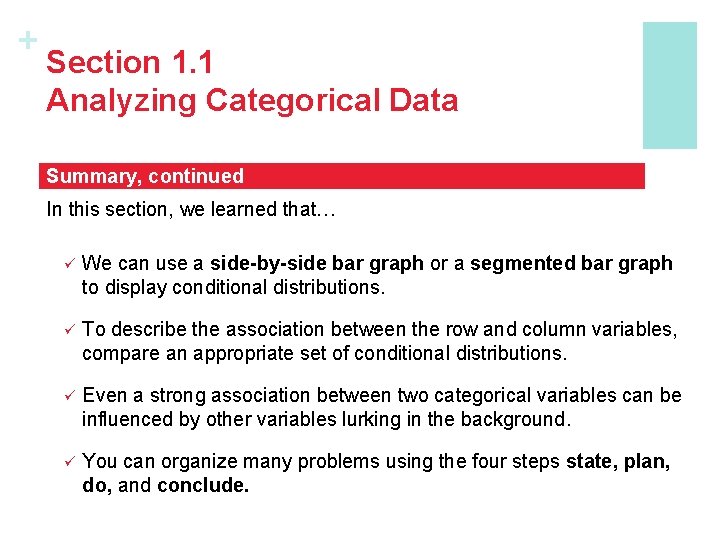
+ Section 1. 1 Analyzing Categorical Data Summary, continued In this section, we learned that… ü We can use a side-by-side bar graph or a segmented bar graph to display conditional distributions. ü To describe the association between the row and column variables, compare an appropriate set of conditional distributions. ü Even a strong association between two categorical variables can be influenced by other variables lurking in the background. ü You can organize many problems using the four steps state, plan, do, and conclude.
+ Looking Ahead… In the next Section… We’ll learn how to display quantitative data. üDotplots üStemplots üHistograms We’ll also learn how to describe and compare distributions of quantitative data.
+ Homework Textbook pg 23 Problems: 19, 21, 23, 25, 27 -32