
Chapter 1 Exploring and Classifying Life Section 1





- Slides: 23
Chapter 1: Exploring and Classifying Life
Section 1: What is science?
- Science – an organized way of studying things and finding answers to questions. - Critical thinking – a process that uses certain skills to solve problems
- Scientific methods – an organized way to solve a problem using a series of steps 1. State the problem. 2. Gather information. 3. Form a hypothesis – a prediction that can be tested.
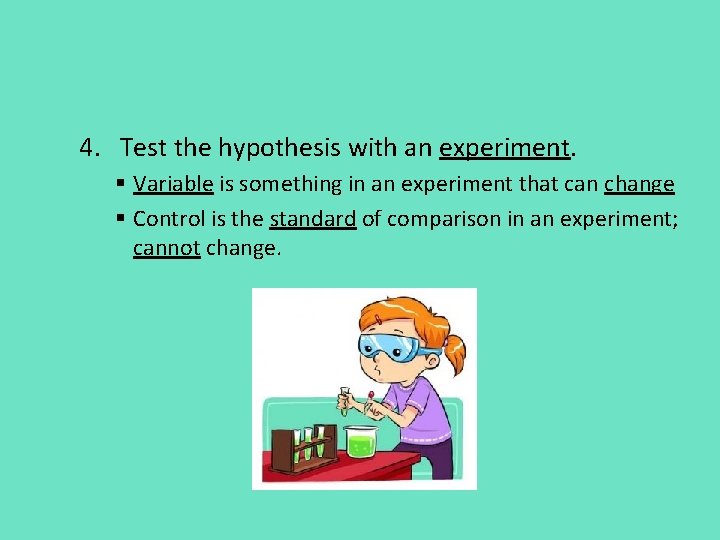
4. Test the hypothesis with an experiment. § Variable is something in an experiment that can change § Control is the standard of comparison in an experiment; cannot change.
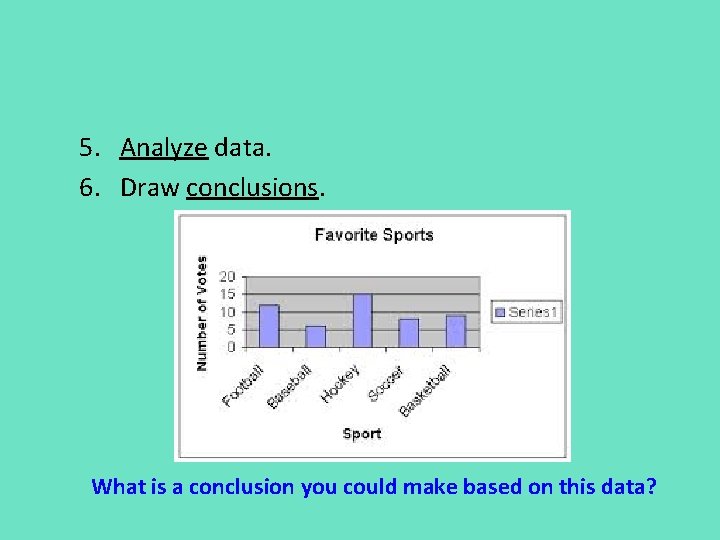
5. Analyze data. 6. Draw conclusions. What is a conclusion you could make based on this data?
- Theories and laws 1. Scientific theory – an explanation of things or events based on scientific knowledge; the result of many observations and experiments. 2. Scientific law – a statement about how things work in nature
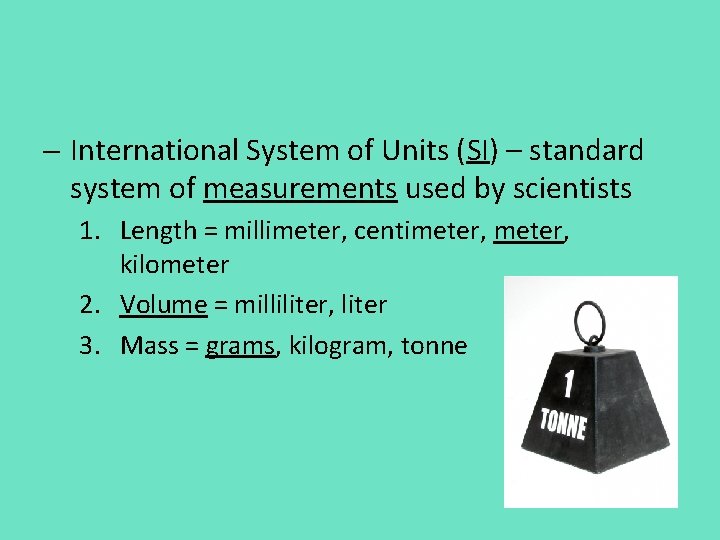
- International System of Units (SI) – standard system of measurements used by scientists 1. Length = millimeter, centimeter, kilometer 2. Volume = milliliter, liter 3. Mass = grams, kilogram, tonne
Section 2: Living Things
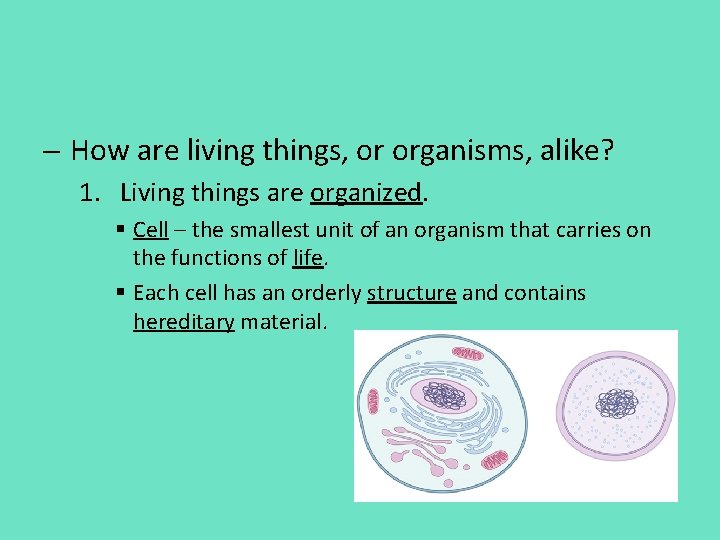
- How are living things, or organisms, alike? 1. Living things are organized. § Cell – the smallest unit of an organism that carries on the functions of life. § Each cell has an orderly structure and contains hereditary material.
2. Living things respond. § Stimulus – anything that causes some change in an organism § Response – the way an organism reacts to a stimulus, often results in movement § Homeostasis – maintaining the proper conditions inside an organism Stimulus Response
3. Living things take in and use energy. 4. Living things grow and develop. § Growth of many-celled organisms is due to an increase in the number of cells. § Growth of one-celled organisms is due to an increase in the size of the cell. § Development – changes that take place during the life of an organism. – Ex: a baby learning to walk or talk 5. Living things reproduce.
- What do living things need? 1. A place to live that provides for all of the organism’s needs 2. Raw materials, like water, proteins, fats, and sugars § Most living things are made up of more than 50% water
Section 3: Where does life come from?
- Spontaneous generation – early theory that living things could come from nonliving things 1. In 1668, Francesco Redi performed an experiment which showed that fly eggs do not come from meat. 2. In 1768, Lazzaro Spallanzani designed an experiment to show that tiny organisms come from other tiny organisms in the air. 3. Disproved by Louis Pasteur in the mid-1800 s - Biogenesis – theory that living things can only come from other living things
- Alexander I. Oparin’s hypothesis on the origins of life – gases in Earth’s early atmosphere combined to form more complex compounds found in living things 1. Gases: ammonia, hydrogen, methane, and water vapor 2. Stanley L. Miller and Harold Urey tested Oparin’s hypothesis and showed that chemicals found in living things could be produced § Showed that substances present in living things could be made from nonliving things in the environment - For centuries, scientists have tried to find the origins of life, and some scientists are still investigating ideas about life’s origins.
Section 4: How are living things classified?
- Classification systems 1. Aristotle classified organisms more than 2, 000 years ago. 2. Carolus Linnaeus introduced a system based on similar structures of organisms 3. Modern systems based on phylogeny – the evolutionary history of an organism, how it has changed over time.
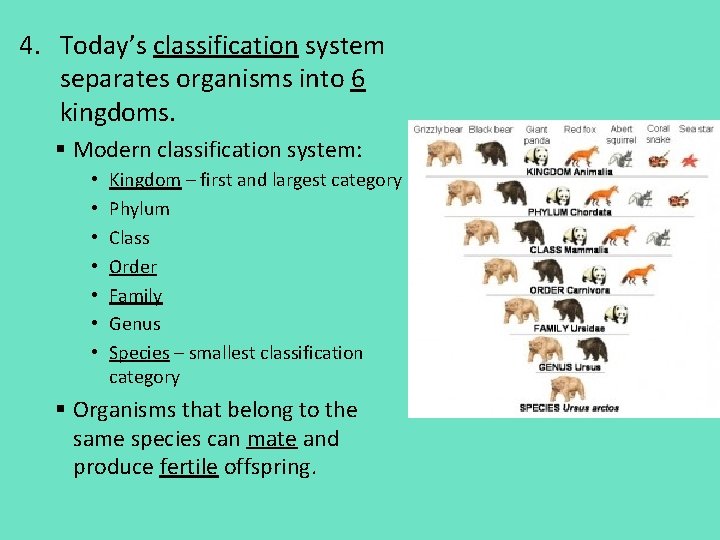
4. Today’s classification system separates organisms into 6 kingdoms. § Modern classification system: • • Kingdom – first and largest category Phylum Class Order Family Genus Species – smallest classification category § Organisms that belong to the same species can mate and produce fertile offspring.
- Binomial nomenclature – two-word system used by Linnaeus used to name species 1. First word indicates the genus, or group of similar species. 2. Second word tells something about the species – what it looks like, where it is found, or who discovered it. 3. Example: Homo sapiens
4. Why use scientific names? § To avoid mistakes § To show organisms in the same genus are related § To give descriptive information § To allow information to be organized easily
What do you call this?
- Tools for identifying organisms 1. Field guides – descriptions and illustrations of organisms 2. Dichotomous keys – detailed lists of identifying characteristics that include scientific names.