
Chapter 1 EvidenceBased Assessment Copyright 2020 by Elsevier
Chapter 1 Evidence-Based Assessment Copyright © 2020 by Elsevier Inc. All rights reserved.
Assessment: Point of Entry in an Ongoing Process Subjective data + objective data + patient’s record, and laboratory studies form the database. Information from the database allows the nurse to make a clinical judgment or diagnosis about the patient’s health state. Key is organization of assessment based on complete factually based data. Copyright © 2020 by Elsevier Inc. All rights reserved.

Diagnostic Reasoning Hypothetico-deductive model components attend to initially available cues (pieces of information). Ø formulate diagnostic hypotheses (tentative explanation of cues). Ø gather relevant data. Ø evaluate each hypothesis with ongoing data collection. Ø serve as basis for ongoing investigation. Ø Copyright © 2020 by Elsevier Inc. All rights reserved.
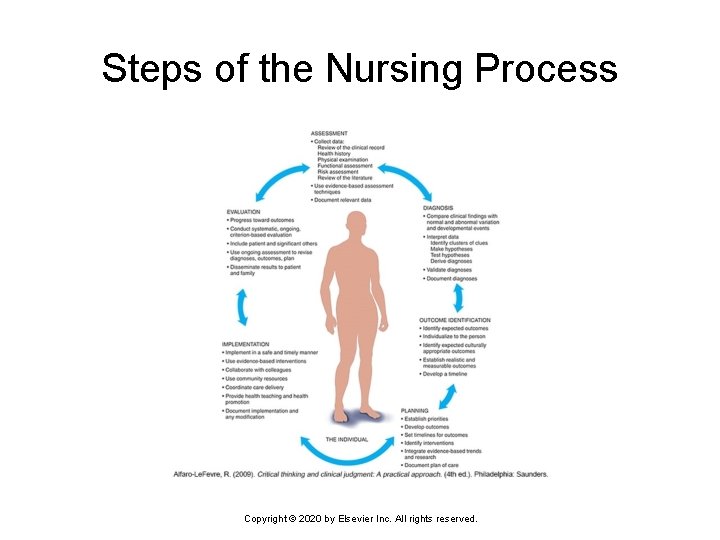
Steps of the Nursing Process Copyright © 2020 by Elsevier Inc. All rights reserved.
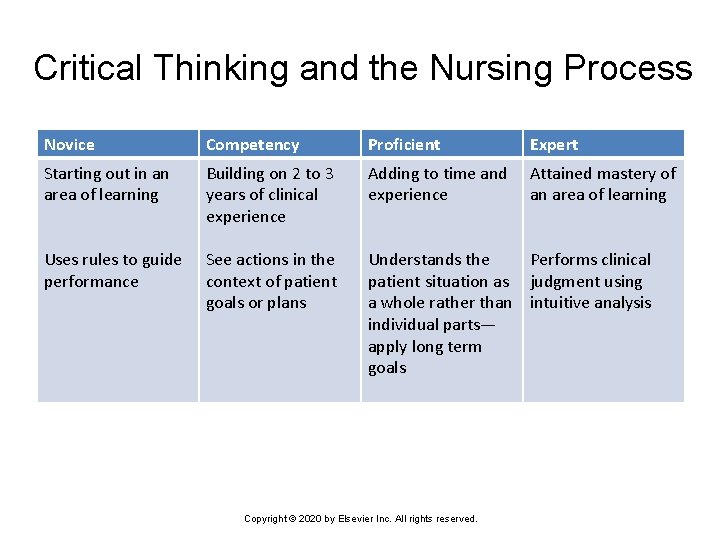
Critical Thinking and the Nursing Process Novice Competency Proficient Expert Starting out in an area of learning Building on 2 to 3 years of clinical experience Adding to time and experience Attained mastery of an area of learning Uses rules to guide performance See actions in the context of patient goals or plans Understands the Performs clinical patient situation as judgment using a whole rather than intuitive analysis individual parts— apply long term goals Copyright © 2020 by Elsevier Inc. All rights reserved.
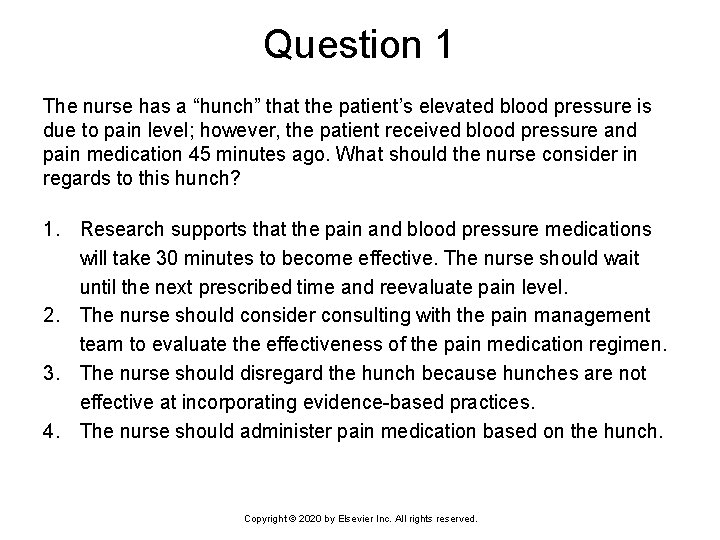
Question 1 The nurse has a “hunch” that the patient’s elevated blood pressure is due to pain level; however, the patient received blood pressure and pain medication 45 minutes ago. What should the nurse consider in regards to this hunch? 1. Research supports that the pain and blood pressure medications will take 30 minutes to become effective. The nurse should wait until the next prescribed time and reevaluate pain level. 2. The nurse should consider consulting with the pain management team to evaluate the effectiveness of the pain medication regimen. 3. The nurse should disregard the hunch because hunches are not effective at incorporating evidence-based practices. 4. The nurse should administer pain medication based on the hunch. Copyright © 2020 by Elsevier Inc. All rights reserved.
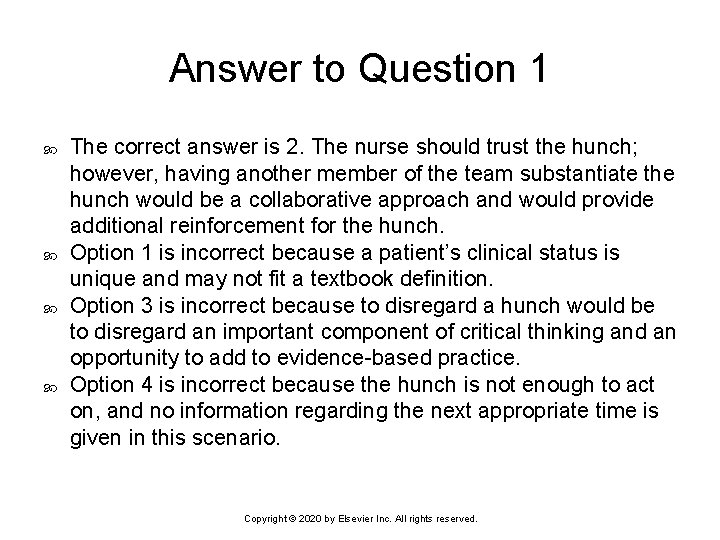
Answer to Question 1 The correct answer is 2. The nurse should trust the hunch; however, having another member of the team substantiate the hunch would be a collaborative approach and would provide additional reinforcement for the hunch. Option 1 is incorrect because a patient’s clinical status is unique and may not fit a textbook definition. Option 3 is incorrect because to disregard a hunch would be to disregard an important component of critical thinking and an opportunity to add to evidence-based practice. Option 4 is incorrect because the hunch is not enough to act on, and no information regarding the next appropriate time is given in this scenario. Copyright © 2020 by Elsevier Inc. All rights reserved.

Priority Problems Level First-level priority Ø Second-level priority Ø Next in urgency, requiring attention so as to avoid further deterioration Third-level priority Ø Emergent, life threatening, and immediate Important to patient’s health but can be addressed after more urgent problems are addressed. Collaborative problems Ø Approach to treatment involves multiple disciplines. Copyright © 2020 by Elsevier Inc. All rights reserved.
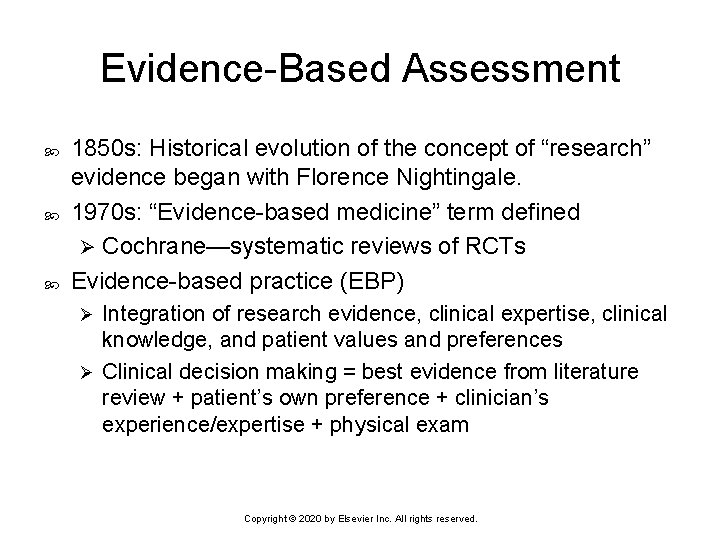
Evidence-Based Assessment 1850 s: Historical evolution of the concept of “research” evidence began with Florence Nightingale. 1970 s: “Evidence-based medicine” term defined Ø Cochrane—systematic reviews of RCTs Evidence-based practice (EBP) Integration of research evidence, clinical expertise, clinical knowledge, and patient values and preferences Ø Clinical decision making = best evidence from literature review + patient’s own preference + clinician’s experience/expertise + physical exam Ø Copyright © 2020 by Elsevier Inc. All rights reserved.
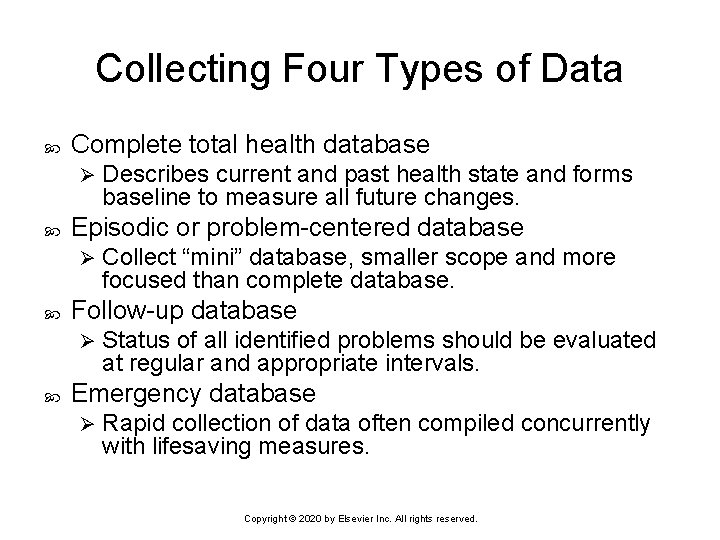
Collecting Four Types of Data Complete total health database Ø Episodic or problem-centered database Ø Collect “mini” database, smaller scope and more focused than complete database. Follow-up database Ø Describes current and past health state and forms baseline to measure all future changes. Status of all identified problems should be evaluated at regular and appropriate intervals. Emergency database Ø Rapid collection of data often compiled concurrently with lifesaving measures. Copyright © 2020 by Elsevier Inc. All rights reserved.
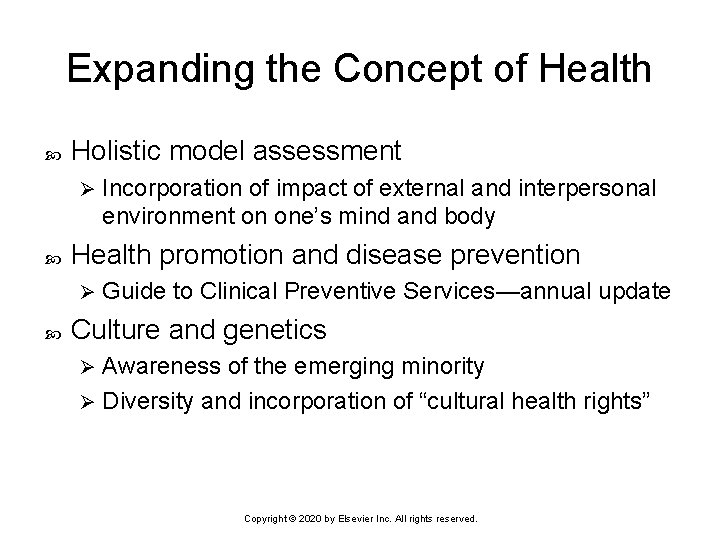
Expanding the Concept of Health Holistic model assessment Ø Health promotion and disease prevention Ø Incorporation of impact of external and interpersonal environment on one’s mind and body Guide to Clinical Preventive Services—annual update Culture and genetics Awareness of the emerging minority Ø Diversity and incorporation of “cultural health rights” Ø Copyright © 2020 by Elsevier Inc. All rights reserved.
Case Study Question 1 1. A nurse working in the emergency department triage wants to apply principles of priority setting with regard to an organizational framework for delivery of care. Based on your understanding of the principles of priority setting, what categories would be included in the framework? Copyright © 2020 by Elsevier Inc. All rights reserved.
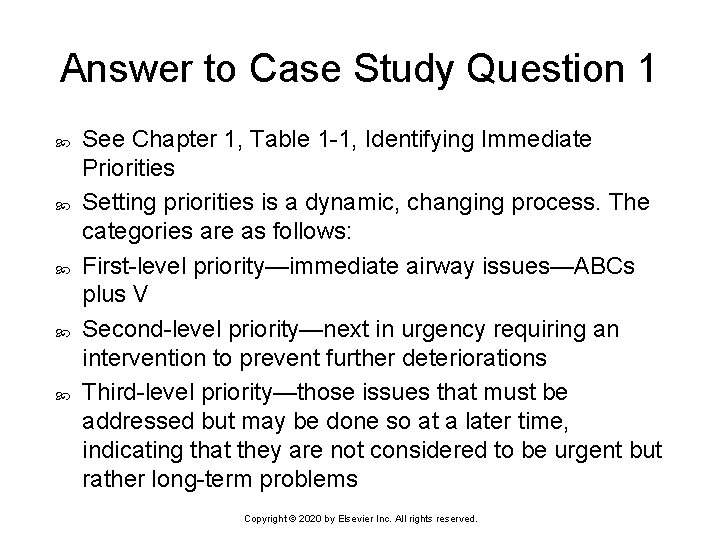
Answer to Case Study Question 1 See Chapter 1, Table 1 -1, Identifying Immediate Priorities Setting priorities is a dynamic, changing process. The categories are as follows: First-level priority—immediate airway issues—ABCs plus V Second-level priority—next in urgency requiring an intervention to prevent further deteriorations Third-level priority—those issues that must be addressed but may be done so at a later time, indicating that they are not considered to be urgent but rather long-term problems Copyright © 2020 by Elsevier Inc. All rights reserved.
Case Study Question 2 Using this priority principle framework, how would the nurse categorize the patients who arrived at the emergency department for treatment? A 48 -year-old male presenting with chest pain A 19 -year-old female who has frequent headaches with stable vital signs A 68 -year-old male who had a ground-level fall (GLF) Copyright © 2020 by Elsevier Inc. All rights reserved.
Answer to Case Study Question 2 See Chapter 1, Table 1 -1 #1: The 48 -year-old male should be categorized as a level-1 priority—so as to rule out a cardiac event. #2: The 68 -year-old who had a GLF should be categorized as a level-2 priority with the potential to emerge also as a level-1 priority. Level 2 in that the patient should be evaluated for mental status changes and level 1 if there are circulation/vascular problems associated with the injury. #3: The 5 -year-old should be categorized as a level-2 priority because the child is not exhibiting any significant distress at this time and is playing with a toy; the foreign body (toy truck) must be removed before it causes any damage, so the child should be seen promptly. #4: The 19 -year-old female should be categorized as a level 2, as the nature of her complaint, frequent headaches, should be assessed but it is not a priority concern at this time; however, the prudent nurse must still determine the etiology or risk factors for “frequent headaches. ” Copyright © 2020 by Elsevier Inc. All rights reserved.
Case Study Question 3 A 5 -year-old male who has a toy truck sticking out of his left ear and is playing with a toy. The nurse has used clinical decision making to make her priority category assessments for the four patients who have arrived for treatment. Which priority information should the nurse obtain for the 48 -year-old male who has chest pain? Copyright © 2020 by Elsevier Inc. All rights reserved.
Answer to Case Study Question 3 See sections in Chapter 1: Evidenced-Based Assessment: Critical Thinking & The Diagnostic Process. The nurse would obtain assessment data relevant to the patient’s vital signs, pulse oximetry, airway status, EKG tracing, pain assessment scale, allergy status, last time that the patient had something to eat, presence of associated symptoms such as nausea, vomiting, or headache. The nurse should obtain a past medical/surgical history indicating whether the patient has any comorbidities or other variables that may affect therapeutic treatment. The nurse should also obtain family medical as well as social history (smoking, alcohol, or drug use). Specific information relative to pain parameters such as quality, duration, intensity, time of onset, and precipitating or alleviating factors should be recorded. The nurse would anticipate that the physician would order STAT testing r/t cardiac enzymes, chemistry/coagulation/complete blood count labs, ABGs, and additional cardiac/hemodynamic monitoring as needed. Based on the patient’s presentation status, the nurse would assume that the patient would be kept NPO and an intravenous line accessed with fluids in order to maintain hydration and allow for medication to be administered. Copyright © 2020 by Elsevier Inc. All rights reserved.
Case Study Question 4 What physician orders would the nurse anticipate based on the clinical presentation for this patient? The nurse is verifying physician’s orders for the 48 -year-old male patient with chest pain when she is advised by the charge nurse that the 19 year-old female patient with complaints of frequent headaches had a seizure. What would the nurse’s initial action be? Copyright © 2020 by Elsevier Inc. All rights reserved.
Answer to Question 4 See sections in Chapter 1: Evidenced-Based Assessment: Critical Thinking & the Diagnostic Process, Table 1 -1. The 19 -year-old female patient is now categorized as a Priority Level 1 problem due to the emergent change in her medical condition. At the time of initial triage, the patient presented with stable vital signs and as such was not considered to be a high-level priority patient. This finding provides evidence that patient status can change rapidly, thus the nurse must use clinical decision making to ensure that care is delivered as needed based on patient category needs. Copyright © 2020 by Elsevier Inc. All rights reserved.
- Slides: 19