
Chapter 1 EvidenceBased Assessment Copyright 2016 by Elsevier
Chapter 1 Evidence-Based Assessment Copyright © 2016 by Elsevier, Inc. All rights reserved. Copyright © 2012, 2008, 2004, 2000, 1996, 1993 by Saunders, an affiliate of Elsevier Inc.

Assessment: Point of Entry in an Ongoing Process Subjective data Ø Objective data Ø What patient says about himself or herself during history taking Observed when inspecting, percussing, palpating, and auscultating patient during physical examination Database Ø Formed from these elements, plus patient’s record and laboratory studies Copyright © 2016 by Elsevier, Inc. All rights reserved. Copyright © 2012, 2008, 2004, 2000, 1996, 1993 by Saunders, an affiliate of Elsevier Inc. 2
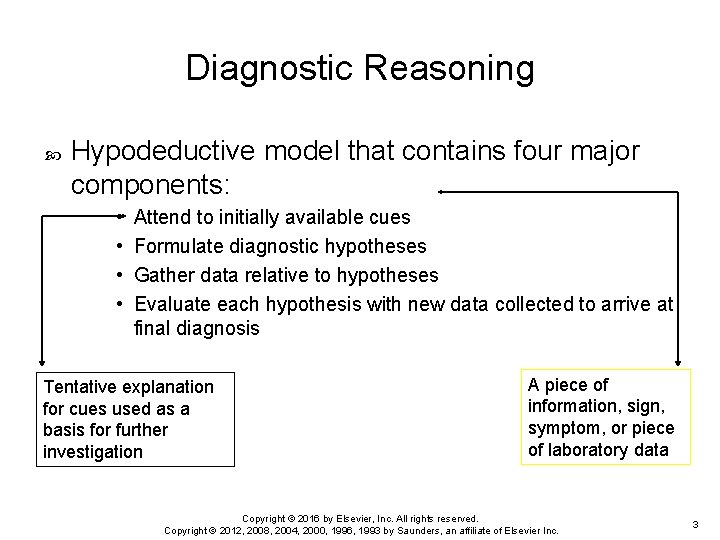
Diagnostic Reasoning Hypodeductive model that contains four major components: • • Attend to initially available cues Formulate diagnostic hypotheses Gather data relative to hypotheses Evaluate each hypothesis with new data collected to arrive at final diagnosis Tentative explanation for cues used as a basis for further investigation A piece of information, sign, symptom, or piece of laboratory data Copyright © 2016 by Elsevier, Inc. All rights reserved. Copyright © 2012, 2008, 2004, 2000, 1996, 1993 by Saunders, an affiliate of Elsevier Inc. 3
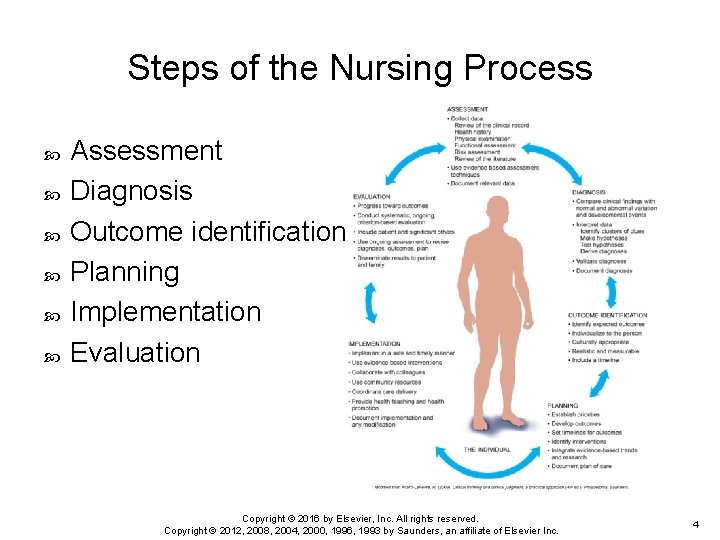
Steps of the Nursing Process Assessment Diagnosis Outcome identification Planning Implementation Evaluation Copyright © 2016 by Elsevier, Inc. All rights reserved. Copyright © 2012, 2008, 2004, 2000, 1996, 1993 by Saunders, an affiliate of Elsevier Inc. 4
Nursing Process: Assessment Collection of data from multiple sources Review of clinical record Ø Interview Ø Health history Ø Physical examination Ø Functional assessment Ø Cultural and spiritual assessment Ø Consultation Ø Review of the literature Ø Copyright © 2016 by Elsevier, Inc. All rights reserved. Copyright © 2012, 2008, 2004, 2000, 1996, 1993 by Saunders, an affiliate of Elsevier Inc. 5
Nursing Process: Diagnosis Interpretation of data by identifying clusters of cues so as to make inferences Compare clusters of cues with definitions and defining characteristics Validation of inferences based on findings Identify related factors Document the diagnosis Copyright © 2016 by Elsevier, Inc. All rights reserved. Copyright © 2012, 2008, 2004, 2000, 1996, 1993 by Saunders, an affiliate of Elsevier Inc. 6
Nursing Process: Outcome Identification Identify expected outcomes related to patient individualization Ensure outcomes are realistic and measurable Specify short-term and long-term goal measurement criteria Copyright © 2016 by Elsevier, Inc. All rights reserved. Copyright © 2012, 2008, 2004, 2000, 1996, 1993 by Saunders, an affiliate of Elsevier Inc. 7
Nursing Process: Planning Establish priorities based on meeting identified patient care goals Develop outcomes and set time frames for meeting proposed outcomes Identify relevant interventions and utilize interdisciplinary health care team members in the care planning process for the patient Document plan of care Copyright © 2016 by Elsevier, Inc. All rights reserved. Copyright © 2012, 2008, 2004, 2000, 1996, 1993 by Saunders, an affiliate of Elsevier Inc. 8
Question The nurse has a “hunch” that the patient’s elevated blood pressure is due to pain level; however, the patient received blood pressure and pain medication 45 minutes ago. What should the nurse consider in regards to this hunch? 1. Research supports that the pain and blood pressure medications will take 30 minutes to become effective. The nurse should wait until the next prescribed time and reevaluate pain level. 2. The nurse should consider consulting with the pain management team to evaluate the effectiveness of the pain medication regimen. 3. The nurse should disregard the hunch because hunches are not effective at incorporating evidence-based practices. 4. The nurse should administer pain medication based on the hunch. Copyright © 2016 by Elsevier, Inc. All rights reserved. Copyright © 2012, 2008, 2004, 2000, 1996, 1993 by Saunders, an affiliate of Elsevier Inc. 9
Nursing Process: Implementation Determine patient readiness and involve patient(s) in health care process Review planned interventions with interdisciplinary health care team members to facilitate collaborative effort Utilize principles of delegation, being mindful of supervision and evaluation Counsel person and significant others Refer for continuing care Document care provided Copyright © 2016 by Elsevier, Inc. All rights reserved. Copyright © 2012, 2008, 2004, 2000, 1996, 1993 by Saunders, an affiliate of Elsevier Inc. 10
Nursing Process: Evaluation Refer to established outcomes Evaluate individual’s condition and compare actual outcomes with expected outcomes Summarize results of evaluation Identify reasons for failure to achieve expected outcomes Take corrective action to modify plan of care Document evaluation in plan of care Copyright © 2016 by Elsevier, Inc. All rights reserved. Copyright © 2012, 2008, 2004, 2000, 1996, 1993 by Saunders, an affiliate of Elsevier Inc. 11
Critical Thinking Principles Proceed through sequential steps from novice to expert Ø Utilize a multidimensional thinking approach to interpret data Ø Use an organized, systematic assessment format Validate and confirm findings based on nonjudgmental interpretation of data Ø Incorporation of experience provides foundation for development of clinical practice Check and corroborate accuracy and reliability of data Cluster data information to support evidence as well as rule out inconsistent clinical findings in terms of differential diagnosis Ø Distinguish relevant signs and symptoms Copyright © 2016 by Elsevier, Inc. All rights reserved. Copyright © 2012, 2008, 2004, 2000, 1996, 1993 by Saunders, an affiliate of Elsevier Inc. 12
Priority Problems Level First-level priority Ø Second-level priority Ø Next in urgency, requiring attention so as to avoid further deterioration Third-level priority Ø Emergent, life threatening, and immediate Important to patient’s health but can be addressed after more urgent problems are addressed Collaborative problems Ø Approach to treatment involves multiple disciplines Copyright © 2016 by Elsevier, Inc. All rights reserved. Copyright © 2012, 2008, 2004, 2000, 1996, 1993 by Saunders, an affiliate of Elsevier Inc. 13
Problems and Outcomes Identify patient outcomes and delineate measurable goals Ø Include evaluation methods that will allow for validation of results or adjustments to care planning Ø Qualify short-term and long-term goals that are realistic and patient centered Incorporation of planning methods is a critical element in the delivery of care Continuously evaluate the plan of care Ø Analyze and implement changes as needed in order to maintain pathway toward goal achievement Copyright © 2016 by Elsevier, Inc. All rights reserved. Copyright © 2012, 2008, 2004, 2000, 1996, 1993 by Saunders, an affiliate of Elsevier Inc. 14
Comprehensive Plan of Care Evaluate and update plan Record revised plan and keep it up-to-date Communicate revised plans to multidisciplinary team Be aware that this is a legal document, and accurate recording is important for evaluation, insurance reimbursement, and research Copyright © 2016 by Elsevier, Inc. All rights reserved. Copyright © 2012, 2008, 2004, 2000, 1996, 1993 by Saunders, an affiliate of Elsevier Inc. 15
Evidence-Based Assessment Current and best clinical practice based on research standards focused on systematic reviews of randomized clinical trials (RCTs) Utilizing evidenced-based practice (EBP) in conjunction with provider experience will lead to better health outcomes for patients Fostering a “culture of EBP” at both the undergraduate and graduate levels will assist health educators to make EBP the “gold standard” of practice Copyright © 2016 by Elsevier, Inc. All rights reserved. Copyright © 2012, 2008, 2004, 2000, 1996, 1993 by Saunders, an affiliate of Elsevier Inc. 16
Question What is the best electronic resource for incorporating evidence-based practice into health assessment? 1. Wikipedia. org 2. Nursingworld. org 3. Mayoclinic. com 4. Web. MD. com Copyright © 2016 by Elsevier, Inc. All rights reserved. Copyright © 2012, 2008, 2004, 2000, 1996, 1993 by Saunders, an affiliate of Elsevier Inc. 17
Collecting Four Types of Data Complete total health database Includes complete health history and full physical examination Ø Describes current and past health state and forms baseline to measure all future changes Ø Yields first diagnoses Ø Episodic or problem-centered database For limited or short-term problems Ø Collect “mini” database, smaller scope and more focused than complete database Ø Concerns mainly one problem, one cue complex, or one body system Ø History and examination follow direction of presenting concern Ø Copyright © 2016 by Elsevier, Inc. All rights reserved. Copyright © 2012, 2008, 2004, 2000, 1996, 1993 by Saunders, an affiliate of Elsevier Inc. 18
Collecting Four Types of Data (Cont. ) Follow-up database Status of all identified problems should be evaluated at regular and appropriate intervals Ø Note changes that have occurred Ø Evaluate whether problem is getting better or worse Ø Identify coping strategies being used Ø Emergency database Rapid collection of data, often compiled concurrently with lifesaving measures Ø Diagnosis must be rapid and comprehensive in nature Ø Copyright © 2016 by Elsevier, Inc. All rights reserved. Copyright © 2012, 2008, 2004, 2000, 1996, 1993 by Saunders, an affiliate of Elsevier Inc. 19
Expanding the Concept of Health Assessment: collection of data about an individual’s health state A clear idea of health is important because it determines assessment data to be collected Copyright © 2016 by Elsevier, Inc. All rights reserved. Copyright © 2012, 2008, 2004, 2000, 1996, 1993 by Saunders, an affiliate of Elsevier Inc. 20
Holistic Model of Health Mind, body and spirit are interdependent and function as a whole Multifaceted basis of disease Individual and human environment are open systems Expanded assessment factors such as lifestyle behaviors, culture and values, family and social roles, self-care behaviors, job-related stress, developmental tasks, failures and frustrations of life Health promotion and disease prevention form the core of nursing Copyright © 2016 by Elsevier, Inc. All rights reserved. Copyright © 2012, 2008, 2004, 2000, 1996, 1993 by Saunders, an affiliate of Elsevier Inc. 21
Frequency of Assessment Interval of assessment varies with illness and wellness needs Ill people seek care because of pain or abnormal signs and symptoms Ø This prompts an assessment: gathering a complete, episodic, or emergency database Ø • Screening history for dietary intake, physical activity, tobacco/alcohol/drug use, and sexual practices • Counseling for injury prevention, substance use, sexual behavior, diet and exercise, and dental health Copyright © 2016 by Elsevier, Inc. All rights reserved. Copyright © 2012, 2008, 2004, 2000, 1996, 1993 by Saunders, an affiliate of Elsevier Inc. 22
Frequency of Assessment (Cont. ) Routine periodic examination might include the following services for preventive health care: Screening history for dietary intake, physical activity, tobacco/alcohol/drug use, and sexual practices Ø Counseling for injury prevention, substance use, sexual behavior, diet and exercise, and dental health Ø Immunizations Ø Chemoprophylaxis for multivitamin with folic acid for females capable of or planning pregnancy Ø Copyright © 2016 by Elsevier, Inc. All rights reserved. Copyright © 2012, 2008, 2004, 2000, 1996, 1993 by Saunders, an affiliate of Elsevier Inc. 23
Frequency of Assessment (Cont. ) For well persons, opinions are changing about assessment intervals Annual checkup is vague: What does it constitute? Is it necessary? Does it sometimes give an implicit promise of health and thus provide false security? Ø Timing of formerly accepted procedures is now variable: for example, annual Pap tests Ø Same annual routine physical examination cannot be recommended for all persons because health priorities vary among individuals, age groups, and risk categories Ø Copyright © 2016 by Elsevier, Inc. All rights reserved. Copyright © 2012, 2008, 2004, 2000, 1996, 1993 by Saunders, an affiliate of Elsevier Inc. 24
Assessment through the Life Cycle Age-specific charts for periodic health examinations are a positive approach to health assessment Define lifetime schedule of health care, organized into packages for four specific age groups Ø Each chart lists a frequency schedule for periodic health visits and preventive services for age group Ø • These services include screening factors to gather during the history, and age-specific items for physical examination and laboratory procedures, counseling topics, and immunizations Copyright © 2016 by Elsevier, Inc. All rights reserved. Copyright © 2012, 2008, 2004, 2000, 1996, 1993 by Saunders, an affiliate of Elsevier Inc. 25
Assessment through the Life Cycle (Cont. ) Age-specific charts focus on major risk factors specific for each age group based on lifestyle, health needs, and problems Shift emphasis from an annual physical examination toward rational and varying periodicity Ø Incorporate health promotion and disease prevention at every health visit, not just at one annual physical examination Ø Health education and counseling are highlighted as means to promote health Ø Copyright © 2016 by Elsevier, Inc. All rights reserved. Copyright © 2012, 2008, 2004, 2000, 1996, 1993 by Saunders, an affiliate of Elsevier Inc. 26
Cross-Cultural Care Concepts A holistic model of health care assessment must include culture Inclusion of heritage assessment is of paramount importance to gather meaningful data and intervene with culturally sensitive and appropriate care Ø With the rapid increases in numbers of individuals from diverse cultural backgrounds in the United States, a concern for the cultural beliefs and practices of people is increasingly important in health care Copyright © 2016 by Elsevier, Inc. All rights reserved. Copyright © 2012, 2008, 2004, 2000, 1996, 1993 by Saunders, an affiliate of Elsevier Inc. 27
Cross-Cultural Care Principles A serious conceptual problem arises as nurses and physicians are expected to know, understand, and meet health needs of people from culturally diverse backgrounds without formal preparation for doing so International interchanges are increasing among nurses and physicians, making attention to cultural aspects of health and illness an even greater priority Copyright © 2016 by Elsevier, Inc. All rights reserved. Copyright © 2012, 2008, 2004, 2000, 1996, 1993 by Saunders, an affiliate of Elsevier Inc. 28
High-Level Assessment Skills Attention to life cycle, holism, and culture must not detract from the importance of assessment skills themselves Assessment skills require hands-on expertise refined to a high level The nurse is the first and often only health professional to see an individual in many communities Ø The nurse is the only health professional continually present at bedside in hospitals Ø Copyright © 2016 by Elsevier, Inc. All rights reserved. Copyright © 2012, 2008, 2004, 2000, 1996, 1993 by Saunders, an affiliate of Elsevier Inc. 29
Cost Containment Principles Efforts at cost containment result in hospital populations composed of people with increased acuity, shorter stays, and earlier discharges than in the past Nurses must make faster, more efficient assessments Ø Nurses required to go people’s homes for follow-up assessment and diagnosis Ø First-rate assessment skills grounded in holistic approach and knowledge of age-specific problems are required Ø Copyright © 2016 by Elsevier, Inc. All rights reserved. Copyright © 2012, 2008, 2004, 2000, 1996, 1993 by Saunders, an affiliate of Elsevier Inc. 30
Case Study A nurse working in the emergency department triage wants to apply principles of priority setting with regard to an organizational framework for delivery of care. Based on your understanding of the principles of priority setting, what categories would be included in the framework? Copyright © 2016 by Elsevier, Inc. All rights reserved. Copyright © 2012, 2008, 2004, 2000, 1996, 1993 by Saunders, an affiliate of Elsevier Inc. 31
Case Study (Cont. ) Using this priority principle framework, how would the nurse categorize the patients who arrived at the emergency department for treatment? A 48 -year-old male presenting with chest pain A 19 -year-old female who has frequent headaches with stable vital signs A 68 -year-old male who had a ground-level fall (GLF) Copyright © 2016 by Elsevier, Inc. All rights reserved. Copyright © 2012, 2008, 2004, 2000, 1996, 1993 by Saunders, an affiliate of Elsevier Inc. 32
Case Study (Cont. ) A 5 -year-old male who has a toy truck sticking out of his left ear and is playing with a toy The nurse has used clinical decision making to make her priority category assessments for the four patients who have arrived for treatment. Which priority information should the nurse obtain for the 48 -year-old male who has chest pain? Copyright © 2016 by Elsevier, Inc. All rights reserved. Copyright © 2012, 2008, 2004, 2000, 1996, 1993 by Saunders, an affiliate of Elsevier Inc. 33
Case Study (Cont. ) What physician orders would the nurse anticipate based on the clinical presentation for this patient? The nurse is verifying physician’s orders for the 48 -year-old male patient with chest pain when she is advised by the charge nurse that the 19 year-old female patient with complaints of frequent headaches had a seizure. What would the nurse’s initial action be? Copyright © 2016 by Elsevier, Inc. All rights reserved. Copyright © 2012, 2008, 2004, 2000, 1996, 1993 by Saunders, an affiliate of Elsevier Inc. 34
- Slides: 34