
Chapter 1 Equations and Inequalities 1 2 Linear
- Slides: 19
Chapter 1 Equations and Inequalities 1. 2 Linear Equations and Rational Equations Warm Up: 1. Draw a table and graph: y = |x| + 1 What are the x- and the y-intercepts of the graph? Copyright © 2014, 2010, 2007 Pearson Education, Inc. 1
Objectives: • Solve linear equations in one variable. • Solve linear equations containing fractions. • Solve rational equations with variables in the denominators. • Recognize identities, conditional equations, and inconsistent equations. • Solve applied problems using mathematical models. Copyright © 2014, 2010, 2007 Pearson Education, Inc. 2
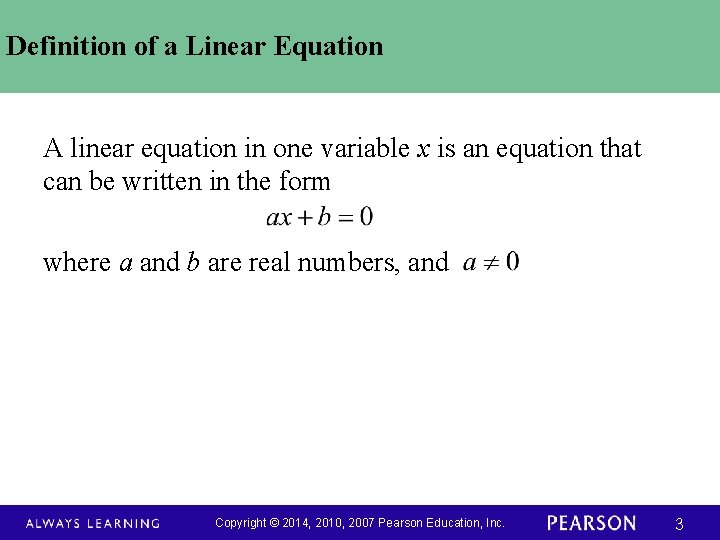
Definition of a Linear Equation A linear equation in one variable x is an equation that can be written in the form where a and b are real numbers, and Copyright © 2014, 2010, 2007 Pearson Education, Inc. 3
Generating Equivalent Equations An equation can be transformed into an equivalent equation by one or more of the following operations: 1. Simplify an expression by removing grouping symbols and combining like terms. 2. Add (or subtract) the same real number or variable expression on both sides of the equation. 3. Multiply (or divide) by the same nonzero quantity on both sides of the equation. 4. Interchange the two sides of the equation. Copyright © 2014, 2010, 2007 Pearson Education, Inc. 4
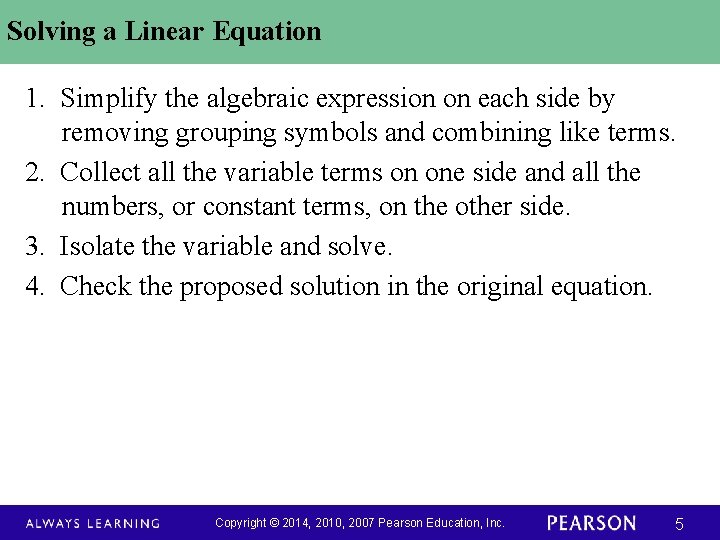
Solving a Linear Equation 1. Simplify the algebraic expression on each side by removing grouping symbols and combining like terms. 2. Collect all the variable terms on one side and all the numbers, or constant terms, on the other side. 3. Isolate the variable and solve. 4. Check the proposed solution in the original equation. Copyright © 2014, 2010, 2007 Pearson Education, Inc. 5
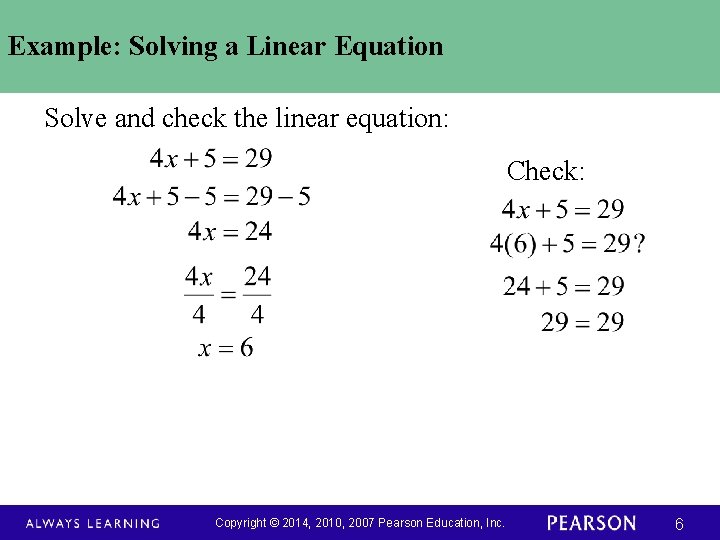
Example: Solving a Linear Equation Solve and check the linear equation: Check: Copyright © 2014, 2010, 2007 Pearson Education, Inc. 6
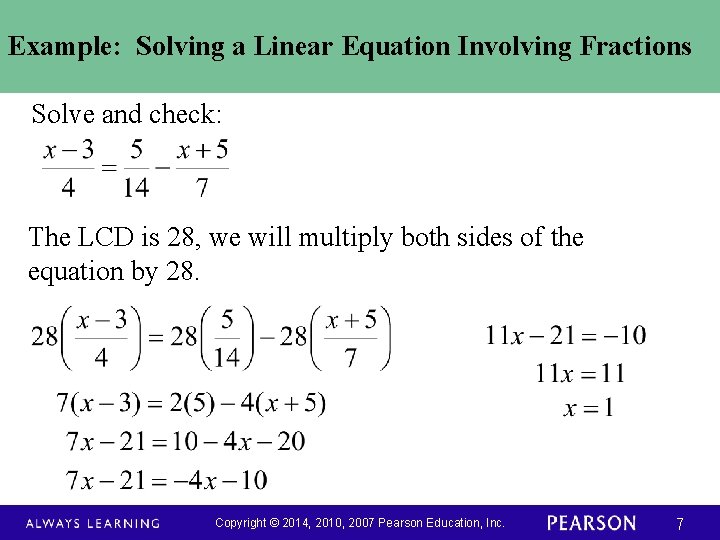
Example: Solving a Linear Equation Involving Fractions Solve and check: The LCD is 28, we will multiply both sides of the equation by 28. Copyright © 2014, 2010, 2007 Pearson Education, Inc. 7
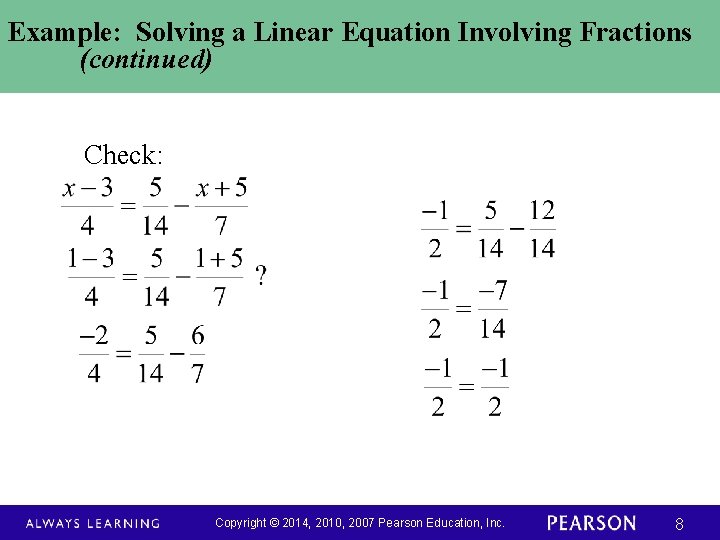
Example: Solving a Linear Equation Involving Fractions (continued) Check: Copyright © 2014, 2010, 2007 Pearson Education, Inc. 8
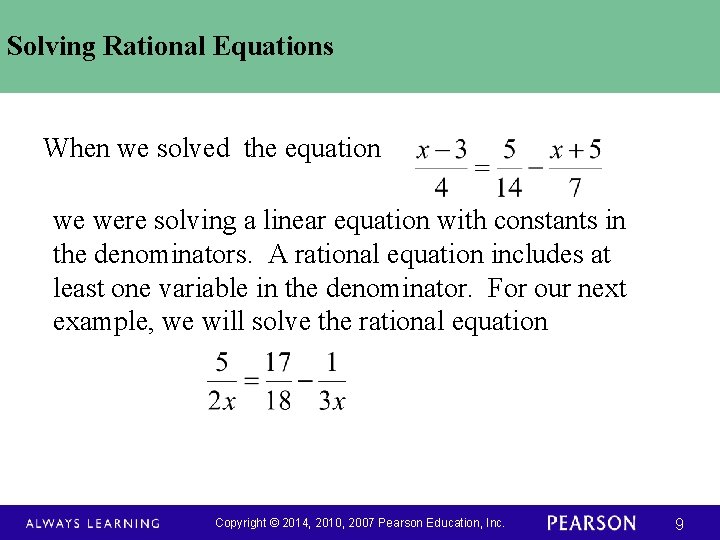
Solving Rational Equations When we solved the equation we were solving a linear equation with constants in the denominators. A rational equation includes at least one variable in the denominator. For our next example, we will solve the rational equation Copyright © 2014, 2010, 2007 Pearson Education, Inc. 9
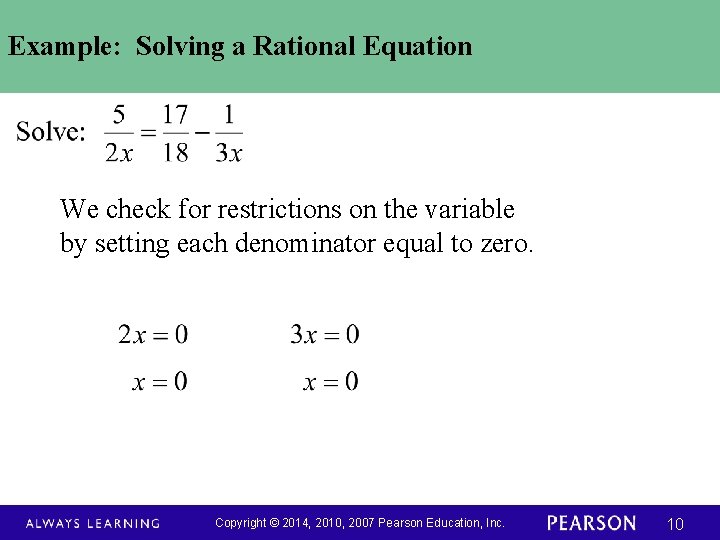
Example: Solving a Rational Equation We check for restrictions on the variable by setting each denominator equal to zero. Copyright © 2014, 2010, 2007 Pearson Education, Inc. 10
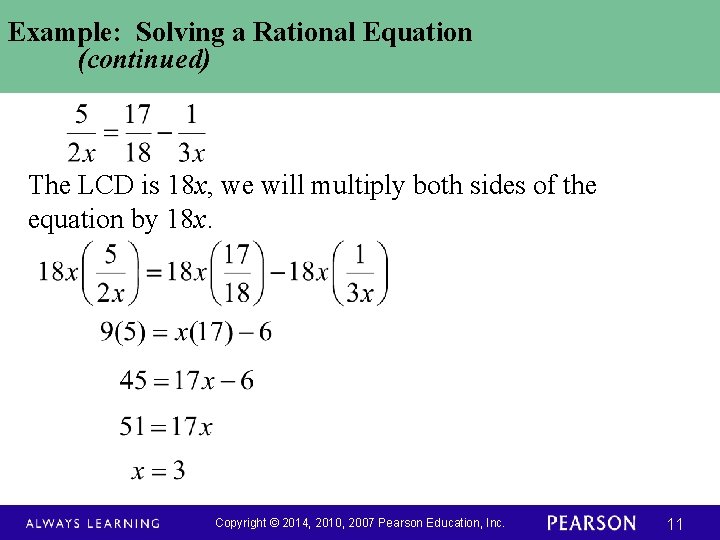
Example: Solving a Rational Equation (continued) The LCD is 18 x, we will multiply both sides of the equation by 18 x. Copyright © 2014, 2010, 2007 Pearson Education, Inc. 11
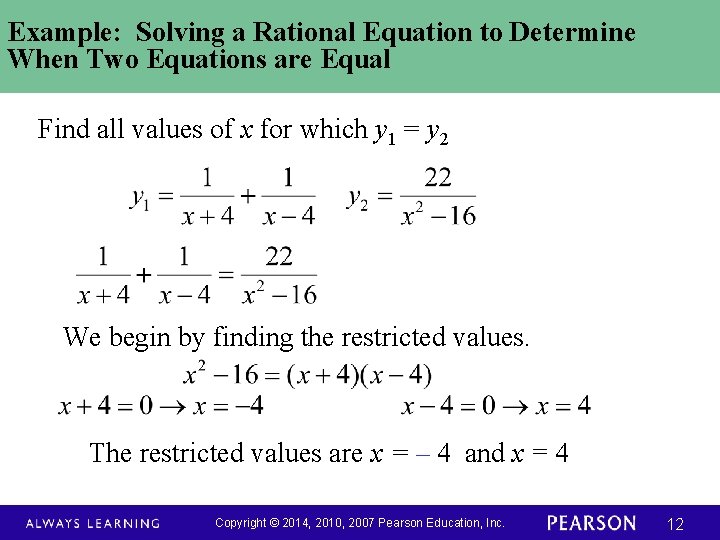
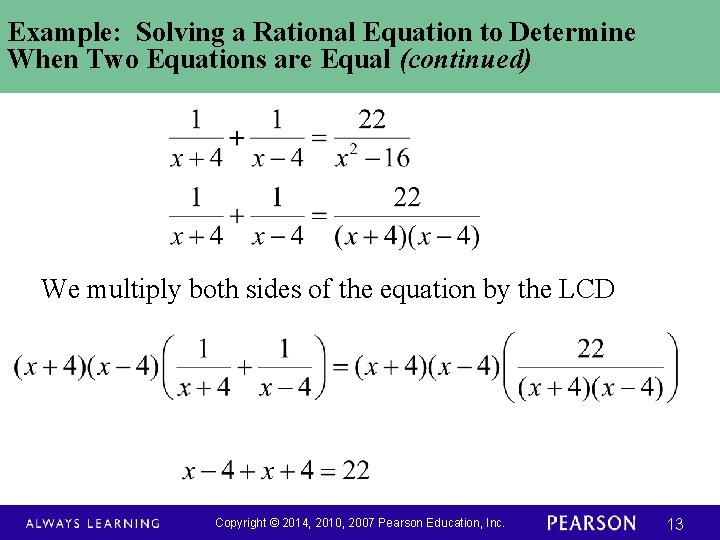
Example: Solving a Rational Equation to Determine When Two Equations are Equal Find all values of x for which y 1 = y 2 We begin by finding the restricted values. The restricted values are x = – 4 and x = 4 Copyright © 2014, 2010, 2007 Pearson Education, Inc. 12
Example: Solving a Rational Equation to Determine When Two Equations are Equal (continued) We multiply both sides of the equation by the LCD Copyright © 2014, 2010, 2007 Pearson Education, Inc. 13
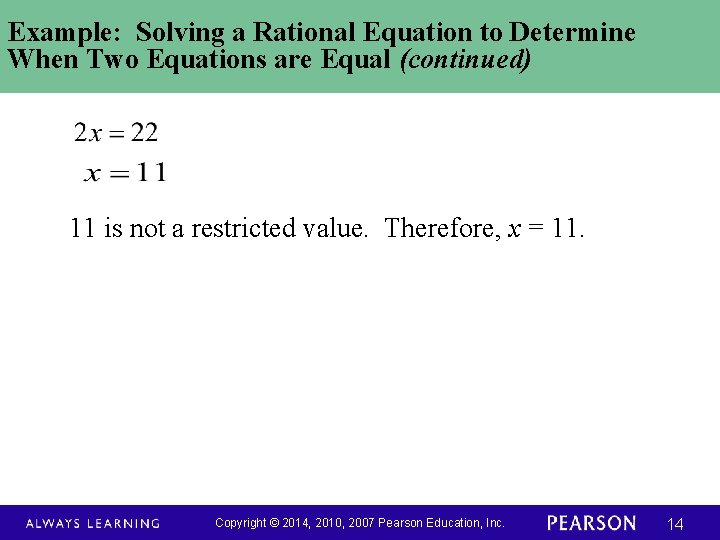
Example: Solving a Rational Equation to Determine When Two Equations are Equal (continued) 11 is not a restricted value. Therefore, x = 11. Copyright © 2014, 2010, 2007 Pearson Education, Inc. 14
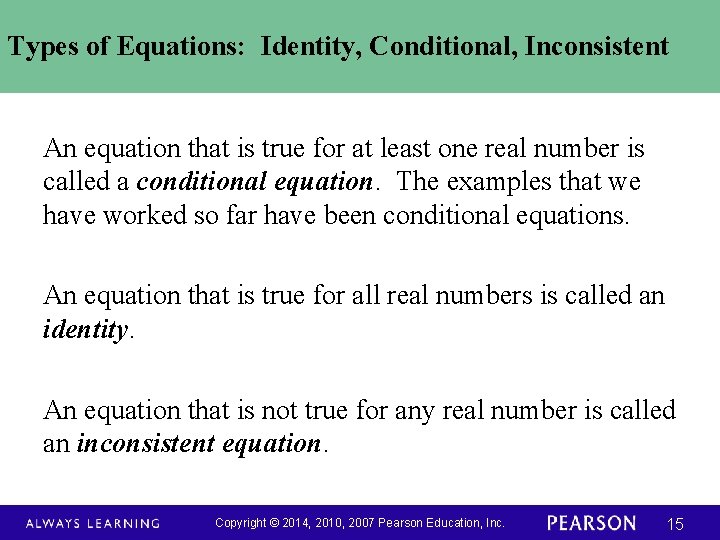
Types of Equations: Identity, Conditional, Inconsistent An equation that is true for at least one real number is called a conditional equation. The examples that we have worked so far have been conditional equations. An equation that is true for all real numbers is called an identity. An equation that is not true for any real number is called an inconsistent equation. Copyright © 2014, 2010, 2007 Pearson Education, Inc. 15
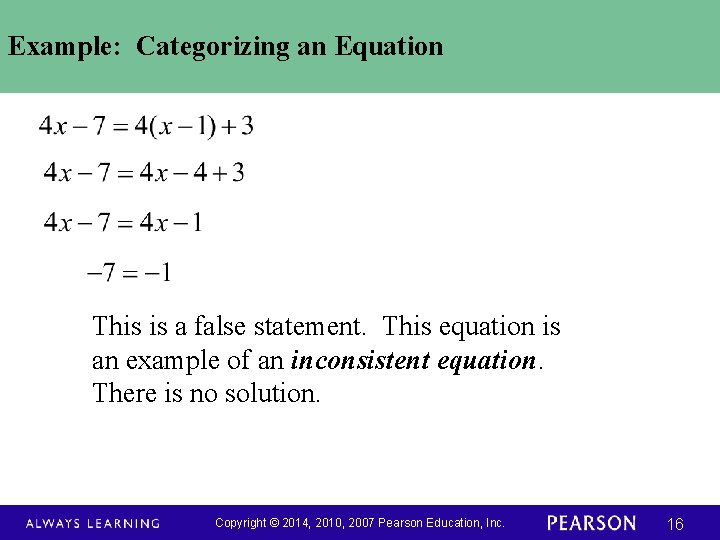
Example: Categorizing an Equation This is a false statement. This equation is an example of an inconsistent equation. There is no solution. Copyright © 2014, 2010, 2007 Pearson Education, Inc. 16
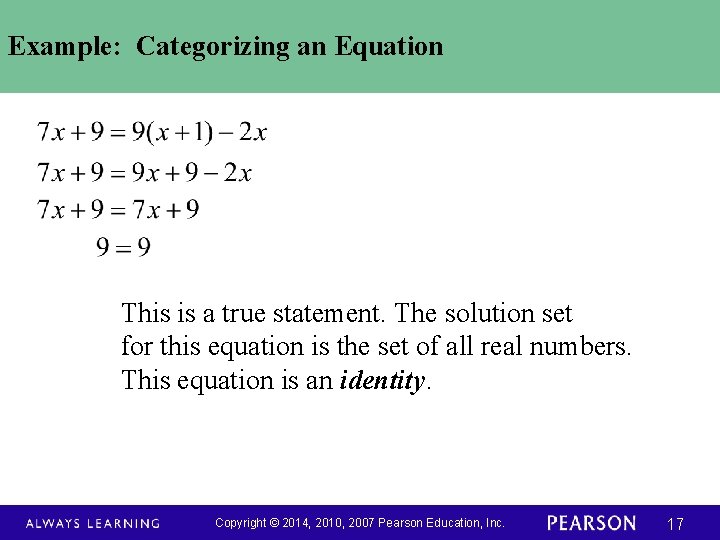
Example: Categorizing an Equation This is a true statement. The solution set for this equation is the set of all real numbers. This equation is an identity. Copyright © 2014, 2010, 2007 Pearson Education, Inc. 17
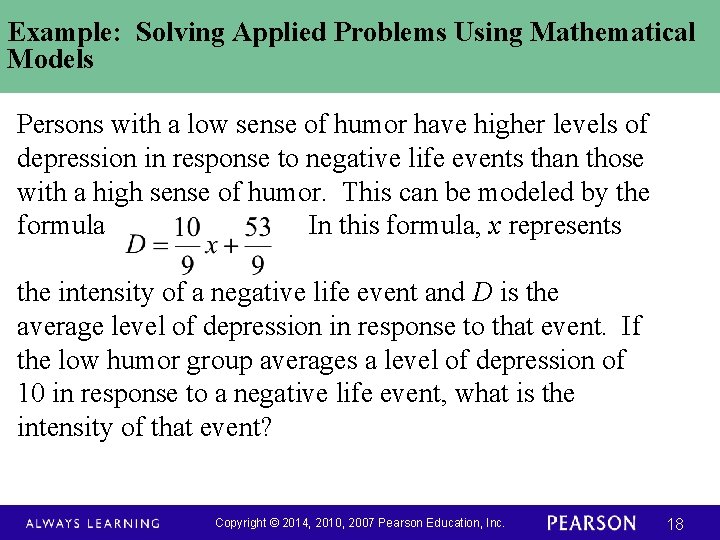
Example: Solving Applied Problems Using Mathematical Models Persons with a low sense of humor have higher levels of depression in response to negative life events than those with a high sense of humor. This can be modeled by the formula In this formula, x represents the intensity of a negative life event and D is the average level of depression in response to that event. If the low humor group averages a level of depression of 10 in response to a negative life event, what is the intensity of that event? Copyright © 2014, 2010, 2007 Pearson Education, Inc. 18
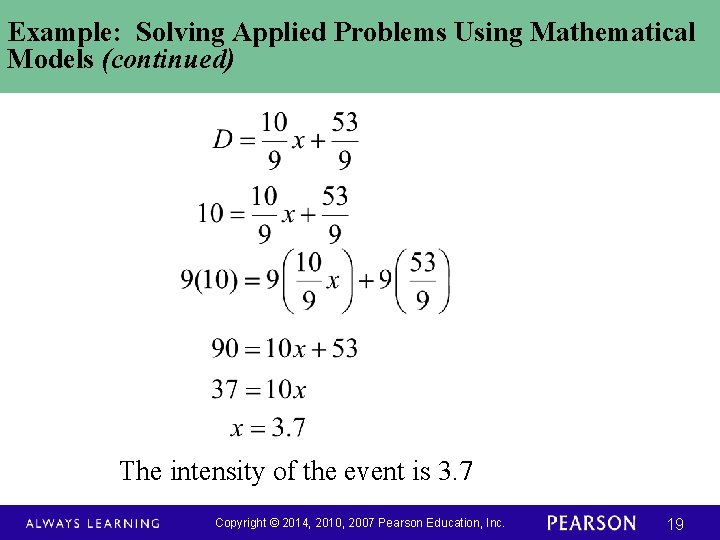
Example: Solving Applied Problems Using Mathematical Models (continued) The intensity of the event is 3. 7 Copyright © 2014, 2010, 2007 Pearson Education, Inc. 19