
Chapter 1 Emergency Medical Responder and Emergency Medical
- Slides: 32
Chapter 1 Emergency Medical Responder and Emergency Medical Services EMR 1 -1
Introduction • • • The EMR is an essential part of the Emergency Medical Services (EMS) EMRs are often the first trained providers to arrive on the scene Training includes knowledge and skills in basic medical and trauma assessment and management Along with being trained, the EMR needs to be professional EMR must follow the legal and ethical scope of practice Cont. EMR 1 -2
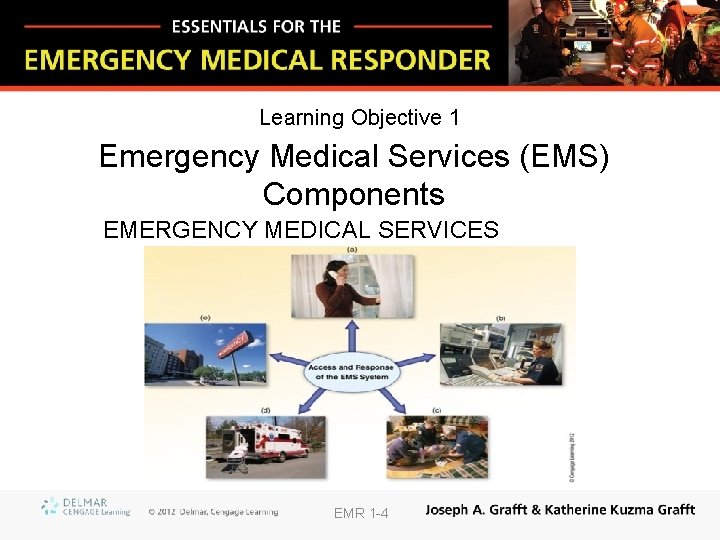
Learning Objective 1 Emergency Medical Services (EMS) Components EMERGENCY MEDICAL SERVICES • Network of professionals • Level of service dispatched to an emergency call varies • The EMS system is initiated with a call for service • Level of care a patient receives en route depends on several factors Cont. EMR 1 -3
Learning Objective 1 Emergency Medical Services (EMS) Components EMERGENCY MEDICAL SERVICES EMR 1 -4
Learning Objective 1 Emergency Medical Services (EMS) Components COMPONENTS • Public EMS • Fire base EMS • Private EMS • Third service • Other EMS response positions EMR 1 -5
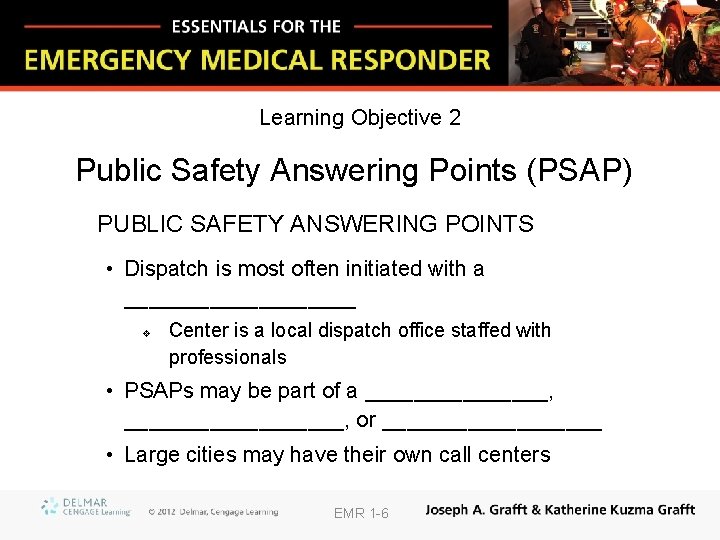
Learning Objective 2 Public Safety Answering Points (PSAP) PUBLIC SAFETY ANSWERING POINTS • Dispatch is most often initiated with a 9 -1 -1 call v Center is a local dispatch office staffed with professionals • PSAPs may be part of a sheriff’s office, local fire or police department, or similar organization • Large cities may have their own call centers EMR 1 -6
Learning Objective 2 Public Safety Answering Points (PSAP) THE 9 -1 -1 SYSTEM • The U. S. national emergency number • Prefix may be required to reach an outside line ENHANCED 9 -1 -1 • Hard-wired telephones have enhanced 9 -1 -1 • Operator immediately sees name and address • Address is relayed to the responding agency EMR 1 -7
Learning Objective 2 Public Safety Answering Points (PSAP) TECHNOLOGY AND 9 -1 -1 • Cell phones and global positioning satellite (GPS) • Calls are routed to the closet PSAP tower v Tower may be in a different jurisdiction or state • Difficulties for emergency personnel to respond EMR 1 -8
Learning Objective 3 Define Medical Oversight AUTHORIZATION TO PRACTICE • Each state independently regulates the practice of medicine • EMR professionals are certified to practice in a specific area v v v State County Region EMR 1 -9
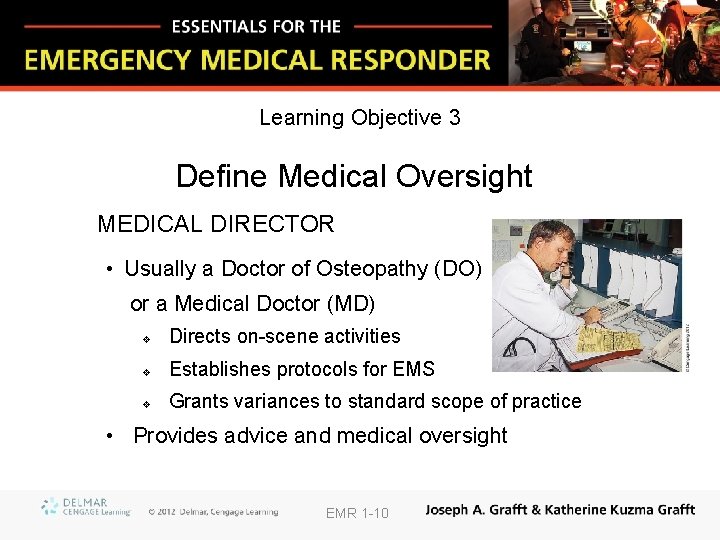
Learning Objective 3 Define Medical Oversight MEDICAL DIRECTOR • Usually a Doctor of Osteopathy (DO) or a Medical Doctor (MD) v Directs on-scene activities v Establishes protocols for EMS v Grants variances to standard scope of practice • Provides advice and medical oversight EMR 1 -10
Learning Objective 3 Define Medical Oversight PROTOCOLS • Medical guidelines v Form a decision tree • Provides procedures to perform and techniques to use • Can be expanded or restricted v Medical director’s responsibility of protocols ü Training ü Performance of skills EMR 1 -11
Learning Objective 4 Quality Improvement and Quality Assurance QUALITY MANAGEMENT • Ensures quality of the service • Means by which to achieve highest quality of service • Patient safety and the reduction of errors • Two components v v Quality assurance Quality improvement EMR 1 -12
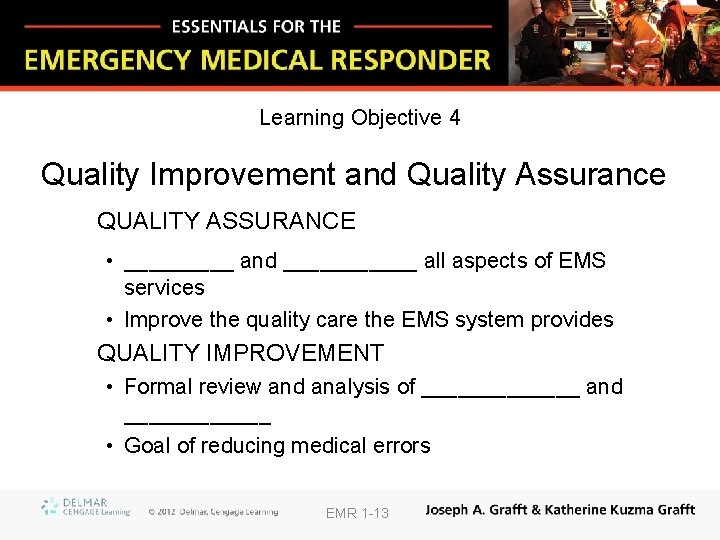
Learning Objective 4 Quality Improvement and Quality Assurance QUALITY ASSURANCE • Monitor and evaluate all aspects of EMS services • Improve the quality care the EMS system provides QUALITY IMPROVEMENT • Formal review and analysis of performance and processes • Goal of reducing medical errors EMR 1 -13
Learning Objective 4 Quality Improvement and Quality Assurance POLICIES • What is expected and what is not allowed • Typical policies PROCEDURES • Employer-required steps to follow when providing patient care • Common procedures EMR 1 -14
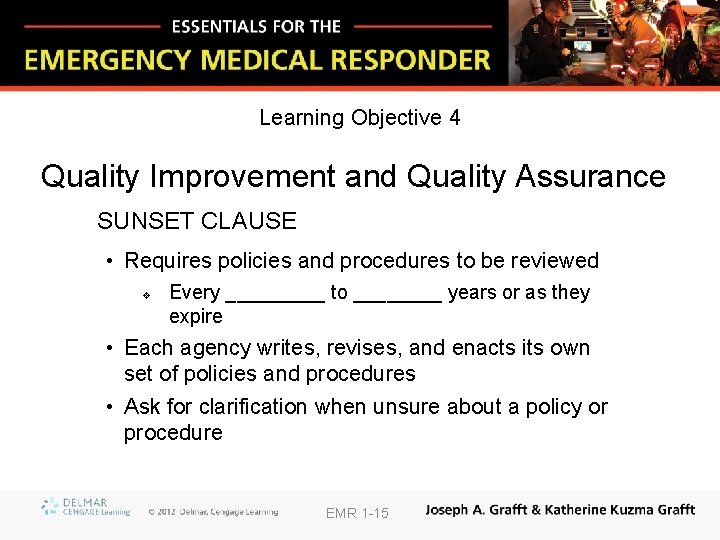
Learning Objective 4 Quality Improvement and Quality Assurance SUNSET CLAUSE • Requires policies and procedures to be reviewed v Every three to five years or as they expire • Each agency writes, revises, and enacts its own set of policies and procedures • Ask for clarification when unsure about a policy or procedure EMR 1 -15
Learning Objective 5 Role of an Emergency Medical Responder (EMR) ROLES AND RESPONSIBILITIES • Readiness v Classroom and hands-on training • Safety v Personal safety first • Caring for patients • Communication Cont. EMR 1 -16
Learning Objective 5 Role of an Emergency Medical Responder (EMR) ROLES AND RESPONSIBILITIES • Patient advocacy • Continuous care and transfer • Patient confidentiality • Professionalism • Education and training EMR 1 -17
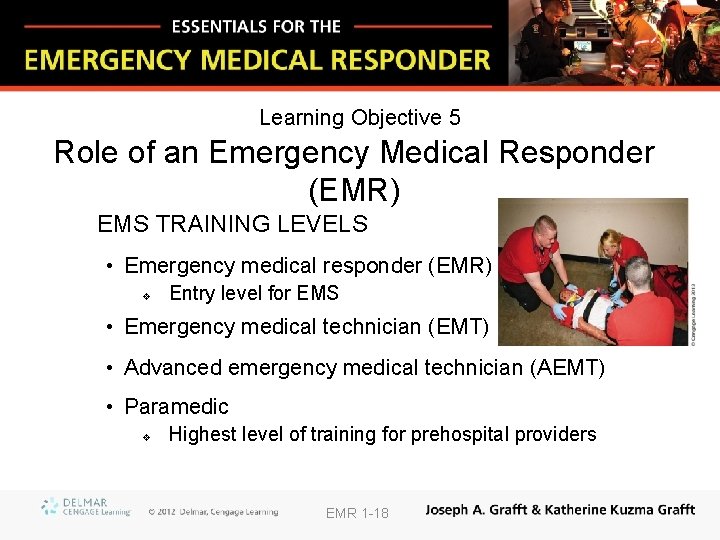
Learning Objective 5 Role of an Emergency Medical Responder (EMR) EMS TRAINING LEVELS • Emergency medical responder (EMR) v Entry level for EMS • Emergency medical technician (EMT) • Advanced emergency medical technician (AEMT) • Paramedic v Highest level of training for prehospital providers EMR 1 -18
Learning Objective 6 Ethics with Patients, Health Care Professionals, and the Public CHARACTER • Core values are basic personal beliefs and behaviors • Directs everything you do in your profession ETHICAL BEHAVIOR • Doing what is right based on a set of moral principles and values • EMRs need to rely on core values EMR 1 -19
Learning Objective 6 Ethics with Patients, Health Care Professionals, and the Public ADDITIONAL RESPONSIBILITIES TO CONSIDER • Bystanders v v Connection to patient Witnessed the incident • Technology v v v Pictures Video Text messages EMR 1 -20
Learning Objective 7 Identify Three Types of Medical Errors MEDICAL ERRORS • Skill-based errors • Knowledge-based errors • Rule-based errors • Research activities • Legal considerations EMR 1 -21
Learning Objective 8 Explain the Three Types of Consents CONSENT • Informed consent • Expressed consent • Implied consent • Treatment of minors and emancipated minors v In loco parentis v Emancipated minor EMR 1 -22
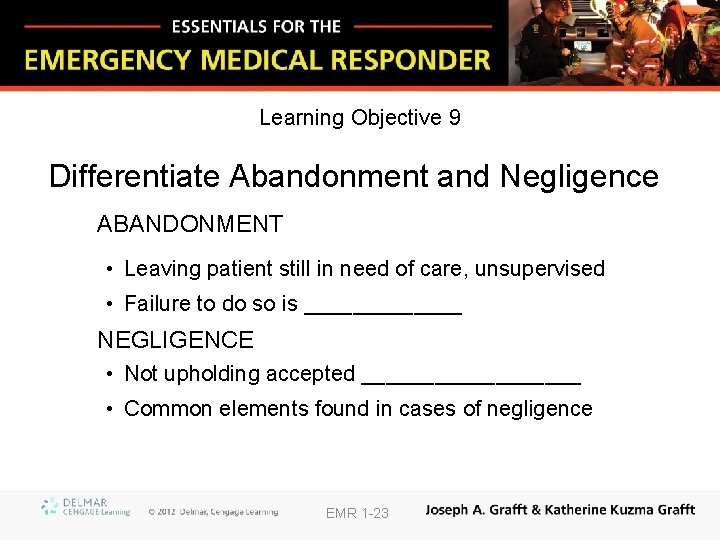
Learning Objective 9 Differentiate Abandonment and Negligence ABANDONMENT • Leaving patient still in need of care, unsupervised • Failure to do so is a crime NEGLIGENCE • Not upholding accepted medical practice • Common elements found in cases of negligence EMR 1 -23
Learning Objective 9 Differentiate Abandonment and Negligence ASSAULT • A patient is afraid that he or she may be touched without having given consent BATTERY • Actually unlawfully touching the patient against his or her wishes EMR 1 -24
Learning Objective 10 Explain the Good Samaritan Law GOOD SAMARITAN LAW • Meant to provide legal protection for a person who voluntarily assists an injured or ill person v v Rescuer is not expecting a reward Rescuer provides care in good faith • Ways to protect yourself from legal liability EMR 1 -25
Learning Objective 11 Define Culture of Emergency Services CULTURE OF EMS • Structure and history of an EMS agency • EMR must respect and understand this culture • Industrial response teams have a distinct culture • The most important component will always be the successful treatment of the patients EMR 1 -26
Summary • Standards to become an EMR are meant to establish minimum requirements • EMR must see this level is a starting point • An EMR will have the opportunity to compile the skills that best serve the community • EMRs must demonstrate ethical behavior and professionalism • Above all, provide quality patient care within the individual’s scope of practice EMR 1 -27
NOTES QUIZ Chapter 1
Learning Objective 2 Public Safety Answering Points (PSAP) PUBLIC SAFETY ANSWERING POINTS • Dispatch is most often initiated with a __________ v Center is a local dispatch office staffed with professionals • PSAPs may be part of a ________, _________, or _________ • Large cities may have their own call centers EMR 1 -6
Learning Objective 4 Quality Improvement and Quality Assurance QUALITY ASSURANCE • _____ and ______ all aspects of EMS services • Improve the quality care the EMS system provides QUALITY IMPROVEMENT • Formal review and analysis of _______ and ______ • Goal of reducing medical errors EMR 1 -13
Learning Objective 4 Quality Improvement and Quality Assurance SUNSET CLAUSE • Requires policies and procedures to be reviewed v Every _____ to ____ years or as they expire • Each agency writes, revises, and enacts its own set of policies and procedures • Ask for clarification when unsure about a policy or procedure EMR 1 -15
Learning Objective 9 Differentiate Abandonment and Negligence ABANDONMENT • Leaving patient still in need of care, unsupervised • Failure to do so is _______ NEGLIGENCE • Not upholding accepted _________ • Common elements found in cases of negligence EMR 1 -23