
Chapter 1 Early History of Punishment and the


- Slides: 33
Chapter 1: Early History of Punishment and the Development of Prisons in the United States 1
Topics to Cover • Defining Corrections • The Notion of Punishment and Corrections Throughout History • The Enlightenment and Correctional Reform • Punishment During Early American History: 1700 s-1800 s • The Age of the Reformatory in America • Prisons in America: 1900 s to the end of World War II • Modern Day Systems: Federal and State Inmate Characteristics Hanser, Introduction to Corrections. © 2016, SAGE Publications.
Define corrections and the role it has in the criminal justice system DEFINING CORRECTIONS: A VARIETY OF POSSIBILITIES Hanser, Introduction to Corrections. © 2016, SAGE Publications.
The Role of Corrections in the Criminal Justice System • Corrections – A process whereby practitioners: – Engage in organized security and treatment – Goal to correct criminal tendencies • Other four segments of justice system: – Law enforcement, courts, juvenile justice system, victim services DEFINING CORRECTIONS: A VARIETY OF POSSIBILITIES Hanser, Introduction to Corrections. © 2016, SAGE Publications.
Identify early historical developments and justifications in the use of punishment and corrections THE NOTION OF PUNISHMENT AND CORRECTIONS THROUGHOUT HISTORY Hanser, Introduction to Corrections. © 2016, SAGE Publications.
Punishment and Corrections • Punishment and Corrections not synonymous: • Goal of punishment to correct offender’s behavior • Brutalization hypothesis THE NOTION OF PUNISHMENT AND CORRECTIONS Hanser, Introduction to Corrections. © 2016, SAGE Publications. THROUGHOUT HISTORY
Early Codes of Law • Babylonian and Sumerian Codes – Code of Hammurabi • Roman Law and Punishment – Imprisonment – Civil death • Western Europe and East Asia – Penal Servitude THE NOTION OF PUNISHMENT AND CORRECTIONS Hanser, Introduction to Corrections. © 2016, SAGE Publications. THROUGHOUT HISTORY
Early Historical Role of Religion, Punishment, and Corrections • Church’s Role in Justice System – Large peasantry class – Literate religious leaders – Trial by ordeal – Save soul of condemned – Sanctuary THE NOTION OF PUNISHMENT AND CORRECTIONS Hanser, Introduction to Corrections. © 2016, SAGE Publications. THROUGHOUT HISTORY
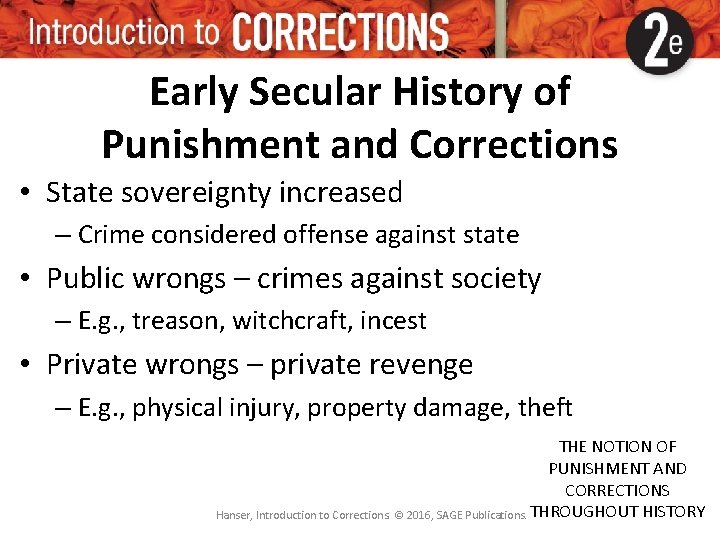
Early Secular History of Punishment and Corrections • State sovereignty increased – Crime considered offense against state • Public wrongs – crimes against society – E. g. , treason, witchcraft, incest • Private wrongs – private revenge – E. g. , physical injury, property damage, theft THE NOTION OF PUNISHMENT AND CORRECTIONS Hanser, Introduction to Corrections. © 2016, SAGE Publications. THROUGHOUT HISTORY
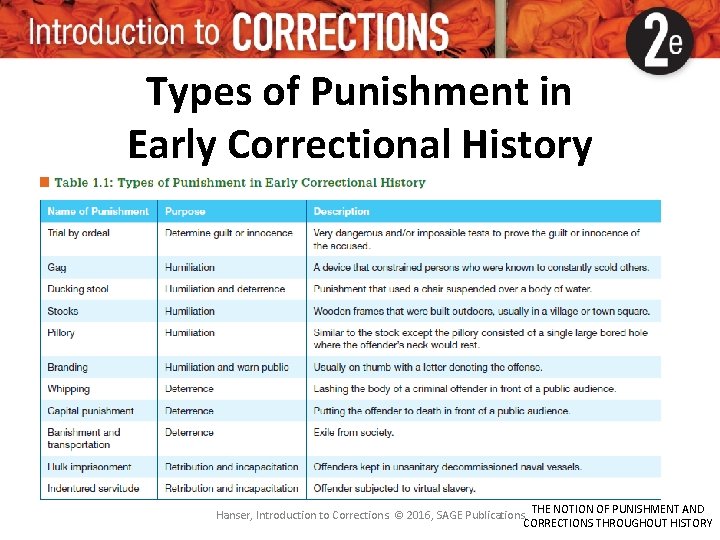
Types of Punishment in Early Correctional History THE NOTION OF PUNISHMENT AND Hanser, Introduction to Corrections. © 2016, SAGE Publications. CORRECTIONS THROUGHOUT HISTORY
Discuss the development of the Enlightenment and key persons on correctional reform THE ENLIGHTENMENT AND CORRECTIONAL REFORM Hanser, Introduction to Corrections. © 2016, SAGE Publications.
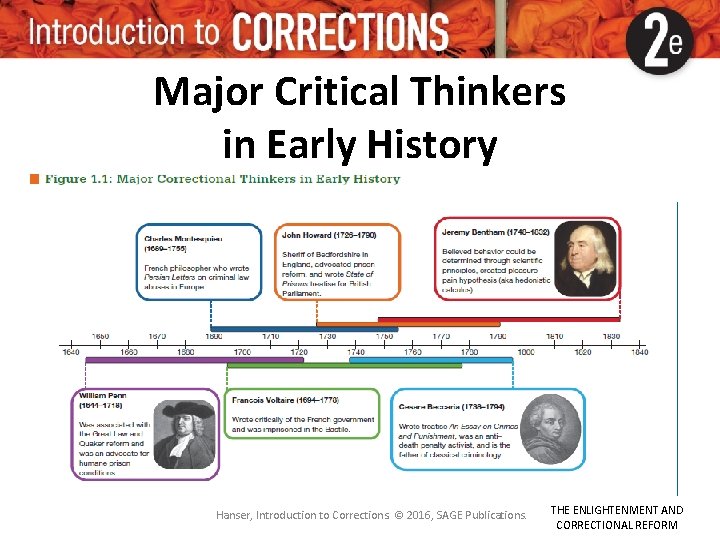
Major Critical Thinkers in Early History Hanser, Introduction to Corrections. © 2016, SAGE Publications. THE ENLIGHTENMENT AND CORRECTIONAL REFORM
Towards Humane Punishment and Reform • William Penn, the Quakers, and the Great Law – Loss of liberty, hard labor more effective than death penalty • Charles Montesquieu, Francois Voltaire, and Cesare Beccaria – Focus on human rights – Proportional punishment – Rehabilitation over retribution Hanser, Introduction to Corrections. © 2016, SAGE Publications. THE ENLIGHTENMENT AND CORRECTIONAL REFORM
Towards Humane Punishment and Reform • John Howard: The Making of the Penitentiary – State of Prisons to improve conditions • Jeremy Bentham: Hedonistic Calculus – Punishment as deterrence – swift, severe, and certain • Classical criminology – Punishment should be useful, purposeful, and reasonable THE ENLIGHTENMENT AND CORRECTIONAL REFORM Hanser, Introduction to Corrections. © 2016, SAGE Publications.
Discuss the development of punishment in early American history PUNISHMENT DURING EARLY AMERICAN HISTORY: 1700 S-1800 S Hanser, Introduction to Corrections. © 2016, SAGE Publications.
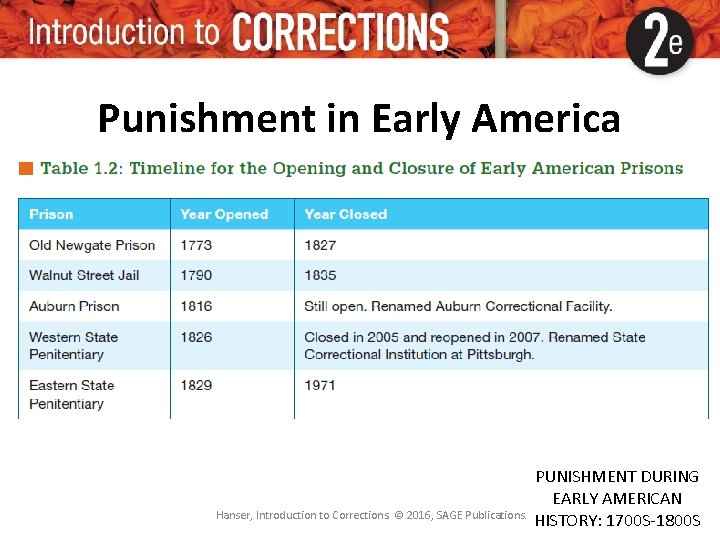
Punishment in Early America Hanser, Introduction to Corrections. © 2016, SAGE Publications. PUNISHMENT DURING EARLY AMERICAN HISTORY: 1700 S-1800 S
Punishment in Early America • Old Newgate Prison – First prison, designed for punishment • The Walnut Street Jail – First penitentiary, designed for reform Hanser, Introduction to Corrections. © 2016, SAGE Publications. PUNISHMENT DURING EARLY AMERICAN HISTORY: 1700 S-1800 S
Punishment in Early America • The Pennsylvania System – Designed for solitude, repentance • The Auburn System – Designed for work, repentance • Two American Prototypes in Conflict – The Auburn System’s economic benefits prevailed PUNISHMENT DURING EARLY AMERICAN HISTORY: 1700 S-1800 S Hanser, Introduction to Corrections. © 2016, SAGE Publications.
Punishment in Early America • The Southern System – Pre-Civil War: Black Codes – Post-Civil War: Penal farms • Ruffin v. Commonwealth – Chain gangs: Profitable labor • The Western System – Holding cells for inmates – Contracted custody with other states – Eventually adopted Auburn System Hanser, Introduction to Corrections. © 2016, SAGE Publications. PUNISHMENT DURING EARLY AMERICAN HISTORY: 1700 S-1800 S
Describe the changes to prison systems brought about by the Age of the Reformatory in America THE AGE OF THE REFORMATORY IN AMERICA Hanser, Introduction to Corrections. © 2016, SAGE Publications. 20
New Era of Reform • National Prison Association – 1870 – drafted Declaration of Principles: – Reformation over punishment – Classification of inmates – Indeterminate sentences – Self-efficacy • Elmira Reformatory – 1876 – Individualized plans of reform – Evidence shows limited success in rehab Hanser, Introduction to Corrections. © 2016, SAGE Publications. THE AGE OF THE REFORMATORY IN AMERICA
Identify the various prison systems, eras, and models that developed in the early- and mid-1900 s in America PRISONS IN AMERICA: 1900 S TO THE END OF WORLD WAR II Hanser, Introduction to Corrections. © 2016, SAGE Publications.
Prisons in America • Prison Farming Systems – Profit driven, based on agriculture – Arkansas System – Inmates in charge of other inmates • Progressive Era – Humane treatment of inmates – Deviance – social and psychological causes • The Era of the “Big House” – Made of concrete and steel – Checkpoints throughout facility Hanser, Introduction to Corrections. © 2016, SAGE Publications. PRISONS IN AMERICA: 1900 S TO THE END OF WORLD WAR II
Prisons in America • The Medical Model – Mental health approach – Criminality result of internal deficiencies – Classification process • The Reintegration Model – Criminality result of external environment – Martinson Report • The Crime Control Model – “Get tough” policies Hanser, Introduction to Corrections. © 2016, SAGE Publications. PRISONS IN AMERICA: 1900 S TO THE END OF WORLD WAR II
Explain how state and federal prisons differ and identify the Big Four in American corrections MODERN DAY SYSTEMS: FEDERAL AND STATE INMATE CHARACTERISTICS Hanser, Introduction to Corrections. © 2016, SAGE Publications.
Corrections Today • Federal Bureau of Prisons – 1930 – > 100 facilities – > 50% drug offenders – 12% are citizens of other countries – > 50% low- or minimum-security risk – Average time served is 6. 5 years • State Corrections – > 50% violent offenders – Most common form of corrections – State budgets smaller than BOP’s MODERN DAY SYSTEMS: FEDERAL AND STATE INMATE CHARACTERISTICS Hanser, Introduction to Corrections. © 2016, SAGE Publications.
The Emergence of the “Big Four” • The four largest state correctional systems – Texas: ~ 168, 000 – Florida: ~ 103, 000 – California: ~ 135, 000 – New York: ~ 55, 000 • Big four states: – Large free-world populations – Relatively representative of U. S. population – Ethnically diverse MODERN DAY SYSTEMS: – Robust economies FEDERAL AND STATE Hanser, Introduction to Corrections. © 2016, SAGE Publications. INMATE CHARACTERISTICS
Early history of punishment and the development of prisons in the United States DISCUSSION QUESTIONS Hanser, Introduction to Corrections. © 2016, SAGE Publications.
Discussion Questions • Identify punishment and identify corrections. Explain how each differs from the other, and explain why they are often confused with one another • Explain how punishment has progressed from ancient and medieval times to current-day practices. Are there still similarities in thought, and, if so, what are they? • Identify key thinkers and persons of influence who have impacted the field of corrections. For each, be sure to highlight their particular contribution(s) to the field. Hanser, Introduction to Corrections. © 2016, SAGE Publications.
Discussion Questions • What is the significance of Old Newgate Prison? What distinguishes this structure from the penitentiary wing added to the Walnut Street Jail? Why is Old Newgate Prison important to correctional history in the United States? • Explain how the classical school of criminology, behavioral psychology, and the field of corrections can be interrelated in reforming offender behavior. Hanser, Introduction to Corrections. © 2016, SAGE Publications.
Discussion Questions • What are some key differences between the Philadelphia and Auburn prison systems? • How did different regions differ in their approaches to prison operations? Compare at least two regions. • What is meant by the Big Four in American corrections, and why is this important? Hanser, Introduction to Corrections. © 2016, SAGE Publications.
Discussion • • • Or… Questions Case Study Exercise Review Looking Ahead Hanser, Introduction to Corrections. © 2016, SAGE Publications.
Open-Access Student Resources • • • Mobile-friendly quizzes Mobile-friendly e. Flashcards Learning objective summaries Video and multimedia resources SAGE journal articles http: //edge. sagepub. com/hanser 2 e Hanser, Introduction to Corrections. © 2016, SAGE Publications.