
CHAPTER 1 DIAS INOLVIDABLES AN UNFORGETTABLE DAYS IN
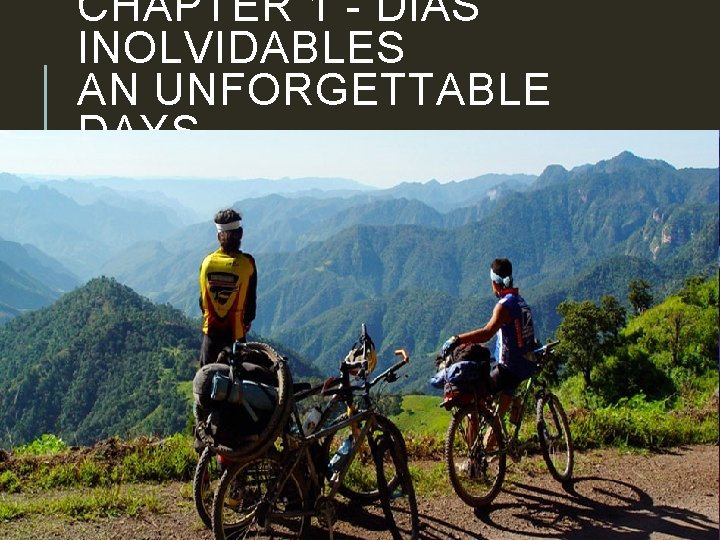
CHAPTER 1 - DIAS INOLVIDABLES AN UNFORGETTABLE DAYS
IN THIS LESSON YOU WILL LEARN TO 1. Read, Write, listen to, and understand information about TURISM activities and features of the natural environment 2. Communicate about ecotourism, camping equipment and responsible tourism practices 3. Narrate a camping adventure in a National Park in a Latin Country 4. Talk about events in the past – Reading Comprehension Story
READ, WRITE, LISTEN TO, AND UNDERSTAND INFORMATION ABOUT SUSTAINABLE TOURISM ACTIVITIES AND FEATURES OF THE NATURAL ENVIRONMENT OBJECTIVE # 1
ASSESSMENTS – EVALUACIONES OBJECTIVE #1 1. Cooperative and Individual Rubric Evaluation (Rubric) § Online Research and Oral Presentation Presenting the following topics § In what ways the tourism brings positive and negative effects to the country’s economy, ecology, and culture? § What is sustainable tourism? 2. 4 P- Essay – What is Sustainable Tourism? (Rubric)
IN WHAT WAYS THE TOURISM BRINGS POSITIVE AND NEGATIVE EFFECTS TO THE COUNTRY'S ECONOMY, ECOLOGY, AND CULTURE? 1. Positive and Negative Effects Spanish (click here) English (click here) Video (click here) 2. Sustainable Tourism is the Future of Travel (click here) 3. BBC-London (click here) 4. Sustainable travel (click here) Essential Question - Pregunta Esencial
"With more than one billion international tourists now traveling the world each year, tourism has become a powerful and transformative force that is making a genuine difference in the lives of millions of people. The world's leading employment sectors, tourism provides important livelihood opportunities, helping alleviate poverty and drive inclusive development. " - United Nations Secretary-General, Banki-moon World Tourism Day Message, 2015 Sustainable Meaning (click here)
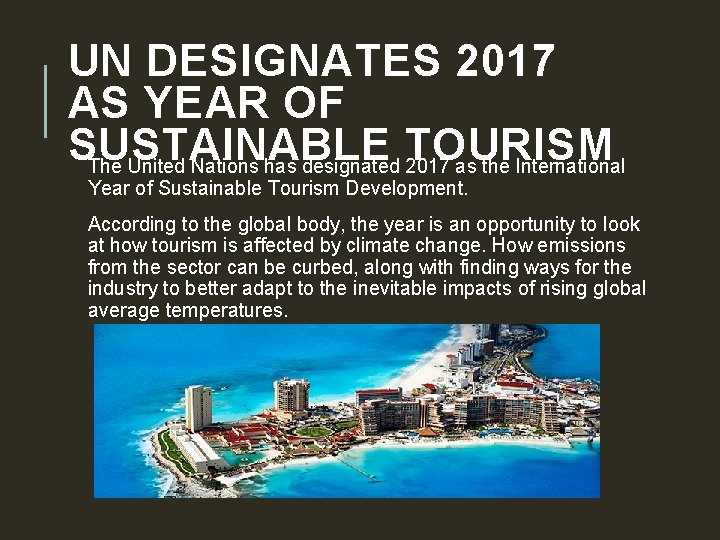
UN DESIGNATES 2017 AS YEAR OF SUSTAINABLE TOURISM The United Nations has designated 2017 as the International Year of Sustainable Tourism Development. According to the global body, the year is an opportunity to look at how tourism is affected by climate change. How emissions from the sector can be curbed, along with finding ways for the industry to better adapt to the inevitable impacts of rising global average temperatures.
WARM-UP What is Sustainab le tourism? (click here)
WHY SUSTAINABLE TOURISM? 1. Video (click here) 2. ONU – UN Video (click here) 3. The United Nations Sustainable Development Summit: 17 Goals to Transform Our World (click here) 4. IY 2017 campaign Video travel. enjoy. respect. (click here) 5.
TURISMO SUSTENTABLE - EXAMPLES 1. Consejos para un turismo sostenible – Tips for a sustainable turism (click here) 2. Machu Pichu – Peru – Example of Sustainability (click here) 3. Sustainable Turism (Nueva Zelanda (New Zealand) (click here) 4. Sustainable Construction – Germany (click here) 5. Tourism of 2030 First Part (click here) Second Part (click here)
TURISMO SOSTENIBLE DEFINICION SUSTAINABLE TOURISM DEFINITION üSustainable tourism is the concept of visiting a place as a tourist and trying to make only a positive impact on the environment, society and economy. A key aspect is respect for the people who call the location home, the culture and customs of the area, and the socio-economic system. üSustainable tourism development requires the informed participation of all relevant stakeholders, as well as strong political leadership to ensure wide participation and consensus building. Achieving sustainable tourism is a continuous process and it requires constant monitoring of impacts, introducing the necessary preventive and/or corrective measures whenever necessary. üSustainable tourism should also maintain a high level of tourist satisfaction and ensure a meaningful experience to the tourists, raising their awareness about sustainability issues and promoting sustainable tourism practices amongst them.
RESPONSIBLE TOURISM IS … Responsible tourism is like sustainable tourism, however as often the word sustainability is often overused and not understood, responsible tourism has been adopted as a term used by industry. Responsible tourism is any form of tourism that can be consumed in a more responsible way. Responsible tourism is tourism which: üminimizes negative social, economic and environmental impacts ügenerates greater economic benefits for local people and enhances the well-being of host communities üimproves working conditions and access to the industry üinvolves local people in decisions that affect their lives and life chances ümakes positive contributions to the conservation of natural and cultural heritage embracing diversity üprovides more enjoyable experiences for tourists through more meaningful connections with local people, and a greater understanding of local cultural, social and environmental issues üprovides access for physically challenged people üis culturally sensitive, encourages respect between tourists and hosts, and builds local pride 1. Travel and enjoy (click here) and confidence
COMMUNICATE ABOUT ECOTOURISM, CAMPING EQUIPMENT AND RESPONSIBLE TOURISM PRACTICES OBJECTIVE # 2
ASSESSMENTS – EVALUACIONES OBJECTIVE #2 1. Cooperative and Individual Rubric Evaluation (Rubric) § Research: Ecoturismo en Paises Hispanohablantes 2. Oral Presentation – §(Rubric) Oral Presentation Rubric
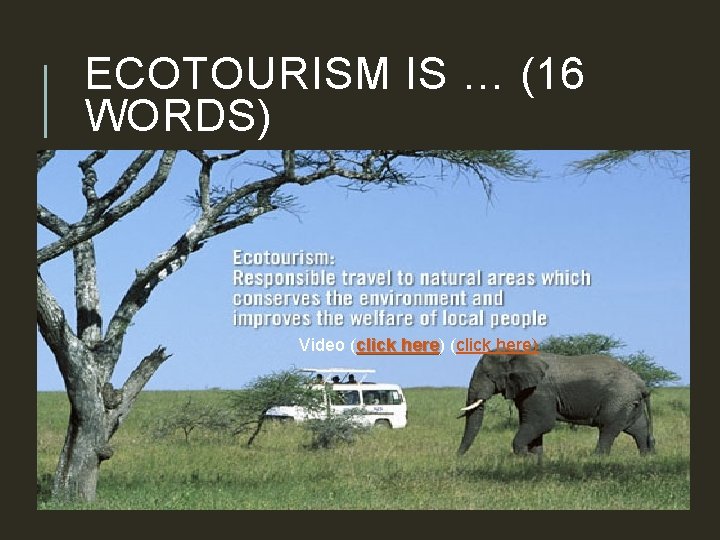
ECOTOURISM IS … (16 WORDS) Video (click here) click here
ECOTURISM CONCEPT “Ecotourism is environmentally responsible travel and visitation to relatively undisturbed natural areas, in order to enjoy, study and appreciate nature (and any accompanying cultural features – both past and present), that promotes conservation, has low visitor impact, and provides for beneficially active socio-economic involvement of local populations” Ecotourism is a form of sustainable tourism – all forms of tourism can become more sustainable but not all forms of tourism can be ecotourism Video en español
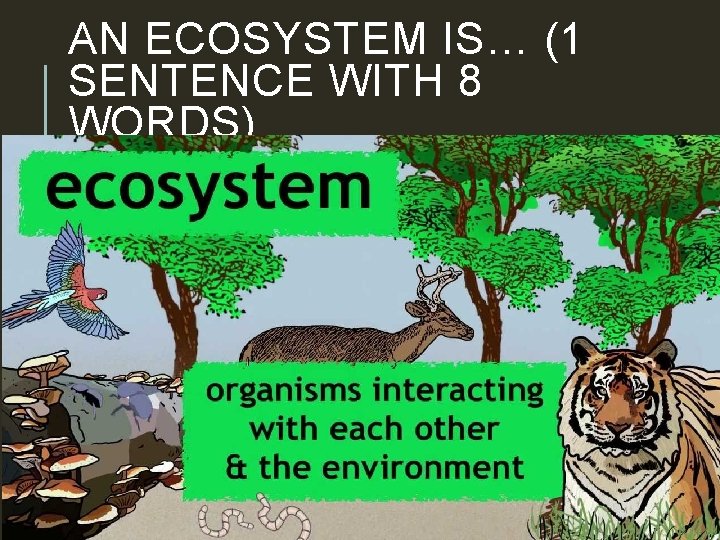
AN ECOSYSTEM IS… (1 SENTENCE WITH 8 WORDS)
ECOSYSTEMS IN THE WORLD 1. Different Types of Ecosystems (click here) 2. Video – Explore the world (click here) 3. A beautiful Planet (click here)

ESSAY: WHAT IS THE RELATIONSHIP BETWEEN SUSTAINABLE TOURISM & ECOTOURISM? First Paragraph: respond the question Second Paragraph: support your response with reasons or rationale (the why) Third Paragraph: Present evidence Fourht Paragraph: Conclusion
ECOTOURISM a. The international Ecoturism Society (TIES) definition (click here) b. Facts (click here) c. World Ecosystems (click here)
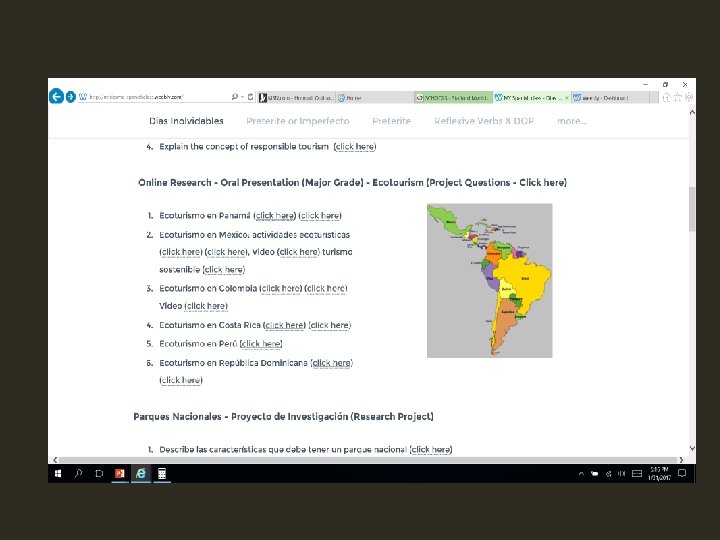
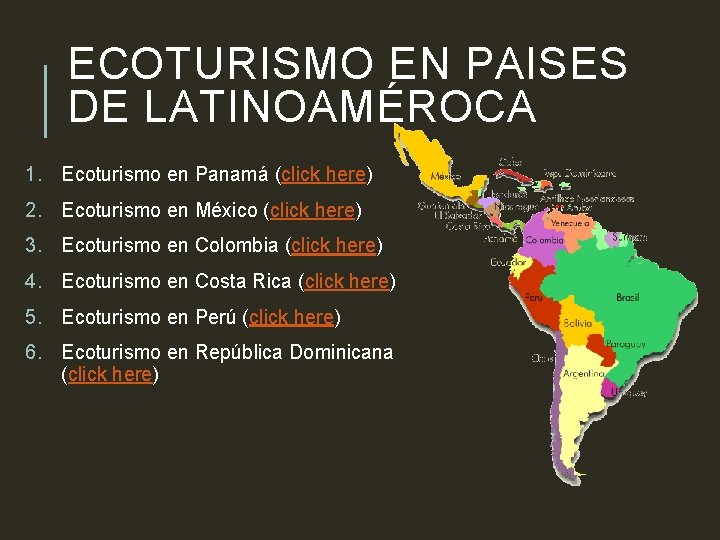
ECOTURISMO EN PAISES DE LATINOAMÉROCA 1. Ecoturismo en Panamá (click here) 2. Ecoturismo en México (click here) 3. Ecoturismo en Colombia (click here) 4. Ecoturismo en Costa Rica (click here) 5. Ecoturismo en Perú (click here) 6. Ecoturismo en República Dominicana (click here)
GUIDELINES FOR THE ONLINE READING ORAL PRESENTATION PROJECT. “ECOTURISMO EN PAISES LATINOAMERICANOS” Responsible Tourism Criteria 1. minimizes negative social, economic and environmental impacts 2. generates greater economic benefits for local people and enhances the well -being of host communities 3. improves working conditions and access to the industry 4. involves local people in decisions that affect their lives and life chances 5. makes positive contributions to the conservation of natural and cultural heritage embracing diversity 6. provides more enjoyable experiences for tourists through more meaningful connections with local people, and a greater understanding of local cultural, social and environmental issues 7. provides access for physically challenged people 8. is culturally sensitive, encourages respect between tourists and hosts, and builds local pride and confidence Steps: 1. Navigate the page, reading and taking notes from the information provided. 2. Take in consideration all the recommendations provided to preserve the environment and the culture, following the criteria of responsible tourism. 3. As a group decide what part of the information will be done by each student. 4. Divide the text in your cooperative group in equitable way 4. Present the written information in Spanish and the oral presentation in English. Follow the criteria for the oral presentation.
ADDITIONAL INFORMATION ¿Qué papel desempeña el ecoturismo en Latinoamérica? (click here) Describe lo que significa turismo alternativo en zonas indígenas de América Latina (click here) 1. Describe lo que significa turismo alternativo en zonas indígenas de América Latina (click here)
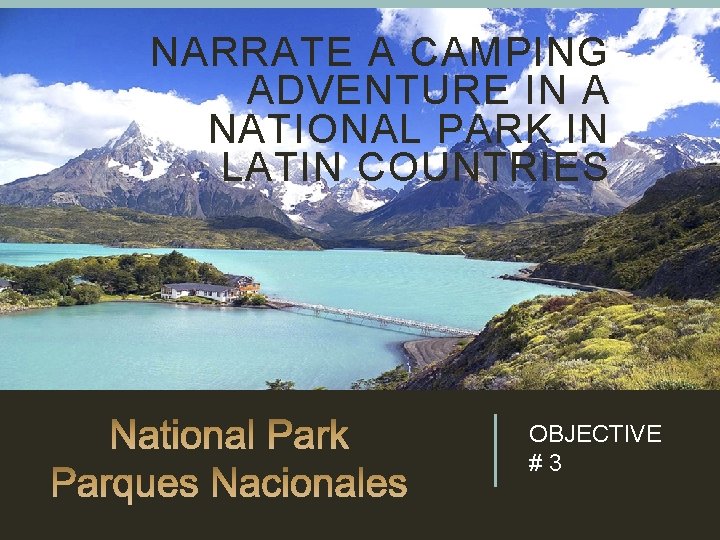
NARRATE A CAMPING ADVENTURE IN A NATIONAL PARK IN LATIN COUNTRIES OBJECTIVE # 3
ASSESSMENTS – EVALUACIONES OBJECTIVE #3 1. Parques Nacionales Research Evaluation (Rubric) § Research: Parques Nacionales Project (click here) 3. Oral Presentation in Spanish– (Rubric)
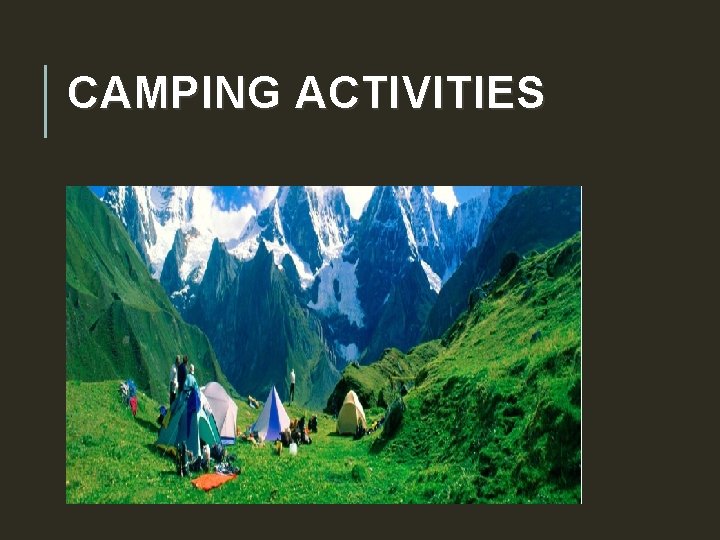
CAMPING ACTIVITIES
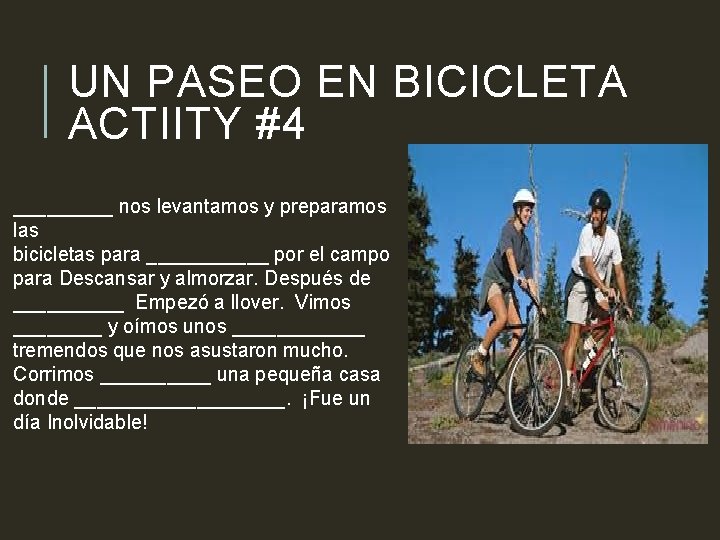
UN PASEO EN BICICLETA ACTIITY #4 _____ nos levantamos y preparamos las bicicletas para ______ por el campo para Descansar y almorzar. Después de _____ Empezó a llover. Vimos ____ y oímos unos ______ tremendos que nos asustaron mucho. Corrimos _____ una pequeña casa donde __________. ¡Fue un día Inolvidable!
ACTIVIDAD #5 - DEFINICIONES 1. Suceder pasar 2. Perder el equilibrio caerse 3. Refugiarse esconderse 4. Acercarse a Ir cerca de 5. al anochecer Cuando empieza la noche 6. al amanecer Cuando empieza la mañana 7. así De esta manera
AMPLIACION DEL LENGUAJE (IR DE…) P. 28 Muchos verbos en español se pueden expresar ir de
AL MAL TIEMPO DARLE BUENA CARA Actividad #7 p. 27 Actividad #9 p. 28
CAMPING ACTIVITIES 1. Chapter Vocabulary - Flashcards (click here) 2. ¿Qué tipo de equipo para campamento necesitas? - Camping Equipment and Activities Vocabulary (click here) 3. Reading Comprehension : "Una Aventura Desastrosa" (vocabulary) 4. Backpacking in Costa Rica (Documental) (click here)
¿QUE VAS A LLEVAR? 1. ¿Qué debo llevar para acampar? (click here) 2. Reading Comprehension : "Una Aventura Desastrosa" (vocabulary) 3. Backpacking in Costa Rica (Documental) (click here) 4. Ms. Frias Weebly – Video (click here)
WHAT IS A NATIONAL PARK? - ¿QUÉ ES UN PARQUE NACIONAL? • Activity Sheet (click here) – Translate the vocabulary to Spanish and write it in your journal • National parks are large areas of public land set aside for native plants, animals and the places in which they live. • National parks protect places of natural beauty. They also protect places important to Aboriginal people, and places that show people lived in the past. • People work in national parks to look after and study the park's plants, animals, landforms and sites. People visit national parks to enjoy the scenery and stay healthy by walking, camping, having a picnic or exploring.
WHY DO WE HAVE NATIONAL PARKS? There are many good reasons for having national parks. They provide a safe home for native plants and animals. They help keep the air and water clean. They help us to learn about the environment. National parks give us places to enjoy. For the variety of living things For our enjoyment and health All the different plants and animals on Earth make up the variety of living things, or 'biodiversity'. We share this planet with all these creatures and we must do our best to protect them. Many plants and animals can only live in certain areas. National parks protect some of these areas. For a healthy environment We all need fresh air, clean water and food. Without them we would die. The leaves of plants make fresh air. Their roots hold the soil together, which stops erosion and helps keep our waterways clean. National parks have lots of plants so they play a big part in keeping our environment healthy. National parks are places of natural beauty. They are places for people to relax in and enjoy. Many people have fun bushwalking, camping or having a picnic. There are lots of things to do in a national park such as swimming, skiing, painting, taking photographs, enjoying the view and taking in fresh air. For learning National parks are places for everybody to learn about native plants and animals and the way they rely on each other. Historic sites and Aboriginal sites also help us to learn about how people lived in the past.
HOW CAN WE TAKE CARE OF A NATIONAL PARK? ØWhen visiting a national park you need to ensure that you don't disturb plants, animals, special sites, or the enjoyment of other visitors. ØStaying safe in national parks When bushwalking, tell someone where you are going Take food and water, warm clothing and a raincoat Do not go alone Be careful when walking on rocks at the sea edge Put on sunscreen and a hat Stay behind safety fences Before swimming check the depth, temperature and current. Características que debe tener un parque nacional (click here)
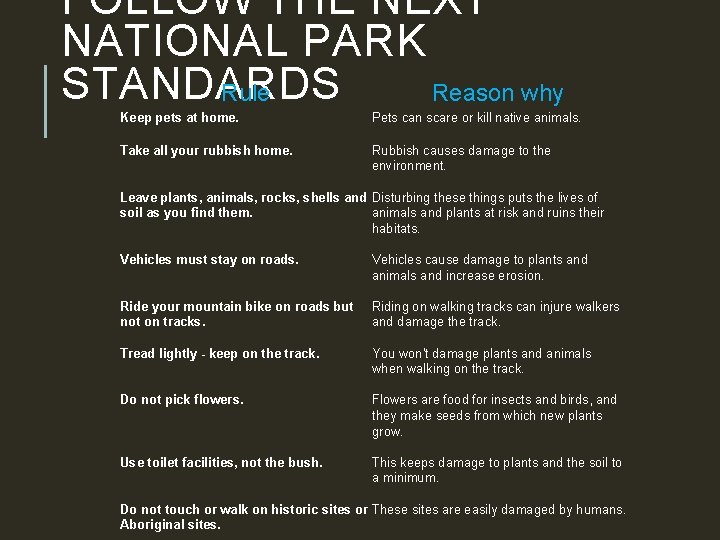
FOLLOW THE NEXT NATIONAL PARK STANDARDS Rule Reason why Keep pets at home. Pets can scare or kill native animals. Take all your rubbish home. Rubbish causes damage to the environment. Leave plants, animals, rocks, shells and Disturbing these things puts the lives of soil as you find them. animals and plants at risk and ruins their habitats. Vehicles must stay on roads. Vehicles cause damage to plants and animals and increase erosion. Ride your mountain bike on roads but not on tracks. Riding on walking tracks can injure walkers and damage the track. Tread lightly - keep on the track. You won't damage plants and animals when walking on the track. Do not pick flowers. Flowers are food for insects and birds, and they make seeds from which new plants grow. Use toilet facilities, not the bush. This keeps damage to plants and the soil to a minimum. Do not touch or walk on historic sites or These sites are easily damaged by humans. Aboriginal sites.
FONDO CULTURAL 1. Parques nacionales del América del Sur (p. 27) 2. Las estrellas del sur (actividad 11) (p. 29)
CONCLUSION 1. La tierra del olvido – Song – Parques Nacionales Colombia - Carlos Vives (click here)
PROYECTO – PARQUES NACIONALES RESEARCH Slide #1 Country and National Park Name - Nombre del parque nacional y del país Add photos, maps as a first slide and background music related with your national park Slide #2 – 3 Trip Cost - Costo del viaje Ticket Airplane Cost Currency Camping Equipment allowed Entrance Fee Slide #4 – 7 Parque Nacional – National Park Include Photos and information background from the National Park Activities to do in the National Park How many days are required to known well this park Add a Video that present the most important information about the park no more than 3” Slide #8 – 9 Ten Facts about this National Park and conclusion Search and include ten facts about your selected national park All the information must Add Photos, Maps, Animals, Plants, etc Slide #10 – Student Names Add students. name with a photo Be written in Spanish. English Concepts are not accepted fo This project
PARQUES NACIONALES 1. Canaima National Park (click here) 2. Los Glaciares National Park (click here) 3. Iguazú National Park (click here) 4. Tierra del Fuego National Park (click here) 5. Rincón de la Vieja National Park (click here) 6. Galápagos National Park (click here) 7. Titicaca National Park (click here) 8. Tenorio National Park (click here) 9. Pan de Azúcar National Park (click here) 10. Arrecifes de Cozumel National Park (click here) 11. Bocas del Toro National Park (click here) 12. El Imposible National Park (click here) 13. Nahuel Huapi National Park (click here) 14. Yunque Nationa Park (click here) 15. Conguillío National Park (click here)
CULTURAL BACKGROUND 1. Describe las características que debe tener un parque nacional (click here) 2. Los Ecocamps de Torres del Paine - (click here) 3. Rafting Rio Maipo (click here) 4. Patrimonios Nacionales de America Latina (click here) 5. Parques Nacionales en América Latina (click here)

CONCLUSION – REFLECTION ESSAY Write a reflective essay explaining how learning about sustainable environment, ecotourism, national parks, camping activities and responsible tourism helped you to have an awareness of natural environment, culture and traditions from different nations and people. 2017 International Year of Sustainable Tourism (click here)
CYCLE - REFLECTION How was my progress learning Spanish during these three weeks? What do I need to do better for the next following six weeks? What was the knowledge in this unit that I learned and explain how will you apply it in your real life?

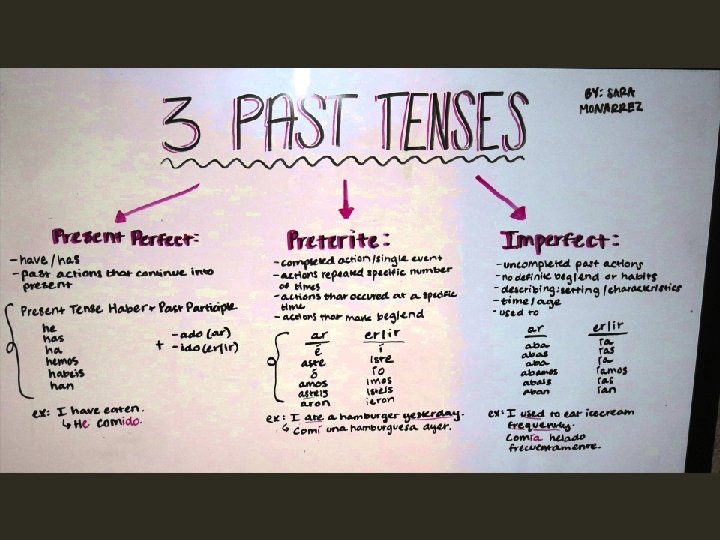
TALK ABOUT EVENTS IN THE PAST TENSE
GRAMMAR IN CONTEXT TEXTBOOK GRAMÁTICA EN CONTEXTO LIBRO DE TEXTO 1. Ir + de (p. 28) 2. Verbos con cambio ortográfico - (p. 30 Activities 14, 15) 3, El pretérito de los verbos irregulars - (p. 31 -32 Activities 16, 17, 18) 4. El pretérito de los verbos con cambio de raíz e-i, o-u - (p. p. 33 Activities 19, 20, 21, 22)
READING COMPREHENSION TEST El Camino de Santiago Lectura (p. 48 -49) 1. The student will be able to read about a famous pilgrimages route in Spain 2. Learn about how this route still thrives today 3. Compare a pilgrimages to your own travel experiences Video " El Camino de Santiago" (click here)
- Slides: 48