
Chapter 1 Developing a Helping Relationship Learning Objectives
Chapter 1: Developing a Helping Relationship
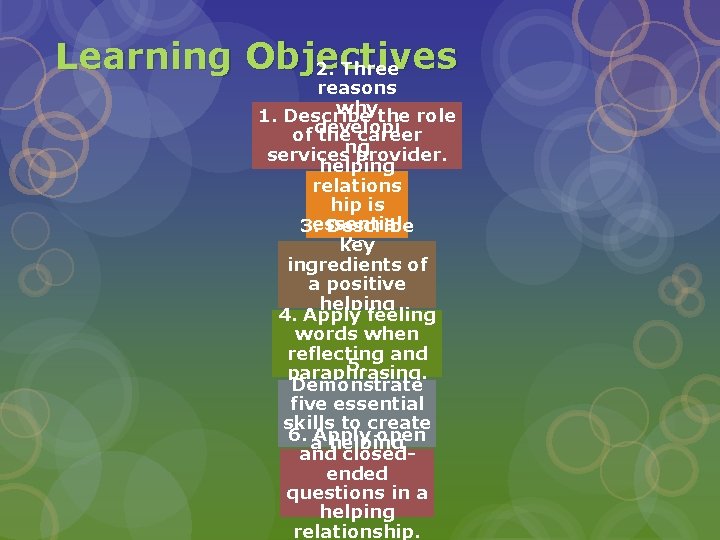
Learning Objectives 2. Three reasons whythe role 1. Describe of developi the career servicesng provider. helping relations hip is 3. essential Describe to key effective of ingredients a career positive develop helping 4. relationship. Apply feeling ment words when services. reflecting and 5. paraphrasing. Demonstrate five essential skills to create 6. a Apply open helping and closedrelationship. ended questions in a helping relationship.
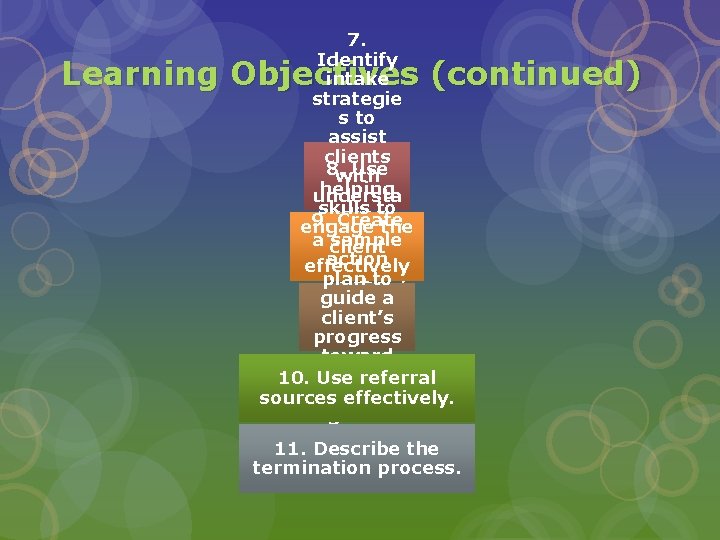
7. Identify intake strategie s to assist clients 8. Use with helping understa skills to nding 9. Create engage theirthe a client sample needs, action effectively strengths, plan to inand the guide intakea barriers. client’s process. progress toward and 10. short Use referral longeffectively. term sources goals. Learning Objectives (continued) 11. Describe the termination process.
Role of Career Services Provider v Determine role that work plays in life v Clients may feel lost and vulnerable v Build trusting relationship and give client hope
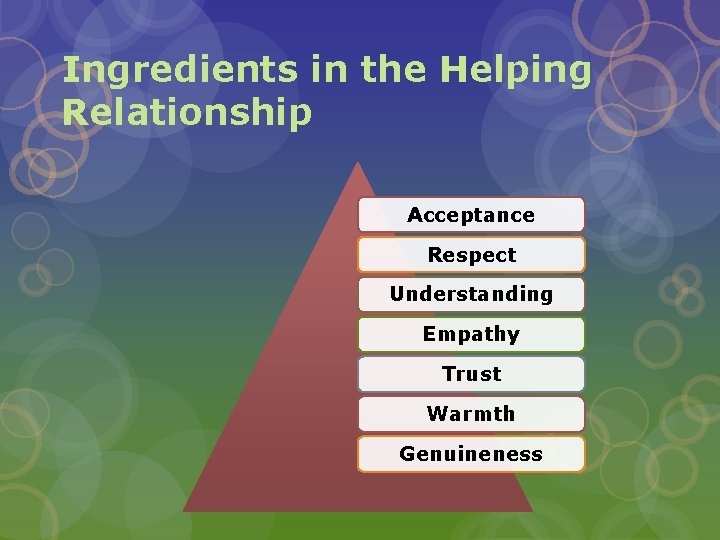
Ingredients in the Helping Relationship Acceptance Respect Understanding Empathy Trust Warmth Genuineness
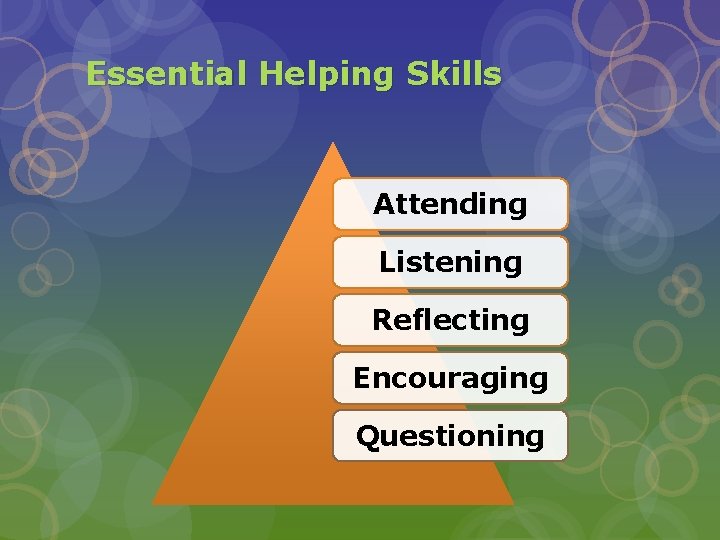
Essential Helping Skills Attending Listening Reflecting Encouraging Questioning
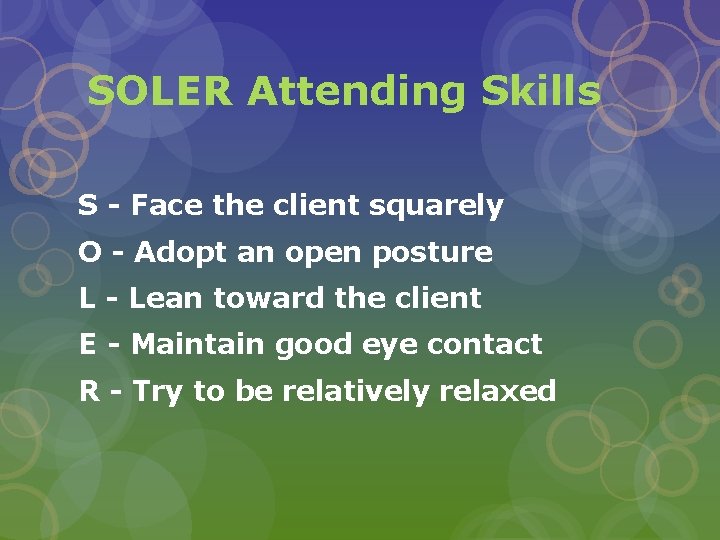
SOLER Attending Skills S - Face the client squarely O - Adopt an open posture L - Lean toward the client E - Maintain good eye contact R - Try to be relatively relaxed
Listening v Core of effective communicating v Allow us to understand interpret what client is conveying v Nonverbal cues important also v. Body language v. Facial expressions v. Tone of voice
Reflecting v Two key components v Content v Feeling v Consists of: v Summarizing v Paraphrasing v Avoid judgment v Validate client’s experiences v Check if on track
Encouraging v Convey “I’m listening” message v Ask for client’s help v. Example v“Tell me more…”
Closed-ended Questions Can be answered with “yes” or “no” or other simple response Advantages v. Easy for clients to answer v. Yield information quickly v. Useful for clarifying information
Closed-ended Questions Disadvantages v. Restrict clients to brief answers v. Keep the questioner in control of the conversation v. May make clients feel interrogated v. May be perceived as advice or criticism
Open-ended Questions Often start with “what”, “how” or “why” or “Tell me about…” Advantages v. Explore clients’ thoughts and feelings v. Give clients more control in the conversation v. Convey your interest in and respect for the client v. Provide information you may not think to ask
Open-ended Questions Disadvantages v. Tend to require more time v. May allow clients to wander or to avoid a topic v. May lead to a series of “I don’t know” answers
Silence v Intentional tool that can be very powerful v Can emphasize importance of topic v Can signal need for client to be more active
Purpose of the Intake Interview v To develop an understanding of the client’s history and current situation v To identify and define a client’s career goals v To recognize obstacles to and resources for goal attainment v To match the client’s needs with appropriate organizational services
Important Elements of the Intake Interview v Basic client information (age, gender, ethnicity, etc. ) v Work experience v Education/training background v Personal/professional accomplishments v Strengths: aptitudes, sources of support v Challenges: learning or other disabilities, financial or other barriers v Clients interests and career goals
Identifying Strengths v Motivation: client’s level of desire to work toward attaining career goals v Education and Transferable Skills: academic, vocational, and experiential v Support System - family, community, faithbased, therapists, classmates or even a pet v Timing - perception of how much time can be spent in job search v Decision-making Skills - comfort and experience with decision making
Identifying Barriers v Finances - living expenses and job-search costs v Transportation – driving/using public transportation v Childcare and eldercare concerns v Mental and Physical Health Issues - illness that may affect self-esteem or work
Importance of Hope v. Plant seeds of trust v. Offer brief summary and hopeful sense of expectation v. Use helping skills in warm and genuine fashion
Effective Goal Setting v Conceivable - can be expressed in words v Believable - something that clients believe they can attain v Achievable - can be attained through the client’s time, energy and effort v Measurable - can be measured in increments of time/accomplishment v Desirable - something that the client truly wants
Elements of an Effective Action Plan v Well-defined long-term goal v Alternative goals v Specific resources needed to accomplish the goals v Short-term goals v Realistic time line v Strategies to overcome anticipated barriers
Additional Interventions v An action taken by career services provider to help a client move forward v Behavioral interventions focus on helping clients expand options v. Positive reinforcement v. Empowerment v. Experiences v. Role models v. Messages
Termination Process v Review progress made v Acknowledge successes v Clarify plans for future v Establish boundaries v Say “good-bye”
Self-Care Strategies v Supportive network of friends v Regular supervision v Good nutrition v Adequate rest v Exercise v Uplifting input v Humor
- Slides: 25