
CHAPTER 1 CROP PRODUCTION AND MANAGEMEMT CLASS SUBJECT
CHAPTER - 1 CROP PRODUCTION AND MANAGEMEMT CLASS SUBJECT : - VIII : - SCIENCE
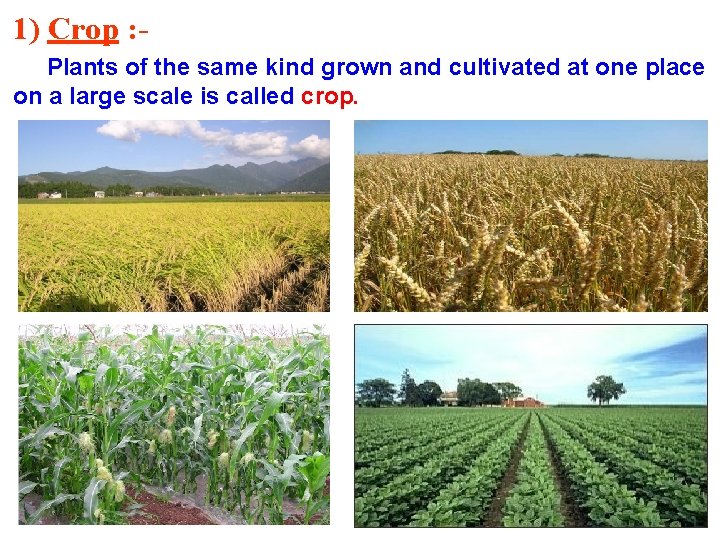
1) Crop : Plants of the same kind grown and cultivated at one place on a large scale is called crop.
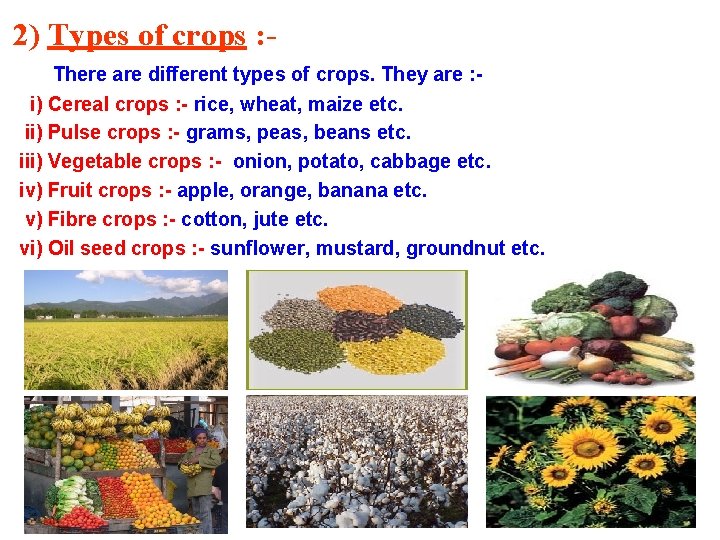
2) Types of crops : There are different types of crops. They are : i) Cereal crops : - rice, wheat, maize etc. ii) Pulse crops : - grams, peas, beans etc. iii) Vegetable crops : - onion, potato, cabbage etc. iv) Fruit crops : - apple, orange, banana etc. v) Fibre crops : - cotton, jute etc. vi) Oil seed crops : - sunflower, mustard, groundnut etc.
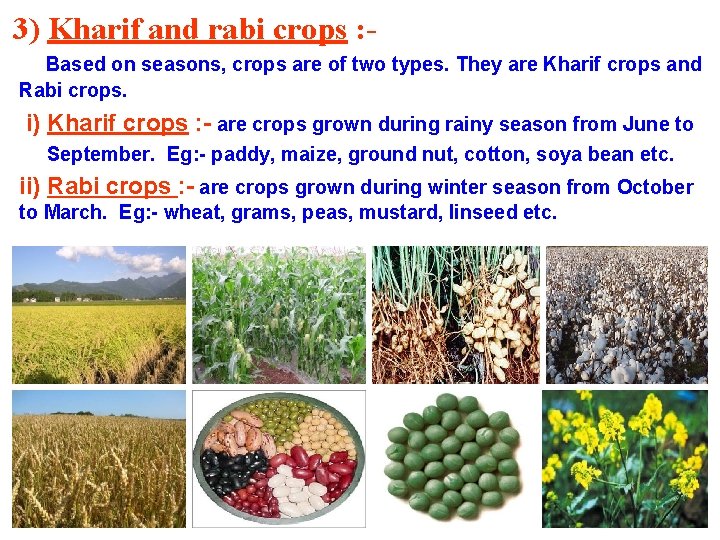
3) Kharif and rabi crops : Based on seasons, crops are of two types. They are Kharif crops and Rabi crops. i) Kharif crops : - are crops grown during rainy season from June to September. Eg: - paddy, maize, ground nut, cotton, soya bean etc. ii) Rabi crops : - are crops grown during winter season from October to March. Eg: - wheat, grams, peas, mustard, linseed etc.
4) Agricultural pactices : The activities undertaken by farmers for cultivation of crops are called agricultural practices. The main steps in agricultural practices are : i) Preparation of soil ii) Sowing of seeds iii) Adding manure and fertiliser iv) Irrigation v) Protection from weeds vi) Harvesting vii) Storage
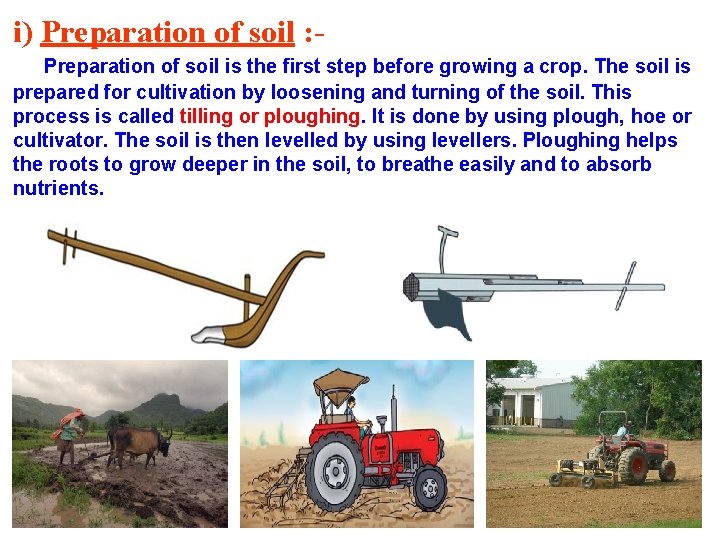
i) Preparation of soil : Preparation of soil is the first step before growing a crop. The soil is prepared for cultivation by loosening and turning of the soil. This process is called tilling or ploughing. It is done by using plough, hoe or cultivator. The soil is then levelled by using levellers. Ploughing helps the roots to grow deeper in the soil, to breathe easily and to absorb nutrients.
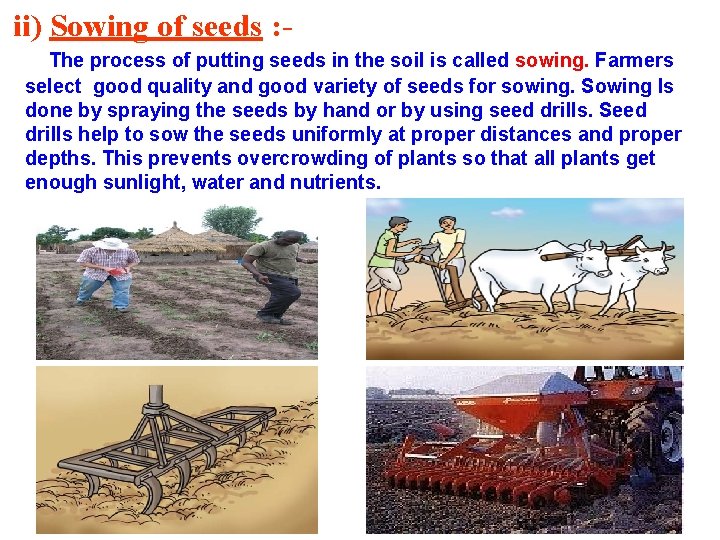
ii) Sowing of seeds : The process of putting seeds in the soil is called sowing. Farmers select good quality and good variety of seeds for sowing. Sowing Is done by spraying the seeds by hand or by using seed drills. Seed drills help to sow the seeds uniformly at proper distances and proper depths. This prevents overcrowding of plants so that all plants get enough sunlight, water and nutrients.
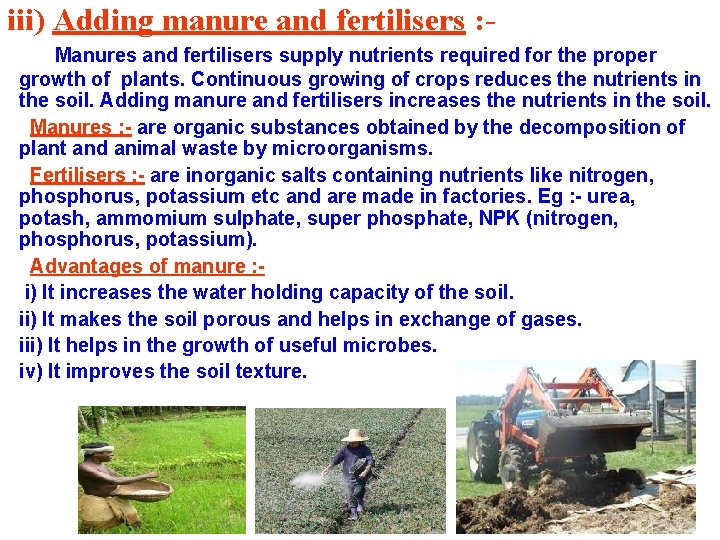
iii) Adding manure and fertilisers : Manures and fertilisers supply nutrients required for the proper growth of plants. Continuous growing of crops reduces the nutrients in the soil. Adding manure and fertilisers increases the nutrients in the soil. Manures : - are organic substances obtained by the decomposition of plant and animal waste by microorganisms. Fertilisers : - are inorganic salts containing nutrients like nitrogen, phosphorus, potassium etc and are made in factories. Eg : - urea, potash, ammomium sulphate, super phosphate, NPK (nitrogen, phosphorus, potassium). Advantages of manure : i) It increases the water holding capacity of the soil. ii) It makes the soil porous and helps in exchange of gases. iii) It helps in the growth of useful microbes. iv) It improves the soil texture.
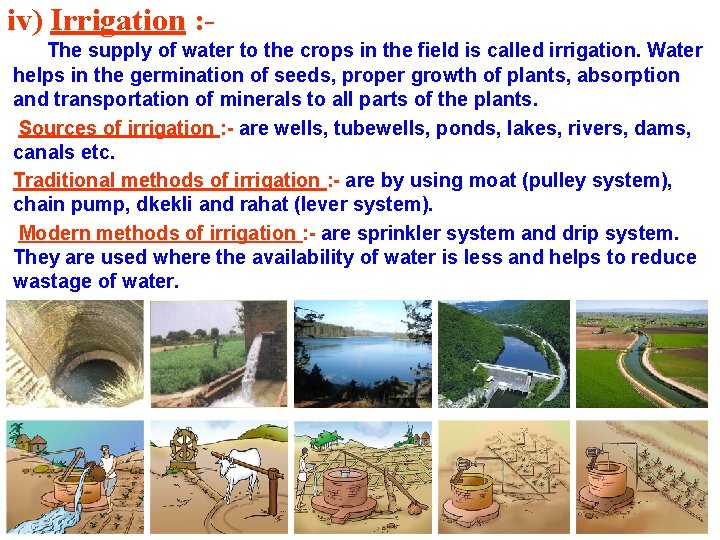
iv) Irrigation : The supply of water to the crops in the field is called irrigation. Water helps in the germination of seeds, proper growth of plants, absorption and transportation of minerals to all parts of the plants. Sources of irrigation : - are wells, tubewells, ponds, lakes, rivers, dams, canals etc. Traditional methods of irrigation : - are by using moat (pulley system), chain pump, dkekli and rahat (lever system). Modern methods of irrigation : - are sprinkler system and drip system. They are used where the availability of water is less and helps to reduce wastage of water.
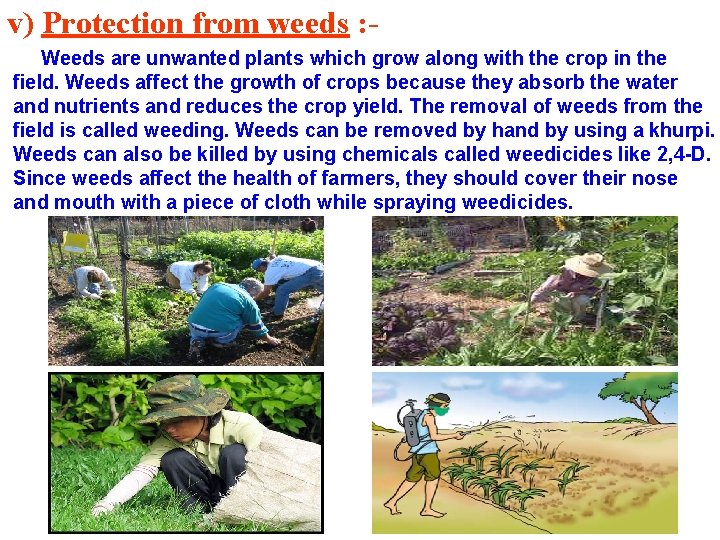
v) Protection from weeds : Weeds are unwanted plants which grow along with the crop in the field. Weeds affect the growth of crops because they absorb the water and nutrients and reduces the crop yield. The removal of weeds from the field is called weeding. Weeds can be removed by hand by using a khurpi. Weeds can also be killed by using chemicals called weedicides like 2, 4 -D. Since weeds affect the health of farmers, they should cover their nose and mouth with a piece of cloth while spraying weedicides.
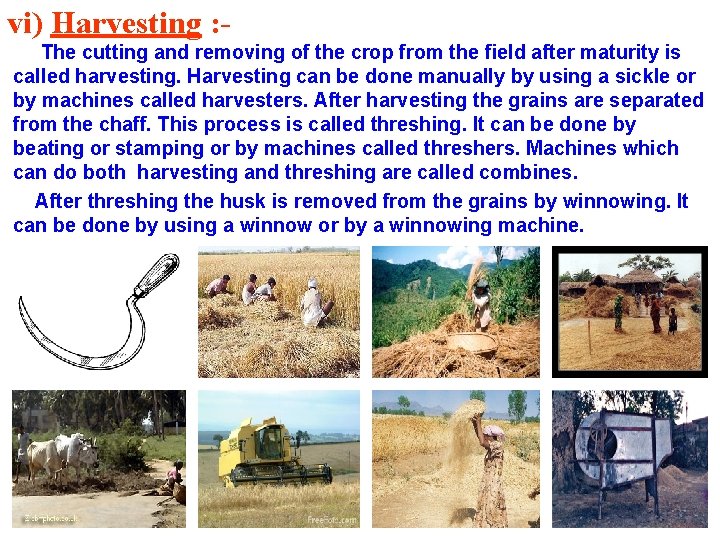
vi) Harvesting : The cutting and removing of the crop from the field after maturity is called harvesting. Harvesting can be done manually by using a sickle or by machines called harvesters. After harvesting the grains are separated from the chaff. This process is called threshing. It can be done by beating or stamping or by machines called threshers. Machines which can do both harvesting and threshing are called combines. After threshing the husk is removed from the grains by winnowing. It can be done by using a winnow or by a winnowing machine.
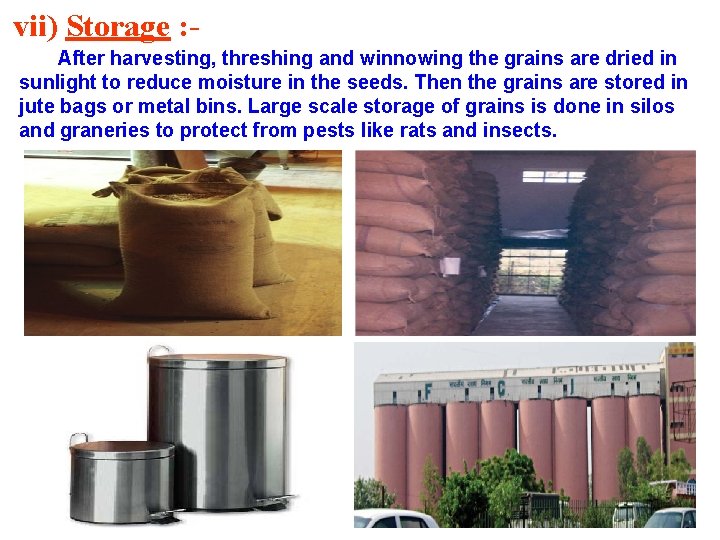
vii) Storage : After harvesting, threshing and winnowing the grains are dried in sunlight to reduce moisture in the seeds. Then the grains are stored in jute bags or metal bins. Large scale storage of grains is done in silos and graneries to protect from pests like rats and insects.
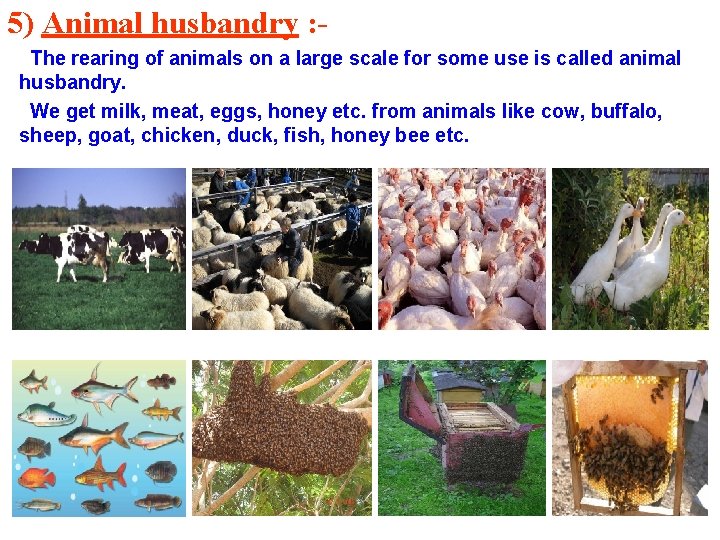
5) Animal husbandry : The rearing of animals on a large scale for some use is called animal husbandry. We get milk, meat, eggs, honey etc. from animals like cow, buffalo, sheep, goat, chicken, duck, fish, honey bee etc.
- Slides: 13