
Chapter 1 Created by Prof Sandra Isabelle Rodriguez

Chapter 1 Created by: Prof. Sandra Isabelle Rodriguez S
The Beginning of Psychology S Wilhelm Wundt – Mounted a campaign to make psychology and independent science. He established the first formal laboratory for research in psychology at the University of Leipzig in Germany. S Wundt is characterized as the founder of psychology S According to Wundt, the subject matter of psychology is consciousness
Battle of the Schools S Structuralism – the task of psychology is to analyze consciousness into its basic elements and investigate how these elements are related. Identify the fundamental components of conscious experience, such as sensation, feelings, and images.
Battle of the Schools cont…. S Functionalism – Psychology should investigate the function or purpose of consciousness rather than its structure What is the purpose of consciousness? What purpose does it serve? How do people adapt their behaviors to the demands of the real world around them?
Sigmund Freud Psychoanalysis S Sigmund Freud – Known as the father of psychoanalysis S Freud treated people with psychological problems with an innovative procedure called psychoanalysis S Psychoanalysis focuses on the individual’s unconscious feelings, thoughts, and desires S Unconsciousness – contains people’s thoughts, memories, and desires that are well below the surface of conscious awareness but that nonetheless exert great influence on behavior
Sigmund Freud – Psychoanalysis cont……… S Psychoanalytic theory – attempts to explain personality, motivation, and mental disorders by focusing on unconscious determinants of behavior S Psychoanalysis = NO FREE WILL S People are driven by their unconscious thoughts, feelings, and desires S Freud was controversial because of his emphasis on sexuality
The Rise of Behaviorism S Key Figures: John Watson, B. F. Skinner, and Ivan Pavlov S Behaviorism – theoretical orientation based on the premise that scientific psychology should only study observable behavior. S Thoughts, feelings, emotions, and desires cannot be seen and therefore cannot be studied S Behaviorism came in opposition to psychoanalysis S Focuses on conscious behaviors
The Rise of Behaviorism cont… S Behavior – refers to any overt (observable) response or activity by an organism S Behaviorism = NO FREE WILL S Gave rise to animal research S Psychology’s mission is to relate overt behaviors (responses) to observable events in the environment (stimulus) S People are driven solely by their environment
Humanism S Key figures – Carl Rogers and Abraham Maslow S Humanists believed that psychoanalysis and behaviorism were “dehumanizing” because they failed to appreciate human potential and suggested that people are not masters of their own destinies S Humanism – emphasizes the unique qualities of humans, especially their freedom and their potential for personal growth S Humanism = FREE WILL and OPTIMISM
Humanism and Positive Psychology S Positive Psychology was spearheaded by Martin Seligman S Positive Psychology – uses research and theory to better understand the positive, adaptive, creative, and fulfilling aspects of human experience. S Contrary to other theories, they do not devote their time on attention to pathology, weakness, damage, and ways to heal suffering.
Applied vs. Clinical S Applied Psychology – the branch of psychology concerned with everyday, practical problems Ex: Marriage and Family Therapy S Clinical Psychology – branch of psychology concerned with the diagnosis and treatment of psychological problems and disorders. S World War II gave rise to clinical psychology Ex: Diagnose and treat disorders such as schizophrenia, bipolar disorder,
Research Areas in Psychology S Developmental Psychology – Looks at human development across the lifespan from conception to death S Social Psychology – Focus on interpersonal behavior and role of social forces. Topics include conformity, attraction, aggression, relationships, and behavior in groups. S Educational Psychology – Studies how people learn and the best ways to teach them. Examines curriculum design, teacher training, achievement testing, student motivation, and classroom dynamics
Research Areas in Psychology cont…. . S Health psychology – Focuses on how psychological factors relate to the promotion and maintenance of physical health and the causation, prevention, and treatment of illnesses. S Physiological Psychology – Examines the influence of genetic factors on behavior and the role of the brain, nervous system, endocrine system, and bodily chemicals in the regulation of behavior
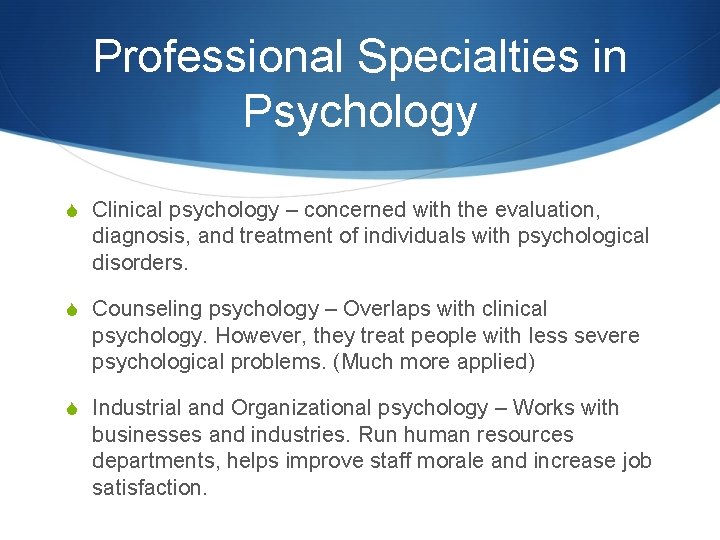
Professional Specialties in Psychology S Clinical psychology – concerned with the evaluation, diagnosis, and treatment of individuals with psychological disorders. S Counseling psychology – Overlaps with clinical psychology. However, they treat people with less severe psychological problems. (Much more applied) S Industrial and Organizational psychology – Works with businesses and industries. Run human resources departments, helps improve staff morale and increase job satisfaction.
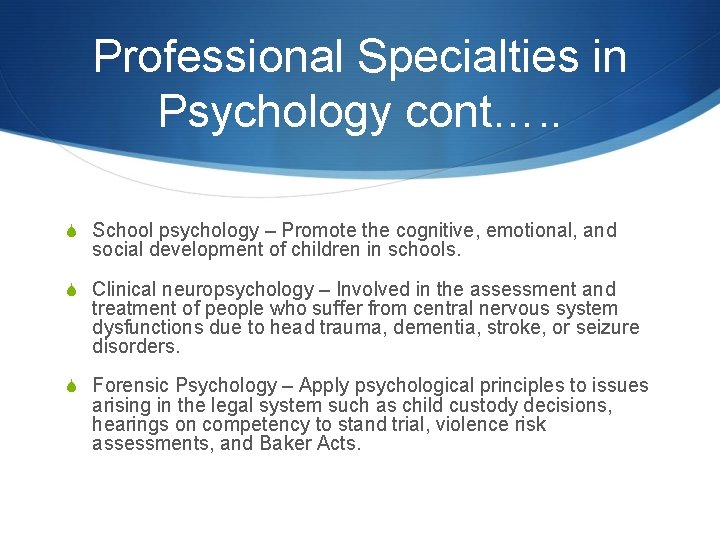
Professional Specialties in Psychology cont…. . S School psychology – Promote the cognitive, emotional, and social development of children in schools. S Clinical neuropsychology – Involved in the assessment and treatment of people who suffer from central nervous system dysfunctions due to head trauma, dementia, stroke, or seizure disorders. S Forensic Psychology – Apply psychological principles to issues arising in the legal system such as child custody decisions, hearings on competency to stand trial, violence risk assessments, and Baker Acts.
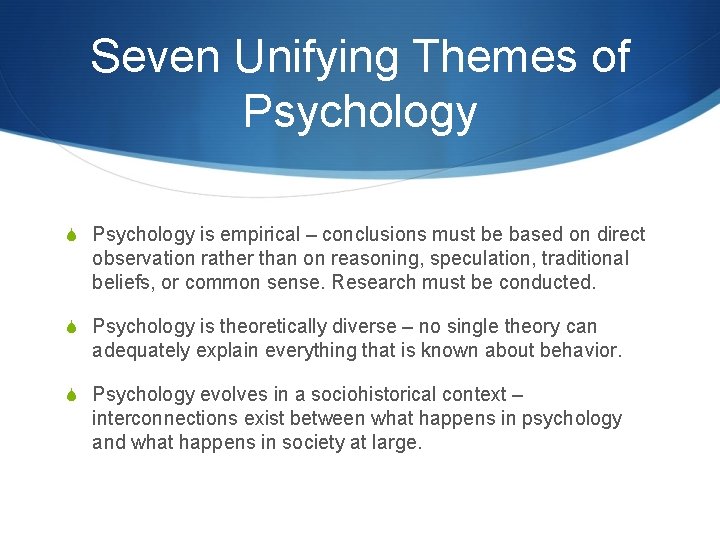
Seven Unifying Themes of Psychology S Psychology is empirical – conclusions must be based on direct observation rather than on reasoning, speculation, traditional beliefs, or common sense. Research must be conducted. S Psychology is theoretically diverse – no single theory can adequately explain everything that is known about behavior. S Psychology evolves in a sociohistorical context – interconnections exist between what happens in psychology and what happens in society at large.
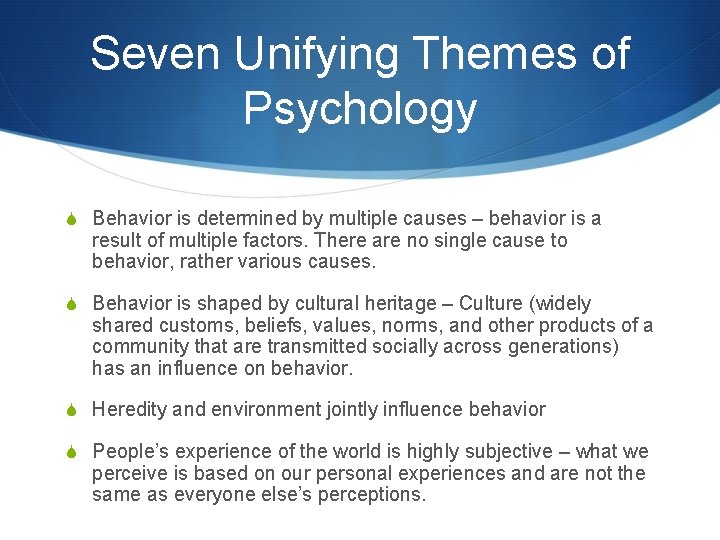
Seven Unifying Themes of Psychology S Behavior is determined by multiple causes – behavior is a result of multiple factors. There are no single cause to behavior, rather various causes. S Behavior is shaped by cultural heritage – Culture (widely shared customs, beliefs, values, norms, and other products of a community that are transmitted socially across generations) has an influence on behavior. S Heredity and environment jointly influence behavior S People’s experience of the world is highly subjective – what we perceive is based on our personal experiences and are not the same as everyone else’s perceptions.
- Slides: 17