
Chapter 1 Cost Value Price The Three Pillars
- Slides: 18
Chapter 1: Cost, Value, Price: The Three Pillars of Profit “If managers create more value at lower costs than their competitors their business will prosper and profit. This is the nub. Everything else is embroidery. ” from Executive Economics: Ten Essential Tools for Managers
F. A. von Hayek from The Use of Knowledge in Society “It is perhaps, worth stressing, that economic problems arise always and only in consequence of change. ” “How easy it is for an inefficient manager to dissipate the differentials on which profitability rests. ”
“To manage is to choose. ” • Economic concepts apply across all functional areas. – – – – Marketing Finance Human Resources Production Choice of markets Technology Ethical Responsibilities
“To manage is to choose. ” • Economics stresses the creation of wealth • The ability of a society to create wealth directly impacts the day-to-day living standards of the populous. • Creating wealth is a two-way street – Create wealth for your customers and you will create wealth for your company. – If you own the company you can create wealth for yourself. Owners are “residual claimants. ”
The Three Pillars of Profit ØCosts – what businesses pay for the inputs they require to produce saleable output ØValue - the creation of well being in the eyes of your customers ØPrice – what your customers pay for the output
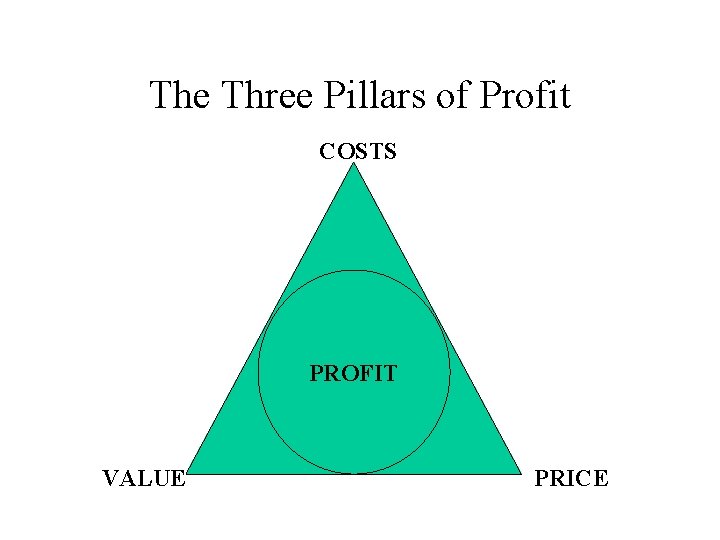
The Three Pillars of Profit COSTS PROFIT VALUE PRICE
Another analogy for the three pillars of profit… Think of a three-legged stool. If all three legs are not matched and aligned, what happens to the stool? – It falls over! • A successful, thriving and most important, surviving business must balance all the legs of costs, value and price.
Value Added ØAs inputs are combined to produce outputs it should increase or add value. ØIf not, the production process used is destroying value.
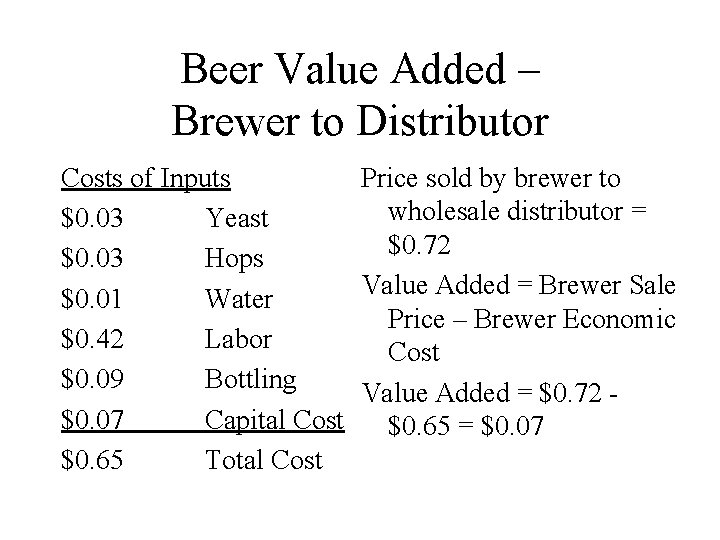
Beer Value Added – Brewer to Distributor Costs of Inputs Price sold by brewer to wholesale distributor = $0. 03 Yeast $0. 72 $0. 03 Hops Value Added = Brewer Sale $0. 01 Water Price – Brewer Economic $0. 42 Labor Cost $0. 09 Bottling Value Added = $0. 72 $0. 07 Capital Cost $0. 65 = $0. 07 $0. 65 Total Cost
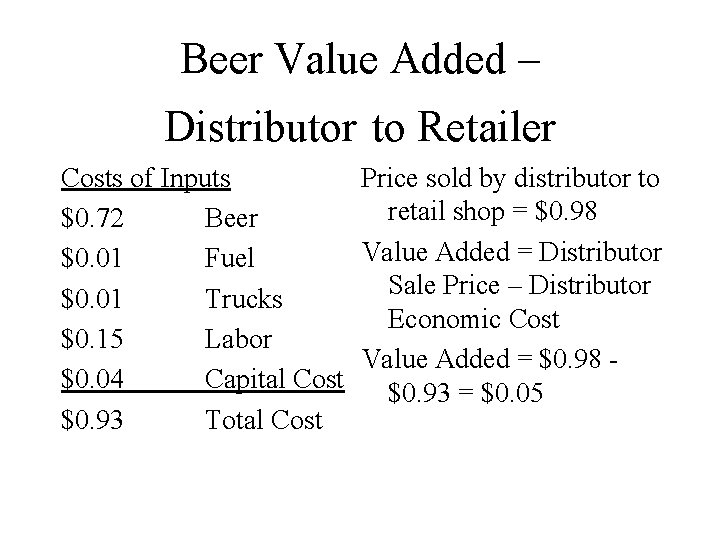
Beer Value Added – Distributor to Retailer Costs of Inputs Price sold by distributor to retail shop = $0. 98 $0. 72 Beer Value Added = Distributor $0. 01 Fuel Sale Price – Distributor $0. 01 Trucks Economic Cost $0. 15 Labor Value Added = $0. 98 $0. 04 Capital Cost $0. 93 = $0. 05 $0. 93 Total Cost
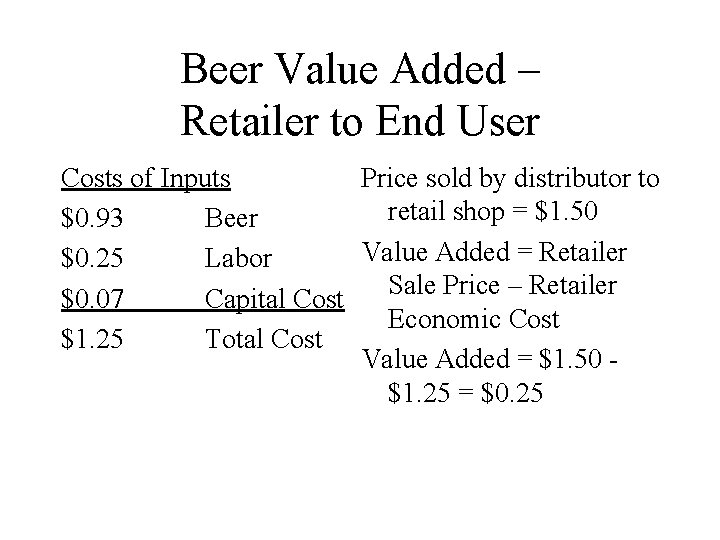
Beer Value Added – Retailer to End User Costs of Inputs Price sold by distributor to retail shop = $1. 50 $0. 93 Beer Value Added = Retailer $0. 25 Labor Sale Price – Retailer $0. 07 Capital Cost Economic Cost $1. 25 Total Cost Value Added = $1. 50 $1. 25 = $0. 25
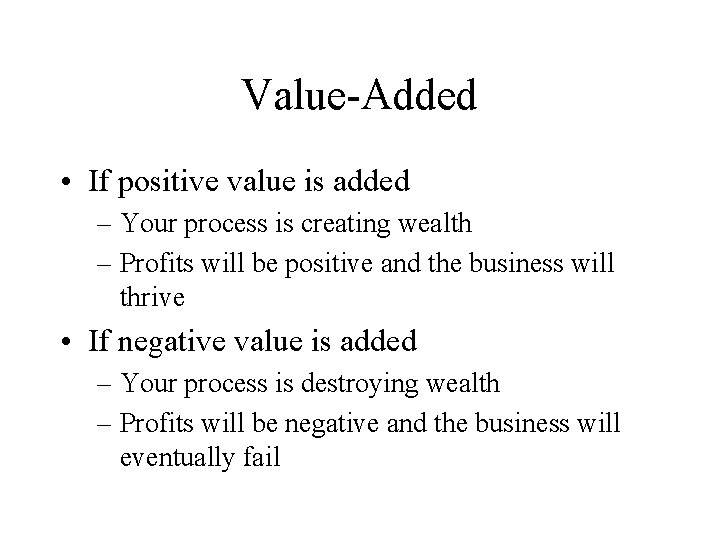
Value-Added • If positive value is added – Your process is creating wealth – Profits will be positive and the business will thrive • If negative value is added – Your process is destroying wealth – Profits will be negative and the business will eventually fail
The Managers Role • What are managers worth? – Straussman found that over 20% of the 300 ongoing businesses he surveyed were surviving but destroying wealth • Management value-added was negative. – Over 85% of all small businesses in American go out of business in their first five years
Success Breeds Failure • “The larger they are the harder they fall. ” • • • Read the section on IBM in textbook What about Enron? Kodak? Polaroid? Compaq? Can you name any major firms that existed ten to twenty years ago that have vanished?
Market Dynamics • Economics is focused on the short term behaviors that can increase the likelihood of long-term behavior • Question: – Most firms will ____________.
Market Dynamics • Answer – Go out of business. • Capitalism is marked by dynamic change or Joseph Schumpeter’s “gale of creative destruction” • This process is speeding up with the forces of globalization.
Schumpeterian Views on Economics as a system • Read Schumpeter • Think about what these views mean for you and your firm.
Strategy • The most basic question any firm can ask of itself is “What business am I in? ” • The answer is far more complex then it may look to be on the surface yet, you must distill it down into one sentence. • All persons, entities, and institutions connected to the firm should know what that sentence is.