
Chapter 1 Computer Abstractions and Technology What is
Chapter 1 Computer Abstractions and Technology
What is Computer Architecture? • The design of computer systems • Goal: improve “performance”: – Run programs faster • Execution time: e. g. less waiting time, more simultaneous tasks • Throughput: e. g. higher framerate, faster downloads – – – Use less power, last longer on battery power Generate less or more uniformally-distributed heat Handle more secure encryption standards Software defined networking at higher line speeds More scalable Less expensive Chapter 1 — Computer Abstractions and Technology — 2
Computer Architecture • Instruction Set Architecture (“architecture”) – The native programming language of a processor • Assembly language • Machine language – Openly published to users, licensed for chip makers • Microarchitecture – The internal organization of a processor – Executes programs – Trade secret CSCE 212 3
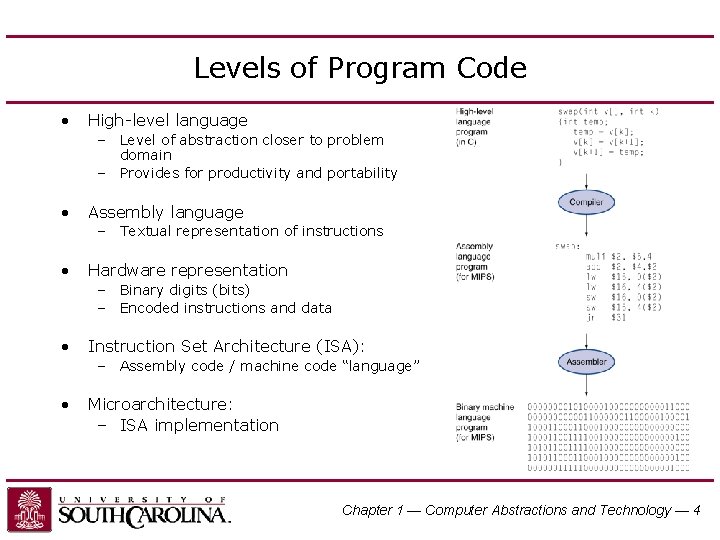
Levels of Program Code • High-level language – Level of abstraction closer to problem domain – Provides for productivity and portability • Assembly language – Textual representation of instructions • Hardware representation – Binary digits (bits) – Encoded instructions and data • Instruction Set Architecture (ISA): – Assembly code / machine code “language” • Microarchitecture: – ISA implementation Chapter 1 — Computer Abstractions and Technology — 4
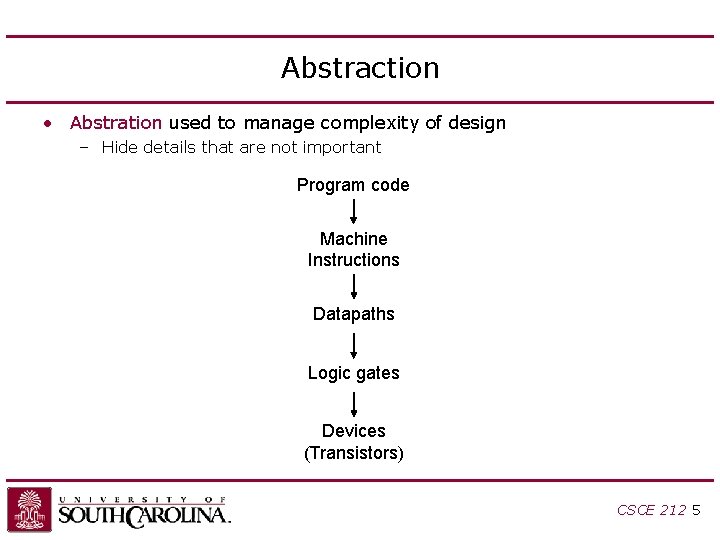
Abstraction • Abstration used to manage complexity of design – Hide details that are not important Program code Machine Instructions Datapaths Logic gates Devices (Transistors) CSCE 212 5
Why Study Computer Architecture • Compiling “machine agnostic” code: – Generally achieve ~1 -20% of peak theoretical performance – Performance tuned code must be explicitly written for the underlying architecture – Especially for embedded and special purpose processors – Understanding computer architecture allows for customization: • Multicore • More efficient use of registers, instructions • Device drivers must directly interface with peripherals – Uses CPU-specific, bit-level features to communicate – E. g. memory-mapped I/O, interrupts, DMA, double buffering, bit fields in status/control registers, memory management, virtual memory Chapter 1 — Computer Abstractions and Technology — 6
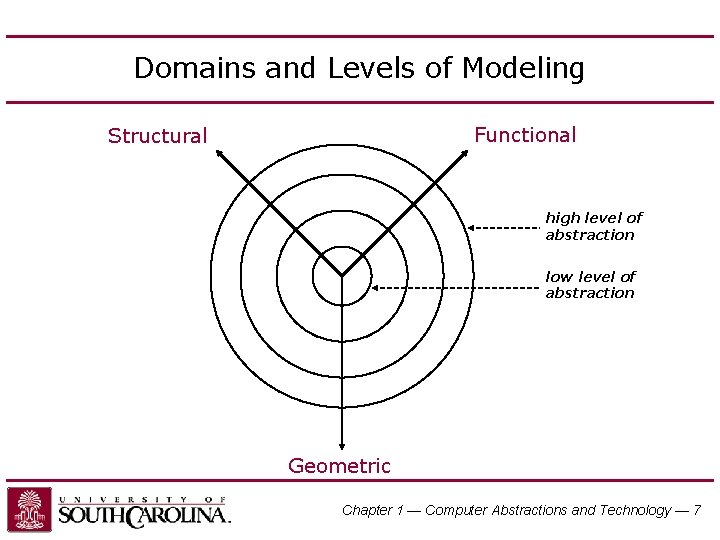
Domains and Levels of Modeling Functional Structural high level of abstraction low level of abstraction Geometric Chapter 1 — Computer Abstractions and Technology — 7
![Functional Abstraction For i=0 to 10 C = C + A[i] MAR <= PC,](http://slidetodoc.com/presentation_image_h/34798c1cc41ab3d8ebcf04fb972e5d02/image-8.jpg "Functional Abstraction For i=0 to 10 C = C + A[i] MAR <= PC,")
Functional Abstraction For i=0 to 10 C = C + A[i] MAR <= PC, memory_read <= 1 PC <= PC + 1 wait until ready = 1 IR <= memory_data memory_read <= 0 Chapter 1 — Computer Abstractions and Technology — 8
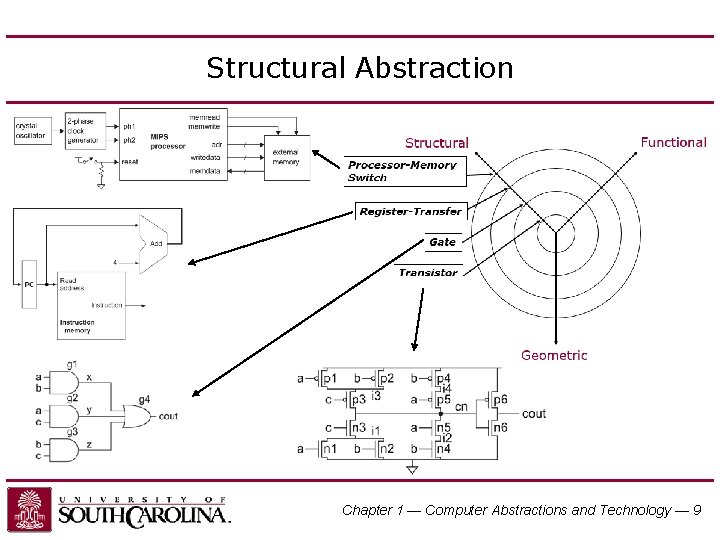
Structural Abstraction Chapter 1 — Computer Abstractions and Technology — 9
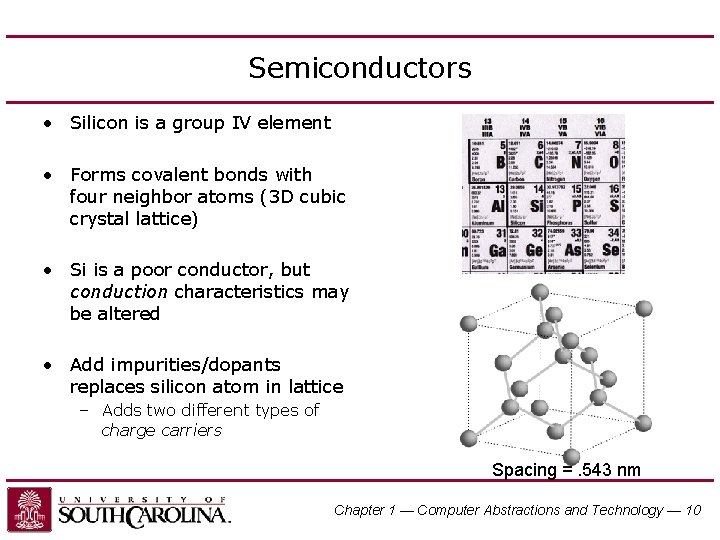
Semiconductors • Silicon is a group IV element • Forms covalent bonds with four neighbor atoms (3 D cubic crystal lattice) • Si is a poor conductor, but conduction characteristics may be altered • Add impurities/dopants replaces silicon atom in lattice – Adds two different types of charge carriers Spacing =. 543 nm Chapter 1 — Computer Abstractions and Technology — 10
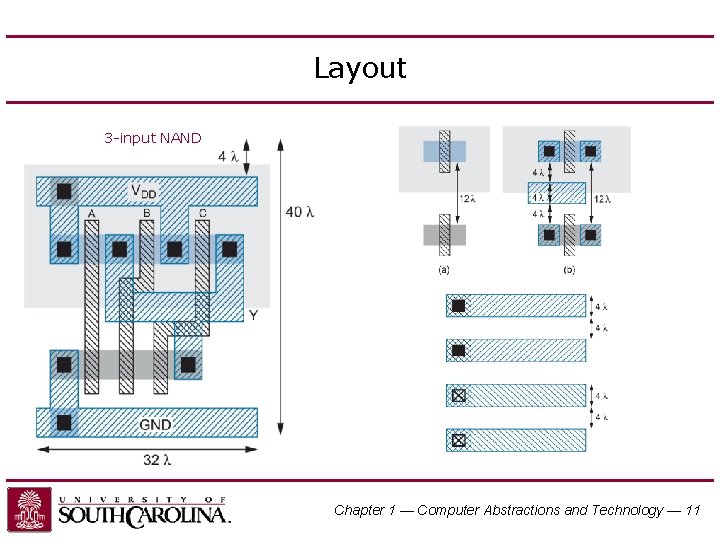
Layout 3 -input NAND Chapter 1 — Computer Abstractions and Technology — 11
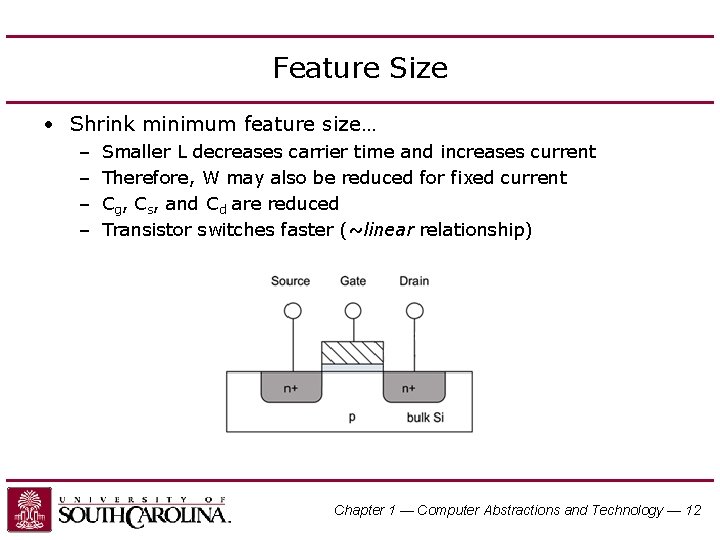
Feature Size • Shrink minimum feature size… – – Smaller L decreases carrier time and increases current Therefore, W may also be reduced for fixed current Cg, Cs, and Cd are reduced Transistor switches faster (~linear relationship) Chapter 1 — Computer Abstractions and Technology — 12
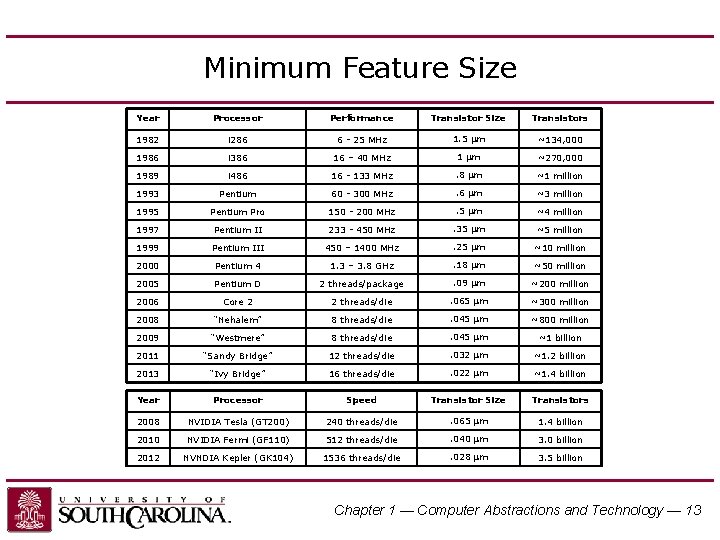
Minimum Feature Size Year Processor Performance Transistor Size Transistors 1982 i 286 6 - 25 MHz 1. 5 mm ~134, 000 1986 i 386 16 – 40 MHz 1 mm ~270, 000 1989 i 486 16 - 133 MHz . 8 mm ~1 million 1993 Pentium 60 - 300 MHz . 6 mm ~3 million 1995 Pentium Pro 150 - 200 MHz . 5 mm ~4 million 1997 Pentium II 233 - 450 MHz . 35 mm ~5 million 1999 Pentium III 450 – 1400 MHz . 25 mm ~10 million 2000 Pentium 4 1. 3 – 3. 8 GHz . 18 mm ~50 million 2005 Pentium D 2 threads/package . 09 mm ~200 million 2006 Core 2 2 threads/die . 065 mm ~300 million 2008 “Nehalem” 8 threads/die . 045 mm ~800 million 2009 “Westmere” 8 threads/die . 045 mm ~1 billion 2011 “Sandy Bridge” 12 threads/die . 032 mm ~1. 2 billion 2013 “Ivy Bridge” 16 threads/die . 022 mm ~1. 4 billion Year Processor Speed Transistor Size Transistors 2008 NVIDIA Tesla (GT 200) 240 threads/die . 065 mm 1. 4 billion 2010 NVIDIA Fermi (GF 110) 512 threads/die . 040 mm 3. 0 billion 2012 NVNDIA Kepler (GK 104) 1536 threads/die . 028 mm 3. 5 billion Chapter 1 — Computer Abstractions and Technology — 13

Inside the Processor • Apple A 5 Chapter 1 — Computer Abstractions and Technology — 14
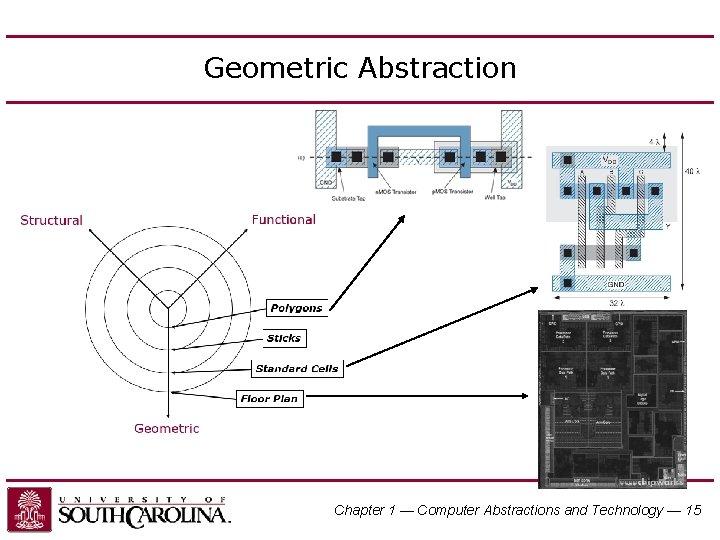
Geometric Abstraction Chapter 1 — Computer Abstractions and Technology — 15
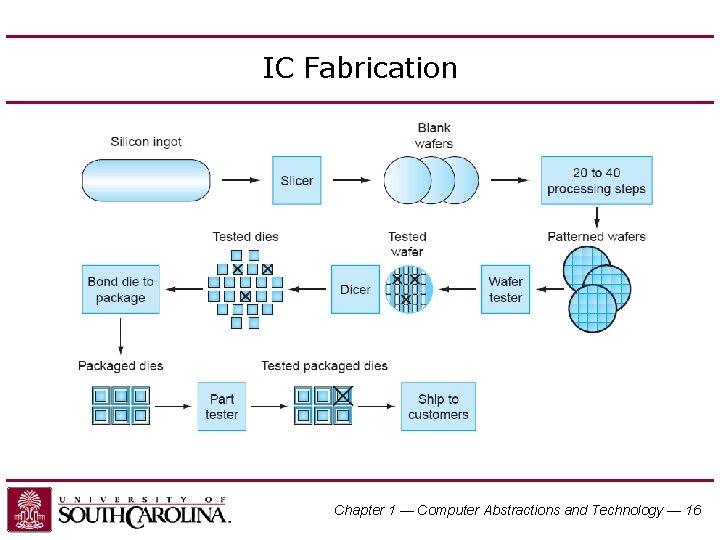
IC Fabrication Chapter 1 — Computer Abstractions and Technology — 16
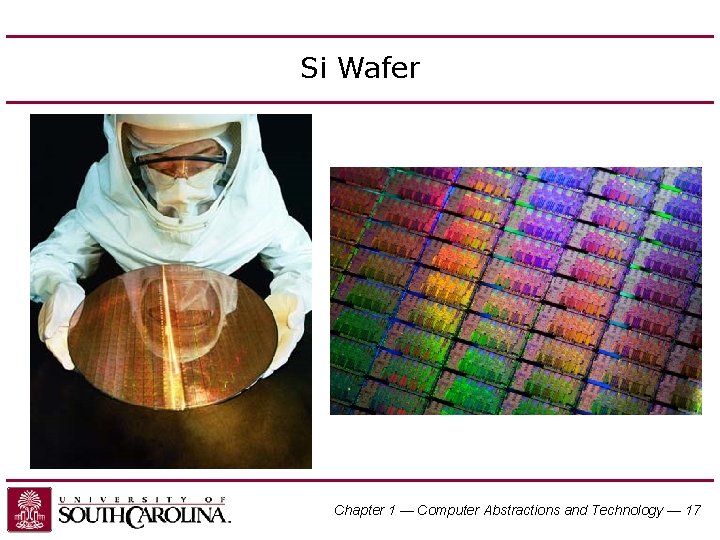
Si Wafer Chapter 1 — Computer Abstractions and Technology — 17

8” Wafer Chapter 1 — Computer Abstractions and Technology — 18
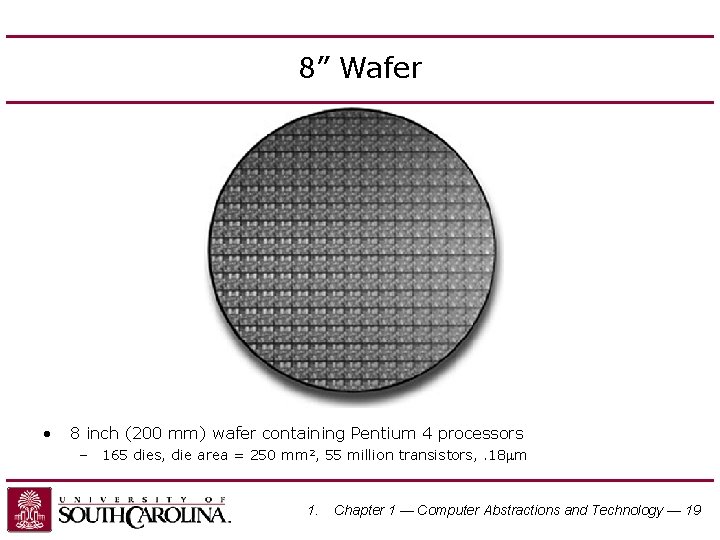
8” Wafer • 8 inch (200 mm) wafer containing Pentium 4 processors – 165 dies, die area = 250 mm 2, 55 million transistors, . 18 mm 1. Chapter 1 — Computer Abstractions and Technology — 19
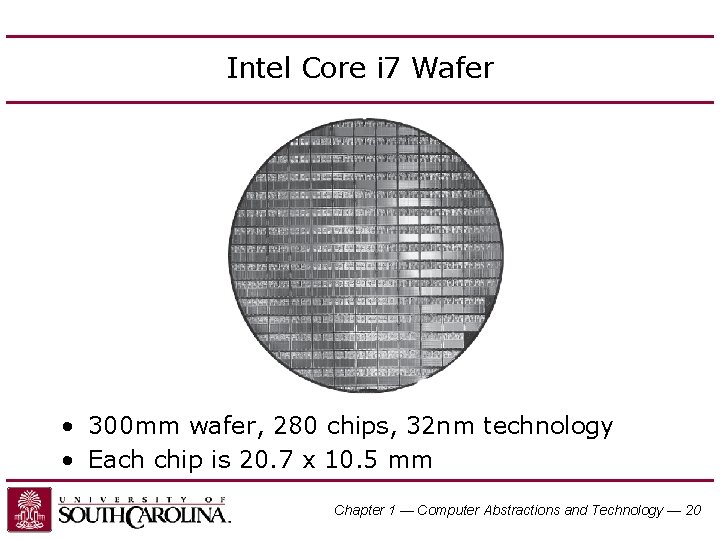
Intel Core i 7 Wafer • 300 mm wafer, 280 chips, 32 nm technology • Each chip is 20. 7 x 10. 5 mm Chapter 1 — Computer Abstractions and Technology — 20
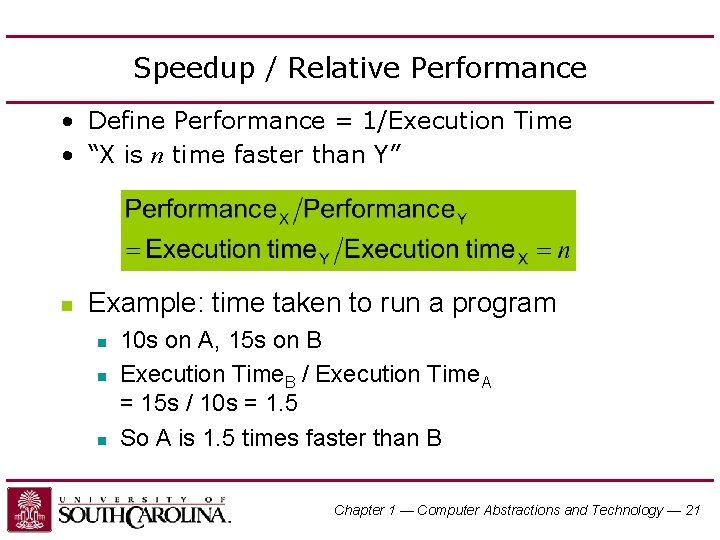
Speedup / Relative Performance • Define Performance = 1/Execution Time • “X is n time faster than Y” n Example: time taken to run a program n n n 10 s on A, 15 s on B Execution Time. B / Execution Time. A = 15 s / 10 s = 1. 5 So A is 1. 5 times faster than B Chapter 1 — Computer Abstractions and Technology — 21
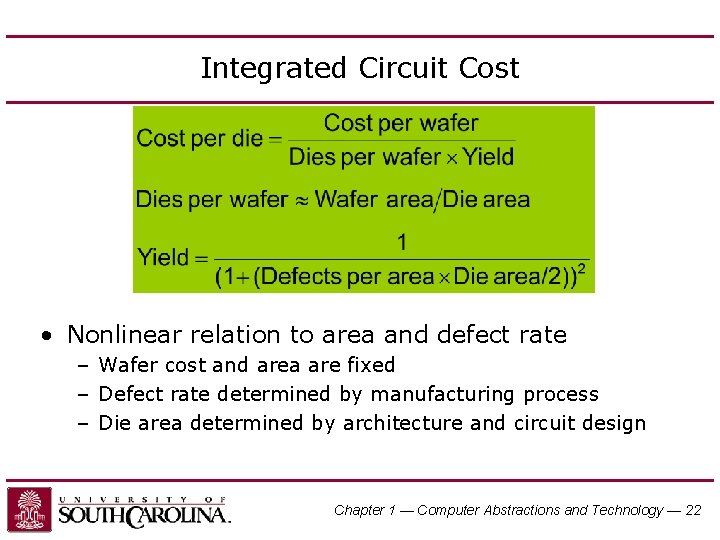
Integrated Circuit Cost • Nonlinear relation to area and defect rate – Wafer cost and area are fixed – Defect rate determined by manufacturing process – Die area determined by architecture and circuit design Chapter 1 — Computer Abstractions and Technology — 22
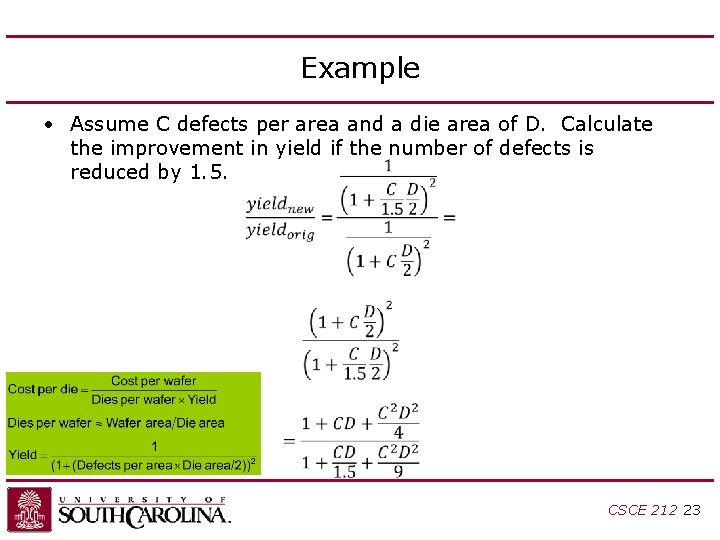
Example • Assume C defects per area and a die area of D. Calculate the improvement in yield if the number of defects is reduced by 1. 5. CSCE 212 23
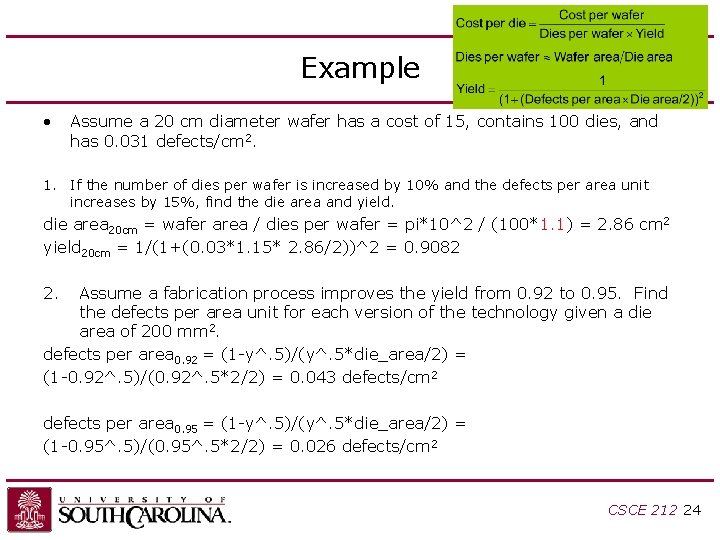
Example • Assume a 20 cm diameter wafer has a cost of 15, contains 100 dies, and has 0. 031 defects/cm 2. 1. If the number of dies per wafer is increased by 10% and the defects per area unit increases by 15%, find the die area and yield. die area 20 cm = wafer area / dies per wafer = pi*10^2 / (100*1. 1) = 2. 86 cm 2 yield 20 cm = 1/(1+(0. 03*1. 15* 2. 86/2))^2 = 0. 9082 2. Assume a fabrication process improves the yield from 0. 92 to 0. 95. Find the defects per area unit for each version of the technology given a die area of 200 mm 2. defects per area 0. 92 = (1 -y^. 5)/(y^. 5*die_area/2) = (1 -0. 92^. 5)/(0. 92^. 5*2/2) = 0. 043 defects/cm 2 defects per area 0. 95 = (1 -y^. 5)/(y^. 5*die_area/2) = (1 -0. 95^. 5)/(0. 95^. 5*2/2) = 0. 026 defects/cm 2 CSCE 212 24
Response Time and Throughput • Response time – How long it takes to do a task • Throughput – Total work done per unit time • e. g. , tasks/transactions/… per hour • How are response time and throughput affected by – Replacing the processor with a faster version? – Adding more processors? • We’ll focus on response time for now… Chapter 1 — Computer Abstractions and Technology — 25
Measuring Execution Time • Elapsed time – Total response time, including all aspects • Processing, I/O, OS overhead, idle time – Determines system performance • CPU time – Time spent processing a given job • Discounts I/O time, other jobs’ shares – Comprises user CPU time and system CPU time – Different programs are affected differently by CPU and system performance Chapter 1 — Computer Abstractions and Technology — 26
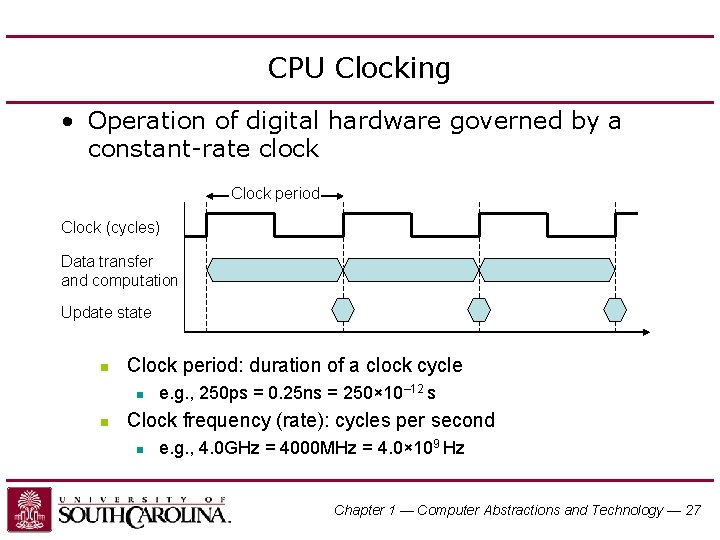
CPU Clocking • Operation of digital hardware governed by a constant-rate clock Clock period Clock (cycles) Data transfer and computation Update state n Clock period: duration of a clock cycle n n e. g. , 250 ps = 0. 25 ns = 250× 10– 12 s Clock frequency (rate): cycles per second n e. g. , 4. 0 GHz = 4000 MHz = 4. 0× 109 Hz Chapter 1 — Computer Abstractions and Technology — 27
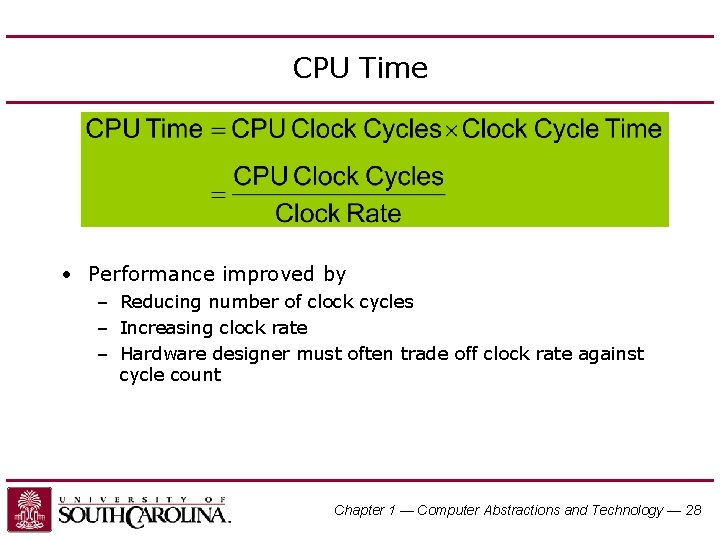
CPU Time • Performance improved by – Reducing number of clock cycles – Increasing clock rate – Hardware designer must often trade off clock rate against cycle count Chapter 1 — Computer Abstractions and Technology — 28
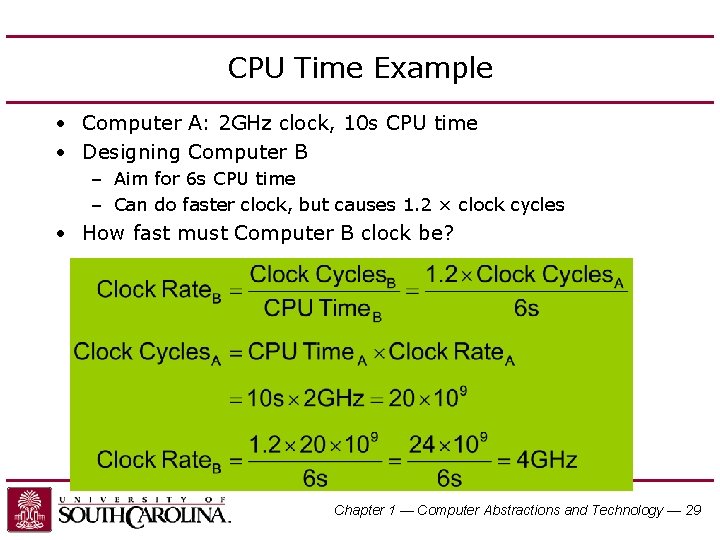
CPU Time Example • Computer A: 2 GHz clock, 10 s CPU time • Designing Computer B – Aim for 6 s CPU time – Can do faster clock, but causes 1. 2 × clock cycles • How fast must Computer B clock be? Chapter 1 — Computer Abstractions and Technology — 29
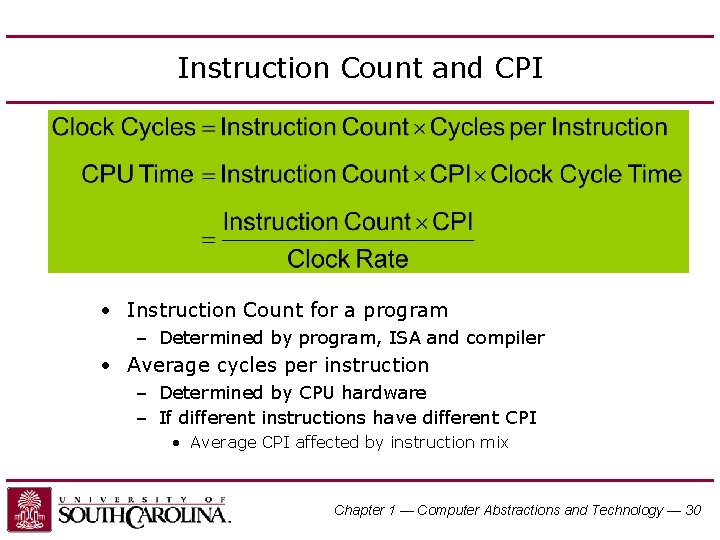
Instruction Count and CPI • Instruction Count for a program – Determined by program, ISA and compiler • Average cycles per instruction – Determined by CPU hardware – If different instructions have different CPI • Average CPI affected by instruction mix Chapter 1 — Computer Abstractions and Technology — 30
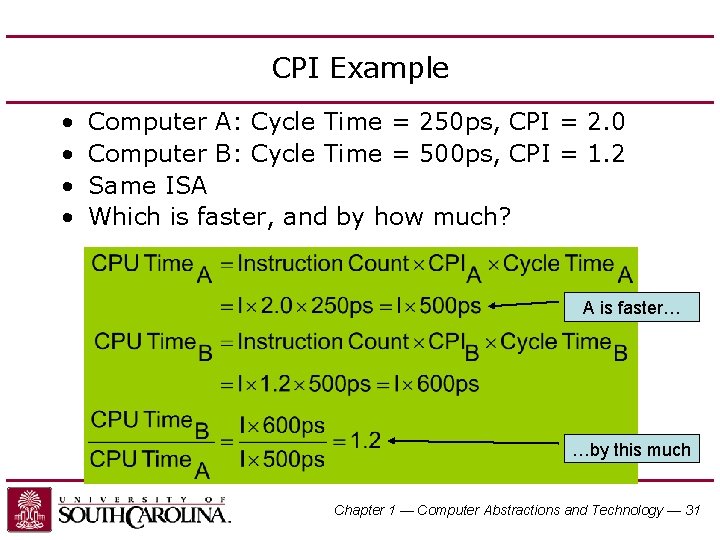
CPI Example • • Computer A: Cycle Time = 250 ps, CPI = 2. 0 Computer B: Cycle Time = 500 ps, CPI = 1. 2 Same ISA Which is faster, and by how much? A is faster… …by this much Chapter 1 — Computer Abstractions and Technology — 31
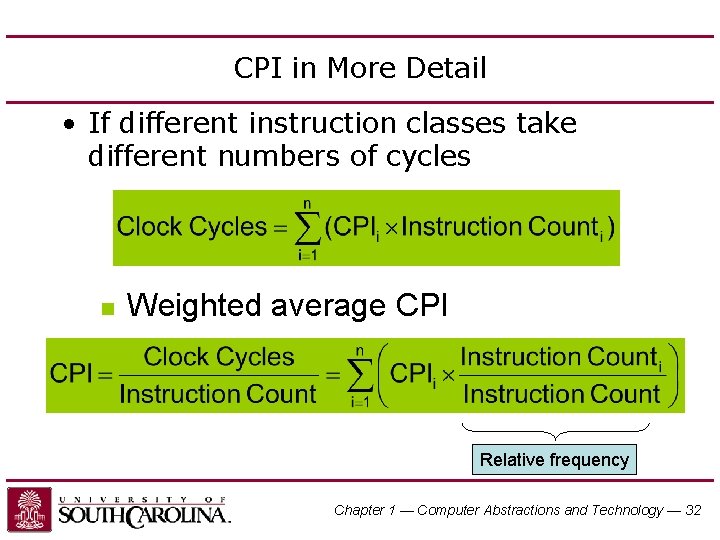
CPI in More Detail • If different instruction classes take different numbers of cycles n Weighted average CPI Relative frequency Chapter 1 — Computer Abstractions and Technology — 32
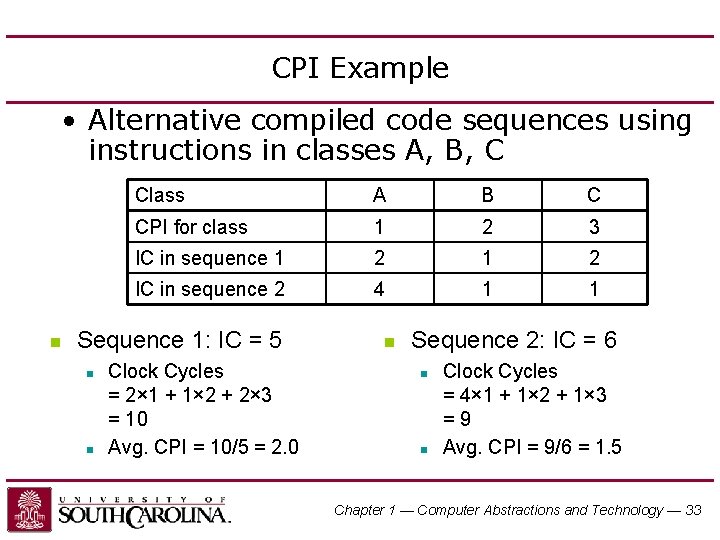
CPI Example • Alternative compiled code sequences using instructions in classes A, B, C n Class A B C CPI for class 1 2 3 IC in sequence 1 2 IC in sequence 2 4 1 1 Sequence 1: IC = 5 n n Clock Cycles = 2× 1 + 1× 2 + 2× 3 = 10 Avg. CPI = 10/5 = 2. 0 n Sequence 2: IC = 6 n n Clock Cycles = 4× 1 + 1× 2 + 1× 3 = 9 Avg. CPI = 9/6 = 1. 5 Chapter 1 — Computer Abstractions and Technology — 33
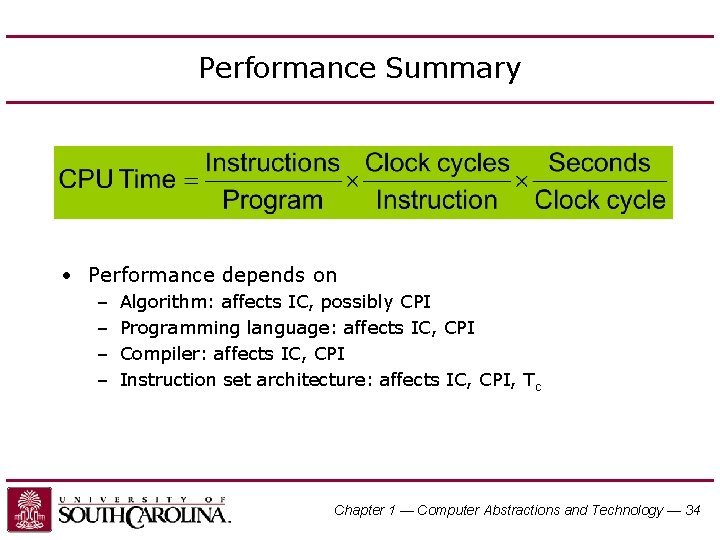
Performance Summary • Performance depends on – – Algorithm: affects IC, possibly CPI Programming language: affects IC, CPI Compiler: affects IC, CPI Instruction set architecture: affects IC, CPI, Tc Chapter 1 — Computer Abstractions and Technology — 34
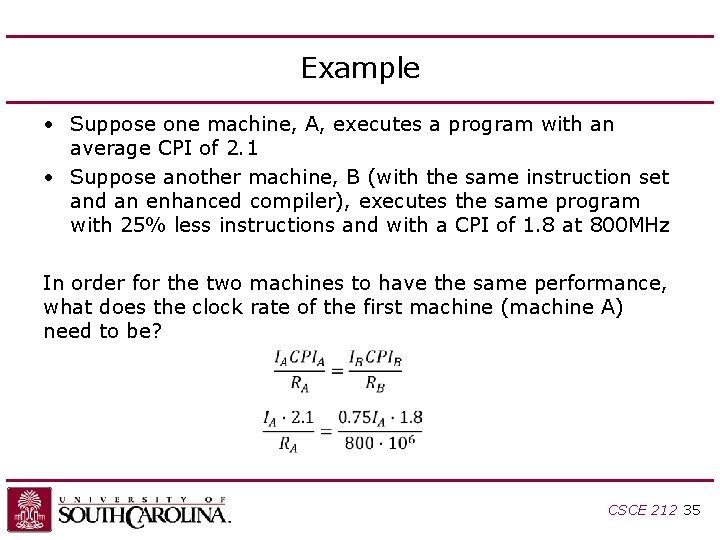
Example • Suppose one machine, A, executes a program with an average CPI of 2. 1 • Suppose another machine, B (with the same instruction set and an enhanced compiler), executes the same program with 25% less instructions and with a CPI of 1. 8 at 800 MHz In order for the two machines to have the same performance, what does the clock rate of the first machine (machine A) need to be? CSCE 212 35
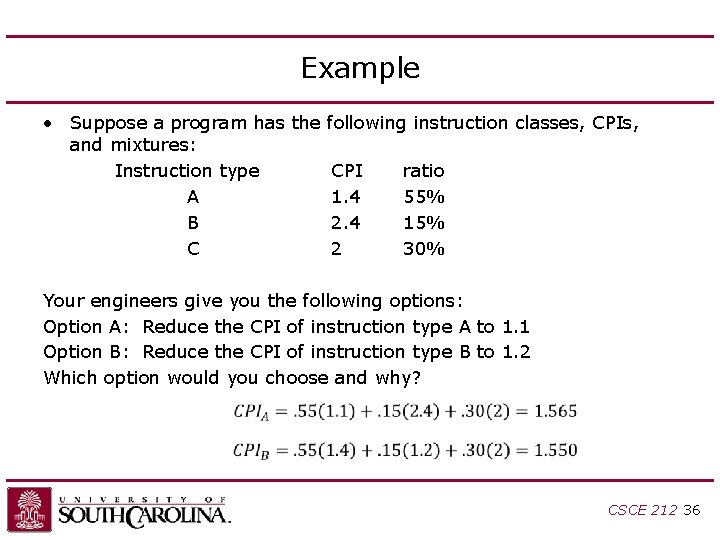
Example • Suppose a program has the following instruction classes, CPIs, and mixtures: Instruction type CPI ratio A 1. 4 55% B 2. 4 15% C 2 30% Your engineers give you the following options: Option A: Reduce the CPI of instruction type A to 1. 1 Option B: Reduce the CPI of instruction type B to 1. 2 Which option would you choose and why? CSCE 212 36
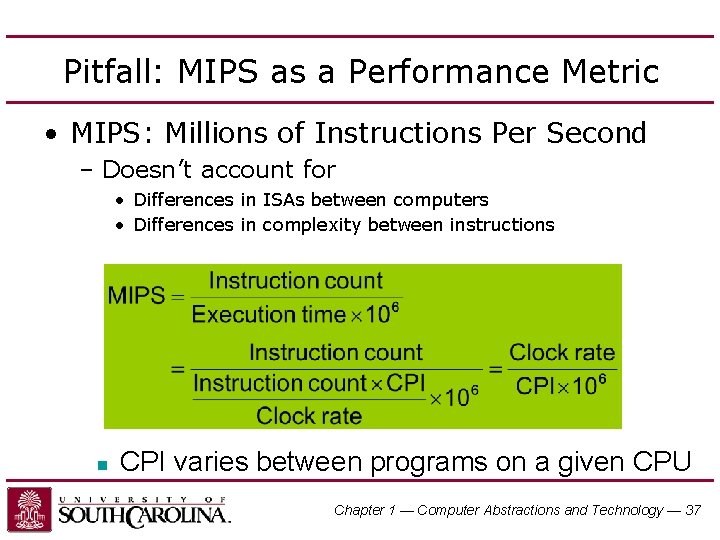
Pitfall: MIPS as a Performance Metric • MIPS: Millions of Instructions Per Second – Doesn’t account for • Differences in ISAs between computers • Differences in complexity between instructions n CPI varies between programs on a given CPU Chapter 1 — Computer Abstractions and Technology — 37
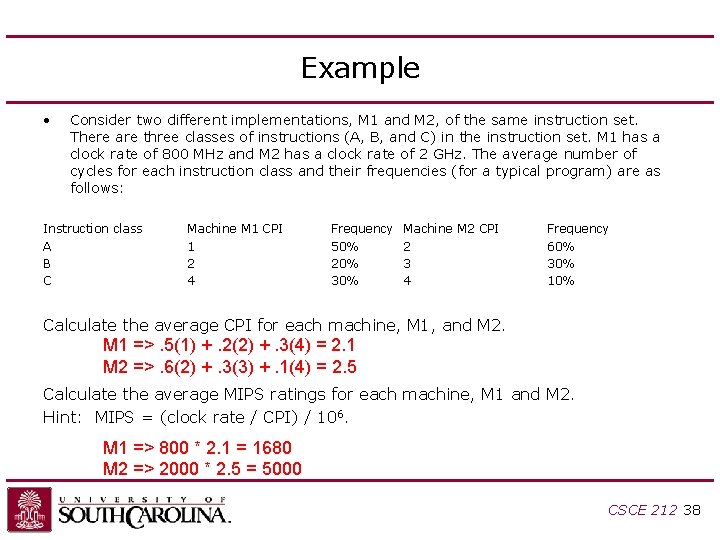
Example • Consider two different implementations, M 1 and M 2, of the same instruction set. There are three classes of instructions (A, B, and C) in the instruction set. M 1 has a clock rate of 800 MHz and M 2 has a clock rate of 2 GHz. The average number of cycles for each instruction class and their frequencies (for a typical program) are as follows: Instruction class A B C Machine M 1 CPI 1 2 4 Frequency 50% 20% 30% Machine M 2 CPI 2 3 4 Frequency 60% 30% 10% Calculate the average CPI for each machine, M 1, and M 2. M 1 =>. 5(1) +. 2(2) +. 3(4) = 2. 1 M 2 =>. 6(2) +. 3(3) +. 1(4) = 2. 5 Calculate the average MIPS ratings for each machine, M 1 and M 2. Hint: MIPS = (clock rate / CPI) / 106. M 1 => 800 * 2. 1 = 1680 M 2 => 2000 * 2. 5 = 5000 CSCE 212 38
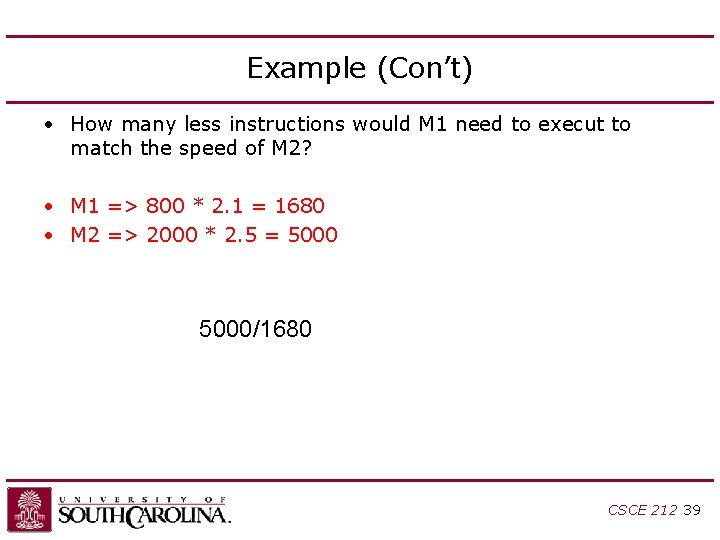
Example (Con’t) • How many less instructions would M 1 need to execut to match the speed of M 2? • M 1 => 800 * 2. 1 = 1680 • M 2 => 2000 * 2. 5 = 5000/1680 CSCE 212 39
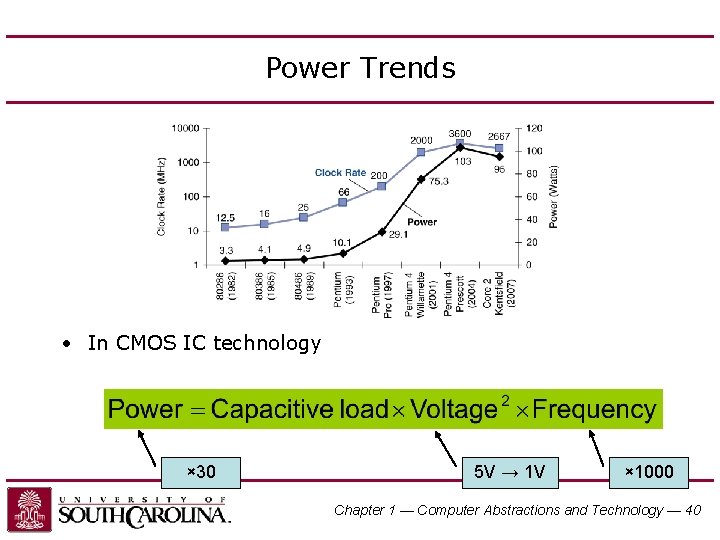
Power Trends • In CMOS IC technology × 30 5 V → 1 V × 1000 Chapter 1 — Computer Abstractions and Technology — 40
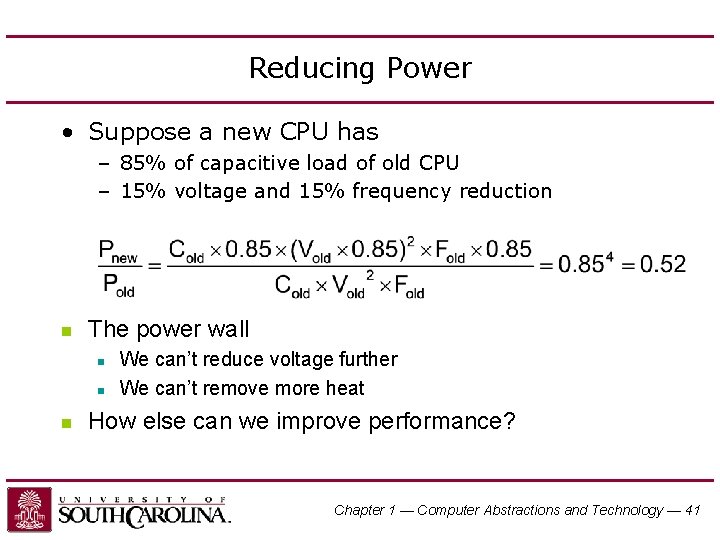
Reducing Power • Suppose a new CPU has – 85% of capacitive load of old CPU – 15% voltage and 15% frequency reduction n The power wall n n n We can’t reduce voltage further We can’t remove more heat How else can we improve performance? Chapter 1 — Computer Abstractions and Technology — 41
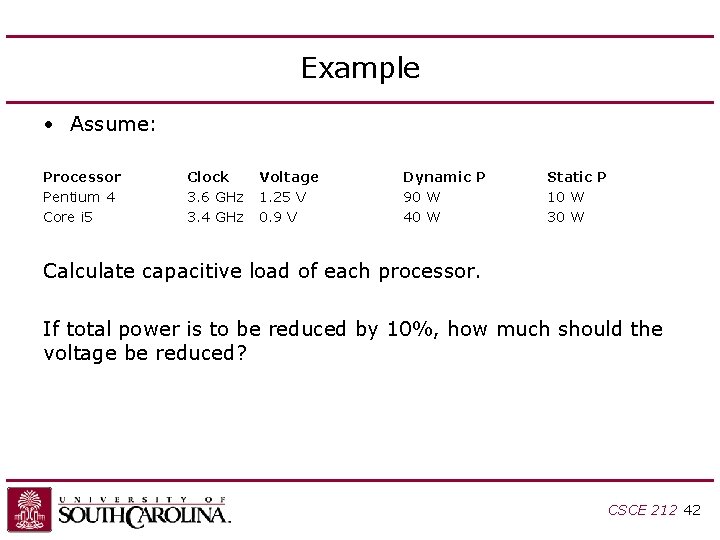
Example • Assume: Processor Pentium 4 Core i 5 Clock 3. 6 GHz 3. 4 GHz Voltage 1. 25 V 0. 9 V Dynamic P 90 W 40 W Static P 10 W 30 W Calculate capacitive load of each processor. If total power is to be reduced by 10%, how much should the voltage be reduced? CSCE 212 42

Example • For given processor, assume we reduce the voltage by 10% and increase the frequency by 5%. What is the improvement to dynamic power consumption? CSCE 212 43
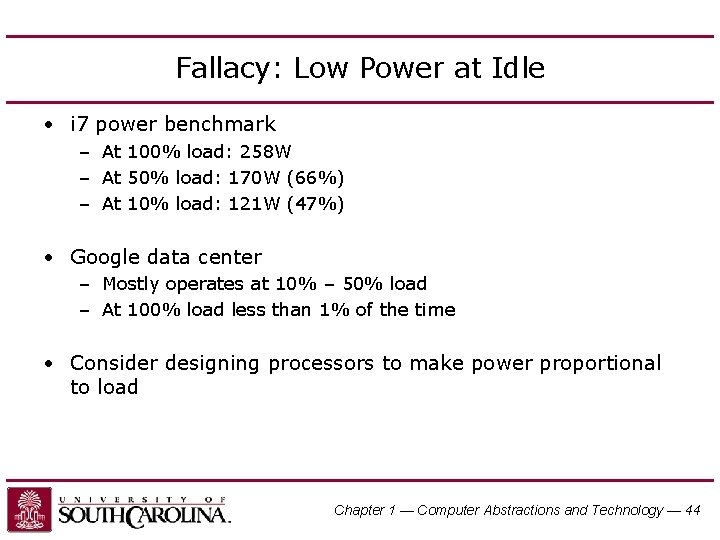
Fallacy: Low Power at Idle • i 7 power benchmark – At 100% load: 258 W – At 50% load: 170 W (66%) – At 10% load: 121 W (47%) • Google data center – Mostly operates at 10% – 50% load – At 100% load less than 1% of the time • Consider designing processors to make power proportional to load Chapter 1 — Computer Abstractions and Technology — 44
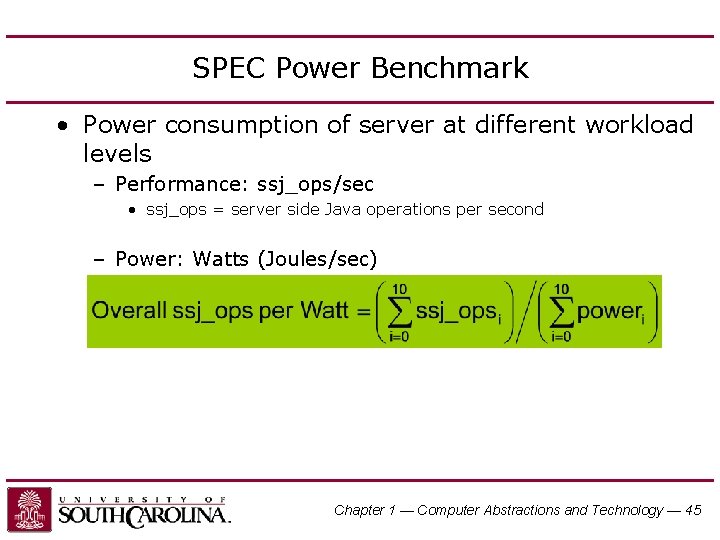
SPEC Power Benchmark • Power consumption of server at different workload levels – Performance: ssj_ops/sec • ssj_ops = server side Java operations per second – Power: Watts (Joules/sec) Chapter 1 — Computer Abstractions and Technology — 45
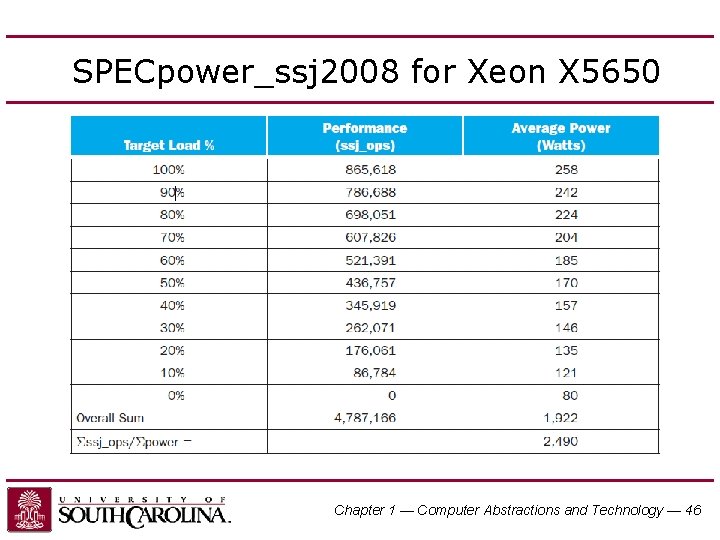
SPECpower_ssj 2008 for Xeon X 5650 Chapter 1 — Computer Abstractions and Technology — 46
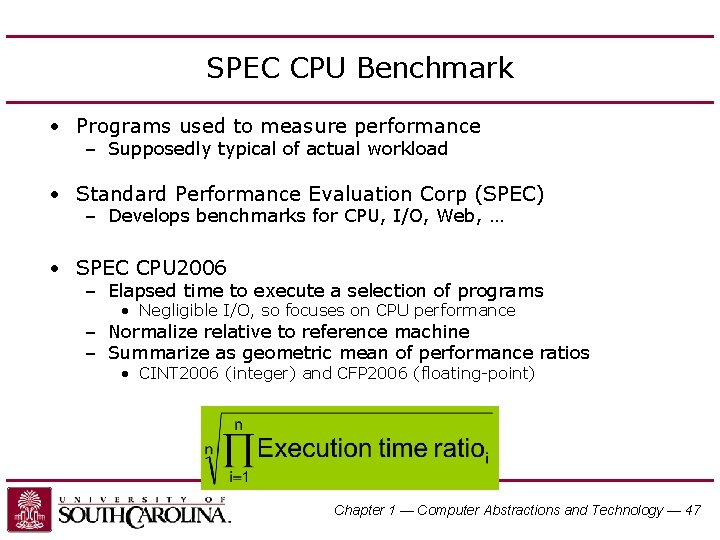
SPEC CPU Benchmark • Programs used to measure performance – Supposedly typical of actual workload • Standard Performance Evaluation Corp (SPEC) – Develops benchmarks for CPU, I/O, Web, … • SPEC CPU 2006 – Elapsed time to execute a selection of programs • Negligible I/O, so focuses on CPU performance – Normalize relative to reference machine – Summarize as geometric mean of performance ratios • CINT 2006 (integer) and CFP 2006 (floating-point) Chapter 1 — Computer Abstractions and Technology — 47
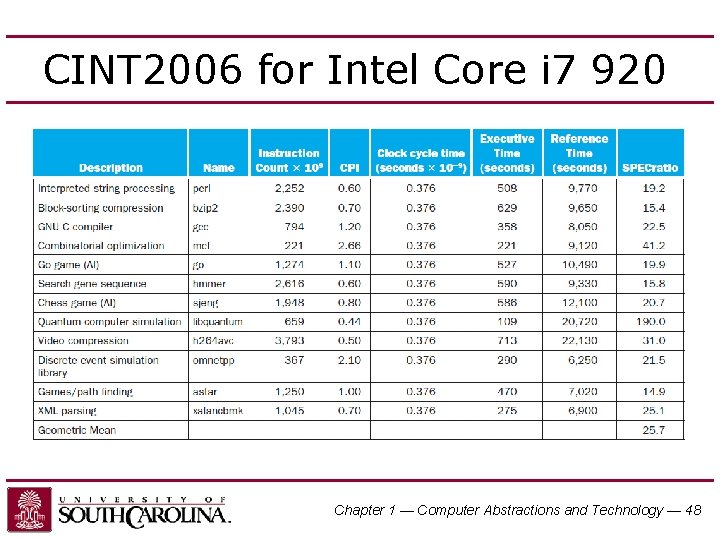
CINT 2006 for Intel Core i 7 920 Chapter 1 — Computer Abstractions and Technology — 48
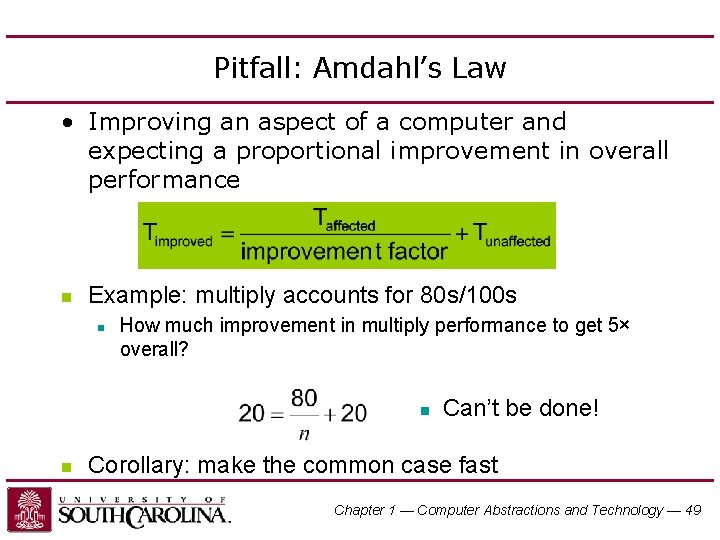
Pitfall: Amdahl’s Law • Improving an aspect of a computer and expecting a proportional improvement in overall performance n Example: multiply accounts for 80 s/100 s n How much improvement in multiply performance to get 5× overall? n n Can’t be done! Corollary: make the common case fast Chapter 1 — Computer Abstractions and Technology — 49
Example • Use Amdahl’s Law to compute the new execution time for an architecture that previously required 25 seconds to execute a program, where 15% of the time was spent executing load/store instructions, if the time required for a load/store operation is reduced by 40% (amount of improvement for load/stores = 1/. 60 = 1. 67). CSCE 212 50
Example • Suppose you have a machine which executes a program consisting of 50% multiply instructions, 20% divide instructions, and the remaining 30% are other instructions. Management wants the machine to run 4 times faster. You can make the divide run at most 3 times faster and the multiply run at most 8 times faster. Can you meet management’s goal by making only one improvement, and which one? CSCE 212 51
Multiprocessors • Multicore microprocessors – More than one processor per chip • Requires explicitly parallel programming – Compare with instruction level parallelism • Hardware executes multiple instructions at once • Hidden from the programmer – Hard to do • Programming for performance • Load balancing • Optimizing communication and synchronization Chapter 1 — Computer Abstractions and Technology — 52
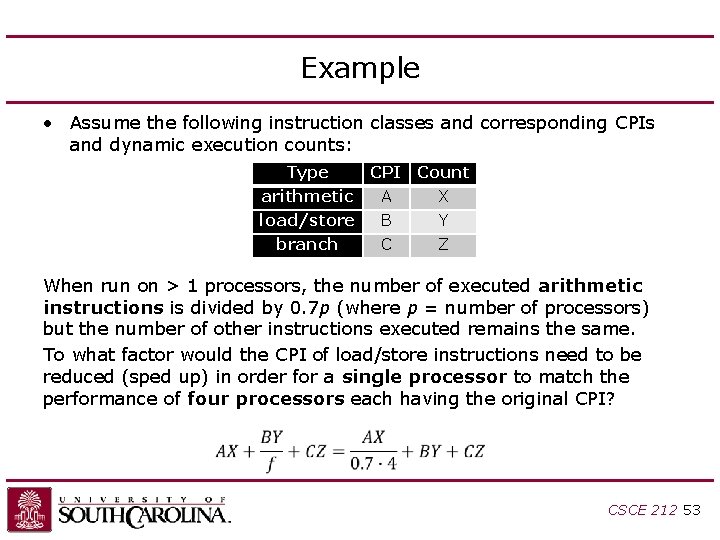
Example • Assume the following instruction classes and corresponding CPIs and dynamic execution counts: Type CPI Count arithmetic A X load/store B Y branch C Z When run on > 1 processors, the number of executed arithmetic instructions is divided by 0. 7 p (where p = number of processors) but the number of other instructions executed remains the same. To what factor would the CPI of load/store instructions need to be reduced (sped up) in order for a single processor to match the performance of four processors each having the original CPI? CSCE 212 53
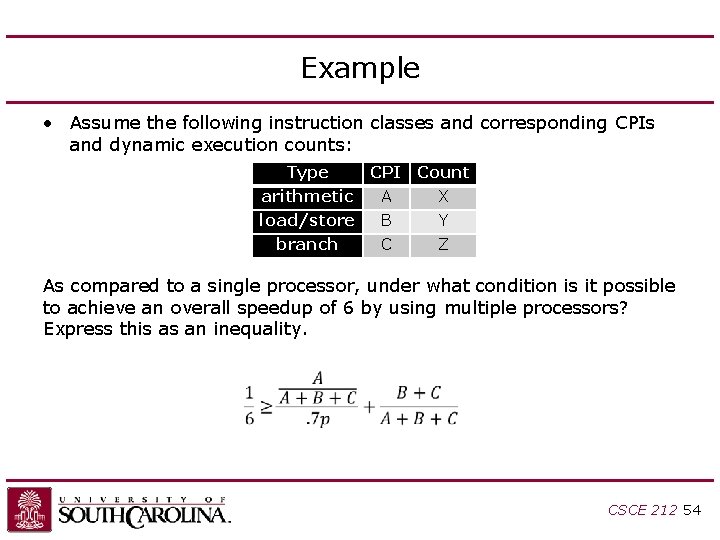
Example • Assume the following instruction classes and corresponding CPIs and dynamic execution counts: Type CPI Count arithmetic A X load/store B Y branch C Z As compared to a single processor, under what condition is it possible to achieve an overall speedup of 6 by using multiple processors? Express this as an inequality. CSCE 212 54
Concluding Remarks • Cost/performance is improving – Due to underlying technology development • Hierarchical layers of abstraction – In both hardware and software • Instruction set architecture – The hardware/software interface • Execution time: the best performance measure • Power is a limiting factor – Use parallelism to improve performance Chapter 1 — Computer Abstractions and Technology — 55
- Slides: 55