
Chapter 1 Communication Networks and Services Network Architecture
![Why Computer Networks? l Business Applications l [Goal 1] Resource Sharing To connect isolated](https://slidetodoc.com/presentation_image_h/2dd4e0c725996c1ac44276cd5a07de13/image-3.jpg "Why Computer Networks? l Business Applications l [Goal 1] Resource Sharing To connect isolated")
![l [Goal 2] Communication Medium Electronic mail (e-mail) l Shared resources (ex: shared hard](https://slidetodoc.com/presentation_image_h/2dd4e0c725996c1ac44276cd5a07de13/image-4.jpg "l [Goal 2] Communication Medium Electronic mail (e-mail) l Shared resources (ex: shared hard")
![l [Goal 3] Electronic Commerce (e-commerce) To do business electronically with other companies. (ex:](https://slidetodoc.com/presentation_image_h/2dd4e0c725996c1ac44276cd5a07de13/image-5.jpg "l [Goal 3] Electronic Commerce (e-commerce) To do business electronically with other companies. (ex:")
![l Home Applications l [Goal 1] Access to remote information l l Newspapers, Digital](https://slidetodoc.com/presentation_image_h/2dd4e0c725996c1ac44276cd5a07de13/image-6.jpg "l Home Applications l [Goal 1] Access to remote information l l Newspapers, Digital")
![l Home Applications (cont. ) l [Goal 3] Interactive entertainment l l Video on](https://slidetodoc.com/presentation_image_h/2dd4e0c725996c1ac44276cd5a07de13/image-7.jpg "l Home Applications (cont. ) l [Goal 3] Interactive entertainment l l Video on")
![l Mobile Network Users l [Goal] To have a portable office l Cellular phone,](https://slidetodoc.com/presentation_image_h/2dd4e0c725996c1ac44276cd5a07de13/image-8.jpg "l Mobile Network Users l [Goal] To have a portable office l Cellular phone,")
- Slides: 35
Chapter 1 Communication Networks and Services Network Architecture and Services
What is Computer Networks? l A collection of autonomous computers interconnected by a single technology l Interconnected via: Copper wire l Fiber optics l Microwaves l Infrared l Communication satellites, etc. l
Why Computer Networks? l Business Applications l [Goal 1] Resource Sharing To connect isolated computer and information to be able to extract and correlate information about the entire company. l To make all programs, equipment (ex: printers, scanners, and CD burners), and especially data available to anyone on the network without regard to the physical location of the resource an the user. l
l [Goal 2] Communication Medium Electronic mail (e-mail) l Shared resources (ex: shared hard driver) l Videoconferencing, a shared virtual blackboard l
l [Goal 3] Electronic Commerce (e-commerce) To do business electronically with other companies. (ex: order the parts of a product from a variety of suppliers) l To do business with consumers over the Internet. l
l Home Applications l [Goal 1] Access to remote information l l Newspapers, Digital library [Goal 2] Person-to-person communication Email, Instant messaging, Chat room, Worldwide newsgroups l Peer-to-peer communication (ex: Napster) l Internet phone, Internet video phone, Internet radio, Telelearning l
l Home Applications (cont. ) l [Goal 3] Interactive entertainment l l Video on demand, Interactive live television show, Multiperson real-time simulation games – possibly with worldwide shared virtual reality. [Goal 4] Electronic commerce l Home shopping, Electric flea markets, On-line auctions
l Mobile Network Users l [Goal] To have a portable office l Cellular phone, PDA, Military use, Wireless sensor networks, Mobile-commerce, Wearable wireless computers Combinations of wireless networks and mobile computing.
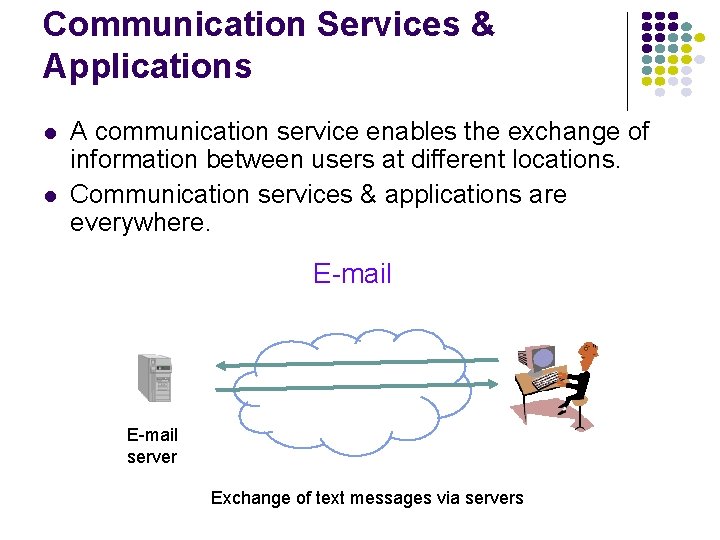
Communication Services & Applications l l A communication service enables the exchange of information between users at different locations. Communication services & applications are everywhere. E-mail server Exchange of text messages via servers
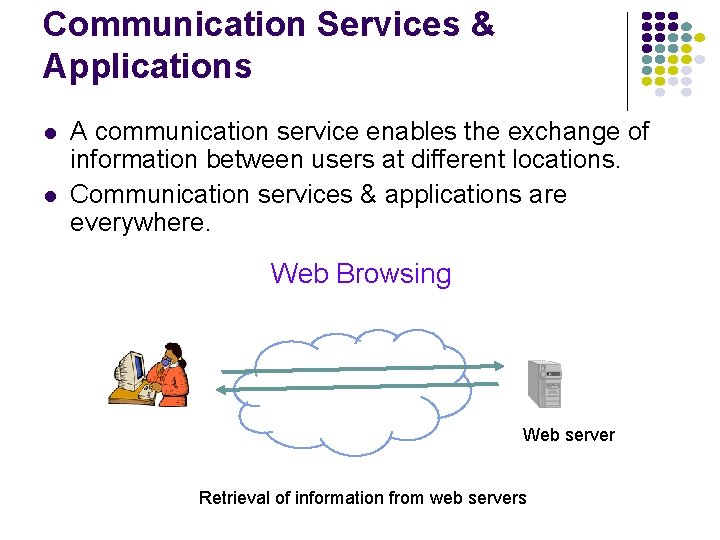
Communication Services & Applications l l A communication service enables the exchange of information between users at different locations. Communication services & applications are everywhere. Web Browsing Web server Retrieval of information from web servers
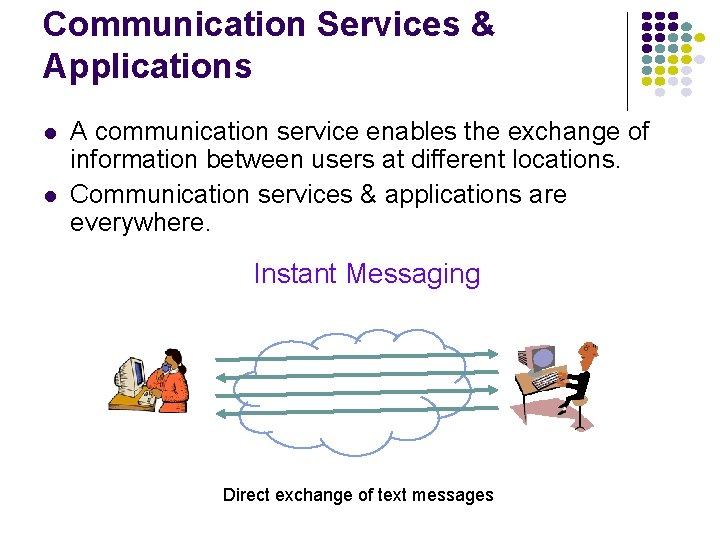
Communication Services & Applications l l A communication service enables the exchange of information between users at different locations. Communication services & applications are everywhere. Instant Messaging Direct exchange of text messages
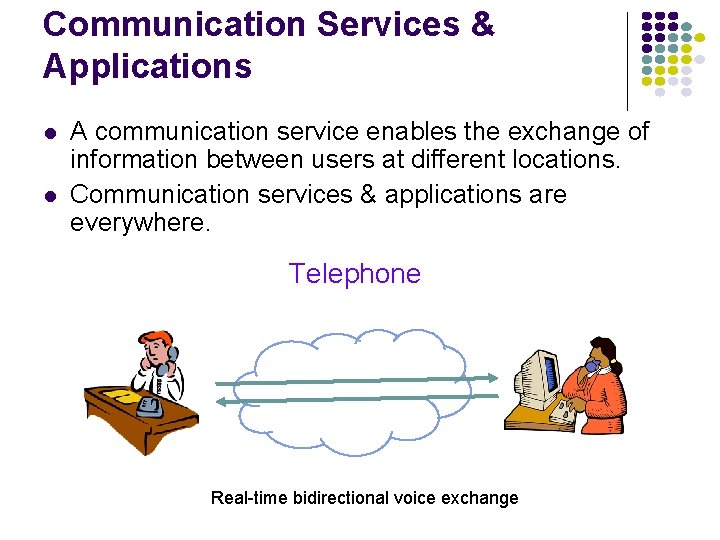
Communication Services & Applications l l A communication service enables the exchange of information between users at different locations. Communication services & applications are everywhere. Telephone Real-time bidirectional voice exchange
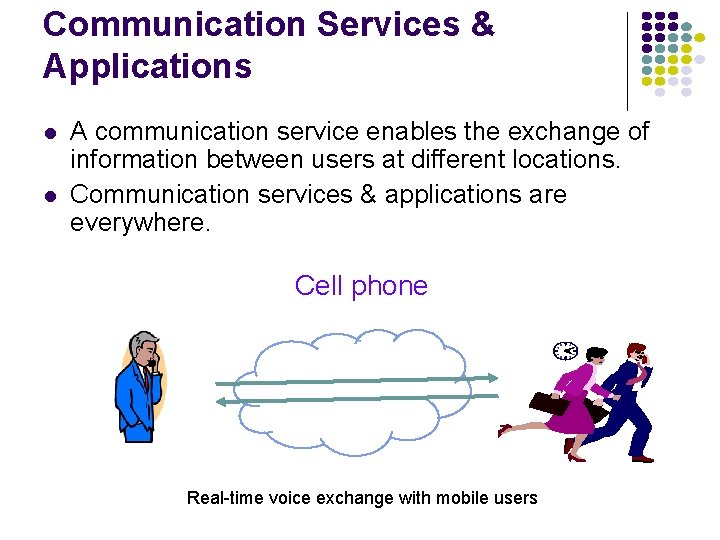
Communication Services & Applications l l A communication service enables the exchange of information between users at different locations. Communication services & applications are everywhere. Cell phone Real-time voice exchange with mobile users
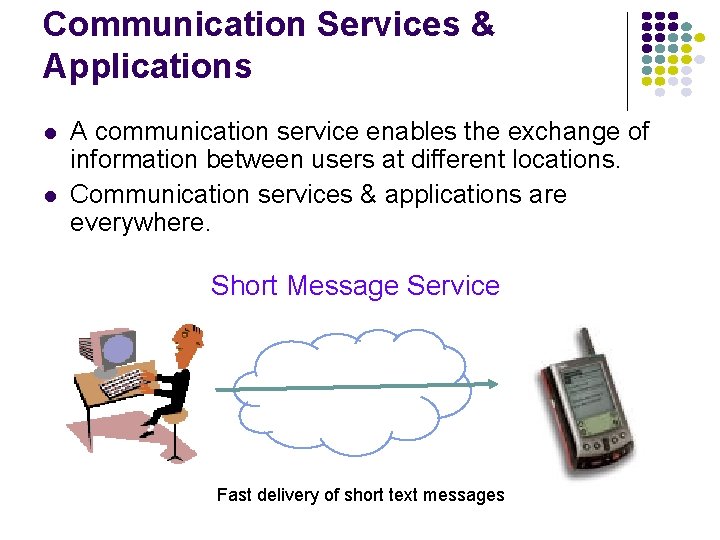
Communication Services & Applications l l A communication service enables the exchange of information between users at different locations. Communication services & applications are everywhere. Short Message Service Fast delivery of short text messages
Many other examples! l Peer-to-peer applications l l l Napster, Gnutella, Kazaa file exchange Audio & video streaming Network games On-line purchasing Text messaging in PDAs, cell phones (SMS) Voice-over-Internet
Services & Applications l Service: Basic information transfer capability l l Applications build on communication services l l l Internet transfer of individual block of information Internet reliable transfer of a stream of bytes Real-time transfer of a voice signal E-mail & web build on reliable stream service Fax and modems build on basic telephone service New applications build on multiple networks l SMS builds on Internet reliable stream service and cellular telephone text messaging
What is a protocol? l l Communications between computers requires very specific unambiguous rules A protocol is a set of rules that governs how two or more communicating parties are to interact l l Internet Protocol (IP) Transmission Control Protocol (TCP) Hyper. Text Transfer Protocol (HTTP) Simple Mail Transfer Protocol (SMTP)
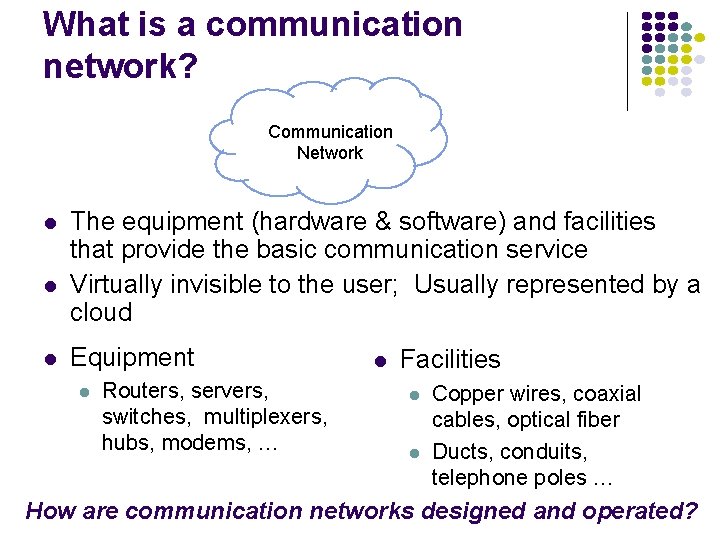
What is a communication network? Communication Network l l l The equipment (hardware & software) and facilities that provide the basic communication service Virtually invisible to the user; Usually represented by a cloud Equipment l Routers, servers, switches, multiplexers, hubs, modems, … l Facilities l l Copper wires, coaxial cables, optical fiber Ducts, conduits, telephone poles … How are communication networks designed and operated?
Communication Network Architecture Network architecture: the plan that specifies how the network is built and operated l Architecture is driven by the network services l Overall communication process is complex l Network architecture partitions overall communication process into separate functional areas called layers Next we will trace evolution of three network architectures: telegraph, telephone, and computer networks l
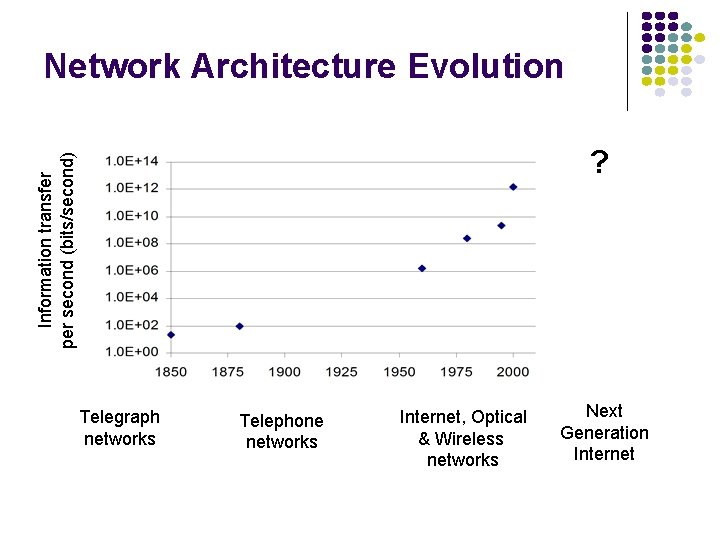
Network Architecture Evolution Information transfer per second (bits/second) ? Telegraph networks Telephone networks Internet, Optical & Wireless networks Next Generation Internet
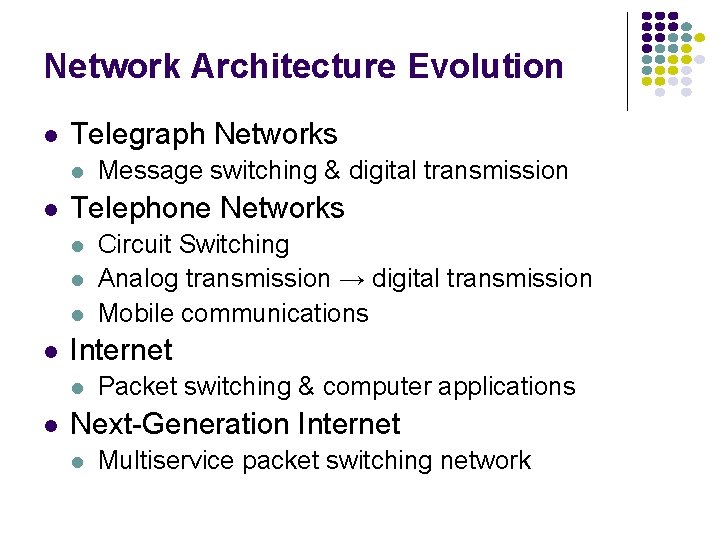
Network Architecture Evolution l Telegraph Networks l l Telephone Networks l l Circuit Switching Analog transmission → digital transmission Mobile communications Internet l l Message switching & digital transmission Packet switching & computer applications Next-Generation Internet l Multiservice packet switching network
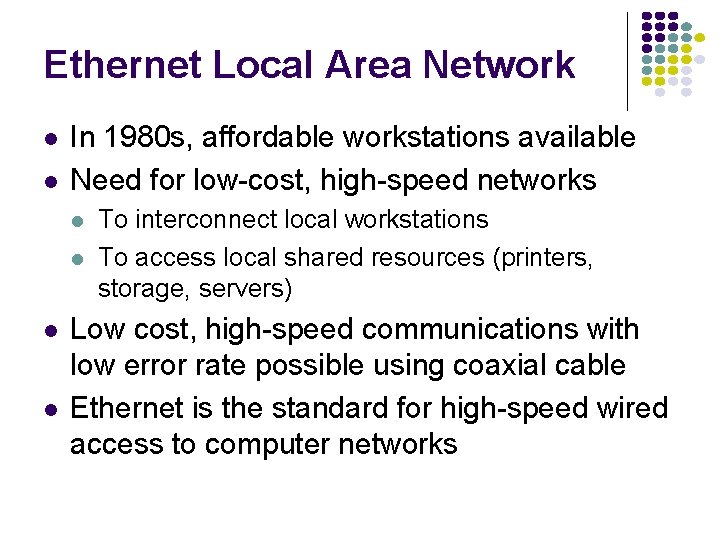
Ethernet Local Area Network l l In 1980 s, affordable workstations available Need for low-cost, high-speed networks l l To interconnect local workstations To access local shared resources (printers, storage, servers) Low cost, high-speed communications with low error rate possible using coaxial cable Ethernet is the standard for high-speed wired access to computer networks
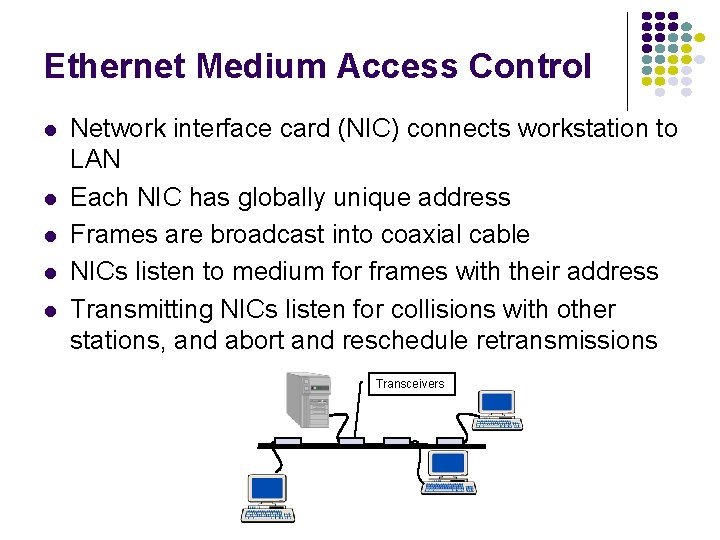
Ethernet Medium Access Control l l Network interface card (NIC) connects workstation to LAN Each NIC has globally unique address Frames are broadcast into coaxial cable NICs listen to medium for frames with their address Transmitting NICs listen for collisions with other stations, and abort and reschedule retransmissions Transceivers
The Internet l l l Different network types emerged for data transfer between computers ARPA also explored packet switching using satellite and packet radio networks Each network has its protocols and is possibly built on different technologies Internetworking protocols required to enable communications between computers attached to different networks Internet: a network of networks
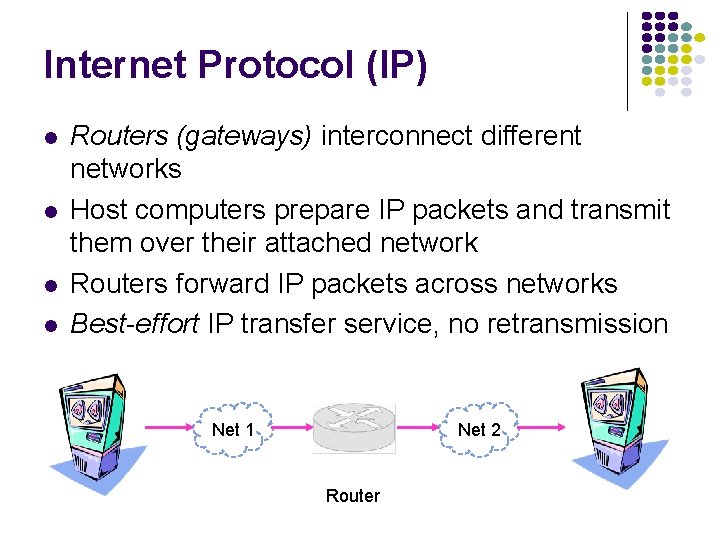
Internet Protocol (IP) l l Routers (gateways) interconnect different networks Host computers prepare IP packets and transmit them over their attached network Routers forward IP packets across networks Best-effort IP transfer service, no retransmission Net 1 Net 2 Router
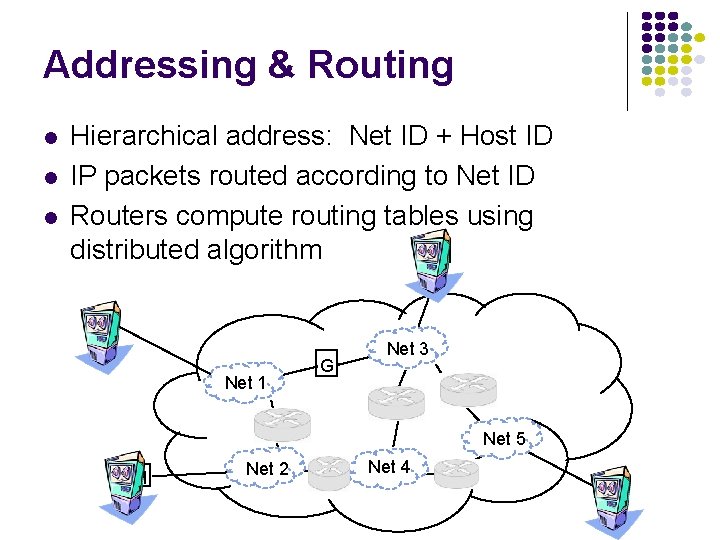
Addressing & Routing l l l Hierarchical address: Net ID + Host ID IP packets routed according to Net ID Routers compute routing tables using distributed algorithm H H G Net 1 Net 3 G G G H Net 2 Net 5 G Net 4 G H
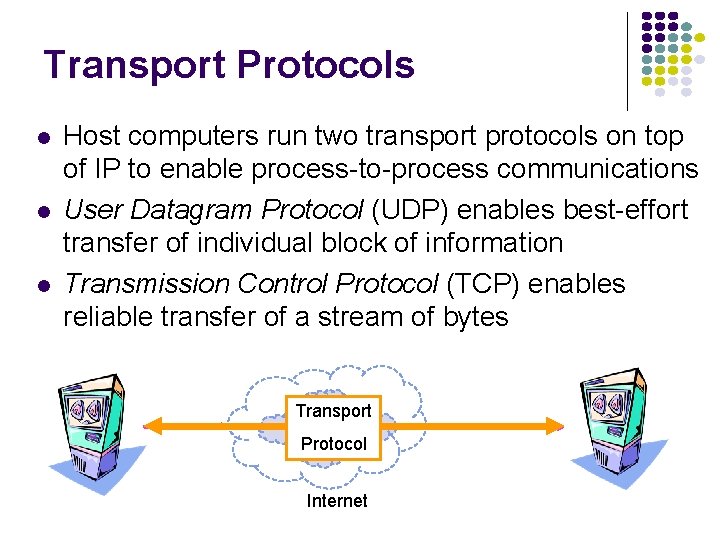
Transport Protocols l l l Host computers run two transport protocols on top of IP to enable process-to-process communications User Datagram Protocol (UDP) enables best-effort transfer of individual block of information Transmission Control Protocol (TCP) enables reliable transfer of a stream of bytes Transport Protocol Internet
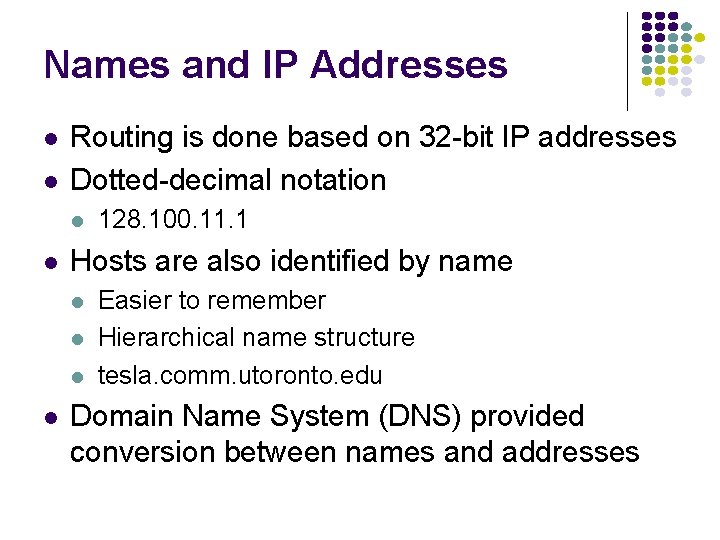
Names and IP Addresses l l Routing is done based on 32 -bit IP addresses Dotted-decimal notation l l Hosts are also identified by name l l 128. 100. 11. 1 Easier to remember Hierarchical name structure tesla. comm. utoronto. edu Domain Name System (DNS) provided conversion between names and addresses
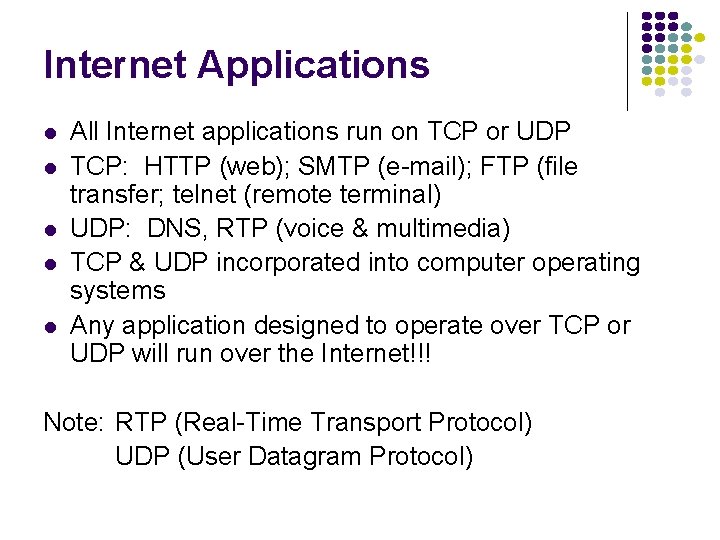
Internet Applications l l l All Internet applications run on TCP or UDP TCP: HTTP (web); SMTP (e-mail); FTP (file transfer; telnet (remote terminal) UDP: DNS, RTP (voice & multimedia) TCP & UDP incorporated into computer operating systems Any application designed to operate over TCP or UDP will run over the Internet!!! Note: RTP (Real-Time Transport Protocol) UDP (User Datagram Protocol)
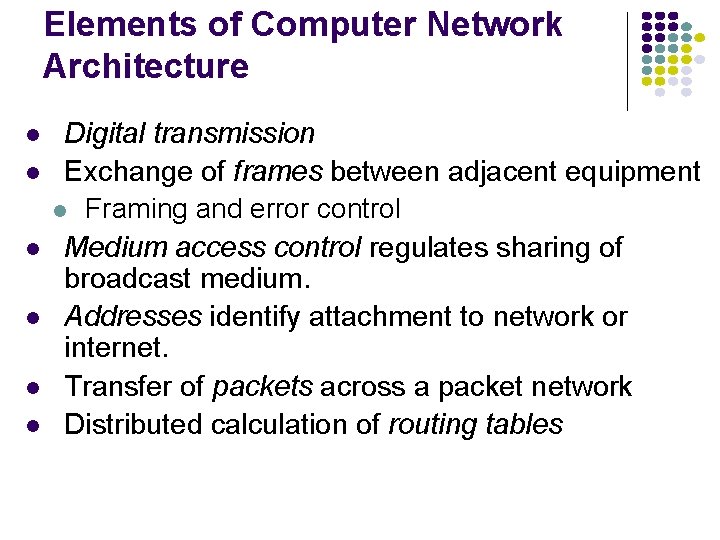
Elements of Computer Network Architecture l l l Digital transmission Exchange of frames between adjacent equipment l Framing and error control Medium access control regulates sharing of broadcast medium. Addresses identify attachment to network or internet. Transfer of packets across a packet network Distributed calculation of routing tables
Elements of Computer Network Architecture l l l Congestion control inside the network Internetworking across multiple networks using routers Segmentation and reassembly of messages into packets at the ingress to and egress from a network or internetwork End-to-end transport protocols for process-to-process communications Applications that build on the transfer of messages between computers. Intelligence is at the edge of the network.
Standards l l New technologies very costly and risky Standards allow players to share risk and benefits of a new market l l Reduced cost of entry Interoperability and network effect Compete on innovation Completing the value chain l l Chips, systems, equipment vendors, service providers Example l 802. 11 wireless LAN products
Standards Bodies l Internet Engineering Task Force l l l International Telecommunications Union l l International telecom standards IEEE 802 Committee l l Internet standards development Request for Comments (RFCs): www. ietf. org Local area and metropolitan area network standards Industry Organizations l MPLS Forum, Wi. Fi Alliance, World Wide Web Consortium
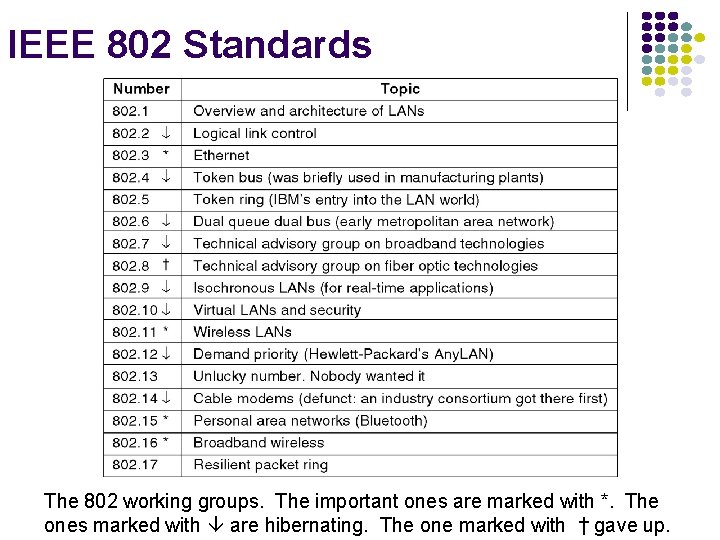
IEEE 802 Standards The 802 working groups. The important ones are marked with *. The ones marked with are hibernating. The one marked with † gave up.
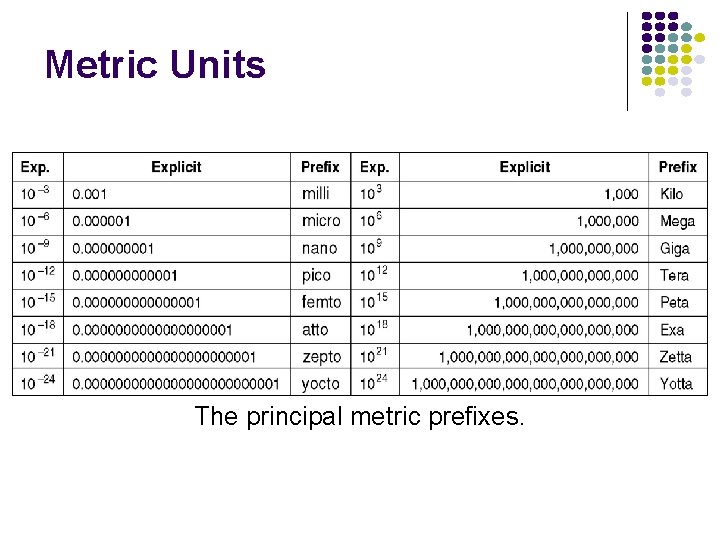
Metric Units The principal metric prefixes.