
Chapter 1 Circuit Elements and Variables What is
Chapter 1 Circuit Elements and Variables

What is Electric Circuit? • An electric circuit is an interconnection of electrical elements • Example: Consists of 3 basic elements: battery, lamp, connecting wires. • When the wires are connected properly, the circuit is said to be closed and the lamp will light. When the wires are disconnected, the circuit is said to be open. 2
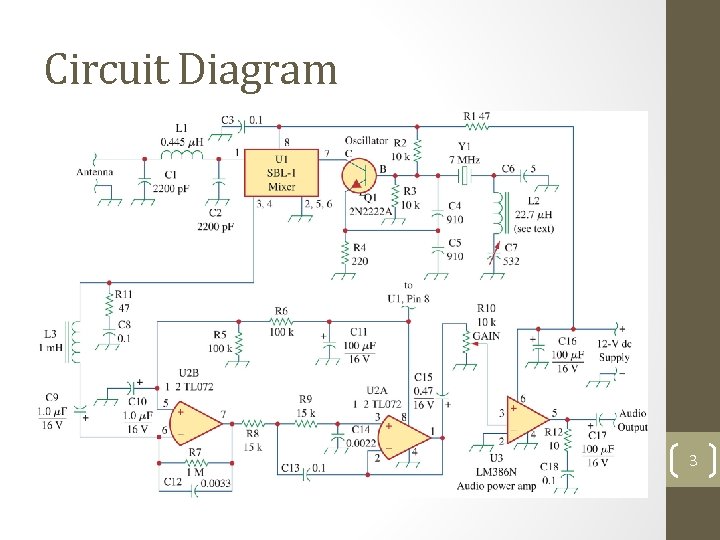
Circuit Diagram 3
Basic Electric Concept 1. Review SI unit (International Systems of Unit) 2. Know the definition of basic electrical quantities : charge, current, voltage, power & energy 3. Know the symbols and definition of the elements of the circuit: passive and active elements & independent and dependent sources 4. To understand some fundamentals laws and basic network to determine the values of electric circuit variables: Ohm’s Law, nodes, branches, loops & Kirchoff’s Law 4
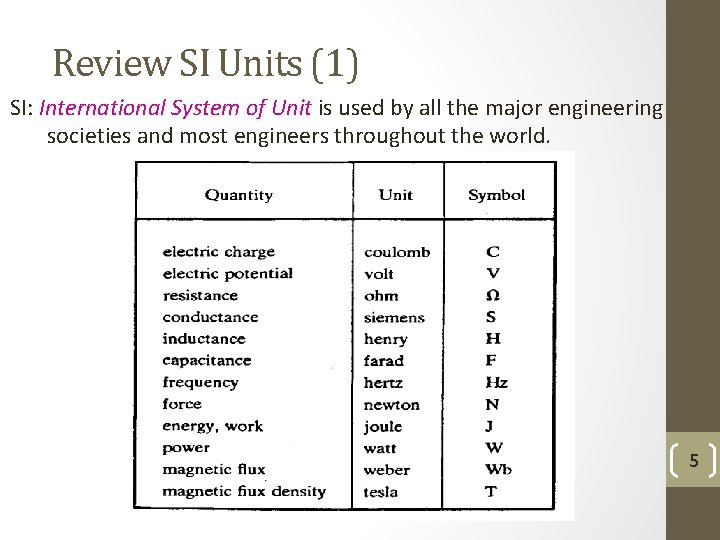
Review SI Units (1) SI: International System of Unit is used by all the major engineering societies and most engineers throughout the world. 5
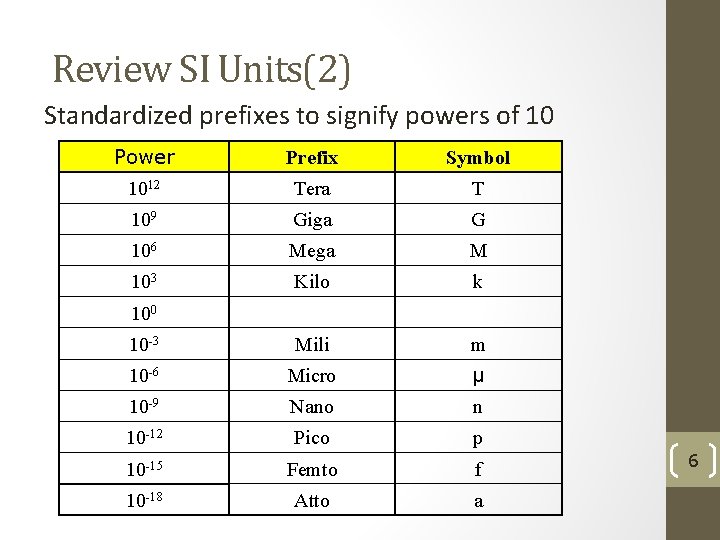
Review SI Units(2) Standardized prefixes to signify powers of 10 Power Prefix Symbol 1012 Tera T 109 Giga G 106 Mega M 103 Kilo k 10 -3 Mili m 10 -6 Micro µ 10 -9 Nano n 10 -12 Pico p 10 -15 Femto f 10 -18 Atto a 100 6
Basic Electric Concept 1. Review SI unit (International Systems of Unit) 2. Know the definition of basic electrical quantities : charge, current, voltage, power & energy 3. Know the symbols and definition of the elements of the circuit: passive and active elements & independent and dependent sources 4. To understand some fundamentals laws and basic network to determine the values of electric circuit variables: Ohm’s Law, nodes, branches, loops & Kirchoff’s Law 7
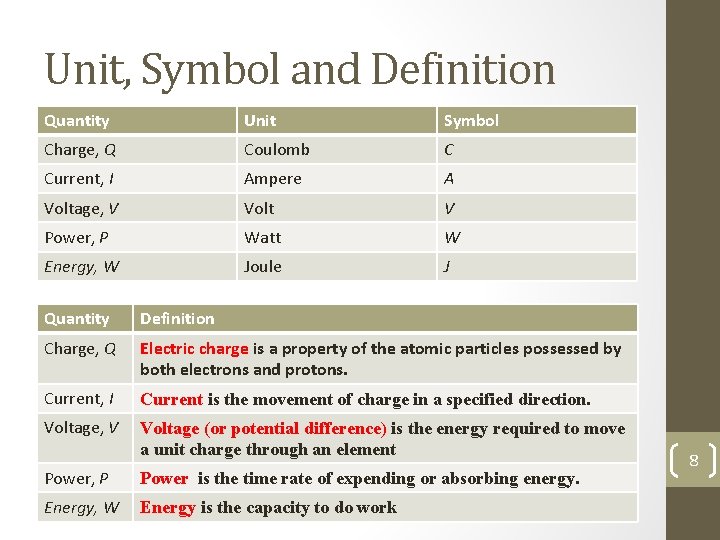
Unit, Symbol and Definition Quantity Unit Symbol Charge, Q Coulomb C Current, I Ampere A Voltage, V Volt V Power, P Watt W Energy, W Joule J Quantity Definition Charge, Q Electric charge is a property of the atomic particles possessed by both electrons and protons. Current, I Current is the movement of charge in a specified direction. Voltage, V Voltage (or potential difference) is the energy required to move a unit charge through an element Power, P Power is the time rate of expending or absorbing energy. Energy, W Energy is the capacity to do work 8
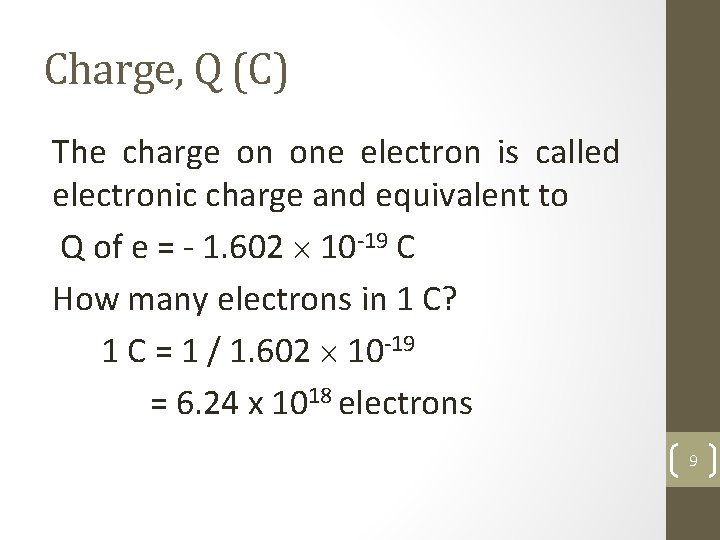
Charge, Q (C) The charge on one electron is called electronic charge and equivalent to Q of e = - 1. 602 10 -19 C How many electrons in 1 C? 1 C = 1 / 1. 602 10 -19 = 6. 24 x 1018 electrons 9
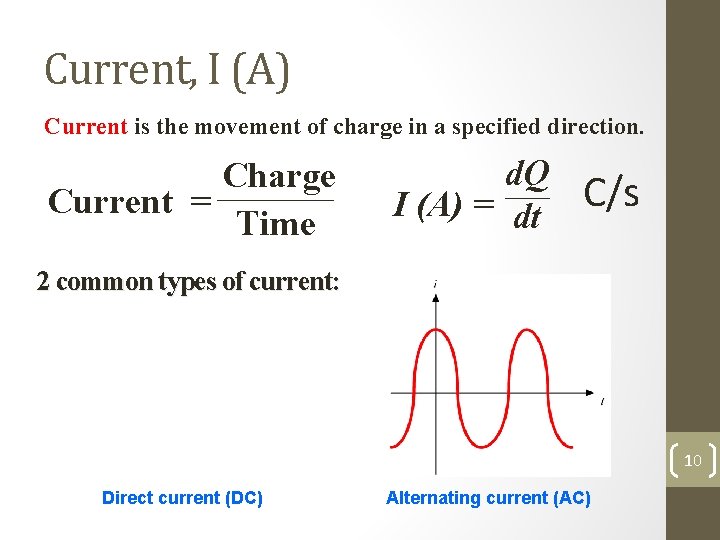
Current, I (A) Current is the movement of charge in a specified direction. Charge Current = Time d. Q I (A) = dt C/s 2 common types of current: 10 Direct current (DC) Alternating current (AC)
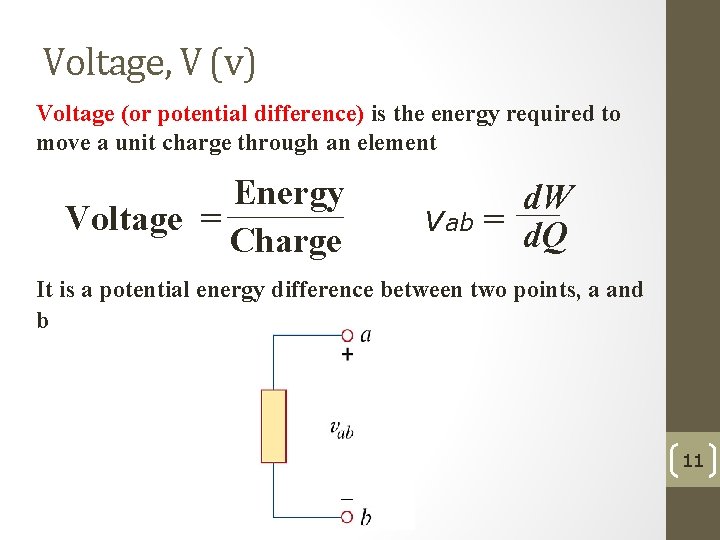
Voltage, V (v) Voltage (or potential difference) is the energy required to move a unit charge through an element Energy Voltage = Charge d. W vab = d. Q It is a potential energy difference between two points, a and b 11
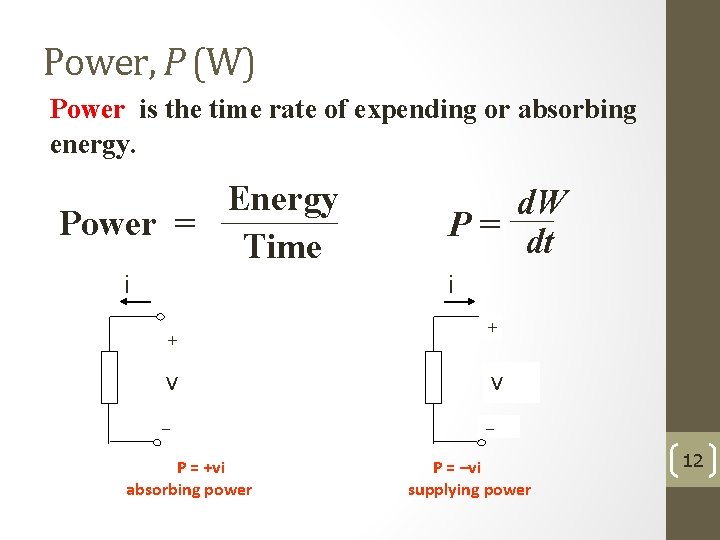
Power, P (W) Power is the time rate of expending or absorbing energy. Energy Power = Time i d. W P = dt i + + v v – – P = +vi absorbing power P = –vi supplying power 12
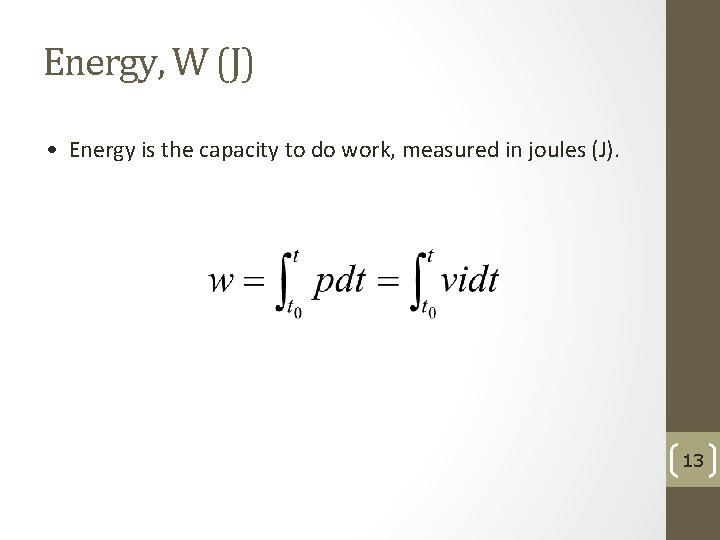
Energy, W (J) • Energy is the capacity to do work, measured in joules (J). 13
Basic Electric Concept 1. Review SI unit (International Systems of Unit) 2. Know the definition of basic electrical quantities : charge, current, voltage, power & energy 3. Know the symbols and definition of the elements of the circuit: passive and active elements & independent and dependent sources 4. To understand some fundamentals laws and basic network to determine the values of electric circuit variables: Ohm’s Law, nodes, branches, loops & Kirchoff’s Law 14
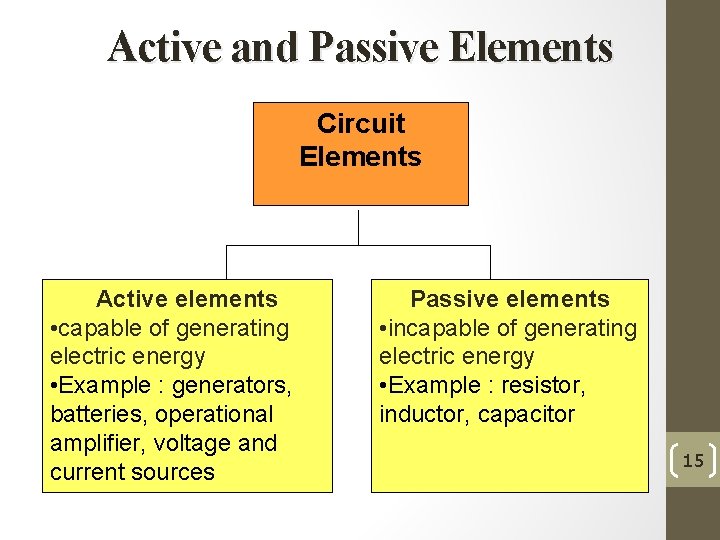
Active and Passive Elements Circuit Elements Active elements • capable of generating electric energy • Example : generators, batteries, operational amplifier, voltage and current sources Passive elements • incapable of generating electric energy • Example : resistor, inductor, capacitor 15
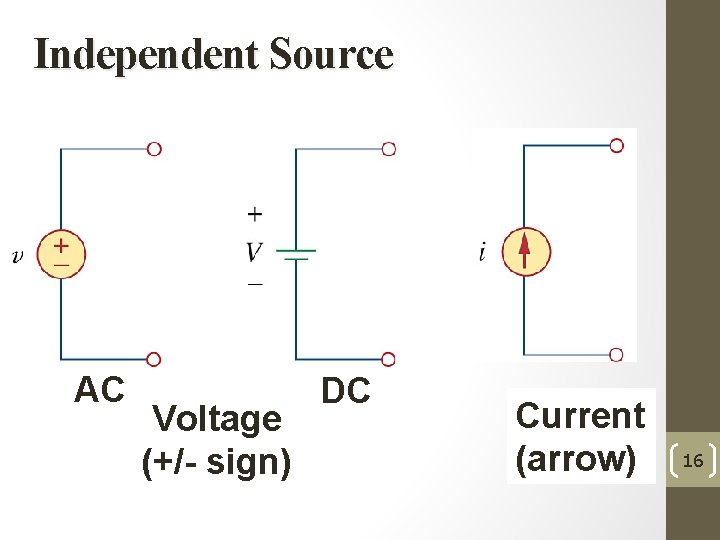
Independent Source AC Voltage (+/- sign) DC Current (arrow) 16
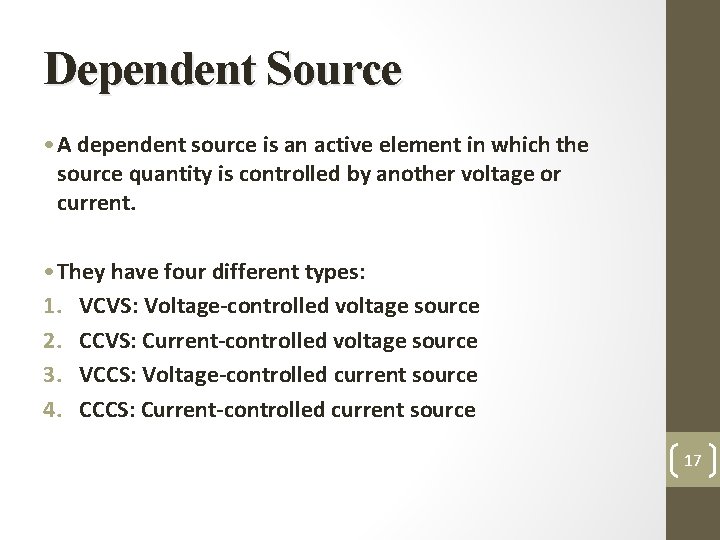
Dependent Source • A dependent source is an active element in which the source quantity is controlled by another voltage or current. • They have four different types: 1. VCVS: Voltage-controlled voltage source 2. CCVS: Current-controlled voltage source 3. VCCS: Voltage-controlled current source 4. CCCS: Current-controlled current source 17
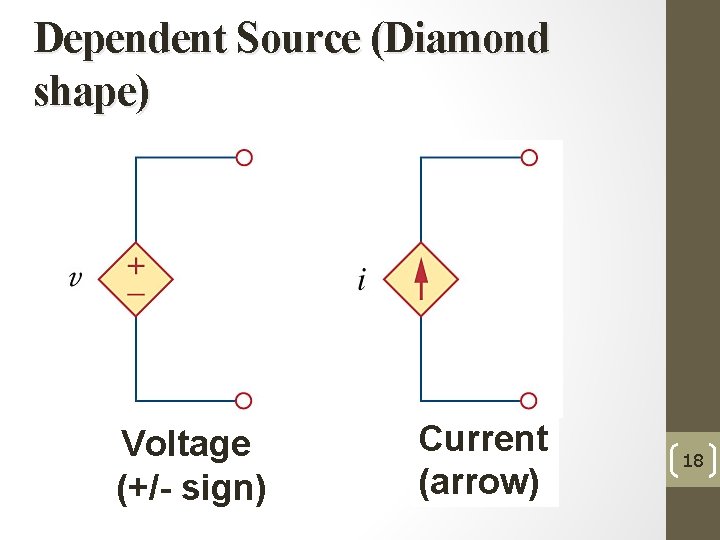
Dependent Source (Diamond shape) Voltage (+/- sign) Current (arrow) 18
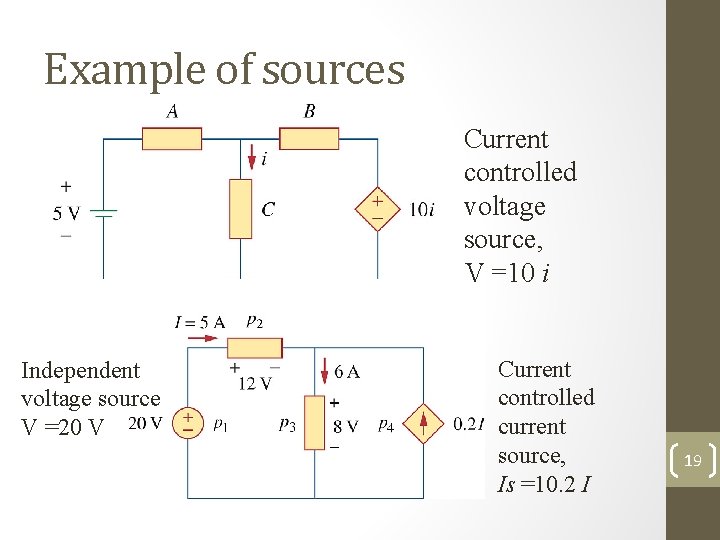
Example of sources Current controlled voltage source, V =10 i Independent voltage source V =20 V Current controlled current source, Is =10. 2 I 19
Basic Electric Concept 1. Review SI unit (International Systems of Unit) 2. Know the definition of basic electrical quantities : charge, current, voltage, power & energy 3. Know the symbols and definition of the elements of the circuit: passive and active elements & independent and dependent sources 4. To understand some fundamentals laws and basic network to determine the values of electric circuit variables: Ohm’s Law, nodes, branches, loops & Kirchoff’s Law 20
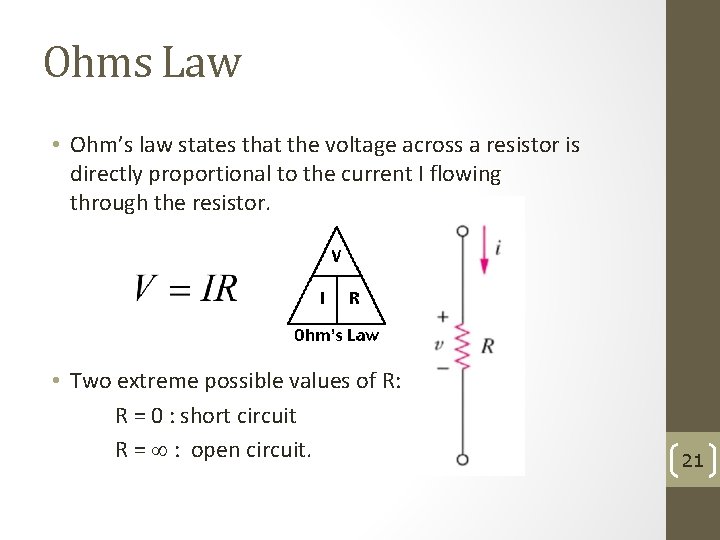
Ohms Law • Ohm’s law states that the voltage across a resistor is directly proportional to the current I flowing through the resistor. • Two extreme possible values of R: R = 0 : short circuit R = : open circuit. 21
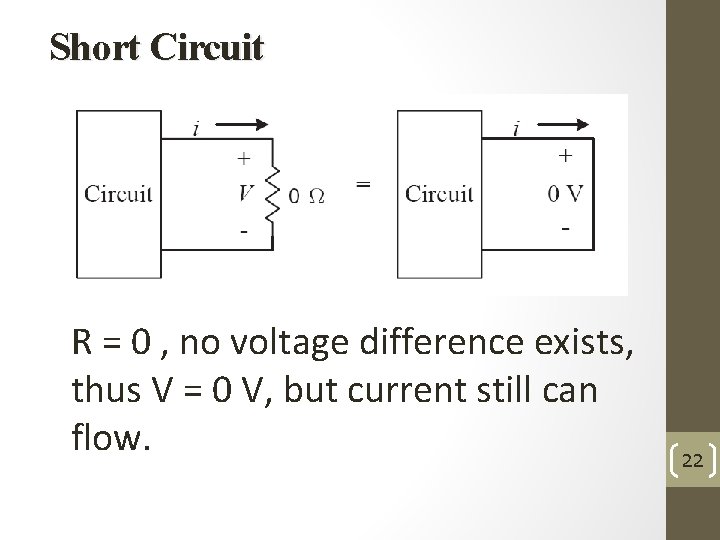
Short Circuit R = 0 , no voltage difference exists, thus V = 0 V, but current still can flow. 22
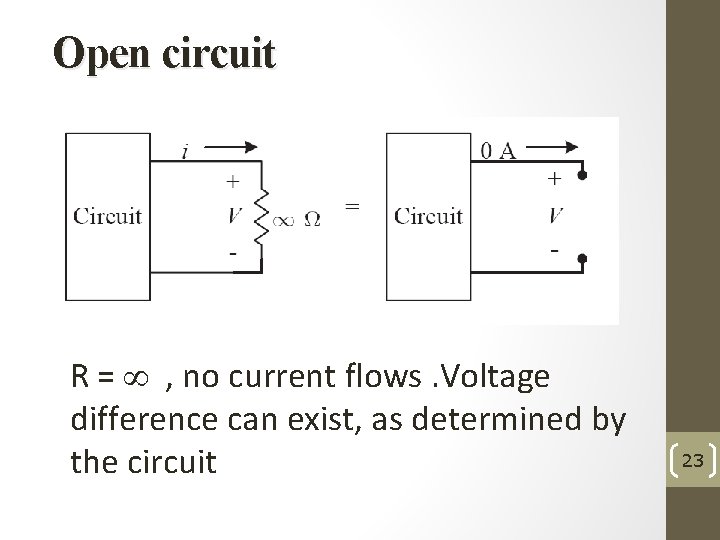
Open circuit R = , no current flows. Voltage difference can exist, as determined by the circuit 23
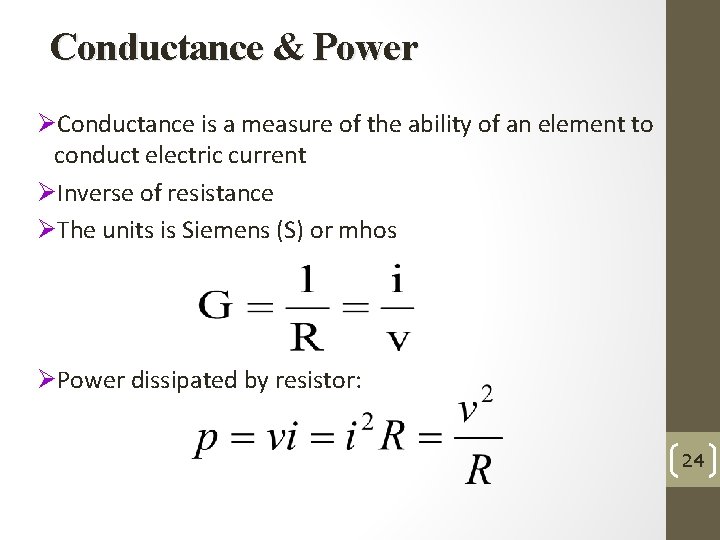
Conductance & Power ØConductance is a measure of the ability of an element to conduct electric current ØInverse of resistance ØThe units is Siemens (S) or mhos ØPower dissipated by resistor: 24
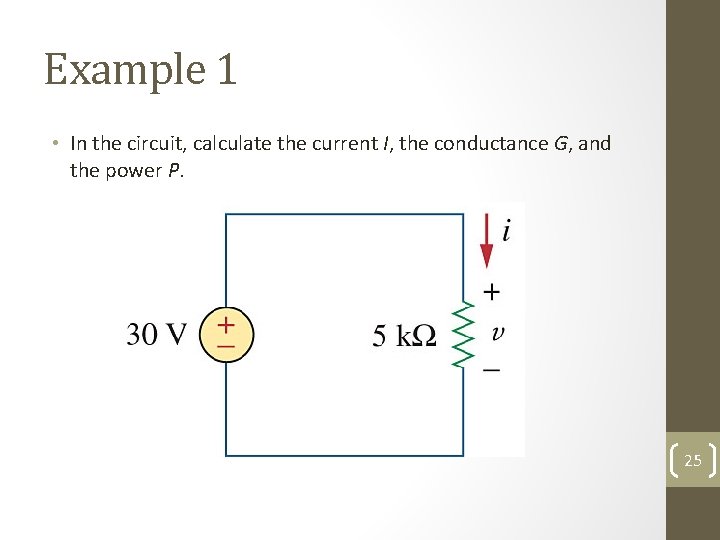
Example 1 • In the circuit, calculate the current I, the conductance G, and the power P. 25
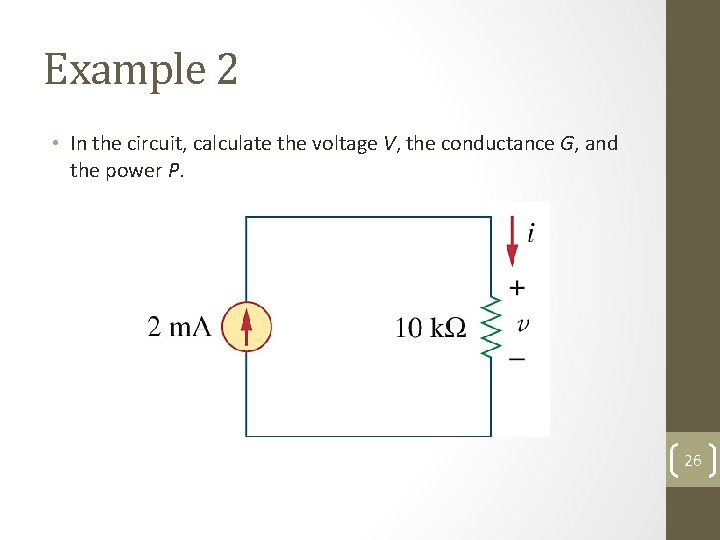
Example 2 • In the circuit, calculate the voltage V, the conductance G, and the power P. 26
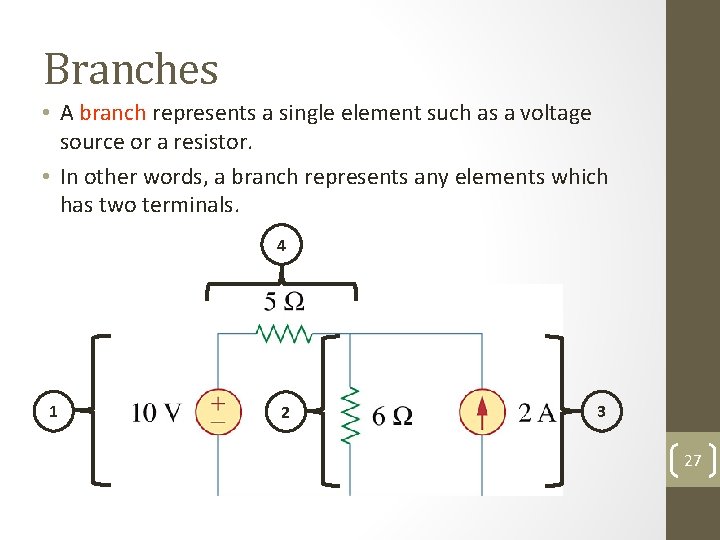
Branches • A branch represents a single element such as a voltage source or a resistor. • In other words, a branch represents any elements which has two terminals. 4 1 2 3 27
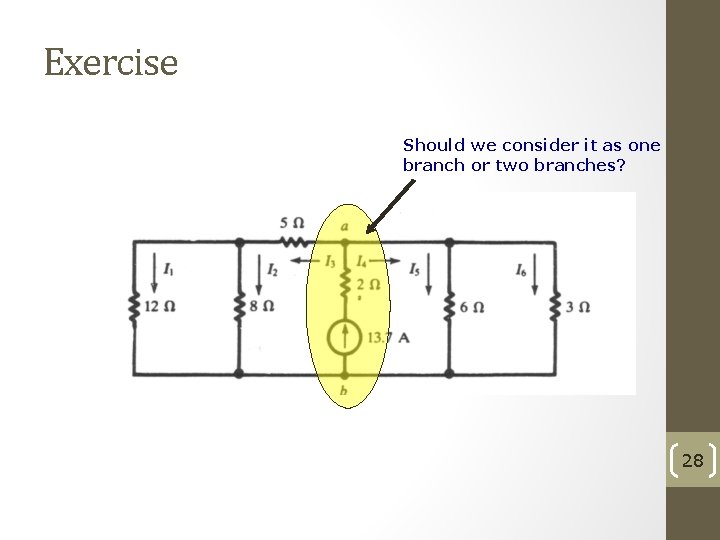
Exercise Should we consider it as one branch or two branches? 28
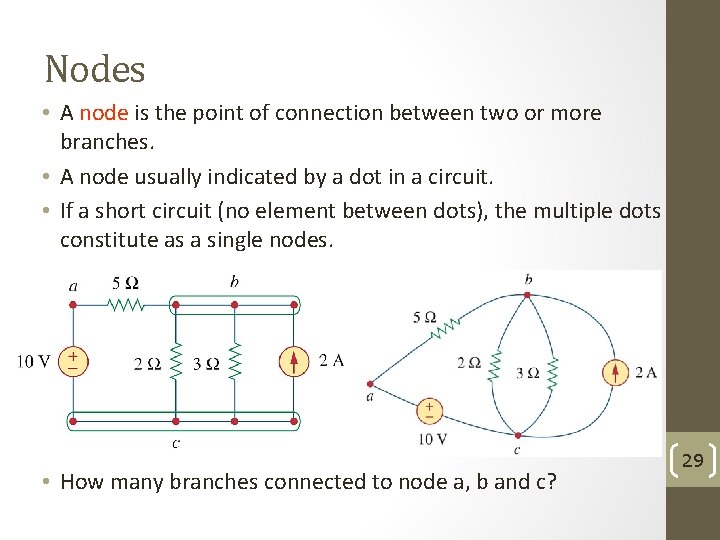
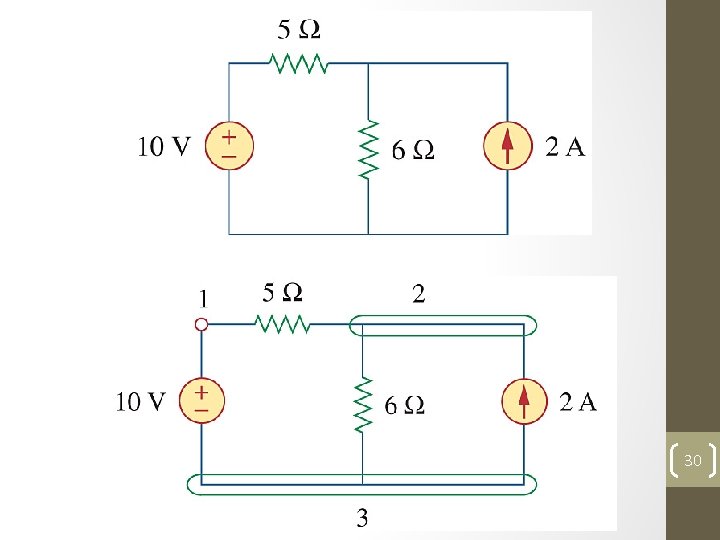
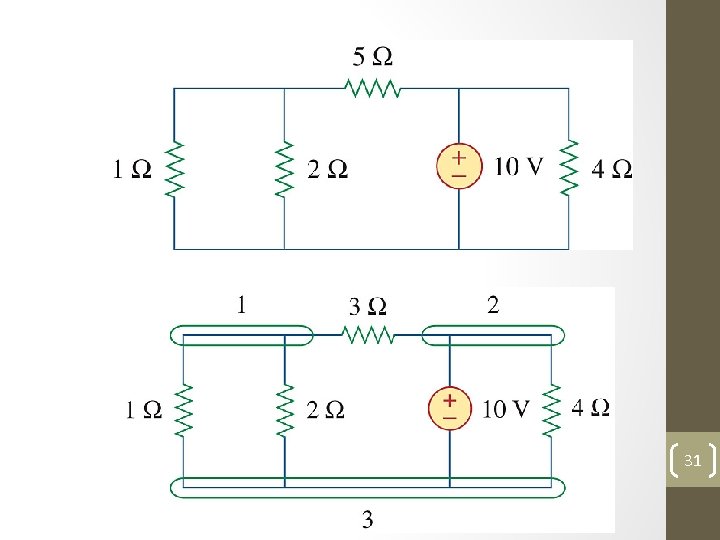
Nodes • A node is the point of connection between two or more branches. • A node usually indicated by a dot in a circuit. • If a short circuit (no element between dots), the multiple dots constitute as a single nodes. • How many branches connected to node a, b and c? 29
30
31
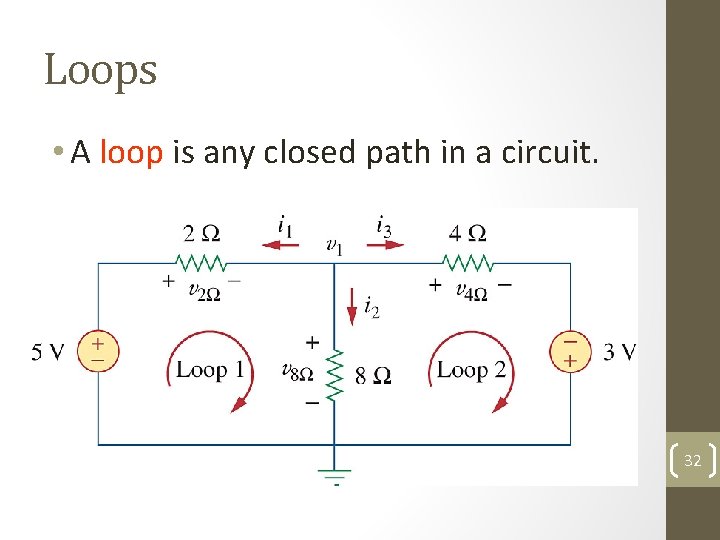
Loops • A loop is any closed path in a circuit. 32
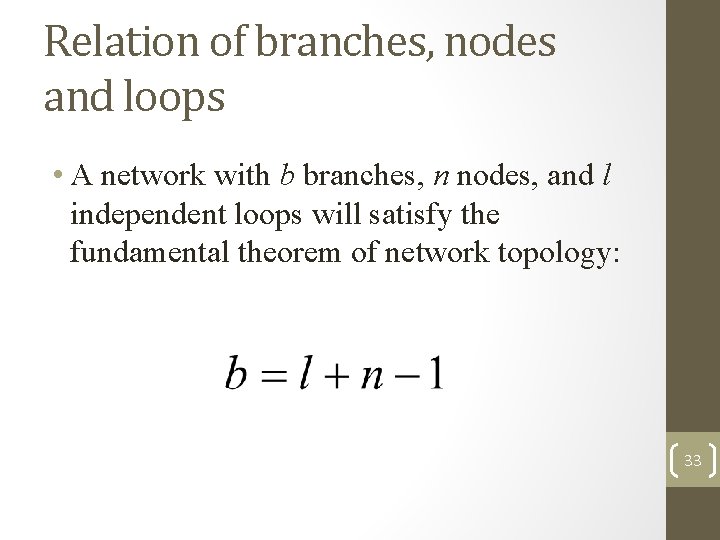
Relation of branches, nodes and loops • A network with b branches, n nodes, and l independent loops will satisfy the fundamental theorem of network topology: 33
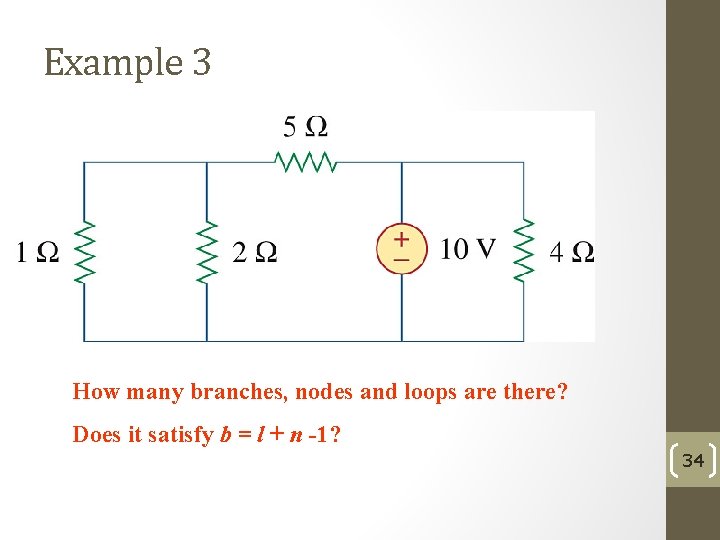
Example 3 How many branches, nodes and loops are there? Does it satisfy b = l + n -1? 34
Kirchhoff Law Ø Gustav Robert Kirchhoff (1824– 1887) Ø Models relationship between: Ø circuit element currents (KCL) Ø circuit element voltages (KVL) Ø Introduce two laws: Ø Kirchhoff Current Law (KCL) Ø Kirchhoff Voltage Law (KVL) 35
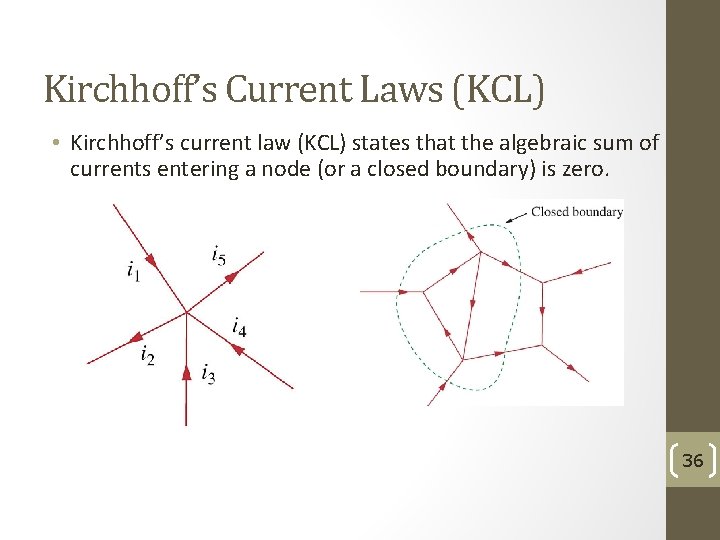
Kirchhoff’s Current Laws (KCL) • Kirchhoff’s current law (KCL) states that the algebraic sum of currents entering a node (or a closed boundary) is zero. 36
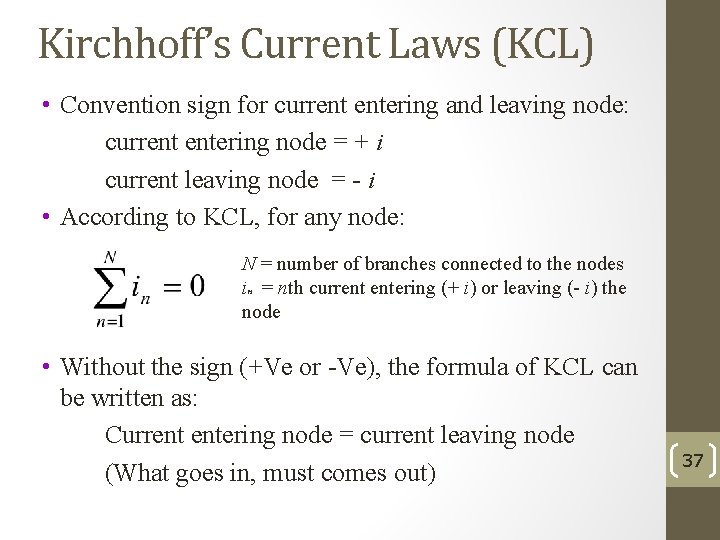
Kirchhoff’s Current Laws (KCL) • Convention sign for current entering and leaving node: current entering node = + i current leaving node = - i • According to KCL, for any node: N = number of branches connected to the nodes i = nth current entering (+ i) or leaving (- i) the node n • Without the sign (+Ve or -Ve), the formula of KCL can be written as: Current entering node = current leaving node (What goes in, must comes out) 37
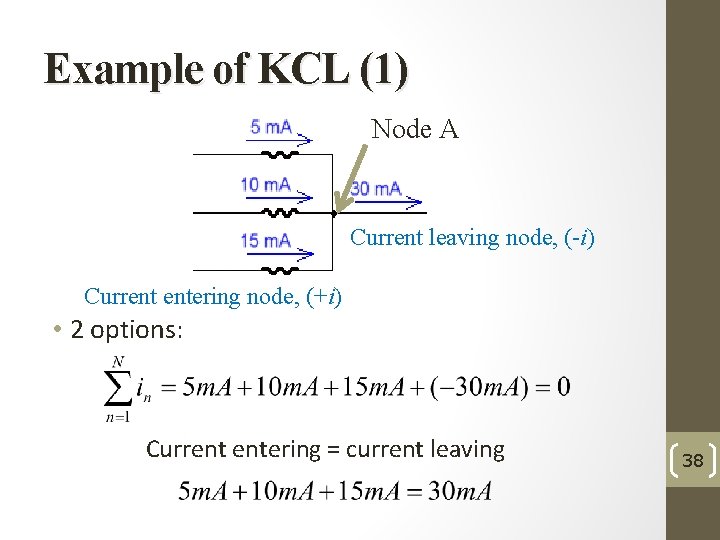
Example of KCL (1) Node A Current leaving node, (-i) Current entering node, (+i) • 2 options: Current entering = current leaving 38
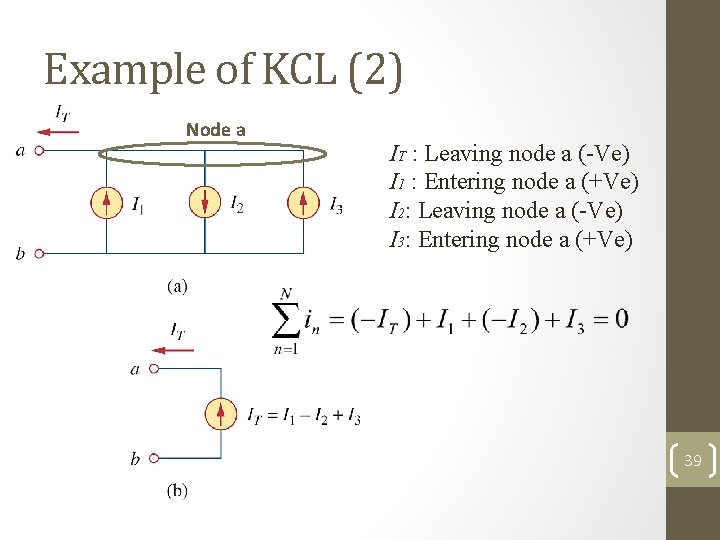
Example of KCL (2) Node a IT : Leaving node a (-Ve) I 1 : Entering node a (+Ve) I 2: Leaving node a (-Ve) I 3: Entering node a (+Ve) 39
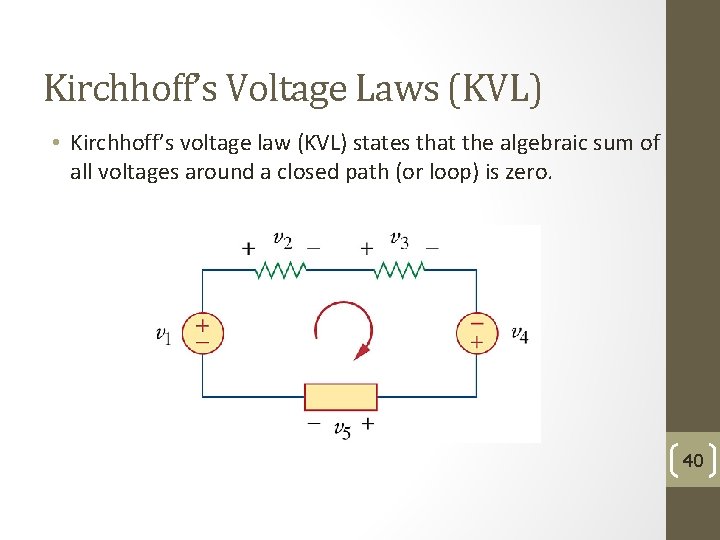
Kirchhoff’s Voltage Laws (KVL) • Kirchhoff’s voltage law (KVL) states that the algebraic sum of all voltages around a closed path (or loop) is zero. 40
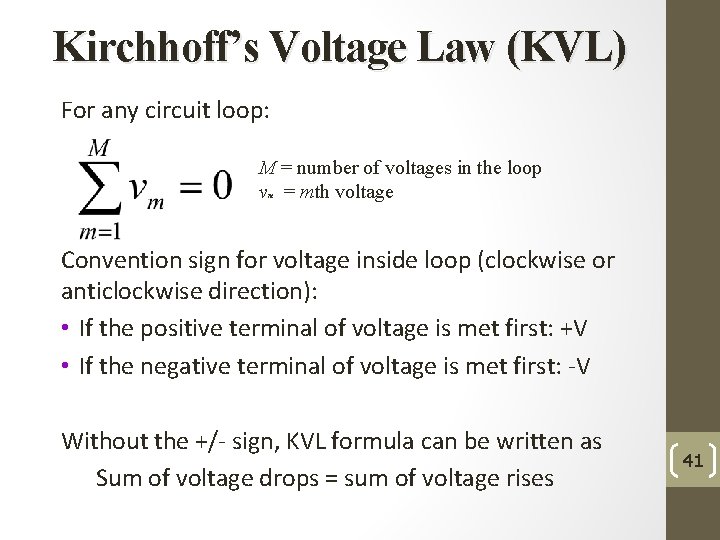
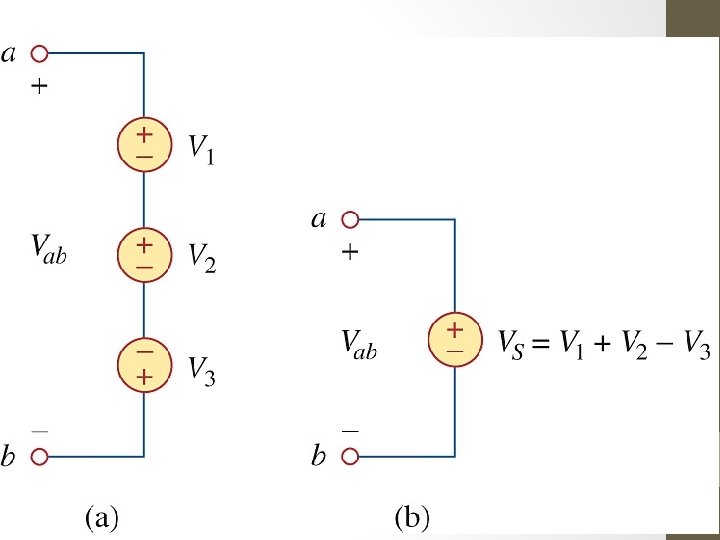
Kirchhoff’s Voltage Law (KVL) For any circuit loop: M = number of voltages in the loop v = mth voltage m Convention sign for voltage inside loop (clockwise or anticlockwise direction): • If the positive terminal of voltage is met first: +V • If the negative terminal of voltage is met first: -V Without the +/- sign, KVL formula can be written as Sum of voltage drops = sum of voltage rises 41
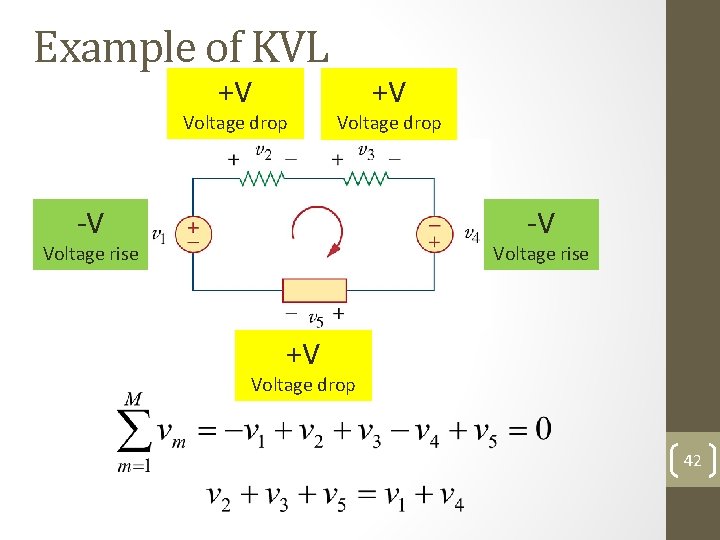
Example of KVL +V Voltage drop -V -V Voltage rise +V Voltage drop 42
43
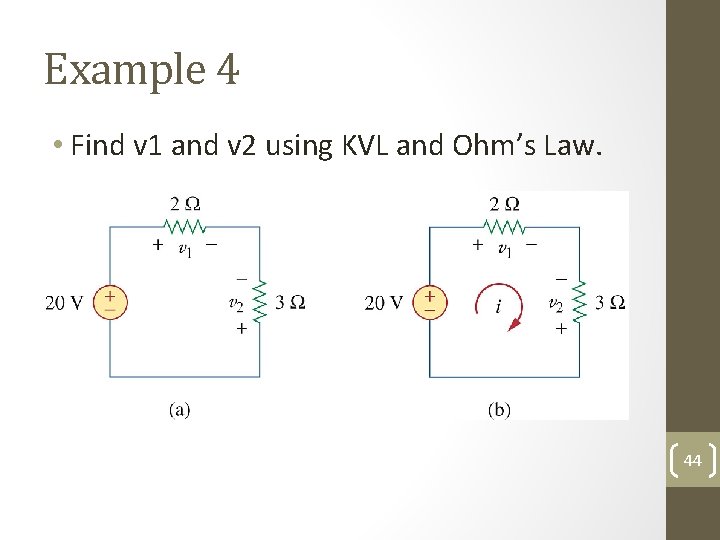
Example 4 • Find v 1 and v 2 using KVL and Ohm’s Law. 44
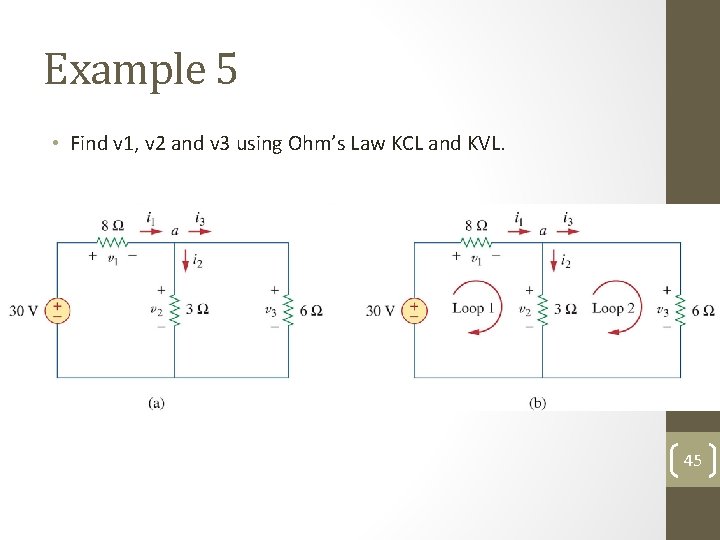
Example 5 • Find v 1, v 2 and v 3 using Ohm’s Law KCL and KVL. 45
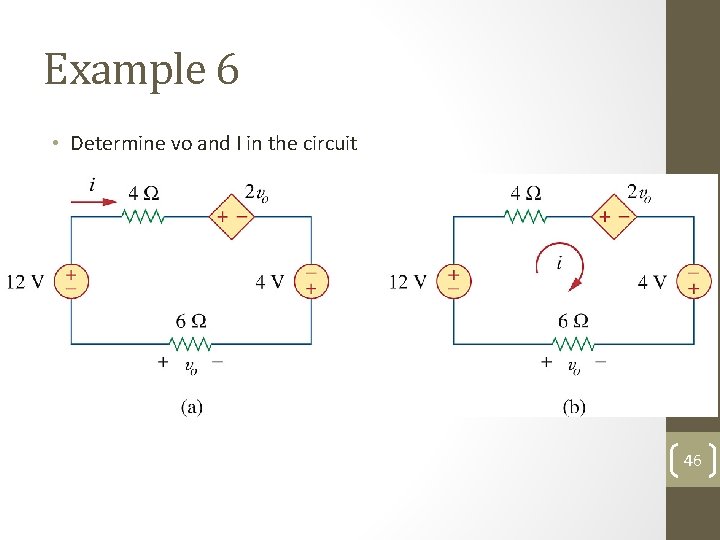
Example 6 • Determine vo and I in the circuit 46
- Slides: 46