
Chapter 1 Child Development Theories and Themes MODULES
- Slides: 20
Chapter 1: Child Development: Theories and Themes MODULES 1. 1 A Word About This Book 1. 2 Theories of Child Development 1. 3 Themes in Child-Development Research Copyright © 2009 Pearson Education Canada 1
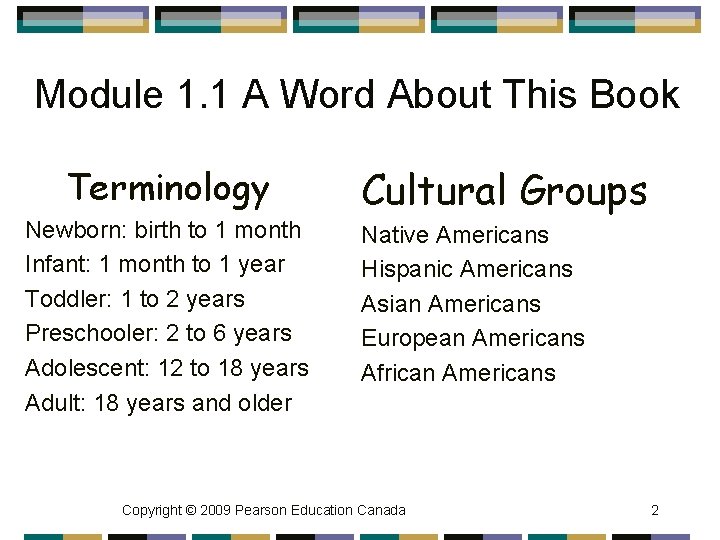
Module 1. 1 A Word About This Book Terminology Newborn: birth to 1 month Infant: 1 month to 1 year Toddler: 1 to 2 years Preschooler: 2 to 6 years Adolescent: 12 to 18 years Adult: 18 years and older Cultural Groups Native Americans Hispanic Americans Asian Americans European Americans African Americans Copyright © 2009 Pearson Education Canada 2
Module 1. 2 Theories of Child Development LEARNING OBJECTIVES 1. 2. 3. 4. 5. State the major tenets of the biological perspective. Explain how psychodynamic theories account for development. Identify the focus of learning theories. Describe how cognitive-development theories explain changes in children’s thinking. Name the main points of the contextual approach. Copyright © 2009 Pearson Education Canada 3
Theory An organized set of ideas designed to explain and make predictions about development. Copyright © 2009 Pearson Education Canada 4
Theories of Child Development John Locke 17 th century philosopher believed that the mind of an infant is a blank slate (tabula rasa) and that all knowledge, abilities, behaviors and motives are acquired by experience. Jean-Jacques Rosseau believed that infant’s were endowed with an innate sense of justice and morality that unfolds naturally as children grow. James Mark Baldwin believed that theory should guide experimentation and that children development occurs in stages, later developed by Piaget. Copyright © 2009 Pearson Education Canada 5
The Biological Perspective Maturational theory Ethological theory -Critical periods -Imprinting -Attachment Copyright © 2009 Pearson Education Canada 6
The Psychodynamic Perspective Sigmund Freud and psychoanalysis Freud’s Psychosexual Theory - Conflict of individual’s instinct and societal norms for behaviour. Three components of personality - Id (primitive instincts and drives) - Ego (practical, rational component) - Superego (moral agent) Copyright © 2009 Pearson Education Canada 7
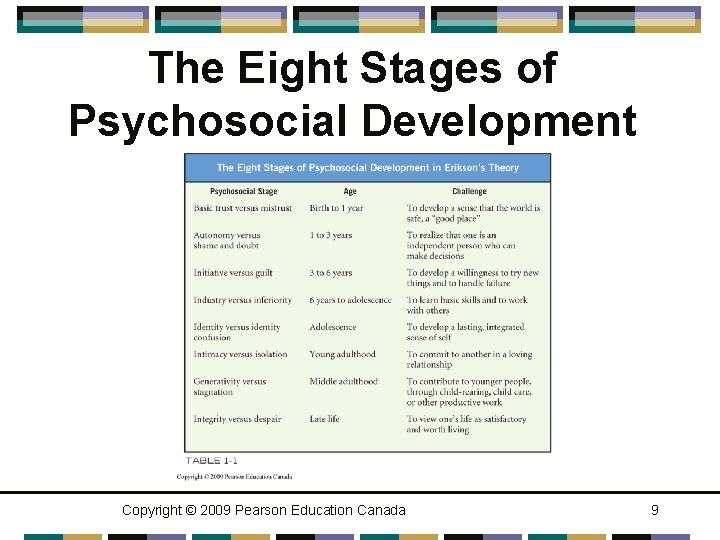
Erikson’s Psychosocial Theory Erikson’s Psychosocial Development - Far less emphasis on sexual urges. - More emphasis on social and cultural influences on development. - Development occurs in a sequence of stages defined by a unique crisis or social challenge. - Journey to adulthood is fraught with obstacles. Copyright © 2009 Pearson Education Canada 8
The Eight Stages of Psychosocial Development Copyright © 2009 Pearson Education Canada 9
The Learning Perspective John B. Watson - Strong emphasis on environmental influences. l recall Locke’s tabula rasa - “Little Albert” experiment Ivan Pavlov - Classical conditioning - Pavlov’s dog Copyright © 2009 Pearson Education Canada 10
Early Learning Theories B. F. Skinner’s Operant Conditioning - Focus on outcome of behaviour for predicting future occurrences of that behaviour. - Reinforcement ↑ probability of behaviour occurring again Positive reinforcement (i. e. reward) Negative reinforcement (i. e. taking away unpleasant things) - Punishment ↓ probability of behaviour occurring again Albert Bandura’s Social Cognitive Theory - Imitation or observational (vicarious) learning. - Emphasizes role of environment, behaviour and cognitions (i. e. self-efficacy) as important in shaping development. Copyright © 2009 Pearson Education Canada 11
The Cognitive-Developmental Perspective Jean Piaget - Infants, children, adolescents naturally motivated to make sense of the physical and social world. - 4 distinct stages in cognitive development - sensorimotor - preoperational thought - concrete operational thought - formal operational thought Copyright © 2009 Pearson Education Canada 12
The Contextual Perspective Culture - the knowledge, attitudes, beliefs, symbolic representations and behaviors associated with a group of people. - provides the context in which a child develops. - Important influence from infancy to adolescence. Copyright © 2009 Pearson Education Canada 13
Ecological Systems Theory Urie Bronfenbrenner’s Ecological Systems Theory l Detailed characterization of various environmental influences on development. l Environment is a series of embedded systems l Microsystem l Mesosystem l Exosystem l Macrosystem Copyright © 2009 Pearson Education Canada 14
Information-Processing Theory Human mind similar to computer. Emphasizes the “parts” of human development. Development reflects changes in - Mental Hardware (different memories and where they are stored) - Mental Software (organized sets of cognitive processes, i. e. how to read) Copyright © 2009 Pearson Education Canada 15
Evolutionary Theory Evolution shapes which behavior and characteristics contribute most to the survival of infants and children. - grandparent-grandchild relationships Evolutionary developmental psychology - Bjorklund and Pellegrini - evolutionary theory as a metatheory of human development. Copyright © 2009 Pearson Education Canada 16
Developmental Psychopathology Broad unified understanding of how abnormal development can occur. -dynamic process - continual transformation across the lifespan Copyright © 2009 Pearson Education Canada 17
Module 1. 3 Themes in Child. Development Research LEARNING OBJECTIVES Demonstrate how well developmental outcomes can be predicted from early life. 2. Understand how heredity and environment influence development. 3. Specify what role children have in their own development. 4. State how development in different domains is connected. 1. Copyright © 2009 Pearson Education Canada 18
Early Development Is Related to Later Development Early development is related to later development but not perfectly. -Predictability of development -Continuous versus Non-Continuous -Nature-Nurture Issue -Active-Passive Child Copyright © 2009 Pearson Education Canada 19
Conclusions The Big Picture - Classic developmental theories tend to be very broad but have given way to more precise and narrower in scope theories. Development in Different Domains is Connected -General themes connected in children’s development: continuous: non-continuous; nature: nurture; active: passive. Copyright © 2009 Pearson Education Canada 20