
Chapter 1 Caring for the Critically Ill Patient


- Slides: 22
Chapter 1 Caring for the Critically Ill Patient Copyright © 2012, 2008, 2004, 2000, 1996, 1992 by Mosby, an imprint of Elsevier Inc.
Objectives Describe critical care nursing roles. Discuss the importance of holistic care for the critically ill patient and family. Compare and contrast interdisciplinary critical care management models and tools. Explain the safety issues in the critical care environment. Discuss the six standards of a healthy work environment. Copyright © 2012, 2008, 2004, 2000, 1996, 1992 by Mosby, an imprint of Elsevier Inc. 2
Critical Care Nursing Roles Expanded-role nursing positions Case managers Ø Patient educators Ø Cardiac rehabilitation specialists Ø Office nurses Ø Advanced practice nurses Clinical nurse specialist (CNS) Ø Nurse practitioner (NP) or acute care nurse practitioner (ACNP) Ø Copyright © 2012, 2008, 2004, 2000, 1996, 1992 by Mosby, an imprint of Elsevier Inc. 3
Question What is the purpose of critical care nursing standards? Standards provide recommendations to care providers. B. Standards are stepwise decision-making tools for specific processes. C. Standards are guidelines for research. D. Standards serve as descriptors of expected nursing roles and responsibilities. A. Copyright © 2012, 2008, 2004, 2000, 1996, 1992 by Mosby, an imprint of Elsevier Inc. 4
Answer D. Standards serve as descriptors of expected nursing roles and responsibilities. The standards are authoritative statements that describe the level of care and performance by which the quality of nursing care can be judged. Standards serve as descriptors of expected nursing roles and responsibilities. Copyright © 2012, 2008, 2004, 2000, 1996, 1992 by Mosby, an imprint of Elsevier Inc. 5
Critical Care Nursing Standards American Association of Critical-Care Nurses (AACN) has established nursing standards to provide a framework for critical care nurses. These standards serve as descriptions of expected nursing roles and responsibilities. Ø These standards are prescriptive of a competent level of nursing practice. Ø Copyright © 2012, 2008, 2004, 2000, 1996, 1992 by Mosby, an imprint of Elsevier Inc. 6
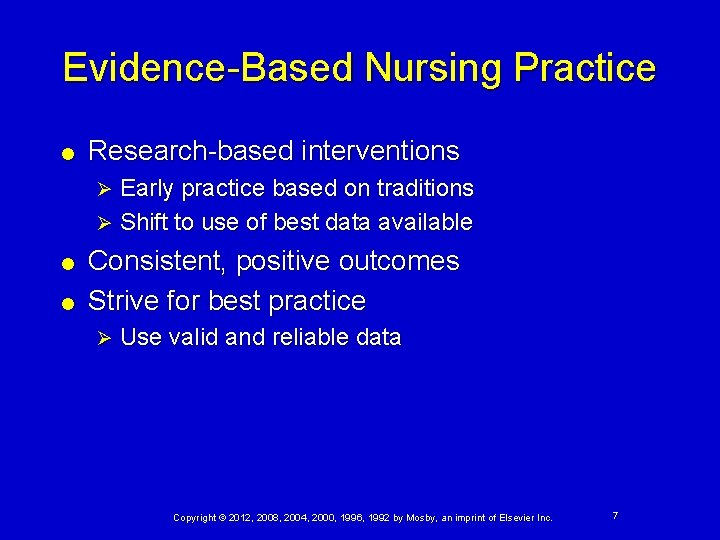
Evidence-Based Nursing Practice Research-based interventions Early practice based on traditions Ø Shift to use of best data available Ø Consistent, positive outcomes Strive for best practice Ø Use valid and reliable data Copyright © 2012, 2008, 2004, 2000, 1996, 1992 by Mosby, an imprint of Elsevier Inc. 7
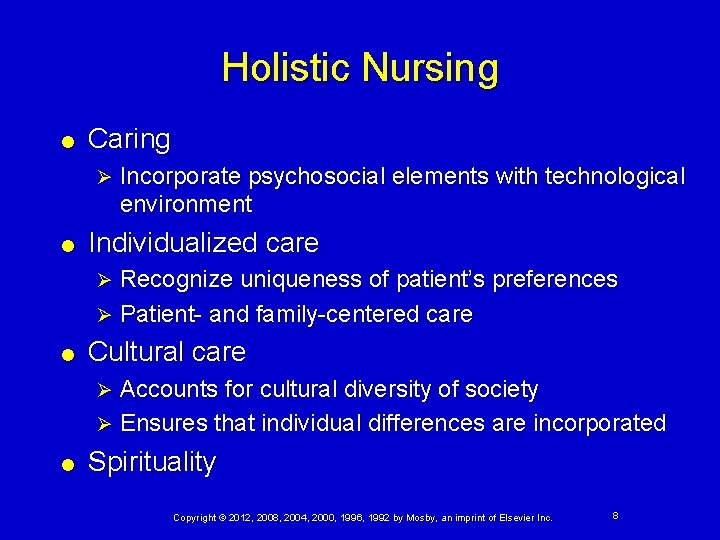
Holistic Nursing Caring Ø Incorporate psychosocial elements with technological environment Individualized care Recognize uniqueness of patient’s preferences Ø Patient- and family-centered care Ø Cultural care Accounts for cultural diversity of society Ø Ensures that individual differences are incorporated Ø Spirituality Copyright © 2012, 2008, 2004, 2000, 1996, 1992 by Mosby, an imprint of Elsevier Inc. 8
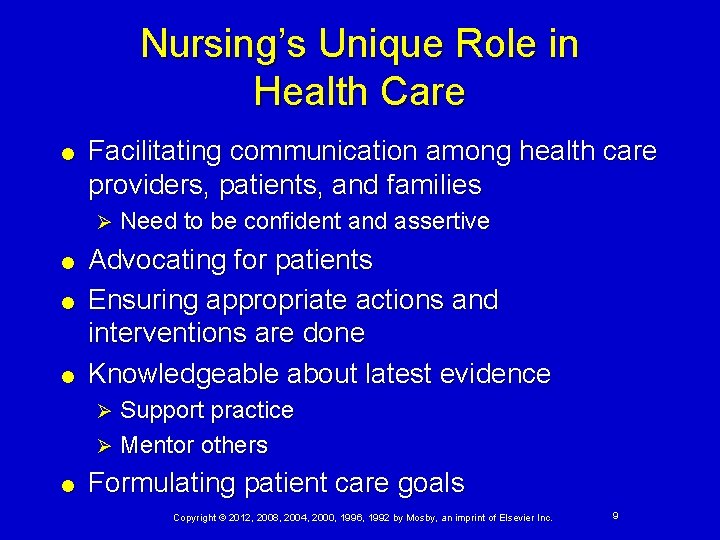
Nursing’s Unique Role in Health Care Facilitating communication among health care providers, patients, and families Ø Need to be confident and assertive Advocating for patients Ensuring appropriate actions and interventions are done Knowledgeable about latest evidence Support practice Ø Mentor others Ø Formulating patient care goals Copyright © 2012, 2008, 2004, 2000, 1996, 1992 by Mosby, an imprint of Elsevier Inc. 9
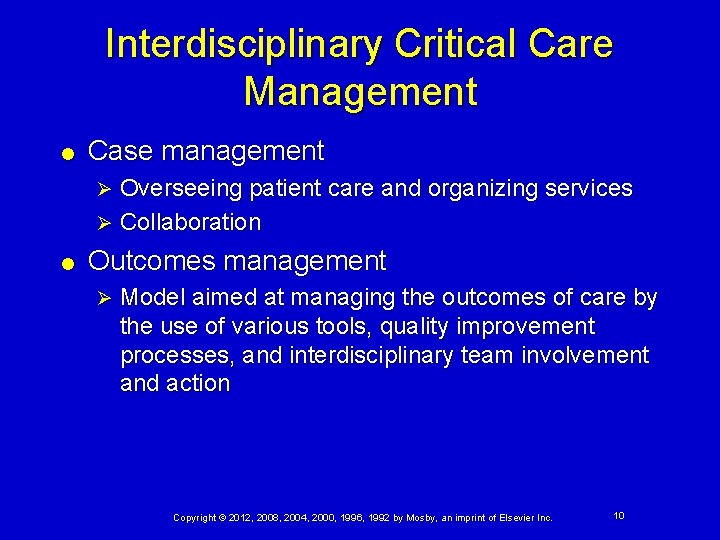
Interdisciplinary Critical Care Management Case management Overseeing patient care and organizing services Ø Collaboration Ø Outcomes management Ø Model aimed at managing the outcomes of care by the use of various tools, quality improvement processes, and interdisciplinary team involvement and action Copyright © 2012, 2008, 2004, 2000, 1996, 1992 by Mosby, an imprint of Elsevier Inc. 10
Care Management Tools Algorithm Ø Practice guideline Ø Stepwise decision-making flowchart Created by expert panels and developed by professional organizations Protocol Ø Directive, useful tool for research studies Copyright © 2012, 2008, 2004, 2000, 1996, 1992 by Mosby, an imprint of Elsevier Inc. 11
Quality, Safety, and Regulatory Issues in Critical Care Safety Institute of Medicine report Ø Safety as an ethical imperative Ø AACN “Practice Alert” • Evidence-based • Reference for safe, quality care Ø (continued) Copyright © 2012, 2008, 2004, 2000, 1996, 1992 by Mosby, an imprint of Elsevier Inc. 12
2011 The Joint Commission (TJC) National Patient Safety Goals Identify patients correctly Improve staff communication Use medications safely Prevent infections Identify patient safety risks Prevent mistakes in surgery Copyright © 2012, 2008, 2004, 2000, 1996, 1992 by Mosby, an imprint of Elsevier Inc. 13
Question Which of the following behaviors are considered intimidating and disruptive? A. B. C. D. Verbal outbursts Physical threats Refusing to carry out a task All of the above Copyright © 2012, 2008, 2004, 2000, 1996, 1992 by Mosby, an imprint of Elsevier Inc. 14
Answer D. All of the above It has been shown that intimidating and disruptive clinician behaviors can lead to errors and preventable adverse patient outcomes. Verbal outbursts, physical threats, and more passive behaviors such as refusing to carry out a task or procedure all under this category. Unfortunately, these types of behavior are not rare in health care organizations, with as many as 40 % of clinicians having said that they were involved in such interactions. Copyright © 2012, 2008, 2004, 2000, 1996, 1992 by Mosby, an imprint of Elsevier Inc. 15
Quality, Safety, and Regulatory Issues in Critical Care (continued) Safe Medical Device Act (SMDA) of 1990 Ø Requires hospitals to report: • Serious or potentially serious device-related injuries or illness of patients and/or employees to the manufacturer of the device • If death is involved must also report to the FDA Ø Implantable devices must be documented and tracked Copyright © 2012, 2008, 2004, 2000, 1996, 1992 by Mosby, an imprint of Elsevier Inc. 16
Privacy and Confidentiality Health Insurance Portability and Accountability Act of 1996 (HIPAA) Ø Protection of health care data Copyright © 2012, 2008, 2004, 2000, 1996, 1992 by Mosby, an imprint of Elsevier Inc. 17
Healthy Work Environment Stressful environment Need to support health care providers Ø Unhealthy environments increase errors Creating a healthy work environment Mentoring new staff Ø Role modeling positive behaviors Ø Leading interdisciplinary teams Ø Copyright © 2012, 2008, 2004, 2000, 1996, 1992 by Mosby, an imprint of Elsevier Inc. 18
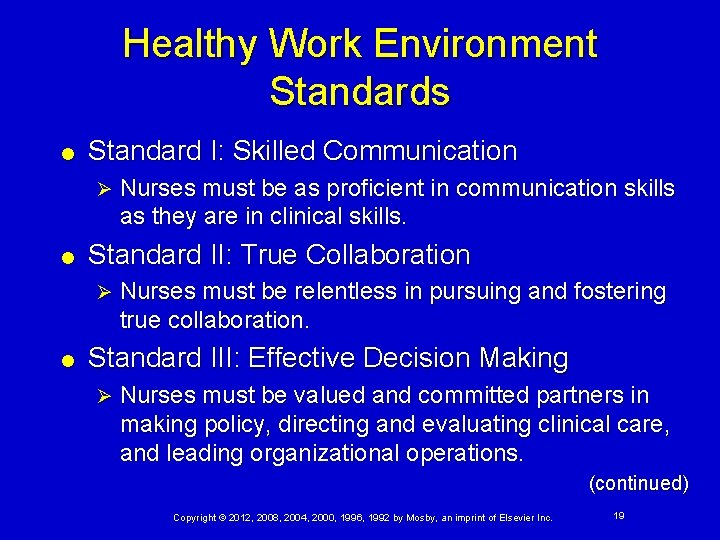
Healthy Work Environment Standards Standard I: Skilled Communication Ø Standard II: True Collaboration Ø Nurses must be as proficient in communication skills as they are in clinical skills. Nurses must be relentless in pursuing and fostering true collaboration. Standard III: Effective Decision Making Ø Nurses must be valued and committed partners in making policy, directing and evaluating clinical care, and leading organizational operations. (continued) Copyright © 2012, 2008, 2004, 2000, 1996, 1992 by Mosby, an imprint of Elsevier Inc. 19
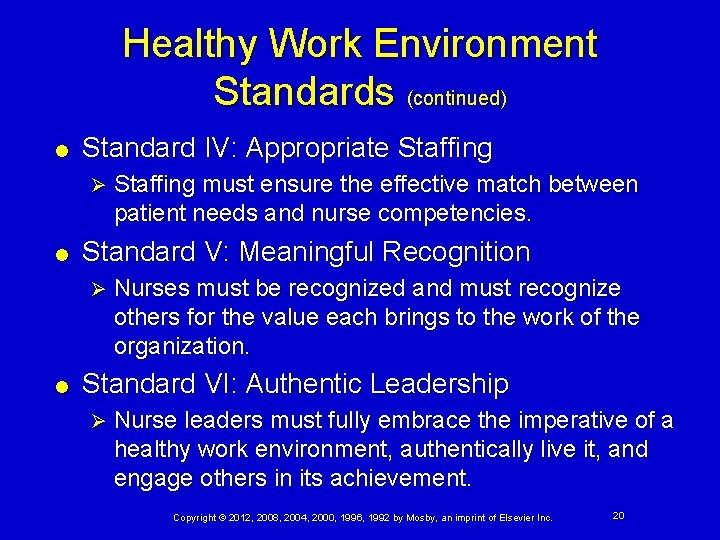
Healthy Work Environment Standards (continued) Standard IV: Appropriate Staffing Ø Standard V: Meaningful Recognition Ø Staffing must ensure the effective match between patient needs and nurse competencies. Nurses must be recognized and must recognize others for the value each brings to the work of the organization. Standard VI: Authentic Leadership Ø Nurse leaders must fully embrace the imperative of a healthy work environment, authentically live it, and engage others in its achievement. Copyright © 2012, 2008, 2004, 2000, 1996, 1992 by Mosby, an imprint of Elsevier Inc. 20
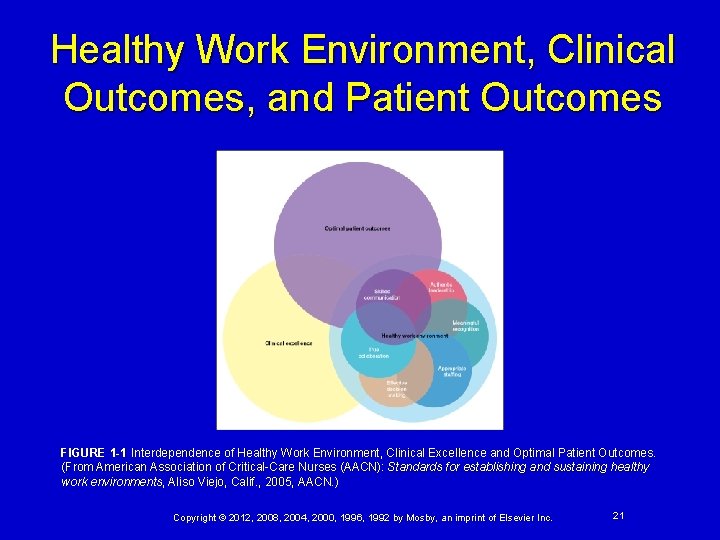
Healthy Work Environment, Clinical Outcomes, and Patient Outcomes FIGURE 1 -1 Interdependence of Healthy Work Environment, Clinical Excellence and Optimal Patient Outcomes. (From American Association of Critical-Care Nurses (AACN): Standards for establishing and sustaining healthy work environments, Aliso Viejo, Calif. , 2005, AACN. ) Copyright © 2012, 2008, 2004, 2000, 1996, 1992 by Mosby, an imprint of Elsevier Inc. 21
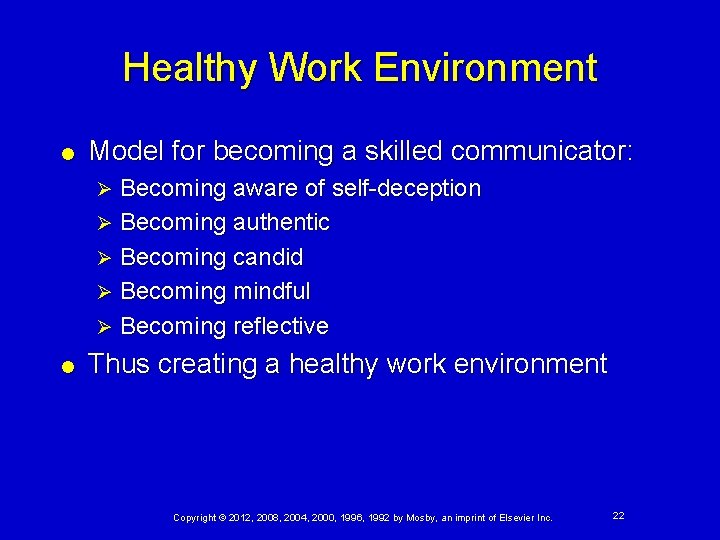
Healthy Work Environment Model for becoming a skilled communicator: Becoming aware of self-deception Ø Becoming authentic Ø Becoming candid Ø Becoming mindful Ø Becoming reflective Ø Thus creating a healthy work environment Copyright © 2012, 2008, 2004, 2000, 1996, 1992 by Mosby, an imprint of Elsevier Inc. 22