
Chapter 1 Building Responsibility What is communication l
Chapter 1 Building Responsibility
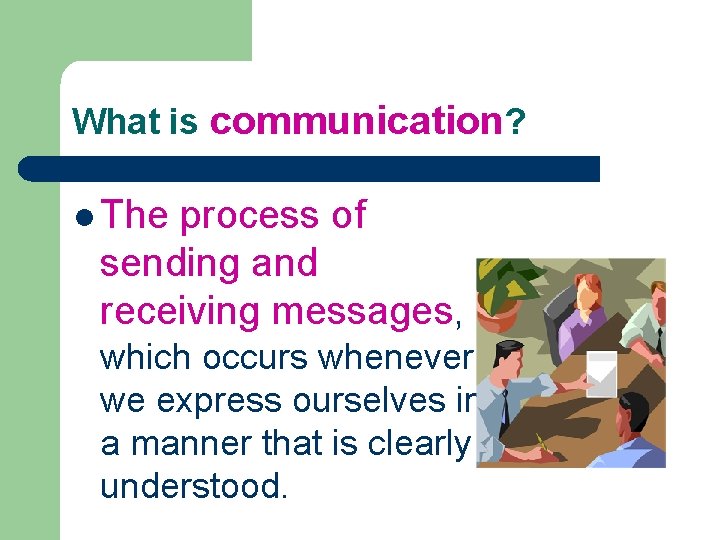
What is communication? l The process of sending and receiving messages, which occurs whenever we express ourselves in a manner that is clearly understood.
The Communication Process l Sender- transmits message l Message- words, body language or symbols that convey an idea l Receiver- intercepts and interprets messages, then transmits feedback l Feedback- words, body language or symbols that respond to a sender’s message
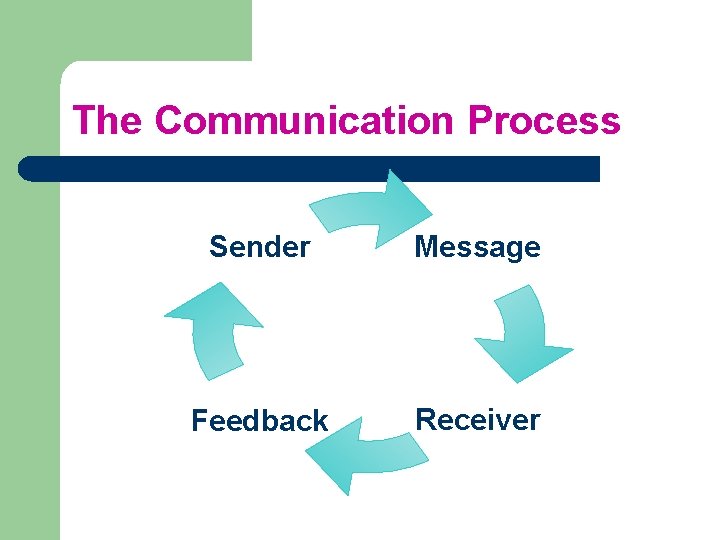
The Communication Process Sender Message Feedback Receiver

Examples of the Communication Process l Talking on the phone l Writing E-Mails l Explaining an Assignment
What happens when a message is blocked? l Communication Barriers- any obstacle that gets in the way of effective communication.
Communication Barriers l Attitudinal- Whatever…I don’t want to talk about this right now. l Social- Um, do I know you? l Educational- I’m much so much smarter than this stupid teacher. l Cultural- You eat what? Gross! l Environmental- It’s so cold in I can’t even think!
How can we avoid these barriers? l Sender Think: What message am I trying to convey? Articulate: Is my message being clearly presented? Watch: Is the receiver understanding my message correctly?
How can we avoid these barriers? l Receiver – Ask: Am I understanding the message correctly? – Learn: Is this message something I’ve never heard before? – Relate: Has something similar happened to me?
Types of Communication l Written Communication- must be read l Oral/Verbal Communication- must be spoken l Nonverbal Communication- relayed through facial expressions or body language. l Symbol- stands for an idea.
Two Types of Speaking l Intrapersonal Communicationinner dialogue with yourself to assess your thoughts and feelings. l Interpersonal Communicationtwo or more people transmitting messages and feedback.
Oratory/ Rhetoric l Art or study of public speaking. – Socrates, Plato, Aristotle
Aristotle’s Appeals - Three Major Methods for Appealing to an Audience l Logical- providing factual evidence to prove your point. l Emotional- appealing to sense of patriotism, family, justice, etc. l Personal- showing your natural honesty, ethics and values. – Ethics – one’s sense of right and wrong
The Driving Force behind the Speaker l Motivation - A need or desire that causes a person to act. – Treating people fairly to avoid stereotypes – Setting a good example for others.
Stereotypes l Labeling every person in a group based on a preconceived idea as to what that group represents.

Homework Bring in a drawing of 5 symbols that explain something special about you or your life. l Complete the handout. l Be prepared to share what that symbol means to you and what it should communicate to others. (Daily Grade) l
- Slides: 18